
Executive Summary & Core Thesis
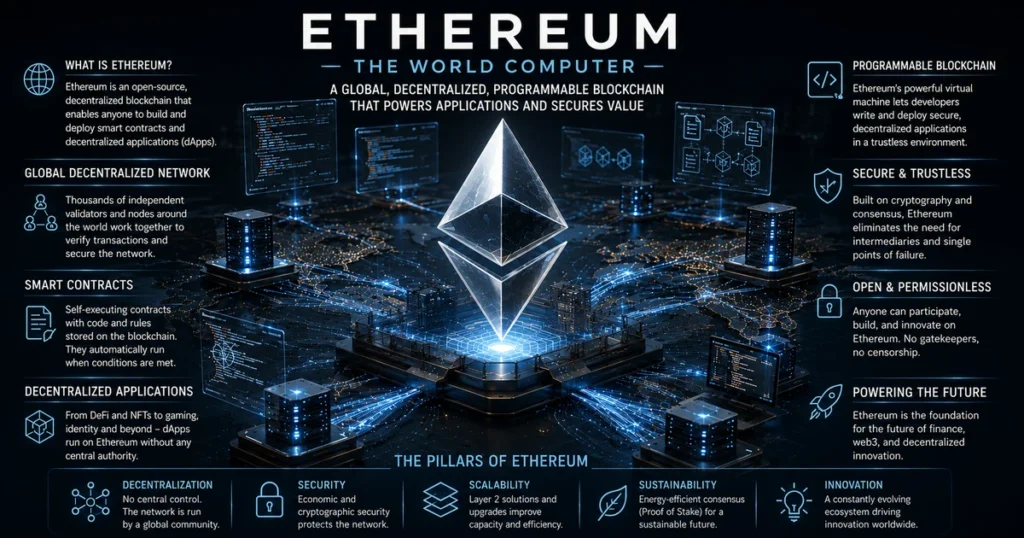
Ethereum is a decentralized, open-source, global computing platform and distributed state machine powered by smart contracts. While Bitcoin was created to function primarily as an alternative peer-to-peer monetary system and scarce digital commodity, Ethereum was conceived as a general-purpose computing platform—often referred to as a “programmable world computer.”
Launched in 2015 by programmer Vitalik Buterin and a team of co-founders, Ethereum expanded blockchain technology beyond static transaction ledgers into deterministic, programmable execution. Powered by its native runtime engine, the Ethereum Virtual Machine (EVM), Ethereum executes application code across a global network of independent nodes without relying on a centralized server or intermediary.
Following its historic transition from Proof of Work to Proof of Stake in September 2022 (“The Merge”), Ethereum reduced its operational energy consumption by an estimated 99.95%, transformed its native asset (Ether or ETH) into a staking and fee-burning instrument, and established itself as one of the primary settlement and security foundations for modern decentralized finance (DeFi), real-world asset (RWA) tokenization, and Layer 2 scaling rollups.
Executive Summary & Core Thesis
Quick Answer: What Is Ethereum?
Ethereum is a decentralized blockchain network that enables developers to build and deploy self-executing software programs called smart contracts. Unlike Bitcoin, which focuses on monetary value transfer, Ethereum functions as a programmable computational platform. The network is powered by its native asset, Ether (ETH), which is used to pay for computing power (gas fees) and secure the network through validator staking. Today, Ethereum serves as a foundational settlement layer for decentralized finance (DeFi), non-fungible tokens (NFTs), and high-throughput Layer 2 scaling networks.
Over its operational history, Ethereum has transformed into a leading platform for open-source finance:
- Economic Scale: Ethereum and its connected Layer 2 ecosystem facilitate large-scale economic activity across decentralized finance, stablecoins, tokenized assets, and other applications.
- Financial Primitives: Ethereum remains one of the dominant settlement and smart-contract platforms for decentralized finance, stablecoins, tokenized assets, and Layer 2 ecosystems.
- Consensus Evolution: The September 15, 2022 Merge successfully eliminated competitive Proof-of-Work mining in favor of validator capital staking, reducing operational energy consumption by approximately 99.95% without service disruption, as contextualized in our historical manual on the history of cryptocurrency.
Foundational Definition: What Is Ethereum?
To understand Ethereum with institutional precision, it must be evaluated across four distinct technological and economic components:
                      ┌─────────────────────────────────────────┐
                      │          THE QUAD-PARTITE NATURE        │
                      └────────────────────┬────────────────────┘
                                           │
         ┌───────────────────┬─────────────┴───────┬───────────────────┐
         ▼                   ▼                     ▼                   ▼
┌─────────────────┐ ┌─────────────────┐   ┌─────────────────┐ ┌─────────────────┐
│ BASE PROTOCOL   │ │ RUNTIME ENGINE  │   │ GLOBAL NODE     │ │ NATIVE ASSET    │
│ (CONSENSUS)     │ │ (THE EVM)       │   │ NETWORK         │ │ (ETHER / ETH)   │
├─────────────────┤ ├─────────────────┤   ├─────────────────┤ ├─────────────────┤
│ Algorithmic     │ │ A 256-bit stack │   │ Thousands of    │ │ An asset used   │
│ Proof-of-Stake  │ │ machine that    │   │ independent full│ │ to pay gas,     │
│ rules that      │ │ executes smart  │   │ nodes and active│ │ secure consensus│
│ coordinate block│ │ contract code   │   │ validators that │ │ via staking, and│
│ ordering & state│ │ deterministically│  │ enforce rules   │ │ store value     │
└─────────────────┘ └─────────────────┘   └─────────────────┘ └─────────────────┘
- The Base Consensus Protocol: The set of rules governing how blocks are proposed, validated, and finalized using Proof of Stake (combining the Casper FFG finality tool and the LMD-GHOST fork-choice rule).
- The Execution Environment (EVM): The decentralized runtime computer that executes transaction payloads and smart contract bytecode across participating network nodes.
- The Global Node Network: A peer-to-peer network of independent computers that maintain the global state database, route transactions, and verify state transitions.
- The Native Asset (Ether / ETH): The native cryptographic token required to purchase computing resources (gas), compensate block proposers, and serve as security collateral in staking.
Cross-Network Architectural Comparison: Ethereum vs. Bitcoin
| Architectural Dimension | Bitcoin (BTC) | Ethereum (ETH) |
| Primary Design Objective | Digital store of value and peer-to-peer electronic money | Programmable general-purpose computational state machine |
| Consensus Mechanism | Proof of Work (SHA-256 Mining) | Proof of Stake (Casper FFG + LMD-GHOST Staking) |
| Accounting Model | Unspent Transaction Output (UTXO) | Account-Based State Model (EOAs & Contract Accounts) |
| Execution Language | Bitcoin Script (Intentionally non-Turing-complete) | Solidity, Vyper (Compiled to Turing-complete EVM bytecode) |
| Monetary Supply Limit | Hard cap of 21,000,000 BTC | No fixed cap; net supply varies with validator issuance and EIP-1559 burn |
| Block Cadence | ~10 minutes (Dynamic difficulty adjustment) | Fixed 12-second discrete slots |
| Primary Scaling Strategy | Payment channels (Lightning Network) | Modular Layer 2 rollups (Optimistic & ZK) + Data Availability |
To examine how base distributed ledgers coordinate consensus across open networks, review our foundational guide on what is blockchain, or explore the monetary mechanics of digital scarcity in our deep dive on what is bitcoin.
Historical Evolution: From Whitepaper to Institutional Settlement Layer

                      ┌─────────────────────────────────────────┐
                      │    LATE 2013: VITALIK BUTERIN WHITEPAPER │
                      │  (Proposes programmable Turing-complete │
                      │   smart contracts on a global ledger)   │
                      └────────────────────┬────────────────────┘
                                           │
                         (July 2014 Online Crowdfunding Sale)
                                           ▼
                      ┌─────────────────────────────────────────┐
                      │     JULY 30, 2015: ETHEREUM FRONTIER    │
                      │  (Mainnet officially launches under     │
                      │   Proof-of-Work Ethash mining)          │
                      └────────────────────┬────────────────────┘
                                           │
                          (The 2016 DAO Exploit & Hard Fork)
                                           ▼
                      ┌─────────────────────────────────────────┐
                      │    JULY 2016: ETH / ETC SPLIT           │
                      │  (Hard fork recovers stolen DAO funds;  │
                      │   spurs foundational governance debate) │
                      └────────────────────┬────────────────────┘
                                           │
                          (December 2020: Beacon Chain Genesis)
                                           ▼
                      ┌─────────────────────────────────────────┐
                      │     SEPTEMBER 15, 2022: THE MERGE       │
                      │  (Execution layer merges with Beacon    │
                      │   Chain; transitions from PoW to PoS)   │
                      └────────────────────┬────────────────────┘
                                           │
                          (March 13, 2024: The Dencun Upgrade)
                                           ▼
                      ┌─────────────────────────────────────────┐
                      │    2024-2026: EIP-4844 BLOBS & ETPs     │
                      │  * Ephemeral blobs slash Layer 2 fees   │
                      │  * Regulated spot Ether ETPs begin      │
                      │    trading in traditional capital markets│
                      └─────────────────────────────────────────┘
Key Milestones in Ethereum’s Development:
- The 2013 Whitepaper: At age 19, computer programmer Vitalik Buterin argued that instead of creating separate blockchains for specific use cases (such as domain names or colored coins), a single blockchain could integrate a universal programming language.
- The 2014 Yellow Paper & Crowdsale: Co-founder Dr. Gavin Wood published the formal mathematical specification of the EVM. The Swiss-based Ethereum Foundation conducted an online token sale, raising ~31,500 BTC (worth approximately $18 million at the time).
- The Frontier Launch (July 30, 2015): The original Proof-of-Work network went live, allowing developers to deploy decentralized applications.
- The DAO Fork (July 2016): A reentrancy vulnerability in an early decentralized venture fund led to the drainage of 3.6 million ETH. The community coordinated an irregular state transition to return funds, creating a philosophical schism that split the network into Ethereum (ETH) and Ethereum Classic (ETC).
- The Merge (September 15, 2022): Ethereum deprecated Proof of Work, joining its original execution layer with the Proof-of-Stake Beacon Chain without historical ledger interruption.
- The Dencun Upgrade (March 13, 2024): Introduced EIP-4844 (Proto-Danksharding), establishing temporary data availability storage (“blobs”) that provide a cheaper data-posting mechanism for Layer 2 rollups and substantially reduce their operational posting costs.
- Spot ETP Integration (July 2024): Following SEC rule approvals, the first spot Ether exchange-traded products began trading on public US securities exchanges.
How Ethereum Works: The End-to-End Transaction and Consensus Lifecycle

Quick Answer: How Ethereum Processes Transactions
When a user initiates a transaction, they sign it with their private key and broadcast it to the network. The transaction enters the mempool, where it is verified by nodes. Every 12 seconds, a validator is algorithmically selected as the block proposer to bundle transactions, execute their code through the EVM, calculate state changes, and propose a new block. Independent validators then attest to the block’s validity. Under normal operating conditions, Ethereum’s Casper-FFG mechanism can finalize checkpoints after the required validator votes, typically taking about two epochs (~12.8 minutes).
                      ┌─────────────────────────────────────────┐
                      │   STEP 1: TRANSACTION AUTHORIZATION     │
                      │  User generates payload and signs with  │
                      │  private key (ECDSA secp256k1)          │
                      └────────────────────┬────────────────────┘
                                           │
                                 (P2P Network Propagation)
                                           ▼
                      ┌─────────────────────────────────────────┐
                      │   STEP 2: MEMPOOL & VALIDATION          │
                      │  Nodes verify nonce, account balance,   │
                      │  and signatures; queued in mempool      │
                      └────────────────────┬────────────────────┘
                                           │
                           (Random Selection Every 12 Seconds)
                                           ▼
                      ┌─────────────────────────────────────────┐
                      │   STEP 3: BLOCK PROPOSAL & EXECUTION    │
                      │  Selected Validator executes bytecode   │
                      │  in EVM, calculates new state roots     │
                      └────────────────────┬────────────────────┘
                                           │
                               (Committee Attestations)
                                           ▼
                      ┌─────────────────────────────────────────┐
                      │   STEP 4: CONSENSUS ATTESTATION         │
                      │  Validator committees vote on block via │
                      │  LMD-GHOST fork-choice rule             │
                      └────────────────────┬────────────────────┘
                                           │
                           (Casper FFG Two-Epoch Checkpoints)
                                           ▼
                      ┌─────────────────────────────────────────┐
                      │   STEP 5: ECONOMIC FINALITY             │
                      │  Checkpoints achieve finality (~12.8m); │
                      │  reversing requires slashing 1/3+ stake │
                      └─────────────────────────────────────────┘
Anatomy of the Ethereum State: Accounts, Tries, and Blocks

Unlike Bitcoin’s Unspent Transaction Output (UTXO) structure—which resembles cash bills being spent and returned as change—Ethereum uses an account-based model, operating similarly to an interactive bank ledger where addresses hold dynamic states:
                      ┌─────────────────────────────────────────┐
                      │         ETHEREUM ACCOUNT MODEL          │
                      └────────────────────┬────────────────────┘
                                           │
         ┌─────────────────────────────────┴─────────────────────────────────┐
         │                                                                   │
         ▼                                                                   ▼
┌──────────────────────────────────┐               ┌──────────────────────────────────┐
│ EXTERNALLY OWNED ACCOUNTS (EOAs) │               │       CONTRACT ACCOUNTS          │
├──────────────────────────────────┤               ├──────────────────────────────────┤
│ * Controlled by private keys     │               │ * Controlled by deployed code    │
│ * Has Nonce (transaction count)  │               │ * Has Nonce (contracts created)  │
│ * Has ETH Balance                │               │ * Has ETH Balance                │
│ * Contains no executable code    │               │ * Contains Code Hash (EVM logic) │
│ * Can initiate transactions      │               │ * Contains Storage Root (Trie)   │
└──────────────────────────────────┘               └──────────────────────────────────┘
The Merkle Patricia Trie
Ethereum’s global state is tracked using a modified Merkle Patricia Trie (a cryptographic data structure combining radix trees and Merkle trees). Every execution-layer block header contains three primary cryptographic roots:
- State Root (
stateRoot): Commits to the complete global mapping of all accounts, balances, and smart contract storage. - Transactions Root (
transactionsRoot): Cryptographically commits to all transactions included within the block. - Receipts Root (
receiptsRoot): Commits to the execution outcomes, cumulative gas usage, and event logs generated by the block’s transactions.
The Ethereum Virtual Machine (EVM): The Global Decentralized Computer

Quick Answer: What Is the EVM?
The Ethereum Virtual Machine (EVM) is the sandboxed runtime environment that executes smart contract code across participating Ethereum nodes. It is a 256-bit, stack-based computing engine that processes low-level machine instructions (opcodes). Because every compliant node executes the exact same instructions given the same transaction inputs, the EVM guarantees deterministic state transitions across the network.
                      ┌─────────────────────────────────────────┐
                      │      SMART CONTRACT SOURCE CODE         │
                      │  (Written in Solidity or Vyper)         │
                      └────────────────────┬────────────────────┘
                                           │
                             (Compiled via solc Compiler)
                                           ▼
                      ┌─────────────────────────────────────────┐
                      │            EVM BYTECODE                 │
                      │  (Hexadecimal opcodes: PUSH1, MSTORE)   │
                      └────────────────────┬────────────────────┘
                                           │
                               (Loaded into Virtual Machine)
                                           ▼
         ┌─────────────────────────────────┴─────────────────────────────────┐
         │                  EVM RUNTIME EXECUTION STACK                      │
         │                                                                   │
         │   ┌────────────────┐ ┌────────────────┐ ┌─────────────────────┐   │
         │   │ 256-BIT STACK  │ │ VOLATILE MEMORY│ │ PERSISTENT STORAGE  │   │
         │   │ (1024 depth max│ │ (Erased after  │ │ (Written to global  │   │
         │   │  word storage) │ │  tx execution) │ │  state trie)        │   │
         │   └────────────────┘ └────────────────┘ └─────────────────────┘   │
         │                                                                   │
         │                     [GAS METERING ENGINE]                         │
         │    (Halts execution if gas allowance is exhausted)                │
         └───────────────────────────────────────────────────────────────────┘
EVM Mechanics and Compatibility
- Deterministic Execution: The EVM is deterministic: given the same valid starting state and transaction inputs, compliant Ethereum clients calculate the identical resulting state transition.
- Preventing Unbounded Execution (Turing Completeness): In computer science, a Turing-complete computer can theoretically execute any computable algorithm. However, an attacker could write an infinite loop (e.g.,
while(true)) and otherwise consume unbounded computational resources. The EVM prevents this from running indefinitely by requiring computation to consume Gas: every computational opcode requires gas, and execution stops when the transaction’s gas allowance is exhausted. If a transaction runs out of gas before completing, its state changes are reverted while the gas consumed is not refunded, protecting network resources. - EVM Compatibility and Equivalence: Ethereum-compatible Layer 2 networks and other EVM-compatible chains can support Solidity-based smart contracts and Ethereum development tooling. Some networks aim for a high degree of EVM equivalence, while others implement compatibility layers with varying degrees of behavioral or tooling differences.
Smart Contracts and Solidity: Programmable Finance
A smart contract is an autonomous software program deployed directly to a blockchain address. When a user sends a transaction containing inputs to that address, the contract executes its programmed logic and modifies internal variables accordingly.
Solidity
// SPDX-License-Identifier: MIT
pragma solidity ^0.8.20;

/// @notice Simplified illustrative logic demonstrating automated collateral evaluation.
/// @dev In a production protocol, debt issuance, oracle verification, and liquidation mechanics require full safety checks.
contract SimpleLiquidationCheck {
    mapping(address => uint256) public collateralBalance;
    mapping(address => uint256) public debtBalance;
    uint256 public constant MIN_COLLATERAL_RATIO = 150; // 150%

    function depositCollateral() external payable {
        require(msg.value > 0, "Deposit must be greater than zero");
        collateralBalance[msg.sender] += msg.value;
    }

    function checkAndLiquidate(address borrower, uint256 currentEthPrice) external {
        uint256 collateralValue = (collateralBalance[borrower] * currentEthPrice) / 1e18;
        uint256 requiredCollateral = (debtBalance[borrower] * MIN_COLLATERAL_RATIO) / 100;

        require(collateralValue < requiredCollateral, "Position is safely collateralized");

        uint256 payout = collateralBalance[borrower];
        collateralBalance[borrower] = 0;
        debtBalance[borrower] = 0;
        payable(msg.sender).transfer(payout);
    }
}
This simplified example illustrates how deterministic smart-contract logic can automate a collateral-checking and liquidation condition once the relevant balances and price inputs are available. A production lending protocol would require substantially more infrastructure, including borrowing logic, reliable price oracles, interest accounting, liquidation incentives, access controls, emergency mechanisms, and protections against oracle manipulation. Smart contracts therefore automate specific contractual rules; they do not universally replace legal escrow agents or traditional financial clearinghouses.
Ether (ETH): The “Triple-Point Asset” Thesis
In traditional asset classification, economists distinguish between capital assets, consumable or transformable assets, and store-of-value assets. In digital-asset research, some analysts describe Ether (ETH) as a “triple-point asset” because it can exhibit characteristics associated with all three categories:
                      ┌─────────────────────────────────────────┐
                      │          ETHER AS A TRIPLE-POINT ASSET   │
                      └────────────────────┬────────────────────┘
                                           │
         ┌─────────────────────────────────┼─────────────────────────────────┐
         │                                 │                                 │
         ▼                                 ▼                                 ▼
┌──────────────────┐             ┌──────────────────┐             ┌──────────────────┐
│ CAPITAL-LIKE     │             │ CONSUMABLE       │             │ STORE-OF-VALUE   │
│ CHARACTERISTICS  │             │ UTILITY          │             │ CHARACTERISTICS  │
├──────────────────┤             ├──────────────────┤             ├──────────────────┤
│ Staked ETH can   │             │ Consumed as gas  │             │ Held as pristine │
│ earn protocol    │             │ to execute smart │             │ collateral across│
│ rewards for      │             │ contracts; base  │             │ decentralized    │
│ network security │             │ fee is burned    │             │ finance protocols│
└──────────────────┘             └──────────────────┘             └──────────────────┘
- Capital-like characteristics: Staked ETH can earn protocol rewards for participating in network security, although staking rewards are variable and involve protocol and operational risks.
- Consumable utility: ETH is required to pay execution and transaction fees on Ethereum, while the protocol burns the base fee under EIP-1559.
- Store-of-value characteristics: ETH is held as a monetary and collateral asset across parts of the Ethereum ecosystem, although whether it functions as a long-term store of value remains an economic and market-based question rather than a guaranteed protocol property.
Monetary Supply and Issuance Dynamics
Unlike Bitcoin’s hardcoded 21 million supply limit, Ethereum does not have an arbitrary maximum cap. Instead, its supply dynamics are determined programmatically by the balance between two opposing forces:
- Gross Issuance: New ETH is minted and awarded to active Proof-of-Stake validators to incentivize network security. The gross issuance rate varies with the amount of ETH participating in staking and the protocol’s issuance rules.
- Supply Burning (EIP-1559): The base transaction fee paid for every on-chain transaction is permanently burned (destroyed).
When on-chain activity is high and the rate of fee burning exceeds validator issuance, the total circulating supply of Ether becomes net deflationary.
Gas Mechanics and Fee Architecture: EIP-1559 and EIP-4844 Blobs

Quick Answer: What Is EIP-1559?
Activated in August 2021, EIP-1559 restructured Ethereum’s transaction fee market. Instead of an unpredictable first-price blind auction, every transaction pays an algorithmically calculated Base Fee (which is permanently burned) plus an optional Priority Fee (tip paid directly to the validator). When blocks exceed the 50% target gas capacity, the base fee automatically increases; when below the target, it decreases.
$$\text{Effective Transaction Fee} = \text{Gas Used} \times \text{Effective Gas Price}$$
For a typical EIP-1559 transaction, the effective gas price consists of the block’s Base Fee plus the effective Priority Fee, subject to the user’s maxFeePerGas limit.
                      ┌─────────────────────────────────────────┐
                      │      USER TRANSACTION FEE ALLOCATION    │
                      └────────────────────┬────────────────────┘
                                           │
         ┌─────────────────────────────────┴─────────────────────────────────┐
         │                                                                   │
         ▼                                                                   ▼
┌──────────────────────────────────┐               ┌──────────────────────────────────┐
│            BASE FEE              │               │          PRIORITY FEE            │
├──────────────────────────────────┤               ├──────────────────────────────────┤
│ * Set automatically by protocol  │               │ * Set by user as incentive       │
│ * Based on previous block demand │               │ * Paid directly to validator     │
│ * PERMANENTLY BURNED (DESTROYED) │               │ * Compensates for block inclusion│
└──────────────────────────────────┘               └──────────────────────────────────┘
The Parallel Blob Fee Market (EIP-4844)
Historically, Layer 2 rollups were forced to publish their compressed transaction data inside standard smart contract storage (calldata), competing with ordinary retail users and causing volatile gas spikes.
The March 2024 Dencun upgrade (EIP-4844) introduced a separate, parallel fee market for Data Blobs. Blobs are large temporary data packets (~128 KB each) attached to blocks. Because blobs are automatically deleted from consensus nodes after approximately 18 days, they do not bloat the permanent state history of the blockchain, enabling Layer 2 networks to settle transactions at costs that can be significantly lower than base-layer transactions.
Consensus: From Proof of Work to Proof of Stake (The Merge)
On September 15, 2022, Ethereum completed “The Merge,” executing an automated transition from computational Proof of Work to capital Proof of Stake:
+-------------------------------------------------------------------------------+
|                      ETHEREUM CONSENSUS ARCHITECTURE                          |
+----------------------+-----------------------------+--------------------------+
| DIMENSION            | PRE-MERGE (PROOF OF WORK)   | POST-MERGE (PROOF OF STAKE)
+----------------------+-----------------------------+--------------------------+
| Security Anchor      | Physical ASIC/GPU Hashrate  | Bonded Capital (32 ETH Staked)
| Block Producers      | Competitive Mining Pools    | Algorithmically Selected Validators
| Block Interval       | Variable (~13 to 15 seconds)| Fixed 12-Second Slots    |
| Energy Profile       | Intensive computation       | ~99.95% operational      |
|                      |                             | energy reduction         |
| Finality Guarantee   | Probabilistic (Nakamoto)    | Economic Finality        |
|                      |                             | (Casper FFG Checkpoints) |
+----------------------+-----------------------------+--------------------------+
The Anatomy of Proof-of-Stake Consensus
- Slots and Epochs: Time is partitioned into discrete 12-second slots. Thirty-two consecutive slots form an epoch (6.4 minutes). In every slot, a pseudo-random algorithm (RANDAO) assigns one active validator to propose a block, while a committee of validators attests to its validity.
- Fork Choice (LMD-GHOST): When temporary chain splits occur, nodes use the Latest Message Driven Greediest Heavily Observed Sub-Tree (LMD-GHOST) algorithm to weigh attestations and follow the chain with the greatest cumulative validator consensus.
- Finality via Casper FFG: At the end of each epoch, validators vote on epoch boundary blocks. Under normal conditions, when two consecutive epoch checkpoints achieve a two-thirds supermajority vote, the chain achieves finality (~12.8 minutes). Reversing a finalized block requires an attacker to commit slashable violations involving at least one-third of the total network stake.
Staking Mechanics: How Ethereum Secures Itself
To become an independent validator on Ethereum, an entity must deposit 32 ETH into the official deposit smart contract and run three dedicated software clients: an Execution Client (e.g., Geth, Nethermind), a Consensus Client (e.g., Lighthouse, Prysm), and a Validator Client.
| Staking Model | Capital Requirement | Operational Complexity | Slashing / Counterparty Risk | Primary Examples |
| Solo Staking | Exact 32 ETH | High (Dedicated hardware, 24/7 power/internet) | Protocol slashing and operational risk; minimal third-party counterparty exposure | Home node setups |
| Pooled / Liquid Staking | Fractional amounts, depending on provider | Low (Tokens swapped for Liquid Staking Tokens) | Smart contract risk; protocol validator slashing | Lido (stETH), Rocket Pool (rETH) |
| Centralized Custodial | Fractional amounts, depending on exchange | Zero (Handled via exchange balance) | Full custodial counterparty risk; insolvency | Coinbase, Kraken, Binance |
Protocol Slashing
If a validator commits a verifiable violation of consensus rules, the network executes automated slashing:
- Double Proposing: Proposing two conflicting blocks for the same slot.
- Surround Voting: Signing an attestation that surrounds an earlier attestation.
- Double Voting: Signing two contradictory attestations during the same epoch checkpoint.
Slashed validators lose part of their staked ETH and are forcibly removed from the validator set. The penalty structure includes an initial penalty, an exit/removal period, and a correlation penalty that can become larger when many validators are slashed around the same time.
Layer 2 Scaling: Modular Rollups and Ephemeral Blobs

Quick Answer: What Is an Ethereum Layer 2?
An Ethereum Layer 2 (L2) is a secondary blockchain protocol that processes transactions separately from Ethereum’s base layer and uses Ethereum for important settlement and data-availability functions. Rollups batch many transactions and post relevant data or commitments to Ethereum, allowing higher throughput and lower per-transaction costs while retaining defined security and settlement relationships with Layer 1.
                      ┌─────────────────────────────────────────┐
                      │     LAYER 2 EXECUTION (OFF-CHAIN)       │
                      │  * Arbitrum, Optimism, Base, zkSync     │
                      │  * Higher throughput than Ethereum L1   │
                      │  * Lower per-transaction execution costs│
                      └────────────────────┬────────────────────┘
                                           │
                         (Submits Rollup Data & State Commitments)
                                           ▼
                      ┌─────────────────────────────────────────┐
                      │    LAYER 1 SETTLEMENT (ON-CHAIN)        │
                      │  * Enforces state transitions           │
                      │  * Resolves fraud/validity disputes     │
                      │  * Stores ephemeral data blobs          │
                      └─────────────────────────────────────────┘
Optimistic Rollups vs. Zero-Knowledge (ZK) Rollups
- Optimistic Rollups (e.g., Arbitrum, Optimism, Base): Assume transactions are valid by default and post state assertions to Layer 1. They implement a dispute period (typically 7 days) during which verifiers can challenge invalid state claims using fraud proofs.
- Zero-Knowledge (ZK) Rollups (e.g., zkSync, Starknet, Scroll): Execute transactions off-chain and submit mathematical validity proofs (ZK-SNARKs or ZK-STARKs). Once Layer 1 validates the proof, the state transition achieves finality without a fraud-proof challenge window.
Cross-Network Comparison: Ethereum vs. Bitcoin vs. Solana
To understand how leading blockchain architectures address the Blockchain Trilemma (balancing Decentralization, Security, and Scalability), institutional allocators evaluate their engineering trade-offs:
| Evaluation Metric | Bitcoin (BTC) | Ethereum (ETH) | Solana (SOL) |
| Core Value Proposition | Non-sovereign digital commodity money | Programmable general-purpose world computer | High-throughput monolithic execution network |
| Consensus Architecture | Proof of Work (Nakamoto) | Proof of Stake (Casper + LMD-GHOST) | Proof of Stake + Tower BFT, using Proof of History as a cryptographic clock |
| Base Layer TPS | ~7 TPS | ~15 to 30 TPS | High observed base throughput |
| Settlement Finality | Probabilistic (~60 minutes for 6 confirmations) | Economic finality (typically ~12.8 minutes under normal conditions) | Fast confirmations; finality depends on the selected commitment level |
| Decentralization Profile | Low hardware cost; accessible home full nodes | Moderate hardware cost; high global validator diversity | High hardware requirements; specialized validator cluster |
| Scaling Philosophy | Layered payment channels (Lightning Network) | Modular rollup-centric roadmap (L2s + Blobs) | Monolithic base-layer hardware optimization |
Decentralized Finance (DeFi) on Ethereum: Composability and Liquidity Infrastructure

Ethereum’s primary economic breakthrough is composability—the ability of smart contracts to interact permissionlessly like software building blocks (“Money Legos”):
                      ┌─────────────────────────────────────────┐
                      │      YIELD AGGREGATOR (e.g., Yearn)     │
                      │   (Routes capital to highest yield)     │
                      └────────────────────┬────────────────────┘
                                           │
                         (Deposits Capital to Earn Interest)
                                           ▼
                      ┌─────────────────────────────────────────┐
                      │     LENDING PROTOCOL (e.g., Aave)       │
                      │  (Pools borrower & lender collateral)   │
                      └────────────────────┬────────────────────┘
                                           │
                         (Supplies Liquidity for Token Swaps)
                                           ▼
                      ┌─────────────────────────────────────────┐
                      │  AUTOMATED MARKET MAKER (e.g., Uniswap) │
                      │  (Executes decentralized swaps via AMM) │
                      └─────────────────────────────────────────┘
Core DeFi Primitives Built and Popularized on Ethereum:
- Automated Market Makers (AMMs): Platforms like Uniswap replaced centralized order-matching books with liquidity pools governed by mathematical formulas ($x \times y = k$), allowing users to swap tokens directly against pooled capital.
- Decentralized Lending & Stablecoins: Protocols like Aave allow overcollateralized lending and borrowing without credit checks, while MakerDAO (Sky) issues the decentralized stablecoin DAI backed by smart-contract-managed collateral vaults.
- Liquid Staking Protocols: Platforms like Lido allow users to stake ETH and receive a receipt token (stETH) that continues to reflect staking rewards while remaining usable as collateral across DeFi.
Non-Fungible Tokens (NFTs) and Token Standards (ERC Architecture)
Ethereum introduced standardized application interfaces called Ethereum Request for Comments (ERC), enabling software interoperability across wallets, exchanges, and smart contracts:
- ERC-20 (Fungible Tokens): Standardized interface for interchangeable tokens (such as stablecoins like USDC and USDT, or governance tokens like UNI and AAVE).
- ERC-721 (Non-Fungible Tokens): Standardized interface for unique, non-interchangeable digital assets, powering digital art, collectibles, access tokens, and other applications requiring individually identifiable tokens.
- ERC-1155 (Multi-Token Standard): A multi-token standard allowing a single smart contract to manage combinations of fungible and non-fungible tokens, often improving gas efficiency when managing multiple token types.
- ERC-4337 (Account Abstraction): Standardizes smart-contract-based accounts without consensus layer changes, enabling recovery mechanisms, transaction batching, and sponsored gas fees.
To examine how companies establish market valuations across traditional stock exchanges versus tokenized market capitalization, review our guide on what market capitalization is.
Architectural Limitations and Vulnerabilities
A disciplined institutional evaluation requires assessing the structural risks inherent to Ethereum:
- Smart Contract Logic Exploits: Because smart contract code is public and executes autonomously, programming errors (such as reentrancy bugs or arithmetic overflows) can allow malicious actors to drain pooled capital irreversibly.
- Maximal Extractable Value (MEV): Searchers and other market participants compete to influence transaction ordering and capture value from block execution. This can involve public mempool strategies such as sandwiching as well as private order flow and builder-based block construction.
- Liquid Staking Concentration: Liquid staking protocols can represent significant portions of Ethereum’s validator stake. Concentration within any single staking provider or operator set can create correlated governance, operational, smart-contract, or infrastructure risks.
- Base Layer Gas Volatility: During periods of intense on-chain demand, Layer 1 gas prices can surge significantly, pricing out small transfers and incentivizing activity onto Layer 2 networks.
Engineering Decision Framework: Ethereum vs. Traditional Databases
                      ┌─────────────────────────────────────────┐
                      │    ENGINEERING DECISION FLOWCHART       │
                      └────────────────────┬────────────────────┘
                                           │
                     Do multiple untrusted parties need to write?
                                           │
                    ┌──────────────────────┴──────────────────────┐
                    ▼ YES                                         ▼ NO
    Is a central trusted third party acceptable?         USE TRADITIONAL DATABASE
                    │                                    (PostgreSQL / DynamoDB)
     ┌──────────────┴──────────────┐
     ▼ NO                          ▼ YES
USE ETHEREUM / ROLLUPS    USE CENTRALIZED DATABASE
- Use Ethereum / L2 Rollups When: You require trustless multi-party execution, composable financial primitives, public auditability, non-custodial asset issuance, and censorship-resistant settlement.
- Use Traditional Databases When: You require very high transaction throughput, low latency, private proprietary data storage, centralized administrative control, or frequently editable records.
Attack Vectors and Security Economics
The economic security of Ethereum’s Proof-of-Stake consensus is grounded in financial finality:
- The 33% Attack (Liveness Disruption): If a coordinated cartel controls more than one-third (33.3%) of active validator stake, they can prevent the network from finalizing epochs, halting finality guarantees.
- Majority-Stake Attacks: Controlling a majority of active stake can give an attacker substantial influence over fork choice and transaction ordering, potentially enabling reorganizations and censorship under certain conditions. Ethereum’s Proof-of-Stake security model is more nuanced than a single “51% attack” threshold because finality, inactivity leaks, slashing, validator behavior, and the timing of an attack all affect the outcome.
- Two-Thirds Supermajority Attack: Controlling roughly two-thirds of active stake can provide enough voting power to finalize conflicting checkpoints under adversarial conditions. Such behavior would require slashable validator actions and could result in severe destruction of the attacker’s stake.
Global and Indian Regulatory Landscape (2026 Standards)
The legal, tax, and compliance status of Ethereum varies across major jurisdictions:
1. United States Regulatory Landscape
- Securities vs. Commodities Treatment: In March 2026, the SEC published an updated administrative interpretation clarifying the application of federal securities laws to certain crypto assets and transactions. The interpretation expressly identifies Ether (ETH) as a “digital commodity” and not itself a security, while noting that a non-security crypto asset may still become subject to federal securities laws when offered or sold as part of an investment contract. Additionally, the SEC’s August 2026 proposed rulemaking for Regulation Crypto Assets would establish a tailored offering framework for certain crypto investment contracts.
- Staking Services Oversight: The SEC’s March 2026 interpretation states that covered protocol-staking activities—including certain solo, custodial, and liquid-staking arrangements—do not involve the offer and sale of a security. The interpretation is fact-specific and does not eliminate the possibility that other products or transactions involving crypto assets could fall under the federal securities laws.
2. European Union (MiCA Standards)
The EU’s Markets in Crypto-Assets (MiCA) framework establishes rules for crypto-assets and related service providers that fall within its scope. Ether is generally treated within the crypto-asset framework rather than as an asset-referenced token or e-money token, subject to the applicable legal classification and scope rules.
3. India (Statutory Framework)
- Technology Adoption: The Government of India, through the Ministry of Electronics and Information Technology (MeitY), recognizes blockchain technology for e-governance and supply chains under the National Blockchain Framework.
- Taxation (Section 115BBH): Ether and qualifying crypto assets can fall within India’s statutory definition of Virtual Digital Assets (VDAs). Income arising from the transfer of VDAs is taxed at a flat 30% rate, plus applicable surcharge and cess, with the cost of acquisition treated according to the statutory rules.
- Loss Set-Off Restriction: Losses incurred from trading ETH cannot be set off against gains from other VDAs or any other income source, nor can they be carried forward.
- TDS (Section 194S): A 1% Tax Deducted at Source (TDS) applies to qualifying VDA transfers subject to applicable statutory thresholds and conditions (including the ₹10,000 / ₹50,000 annual thresholds where applicable).
- FIU-IND Compliance: VDA service providers operating in India must be registered with the Financial Intelligence Unit – India (FIU-IND) and comply with statutory Anti-Money Laundering (AML) and Know Your Customer (KYC) reporting rules.
The Future of Ethereum: Current Roadmap and Long-Term Scaling Direction
Ethereum’s development follows an evolving roadmap shaped by ongoing research across core developer teams:
                      ┌─────────────────────────────────────────┐
                      │      CORE SYSTEM SCALING PILLARS        │
                      └────────────────────┬────────────────────┘
                                           │
         ┌───────────────────┬─────────────┴───────┬───────────────────┐
         ▼                   ▼                     ▼                   ▼
┌─────────────────┐ ┌─────────────────┐   ┌─────────────────┐ ┌─────────────────┐
│ ROLLUP DATA     │ │ STATELESS         │   │ HISTORY EXPIRY  │ │ PROTOCOL-LEVEL│
│ SCALING         │ │ VALIDATION        │   │ (DATA PRUNING)  │ │ ENHANCEMENTS  │
├─────────────────┤ ├─────────────────┤   ├─────────────────┤ ├─────────────────┤
│ Expanding blob  │ │ Cryptographic     │   │ Expiring old    │ │ Native account│
│ bandwidth via   │ │ state-tree designs│   │ historical state│ │ abstraction & │
│ PeerDAS sampling│ │ for light nodes   │   │ on full clients │ │ EVM execution │
└─────────────────┘ └─────────────────┘   └─────────────────┘ └─────────────────┘
Ethereum’s roadmap is community-driven and subject to change. As of 2026, several major upgrades have already shipped, including The Merge, Shapella, Dencun, Pectra, and Fusaka, while subsequent work focuses on scaling, data availability, validator efficiency, censorship resistance, account abstraction, and protocol simplification:
- Rollup Data Scaling: Expanding blob capacity across Layer 2 networks through Peer Data Availability Sampling (PeerDAS) to support high aggregate throughput across rollups.
- Stateless Validation: Developing advanced cryptographic commitments and state-tree designs so validators can eventually verify blocks without requiring every node to store the complete global state locally. The exact long-term tree and commitment architecture remains under active research.
- History Expiry: Limiting the historical data storage burden for full nodes to maintain accessible hardware requirements.
- User Experience & Execution Improvements: Expanding upon the existing ERC-4337 smart-account infrastructure while researching potential protocol-native account abstraction, alongside ongoing EVM performance optimizations.
As of September 2026, Glamsterdam is the next major upgrade in development, targeted for Q4 2026, with Hegotá planned for 2027. Current work includes scaling L1 execution and blob capacity, enshrined proposer-builder separation (ePBS), block-level access lists, censorship-resistance mechanisms, and continued account-abstraction research. These timelines remain subject to change.
Common Myths vs. Empirical Facts
- Myth: Ethereum is simply a competitor to Bitcoin.
- Fact: Bitcoin and Ethereum serve fundamentally different purposes. Bitcoin is optimized for monetary scarcity and decentralized store-of-value settlement; Ethereum is optimized for programmable smart contract execution and application composability.
- Myth: Ethereum 2.0 is a brand-new coin that must be purchased.
- Fact: There is only one native asset: Ether (ETH). “Ethereum 2.0” was an early terminology used to describe a series of protocol upgrades (including The Merge and Proof of Stake); existing tokens were completely unaffected.
- Myth: Ethereum transaction fees are always too expensive for everyday use.
- Fact: While Layer 1 base fees fluctuate based on execution demand, modern Layer 2 rollups leveraging EIP-4844 blobs regularly process transactions for fractions of a cent.
- Myth: Because Ethereum has no fixed supply cap, its monetary supply will inflate forever.
- Fact: Under EIP-1559, base transaction fees are permanently burned. When network demand is high, fee burning exceeds validator issuance, resulting in net supply deflation.
Frequently Asked Questions (Institutional FAQ)
What is Ethereum in simple terms?
Ethereum is an open-source, decentralized global software platform that allows developers to build and run smart contracts and applications without relying on a central company, server, or middleman.
How does Ethereum work?
Ethereum works as a distributed state machine. Users submit transactions with cryptographic signatures. Independent computers around the world execute the transaction code using the Ethereum Virtual Machine (EVM) and agree on the new global balances and states through Proof-of-Stake consensus.
What is the difference between Ethereum and Ether?
Ethereum is the software protocol, blockchain network, and computational ecosystem. Ether (ETH) is the native cryptocurrency token used to pay for computational gas fees and secure the network through validator staking.
What is the difference between Ethereum and Bitcoin?
Bitcoin is primarily designed as a decentralized digital monetary asset with an absolute supply cap of 21 million units. Ethereum is a general-purpose programmable platform that executes smart contracts and powers decentralized finance, decentralized applications, and digital tokens.
What are smart contracts?
A smart contract is a computer program stored on a blockchain that executes its programmed logic when called by transactions or other on-chain conditions. It can automate specific contractual or application rules without requiring an intermediary to manually execute those rules, although legal and institutional requirements may still apply.
What is Ethereum gas and how does EIP-1559 work?
Gas is the computational unit used to measure the effort required to execute operations on Ethereum. Under EIP-1559, transactions pay an automated Base Fee that is permanently burned by the protocol, plus an optional Priority Fee paid to validators for faster inclusion.
What was the Ethereum Merge?
The Merge took place on September 15, 2022, uniting Ethereum’s original execution layer with the Proof-of-Stake Beacon Chain. It eliminated Proof-of-Work mining, reducing Ethereum’s operational energy consumption by approximately 99.95%.
What is Ethereum staking?
Staking is the process of locking up Ether (32 ETH for solo validators, or fractional amounts via pools) as economic collateral to help validate transactions and secure the network in exchange for protocol rewards.
What are Ethereum Layer 2 rollups and EIP-4844 blobs?
Layer 2 rollups are secondary networks (such as Arbitrum, Optimism, and Base) that process transactions off-chain to reduce costs and increase speed. EIP-4844 blobs are temporary data storage packets on Layer 1 dedicated specifically to rollup transaction data, substantially lowering Layer 2 fees.
Is Ethereum legal in India?
Blockchain technology is recognized and researched by Indian government bodies such as MeitY. Qualifying crypto assets, including Ether where covered by the statutory definition, fall within India’s Virtual Digital Asset (VDA) tax framework. Income from the transfer of VDAs is subject to the applicable tax rules, including Section 115BBH, while Section 194S provides for 1% TDS on qualifying transfers subject to statutory conditions and thresholds.
What is the future of Ethereum?
Ethereum’s future roadmap focuses on modular scaling through Layer 2 rollups, stateless node validation via cryptographic commitments, account abstraction, and expanded institutional settlement for tokenized real-world assets.
Is Ethereum safe?
The underlying core Ethereum protocol is secured by large amounts of staked economic collateral and robust cryptography. However, users face risks from smart contract programming bugs, centralized exchange custody, phishing scams, and market price volatility.
Strategic Summary & Further Reading
Ethereum represents an architectural leap in distributed computing, transitioning blockchain from a static monetary record into a dynamic, programmable economic engine:
- The Programmable World Computer: Replaces static ledgers with the EVM, executing complex financial and application logic deterministically across an open global network.
- Economic Security via Proof of Stake: Replaces energy-intensive mining with validator staking, establishing economic finality while reducing operational energy consumption by approximately 99.95%.
- Tri-Partite Asset Dynamics: Exhibits capital-like staking rewards, consumable gas utility, and monetary deflationary burning characteristics via EIP-1559.
- Modular Scaling Architecture: Offloads high-frequency execution to Layer 2 rollups while anchoring settlement, consensus, and data availability to the secure base chain.
- Institutional Foundation: Powers significant open-source decentralized finance protocols, stablecoins, and the institutional exploration of tokenized real-world assets.
Next Reading Suggestions
- What Is Blockchain? The Complete Guide to Distributed Ledger Technology, Consensus, and Smart Contracts
- What Is Bitcoin? The Complete Guide to the First Decentralized Digital Currency
- History of Cryptocurrency: The Complete Evolution of Bitcoin, Blockchain, and Digital Assets
- What Is Crypto? The Complete Guide to Cryptocurrency, Blockchain, and Digital Assets
- What Is Gold? The Complete Guide to Real Money, Store of Value & Why It Matters
- What Are Stocks? The Complete Guide to Shares, Equity, and Ownership
- What Is the Stock Market? How Global Equity Markets Work and Allocate Capital
- What Is a Stock Exchange? How Exchanges Work, Trade Stocks, and Settle Transactions
- How Stock Prices Are Determined: Market Microstructure, Supply and Demand, and Valuation
- What Is Market Capitalization? The Complete Guide to Market Cap, Company Size, and Valuation
- What Are Blue Chip Stocks? The Complete Guide to Quality, Dividends, and Long-Term Investing
- What Are Dividends? A Complete Guide to Dividend Investing, Payouts, and Yield
- How to Invest in Stocks: The Complete Step-by-Step Guide for Beginners and Long-Term Investors
- Stock Market History: The Evolution of Global Equity Markets and Capital Systems
Author Box & E-E-A-T Verification
Written & Researched By: CurrencyPlans
Fact-Checked & Reviewed By: CurrencyPlans
Editorial Integrity & Research Standards: CurrencyPlans publishes educational research grounded in computer science history, distributed systems principles, and publicly available regulatory disclosures. Consensus mechanisms, EVM opcodes, protocol upgrade schedules, and statutory frameworks are cross-referenced with primary and authoritative sources, including the Ethereum Yellow Paper, Ethereum.org developer documentation, EIP specifications (EIP-1559, EIP-4844), the US Securities and Exchange Commission (SEC), the Commodity Futures Trading Commission (CFTC), the European Securities and Markets Authority (ESMA), and the Income Tax Department of India.
Primary Institutional References & Regulatory Resources
For official digital-asset education, historical regulatory notices, and statutory guidance, consult primary institutional sources directly:
- Official Ethereum Protocol Documentation & EIP Standards: Ethereum.org Developer Portal
- Digital Asset Investor Education & Regulatory Notices: US Securities and Exchange Commission (SEC)
- Commodity Futures & Digital Asset Regulatory Frameworks: Commodity Futures Trading Commission (CFTC)
- European Union Digital Finance & MiCA Framework: European Securities and Markets Authority (ESMA)
- Virtual Digital Asset Taxation Guidelines (Section 115BBH / 194S): Income Tax Department of India
- National Blockchain Framework Guidelines: Ministry of Electronics and Information Technology (MeitY)
- International Financial Stability & Central Bank Digital Asset Research: Bank for International Settlements (BIS)
Educational Disclaimer
This guide is prepared strictly for educational, informational, and research purposes and does not constitute personalized financial, investment, legal, technical, or tax advice. Digital assets, smart contracts, and blockchain protocols carry extreme price volatility, technological risks, smart contract vulnerabilities, and potential capital loss. Past network performance, historical staking yields, and protocol upgrades do not guarantee future market results. Always perform independent due diligence and consult a licensed, fiduciary financial advisor before making investment commitments.

