
Executive Summary & Core Thesis
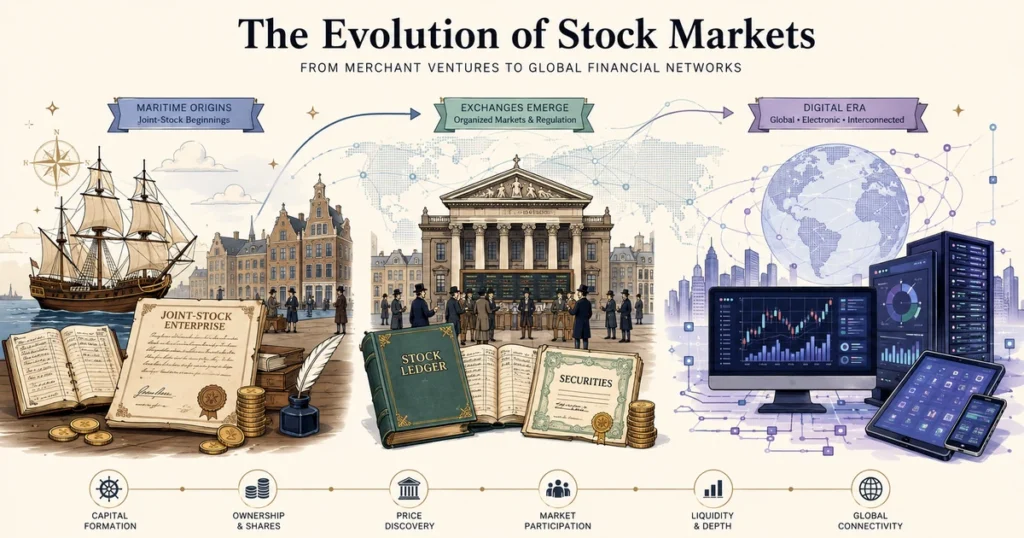
The study of stock market history traces how human civilization organized risk-sharing, corporate enterprise, and long-term capital mobilization over more than four hundred years. From the founding of the Dutch East India Company in Amsterdam in 1602—which established the precedent for publicly traded fractional shares and secondary market liquidity—equity markets have evolved from informal coffeehouse gatherings into an interconnected international capital network representing one of the world’s largest pools of investable capital. Across centuries of speculative cycles, structural drawdowns, regulatory overhauls, and technological transitions from physical open-outcry pits to millisecond electronic matching engines, Stock markets have served as a major mechanism for corporate financing, price discovery, capital allocation, and global economic development.
The Foundational Origins of Equity: Pre-Modern Capital Formation
Before organized public stock exchanges existed, commercial enterprises relied on private debt, state treasuries, or family partnerships.
In ancient Rome, collections of private investors formed societates publicanorum—organizations that bid on government contracts and tax-collection rights, with participants holding tradable partnership shares called partes.
During the late Middle Ages and Renaissance, Italian merchant city-states (Venice, Genoa, Florence) developed formal secondary markets in negotiable sovereign debt bonds (prestiti). While these early financial networks created liquid markets for sovereign borrowing, they lacked the core mechanism of the modern stock exchange: permanent joint-stock equity with limited liability and fractional public trading.
+-------------------------------------------------------------------------------+
|                      THE PRE-MODERN CAPITAL ACCUMULATION LADDER               |
+----------------------+-----------------------------+--------------------------+
| ERA                  | REGIONAL HUB                | PRIMARY ASSET TRADED     |
+----------------------+-----------------------------+--------------------------+
| Classical Antiquity  | Roman Republic / Empire     | Tax farming shares       |
| Medieval Era         | Champagne Fairs (France)    | Merchant bills of exch.  |
| Renaissance (1300s)  | Venice, Genoa, Florence     | Sovereign public debt    |
| 16th Century         | Antwerp, Bruges (Flanders)  | Commodities & state IOUs |
+----------------------+-----------------------------+--------------------------+
The 17th Century: Amsterdam and the Emergence of Secondary Share Trading (1602)
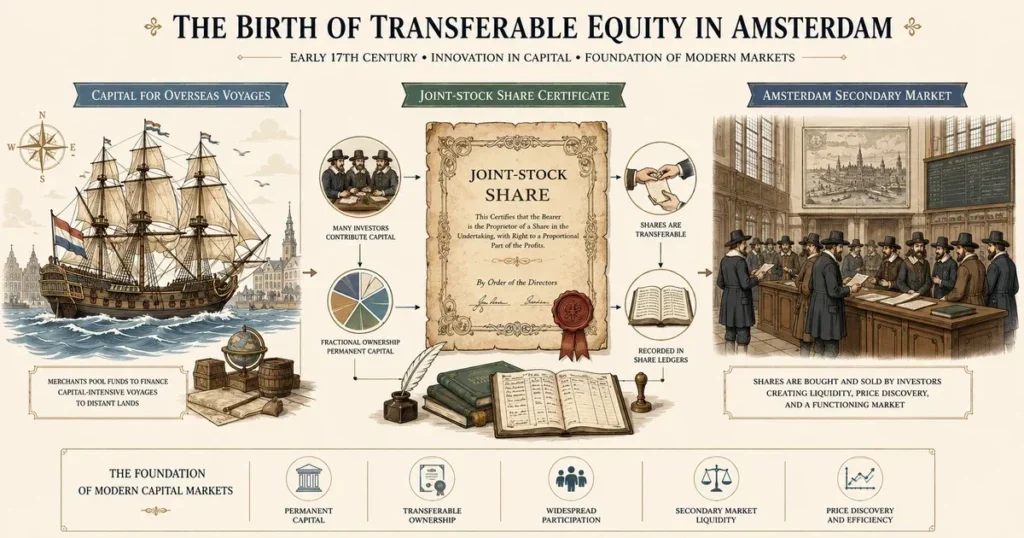
The institutional birth of the modern stock market is commonly associated with the 1602 founding of the Verenigde Oostindische Compagnie (VOC), or Dutch East India Company, and the subsequent emergence of an active secondary market for its shares in Amsterdam.
                      ┌─────────────────────────────────────────┐
                      │    HIGH-RISK MARITIME SPICE EXPEDITIONS │
                      └────────────────────┬────────────────────┘
                                           │
                           (Demanded Massive Long-Term Capital)
                                           ▼
                      ┌─────────────────────────────────────────┐
                      │      DUTCH EAST INDIA COMPANY (1602)    │
                      │  (Transferable fractional public shares)│
                      └────────────────────┬────────────────────┘
                                           │
                           (Introduced Continuous Liquidity)
                                           ▼
                      ┌─────────────────────────────────────────┐
                      │      AMSTERDAM SECONDARY SHARE MARKET   │
                      │ (Early marketplace for shares & forwards│
                      └─────────────────────────────────────────┘
Why Amsterdam Established the Capital Blueprint
- Permanent Capital Structure: Earlier trading ventures liquidated their capital assets upon completion of a voyage. The VOC retained investor capital permanently across multiple voyages, issuing transferable stock ownership certificates.
- Transferable Equity Participation: VOC shares were transferable and could be traded across a broad range of investors, creating one of the earliest active secondary equity markets.
- Continuous Secondary Liquidity: Trading took place regularly, establishing continuous price discovery and secondary market liquidity.
- Early Derivatives Contracts: Over subsequent decades, market participants in Amsterdam developed trading techniques including forward agreements, options contracts, repo transactions, and short-selling practices (windhandel).
The 18th Century: Speculative Manias and the Rise of London
During the late 17th and early 18th centuries, the center of global commercial gravity shifted toward London. British merchants gathered in coffeehouses along Exchange Alley—most notably Jonathan’s Coffee-House and Garraway’s—to quote prices for shipping shares, sovereign annuities, and commodities.
The Bubble Act of 1720 & Structural Lessons
In 1720, dual speculative manias demonstrated the systemic risks of excessive leverage, aggressive promotion, and state-sponsored monopoly schemes:
- The South Sea Bubble (Britain): The South Sea Company agreed to assume Britain’s national debt in exchange for monopoly trading rights in Spanish America. Speculative mania drove share prices from £128 in January 1720 to over £1,000 in August, before collapsing precipitously.
- The Mississippi Bubble (France): Engineered by John Law, the Mississippi Company absorbed French royal debt and issued vast quantities of paper banknotes, culminating in an economic collapse that destabilized French public finances.
In response, the British Parliament passed the Bubble Act of 1720, restricting the formation of joint-stock companies without an explicit Royal Charter. Although the Act was later repealed in 1825, organized securities trading in London continued to develop through broker networks, and the London Stock Exchange (LSE) was formally established in 1801.
The 19th Century: The Buttonwood Agreement and Wall Street’s Rise
In the post-Revolutionary United States, financial trading centered along Wall Street in Lower Manhattan.
                      ┌─────────────────────────────────────────┐
                      │    ALEXANDER HAMILTON BONDS (1790)      │
                      │ (Consolidation of US Revolutionary debt)│
                      └────────────────────┬────────────────────┘
                                           │
                           (Required Structured Dealer Trading)
                                           ▼
                      ┌─────────────────────────────────────────┐
                      │    BUTTONWOOD AGREEMENT (MAY 17, 1792)  │
                      │  (24 brokers agree on fixed commissions)│
                      └────────────────────┬────────────────────┘
                                           │
                           (Formalized Exchange Organization)
                                           ▼
                      ┌─────────────────────────────────────────┐
                      │ NEW YORK STOCK & EXCHANGE BOARD (1817)  │
                      │         (Later renamed the NYSE)        │
                      └─────────────────────────────────────────┘
On May 17, 1792, twenty-four prominent merchants and brokers gathered under a buttonwood tree outside 68 Wall Street to sign the Buttonwood Agreement, establishing foundational operating rules:
- Brokers agreed to trade securities directly with one another.
- Brokers agreed to charge commissions of at least one-quarter of one percent (0.25%).
In 1817, this merchant association formalized its constitution, adopting the name New York Stock & Exchange Board (shortened to the New York Stock Exchange / NYSE in 1863).
Throughout the 19th century, the rapid expansion of American canals, mining, and transcontinental railroads generated substantial corporate financing requirements, cementing common stocks and corporate bonds as central instruments of industrial capital formation.
The Chronological Timeline of Global Stock Market History
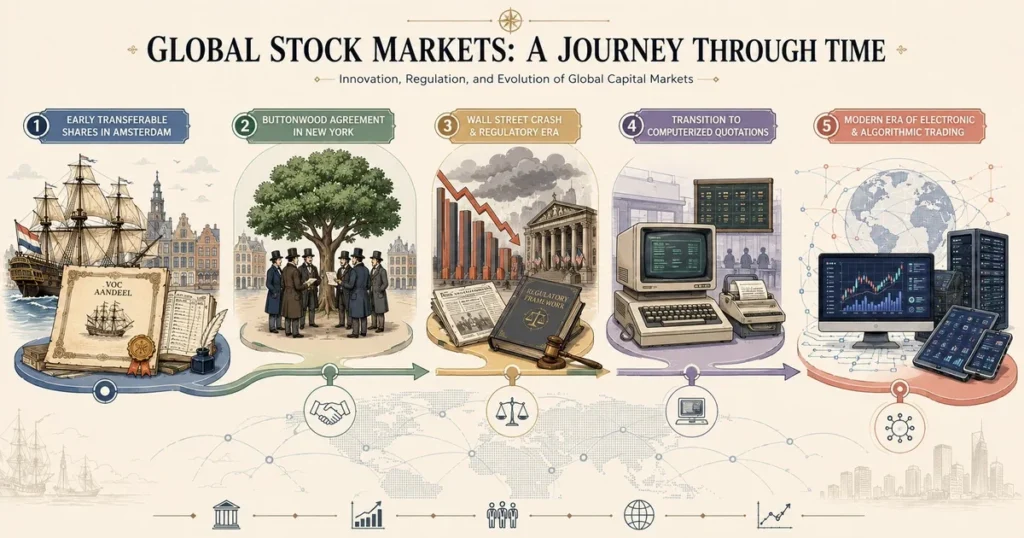
| Year / Period | Key Milestone | Institutional Significance |
| 1602 | VOC Share Issuance (Amsterdam) | Transferable fractional shares established; early secondary trading develops. |
| 1698 | Early price lists at Jonathan’s Coffee-House | John Castaing organizes regular published price sheets for stocks and commodities in London. |
| 1720 | South Sea & Mississippi Bubbles | Multi-national equity bubbles lead to major regulatory crackdowns (Bubble Act). |
| 1792 | Buttonwood Agreement Signed | Founding charter establishing rules for Wall Street broker trading. |
| 1801 | London Stock Exchange (LSE) Formed | LSE establishes a subscription-based formal exchange floor. |
| 1878 | Tokyo Stock Exchange Established | Tokyo Stock Exchange is established during Japan’s Meiji-era modernization, helping formalize organized securities trading in Japan. |
| 1929 | Wall Street Crash (Black Tuesday) | Triggers severe economic contraction; prompts modern securities legislation. |
| 1934 | US SEC Established | Introduction of statutory federal securities disclosure and investor protection laws. |
| 1971 | NASDAQ Launches | Launched as an electronic quotation system, using computer networks to distribute dealer price quotes without requiring a physical floor. |
| 1986 | London “Big Bang” Deregulation | Abolishes fixed commissions and shifts trading toward electronic screen networks. |
| 1987 | Black Monday Crash (Oct 19) | Highlights the risks of automated portfolio strategies; leads to market-wide circuit breakers. |
| 2000–2002 | Dot-Com Bubble Deflation | Collapse of speculative technology valuations; accelerates corporate governance reforms. |
| 2008 | Global Financial Crisis (GFC) | Systemic credit contraction prompts central bank liquidity facilities and stricter capital rules. |
| Modern Era | Electronic & Automated Trading | Broad adoption of algorithmic order routing, electronic matching engines, and data analytics. |
The Anatomy of Major Market Crashes and Panics
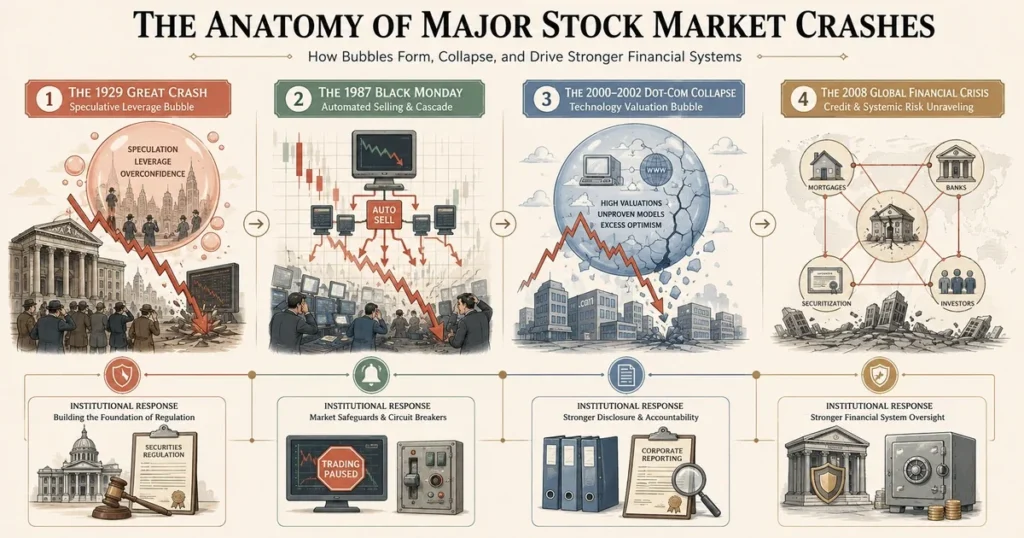
Market drawdowns and financial panics have repeatedly acted as catalysts for regulatory, structural, and operational changes:
+-------------------------------------------------------------------------------+
|                     HISTORICAL CRASH ANATOMY & LESSONS LEARNED                |
+-------------------+------------------------------------+----------------------+
| EVENT             | PRIMARY MACRO CATALYST             | REGULATORY / SYSTEMIC|
|                   |                                    | RESPONSE             |
+-------------------+------------------------------------+----------------------+
| **1929 Crash**    | Extensive margin leverage, credit  | Federal securities   |
| (Great Crash)     | expansion, banking instability     | reforms, including   |
|                   |                                    | Glass-Steagall Act   |
|                   |                                    | (1933) and SEC       |
|                   |                                    | creation (1934)      |
+-------------------+------------------------------------+----------------------+
| **1987 Crash**    | Automated portfolio insurance loops| Market-wide Circuit  |
| (Black Monday)    | and systemic liquidity strain      | Breakers established |
+-------------------+------------------------------------+----------------------+
| **2000–2002**     | Unprofitable tech firm valuations, | Sarbanes-Oxley Act,  |
| (Dot-Com Bubble)  | speculative growth assumptions     | stricter reporting   |
+-------------------+------------------------------------+----------------------+
| **2008 Crisis**   | Structured mortgage securitization,| Dodd-Frank Act, bank |
| (GFC)             | investment bank leverage failure   | stress-testing / CCAR|
+-------------------+------------------------------------+----------------------+
1. The Great Crash of 1929
During the late 1920s, US equity markets experienced significant speculation, supported by substantial margin lending. Following severe selling on Black Tuesday (October 29, 1929), market liquidity deteriorated under forced margin liquidations. The Dow Jones Industrial Average ultimately fell roughly 89% from its September 1929 peak to its July 1932 low before embarking on a multi-decade recovery.
2. Black Monday (October 19, 1987)
In a single trading session, the Dow Jones Industrial Average dropped 22.6%—the largest single-day percentage decline in US stock market history. The sell-off demonstrated how automated hedging strategies, such as Portfolio Insurance, could interact with falling prices to amplify market-wide selling pressure.
The Regulatory Evolution: From Unregulated Curb Trading to the SEC
For centuries, equity trading operated under private exchange bylaws, informal merchant customs, or local commercial law. Periods of fraud, syndicate manipulation, and informational asymmetry eventually prompted statutory oversight.
The Securities Act of 1933 & Securities Exchange Act of 1934
Following the 1929 stock market crash, the United States enacted comprehensive federal securities legislation that set the standard for modern capital market regulation worldwide:
- Mandatory Prospectus Disclosure: Issuers offering securities to the public must provide full and fair disclosure of material operational and financial data.
- Continuous Reporting Mandates: Public companies must publish standardized periodic financial reports (including annual $10\text{-}K$ and quarterly $10\text{-}Q$ filings).
- The SEC: Established the Securities and Exchange Commission as an independent statutory agency responsible for maintaining fair, orderly, and efficient markets, enforcing antifraud rules, and overseeing exchange operations.
The Technological Shift: From Open-Outcry Pits to High-Frequency Algorithmic Execution
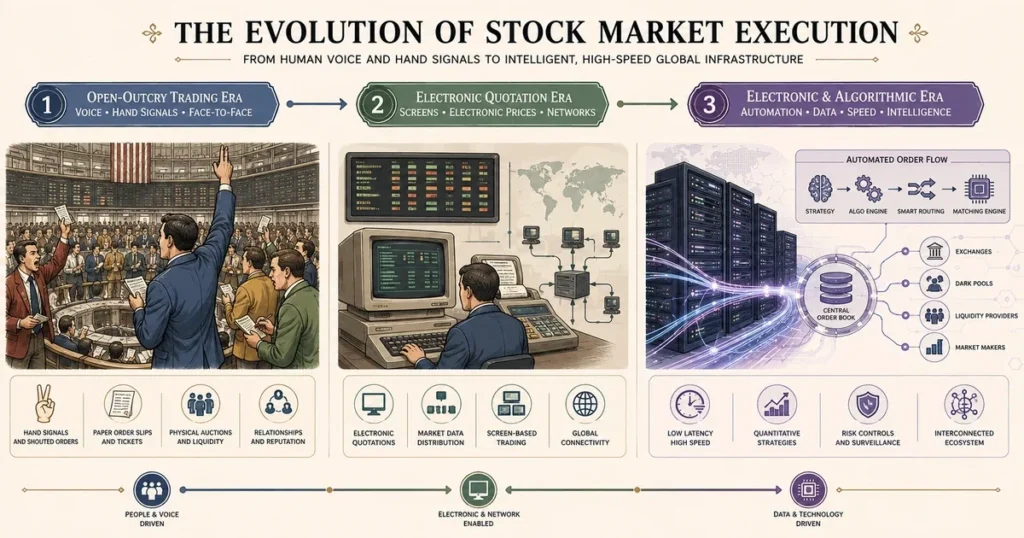
The microstructure of equity execution has evolved through three distinct operational phases:
                      ┌─────────────────────────────────────────┐
                      │       PHYSICAL OPEN-OUTCRY PITS         │
                      │  (Floor specialists, chalkboards, hand  │
                      │   signals, and face-to-face auctions)   │
                      └────────────────────┬────────────────────┘
                                           │
                           (Computerized Screen Networks - 1971)
                                           ▼
                      ┌─────────────────────────────────────────┐
                      │    ELECTRONIC ORDER MATCHING (ECNs)     │
                      │   (Screen-based quotation, electronic   │
                      │    order books, automated matching)     │
                      └────────────────────┬────────────────────┘
                                           │
                        (Colocation & High-Speed Networks)
                                           ▼
                      ┌─────────────────────────────────────────┐
                      │     AUTOMATED & ALGORITHMIC TRADING     │
                      │  (Quantitative market making, smart     │
                      │   order routing, data-driven execution) │
                      └─────────────────────────────────────────┘
- The Floor Trading Era (1600s–1970s): Orders were executed by floor brokers and specialists using hand signals, physical paper slips, and verbal open-outcry auctions inside centralized exchange pits.
- The Electronic Quotation & Screen Era (1971–1990s): NASDAQ launched in 1971 as an electronic quotation system, providing automated price quotations over a computer network rather than through a single physical floor. The London “Big Bang” in 1986 accelerated the global shift to screen-based trading.
- The Algorithmic & Modern Infrastructure Era (2000s–Present): Modern equity markets rely extensively on algorithmic execution, automated market making, smart order routing, and high-speed electronic infrastructure, with market participants utilizing colocation facilities to optimize connectivity.
Global Equity Architecture: Major World Stock Exchanges
Modern equity capital is allocated across major international exchanges operating across global time zones:
| Exchange Name | Primary Financial Hub | Established / Modern Formation | Primary Benchmark Index |
| New York Stock Exchange (NYSE) | New York, USA | 1792 (Buttonwood) | Dow Jones Industrial Average / S&P 500 |
| NASDAQ | New York, USA | 1971 (Electronic Quotation) | Nasdaq-100 / Nasdaq Composite |
| London Stock Exchange (LSE) | London, UK | 1801 (Formalized) | FTSE 100 |
| Tokyo Stock Exchange (TSE) | Tokyo, Japan | 1878 (Meiji Era) | Nikkei 225 / TOPIX |
| Shanghai Stock Exchange (SSE) | Shanghai, China | 1990 (Modern Era) | SSE Composite |
| Hong Kong Exchanges (HKEX) | Hong Kong SAR | 1891 (Formalized) | Hang Seng Index |
| Euronext | Multi-City Europe (AMS/PAR/BRU) | 2000 (Cross-Border Merger) | CAC 40 / AEX Index |
| BSE / National Stock Exchange (NSE) | Mumbai, India | 1875 (BSE) / 1992 (NSE) | BSE SENSEX / NIFTY 50 |
Structural Comparison: Major Epochs in Stock Market History
| Characteristic | Early Modern Era (1600s–1700s) | Industrial Expansion Era (1800s–Mid 1900s) | Modern Electronic Era (Late 1900s–Present) |
| Primary Listed Sectors | Maritime voyages, sovereign chartered companies | Railroads, manufacturing, mining, steel | Technology, healthcare, consumer, finance |
| Execution Medium | Open courtyards, coffeehouses | Centralized physical exchange trading floors | Electronic communication and matching networks |
| Settlement Timeframe | Weeks to months (Paper certificates) | Multi-day paper settlement cycles | Accelerated electronic settlement (e.g., $T+1$) |
| Information Transmission | Letters, courier networks, sailing ships | Telegraph tickers, telephone | Real-time electronic data feeds and APIs |
| Investor Access | Limited to merchant elites and partnerships | Broadening through traditional brokerages | Global electronic access via online platforms |
Macroeconomic Case Dissections: Historic Structural Shocks
Dissection 1: The Panic of 1907 and Central Banking
- Historical Context: In October 1907, an unsuccessful attempt to corner the stock of the United Copper Company led to runs on several New York trust companies, triggering severe liquidity shortages.
- The Structural Issue: Without a national central bank to provide emergency liquidity, the financial system depended on private interventions led by financier J. Pierpont Morgan.
- The Policy Outcome: The panic highlighted the systemic necessity of a formalized lender of last resort, contributing directly to the creation of the Federal Reserve System in 1913.
Dissection 2: The 2010 “Flash Crash” and Automated Microstructure
- Historical Context: On May 6, 2010, major US stock indices experienced a sudden, severe drop within minutes before recovering most of the loss shortly thereafter.
- The Structural Issue: Large algorithmic sell orders combined with the rapid withdrawal of automated market-maker quotes created a brief but severe liquidity imbalance.
- The Policy Outcome: Regulatory authorities implemented Limit-Up/Limit-Down (LULD) mechanisms and single-stock trading halts to moderate rapid price swings in electronic trading environments.
The Future of Stock Markets: Tokenization, Extended Trading, and AI Liquidity
The structure of equity trading continues to evolve across several operational areas:
- Shortened Settlement Cycles: Several major markets have moved toward $T+1$ standard settlement to lower counterparty risk, while market infrastructure providers continue researching atomic and distributed ledger settlement models.
- Extended Trading Hours: Extended-hours and near-continuous trading initiatives are being explored and expanded in some markets, potentially increasing market access across international time zones.
- Digital Asset Tokenization & Smart Contracts: Financial institutions are investigating the tokenization of traditional equity instruments to automate corporate actions, dividend distributions, and cross-border settlement workflows.
Frequently Asked Questions (Institutional FAQ)
What is the historical origin of publicly traded joint-stock shares?
Transferable public joint-stock shares are widely traced back to the Dutch East India Company (VOC) in 1602, which issued permanent fractional equity to investors that could be bought and sold on the secondary market in Amsterdam.
What was the purpose of the Buttonwood Agreement in stock market history?
Signed on May 17, 1792, by 24 New York brokers under a buttonwood tree, the agreement established formal ground rules for trading public securities, including mutual trading preferences and minimum commission rates of at least one-quarter of one percent (0.25%).
Why were market-wide circuit breakers introduced?
Following the Black Monday crash of October 19, 1987, exchanges introduced mandatory Circuit Breakers—coordinated trading halts triggered when broad market indexes fall by predefined thresholds, giving market participants time to reassess liquidity and prevent cascading panic selling.
What was the significance of London’s 1986 “Big Bang”?
The “Big Bang” of October 27, 1986, deregulated the London Stock Exchange by eliminating fixed commission minimums, permitting foreign ownership of member firms, and accelerating the transition from physical trading pits to screen-based dealing.
How did the introduction of NASDAQ in 1971 change equity markets?
Launched in 1971, NASDAQ was established as an electronic quotation system, showing that computer networks could centralize and display dealer price quotes efficiently without requiring a single physical trading floor.
Strategic Summary & Institutional Takeaways
Understanding stock market history provides essential perspective on modern financial markets, corporate capital formation, and risk management.
From 17th-century Amsterdam to modern algorithmic execution networks, stock markets have evolved to provide liquidity, price discovery, and capital allocation across economic cycles. While market instruments and technologies change, the fundamental principles of valuation, risk-sharing, and regulatory oversight remain central to maintaining stable capital markets.
By studying historical market panics, regulatory developments, and technological transitions, investors and analysts can evaluate modern market structures with analytical clarity and historical discipline.
Next Reading Suggestions
- [Understanding Real Effective Exchange Rates (REER) in Global Trade]
- [Central Bank Interventions: Mechanics of Sovereign Currency Management]
- [Interest Rates and Exchange Rates: The Macroeconomic Transmission Mechanism]
- [The Structural Role of the US Dollar as the Global Anchor Reserve Asset]
Author Box & E-E-A-T Verification
Written By: CurrencyPlans Financial Research Team
Fact-Checked & Reviewed By: Senior Institutional Market Analyst & Financial Historian
Editorial Integrity & Research Standards: CurrencyPlans publishes institutional-grade research grounded in verified historical archives and financial data. All market chronologies, regulatory developments, and exchange histories are cross-referenced with primary multilateral institutions and exchange historical archives, including the World Federation of Exchanges (WFE) and national securities regulators.
Primary Institutional References & Historical Archives
For further research into the history of securities exchanges, market microstructure, and regulatory frameworks:
- Global Securities Exchanges Data & Records: World Federation of Exchanges (WFE)
- Historical US Securities Legislation & Reports: US Securities and Exchange Commission (SEC)
- Historical Financial Market Research: Bank for International Settlements (BIS)
- New York Stock Exchange History & Governance: New York Stock Exchange (NYSE)
- London Stock Exchange Historical Records: London Stock Exchange Group (LSEG)
Educational Disclaimer
This guide is prepared strictly for educational, informational, and historical research purposes and does not constitute financial, investment, legal, or tax advice. Past market performance and historical equity returns do not guarantee future investment outcomes. Always perform independent due diligence and consult a licensed financial advisor before allocating capital to financial markets.

