
Executive Summary & Core Thesis
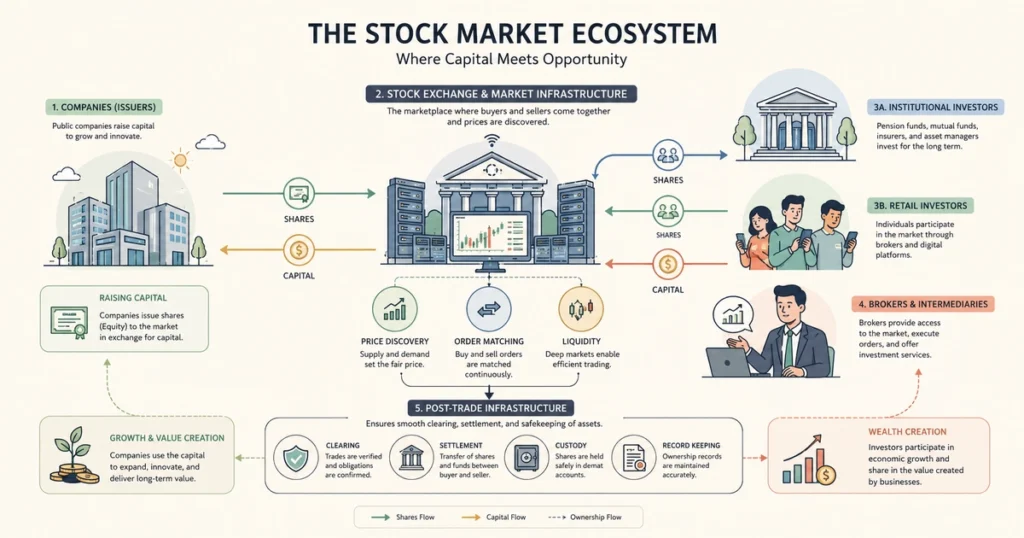
The stock market is an essential component of the modern financial architecture, encompassing the collection of exchanges, alternative trading venues, clearing houses, and market intermediaries that facilitate the issuance, trading, and settlement of corporate equity securities.
Modern stock markets operate as interconnected networks of exchanges, trading venues, intermediaries, clearing systems, and securities depositories that increasingly rely on electronic infrastructure to convert household and institutional savings into productive commercial investment. By providing a transparent environment where equity share prices are determined continuously through open-market supply and demand, stock markets enable corporations to raise permanent capital to fund operations, research, and infrastructure, while allowing participants to manage financial risk and participate in broader economic expansion.
The Foundational Definition: What Is the Stock Market?
In financial economics, the stock market is the overarching ecosystem through which shares of publicly held companies are issued, bought, and sold. It includes stock exchanges, alternative trading venues, brokers, investors, clearing systems, securities depositories, and the regulatory frameworks that govern equity trading.
In simple terms, the stock market is the financial system that connects businesses seeking expansion capital with investors who buy and sell ownership interests in those companies. To understand this dynamic fully, it is important to first understand what stocks are, as stocks represent ownership interests in a corporation that can be issued and traded through public markets.
When a private company becomes publicly held, its ownership is represented by shares that may be issued and traded subject to applicable corporate and securities laws. These shares constitute equity securities that can be bought and sold through the stock-market ecosystem. The broader market operates within legal, institutional, and technological frameworks that allow these securities to be priced, transferred, cleared, and settled among market participants under regulatory oversight.
| Component | Function in the Market | Primary Economic Role |
| Public Corporations | Issue equity shares | Access long-term non-debt capital |
| Investors (Buy-Side) | Allocate financial capital | Seek potential capital growth and income |
| Stock Exchanges | Provide execution matching | Facilitate transparent price discovery |
| Clearing & Custody | Process trades and asset safekeeping | Manage settlement and counterparty risk |
Modern equity trading is predominantly electronic, although some markets and trading venues continue to incorporate specialized forms of floor-based or specialist-assisted trading to support deep order flow.
Stock Market vs. Stock Exchange: Understanding the Structural Distinction
Quick Answer: Market vs. Exchange
- The Stock Market: The complete macro ecosystem—encompassing all trading platforms, retail and institutional participants, clearing corporations, brokerages, and regulations.
- A Stock Exchange: The specific, licensed venue or entity (e.g., NYSE, NASDAQ, London Stock Exchange) where buyers and sellers meet to execute transactions in listed securities.
In mainstream discourse, the terms stock market and stock exchange are frequently used interchangeably, but they describe distinct structural concepts:
- The Stock Market (The Broad Ecosystem): Represents the aggregate economic network encompassing all trading venues, institutional and retail investors, regulatory authorities, market intermediaries (broker-dealers), and listed companies within an economy or across the world.
- A Stock Exchange (Specific Matching Venues): A distinct, legally registered corporate entity or organized marketplace where specific securities are listed and matched (such as the New York Stock Exchange, NASDAQ, the London Stock Exchange, Euronext, Tokyo Stock Exchange, or the National Stock Exchange of India). As detailed in our comprehensive review of stock market history, these formal venues evolved from regional merchant gathering halls into highly regulated matching engines.
- Alternative Trading Venues (ATSs / ECNs): Electronic platforms that provide alternative execution mechanisms and liquidity pools operating alongside traditional exchanges.
A single national stock market can contain multiple competing stock exchanges that operate under a unified statutory regulatory framework.
Why the Stock Market Exists: The Two Core Economic Purposes
The stock market serves two important economic functions that support capital formation and investment:
1. Capital Formation for Corporate Enterprises
Developing high-technology products, building large-scale manufacturing facilities, and conducting multi-year research initiatives require substantial resources. If companies relied solely on debt (such as bank loans or corporate bonds), they would face mandatory interest payments that could strain balance sheets during economic downturns. By issuing equity, companies secure permanent capital that does not require repayment, allowing management to pursue long-term operational growth.
2. Capital Allocation and Liquidity for Investors
Without a secondary stock market, purchasing equity in an operating business would be illiquid. An investor who bought a share of a private company might have to wait years for an acquisition to exit their position. The stock market provides continuous secondary liquidity, allowing individuals, pension funds, and endowments to buy and sell shares within seconds at transparent, publicly quoted market prices.
| Dimension | Corporate Capital Function | Investor Allocation Function |
| Core Objective | Raises non-debt expansion capital | Converts savings into productive assets |
| Cash Flow Profile | No fixed contractual debt payments | Offers potential capital growth and income |
| Risk Dynamic | Spreads business risk across shareholders | Exposure to company and market volatility |
| Strategic Benefit | Establishes public currency for acquisitions | Provides secondary liquidity on demand |
Primary vs. Secondary Markets: The Two-Tiered Capital Engine
Quick Answer: Primary vs. Secondary Market
- Primary Market: Where newly issued securities are sold to investors, with proceeds from new issuance flowing directly to the issuer (e.g., during an IPO).
- Secondary Market: Where investors trade existing shares among themselves on public exchanges without capital flowing directly to the issuing company.
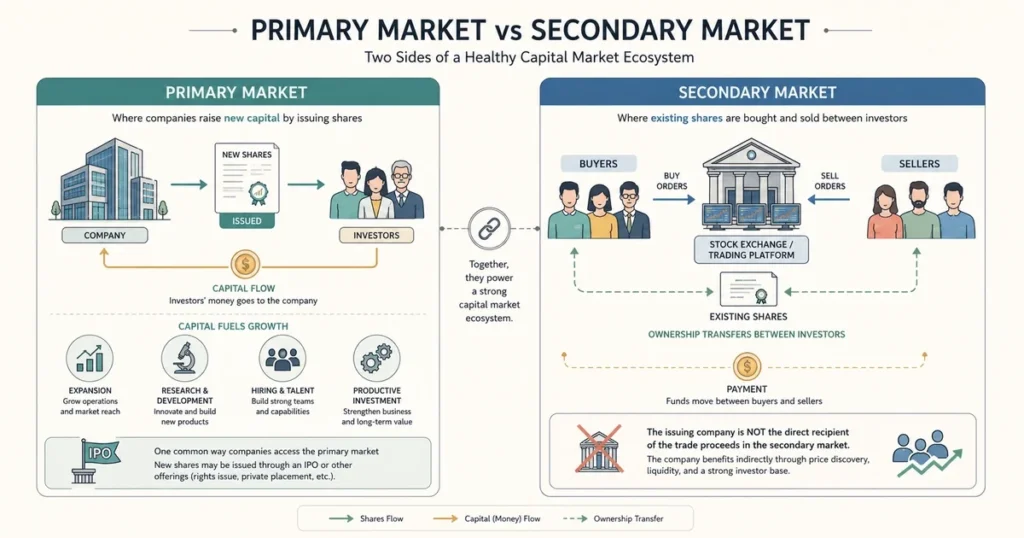
| Market Layer | Primary Market (Issuance) | Secondary Market (Trading) |
| Transaction Type | Creation of new public equity shares | Exchange of existing, outstanding shares |
| Capital Destination | Cash proceeds flow directly to issuing company | Cash transfers directly between buyer and seller |
| Key Execution Venues | Investment banking syndicates & IPO book-building | Public stock exchanges (NYSE, NASDAQ, LSE, NSE) |
| Primary Economic Role | Funds business expansion, R&D, and deleveraging | Provides continuous liquidity and real-time valuation |
The Primary Market (Capital Issuance)
The primary market is where securities are created and sold for the first time. Through an Initial Public Offering (IPO) or subsequent public offerings, a corporation issues shares to institutional and retail investors. The capital raised from new primary shares flows directly to the issuing company’s balance sheet to fund expansion, research, or balance sheet deleveraging.
The Secondary Market (Liquidity and Trading)
Once shares have been issued in the primary market, they trade on the secondary market—which is what is commonly referred to as trading on the stock market. In the secondary market, investors trade existing shares with one another. The issuing company is not a party to these transactions and receives no direct cash from secondary trades. Instead, the secondary market establishes market valuations and provides the liquidity that makes primary market investment feasible.
How Stock Prices Are Formed: Order Books and Continuous Auction Mechanics
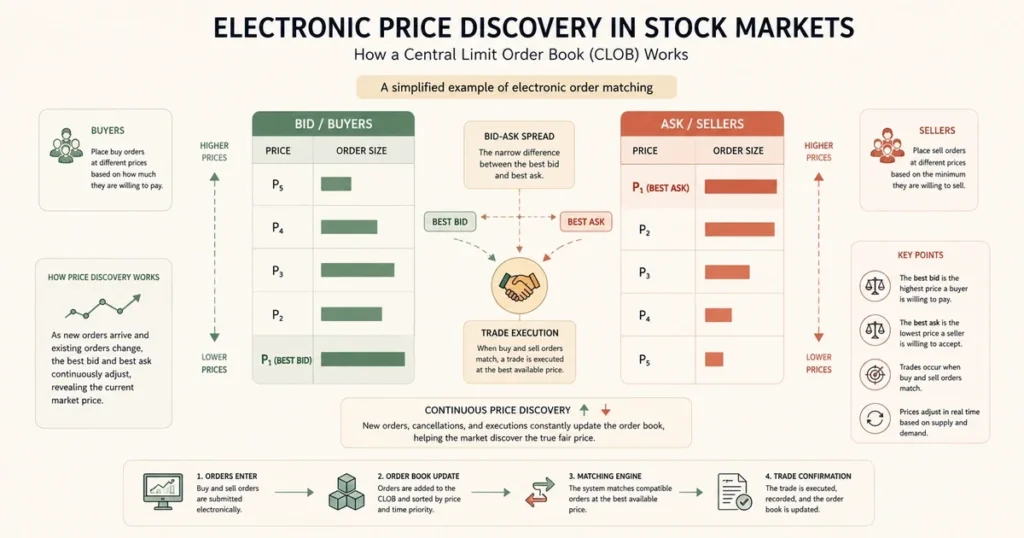
On many modern electronic exchanges, stock prices are formed through continuous price discovery as buy and sell orders interact within an electronic central limit order book (CLOB), although market structures vary by venue.
                      ┌─────────────────────────────────────────┐
                      │       ELECTRONIC ORDER BOOK (CLOB)      │
                      └────────────────────┬────────────────────┘
                                           │
         ┌─────────────────────────────────┴─────────────────────────────────┐
         │                                                                   │
         ▼                                                                   ▼
┌──────────────────┐               ┌──────────────────────────────────┐
│         THE BID QUEUE            │               │         THE ASK QUEUE            │
│  (Buyers waiting in price order) │               │  (Sellers waiting in price order)│
├──────────────────┤               ├──────────────────────────────────┤
│ 100 shares @ $99.98              │               │ 200 shares @ $100.02             │
│ 500 shares @ $99.95              │               │ 400 shares @ $100.05             │
│ 1,200 shares @ $99.90            │               │ 800 shares @ $100.10             │
└──────────────────┘               └──────────────────────────────────┘
                                   │               │
                                   └───────┬───────┘
                                           │
                                    [BID-ASK SPREAD]
                                   ($100.02 - $99.98 = $0.04)
In simple terms, buyers compete by offering the highest price they are willing to pay, while sellers compete by offering the lowest price they are willing to accept. Transactions occur automatically when compatible bids and asks cross.
Core Market Microstructure Concepts
- The Bid Price: The highest displayed price that any buyer is currently willing to pay for a share.
- The Ask (Offer) Price: The lowest displayed price that any seller is currently willing to accept for their share.
- The Bid-Ask Spread: The numerical gap between the lowest Ask and the highest Bid ($\text{Spread} = \text{Ask} – \text{Bid}$). This spread represents the transaction cost of immediate liquidity.
- Market Orders: An order that executes immediately at the best available prevailing prices in the order book, prioritizing execution certainty over price level.
- Limit Orders: An order that rests in the order book to buy or sell only at a specific price or better, prioritizing price control over execution immediacy.
When high volumes of aggressive buy orders consume resting Ask orders, the market price adjusts upward. When heavy selling volume exhausts resting Bid orders, the displayed market price moves downward.
The Core Participants: Who Operates in the Stock Market?
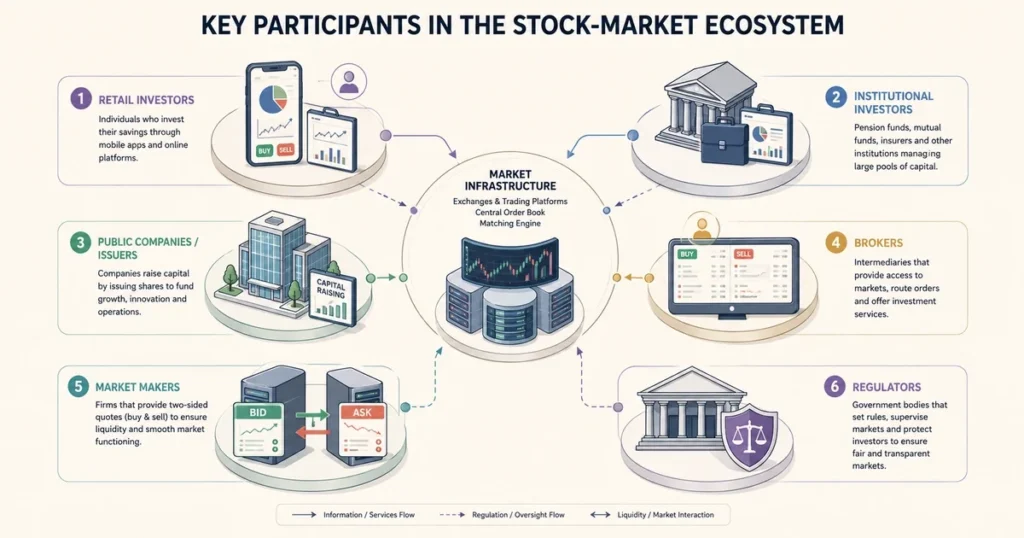
The stock market functions through a diverse ecosystem of market participants, each fulfilling distinct operational roles:
| Participant Category | Representative Entities | Core Operational Function |
| Institutional Investors | Pension funds, sovereign wealth funds, mutual funds, insurance companies | Deploy pooled capital for long-term investment strategies. |
| Retail Investors | Individual investors, family offices | Allocate personal savings via electronic retail brokerages. |
| Corporate Issuers | Public corporations across all economic sectors | Issue shares to raise capital and manage public reporting. |
| Market Makers (Dealers) | Quantitative trading firms, specialist broker-dealers | Provide two-sided quotations and liquidity, subject to market rules. |
| Statutory Regulators | SEC (US), FCA (UK), SEBI (India), ESMA (Europe) | Enforce securities laws, ensure market transparency, and protect investors. |
Understanding Stock Market Indexes: Measuring Overall Market Performance
Because thousands of individual stocks trade simultaneously, economists and investors track aggregate market movements using stock market indexes. An index measures the statistical price performance of a representative basket of equities:
| Index Name | Jurisdiction | General Weighting Methodology |
| S&P 500 | United States | Float-adjusted market-cap weighted |
| Dow Jones Industrial Average | United States | Price-weighted |
| Nasdaq Composite | United States | Market-cap weighted |
| FTSE 100 | United Kingdom | Free-float market-cap weighted |
| DAX 40 | Germany | Free-float market-cap weighted |
| Nikkei 225 | Japan | Price-weighted |
| NIFTY 50 | India | Free-float market-cap weighted |
| BSE SENSEX | India | Free-float market-cap weighted |
- Market-Cap Weighted Indexes (e.g., S&P 500): Companies with larger market capitalizations represent a proportionally larger percentage of the index. A price movement in a mega-cap stock impacts the index value more than an identical percentage movement in a smaller constituent.
- Price-Weighted Indexes (e.g., Dow Jones): Stocks with higher nominal share prices carry greater mathematical weight in the index calculation, regardless of the overall market capitalization of the underlying company.
Market Plumbing: From Trade Execution to Central Depository Custody
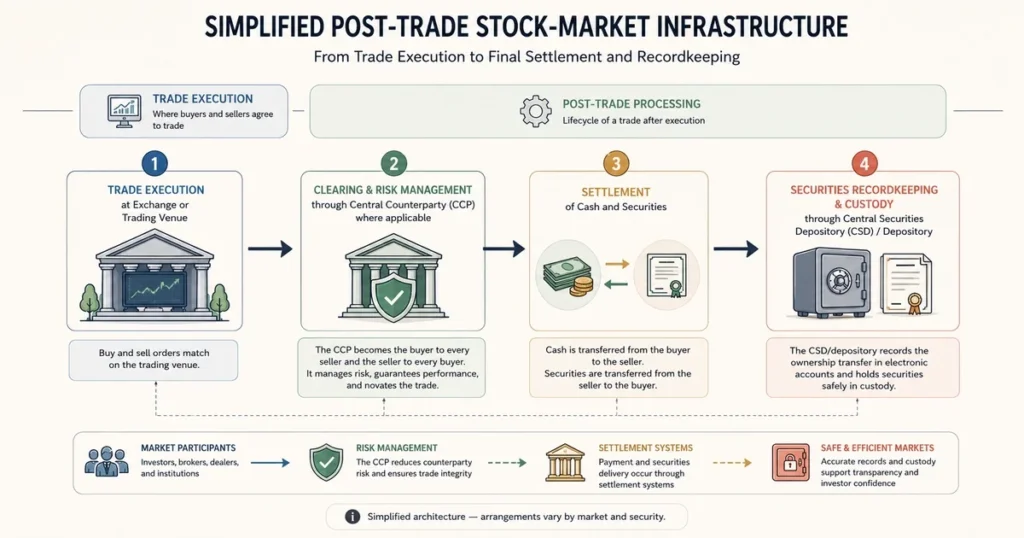
Behind electronic trading screens lies a multi-tiered post-trade settlement architecture designed to reduce and manage counterparty and settlement risk:
                      ┌─────────────────────────────────────────┐
                      │             RETAIL / BUY-SIDE           │
                      │   (Investor places electronic order)    │
                      └────────────────────┬────────────────────┘
                                           │
                              (Fix Protocol / Smart Order Routing)
                                           ▼
                      ┌─────────────────────────────────────────┐
                      │          BROKER-DEALER ROUTER           │
                      │   (Verifies margin, routes to venue)    │
                      └────────────────────┬────────────────────┘
                                           │
                               (Order Matching Engine Execution)
                                           ▼
                      ┌─────────────────────────────────────────┐
                      │          STOCK EXCHANGE MATCH           │
                      │   (Generates electronic trade report)   │
                      └────────────────────┬────────────────────┘
                                           │
                           (Continuous Net Settlement - Clearing)
                                           ▼
                      ┌─────────────────────────────────────────┐
                      │      CENTRAL CLEARING HOUSE (CCP)       │
                      │  (Novation: Manages counterparty risk   │
                      │   under its formal clearing framework)  │
                      └────────────────────┬────────────────────┘
                                           │
                             (Book-Entry Ownership Transfer)
                                           ▼
                      ┌─────────────────────────────────────────┐
                      │     CENTRAL DEPOSITORY (CSD / CUSTODY)  │
                      │   (Dematerialized book-entry transfer)  │
                      └─────────────────────────────────────────┘
*> Note: Simplified illustration; actual trading, clearing, settlement, and custody arrangements vary by market, security, and trading venue.
Post-Trade Processing Phases
- Trade Execution: The buy order and sell order match within an exchange’s central matching engine.
- Novation via the Central Counterparty (CCP): Where a CCP is used, it becomes the counterparty to cleared trades and manages associated counterparty risk under its clearing framework.
- Custodial Settlement: Settlement cycles vary by jurisdiction and security. In markets that operate on a $T+1$ standard, the exchange of cash for shares settles electronically via book-entry at a central securities depository (such as DTC in the US or NSDL/CDSL in India) one business day after the trade date.
The Structural Benefits of Stock Markets for Modern Economies
A healthy, transparent stock market supports broader macroeconomic development:
- Efficient Capital Mobilization: Directs capital toward productive, innovative, and growing commercial enterprises.
- Democratization of Capital Growth: Allows individual citizens and retirement savers to participate directly in the wealth generated by public corporations.
- Corporate Governance & Transparency: Publicly listed companies are subject to statutory financial reporting and independent audit requirements, improving managerial accountability.
- Continuous Market Valuation: Provides continuously updated market valuations for publicly traded companies, establishing reference valuations for mergers, corporate acquisitions, and investment analysis.
The Core Risks and Volatility Dynamics of Stock Markets
While stock markets provide long-term wealth-building potential, equity ownership entails structural financial risks:
| Risk Dimension | Market-Wide Systematic Risk | Company-Specific Unsystematic Risk |
| Scope of Impact | Broad macroeconomic contractions | Isolated to single firms or narrow sectors |
| Primary Catalysts | Policy rate hikes, recessions, geopolitical war | Management errors, product failures, legal actions |
| Management Method | Asset class allocation, cash buffers, hedging | Broad portfolio diversification across sectors |
- Market Volatility: Stock prices fluctuate daily in response to earnings reports, policy announcements, and shifts in broader investor sentiment.
- Capital Loss Risk: If a publicly traded corporation experiences persistent operational decline or enters insolvency, common stockholders sit at the residual bottom of the liquidation priority ladder and may lose their invested capital.
- Liquidity Risk: In smaller-capitalization stocks or during periods of market stress, trading volume can decline, making it challenging to exit positions without price slippage.
Macroeconomic Forces That Drive the Stock Market
Stock markets reflect and respond to the broader macroeconomic environment through three primary transmission channels:
1. The Benchmark Interest Rate Channel
When central banks adjust policy rates, risk-free yields change across sovereign debt markets. Higher benchmark interest rates raise corporate debt financing costs, reduce consumer borrowing, and increase the hurdle discount rate applied to future corporate cash flows, often placing downward valuation pressure on equities. The macroeconomic link between interest rates and exchange rates further influences these domestic valuation multiples.
2. The Aggregate Demand & GDP Channel
Sustained growth in real Gross Domestic Product (GDP) increases disposable household income and business expenditure. Expanding economic output directly supports corporate sales volume, capacity utilization, and operating profitability across major listed sectors.
3. The Inflation & Cost-Structure Channel
Elevated inflation raises raw material, logistics, and labor expenses. Unless public corporations possess pricing power to pass input cost increases to end consumers, margin compression occurs, which can reduce reported earnings and suppress share prices.
Frequently Asked Questions (Institutional FAQ)
What is the simplest definition of the stock market?
The stock market is a broad financial ecosystem of exchanges, trading venues, intermediaries, investors, issuers, and regulatory frameworks through which corporate equity shares are issued and traded.
What is the difference between a stock market and a stock exchange?
The stock market is the broad, aggregate financial ecosystem that includes all trading venues, market participants, and regulatory frameworks. A stock exchange is a specific, registered organized entity (such as the NYSE, NASDAQ, or LSE) where securities are formally listed and matched.
Can an everyday retail investor lose more money than they invest in the stock market?
In a standard cash purchase of shares without leverage, an investor’s loss is generally limited to the amount invested. Margin borrowing, derivatives, short selling, or other leveraged strategies can create losses beyond the initial cash invested.
What causes the overall stock market to rise or fall on a given day?
The stock market moves based on aggregate supply and demand across listed equities, influenced by shifts in central bank interest rate expectations, inflation data releases, corporate quarterly earnings reports, geopolitical events, and broader economic sentiment.
What is the difference between the primary market and the secondary market?
The primary market is where newly created shares are sold directly by a corporation to investors to raise capital (such as during an IPO). The secondary market is where existing investors trade those previously issued shares among themselves, with no capital flowing to the issuing corporation.
Strategic Summary & Institutional Takeaways
Understanding what the stock market is provides the foundation for analyzing corporate finance, institutional investment, and macroeconomic capital flows.
The stock market serves as a primary capital allocation system, connecting corporations seeking expansion capital with investors seeking wealth generation. Through primary market issuance, companies obtain permanent capital without incurring fixed debt repayment obligations, while secondary public exchanges provide continuous liquidity, transparent order matching, and institutional price discovery.
By understanding the differences between markets and exchanges, evaluating order book price formation, and recognizing the macroeconomic drivers of equity volatility, market participants can navigate global financial markets with analytical clarity and structured discipline.
Next Reading Suggestions
- What Are Stocks? The Complete Guide to Shares, Equity, and Ownership
- Stock Market History: The Evolution of Global Equity Markets and Capital Systems
- Currency Exchange Rate: How Foreign Currencies Are Valued and Traded
- Interest Rates and Exchange Rates: The Macroeconomic Transmission Mechanism
Author Box & E-E-A-T Verification
Written By: CurrencyPlans Financial Research Team
Fact-Checked & Reviewed By: Financial Research Team & Equity Editorial Board
Editorial Integrity & Research Standards: CurrencyPlans publishes institutional-grade research grounded in verified corporate finance principles, academic financial economics, and regulatory disclosures. All capital market structures, exchange mechanisms, and clearing processes are cross-referenced with primary multilateral institutions and securities regulatory frameworks, including the US Securities and Exchange Commission (SEC), the Financial Industry Regulatory Authority (FINRA), and the World Federation of Exchanges (WFE).
Primary Institutional References & Regulatory Resources
For official regulatory guidelines, market architecture standards, and global securities data, consult primary institutional sources directly:
- Global Exchange Statistics & Architecture Data: World Federation of Exchanges (WFE)
- Investor Education & Securities Regulations: US Securities and Exchange Commission (SEC)
- Capital Market Governance & Oversight Standards: Financial Industry Regulatory Authority (FINRA)
- International Financial Stability & Capital Market Research: Bank for International Settlements (BIS)
- International Financial Statistics & Economic Data: International Monetary Fund (IMF) Data Portal
Educational Disclaimer
This guide is prepared strictly for educational, informational, and research purposes and does not constitute financial, investment, legal, or tax advice. Equities and capital market instruments carry inherent risk of capital loss, price volatility, and business failure. Past performance does not guarantee future results. Always perform independent due diligence and consult a licensed financial advisor before making investment commitments.

