
Executive Summary & Core Thesis
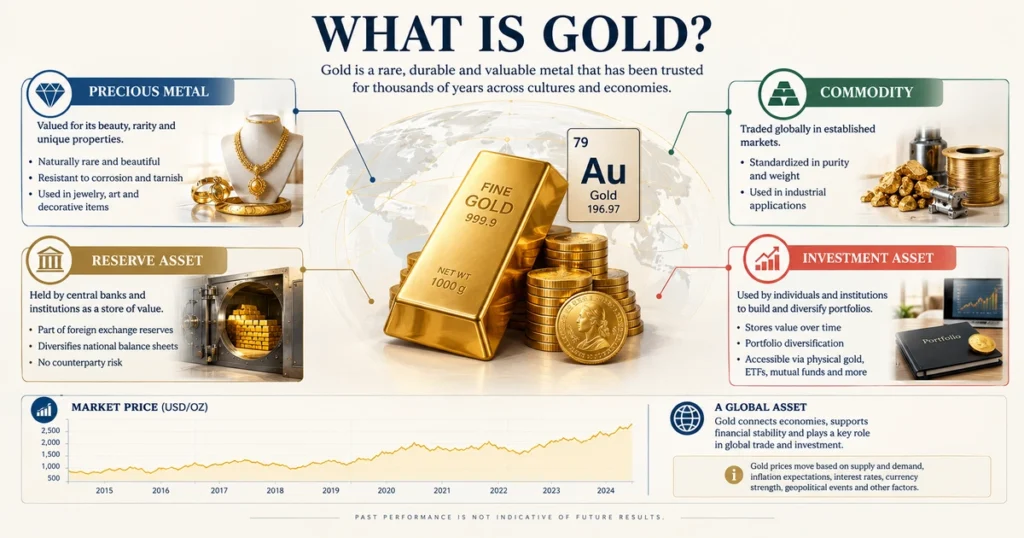
Gold (chemical symbol Au, atomic number 79) is a dense, corrosion-resistant precious metal with a long history in jewelry, trade, coinage, and monetary reserves. Unlike fiat currency, physical gold cannot be created through monetary policy or issued by government decree. Its above-ground supply grows gradually through mining and recycling, with new production constrained by geological, technological, financial, and regulatory factors.
In contemporary financial markets, gold has a dual role: it is a physical commodity used in jewelry and some industrial applications, and it is a reserve and investment asset held by central banks, institutions, and individuals. Physical gold does not pay interest or dividends and, when held in allocated form, is not a claim on an issuer. Its market price can respond to real interest rates, currency movements, inflation expectations, risk sentiment, central-bank demand, and other factors. That makes gold useful for understanding money, diversification, and purchasing-power risk, but it does not make gold a guaranteed hedge in every period.
The Foundational Definition: What Is Gold?
Quick Answer: What Is Gold?
Gold is a naturally occurring precious metal used as a commodity, reserve asset, and investment asset. Its durability, scarcity, density, divisibility, and recognizability have supported its monetary use across many societies. Physical allocated gold is not a corporate or sovereign promise to pay, although ownership still involves market, storage, custody, and liquidity risks.
In financial theory and monetary economics, gold is one of the most historically important examples of commodity money. While everyday transactions in modern economies occur through national fiat currencies (such as the US Dollar, Euro, British Pound, or Japanese Yen), fiat money relies entirely on statutory legal tender laws and the creditworthiness of sovereign issuers.
Gold’s market value reflects its physical characteristics, scarcity, history as money, and global supply-and-demand conditions. When an investor or central bank owns allocated physical gold directly, the metal itself is not a promise by a corporate or sovereign issuer. However, intermediaries, custodians, unallocated accounts, and financial products can introduce counterparty or operational risks.
To understand how physical monetary assets contrast with fractional claims on public corporations, review our foundational guide on what stocks are.
                      ┌─────────────────────────────────────────┐
                      │            THE NATURE OF MONEY          │
                      └────────────────────┬────────────────────┘
                                           │
         ┌─────────────────────────────────┴─────────────────────────────────┐
         │                                                                   │
         ▼                                                                   ▼
┌──────────────────────────────────┐               ┌──────────────────────────────────┐
│         FIAT CURRENCIES          │               │         MONETARY GOLD            │
├──────────────────────────────────┤               ├──────────────────────────────────┤
│ * Created by sovereign decree    │               │ * Formed through stellar physics │
│ * Supply expandable at near-$0   │               │ * Supply constrained by geology  │
│ * Issuer and monetary-policy risk │               │ * No issuer default claim when   │
│ * Purchasing power can decline    │               │ * Long historical monetary use   │
│   over long time horizons        │               │   power preservation             │
└──────────────────────────────────┘               └──────────────────────────────────┘
The Chemical and Physical Scarcity of Element 79
Quick Answer: Chemical & Physical Properties
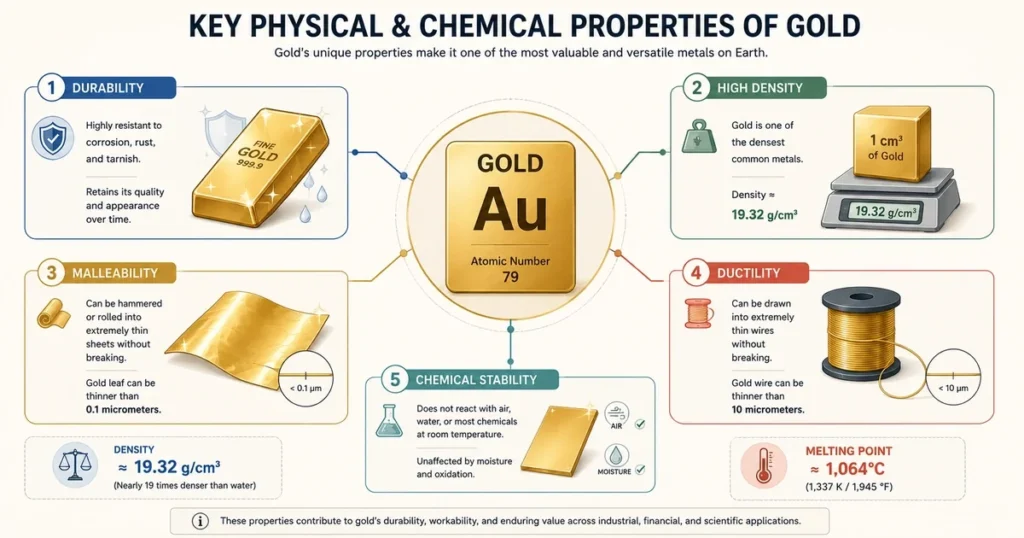
Gold is element 79 on the periodic table and has chemical and physical properties that have made it unusually useful as a durable store of material value. It is highly resistant to corrosion and oxidation, melts at about 1,064°C, is highly malleable and ductile, and has a density of about 19.32 g/cm³. These properties help explain why refined gold can remain physically intact for very long periods.
Gold became important in many historical societies because its combination of durability, scarcity, divisibility, portability, recognizability, and relative chemical stability suited monetary use. The reasons varied by place and period, so a simple periodic-table process of elimination does not fully explain the history of money:
- Gases and many liquids: Their handling, storage, measurement, and transport can be less convenient for monetary use.
- Reactive Metals: Metals such as iron can corrode readily, while copper can form surface oxides and carbonates. These properties can make some metals less convenient for long-term monetary storage, although they were historically used as money and remain economically valuable.
- Radioactive elements: Radiation, regulatory requirements, and physical decay make them unsuitable for ordinary monetary use.
- Abundant Elements (e.g., Aluminum, Silicon): Too common in the Earth’s crust to sustain scarcity value.
- Very Rare Metals: Metals such as platinum and rhodium have different physical and geological characteristics and were not historically used as widely as gold for coinage. Melting point alone does not explain their monetary history.
Gold has an unusual combination of chemical stability, high density, malleability, visual distinctiveness, and relative scarcity. It is resistant to air and moisture and to many common chemical reactions, although it can react under particular conditions. These characteristics make it durable and workable without making it uniquely suitable for every monetary system.
| Monetary Property | Physical Characteristic of Gold | Practical Economic Benefit |
|---|---|---|
| Durability | Highly resistant to corrosion and oxidation | Helps preserve the physical metal over very long periods |
| Portability | High density of about 19.32 g/cm³ | Allows substantial value to be stored in compact forms |
| Divisibility | Highly malleable and ductile | Can be divided, melted, or recast without destroying the underlying metal |
| Fungibility | Refined gold of equivalent purity has the same elemental composition | Standardized gold can be exchanged by weight and purity |
| Verifiability | Distinctive physical and chemical properties | Purity can be assessed through professional testing and assaying |
| Scarcity | Low natural abundance and costly extraction | New supply is constrained by geology and mining economics |
The Stock-to-Flow Architecture: Why Gold Cannot Be Arbitrarily Diluted
Quick Answer: The Stock-to-Flow Ratio
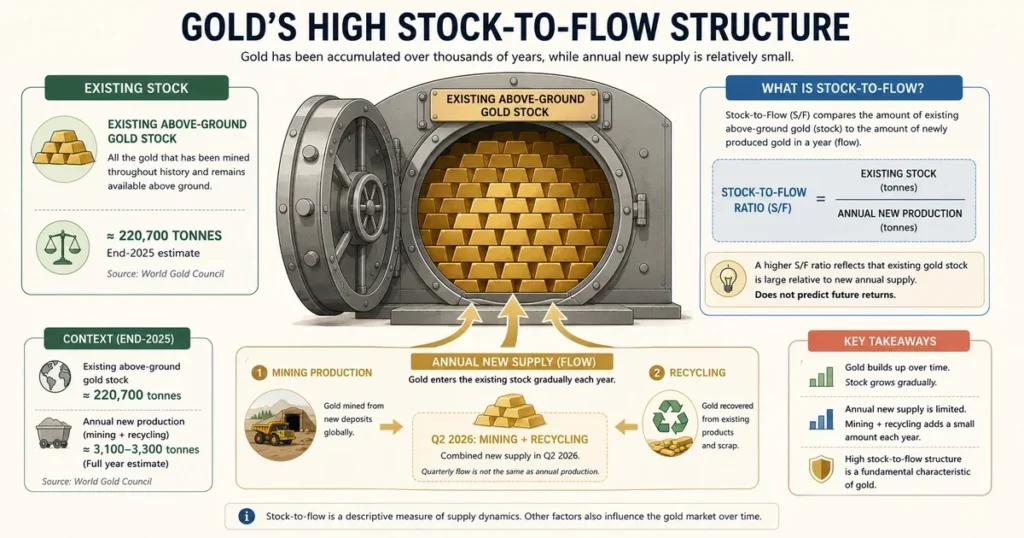
The stock-to-flow ratio measures the relationship between the total accumulated existing supply of an asset (stock) and its annual new production (flow). Gold has a high stock-to-flow ratio because a large quantity of previously mined gold remains in above-ground stocks while annual mine production is relatively small compared with that stock. This makes annual supply growth relatively gradual, although recycling and changes in mine output also affect total available supply. A high stock-to-flow ratio does not by itself guarantee stable purchasing power.
In commodity economics, the primary driver of price debasement is an elastic supply response. If the price of copper, wheat, or oil doubles, producers immediately ramp up drilling, planting, and extraction, flooding the market with new supply and crashing the price back down.
Gold is characterized by a high stock-to-flow ratio, meaning its accumulated above-ground stock is large relative to annual mine production. The World Gold Council estimates that above-ground stocks were about 220,700 tonnes at the end of 2025; because this figure changes as production and recycling are updated, it should be treated as a dated market estimate rather than a permanent constant:
$$\text{Stock-to-Flow Ratio} = \frac{\text{Total Existing Above-Ground Stock}}{\text{Annual Newly Mined Production (Flow)}}$$
              ┌──────────────────────────────────────────────┐
              │       GLOBAL ABOVE-GROUND GOLD STOCK         │
              │          Large accumulated stock             │
              └──────────────────────┬───────────────────────┘
                                     │
                                     ▼
                        GRADUAL ANNUAL SUPPLY GROWTH
                            Mining + Recycling
                                     │
                                     ▼
              ┌──────────────────────────────────────────────┐
              │        HIGH STOCK-TO-FLOW STRUCTURE          │
              │ Existing gold stocks are large relative to   │
              │ annual mine production, so total supply      │
              │ generally grows gradually over time.         │
              └──────────────────────────────────────────────┘
Because above-ground gold stocks are large relative to annual mine production, it would take many decades of mining at a constant rate to add an amount of newly mined gold comparable with the existing stock. The exact ratio changes over time as production estimates and above-ground-stock estimates are revised.
This supply structure limits the speed at which newly mined gold can expand total above-ground supply. World Gold Council data for Q2 2026 reported mine production of about 965.6 tonnes and recycled gold of about 326.1 tonnes for the quarter, illustrating that both new mining and recycling contribute to supply. For a practical overview of how investors can obtain different forms of gold exposure, see our Gold Investment Guide. It does not, however, determine purchasing power by itself: gold prices also respond to investment demand, interest rates, currencies, central-bank activity, recycling, and broader economic conditions.
The History of Gold as Money: From Ancient Coinage to Bretton Woods
Quick Answer: Monetary History
Gold has been used in ornaments, bullion, and coinage for thousands of years, with early electrum and gold coinage associated with ancient Lydia. The classical international gold standard developed in the 19th century and operated, in different forms, until World War I. The Bretton Woods system established the US dollar as the principal reserve currency and fixed its official value against gold at $35 per troy ounce for eligible official foreign monetary holders. On August 15, 1971, the United States suspended dollar convertibility into gold for foreign official holders, contributing to the transition toward today’s predominantly fiat monetary system.
The historical trajectory of gold reflects the gradual abstraction of money from physical weight to sovereign debt:
1. The Classical Gold Standard (1871–1914)
During the late 19th and early 20th centuries, major industrial nations fixed the value of their national currencies to statutory quantities of gold. Banknotes and deposits were linked to gold through different institutional arrangements, but they were not simply warehouse receipts in every country. Gold-standard constraints could limit monetary expansion, yet governments and banks could still borrow, run deficits, and experience financial crises. The period also saw substantial international trade and capital flows, but its economic record cannot be reduced to a single claim about monetary discipline.
2. The Bretton Woods Agreement (1944–1971)
Following the economic devastation of World War II, 44 allied nations gathered at Bretton Woods, New Hampshire, to construct a new international monetary architecture. The US Dollar was established as the primary global reserve currency, formally pegged to gold at the statutory rate of $35 per troy ounce, while all other currencies maintained fixed exchange rates relative to the dollar. Foreign central banks retained the legal right to convert excess dollar holdings into physical US gold reserves at the US Treasury.
3. The “Nixon Shock” of August 15, 1971
By the late 1960s, US external dollar liabilities and official foreign claims had increased while US gold reserves had declined from earlier levels. Several countries converted official dollar holdings into gold. On August 15, 1971, President Richard Nixon announced the suspension of dollar convertibility into gold for foreign official holders, a major step in the eventual transition away from the Bretton Woods fixed-exchange-rate system.
This historic decision marked a major step in the transition away from the Bretton Woods fixed-exchange-rate system toward today’s predominantly fiat monetary system.
For the detailed chronology of the gold standard, Bretton Woods, and the Nixon Shock, see our dedicated Gold Standard History guide.
The Primary Macro Drivers: Real Interest Rates, Fiat Liquidity, and Central Bank Buying
Quick Answer: What Drives Gold Prices?
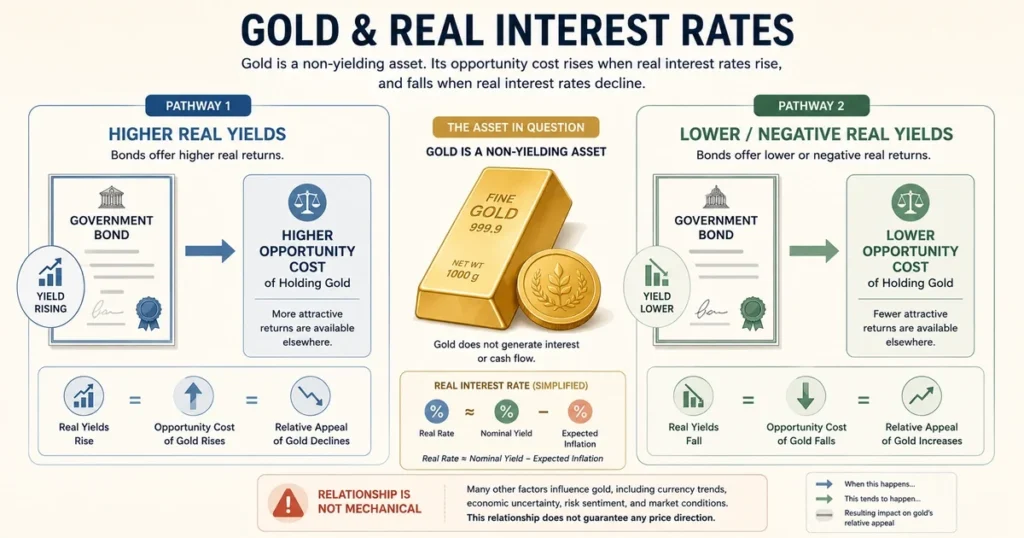
Gold prices are influenced by a combination of real interest rates, opportunity costs, the US dollar, investment demand, central-bank activity, inflation expectations, geopolitical risk, and broader supply-and-demand conditions. Lower real yields can reduce the opportunity cost of holding a non-yielding asset, but the relationship is not mechanical and gold can move for several reasons at once.
To analyze why gold prices fluctuate across multi-year cycles, institutional analysts track four interrelated macroeconomic variables:
1. Real Interest Rates (The Opportunity Cost Mechanism)
Because physical gold does not generate a coupon or dividend yield, holding gold carries an opportunity cost—the yield an investor foregoes by not holding cash or sovereign bonds.
A commonly used approximation for the expected real interest rate is:
$$\text{Real Interest Rate} = \text{Nominal Government Bond Yield} – \text{Expected Inflation Rate}$$
- Rising Real Yields: Higher real yields can increase the opportunity cost of holding non-yielding gold and may weigh on investment demand, although other market forces can offset this effect.
- Falling / Negative Real Yields: Lower or negative real yields can reduce the opportunity cost of holding gold and may support investment demand, but they do not guarantee rising gold prices.
2. Central Bank Reserve Accumulation
Central banks have increased their attention to gold in recent years, with purchases varying substantially by country and year. Gold can diversify official reserves, has deep global markets, and is not a liability of another sovereign issuer. However, gold is not immune to every legal, custody, market, or geopolitical risk, and holding gold does not by itself guarantee sovereign solvency.
To examine how sovereign monetary policy and interest rates alter global market dynamics, read our deep-dive on interest rates and exchange rates.
Central Bank Gold Reserves: Why Official Institutions Hold Gold
Central banks hold gold for reserve diversification, liquidity, historical monetary importance, and its status as an asset that is not another sovereign’s debt claim. The World Gold Council’s 2026 survey found that central banks had accumulated an average of about 1,000 tonnes per year over the preceding four years, roughly double the average of the prior decade.
Reported holdings vary by country and update schedule. For example, the World Gold Council reported China’s official holdings at about 2,331 tonnes in its June 2026 statistics, or roughly 9% of total official reserves at that point. India-focused WGC data showed the Reserve Bank of India’s gold holdings at about 880 tonnes at the end of June 2026, with gold representing roughly 16% of total reserves at that point.
| Example Holder | Approximate Reported Gold Holding | Why It Matters |
|---|---|---|
| United States | Largest official gold holding | Long-established strategic reserve asset |
| Germany | More than 3,000 tonnes | Major European official reserve holding |
| Italy | About 2,400 tonnes | High gold share of official reserves |
| China | ~2,331 tonnes | Continued reported accumulation in 2026 |
| India | ~880 tonnes | Gold’s share of reserves has risen with valuation |
These figures are reported official holdings as of the stated reporting dates, not estimates of every possible private or unreported transaction. The World Gold Council notes that its monthly country statistics are based on publicly reported changes, while its broader demand estimates can include estimates of unreported buying.
For a detailed country-by-country breakdown, readers can continue with the site’s dedicated Gold Reserve Explained guide.
Implementation Vehicles: Physical Gold, ETFs, Futures, Digital Gold, and Mining Shares
Gold exposure can be obtained through several structures, and they should not be treated as interchangeable.
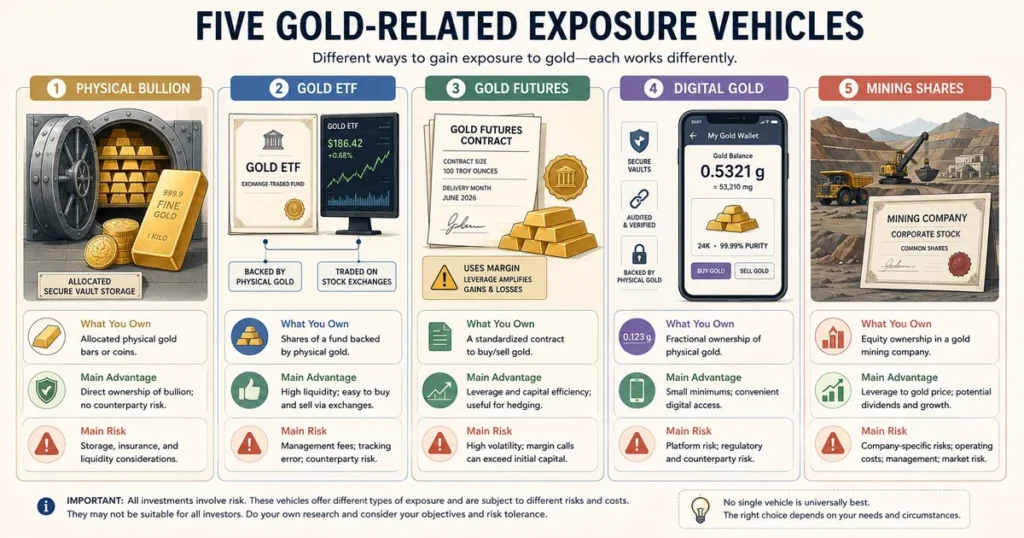
| Vehicle | What You Own or Control | Main Advantages | Main Risks |
|---|---|---|---|
| Physical bullion | Coins or allocated bars | Direct metal ownership | Storage, insurance, spreads, authenticity |
| Gold ETF | Fund shares providing gold exposure | Exchange liquidity and convenience | Fees, tracking difference, fund structure |
| Futures | Standardized derivative contract | Efficient trading and hedging | Leverage, margin, rollover and settlement risk |
| Digital gold | Platform-based gold exposure | Fractional access and convenience | Platform, custody, and regulatory structure |
| Mining shares | Equity in mining companies | Potential operating leverage and dividends | Company, cost, jurisdiction, and equity-market risk |
For the mechanics of exchange-traded gold exposure, see the site’s Gold ETF guide. For fractional platform structures, see Digital Gold Explained. Investors interested in leveraged derivatives should read the Gold Futures guide before treating futures as an alternative to physical bullion.
The choice depends on the intended role. Physical bullion emphasizes direct ownership; ETFs emphasize market access; futures emphasize trading and hedging; digital products emphasize convenience; and mining shares add business risk on top of the gold-price exposure.
Gold vs. Other Asset Classes: Equities, Real Estate, and Bitcoin
Gold, stocks, real estate, and Bitcoin have different economic drivers.
| Asset | Main Economic Driver | Typical Role | Key Risks |
|---|---|---|---|
| Gold | Supply/demand, rates, currencies, investment demand | Diversification / reserve asset | Price volatility, no cash flow |
| Equities | Business earnings and valuations | Long-term growth | Business and market risk |
| Real estate | Rental income, property values, financing | Income / real assets | Illiquidity, leverage, local-market risk |
| Bitcoin | Digital-asset demand and network adoption | Speculative / alternative exposure | High volatility, regulatory and technology risks |
US spot Bitcoin exchange-traded products were approved for listing and trading in January 2024, giving investors a regulated exchange-traded route to bitcoin exposure. The SEC explicitly stated that the approval did not constitute an endorsement of bitcoin and highlighted its risks.
That development makes the comparison with gold more useful, not less. Both can be scarce assets outside conventional corporate cash-flow models, but gold has a much longer history as a physical monetary and reserve asset, while Bitcoin is a comparatively new digital network asset. Investors should compare their volatility, liquidity, custody, regulation, tax treatment, and intended portfolio role rather than assuming one is a direct substitute for the other.
Downside Risks, Opportunity Costs, and Common Misconceptions
Quick Answer: Risks of Owning Gold
The primary risk of owning gold is its opportunity cost—it produces no cash flows, interest, or dividends. During extended periods of strong economic growth and attractive real yields, gold can underperform equities and yield-bearing assets for years. Additionally, gold is subject to significant multi-year price volatility, carrying storage and insurance costs for physical bullion, and potential tracking errors in financial instruments.
Disciplined financial analysis requires dispelling common emotional myths surrounding gold:
1. The Myth: “Gold Is a Fast-Paced Get-Rich-Quick Investment”
Gold is not a guaranteed wealth-acceleration asset. Because it does not generate operating cash flow, its long-term return depends primarily on changes in its market price. Productive companies can compound value through earnings and reinvestment, although equity returns also vary considerably across periods.
2. The Opportunity Cost Drag in High Real-Rate Regimes
From the early 1980s through the late 1990s, gold experienced a prolonged period of weak or declining nominal prices while US equities delivered strong returns. The precise magnitude depends on the start and end dates and whether prices are adjusted for inflation, dividends, or currency effects. The episode illustrates the opportunity cost of holding a non-yielding asset during a long equity expansion.
3. Physical Storage, Premiums, and Liquidity Friction
Buying physical bullion involves paying dealer markups (premiums) over the spot price of gold upon purchase, and accepting a slight discount when selling back to dealers. Secure storage, insurance, and custody can create ongoing carrying costs for physical gold, while dealer spreads and taxes can also reduce realized returns. The total cost depends on the ownership method, product structure, and jurisdiction.
How Gold’s Value Is Formed in Modern Markets
Gold does not have a single mechanism that determines its value. Its market price emerges from the interaction of physical supply, recycling, jewelry demand, industrial use, investment demand, central-bank activity, futures and derivatives markets, currency movements, interest rates, and investor expectations.
This distinction matters because scarcity alone does not determine price. Gold can remain scarce while its market price falls if demand weakens. Conversely, stronger investment demand can lift prices even when mine production changes only gradually. Gold therefore combines a relatively slow-moving physical supply base with financial markets in which expectations can change quickly.
Physical Supply
Newly mined gold enters the market gradually because developing mines requires exploration, permitting, construction, financing, and years of production. Existing gold can also return to the market through recycling. Unlike a perishable commodity, much of the gold ever mined remains potentially recoverable because the metal itself is not consumed in the same way as fuel.
Investment Demand
Investment demand can come from physical bars and coins, exchange-traded products, futures, options, and other financial instruments. Investors may buy gold because they expect prices to rise, want diversification, or want an asset that is not directly tied to the earnings of a corporation or the debt of a particular sovereign issuer.
Central-Bank Demand
Central banks may hold gold as part of official reserves. Gold can diversify reserves that otherwise consist largely of foreign-currency assets and government securities. The strategic reasons differ by country, so central-bank purchases should be interpreted as one part of the global demand picture rather than as a guaranteed signal about future prices.
Physical Gold: What Ownership Actually Means
Owning physical gold is different from owning a financial claim whose value is linked to gold. A coin or allocated bar represents direct ownership of a specified quantity of metal, subject to the legal and custody arrangements governing that ownership.
Direct ownership can reduce issuer credit exposure, but it creates other practical responsibilities. Buyers may pay a premium above the spot price, and sellers may receive less than spot after dealer spreads or transaction costs. Storage can involve a safe, bank facility, professional vault, or other custody arrangement. Insurance, verification, transportation, and taxes can also affect the net return.
The distinction between allocated and unallocated gold is especially important. Allocated gold is generally associated with specifically identified bars or ownership interests in identified bullion, while unallocated arrangements generally represent a contractual claim against an institution rather than direct title to specific bars. The exact legal structure varies by provider and jurisdiction, so investors should read product documentation rather than relying on labels alone.
Gold, Inflation, and Purchasing Power
Gold is frequently described as an inflation hedge, but the term needs qualification. Inflation is a sustained increase in the general price level, while the price of gold is determined in financial markets. Gold can rise during inflationary periods, but it can also fall or remain weak if other forces—such as higher real interest rates or a stronger currency—dominate.
For long-term purchasing-power analysis, investors should distinguish between nominal gold returns and real returns. A gold price that doubles may sound impressive, but the relevant question is how much the general cost of goods and services changed during the same period, as well as what transaction, storage, tax, and currency costs were incurred.
Frequently Asked Questions About Gold
What is gold in simple terms?
Gold is a naturally occurring precious metal with high durability, density, malleability, recognizability, and relative scarcity. It is used in jewelry, technology, investment products, and official reserves.
Does physical gold pay interest or dividends?
No. Physical gold does not generate interest, dividends, or operating cash flow. An investor’s return generally depends on changes in the gold price after costs and taxes.
Is gold a guaranteed hedge against inflation?
No. Gold can respond positively to inflation concerns, but its price is also affected by real interest rates, the US dollar, investment demand, central-bank purchases, and market positioning. It can fall during inflationary periods.
What is the difference between 24K, 22K, and 18K gold?
24K generally denotes very high-purity gold. 22K contains about 91.6% gold and 18K contains about 75%, with the balance made up of alloy metals. Jewelry commonly uses lower-karat alloys because they are harder and more durable.
What is BIS Hallmarking in India?
BIS hallmarking is India’s system for assaying and marking the purity of specified precious-metal articles. Buyers should check the applicable BIS hallmark and purity details rather than relying only on a seller’s verbal description.
What are gold jewellery making charges?
Making charges cover manufacturing or craftsmanship associated with jewelry. They are separate from the underlying value of the gold and vary by design, jeweller, workmanship, and market. Compare the total invoice rather than judging value only from the quoted gold rate.
What is better in India: Sovereign Gold Bonds, Gold ETFs, or physical gold?
There is no universal best choice. Physical gold provides direct ownership but involves storage and transaction considerations. Gold ETFs provide exchange-traded exposure with fund-level fees and tracking considerations. Sovereign Gold Bonds are government securities with their own maturity, interest, liquidity, taxation, and issuance rules; availability and tax treatment can change. Compare current official terms before investing.
Why do central banks hold gold?
Central banks use gold as one component of reserve management. It can diversify foreign-exchange reserves and is not another sovereign’s debt claim. The World Gold Council’s 2026 survey shows that central-bank interest in gold remains elevated.
Strategic Summary & Practical Takeaways
Understanding what gold is provides essential clarity regarding the nature of money, sovereign credit, and capital preservation.
Gold remains an important non-sovereign monetary and investment asset. Its durability, scarcity, density, and high stock-to-flow characteristics help explain its historical monetary role. However, gold is not literally imperishable or unforgeable, and its market value can fluctuate substantially.
Disciplined investing requires treating gold as one component of a broader portfolio rather than as a guaranteed insurance policy. Its lack of cash flow creates an opportunity cost, while its diversification characteristics may be useful in some environments. Any allocation should reflect the investor’s objectives, risk tolerance, time horizon, costs, and tax circumstances.
Next Reading: Continue Your Gold Research
- Gold Investment Guide — compare ownership structures, costs, and portfolio considerations.
- What Is a Gold ETF? — understand exchange-traded gold exposure.
- Digital Gold Explained — examine fractional and platform-based gold ownership.
- Gold Futures Explained — learn how futures contracts, margin, and leverage work.
- Gold Trading Guide — explore trading mechanics and risk management.
- Gold category — browse the site’s broader gold research.
Author Box & Editorial Review
Written By: CurrencyPlans Financial Research Team
Fact-Checked & Reviewed By: Commodities Research Team & Editorial Board
Editorial Standard: Educational material is based on established monetary and commodity-market concepts and publicly available institutional data.
Primary Institutional References & Regulatory Resources
For official monetary research, central bank reserve data, and precious metal statistics, consult primary institutional sources directly:
- Global Gold Market Statistics & Central Bank Reserve Data: World Gold Council (WGC)
- International Financial Stability & Sovereign Reserve Research: Bank for International Settlements (BIS)
- Global Macroeconomic Statistics & International Reserves: International Monetary Fund (IMF) Data Portal
- Commodity Futures Trading & Market Conduct Guidelines: Commodity Futures Trading Commission (CFTC)
- Investor Education & Precious Metals Guidance: US Securities and Exchange Commission (SEC) – Investor.gov
Educational Financial Disclaimer
This article is for educational and informational purposes only. It is not financial, tax, legal, or investment advice and does not recommend buying or selling gold or any other asset. Gold prices can be volatile, and physical, fund, derivative, digital, and mining investments carry different risks. Tax rules, product availability, and regulatory requirements vary by jurisdiction and can change over time.

