
Executive Summary & Core Thesis
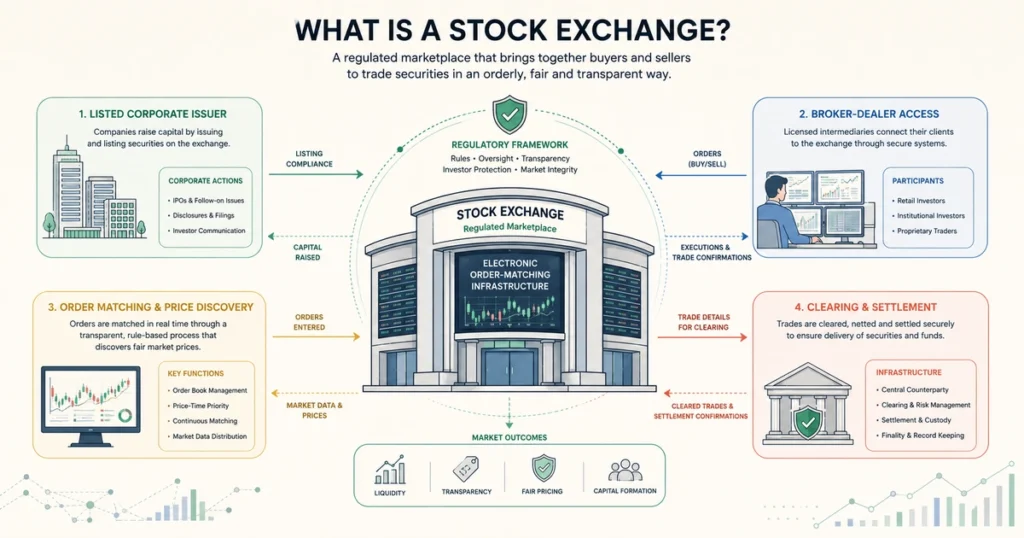
A stock exchange is a regulated marketplace and trading institution that provides the infrastructure and rules for listing and trading securities, including publicly traded equities and, depending on the venue, other financial instruments. Functioning as a critical component of modern capital markets, a stock exchange provides the physical or electronic infrastructure designed to support transparent price discovery, liquidity, and orderly trade execution.
While commonly conflated with the broader concept of the stock market, an exchange is a specific organizational venue that establishes formal listing standards, operates electronic order-matching systems, and coordinates with post-trade clearing and settlement infrastructure. By providing a standardized venue for publicly traded securities, stock exchanges help companies access public capital markets while giving investors an organized mechanism for buying and selling securities under applicable regulatory and market rules.
The Foundational Definition: What Is a Stock Exchange?
In financial economics and securities law, a stock exchange is an organized, regulated marketplace that provides the infrastructure and rules for listing and trading standardized corporate equity securities.
An exchange creates a rules-based trading environment where buyers and sellers can transact with confidence that market operations adhere to established regulatory frameworks. Before an enterprise can list its equity on an exchange, it must satisfy strict admission hurdles, publish comprehensive financial prospectuses, and agree to recurring disclosure standards. Once admitted, the company’s equity—divided into standardized units of fractional ownership as explored in our guide on what stocks are—becomes tradeable among institutional and retail market participants.
| Structural Feature | Traditional Open-Outcry Exchange (Historical) | Modern Electronic Exchange (Current Standard) |
| Execution Medium | Physical trading pits, hand signals, acoustic shouting | High-speed algorithmic matching engines in data centers |
| Order Transmission | Pneumatic tubes, runners, floor brokers | Dedicated fiber-optic networks, standardized messaging gateways |
| Market Data | Chalkboard price displays, delayed ticker tapes | Sub-millisecond Level 2 and Level 3 real-time data feeds |
| Share Custody | Physical paper share certificates stored in vaults | Dematerialized electronic book-entry ledgers |
| Corporate Model | Member-owned mutual non-profit associations | Demutualized, publicly traded for-profit corporations |
Over recent decades, many major global exchanges underwent demutualization, transitioning from private clubs owned by member brokers into competitive, publicly traded corporations (such as Nasdaq Inc., Intercontinental Exchange, London Stock Exchange Group, and Deutsche Börse).
Why Stock Exchanges Exist: The Capital Allocation Engine
Without organized stock exchanges, modern industrial economies could not efficiently mobilize large-scale capital. Operating businesses require funding to construct factories, develop advanced software, conduct clinical drug trials, and expand infrastructure.
An exchange addresses two fundamental economic challenges:
1. The Liquidity Constraint for Capital Allocators
If an investor buys an equity stake in a private manufacturing business, that capital is relatively illiquid. If the investor needs cash several years later, finding a buyer requires private negotiations, legal due diligence, and substantial transaction friction. A stock exchange can substantially reduce this liquidity constraint by providing an organized venue where ownership shares can be converted back into cash rapidly at transparent, market-determined prices.
2. The Information Asymmetry and Trust Barrier
Investing capital into an enterprise managed by third-party executives introduces principal-agent dynamics. Investors therefore require reliable information about financial performance, corporate obligations, risk exposures, and governance. Stock exchanges address these information and governance risks through listing requirements, disclosure standards, corporate-governance rules, and coordination with applicable regulatory oversight. These requirements help establish the transparency and market standards necessary for securities to remain eligible for trading on the venue.
| Core Economic Objective | Operational Mechanism on the Exchange | Macroeconomic Benefit |
| Capital Formation | Initial Public Offerings (IPOs) and rights issues | Channels investment into productive enterprises |
| Continuous Liquidity | Central Limit Order Books and market makers | Reduces investment liquidity risk |
| Price Discovery | Real-time continuous double auctions | Establishes transparent market prices |
| Investor Protection | Exchange surveillance and listing enforcement | Supports public trust in financial markets |
Stock Exchange vs. Stock Market: Structural and Legal Distinctions
Quick Answer: Exchange vs. Market
- The Stock Market: The overarching economic ecosystem encompassing all investors, issuers, brokerages, clearing houses, and regulations within an economy.
- A Stock Exchange: A specific regulated marketplace or exchange operator (e.g., NYSE, Nasdaq, LSE, Tokyo Stock Exchange) that operates a physical or electronic trading venue where listed securities are matched.
In casual discourse, the terms stock exchange and stock market are often treated as synonyms, but they occupy different structural levels in financial market architecture:
                      ┌─────────────────────────────────────────┐
                      │          THE STOCK MARKET ECOSYSTEM     │
                      │  (Aggregate macroeconomic network of    │
                      │   capital allocation, laws, & liquidity)│
                      └────────────────────┬────────────────────┘
                                           │
         ┌─────────────────────────────────┼─────────────────────────────────┐
         │                                 │                                 │
         ▼                                 ▼                                 ▼
┌──────────────────┐             ┌──────────────────┐             ┌──────────────────┐
│  STOCK EXCHANGE  │             │  STOCK EXCHANGE  │             │ ALTERNATIVE POOLS│
│  (e.g., NYSE)    │             │  (e.g., NASDAQ)  │             │ (ATSs / MTFs)    │
├──────────────────┤             ├──────────────────┤             ├──────────────────┤
│ Specific licensed│             │ Specific licensed│             │ Off-exchange     │
│ auction venue    │             │ electronic venue │             │ execution venues │
└──────────────────┘             └──────────────────┘             └──────────────────┘
For a comprehensive evaluation of the total market ecosystem, refer to our detailed manual on what the stock market is.
| Comparative Dimension | The Stock Market | A Stock Exchange |
| Fundamental Scope | The entire asset class and economic mechanism | A specific registered marketplace institution |
| Legal Status | Abstract economic concept | Distinct corporate entity with statutory license |
| Institutional Governance | Regulated by sovereign statutes (SEC, FCA, SEBI) | Governed by internal corporate boards and rulebooks |
| Primary Components | Exchanges, ATSs, clearing houses, brokers, banks | Order matching engines, listing boards, data feeds |
| Practical Example | “The European Equity Market” | London Stock Exchange (LSE) or Euronext |
Exchange vs. Broker vs. Clearing House: The Three Pillars of Trade Execution
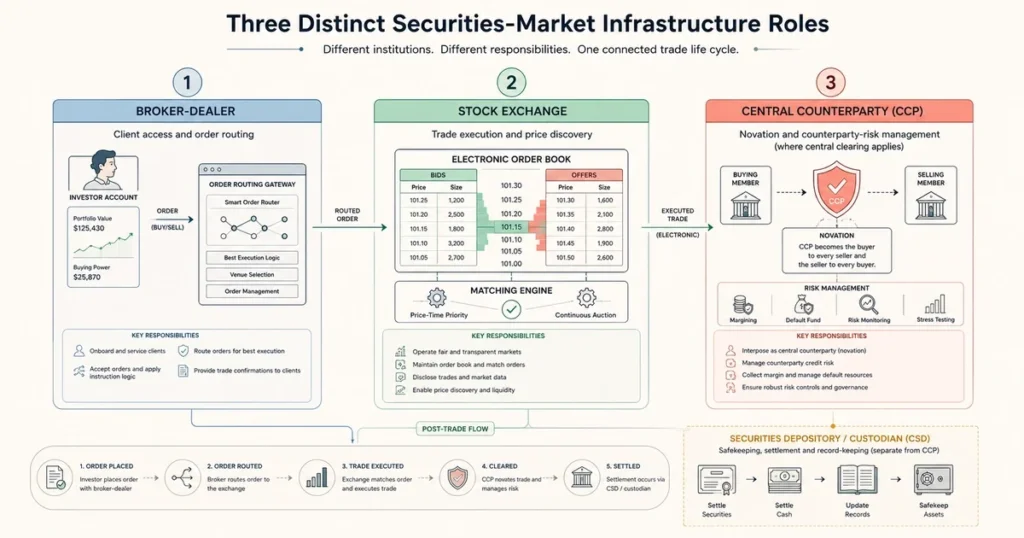
Every equity transaction depends on three distinct institutional entities working in coordination:
| Entity Type | Primary Operational Role | Customer Interface | Regulatory Mandate |
| 1. Broker-Dealer | Provides client account access, verifies margin, and routes orders | Direct interface for retail and institutional investors | Client suitability, anti-money laundering, best execution |
| 2. Stock Exchange | Operates the applicable trading and order-matching system | Direct interface for licensed member brokers and market makers | Fair and orderly matching, market surveillance, transparent pricing |
| 3. Clearing House (CCP) | Novates executed trades and manages financial settlement risk | Interface for clearing member banks and brokerages | Risk management, default guarantee funds, multilateral netting |
[Retail/Institutional Investor]
              │
              ▼ (Places Order via App/Terminal)
     [Broker-Dealer Router]
              │
              ▼ (Routes Order via Member Gateway)
       [Stock Exchange] ─── (Matches Buy and Sell Orders)
              │
              ▼ (Dispatches Execution Details)
   [Clearing House (CCP)] ─── (Manages Settlement & Coordinates Ownership Transfer)
Primary vs. Secondary Market Functions on an Exchange
A stock exchange supports both the initial listing of financial capital and the ongoing trading of existing shares:
1. The Primary Market Listing Framework
In primary market transactions, corporations may issue securities to raise capital through an Initial Public Offering (IPO) or a subsequent follow-on offering. The exchange provides the listing framework and trading infrastructure needed for the security to begin public trading, while the issuance itself is governed by applicable securities laws and offering procedures. The cash proceeds from newly issued securities flow to the corporate issuer and may be used to finance expansion, research and development, acquisitions, debt reduction, or other corporate purposes.
2. The Secondary Market Liquidity Engine
Once primary shares are distributed, they begin trading on the secondary market. Here, investors buy and sell existing shares among themselves. The issuing company is not a party to secondary trades and receives no direct capital from these transactions. Instead, the exchange provides continuous liquidity and transparent valuation metrics, which are critical for capital allocation.
Listing Requirements and Corporate Disclosure Standards
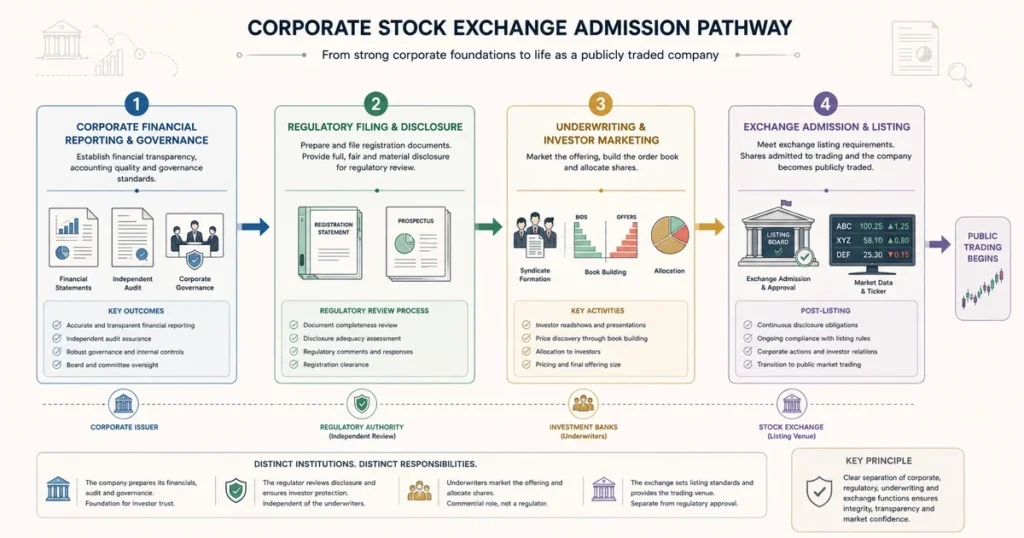
An exchange maintains quantitative and qualitative listing standards before admitting a company to its official board:
                      ┌─────────────────────────────────────────┐
                      │   CORPORATE FINANCIAL REPORTING &       │
                      │              GOVERNANCE                  │
                      │ (GAAP/IFRS financial statements,         │
                      │  independent audits, board governance,  │
                      │  and corporate structure)                │
                      └────────────────────┬────────────────────┘
                                           │
                                           ▼
                      ┌─────────────────────────────────────────┐
                      │      REGULATORY FILING & DISCLOSURE      │
                      │ (Registration documents, prospectus,    │
                      │  statutory disclosures, regulatory      │
                      │  review where applicable)                │
                      └────────────────────┬────────────────────┘
                                           │
                                           ▼
                      ┌─────────────────────────────────────────┐
                      │    UNDERWRITING & INVESTOR MARKETING     │
                      │ (Investment-bank syndicate, book-        │
                      │  building, pricing, and allocation)     │
                      └────────────────────┬────────────────────┘
                                           │
                                           ▼
                      ┌─────────────────────────────────────────┐
                      │        EXCHANGE ADMISSION & LISTING      │
                      │ (Listing approval, ticker assignment,   │
                      │  and commencement of public trading)    │
                      └─────────────────────────────────────────┘
Quantitative and Qualitative Admission Criteria
Exchanges apply specific financial, market-value, public-float, shareholder-distribution, and governance requirements that vary by listing tier and security type:
- Financial Hurdles: Quantitative standards regarding operating revenue history, aggregate pre-tax earnings, cash flow continuity, or total market capitalization.
- Liquidity and Float Standards: Requirements for minimum publicly held shares (public float) and minimum counts of round-lot shareholders to support trading liquidity.
- Corporate Governance Criteria: Mandatory requirements for independent board directors, established audit committees, and compliance with national governance codes.
- Continuous Material Disclosure: Statutory obligations to immediately report material corporate developments (such as quarterly earnings reports, mergers, or senior leadership changes) via standardized regulatory feeds.
Alternative Listing Pathways: Direct Listings and Mergers
While the traditional IPO remains common, companies may become publicly listed through routes such as an IPO, direct listing, or certain business combinations (such as merging with a Special Purpose Acquisition Company), subject to applicable securities laws and exchange listing requirements.
How Orders Enter an Exchange: Connectivity and Routing
When an investor submits an order through a brokerage platform, that instruction follows a structured technical pipeline:
                      ┌─────────────────────────────────────────┐
                      │             RETAIL INVESTOR             │
                      │    (Enters Market Buy Order on Phone)   │
                      └────────────────────┬────────────────────┘
                                           │
                                  (Encrypted API Call)
                                           ▼
                      ┌─────────────────────────────────────────┐
                      │         BROKER ORDER ROUTER             │
                      │  (Checks margin, performs risk checks,  │
                      │   applies Smart Order Routing - SOR)    │
                      └────────────────────┬────────────────────┘
                                           │
                               (Financial Messaging Protocol - FIX)
                                           ▼
                      ┌─────────────────────────────────────────┐
                      │        EXCHANGE MEMBER GATEWAY          │
                      │  (Validates session, parses order, and  │
                      │   assigns matching sequence timestamp)  │
                      └────────────────────┬────────────────────┘
                                           │
                                           ▼
                      ┌─────────────────────────────────────────┐
                      │       CENTRAL MATCHING ENGINE           │
                      │   (Evaluates Order Book Priority Queues)│
                      └────────────────────┘
- Broker Pre-Trade Risk Checks: The broker verifies client margin availability, account permissions, and risk parameters.
- Smart Order Routing (SOR): If a security trades across multiple execution venues, the broker’s algorithmic router identifies execution paths designed to achieve best execution.
- Standardized Messaging Protocols: Orders may be transmitted using standardized financial messaging protocols such as FIX, alongside venue-specific connectivity and network infrastructure.
- Gateway Ingestion: The exchange gateway records the order’s arrival and assigns the venue’s applicable sequencing or timestamp information for matching purposes.
Order Matching Microstructure: Price-Time Priority and Continuous Auctions
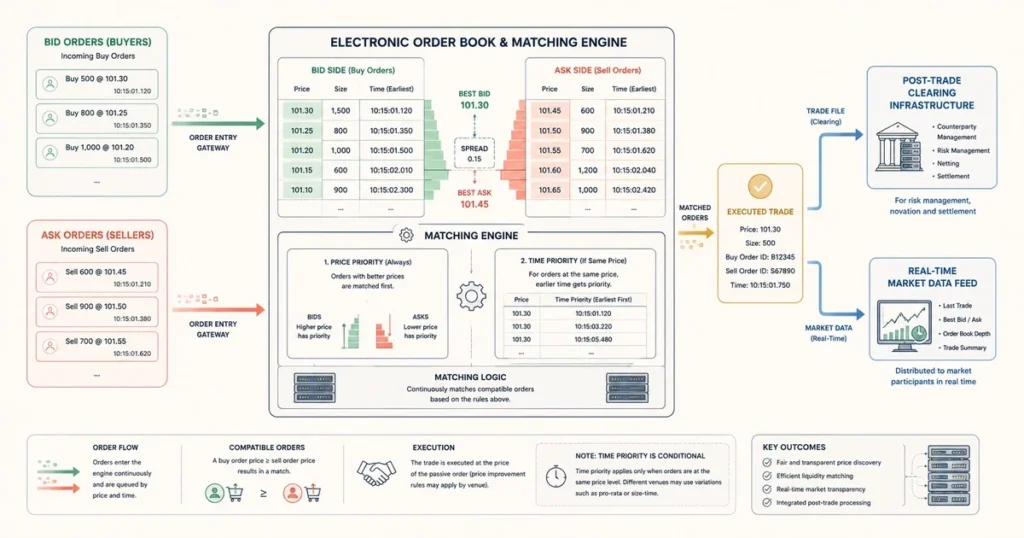
Many electronic exchanges use defined matching algorithms, often incorporating price priority and time priority within an electronic Central Limit Order Book (CLOB):
                      ┌─────────────────────────────────────────┐
                      │       ELECTRONIC ORDER BOOK (CLOB)      │
                      └────────────────────┬────────────────────┘
                                           │
         ┌─────────────────────────────────┴─────────────────────────────────┐
         │                                                                   │
         ▼                                                                   ▼
┌──────────────────┐               ┌──────────────────────────────────┐
│         THE BID QUEUE            │               │         THE ASK QUEUE            │
│  (Buyers waiting in price order) │               │  (Sellers waiting in price order)│
├──────────────────┤               ├──────────────────────────────────┤
│ 200 shares @ $149.98             │               │ 300 shares @ $150.02             │
│ 600 shares @ $149.95             │               │ 500 shares @ $150.05             │
│ 1,500 shares @ $149.90           │               │ 1,000 shares @ $150.10           │
└──────────────────┘               └──────────────────────────────────┘
                                   │               │
                                   └───────┬───────┘
                                           │
                                    [BID-ASK SPREAD]
                                   ($150.02 - $149.98 = $0.04)
To examine how these order book mechanics govern market valuations, see our detailed technical breakdown on how stock prices are determined.
Common Matching Rules:
- Price Priority: Orders offering the most competitive prices are executed first. The highest Bid (buyer willing to pay the most) and the lowest Ask (seller willing to accept the least) sit at the front of the execution queue.
- Time Priority (FIFO): Where price-time priority applies, earlier orders at the same price generally receive execution priority over later arrivals.
- Execution & Data Broadcast: When an incoming order matches resting liquidity, the engine records the execution, transmits trade data to clearing infrastructure, and broadcasts the trade across public data feeds.
Market Participants Operating on the Exchange Floor and Servers
A modern stock exchange functions through a diverse ecosystem of market participants fulfilling complementary market roles:
| Participant Category | Structural Role on the Exchange | Capital Source / Mandate |
| Designated Market Makers (DMMs) | Provide two-sided Bid/Ask quotes subject to applicable exchange rules | Corporate or proprietary capital; compensation may include spreads, liquidity incentives, or other exchange arrangements |
| Quantitative Trading Firms (HFT) | Use automated strategies for market making, liquidity provision, arbitrage, and other short-horizon trading | Proprietary quantitative capital utilizing specialized connectivity |
| Institutional Asset Managers | Deploy large-scale orders for portfolio management and long-term investment mandates | Pension funds, mutual funds, sovereign wealth funds, and endowments |
| Retail Investors | Allocate personal savings and trade publicly listed securities | Personal capital typically channeled through retail broker-dealers |
| Corporate Treasuries | Execute authorized share repurchases and other corporate treasury transactions | Corporate cash reserves managed under applicable legal and regulatory requirements |
Trading Sessions: Opening Auctions, Continuous Trading, and Closing Crosses
Trading on major stock exchanges is commonly structured into distinct operating phases throughout the trading day:
+-------------------------------------------------------------------------------+
|                       DAILY EXCHANGE TRADING PHASES                           |
+----------------------+-----------------------------+--------------------------+
| TRADING PHASE        | TIMING (TYPICAL)            | PRIMARY OPERATIONAL FLOW |
+----------------------+-----------------------------+--------------------------+
| Pre-Market Session   | Before Regular Trading     | Order entry, indicative  |
|                      | Session                    | pricing, and order       |
|                      |                             | collection where offered |
+----------------------+-----------------------------+--------------------------+
| Opening Auction      | At Market Open             | Single-price auction     |
|                      |                             | using the venue's defined|
|                      |                             | auction algorithm        |
+----------------------+-----------------------------+--------------------------+
| Continuous Trading   | Regular Trading Hours      | Real-time order matching |
|                      |                             | under the venue's defined|
|                      |                             | priority rules           |
+----------------------+-----------------------------+--------------------------+
| Closing Auction      | At Market Close            | Auction-based matching   |
| (Closing Cross)      |                             | using the venue's defined|
|                      |                             | closing algorithm and    |
|                      |                             | establishing a closing   |
|                      |                             | reference price          |
+----------------------+-----------------------------+--------------------------+
| After-Hours Session  | After Regular Trading     | Electronic trading or    |
|                      | Session                    | order handling where     |
|                      |                             | offered by the venue     |
+----------------------+-----------------------------+--------------------------+
The Role of the Closing Auction
The closing auction (or closing cross) is one of the most liquidity-dense events of the trading day. Instead of executing trades continuously, the matching engine accumulates eligible orders over the final minutes of the session and runs an algorithm that determines the single price that maximizes executable volume. The resulting official closing price can serve as an important reference for portfolio valuation, fund accounting, index calculations, and benchmark-related activity, depending on the market and methodology.
Clearing, Settlement, and Custodial Transfer Mechanisms
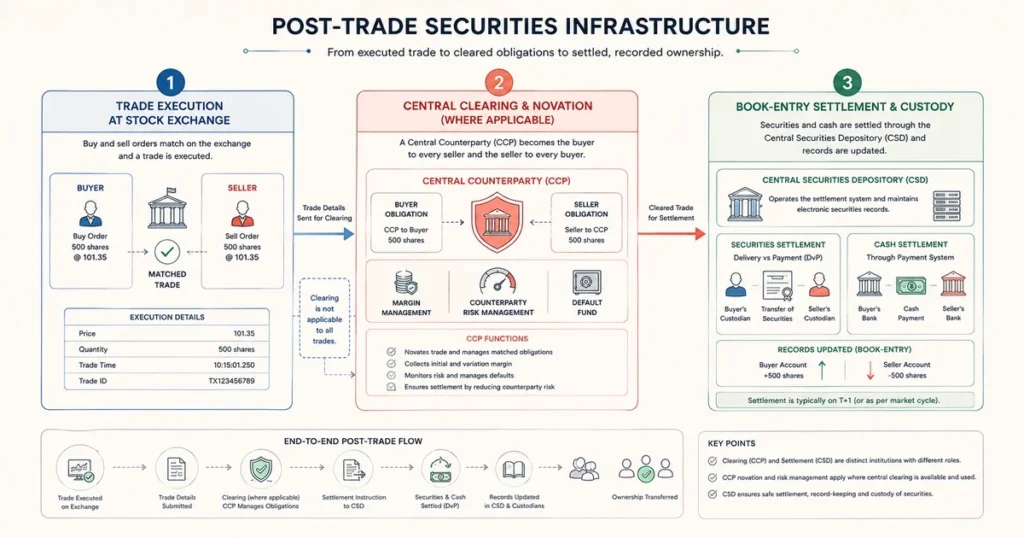
Trade matching on the exchange represents the initial execution agreement. Completing the financial transfer requires a coordinated post-trade settlement architecture:
                      ┌─────────────────────────────────────────┐
                      │    STEP 1: TRADE MATCHING AT EXCHANGE   │
                      │ (Buyer and Seller agreed on price/volume│
                      └────────────────────┬────────────────────┘
                                           │
                                           ▼
                      ┌─────────────────────────────────────────┐
                      │     STEP 2: NOVATION AT CLEARING HOUSE  │
                      │  (Central Counterparty CCP becomes buyer│
                      │   to every seller & seller to every buy)│
                      └────────────────────┬────────────────────┘
                                           │
                                           ▼
                      ┌─────────────────────────────────────────┐
                      │ STEP 3: DEMATERIALIZED SETTLEMENT (CSD) │
                      │  (Securities and cash transfer through  │
                      │   custodians & depository accounts)     │
                      └─────────────────────────────────────────┘
*> Note: Simplified illustration; actual clearing, settlement, and custodial mechanisms vary by jurisdiction, asset class, and regulatory framework.
1. Central Counterparty Novation
For trades subject to central clearing, the matched transaction is submitted to the applicable Central Counterparty Clearing House (CCP). Through novation, the CCP legally replaces the original bilateral trade contract, becoming the buyer to every seller and the seller to every buyer. This structure centralizes and manages counterparty risk through margining, multilateral netting, default-management resources, and formal clearing rules.
2. Dematerialized Book-Entry Settlement
Physical share certificates have been largely replaced by electronic records. Settlement ultimately updates the relevant electronic book-entry records so that the securities and cash obligations are transferred through the applicable CSD, custodian, and intermediary structure.
3. Settlement Cycles
Settlement cycles vary by jurisdiction and security. In the United States, most applicable broker-dealer securities transactions have operated on a T+1 standard settlement cycle since May 28, 2024; settlement cycles vary by jurisdiction and security globally.
Technology Architecture: From Floor Pits to High-Frequency Colocation
The physical reality of modern stock exchanges has migrated from historic trading floors to massive, climate-controlled enterprise data centers:
                      ┌─────────────────────────────────────────┐
                      │        EXCHANGE CENTRAL MATCHING SERVER │
                      └────────────────────┬────────────────────┘
                                           │
         ┌─────────────────────────────────┴─────────────────────────────────┐
         │                                                                   │
         ▼                                                                   ▼
┌──────────────────┐               ┌──────────────────────────────────┐
│     COLOCATED HFT SERVERS        │               │      REMOTE BROKER SERVERS       │
│  (Direct fiber within data room; │               │  (Transmitted over city networks;│
│   low-latency connectivity)     │               │   standard network latency)      │
└──────────────────┘               └──────────────────────────────────┘
Infrastructure Optimization
- Colocation Facilities: Financial institutions pay subscription fees to place their algorithmic trading servers within the exchange data center, reducing network latency and improving the speed and predictability of order transmission.
- High-Speed Network Links: Optimized optical and wireless network routes connect major financial centers, enabling rapid communication across geographically separated venues.
How Stock Exchanges Make Money: The For-Profit Business Model
Modern demutualized stock exchanges operate as commercial enterprises with diversified corporate revenue streams:
| Revenue Channel | Operational Source | Commercial Description |
| Transaction & Trading Fees | Order execution and trading activity | Transaction-based fees, execution charges, and other trading-related fees where applicable |
| Corporate Listing Fees | Initial public offerings and ongoing listings | Initial and recurring listing fees charged according to the exchange’s applicable fee schedule |
| Market Data Services | Real-time and historical market-data distribution | Licensing market data, including order-book and trade information, to data vendors and financial institutions |
| Connectivity & Colocation | Data-center infrastructure and network connectivity | Fees for colocation space, connectivity services, network ports, and related infrastructure where offered |
| Index Licensing | Proprietary index construction and benchmark products | Licensing index products, benchmark data, and related intellectual property to asset managers and other financial users |
| Technology Services | Trading, connectivity, surveillance, and market-technology infrastructure | Fees for technology platforms, software, infrastructure, connectivity, or related services where offered |
Major Global Stock Exchanges and Regional Networks
Global public wealth is organized across major continental exchanges operating in an interconnected sequence of equity-market trading sessions across global time zones:
| Stock Exchange | Headquarters | Base Currency | Associated Major Benchmark(s) |
| New York Stock Exchange (NYSE) | New York City, USA | USD ($) | Dow Jones Industrial Average / S&P 500 |
| NASDAQ | New York City, USA | USD ($) | Nasdaq-100 / Nasdaq Composite |
| London Stock Exchange (LSE) | London, United Kingdom | GBP (£) | FTSE 100 |
| Tokyo Stock Exchange (TSE) | Tokyo, Japan | JPY (¥) | Nikkei 225 / TOPIX |
| Shanghai Stock Exchange (SSE) | Shanghai, China | CNY (¥) | SSE Composite |
| Euronext | Multi-City (Paris, Amsterdam, Brussels) | EUR (€) | Euronext 100 / CAC 40 / AEX |
| Hong Kong Stock Exchange (HKEX) | Hong Kong SAR | HKD ($) | Hang Seng Index |
| National Stock Exchange of India (NSE) | Mumbai, India | INR (₹) | NIFTY 50 |
| BSE Limited (Bombay Stock Exchange) | Mumbai, India | INR (₹) | BSE SENSEX |
The historical development of these global financial hubs is explored in our comprehensive chronicle of stock market history.
Market Surveillance, Circuit Breakers, and Investor Protection
To maintain orderly trading and mitigate systemic disruption during periods of extreme volatility, regulated exchanges implement structured risk-control mechanisms:
U.S. Market-Wide Circuit Breakers (MWCB)
In the United States, market-wide circuit breakers halt trading across all NMS equity and options exchanges during severe intraday declines in the S&P 500 index:
- Level 1 Halt (7% decline before 3:25 PM ET): Trading is halted for 15 minutes.
- Level 2 Halt (13% decline before 3:25 PM ET): Trading is halted for an additional 15 minutes.
- Level 3 Halt (20% decline at any time): Trading is suspended for the remainder of the trading day.
U.S. Limit-Up / Limit-Down (LULD) Mechanism
The U.S. LULD plan prevents individual National Market System (NMS) securities from trading outside specified price bands, which are calculated as a percentage above and below the security’s recent reference price. If trading cannot occur within the established band for 15 seconds, the primary exchange pauses trading in that security for five minutes.
Automated Market Surveillance
Exchanges employ surveillance algorithms to detect potential market abuse, including manipulative trading patterns, wash trading, and unusual order concentrations.
Frequently Asked Questions (Institutional FAQ)
What is the primary difference between a stock exchange and a stock market?
A stock market is the overarching economic system that encompasses exchanges, trading platforms, retail and institutional participants, clearing corporations, brokers, and regulatory frameworks. A stock exchange is a specific regulated marketplace or exchange operator (such as the NYSE, Nasdaq, or LSE) that provides a venue for listing and trading public securities and operates the applicable order-matching infrastructure.
How do companies get listed on a stock exchange?
Companies may become publicly listed through routes such as an Initial Public Offering (IPO), direct listing, or certain business combinations, subject to applicable securities laws and exchange listing requirements. To qualify, the corporation must satisfy minimum quantitative listing criteria and complete regulatory disclosure reviews.
What happens inside a stock exchange when an order is placed?
When an order arrives at the exchange gateway, it is validated, sequenced, and evaluated by the matching engine. If it is eligible to rest in the Central Limit Order Book, it is recorded at the applicable price level; otherwise, it may execute immediately or be handled according to the order’s instructions.
How do stock exchanges protect investors during extreme volatility?
Regulated stock exchanges deploy automated risk controls, including market-wide circuit breakers (which halt all trading during severe index declines) and price-band mechanisms (such as Limit-Up/Limit-Down rules) that pause trading in individual securities experiencing sudden price spikes.
Can an individual trade directly on a stock exchange floor?
Retail investors generally access stock exchanges through broker-dealers. Eligible institutional participants may obtain direct or sponsored market access where permitted by the exchange and applicable regulatory rules. In either case, access is subject to the venue’s membership, connectivity, risk-control, and compliance requirements.
Strategic Summary & Institutional Takeaways
Understanding what a stock exchange is clarifies the operational mechanics of global corporate finance, capital allocation, and market microstructure.
A stock exchange serves as an institutional gateway through which corporate securities can become publicly listed and traded. By establishing listing standards, operating trading and order-matching systems, and coordinating with applicable clearing and settlement infrastructure, stock exchanges provide an organized framework for price discovery, liquidity, and orderly market activity.
By recognizing the structural distinction between exchanges and markets, understanding order-matching priorities, and analyzing post-trade clearing architecture, investors and financial analysts can navigate global equity markets with operational clarity and institutional discipline.
Next Reading Suggestions
- What Is the Stock Market? How Global Equity Markets Work and Allocate Capital
- What Are Stocks? The Complete Guide to Shares, Equity, and Ownership
- How Stock Prices Are Determined: Market Microstructure, Supply and Demand, and Valuation
- Stock Market History: The Evolution of Global Equity Markets and Capital Systems
Author Box & E-E-A-T Verification
Written By: CurrencyPlans Financial Research Team
Fact-Checked & Reviewed By: Financial Research Team & Equity Editorial Board
Editorial Integrity & Research Standards: CurrencyPlans publishes institutional-grade research grounded in verified corporate finance principles, academic financial economics, and regulatory disclosures. All capital market structures, exchange mechanisms, and clearing processes are cross-referenced with primary multilateral institutions and securities regulatory frameworks, including the US Securities and Exchange Commission (SEC), the Financial Industry Regulatory Authority (FINRA), and the World Federation of Exchanges (WFE).
Primary Institutional References & Regulatory Resources
For official regulatory guidelines, market architecture standards, and global securities data, consult primary institutional sources directly:
- Global Exchange Statistics & Architecture Data: World Federation of Exchanges (WFE)
- Investor Education & Market Microstructure Regulations: US Securities and Exchange Commission (SEC)
- Order Execution & Market Making Rules: Financial Industry Regulatory Authority (FINRA)
- International Financial Stability & Capital Market Research: Bank for International Settlements (BIS)
- International Financial Statistics & Economic Data: International Monetary Fund (IMF) Data Portal
Educational Disclaimer
This guide is prepared strictly for educational, informational, and research purposes and does not constitute financial, investment, legal, or tax advice. Equities and capital market instruments carry inherent risk of capital loss, price volatility, and business failure. Past performance does not guarantee future results. Always perform independent due diligence and consult a licensed financial advisor before making investment commitments.

