
Executive Summary & Core Thesis
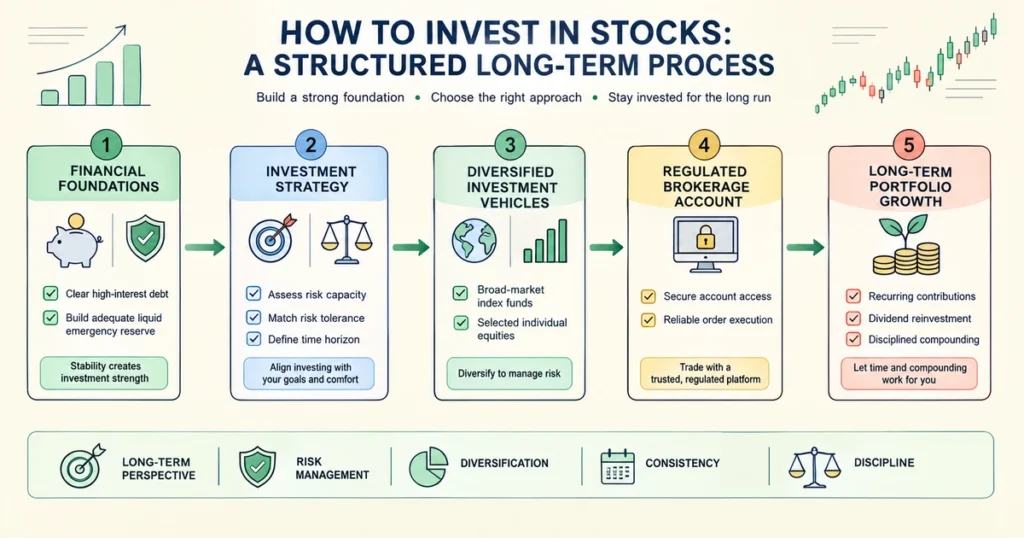
Learning how to invest in stocks can provide a structured way to participate in long-term wealth building and broader economic growth. By purchasing shares, an investor acquires an ownership interest in operating corporations—gaining exposure to their commercial development, innovation, cash flows, and potential dividend distributions.
Successful stock investing is not about speculative short-term market timing or gambling on intraday price swings. Rather, it is a disciplined financial process grounded in sound personal balance sheet foundations, prudent asset allocation, low-cost account selection, diversified vehicle implementation (such as broad-market index funds alongside high-quality individual equities), and emotional resilience across changing macroeconomic cycles.
Step 1: Establishing Financial Foundations Before Buying Shares
Quick Answer: Pre-Investment Checklist
- High-Interest Debt: Paying off high-interest debt produces a guaranteed financial saving equal to the interest avoided, whereas stock market returns are variable and uncertain.
- Emergency Cash Buffer: Maintain an accessible emergency reserve appropriate to your living expenses, income stability, and near-term financial obligations before investing money needed for emergencies.
- Capital Horizon: Allocate money toward equities only when you have a sufficiently long time horizon to tolerate market volatility and do not expect to need the capital for near-term obligations.
Before deploying capital into equity markets, an investor should audit their personal balance sheet. The stock market is an engine for long-term wealth accumulation, not a tool for solving immediate cash flow shortages.
                      ┌─────────────────────────────────────────┐
                      │    STEP 1: CLEAR HIGH-INTEREST DEBT     │
                      │  (Eliminate high-cost revolving credit) │
                      └────────────────────┬────────────────────┘
                                           │
                                           ▼
                      ┌─────────────────────────────────────────┐
                      │    STEP 2: BUILD AN EMERGENCY FUND      │
                      │  (Adequate liquid emergency reserve)    │
                      └────────────────────┬────────────────────┘
                                           │
                                           ▼
                      ┌─────────────────────────────────────────┐
                      │    STEP 3: ALLOCATE SURPLUS TO STOCKS   │
                      │  (Avoid investing near-term cash needs  │
                      │   in volatile equity investments)       │
                      └─────────────────────────────────────────┘
1. The High-Interest Debt Hurdle
If an individual carries high-interest consumer debt, paying off that balance produces a guaranteed financial saving equal to the interest that would otherwise have been paid. Stock-market returns are variable and uncertain by comparison; attempting to invest while servicing expensive debt may be financially counterproductive.
2. The Liquid Emergency Fund
Equity markets fluctuate. If an unexpected expense arises during a broad market downturn, lacking cash reserves may force you to liquidate shares at depressed prices. A dedicated emergency reserve held in an accessible, liquid cash or cash-equivalent account can reduce the need to sell long-term investments during a market downturn.
3. Time Horizon Verification
Stock prices can be volatile over days, weeks, and months. However, over multi-year periods, corporate earnings growth often helps offset cyclical downturns. Capital needed in the near term—such as a property down payment next year or tuition fees due in months—belongs in capital-preservation instruments, not common stocks.
Step 2: Defining Your Investment Strategy and Horizon
Quick Answer: Strategy & Time Horizon
- Investing vs. Trading: Investing is long-term business co-ownership focused on multi-year earnings; trading is short-term speculation focused on brief price movements.
- Risk Capacity & Tolerance: Risk capacity is your financial ability to absorb losses; risk tolerance is your emotional ability to endure portfolio declines without selling in a panic.
- Time Horizon: A longer time horizon may allow an investor to tolerate greater exposure to volatile assets, but the appropriate allocation still depends on overall financial goals and liquidity needs.
Every investor brings unique financial goals, risk tolerances, and time horizons to the market. Defining these parameters early establishes the blueprint for all future asset allocation decisions.
+-------------------------------------------------------------------------------+
|                      INVESTING vs. SHORT-TERM TRADING                         |
+----------------------+-----------------------------+--------------------------+
| STRATEGIC DIMENSION  | LONG-TERM INVESTING         | SHORT-TERM TRADING       |
+----------------------+-----------------------------+--------------------------+
| Primary Objective    | Compound wealth over years  | Capture price fluctuations|
| Analytical Focus     | Business fundamentals & cash| Technical charts & flow  |
| Time Horizon         | Multi-year horizons         | Seconds, Days, to Weeks  |
| Transaction Activity | Minimal; low turnover       | High frequency & volume  |
| Tax Considerations   | Often subject to long-term  | Frequently subject to    |
|                      | capital gains frameworks    | short-term/income tax    |
| Emotional Demand     | Patience and discipline     | Continuous monitoring    |
+----------------------+-----------------------------+--------------------------+
1. Assessing Risk Capacity vs. Risk Tolerance
- Risk Capacity (Financial): How much financial loss your balance sheet can realistically absorb without jeopardizing your lifestyle. An investor with stable income, low near-term liquidity needs, and substantial financial reserves may have greater risk capacity than an investor who depends on the portfolio for near-term living expenses.
- Risk Tolerance (Psychological): Your emotional ability to watch your portfolio decline during a broad market correction without panic-selling at market troughs.
2. The Role of the Investment Horizon
A longer time horizon may allow an investor to tolerate greater exposure to volatile assets, but the appropriate allocation still depends on financial goals, risk capacity, liquidity needs, and risk tolerance. Long horizons allow you to benefit from potential compound returns while giving businesses sufficient time to navigate cyclical economic downturns.
Step 3: Choosing Your Investment Vehicle: Individual Stocks vs. ETFs and Index Funds
Quick Answer: Stocks vs. Index Funds
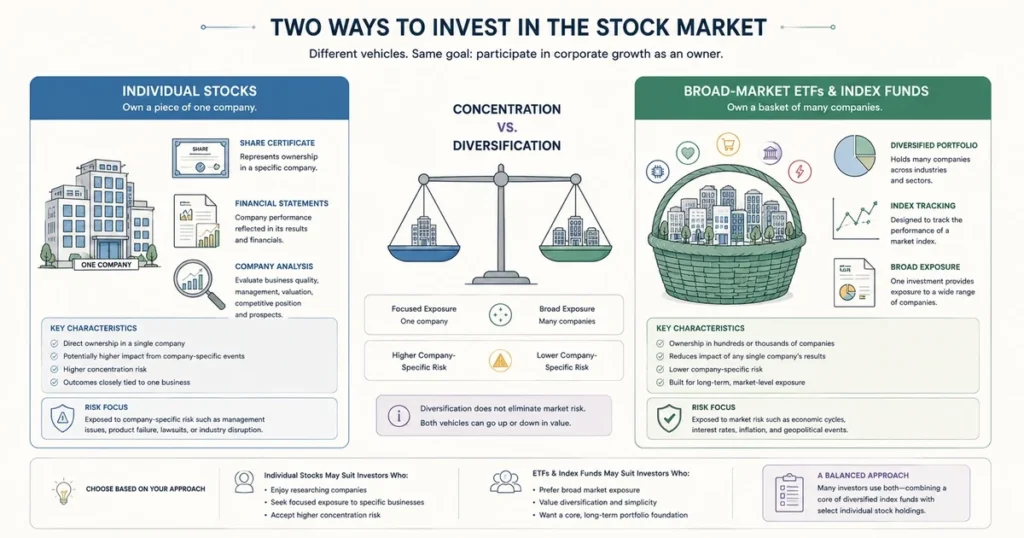
- Individual Stocks: Purchasing fractional ownership in a single named corporation. Offers direct ownership and outperformance potential, but carries company-specific operational risk.
- ETFs & Index Funds: Purchasing a fund that holds a broad basket of companies. Offers broad diversification and generally seeks to track the performance of a selected market index before fees and expenses.
- Core Recommendation: Many investors establish a diversified foundation in broad-market index funds or ETFs before adding individual company shares.
When learning how to invest in stocks, one of the most critical decisions is determining what form of equity to hold. To understand the underlying structure of these assets, read our comprehensive guide on what stocks are, which details how shares represent legal claims on corporate equity.
| Investment Vehicle | Diversification Level | Management Effort | Risk Profile | Cost Considerations |
| Individual Stocks | Low (Single business) | High (Requires financial statement analysis) | High company-specific idiosyncratic risk | Often low or zero advertised commissions; spreads and fees may apply |
| Broad Index ETFs | High (Hundreds or thousands of firms) | Extremely Low (Passive buy-and-hold) | Broad market risk plus fund-specific, tracking, and geographic risks | Generally lower ongoing costs than many actively managed funds, but actual expenses vary by fund |
| Actively Managed Funds | Moderate to High | Low for investor (Managed by professional team) | Manager underperformance and strategy risk | Moderate to high expenses depending on the fund and strategy |
1. The Core-and-Satellite Strategy
Many long-term allocators organize their portfolios using an illustrative Core-and-Satellite architecture:
- The Core (illustrative 70%–90%): Invested in broad-market index funds or ETFs to provide diversified exposure to a wide range of companies and participate in overall market performance, subject to fees, tracking differences, and market risk.
- The Satellite (illustrative 10%–30%): Allocated toward selected high-conviction individual stocks where the investor has completed thorough fundamental research.
                      ┌─────────────────────────────────────────┐
                      │        TOTAL EQUITY PORTFOLIO           │
                      └────────────────────┬────────────────────┘
                                           │
         ┌─────────────────────────────────┴─────────────────────────────────┐
         │                                                                   │
         ▼ (Illustrative 70% - 90%)                                          ▼ (Illustrative 10% - 30%)
┌──────────────────────────────────┐               ┌──────────────────────────────────┐
│      THE DIVERSIFIED CORE        │               │     THE ACTIVE SATELLITES        │
│  (Broad-Market Index ETFs, Total │               │  (High-conviction individual     │
│   Stock Market, Global Equities) │               │   stocks: Tech, Healthcare, etc.)│
└──────────────────────────────────┘               └──────────────────────────────────┘
Step 4: Selecting the Right Account: Tax-Advantaged vs. Taxable Brokerage Accounts
Quick Answer: Account Types
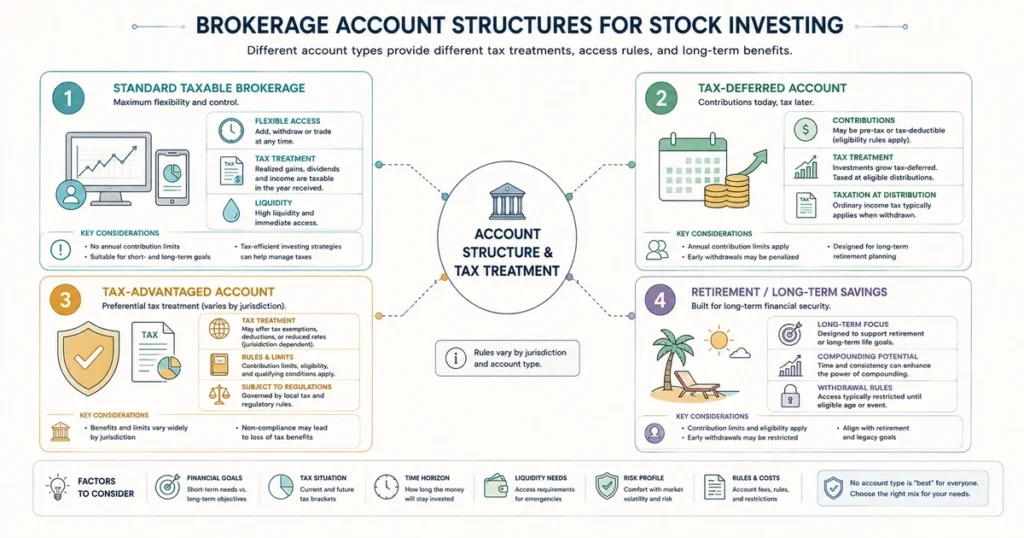
- Tax-Advantaged Accounts: Government-sponsored retirement and savings accounts that provide tax deductions, tax-deferred growth, or exempt withdrawals under specific national rules.
- Standard Taxable Brokerage Accounts: Standard taxable brokerage accounts generally provide flexible access to invested capital and typically do not have the contribution limits associated with certain tax-advantaged accounts, although rules vary by jurisdiction and account structure.
- Priority Rule: Compare available tax-advantaged accounts with taxable brokerage accounts based on your goals, liquidity needs, contribution limits, tax situation, and jurisdiction.
The legal container holding your investments directly influences long-term tax efficiency and net returns.
+-------------------------------------------------------------------------------+
|                      ACCOUNT STRUCTURES & TAX CHARACTERISTICS                 |
+----------------------+-----------------------------+--------------------------+
| ACCOUNT TYPE         | GENERAL TAX CHARACTERISTIC  | PRIMARY UTILIZATION      |
+----------------------+-----------------------------+--------------------------+
| Tax-Deferred Account | Contributions may be pre-   | Long-term retirement     |
| (e.g., Traditional)  | tax; taxes paid upon future | savings accumulation     |
|                      | eligible distribution       |                          |
+----------------------+-----------------------------+--------------------------+
| Tax-Advantaged       | Tax treatment varies by     | Long-term savings and    |
| Account              | account and jurisdiction    | investing under applic-  |
|                      |                             | able local rules         |
+----------------------+-----------------------------+--------------------------+
| Standard Taxable     | Flexible access; taxable on | Medium-term capital goals|
| Brokerage Account    | realized capital gains and  | & unrestricted access to |
|                      | distributions               | invested funds           |
+----------------------+-----------------------------+--------------------------+
1. Tax-Advantaged Account Frameworks
Tax-advantaged accounts vary substantially by country. Examples include Traditional and Roth IRAs and 401(k) plans in the United States, Individual Savings Accounts (ISAs) in the United Kingdom, and superannuation arrangements in Australia. Contribution limits, tax deductions, investment treatment, withdrawal rules, and eligibility requirements differ by jurisdiction and account type.
Tax-exempt or tax-free treatment should not be assumed for every account or every withdrawal. Always verify the current rules and qualification criteria for your country and specific account type.
2. Standard Taxable Brokerage Accounts
If you have maximized available retirement account limits, or if you plan to utilize your capital prior to retirement age without statutory early-withdrawal penalties, a taxable brokerage account generally provides flexible access to invested capital and a broad range of investment choices, subject to applicable settlement rules, account restrictions, and local regulations.
Step 5: Choosing a Regulated Brokerage Platform
Quick Answer: Broker Selection Checklist
- Regulatory Registration: Ensure the broker is authorized by statutory regulators (such as the SEC and FINRA in the US, FCA in the UK, or SEBI in India).
- Fee Transparency: Compare commissions, bid-ask spreads, foreign-exchange charges, account fees, fund expenses, transfer fees, and other applicable costs rather than focusing only on advertised commission rates.
- Platform Capabilities: Look for reliable order execution, clear reporting, fractional share support, and automated recurring deposits.
For most retail investors, stock orders are submitted through a regulated brokerage or investment platform, which routes the order to an appropriate trading venue or liquidity provider. Understanding how these entities coordinate with trading venues is detailed in our guide on what a stock exchange is.
| Brokerage Feature | Important Considerations | Potential Red Flags |
| Regulatory Oversight | Authorized by statutory national authorities with investor protection schemes | Unregulated offshore platforms lacking clear jurisdiction |
| All-In Pricing | Transparent pricing across execution, currency conversion, and fund expenses | Hidden withdrawal surcharges and opaque maintenance fees |
| Fractional Shares | Ability to invest exact cash amounts across higher-priced equities | Restrictive rules requiring whole-share purchases only |
| Cash Management | Understand where uninvested cash is held, what interest or yield is paid, and what protections and fees apply | Unclear treatment of uninvested cash, restrictive transfer rules, or undisclosed fees |
| Platform Usability | Reliable mobile/desktop access with robust two-factor authentication | Unstable systems prone to outages during volatile trading |
Step 6: Funding Your Account and Setting Capital Allocations
Quick Answer: Funding & Allocation
- Funding Method: Transfer money using an available bank-transfer or payment method supported by your regulated brokerage and country.
- Asset Allocation: Determine the percentage split between equities, fixed-income instruments, and cash reserves based on your goals and risk tolerance.
- Automated Contributions: Set up scheduled transfers to maintain consistent investment discipline.
Once your brokerage account application is approved and identity verification (KYC/AML) is complete, you can fund your account ledger before executing orders.
                      ┌─────────────────────────────────────────┐
                      │          PERSONAL BANK ACCOUNT          │
                      └────────────────────┬────────────────────┘
                                           │
                           (Scheduled Electronic Bank Transfer)
                                           ▼
                      ┌─────────────────────────────────────────┐
                      │       BROKERAGE UNINVESTED CASH         │
                      └────────────────────┬────────────────────┘
                                           │
         ┌─────────────────────────────────┴─────────────────────────────────┐
         │                                                                   │
         ▼ (Illustrative Equity Share)                                       ▼ (Illustrative Fixed Income Share)
┌──────────────────────────────────┐               ┌──────────────────────────────────┐
│      EQUITY ALLOCATION           │               │     FIXED INCOME / CASH          │
│  (Index Funds, ETFs, Stocks)     │               │  (Short-term bonds, money market)│
└──────────────────────────────────┘               └──────────────────────────────────┘
Illustrative Asset Allocation Examples
These percentages are illustrative examples rather than universal recommendations. Appropriate allocations vary with time horizon, financial situation, risk tolerance, liquidity needs, and jurisdiction:
- Growth-Oriented Horizon: A higher illustrative equity allocation (e.g., 80%–90%) may be appropriate for some investors with multi-decade time horizons, alongside a fixed-income or cash allocation based on their risk capacity and liquidity needs.
- Balanced Horizon: A moderate illustrative equity allocation (e.g., 60%–70%) can be combined with fixed-income assets to diversify sources of risk and potentially reduce overall portfolio volatility.
- Capital Preservation Horizon: A more conservative illustrative equity allocation (e.g., 40%–50%) may be considered by investors with shorter time horizons or greater near-term liquidity needs, with the remaining allocation held in fixed-income and cash or cash-equivalent assets as appropriate.
Step 7: Fundamental Stock Research: How to Analyze a Company
Quick Answer: Analyzing a Stock
- Business Model: Understand how the company generates revenues and whether it possesses durable competitive advantages (moats).
- Financial Health: Evaluate revenue trends, operating margins, free cash flow generation, and balance sheet leverage.
- Valuation Multiples: Compare Price-to-Earnings (P/E), EV/EBITDA, and other valuation metrics against historical baselines and industry peers.
If you allocate capital to individual stocks, fundamental research can help you evaluate the company’s financial condition, competitive position, valuation, and risks.
| Financial Dimension | Primary Financial Statement | Key Metric to Evaluate | Analytical Interpretation |
| Top-Line Growth | Income Statement | Revenue Expansion | Consistent, sustainable revenue expansion over multi-year periods |
| Profitability | Income Statement | Operating Profit Margin | Sustainable or expanding profit margins relative to industry competitors |
| Cash Generation | Cash Flow Statement | Free Cash Flow (FCF) | Positive and sustainable free cash flow after required capital expenditures, interpreted in context |
| Balance Sheet Solvency | Balance Sheet | Debt-to-Equity / Net Debt | Manageable leverage; adequate liquidity relative to debt maturities |
| Capital Efficiency | Financial Disclosures | Return on Invested Capital | ROIC consistently higher than the company’s cost of capital |
Avoiding Common Analytical Traps
- The “Nominal Price” Fallacy: A stock trading at
$10per share is not inherently cheaper than a stock trading at$500per share. Nominal share price reflects share count and market capitalization. Fundamental valuation metrics—such as the P/E ratio or Discounted Cash Flow models explained in our guide on how stock prices are determined—reveal true valuation. - Revenue Without Cash Flow: High revenue growth without a clear path to sustainable free cash flow may require repeated external financing, which can increase the risk of shareholder dilution.
Step 8: Placing Your First Stock Order: Order Types and Execution Steps
Quick Answer: Order Execution
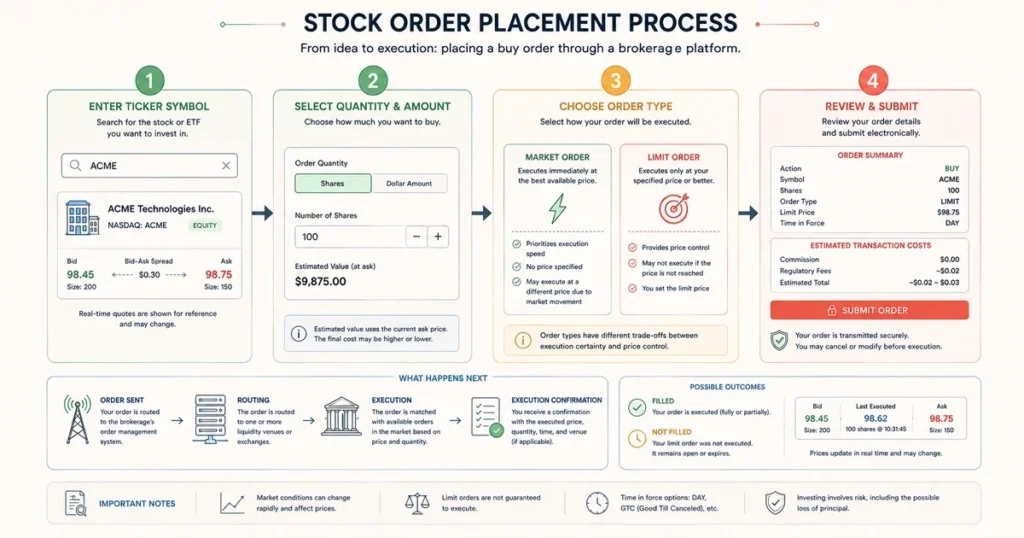
- Step 1: Enter the exact Ticker Symbol for the stock or fund you want to trade (e.g.,
MSFT,VTI).- Step 2: Select the order type—use a Market Order for execution at the best available market prices, generally prioritizing execution speed over price certainty; the actual execution price is not guaranteed. Use a Limit Order to specify the maximum price you will pay or the minimum price you will accept when selling.
- Step 3: Review the order summary, verify total transaction costs, and click Submit Order.
Executing a trade inside your brokerage platform requires understanding order types and execution mechanics.
                      ┌─────────────────────────────────────────┐
                      │    STEP 1: ENTER TICKER SYMBOL          │
                      │  (Search company or fund code)          │
                      └────────────────────┬────────────────────┘
                                           │
                                           ▼
                      ┌─────────────────────────────────────────┐
                      │    STEP 2: SELECT QUANTITY & AMOUNT     │
                      │  (Specify total shares or dollar value) │
                      └────────────────────┬────────────────────┘
                                           │
                                           ▼
                      ┌─────────────────────────────────────────┐
                      │    STEP 3: CHOOSE ORDER TYPE            │
                      │  (Market Order vs. Limit Order)         │
                      └────────────────────┬────────────────────┘
                                           │
                                           ▼
                      ┌─────────────────────────────────────────┐
                      │    STEP 4: CONFIRM & SUBMIT EXECUTION   │
                      │  (Review order payload & route to venue)│
                      └─────────────────────────────────────────┘
Market Orders vs. Limit Orders
- Market Order: An instruction to buy or sell a security at the best available market price. Market orders prioritize execution speed over price certainty, which can lead to price slippage in volatile or illiquid markets.
- Limit Order: An instruction to purchase a stock only at a specified price or lower (or sell at a specified price or higher). A limit order provides price control, but risks non-execution if market prices do not reach the specified limit level.
For beginners trading liquid stocks or broad-market ETFs, a limit order can provide price control, but it does not guarantee execution. Investors should choose between market and limit orders based on the trade-off between execution certainty and price control.
Step 9: Building a Balanced, All-Weather Portfolio
Quick Answer: Portfolio Diversification
- Sector Diversification: Spread investments across diverse economic sectors (e.g., technology, healthcare, industrials, consumer staples, utilities).
- Geographic Exposure: Hold domestic and international equities to diversify exposure across different economies, currencies, and regional market conditions.
- Position Sizing: Avoid excessive concentration in any single company unless that exposure is deliberate and consistent with your risk capacity. A predefined position-size limit can be used as an illustrative risk-management guideline, but appropriate allocations depend on investor objectives, diversification, and risk capacity.
Diversification can reduce company-specific risk and may improve the resilience of a portfolio, although it cannot eliminate market risk or guarantee a particular return.
+-------------------------------------------------------------------------------+
|                       SECTOR ALLOCATION ARCHITECTURE                          |
+----------------------+-----------------------------+--------------------------+
| ECONOMIC SECTOR      | CHARACTERISTIC BEHAVIOR     | REPRESENTATIVE SEGMENTS  |
+----------------------+-----------------------------+--------------------------+
| Technology           | Capital growth; cyclical    | Software, Semiconductors |
| Healthcare           | Defensive; steady demand    | Pharmaceuticals, Devices |
| Consumer Staples     | Inelastic demand profile    | Packaged Goods, Food     |
| Financial Services   | Sensitive to interest rates | Commercial Banks, Credit |
| Industrials          | Linked to economic output   | Logistics, Manufacturing |
| Utilities & Energy   | Cash flow yield focus       | Electricity, Energy Infra|
+----------------------+-----------------------------+--------------------------+
1. Managing Unsystematic Risk
As explored in institutional portfolio theory, equity risk encompasses two main categories:
- Unsystematic (Company-Specific) Risk: The risk that an individual company suffers operational disruptions, management turnover, or product obsolescence. Holding a diversified basket of companies across multiple sectors substantially reduces unsystematic risk.
- Systematic (Market) Risk: Macroeconomic developments that affect the entire market simultaneously (such as interest rate shifts or broad recessions). Systematic risk cannot be diversified away within equities, but can be managed through asset allocation and cash buffers.
2. Geographic Allocation
Holding international equities alongside domestic investments provides exposure to diverse economic cycles and currencies. Global market mechanisms are analyzed in our foundational guide on what the stock market is.
Step 10: The Power of Compounding: Dollar-Cost Averaging and Dividend Reinvestment
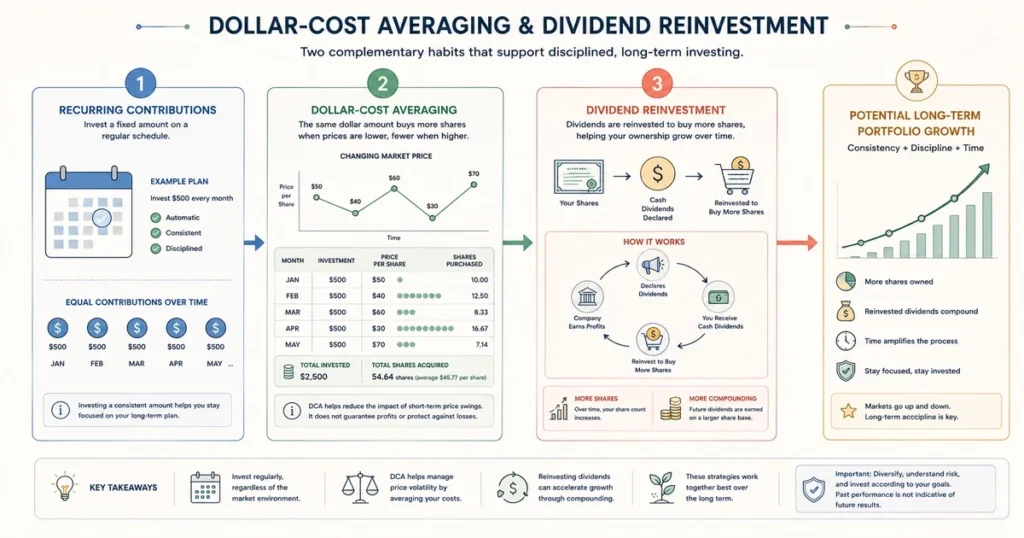
Quick Answer: Compounding Mechanics
- Dollar-Cost Averaging (DCA): Investing a fixed amount at regular intervals helps maintain consistent contribution discipline, naturally purchasing more shares when prices are lower and fewer when prices are higher.
- Dividend Reinvestment (DRIP): Reinvesting declared dividends to purchase additional shares allows distributions to contribute to long-term compounding when dividends continue to be paid.
- Core Benefit: Can reduces the emotional pressure of attempting to time market entry points.
Successful investing is a process of consistent capital allocation supported by long-term compounding.
                      ┌─────────────────────────────────────────┐
                      │       RECURRING CONTRIBUTION            │
                      └────────────────────┬────────────────────┘
                                           │
                         (Fixed Periodic Deposit)
                                           ▼
                      ┌─────────────────────────────────────────┐
                      │    DOLLAR-COST AVERAGING (DCA) ENTRY    │
                      │  (Consistent contribution schedule      │
                      │   across market fluctuations)           │
                      └────────────────────┬────────────────────┘
                                           │
                                           ▼
                      ┌─────────────────────────────────────────┐
                      │       PORTFOLIO PRINCIPAL BASE          │
                      └────────────────────┬────────────────────┘
                                           │
                         (Generates Cash Dividends, When Declared)
                                           ▼
                      ┌─────────────────────────────────────────┐
                      │    REINVESTMENT PURCHASES NEW SHARES    │
                      │  (Expands underlying share count        │
                      │   to support potential compounding)     │
                      └─────────────────────────────────────────┘
1. The Disciplined Mechanics of Dollar-Cost Averaging
Attempting to time market bottoms is challenging even for professional market participants. With Dollar-Cost Averaging:
- Over multi-year periods, DCA can help investors maintain a consistent contribution discipline and naturally purchase more shares when prices are lower and fewer when prices are higher.
- It establishes a systematic investing habit that can reduce emotional hesitation during periods of market volatility.
2. Dividend Reinvestment Plans (DRIPs)
Some corporations distribute part of their profits to shareholders as cash dividends, while others retain earnings for reinvestment or other corporate purposes. Enrolling in an automated Dividend Reinvestment Plan (DRIP) within your brokerage platform directs cash distributions toward purchasing additional whole and fractional shares. These newly acquired shares can generate additional dividends in the future, allowing reinvested distributions to contribute to long-term compounding when dividends continue to be paid.
Step 11: Risk Management: Navigating Volatility, Drawdowns, and Panics
Quick Answer: Managing Market Drops
- Volatility Is Inherent: Market declines, pullbacks, and corrections are normal features of equity markets.
- Unrealized vs. Realized Losses: Selling a position below its purchase price during a downturn realizes the loss and removes the position from any potential future recovery.
- Long-Term Perspective: Historically, many broad-market indexes have recovered from major downturns, but past recoveries do not guarantee future results.
Maintaining emotional discipline during market downturns is central to long-term investing success.
| Market Event | Common Definition | Investor Perspective |
| Market Pullback | An informal term for a relatively modest decline from a recent market high | Review the broader financial plan rather than react to short-term noise |
| Market Correction | Often defined as a decline of 10% or more from recent highs | Reassess risk tolerance and maintain the planned asset allocation |
| Bear Market | Often defined as a decline of 20% or more from recent highs | Focus on diversification, liquidity needs, and long-term objectives |
Managing the Psychology of Volatility
If prices decline after you invest, your holdings may show unrealized losses. Those losses may recover over time, but recovery is not guaranteed, particularly for individual companies. Selling during market downturns locks in losses when the position is sold below its purchase price, removing the opportunity to participate in subsequent market recoveries.
Step 12: Tax Efficiency and Portfolio Maintenance (Rebalancing)
Quick Answer: Rebalancing & Taxes
- Portfolio Rebalancing: Adjusting portfolio weights periodically to restore your target asset allocation when market movements cause allocations to drift.
- Tax Considerations: Consider the tax treatment of different assets and account types when deciding where to hold investments; optimal placement depends on jurisdiction, account rules, investment characteristics, and individual circumstances.
- Tax-Loss Harvesting: Tax-loss harvesting involves selling securities at a realized loss to offset eligible realized capital gains, subject to the tax rules that apply in the investor’s jurisdiction.
Over time, market movements cause portfolio allocations to drift from their original targets as certain assets outpace others.
                      ┌─────────────────────────────────────────┐
                      │    INITIAL ALLOCATION: 80% EQ / 20% BD  │
                      └────────────────────┬────────────────────┘
                                           │
                        (Equity Market Outperforms Over Time)
                                           ▼
                      ┌─────────────────────────────────────────┐
                      │    DRIFTED ALLOCATION: 90% EQ / 10% BD  │
                      │  (Portfolio risk profile has increased) │
                      └────────────────────┬────────────────────┘
                                           │
                         (Rebalancing Action Triggered)
                                           ▼
                      ┌─────────────────────────────────────────┐
                      │    REBALANCED TARGET: 80% EQ / 20% BD   │
                      │  (Direct new contributions to bonds or  │
                      │   rebalance within tax-advantaged accts)│
                      └─────────────────────────────────────────┘
1. Portfolio Rebalancing Techniques
If an 80/20 equity-to-bond portfolio drifts to 90/10 during an equity expansion, your risk exposure increases:
- Cash-Flow Rebalancing: Direct fresh periodic contributions into the under-weighted asset class until target balance is restored, avoiding asset sales.
- Rebalancing in Tax-Advantaged Accounts: Reallocate holdings inside tax-advantaged retirement accounts to avoid triggering immediate capital gains taxes.
2. Tax Considerations
Tax-loss harvesting involves selling securities at a realized loss to offset eligible realized capital gains. This strategy is jurisdiction-specific and subject to local rules. For example, U.S. taxpayers may be subject to wash-sale rules when substantially identical securities are acquired within 30 days before or after a loss sale, which may disallow the current deduction of the loss.
Common Pitfalls and Costly Mistakes to Avoid
Quick Answer: Red Flags in Investing
- Market Timing: Trying to predict short-term market tops and bottoms often leads to underperformance.
- Chasing Performance: Purchasing assets solely because they experienced rapid past price appreciation.
- Underestimating Fees: High expense ratios and hidden trading costs compound over time, reducing net returns.
- Overconcentration: Placing an excessive portion of net worth into a single company or employer stock.
Avoiding catastrophic mistakes is often more important to long-term wealth building than attempting to identify a single future market winner:
| Common Mistake | Potential Consequence | Recommended Mitigation |
| Performance Chasing | Buying speculative assets at elevated valuations due to fear of missing out | Follow a disciplined asset allocation and evaluate fundamental valuations |
| High Fee Drag | Ongoing management and platform fees reduce long-term compound wealth | Prioritize low-cost index funds and transparent broker pricing |
| Hyperactive Trading | Frequent trading increases transaction costs and tax liabilities | Maintain a multi-year horizon and automate recurring contributions |
| Single-Stock Concentration | Operational failure at one firm can severely impair total savings | Limit exposure to any single company within a diversified portfolio |
Frequently Asked Questions (Institutional FAQ)
How much money do I need to start investing in stocks?
The minimum amount required to start investing depends on the country, brokerage platform, security, and whether fractional shares are available. Some regulated brokers allow very small initial investments through fractional shares, while others impose higher minimums.
How do investors make money from stocks?
Investors generate financial returns through two primary channels: capital appreciation (selling shares at a higher price than the purchase price as the business expands over time) and dividend distributions (regular cash payouts distributed to shareholders from corporate net profits, when declared).
Is investing in the stock market considered gambling?
No. Owning stocks represents an ownership interest in a business rather than a wager against a house. However, stock investing still involves substantial risk: individual companies can lose value, fail, or become worthless. Unlike gambling, the investor is purchasing a financial claim on an underlying business, but that claim does not guarantee a profit.
What happens if the stock market drops right after I invest?
If prices decline after you invest, your holdings may show unrealized losses. Those losses may recover over time, but recovery is not guaranteed, particularly for individual companies. Historically, broad market indexes have recovered from major downturns, though past recoveries do not guarantee future results.
How are stock investments taxed?
Stock taxation depends heavily on your country, account type, security, holding period, and applicable tax rules. Some jurisdictions distinguish between short- and long-term gains, while others use different systems. Dividends and realized gains may also receive different tax treatment. Always verify the current rules that apply to your jurisdiction.
Strategic Summary & Institutional Takeaways
Learning how to invest in stocks provides a structured pathway for deploying personal capital into productive commercial enterprises.
By clearing high-cost consumer debt, maintaining a liquid emergency cash reserve, choosing a regulated low-cost brokerage platform, and establishing a diversified portfolio foundation through broad index funds and researched equities, investors construct resilient portfolios designed for multi-decade horizons.
Through Dollar-Cost Averaging, automated dividend reinvestment, disciplined rebalancing, and emotional resilience during market volatility, you can participate in global capital market growth with structured risk management and a clear long-term perspective.
Next Reading Suggestions
- What Are Stocks? The Complete Guide to Shares, Equity, and Ownership
- What Is the Stock Market? How Global Equity Markets Work and Allocate Capital
- What Is a Stock Exchange? How Exchanges Work, Trade Stocks, and Settle Transactions
- How Stock Prices Are Determined: Market Microstructure, Supply and Demand, and Valuation
- Stock Market History: The Evolution of Global Equity Markets and Capital Systems
Author Box & E-E-A-T Verification
Written By: CurrencyPlans Financial Research Team
Fact-Checked & Reviewed By: Financial Research Team & Equity Editorial Board
Editorial Integrity & Research Standards: CurrencyPlans publishes educational financial research based on established corporate-finance principles, financial economics, and publicly available regulatory and institutional sources. All investment workflows, brokerage evaluation criteria, account structures, and portfolio risk models are cross-referenced with official guidelines from securities regulatory bodies and multilateral institutions, including the US Securities and Exchange Commission (SEC), the Financial Industry Regulatory Authority (FINRA), and the World Federation of Exchanges (WFE).
Primary Institutional References & Regulatory Resources
For official investor education, market regulation standards, and statutory consumer protection rules, consult primary institutional sources directly:
- Investor Education & Asset Protection Guidelines: US Securities and Exchange Commission (SEC) – Investor.gov
- Broker Verification & Market Conduct Rules: Financial Industry Regulatory Authority (FINRA) – BrokerCheck
- Global Securities Exchanges Architecture & Data: World Federation of Exchanges (WFE)
- International Financial Stability & Capital Market Research: Bank for International Settlements (BIS)
- Global Macroeconomic Statistics & Capital Flow Data: International Monetary Fund (IMF) Data Portal
Educational Disclaimer
This guide is prepared strictly for educational, informational, and research purposes and does not constitute personalized financial, investment, legal, or tax advice. Equities and capital market instruments carry inherent risk of capital loss, price volatility, and business failure. Past performance does not guarantee future results. Always perform independent due diligence and consult a licensed, fiduciary financial advisor before making investment commitments.

