
Executive Summary & Core Thesis
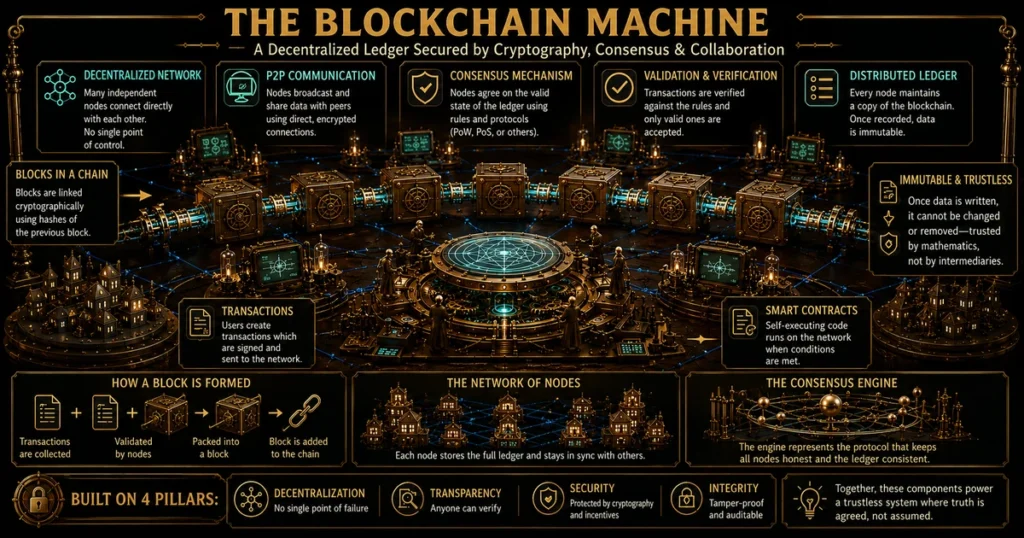
Blockchain is a distributed, cryptographically linked, append-only digital state machine. Depending on its design, a blockchain can be public and permissionless or private and permissioned. Often oversimplified as merely a “distributed database,” a true blockchain integrates three distinct architectural dimensions: an immutable data structure (chronological blocks bound by cryptographic hash pointers), a peer-to-peer network protocol (nodes communicating through distributed network protocols), and an algorithmic consensus mechanism (mathematical rules coordinating agreement on valid state transitions).
Bitcoin introduced the first widely deployed permissionless blockchain architecture in 2008, described by Satoshi Nakamoto in the Bitcoin whitepaper and launched as a live network in January 2009. Bitcoin demonstrated a practical approach to Byzantine coordination among mutually untrusted participants under specific network and consensus assumptions. By reducing dependence on single points of failure, public blockchains can provide verifiable digital scarcity, censorship-resistant settlement, and, where supported, deterministic smart contract execution. Understanding blockchain requires analyzing block structure, cryptographic hashing, Proof-of-Work and Proof-of-Stake models, the Blockchain Trilemma, and modern modular Layer 2 scaling frameworks.
Executive Summary & Core Thesis
Quick Answer: What Is Blockchain?
A blockchain is a distributed digital ledger architecture that records state changes across participating computers. Depending on its design, control over validation and access can be decentralized, permissioned, or shared among a defined group of participants. Rather than relying on a single centralized administrator, data is bundled into “blocks” that are chained together chronologically using cryptographic hashes. Once added under network consensus rules, transactions are append-only and highly resistant to unauthorized alteration, enabling verifiable multi-party verification.
While conventional centralized databases rely on an organization with administrative authority to manage read, write, and edit permissions, a blockchain operates as a shared, deterministic state machine. Since the mining of the Bitcoin Genesis Block in January 2009, the Bitcoin network has operated continuously with a long-running decentralized consensus history, providing an empirical track record of operational reliability without dependence on a central server or controlling authority, as documented in our comprehensive analysis of the history of cryptocurrency.
Foundational Definition: What Is Blockchain?
To understand blockchain with computer-science precision, it must be evaluated through three distinct technical dimensions:
                      ┌─────────────────────────────────────────┐
                      │      THE TRIPARTITE ARCHITECTURE        │
                      └────────────────────┬────────────────────┘
                                           │
         ┌─────────────────────────────────┼─────────────────────────────────┐
         │                                 │                                 │
         ▼                                 ▼                                 ▼
┌──────────────────┐             ┌──────────────────┐             ┌──────────────────┐
│ DATA STRUCTURE   │             │ NETWORK PROTOCOL │             │ CONSENSUS ENGINE │
├──────────────────┤             ├──────────────────┤             ├──────────────────┤
│ An ordered       │             │ A peer-to-peer   │             │ Algorithmic rules│
│ sequence of      │             │ communication    │             │ (PoW, PoS) that  │
│ blocks connected │             │ network of nodes │             │ coordinate valid │
│ by cryptographic │             │ propagating data │             │ state transitions│
│ hash pointers    │             │ and messages     │             │ among peers      │
└──────────────────┘             └──────────────────┘             └──────────────────┘
- The Data Structure: An ordered sequence of blocks in which each block contains data and a cryptographic reference to its predecessor, forming a tamper-evident history.
- The Network Protocol: A peer-to-peer communication network through which participating nodes exchange transactions, blocks, and protocol messages; access and permissions depend on the blockchain design.
- The Consensus Engine: Algorithmic rules (PoW, PoS) that coordinate agreement on valid state transitions among distributed participants.
To understand how digital property is represented across these structures, explore our foundational guide on what crypto is, or review native monetary implementation in our deep dive on what is bitcoin.
The Problem Blockchain Solved: Where Traditional Databases Fall Short
Traditional enterprise databases (such as PostgreSQL, MySQL, or Oracle) utilize a CRUD model (Create, Read, Update, Delete) governed by an organization with centralized administrative control over permissions and data management. In adversarial environments where transacting parties do not trust one another, centralized databases present fundamental vulnerabilities:
| Architectural Property | Traditional Centralized Database | Decentralized Public Blockchain |
| Trust Model | Centralized (Trust the administrator/institution) | Decentralized (Trust cryptography and consensus math) |
| Operations Allowed | CRUD (Create, Read, Update, Delete) | Append-Only (Create, Read; No historical edit/delete) |
| Data Integrity | Maintained by access control and internal audits | Maintained by cryptographic hash-chains and node validation |
| Single Point of Failure | High (Target server downtime or insider breach) | Reduced Dependence (Ledger replicated across many independently operated nodes) |
| Throughput & Speed | High throughput for database queries and transactions | Lower transaction throughput than many centralized systems; varies significantly by blockchain architecture |
| Censorship Potential | High (Administrator can freeze, edit, or delete data) | High Resistance (No single party can normally override the protocol’s consensus rules) |
Blockchain addresses the classical Byzantine coordination problem—how geographically dispersed participants who do not know or trust each other can coordinate on a shared state over an adversarial network, subject to the assumptions of the specific consensus protocol.
How Blockchain Works: The End-to-End Transaction Lifecycle

Quick Answer: How Blockchain Works
A blockchain functions through a four-stage verification and settlement cycle: 1) A user generates and cryptographically signs a transaction, 2) Nodes verify transaction parameters and queue it in the mempool, 3) Consensus participants bundle transactions into a block and execute protocol rules, and 4) Nodes append the block to the ledger, updating the network’s shared state.
                      ┌─────────────────────────────────────────┐
                      │   STAGE 1: TRANSACTION AUTHORIZATION    │
                      │  User generates transaction and signs   │
                      │  with private key using network scheme  │
                      └────────────────────┬────────────────────┘
                                           │
                                 (P2P Network Broadcast)
                                           ▼
                      ┌─────────────────────────────────────────┐
                      │   STAGE 2: MEMPOOL QUEUE & VALIDATION   │
                      │  Nodes verify signatures, inputs,       │
                      │  outputs, and protocol rules before     │
                      │  accepting txs into the mempool         │
                      └────────────────────┬────────────────────┘
                                           │
                                  (Block Construction)
                                           ▼
                      ┌─────────────────────────────────────────┐
                      │   STAGE 3: CONSENSUS PARTICIPATION      │
                      │  Miners or validators propose/participate│
                      │  in block production and consensus      │
                      │  according to the network's protocol    │
                      └────────────────────┬────────────────────┘
                                           │
                                 (Network Propagation)
                                           ▼
                      ┌─────────────────────────────────────────┐
                      │   STAGE 4: APPEND-ONLY SETTLEMENT       │
                      │  Nodes independently verify block, link │
                      │  previous hash, and update local state  │
                      └─────────────────────────────────────────┘
Full nodes independently verify the block according to the network’s consensus rules. If an invalid transaction or block is detected, honest nodes reject it according to the network’s validation rules; protocol-specific penalties may apply to dishonest participants.
Anatomy of a Bitcoin-Style Block: Headers, Payloads, and Merkle Trees
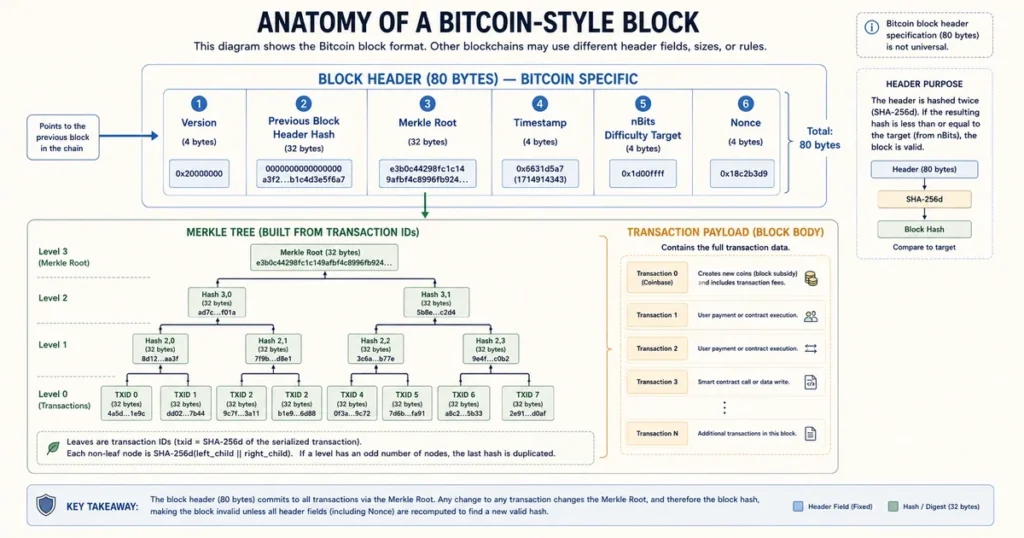
A Bitcoin-style blockchain block consists of a block header containing metadata used for cryptographic linking and consensus, together with a block body containing transaction records.
                      ┌─────────────────────────────────────────┐
                      │             BLOCK HEADER                │
                      │  * Software Version                     │
                      │  * Previous Block Hash (Pointer)        │
                      │  * Merkle Root Hash (Tx Summary)        │
                      │  * Timestamp (Epoch Time)               │
                      │  * Difficulty Target (nBits)            │
                      │  * Nonce (Proof-of-Work Counter)        │
                      └────────────────────┬────────────────────┘
                                           │
                                (Cryptographic Tree Summary)
                                           ▼
                      ┌─────────────────────────────────────────┐
                      │               MERKLE TREE               │
                      │               [Root Hash]               │
                      │              /           \              │
                      │        [Hash AB]       [Hash CD]        │
                      │        /       \       /       \        │
                      │     [H_A]     [H_B]  [H_C]    [H_D]     │
                      │       │         │      │        │       │
                      │     [Tx A]    [Tx B] [Tx C]   [Tx D]    │
                      └─────────────────────────────────────────┘
The Merkle Tree and Efficient Verification
On Bitcoin, transactions in a block are organized into a binary Merkle tree. Individual transactions are hashed pairwise until a single master hash—the Merkle Root—is formed.
- Cryptographic Commitment: A block containing 3,000 transactions can commit to the entire transaction set through a single 32-byte Merkle Root.
- SPV Verification: To prove that an individual transaction is included in a block, a lightweight client can request a Merkle inclusion proof and relevant block headers without downloading the full blockchain. SPV provides lighter verification than running a full node but relies on additional assumptions about the network and headers it receives.
Cryptographic Primitives: Hashing, Asymmetric Keys, and Immutability
Blockchain security depends on three fundamental cryptographic primitives:
1. Cryptographic Hash Functions (SHA-256 and Keccak-256)
A hash function is a deterministic, one-way mathematical algorithm that converts any input data of arbitrary size into a fixed-length string of bytes (e.g., 256 bits).
- Deterministic: The exact same input will always produce the exact same output.
- Pre-Image Resistance: It is computationally infeasible to reverse-engineer the original input from the output hash.
- Avalanche Effect: Altering a single character in the input completely changes the resulting hash output.
2. Asymmetric Public-Key Cryptography
Users interact with blockchains using key pairs. A private key generates digital signatures to authorize spending. The public key is used by network nodes to mathematically verify the signature’s authenticity without exposing the secret private key.
3. Hash Chaining and Ledger Immutability
In Bitcoin, altering a historical transaction changes that block’s Merkle root and therefore its block-header hash. An attacker attempting to rewrite that history would need to reproduce the affected proof-of-work and catch up with the honest chain, making deep historical alteration increasingly difficult as additional blocks are added.
Consensus Mechanisms: The Algorithmic Engine of Trust
Quick Answer: Consensus Mechanisms
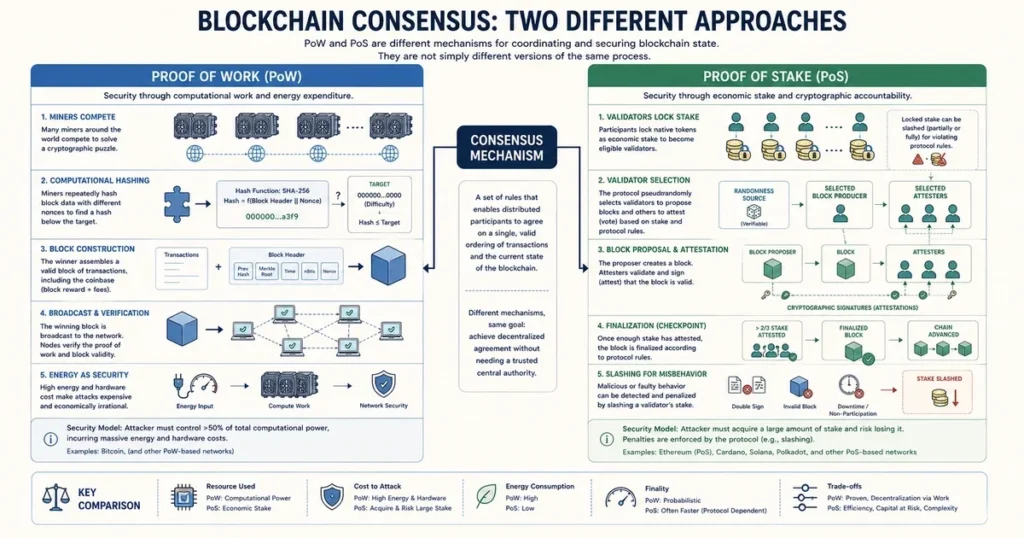
A consensus mechanism is an algorithm that allows decentralized computer nodes to agree on a single valid version of the ledger. Proof of Work (PoW) ties consensus participation and block-production influence to computational work performed using physical hardware and electricity. Proof of Stake (PoS) ties consensus participation to economic stake, with some protocols using slashing or other penalties to discourage dishonest behavior.
+-------------------------------------------------------------------------------+
|                       BLOCKCHAIN CONSENSUS COMPARISON                         |
+----------------------+-----------------------------+--------------------------+
| CONSENSUS DIMENSION  | PROOF OF WORK (PoW)         | PROOF OF STAKE (PoS)     |
+----------------------+-----------------------------+--------------------------+
| Underlying Resource  | Computational Hardware &    | Locked Economic Capital  |
|                      | Electricity                 | (Staked Native Tokens)   |
| Network Validators   | Miners                      | Validators               |
| Energy Consumption   | High (Continuous hashing)   | Minimal (~99.95% lower   |
|                      |                             | on Ethereum post-Merge)  |
| Finality Model       | Probabilistic settlement;   | Protocol-dependent; may  |
|                      | confidence increases with   | provide explicit crypto- |
|                      | confirmations               | economic finality        |
| Primary Examples     | Bitcoin, Litecoin, Monero   | Ethereum, Solana*,       |
|                      |                             | Cardano                  |
+----------------------+-----------------------------+--------------------------+
*These networks use PoS-based consensus architectures combined with additional timing or Byzantine fault-tolerant protocols.
Other Prominent Consensus Models:
- Delegated Proof of Stake (DPoS): Token holders vote for a rotating council of block producers (e.g., TRON, EOS).
- PBFT-style Byzantine Fault Tolerance: Used in some permissioned systems where known participants exchange multiple voting rounds to reach agreement and explicit finality once the required quorum is satisfied.
- Proof of History (PoH): Developed by Solana, provides a cryptographically verifiable passage of time using sequential hashing. It is not itself a consensus mechanism; instead, it helps order events and coordinate timing within Solana’s broader consensus architecture.
Types of Blockchains: Public, Private, Consortium, and Hybrid
Blockchains are categorized according to their permissions and governance models:
| Blockchain Type | Access & Read Permissions | Write & Consensus Permissions | Primary Advantages | Common Implementations |
| Public (Permissionless) | Open to anyone globally | Anyone can independently verify the ledger; consensus participation follows the protocol’s participation and block-production rules | High potential for decentralized participation and censorship resistance | Bitcoin, Ethereum |
| Private (Permissioned) | Restricted to authorized users | Restricted to an individual enterprise | High speed; data privacy; compliance control | Hyperledger Fabric |
| Consortium (Federated) | Shared among member organizations | Controlled by a pre-selected group of institutions | Shared infrastructure without single-entity dominance | R3 Corda, B3i |
| Hybrid | Mixed public/private access or control | Configurable | Can combine enterprise privacy with public infrastructure | Enterprise hybrid networks |
| Modular | Functions (execution, settlement, DA) separated across layers | Protocol-dependent | Specialized scaling and flexibility | Rollup ecosystems and modular networks |
Network Topology: Full Nodes, Light Clients, and Gossip Protocols
A public blockchain typically operates over a distributed peer-to-peer network in which participating nodes exchange transactions, blocks, and protocol messages through network communication mechanisms such as gossip:
                      ┌─────────────────────────────────────────┐
                      │           NODE ARCHITECTURE             │
                      └────────────────────┬────────────────────┘
                                           │
         ┌─────────────────────────────────┼─────────────────────────────────┐
         │                                 │                                 │
         ▼                                 ▼                                 ▼
┌──────────────────┐             ┌──────────────────┐             ┌──────────────────┐
│ FULL NODES       │             │ LIGHT CLIENTS    │             │ HISTORICAL /     │
│                  │             │                  │             │ ARCHIVE NODES    │
├──────────────────┤             ├──────────────────┤             ├──────────────────┤
│ Download, verify,│             │ Download limited │             │ Some networks    │
│ and enforce all  │             │ data and use     │             │ retain extensive │
│ consensus rules  │             │ protocol-specific│             │ historical state │
│ independently    │             │ proofs to verify │             │ for specialized  │
│                  │             │ relevant state   │             │ queries          │
└──────────────────┘             └──────────────────┘             └──────────────────┘
Running a personal full node provides a high degree of self-sovereignty because it independently verifies transactions and blocks according to the network’s consensus rules without relying on a third-party API for validation.
The Blockchain Trilemma: Decentralization, Security, and Scalability

Quick Answer: The Blockchain Trilemma
The Blockchain Trilemma is a widely used design framework describing the trade-offs between Decentralization, Security, and Scalability, particularly when designing a blockchain’s base layer. Base-layer blockchains that prioritize decentralization and security naturally limit on-chain transaction throughput.
                                  SCALABILITY
                                      / \
                                     /   \
                                    /     \
                                   /       \
                                  /  TRADE- \
                                 /    OFFS   \
                                /             \
                 DECENTRALIZATION ------------- SECURITY
- Decentralization + Security (e.g., Bitcoin, Ethereum L1): Prioritize broad verification and strong security, while base-layer throughput remains constrained by protocol limits, execution requirements, network propagation, and decentralization considerations.
- Scalability + Security (e.g., some high-throughput Layer 1s): Can achieve much higher throughput through architectural choices such as parallel execution, larger resource limits, optimized networking, or higher hardware requirements, but these choices can increase the barriers to running validators and may introduce additional centralization trade-offs.
- The Modular Solution: Rather than forcing a single layer to handle every function, modular architectures separate execution, settlement, consensus, and/or data availability across specialized layers; Layer 2 rollups are one important example mitigating these trade-offs.
Modular Blockchain Scaling: Layer 1, Layer 2 Rollups, and Blobs

To scale global adoption without sacrificing base-layer decentralization, blockchain engineering has transitioned toward modular, layered architectures:
                 ┌─────────────────────────────────────────┐
                 │       LAYER 2 — EXECUTION               │
                 │   Optimistic & ZK Rollups               │
                 │   Execute transactions outside L1       │
                 └────────────────────┬────────────────────┘
                                      │
                     Post data / proofs / commitments
                                      ▼
                 ┌─────────────────────────────────────────┐
                 │       LAYER 1 — ETHEREUM                │
                 │   Settlement + Consensus + Data         │
                 │   Availability via calldata / blobs     │
                 └─────────────────────────────────────────┘
- Optimistic Rollups: Assume submitted transactions are valid by default and post transaction data and state commitments to Layer 1, with a dispute period during which invalid state transitions can be challenged. The exact challenge period varies by implementation.
- Zero-Knowledge (ZK) Rollups: Execute transactions off-chain and submit cryptographic validity proofs to Layer 1. Once the proof and associated state transition are accepted by Layer 1, the rollup state can be verified without relying on a fraud-proof challenge period.
- EIP-4844 (Proto-Danksharding): Implemented in Ethereum’s Dencun upgrade in March 2024, introduced ephemeral data blobs dedicated to rollup data posting, substantially reducing the data-availability costs faced by many Layer 2 networks.
Smart Contracts and Programmable Execution (Ethereum & EVM)
While Bitcoin was designed primarily as a monetary ledger, Ethereum introduced the Ethereum Virtual Machine (EVM), providing a general-purpose deterministic execution environment for smart contracts across participating nodes.
A smart contract is software deployed to a blockchain that executes deterministically when a transaction or other protocol-defined event triggers its code. When predefined conditions are met, the code produces the specified state transition.
                      ┌─────────────────────────────────────────┐
                      │       SOLIDITY SMART CONTRACT CODE      │
                      │   'if (collateralValue < loanThreshold) │
                      │    liquidateCollateral();'              │
                      └────────────────────┬────────────────────┘
                                           │
                                (Deterministic Execution)
                                           ▼
                      ┌─────────────────────────────────────────┐
                      │        DECENTRALIZED EXECUTION          │
                      │  Executes deterministically across      │
                      │  participating network nodes            │
                      │  without centralized human intervention │
                      └─────────────────────────────────────────┘
On Ethereum and other gas-metered networks, smart-contract execution consumes gas, with fees paid according to the network’s fee mechanism to meter computational resource usage and prevent infinite execution loops.
Conceptual Clarification: Blockchain vs. Bitcoin vs. Cryptocurrency
A pervasive point of confusion among beginners is treating blockchain, Bitcoin, and cryptocurrency as interchangeable concepts:
| Concept | Technical Classification | Primary Function | Real-World Analogy |
| Blockchain | Underlying Technology & Data Structure | A distributed, cryptographically linked append-only ledger | The Internet / TCP-IP Protocol |
| Bitcoin | Specific Protocol Network & Native Asset | The first decentralized monetary network and digital commodity | Email / The First Website |
| Cryptocurrency | Broad Digital Asset Class | Digital assets designed primarily for value transfer, payments, or monetary use, including native blockchain assets and tokens | Web Applications & Online Media |
To examine the economic sizing and valuation metrics applied to these digital assets across open markets, consult our comprehensive guide on what market capitalization is.
Core Properties: Append-Only History, Transparency, and Censorship Resistance
- Append-Only History: Historical data cannot be edited or deleted through normal operational commands; state changes can only occur through new forward transactions.
- Pseudonymous Transparency: On transparent public blockchains, transaction histories, address balances, and smart-contract interactions can generally be viewed through public explorers. Transactions are linked to cryptographic addresses rather than real-world names, though forensic analysis can trace activity when funds touch regulated fiat gateways.
- Censorship Resistance: Because no single entity controls the entire block-production and validation process, public blockchains can make sustained censorship more difficult. However, individual miners, validators, nodes, exchanges, or jurisdictions can still delay or restrict transactions.
Architectural Limitations and Vulnerabilities
A rigorous institutional assessment requires acknowledging blockchain’s core technical limitations:
- Throughput and Latency Constraints: Many public blockchain base layers process fewer transactions per second than conventional centralized payment infrastructures because they must replicate, validate, and reach protocol-defined agreement on state across distributed participants.
- The Oracle Problem: Blockchains are self-contained cryptographic environments that cannot natively access real-world data (such as stock prices, interest rates, or weather). They rely on decentralized oracle networks (such as Chainlink) to fetch external data, introducing potential external dependency risks.
- Smart Contract Logic Exploits: Coding bugs or logic vulnerabilities (such as reentrancy attacks) in deployed smart contracts can lead to irreversible loss of funds.
- Irreversible Execution: If a user loses their private keys or transfers assets to an incorrect address, transactions cannot be reversed by customer support.
Real-World Use Cases: Beyond Digital Currency
Blockchain utility extends across multiple economic sectors where trust minimization is required:
| Sector | Core Problem Addressed | Blockchain Implementation | Institutional Example |
| Digital Money | Sovereign fiat inflation and double-spending | Blockchain-based digital assets and payment networks | Bitcoin (BTC) |
| Decentralized Finance | Intermediary fees, broker custody, and opaque books | Automated market makers, lending pools, stablecoins | Uniswap, Aave |
| Real-World Assets (RWA) | Illiquidity and slow settlement in traditional assets | On-chain tokenization of Treasuries, credit, and funds | BlackRock BUIDL Fund |
| Supply Chain Tracking | Counterfeiting and lack of provenance verification | Immutable lifecycle logging of physical goods | Pharmaceutical and luxury tracking |
To see how companies and capital markets clear ownership claims across traditional finance, review our guide on what the stock market is.
Engineering Decision Framework: Blockchain vs. Traditional Database
One of the most critical engineering principles is recognizing when not to use a blockchain:
                      ┌─────────────────────────────────────────┐
                      │    ENGINEERING DECISION FLOWCHART       │
                      └────────────────────┬────────────────────┘
                                           │
                     Do multiple untrusted parties need to write?
                                           │
                    ┌──────────────────────┴──────────────────────┐
                    ▼ YES                                         ▼ NO
    Is a central trusted third party acceptable?         USE TRADITIONAL DATABASE
                    │                                    (PostgreSQL / MySQL)
     ┌──────────────┴──────────────┐
     ▼ NO                          ▼ YES
USE PUBLIC BLOCKCHAIN     USE CENTRALIZED DATABASE
- Use a Blockchain When: You require multi-party write permissions, reduced dependence on a central trusted intermediary, append-only historical auditability, and/or censorship-resistant settlement.
- Use a Traditional Database When: You require high throughput, private internal business records, low latency, editable customer data (CRUD operations), or simple internal record keeping.
Network Attack Vectors and Security Economics
Public blockchains maintain security through cryptographic design and economic incentives:
- Majority-Resource Attacks: In Proof-of-Work systems, controlling a majority of effective hashrate can enable attacks such as transaction reordering and double-spending. In Proof-of-Stake systems, the consequences of controlling a large share of validator stake depend on the specific consensus protocol and its quorum, finality, and slashing rules.
- Sybil Attacks: A malicious entity creates many identities or nodes to influence peer-to-peer communication or network participation. PoW and PoS make Sybil-based consensus attacks economically costly by tying influence to computational work or economic stake.
- Maximal Extractable Value (MEV): The value that block producers or other participants can capture by strategically ordering, including, excluding, or inserting transactions, with arbitrage, liquidations, front-running, and sandwiching among common examples.
Global and Indian Regulatory Landscape (2026 Standards)
The regulatory classification of blockchain technology distinguishes between the underlying software infrastructure and the financial assets issued on top of it:
1. United States
In March 2026, the SEC issued an updated interpretation addressing how federal securities laws apply to crypto assets and related transactions, including distinctions involving blockchain technology and certain crypto-asset activities. Additionally, in August 2026, the SEC issued proposed rulemaking for Regulation Crypto Assets, proposing a tailored offering framework for certain investment contracts involving crypto assets.
2. European Union (MiCA)
The EU’s Markets in Crypto-Assets (MiCA) regulation established a harmonized framework for crypto-asset issuers and service providers, with scope and exemptions that depend on the specific activity and type of crypto-asset.
3. India (Technology vs. Asset Framework)
- Technology Adoption: Blockchain technology itself is used and supported in various government and enterprise initiatives in India, including projects associated with MeitY and the National Blockchain Framework. However, the legal and tax treatment depends on the specific blockchain-based asset, activity, or service involved.
- Taxation of Tokens: Specified Virtual Digital Assets (VDAs) are subject to Section 115BBH, under which income from their transfer is taxed at 30% plus applicable surcharge and cess, with limited deductions. Section 194S generally provides for 1% TDS on consideration for transfer of VDA, subject to applicable conditions and thresholds.
To evaluate how interest rates and global central bank policies alter liquidity across digital asset markets, review our guide on interest rates and exchange rates.
The Future of Blockchain (2026–2030 Architecture)
The ongoing evolution of distributed ledger technology centers on four major structural frontiers:
- Pervasive Zero-Knowledge Proofs (ZK): Expansion of ZK-rollups and recursive validity proofs enabling high transaction scaling alongside privacy-preserving verification.
- Account Abstraction (ERC-4337): Smart-account infrastructure enabling features such as batched transactions, sponsored transactions, and flexible authentication or recovery mechanisms implemented by wallet designs.
- Restaking Infrastructure: Protocols (such as EigenLayer) that allow staked assets to secure multiple decentralized services and data availability layers simultaneously.
- Institutional Tokenization Rails: Traditional financial assets such as government bonds, funds, and private credit are increasingly being explored and issued in tokenized form on blockchain-based infrastructure, alongside growing institutional use of regulated digital-asset products.
Common Myths vs. Empirical Facts
- Myth: Blockchain and Bitcoin are the exact same thing.
- Fact: Bitcoin is a specific decentralized monetary application; blockchain is the underlying distributed ledger technology that enables it.
- Myth: Blockchains are completely unhackable.
- Fact: While the core cryptographic primitives used by mature networks like Bitcoin and Ethereum have not been practically broken, smart contracts deployed on top of blockchains can contain software logic bugs that hackers exploit.
- Myth: Blockchain data is private and anonymous.
- Fact: Many public blockchains are pseudonymous and highly transparent, allowing anyone to inspect publicly exposed transaction histories, addresses, and smart-contract activity.
- Myth: All blockchains consume massive electricity.
- Fact: While Proof-of-Work blockchains require computational mining energy, modern Proof-of-Stake blockchains (including Ethereum post-Merge) reduce electricity consumption by ~99.95%.
Frequently Asked Questions (Institutional FAQ)
What is blockchain in simple terms?
A blockchain is a shared digital ledger architecture where transaction records are verified according to the network’s rules and linked together using cryptography. Depending on its design, control over validation can be decentralized, permissioned, or shared among a defined group of participants. Once recorded under the network’s consensus or validation rules, data becomes highly resistant to unauthorized alteration.
How does blockchain work for beginners?
When you send a transaction, independent computers verify it according to the network’s rules. The transaction is combined with others into a block that becomes part of the blockchain, updating the network’s shared state.
What is the difference between a blockchain and a traditional database?
A traditional database is managed by a central administrator who can edit, update, and delete records (CRUD operations). A blockchain is typically append-only and maintained according to network consensus or validation rules; public blockchains can operate without a central authority, while permissioned blockchains may use defined administrators or governing organizations.
What are the types of blockchains?
The four commonly discussed categories are public, private, consortium, and hybrid. Modular architecture is a separate design approach that separates functions such as execution, settlement, consensus, and data availability across layers.
What is the Blockchain Trilemma?
The Blockchain Trilemma is a widely used design framework describing the trade-offs between Decentralization, Security, and Scalability, particularly when designing a blockchain’s base layer.
Is blockchain safe?
The underlying cryptography and consensus architecture of established public blockchains provide high data integrity. However, risks remain in smart contract coding bugs, private key storage, and centralized third-party exchange platforms.
Can a blockchain be hacked?
While mature base-layer consensus systems are designed to resist attacks, vulnerabilities can occur through majority-resource attacks, such as majority hashrate attacks in PoW systems, as well as through validator-stake attacks, bridge vulnerabilities, or smart-contract flaws.
Is blockchain technology legal in India?
Blockchain technology itself is used and supported in various government and enterprise initiatives in India, including projects associated with MeitY. However, the legal and tax treatment depends on the specific blockchain-based asset, activity, or service involved.
What is the difference between Proof of Work and Proof of Stake?
Proof of Work secures networks by requiring miners to expend computational energy and electricity. Proof of Stake secures networks by requiring validators to lock up cryptocurrency tokens as economic collateral.
What is the future of blockchain technology?
The future centers on modular Layer 2 scaling, zero-knowledge proofs, account abstraction, and the tokenization of traditional real-world financial assets across blockchain-based settlement infrastructure.
Strategic Summary & Further Reading
Blockchain technology represents an architectural milestone in computer science and institutional coordination:
- Decentralized State Verification: Reduces dependence on a single point of failure through peer-to-peer consensus and cryptographic verification.
- Append-Only Data Integrity: Once committed under consensus rules, historical records are economically tamper-resistant.
- Trust-Minimized Execution: Enables programmable peer-to-peer transactions with reduced dependence on traditional central intermediaries.
- Modular Scaling Architecture: Addresses base-layer throughput constraints by offloading execution to Layer 2 rollups.
- Foundational Economic Rails: Powers digital commodities, decentralized finance, and the institutional tokenization of real-world assets.
Next Reading Suggestions
- What Is Bitcoin? The Complete Guide to the First Decentralized Digital Currency
- History of Cryptocurrency: The Complete Evolution of Bitcoin, Blockchain, and Digital Assets
- What Is Crypto? The Complete Guide to Cryptocurrency, Blockchain, and Digital Assets
- What Is Gold? The Complete Guide to Real Money, Store of Value & Why It Matters
- What Are Stocks? The Complete Guide to Shares, Equity, and Ownership
- What Is the Stock Market? How Global Equity Markets Work and Allocate Capital
- What Is a Stock Exchange? How Exchanges Work, Trade Stocks, and Settle Transactions
- How Stock Prices Are Determined: Market Microstructure, Supply and Demand, and Valuation
- What Is Market Capitalization? The Complete Guide to Market Cap, Company Size, and Valuation
- What Are Blue Chip Stocks? The Complete Guide to Quality, Dividends, and Long-Term Investing
- What Are Dividends? A Complete Guide to Dividend Investing, Payouts, and Yield
- How to Invest in Stocks: The Complete Step-by-Step Guide for Beginners and Long-Term Investors
- Stock Market History: The Evolution of Global Equity Markets and Capital Systems
Author Box & E-E-A-T Verification
Written & Researched By: CurrencyPlans
Fact-Checked & Reviewed By: CurrencyPlans
Editorial Integrity & Research Standards: CurrencyPlans publishes educational research grounded in computer science history, distributed systems principles, and publicly available regulatory disclosures. Consensus mechanisms, cryptographic protocols, block header structures, and regulatory frameworks are cross-referenced with primary and authoritative sources, including the original Bitcoin and Ethereum whitepapers, academic research repositories, the US Securities and Exchange Commission (SEC), the Financial Crimes Enforcement Network (FinCEN), the Commodity Futures Trading Commission (CFTC), the European Securities and Markets Authority (ESMA), and the Ministry of Electronics and Information Technology (MeitY) of India.
Primary Institutional References & Regulatory Resources
For official digital-asset education, historical regulatory notices, and statutory guidance, consult primary institutional sources directly:
- Digital Asset Investor Education & Regulatory Notices: US Securities and Exchange Commission (SEC)
- Commodity Futures & Digital Asset Regulatory Frameworks: Commodity Futures Trading Commission (CFTC)
- Virtual Currency Anti-Money Laundering Frameworks: Financial Crimes Enforcement Network (FinCEN)
- European Union Digital Finance & MiCA Framework: European Securities and Markets Authority (ESMA)
- National Blockchain Framework Research & Guidelines: Ministry of Electronics and Information Technology (MeitY)
- International Financial Stability & Central Bank Digital Asset Research: Bank for International Settlements (BIS)
Educational Disclaimer
This guide is prepared strictly for educational, informational, and research purposes and does not constitute personalized financial, investment, legal, technical, or tax advice. Digital assets and blockchain systems carry extreme price volatility, technological vulnerabilities, and potential capital loss. Past network uptime and historical consensus security do not guarantee future performance. Always perform independent due diligence and consult a licensed, fiduciary financial advisor before making investment commitments.

