

Executive Summary & Core Thesis
Bitcoin is the world’s first decentralized cryptocurrency, introduced in 2008 by the pseudonymous creator Satoshi Nakamoto. Operating without a central bank, government issuer, or corporate intermediary, Bitcoin combines peer-to-peer networking, public-key cryptography, and Proof-of-Work consensus to enable direct electronic value transfer across an open, global ledger.
In monetary economics and computer science, Bitcoin solved the fundamental “double-spending problem” that previously prevented digital cash from operating in a decentralized environment. With an absolute, mathematically enforced supply limit of 21 million units, programmatic four-year halving schedules, and an append-only Unspent Transaction Output (UTXO) accounting model, Bitcoin functions as a non-sovereign monetary asset, a digital store of value, and a base settlement layer for global finance.
1. Executive Summary & Core Thesis
Quick Answer: What Is Bitcoin?
Bitcoin is a decentralized digital monetary network and scarce digital commodity. It allows users to transfer value peer-to-peer without central clearing authorities. Transactions are validated by independent nodes and recorded in timestamped blocks secured by Proof of Work. Bitcoin’s programmatic issuance schedule guarantees that no more than 21 million Bitcoins will ever exist, making it mathematically scarce, resistant to discretionary inflation, and verifiable by anyone running free, open-source software.
On January 3, 2009, Satoshi Nakamoto mined Bitcoin’s Genesis Block, permanently encoding an excerpt from the front page of London’s The Times:
“The Times 03/Jan/2009 Chancellor on brink of second bailout for banks”
This inscription established a clear philosophical objective: creating an alternative, non-sovereign monetary system immune to arbitrary fiat debasement, bank bailouts, and centralized custodial failure, as examined in our detailed guide on the history of cryptocurrency.
2. Foundational Definition: What Is Bitcoin?
To evaluate Bitcoin with institutional precision, one must distinguish between three distinct classifications:
                      ┌─────────────────────────────────────────┐
                      │          THE TRIPARTITE NATURE          │
                      └────────────────────┬────────────────────┘
                                           │
         ┌─────────────────────────────────┼─────────────────────────────────┐
         │                                 │                                 │
         ▼                                 ▼                                 ▼
┌──────────────────┐             ┌──────────────────┐             ┌──────────────────┐
│ PEER-TO-PEER     │             │ DIGITAL          │             │ DIGITAL          │
│ CASH SYSTEM      │             │ COMMODITY        │             │ PROPERTY         │
├──────────────────┤             ├──────────────────┤             ├──────────────────┤
│ Nakamoto's 2008  │             │ Classified by the│             │ Non-custodial    │
│ original vision: │             │ SEC's 2026       │             │ digital asset    │
│ borderless,      │             │ interpretation as│             │ with control over│
│ censorship-      │             │ a digital        │             │ spendable Bitcoin│
│ resistant        │             │ commodity        │             │ via private keys │
│ settlement rail  │             │                  │             │                  │
└──────────────────┘             └──────────────────┘             └──────────────────┘
- Bitcoin (Capital “B”): Refers to the decentralized software protocol, peer-to-peer network, and public blockchain ledger maintained by thousands of independent node operators.
- bitcoin (Lowercase “b” or “BTC”): Refers to the native fungible monetary token or unit of account used to store and transfer purchasing power within the network.
- Regulatory Classification: In March 2026, the SEC issued an interpretive release, jointly accompanied by CFTC guidance, identifying Bitcoin as a digital commodity rather than a security under the Commission’s interpretation. The interpretation is not itself a statute or regulation and does not eliminate the possibility that particular transactions involving a non-security crypto asset could constitute an investment contract. The CFTC’s jurisdiction primarily covers derivatives and certain commodity-market activities.
3. The Problem Bitcoin Solved: Trustless Digital Scarcity
Before Bitcoin, digital data could be replicated infinitely at zero marginal cost. Creating digital currency traditionally required an authoritative central bank or payment processor to maintain a master ledger, verifying that a user did not spend the same balance twice.
Bitcoin addressed the practical Byzantine coordination problem in an open, permissionless network by combining Proof of Work with a chain-selection rule based on accumulated computational work. This enabled decentralized participants to coordinate on a shared transaction history and establish digital scarcity without a central authority.
4. How Bitcoin Works: The UTXO Model and Transaction Mechanics

Quick Answer: The UTXO Model
Unlike Ethereum or traditional banks that use an account/balance model (like a bank account ledger with a single debit/credit balance), Bitcoin uses the Unspent Transaction Output (UTXO) model. Bitcoin transactions do not transfer balances between accounts; instead, they consume discrete historical pieces of Bitcoin (inputs), destroy them, and create brand-new unspent outputs (UTXOs) locked by spending conditions defined in the transaction output script, with any remaining difference returned to the sender as change.
                      ┌─────────────────────────────────────────┐
                      │             UTXO INPUTS                 │
                      │  Alice spends previous UTXO: 1.0 BTC    │
                      └────────────────────┬────────────────────┘
                                           │
         (Cryptographically Signed — ECDSA or Schnorr, depending on output type)
                                           ▼
                      ┌─────────────────────────────────────────┐
                      │         BITCOIN TRANSACTION             │
                      │   Inputs: 1.0 BTC                       │
                      │   Total Outputs: 0.9995 BTC             │
                      └────────────────────┬────────────────────┘
                                           │
         ┌─────────────────────────────────┴─────────────────────────────────┐
         │                                                                   │
         ▼                                                                   ▼
┌──────────────────────────────────┐               ┌──────────────────────────────────┐
│      OUTPUT 1: PAYMENT           │               │       OUTPUT 2: CHANGE           │
│  0.6 BTC to Bob's                │               │  0.3995 BTC returned to Alice    │
│  spending condition              │               │                                  │
└──────────────────────────────────┘               └──────────────────────────────────┘
                                           │
                      ┌────────────────────┴────────────────────┘
                      │  Difference: 0.0005 BTC -> Miner Fee
                      ▼
The Step-by-Step Transaction Lifecycle:
- Selection: Alice’s wallet selects existing UTXOs sufficient to cover the transaction value plus the required network fee.
- Signing: Alice’s wallet uses her private key to generate a digital signature proving authorized spending rights over those inputs.
- Broadcasting: The signed transaction is broadcast to neighboring nodes and distributed into the global mempool (memory pool).
- Validation: Full nodes verify that inputs are unspent, signatures are mathematically valid, and protocol rules are satisfied.
- Confirmation: A miner bundles the transaction into a candidate block, solves the Proof of Work, and appends it to the blockchain.
5. Bitcoin Mining and Proof of Work
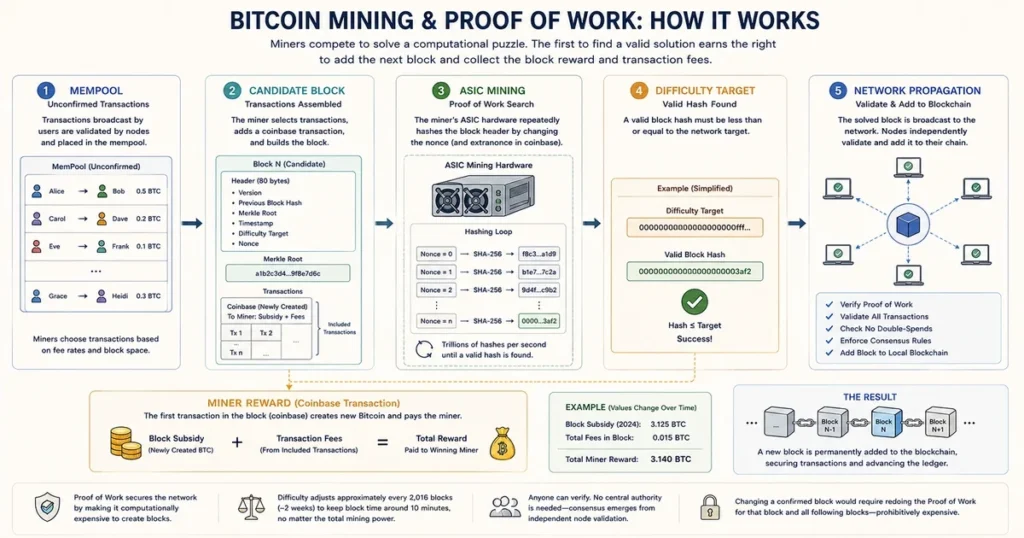
Quick Answer: Bitcoin Mining
Mining is the computational process by which valid transactions are selected, ordered, and committed to the blockchain through Proof of Work, while simultaneously releasing newly minted Bitcoins into circulation. Specialized computer hardware (ASICs) repeatedly executes the SHA-256 cryptographic hash algorithm, searching for a hash output that meets or falls below a target difficulty threshold.
Mining coordinates network security through economic incentives:
- The Difficulty Adjustment: Every 2,016 blocks (roughly two weeks), the Bitcoin network adjusts the mining difficulty based on observed block production time. If blocks are produced faster than the target interval, difficulty increases and the corresponding target decreases; if blocks are produced more slowly, difficulty decreases and the target increases. This feedback mechanism helps keep average block production near 10 minutes as global hashrate changes.
- Coinbase Transaction: The very first transaction in every block is created by the winning miner. It generates the block subsidy (newly minted coins) plus all transaction fees from the block, distributing them directly to the miner’s address.
6. The Blockchain: 80-Byte Headers and Merkle Trees
Every Bitcoin block contains an 80-byte block header that links it cryptographically to the preceding block:
| Header Field | Size | Function |
| Version | 4 Bytes | Protocol software version and consensus tracking |
| Previous Block Hash | 32 Bytes | SHA-256 hash of the previous block header, creating the linear chain |
| Merkle Root | 32 Bytes | Cryptographic summary hash of all transactions within the block |
| Timestamp | 4 Bytes | Miner-provided Unix timestamp subject to Bitcoin consensus time constraints |
| Target (nBits) | 4 Bytes | Encoded mathematical difficulty threshold |
| Nonce | 4 Bytes | 32-bit variable counter iterated by miners during hash computation |
By organizing transactions in a binary Merkle tree, lightweight Simplified Payment Verification (SPV) wallets can verify that a specific transaction was confirmed in a block using a small logarithmic proof without downloading the full multi-hundred-gigabyte blockchain.
7. Bitcoin Supply Mechanics and the Halving Schedule
Quick Answer: Bitcoin Halvings
Bitcoin’s issuance schedule is hardcoded into its open-source protocol. Every 210,000 blocks (approximately every four years), the block subsidy awarded to miners is cut in half. This process continues until roughly the year 2140, when the block subsidy falls to zero, with transaction fees remaining as the miners’ primary on-chain revenue source. The total programmed issuance approaches the 21 million BTC maximum under Bitcoin’s consensus rules.
                      ┌─────────────────────────────────────────┐
                      │      21 MILLION HARD SUPPLY LIMIT       │
                      │  (Asymptotically approached via halvings│
                      │   every 210,000 blocks / ~4 years)      │
                      └────────────────────┬────────────────────┘
                                           │
         ┌───────────────────┬─────────────┴───────┬───────────────────┐
         ▼                   ▼                     ▼                   ▼
┌─────────────────┐ ┌─────────────────┐   ┌─────────────────┐ ┌─────────────────┐
│ 2009-2012: 50.0 │ │ 2012-2016: 25.0 │   │ 2016-2020: 12.5 │ │ 2020-2024: 6.25 │
│ BTC / Block     │ │ BTC / Block     │   │ BTC / Block     │ │ BTC / Block     │
└─────────────────┘ └─────────────────┘   └─────────────────┘ └─────────────────┘
                                                           │
                                                           ▼
                                                  ┌─────────────────┐
                                                  │ 2024-2028: 3.125│
                                                  │ BTC / Block     │
                                                  └─────────────────┘
The Historical Halving Trajectory
| Halving Event | Date Executed | Block Subsidy |
| Genesis | Jan 3, 2009 | 50.0 BTC |
| 1st Halving | Nov 28, 2012 | 25.0 BTC |
| 2nd Halving | Jul 9, 2016 | 12.5 BTC |
| 3rd Halving | May 11, 2020 | 6.25 BTC |
| 4th Halving | Apr 20, 2024 | 3.125 BTC |
| 5th (Projected) | ~2028 | 1.5625 BTC |
Disclaimer: Historical price appreciation following halving events reflects past market cycles and does not guarantee future price performance.
8. Bitcoin Keys, Wallets, and Address Formats

Quick Answer: Keys and Addresses
A Bitcoin wallet does not store physical coins; it stores private cryptographic keys. Using the secp256k1 elliptic curve, a private key can derive a public key, which is then used within the appropriate address or output construction. Many modern Bitcoin wallets use deterministic key generation and may use a BIP-39 recovery phrase, which can contain 12, 15, 18, 21, or 24 words to generate the underlying seed.
Address Format Evolution
                     ┌─────────────────────────────────────────┐
                     │            BIP-39 MNEMONIC              │
                     │      (12, 15, 18, 21, or 24 words)      │
                     └────────────────────┬────────────────────┘
                                          │
            (Example: BIP-84 Native SegWit Account Path: m/84'/0'/0'
             First receiving address: m/84'/0'/0'/0/0)
                                          ▼
                     ┌─────────────────────────────────────────┐
                     │           MASTER PRIVATE KEY            │
                     └────────────────────┬────────────────────┘
                                          │
                      (Deterministic Key Derivation)
                                          ▼
                     ┌─────────────────────────────────────────┐
                     │               PUBLIC KEY                │
                     └────────────────────┬────────────────────┘
                                          │
        ┌───────────────────┬─────────────┴───────┬───────────────────┐
        ▼                   ▼                     ▼                   ▼
┌─────────────────┐ ┌─────────────────┐   ┌─────────────────┐ ┌─────────────────┐
│ P2PKH (Legacy)  │ │ P2SH (Script)   │   │ P2WPKH (SegWit) │ │ P2TR (Taproot)  │
│ Starts with '1' │ │ Starts with '3' │   │ Starts 'bc1q'   │ │ Starts 'bc1p'   │
└─────────────────┘ └─────────────────┘   └─────────────────┘ └─────────────────┘
- Legacy (P2PKH – Pay-to-PubKey-Hash): Addresses begin with
1. Original format; highest data footprint and fee costs. - Script Hash (P2SH): Addresses begin with
3. Enables script-hash based spending conditions, including multisignature constructions and other complex scripts. - Native SegWit (Bech32 – P2WPKH): Addresses begin with
bc1q. Reduces fee overhead by separating witness data from the base transaction serialization and applying a discounted weight to witness data. - Taproot (Bech32m – P2TR): Activated in November 2021 via BIP 341/342; addresses begin with
bc1p. Taproot uses Schnorr signatures and enables more efficient key aggregation and script-based spending constructions, allowing certain multisignature or complex spending policies to present a simpler on-chain footprint.
9. Transaction Fees, Mempool Dynamics, and RBF
Bitcoin transaction fees are determined by the difference between the total value of a transaction’s inputs and outputs, while the fee rate (such as sat/vB) determines how much the sender pays relative to the transaction’s size or weight and therefore its priority for block inclusion.
$$\text{Transaction Fee} = \text{Total UTXO Inputs} – \text{Total UTXO Outputs}$$
- Satoshis per Virtual Byte (sat/vB): Miners prioritize transactions that pay the highest fee rate per unit of block space. When network demand spikes, the mempool fills up, requiring higher fee rates for priority inclusion.
- Replace-by-Fee (RBF): Allows a sender to rebroadcast a stuck transaction with a higher fee rate to accelerate confirmation.
- Child-Pays-For-Parent (CPFP): Allows the recipient to spend an unconfirmed incoming UTXO with a high fee, incentivizing miners to confirm both parent and child transactions simultaneously.
10. Bitcoin Scaling Layers: The Lightning Network and Layer 2 Protocols

Quick Answer: The Lightning Network
The Lightning Network is a decentralized Layer 2 payment protocol built on top of Bitcoin. By opening bidirectional payment channels anchored to the base blockchain via multi-signature smart contracts, participants can route instant microtransactions off-chain with typically low fees, settling net balances back to the base layer.
┌─────────────────────────────────────────┐* Typical base-layer throughput: ~7 TPS
│ LAYER 2: THE LIGHTNING NETWORK │
│ * Fast off-chain settlement │
│ * Sub-satoshi microtransactions │
│ * High theoretical throughput capacity │
└────────────────────┬────────────────────┘
│
(Opens / Closes Bidirectional Channels)
▼
┌───────────────────────────────────────────┐
│ LAYER 1: BITCOIN BASE BLOCKCHAIN │
│ * Robust security & decentralization │
│ * Block inclusion averages ~10 minutes │
││
└────────────────────┬──────────────────────┘
Because Bitcoin’s base layer has constrained block capacity and an average block interval of about 10 minutes, higher transaction volumes can be handled through off-chain layers. The Lightning Network enables fast off-chain payments and has the potential to support extremely high transaction throughput compared with Bitcoin’s base layer, alongside Bitcoin-adjacent networks such as Stacks and Rootstock.
11. Cross-Asset Comparison: Bitcoin vs. Gold vs. Fiat vs. Stocks
To evaluate Bitcoin’s role in the global financial architecture, allocators compare its fundamental properties with traditional asset classes:
| Property | Bitcoin (BTC) | Physical Gold | Fiat Currency (USD, EUR) | Public Equities (Stocks) |
| Supply Limit | Strictly fixed at 21M | Geologically scarce (~1.7% annual mining flow) | Unlimited (Discretionary central bank expansion) | Dilutable via corporate share issuances |
| Divisibility | 100,000,000 Satoshis per BTC | Difficult in small daily denominations | 100 Cents per unit | Fractional shares via brokerages |
| Portability | Global transfer via internet / keys | Expensive, heavy, and insecure to transport | High electronically; restricted across borders | Restricted across regional exchange hours |
| Verifiability | Verifiable independently by running full-node software | Requires chemical, acoustic, or assay testing | Subject to sophisticated counterfeiting | Audited by third-party accounting firms |
| Censorship Resistance | High (Cryptographically enforced on-chain) | High physically; low across commercial vaults | Low (Bank freezes, capital controls) | Low (Brokerage trading halts, court orders) |
| Cash Flow / Yield | Zero cash yield | Zero cash yield | Dependent on short-term rates | Productive corporate earnings & dividends |
12. Bitcoin vs. Ethereum and Altcoins
Bitcoin and alternative smart-contract platforms represent fundamentally different engineering philosophies:
- Bitcoin: Prioritizes protocol stability, backward compatibility, and monetary scarcity. Its native scripting language is deliberately restricted to minimize security vulnerabilities, focusing on functioning as a secure digital monetary asset.
- Ethereum & Altcoins: Function as programmable computing platforms and decentralized state machines. Ethereum utilizes a Turing-complete execution environment (EVM) to support decentralized finance (DeFi), smart contracts, and tokenization, as detailed in our guide on what crypto is.
13. Bitcoin Security: Network Defense and Attack Vectors
The Bitcoin network’s core consensus rules have continued to operate since 2009 despite historical software bugs and attacks. Major historical losses such as Mt. Gox and FTX occurred at centralized intermediaries rather than through a successful compromise of Bitcoin’s underlying consensus mechanism:
- 51% Attacks: If a malicious entity acquired more than 51% of global ASIC hashrate, they could temporarily double-spend recent transactions and reorder blocks, though they could not steal funds from other users’ private keys or alter past protocol issuance rules. The scale and cost of acquiring and operating sufficient mining power makes a sustained 51% attack against Bitcoin economically difficult and highly costly, although the exact economics depend on market conditions and available mining infrastructure.
- Intermediary Vulnerabilities: Major historical Bitcoin-related losses such as Mt. Gox’s 2014 loss of ~850,000 BTC and FTX’s 2022 collapse occurred at centralized intermediaries rather than through a successful compromise of Bitcoin’s underlying consensus mechanism.
14. Bitcoin Custody: Storage Architecture and Security Standards

Quick Answer: Bitcoin Custody
Bitcoin custody falls into two primary models: third-party custody (holding assets on centralized exchanges or with qualified institutional custodians) and self-custody (holding your own private keys). The foundational rule of Bitcoin security is: “Not your keys, not your coins.”
The Self-Custody Security Checklist:
- Hardware Cold Storage: Use dedicated hardware wallets (such as Coldcard, Trezor, or BitBox) that generate private keys offline away from internet-connected computers.
- Physical Seed Phrase Redundancy: Write down the 12-, 15-, 18-, 21-, or 24-word recovery phrase on paper or stamp it onto stainless steel plates; store backups in geographically separated, secure locations. Never photograph or store a seed phrase digitally.
- Optional Passphrase (BIP-39 Passphrase): Adds an optional user-selected passphrase to protect funds in the event of physical device theft.
- Multi-Signature (Multisig): For substantial holdings, configure a 2-of-3 multi-signature setup across hardware devices from different manufacturers to reduce single-device and single-key failure risk.
15. Disciplined Investing Framework: Long-Term Allocation and Volatility
Investing in digital assets requires an objective understanding of cyclical drawdowns:
- Historical Drawdowns: Bitcoin has experienced multiple cyclical bear markets resulting in 70% to 85% drawdowns from all-time highs.
- Dollar-Cost Averaging (DCA): Investing a fixed fiat sum at recurring intervals (e.g., weekly or monthly) smooths the average cost basis and reduces dependence on trying to time cyclical market tops and bottoms.
- Portfolio Sizing: Some institutional portfolio research has examined small Bitcoin allocations as an illustrative portfolio-construction scenario. Appropriate allocation depends on investor objectives, risk tolerance, liquidity needs, time horizon, and regulatory/tax circumstances. Maintaining conservative position sizes allows investors to participate in long-term monetary adoption while protecting their primary balance sheet from severe volatility, as outlined in our manual on how to invest in stocks.
16. Historical Market Cycles and Price Discovery
Bitcoin’s valuation has transitioned through multiple orders of magnitude since its initial market quotation:
                      ┌─────────────────────────────────────────┐
                      │    THE LOGARITHMIC EXPANSION PATH       │
                      └────────────────────┬────────────────────┘
                                           │
         ┌───────────────────┬─────────────┴───────┬───────────────────┐
         ▼                   ▼                     ▼                   ▼
┌─────────────────┐ ┌─────────────────┐   ┌─────────────────┐ ┌─────────────────┐
│ 2010-2011       │ │ 2013            │   │ 2017            │ │ 2021-2024+      │
│ $0.003 -> $31   │ │ $13 -> $1,150   │   │ $900 -> $19,780 │ │ $15k -> $73k+   │
└─────────────────┘ └─────────────────┘   └─────────────────┘ └─────────────────┘
Bitcoin’s historical market cycles have coincided with changes in issuance, liquidity conditions, real interest rates, investor sentiment, and broader risk appetite. The relative contribution of these factors varies across market cycles, as explored in our guide on interest rates and exchange rates.
17. Global and Indian Regulatory and Tax Frameworks
The legal and tax status of Bitcoin varies across jurisdictions:
1. United States
- Regulatory Classification: In March 2026, the SEC issued an interpretive release identifying Bitcoin as a digital commodity rather than a security under the Commission’s interpretation, accompanied by CFTC guidance. On January 10, 2024, the SEC approved 11 spot Bitcoin exchange-traded products (ETPs).
- Taxation: Treated as property under IRS Notice 2014-21. Capital gains taxes apply upon sale, exchange, or spending.
2. European Union
- MiCA Regulation: Bitcoin falls within MiCA’s broader framework for crypto-assets other than asset-referenced tokens and e-money tokens. The regulation primarily governs relevant offers, trading activities, and crypto-asset service providers rather than Bitcoin’s decentralized protocol itself.
3. India (Statutory Framework)
- Legal Status: Bitcoin is not legal tender in India. VDA transactions are subject to applicable tax, AML/CFT, and reporting requirements.
- Taxation (Section 115BBH): Under the Finance Act 2022, gains from Virtual Digital Assets (VDAs) are taxed at a flat 30% rate (plus applicable surcharge and cess). No deductions (other than the cost of acquisition) are permitted.
- No Loss Offset: Losses incurred from trading Bitcoin cannot be offset against gains from other VDAs or any other income head, nor can they be carried forward to subsequent assessment years.
- TDS (Section 194S): A 1% Tax Deducted at Source (TDS) applies to qualifying transfers of Virtual Digital Assets, subject to the applicable annual thresholds of ₹10,000 for most payers and ₹50,000 for specified persons.
- FIU-IND Compliance: Virtual Digital Asset service providers covered as reporting entities under India’s Prevention of Money Laundering Act (PMLA) must register with FIU-IND and comply with applicable AML/CFT and KYC obligations.
4. Sovereign Legal Tender
In September 2021, El Salvador became the first country to adopt Bitcoin as legal tender alongside the US dollar. In 2025, however, legal reforms removed the essential features of mandatory legal-tender status, made private-sector acceptance voluntary, and required taxes to be paid in US dollars.
18. Bitcoin in a Multi-Asset Portfolio
Institutional research (including scenario analysis by BlackRock and Fidelity) demonstrates that adding an illustrative allocation of Bitcoin to a traditional stock-and-bond portfolio can influence its Sharpe ratio (risk-adjusted return):
                      ┌─────────────────────────────────────────┐
                      │    ILLUSTRATIVE MULTI-ASSET PORTFOLIO   │
                      └────────────────────┬────────────────────┘
                                           │
         ┌─────────────────────────────────┼─────────────────────────────────┐
         │                                 │                                 │
         ▼ (e.g., 65%)                     ▼ (e.g., 30%)                     ▼ (e.g., 5% Scenario)
┌──────────────────┐             ┌──────────────────┐             ┌──────────────────┐
│ CORE EQUITIES    │             │ DEFENSIVE ASSETS │             │ BITCOIN (BTC)    │
│  (Broad-Market   │             │ (Bonds, Cash &   │             │ (Diversification │
│   Index Funds)   │             │  Cash Equiv.)    │             │  Potential;      │
├──────────────────┤             ├──────────────────┤             │  High Volatility)│
│ Compound Growth  │             │ Liquidity Anchor │             └──────────────────┘
└──────────────────┘             └──────────────────┘
Periodic annual or semi-annual rebalancing helps investors systematically harvest gains following major cyclical bull runs while reallocating capital during extended drawdowns. This is an illustrative scenario, not a recommended allocation.
19. Common Myths vs. Empirical Facts
- Myth: Bitcoin is completely anonymous.
- Fact: Bitcoin is pseudonymous. All transactions are permanently recorded on a public, transparent ledger. Forensic blockchain analysis can connect wallet addresses to real-world identities when funds touch regulated on-ramps.
- Myth: Bitcoin is used primarily for illicit finance.
- Fact: Independent blockchain analytics, including Chainalysis estimates, indicate that identified illicit activity accounts for less than 1% of attributed crypto transaction volume, although such estimates are incomplete and can change as more illicit addresses are identified.
- Myth: Bitcoin has no intrinsic backing.
- Fact: Bitcoin’s security is supported by Proof of Work, substantial computational and energy expenditure, economic incentives, cryptographic verification, and network consensus. Its market value, however, is determined by supply, demand, utility, liquidity, adoption, and investor expectations.
- Myth: The Bitcoin network can be hacked.
- Fact: Bitcoin’s current consensus mechanism has not been successfully compromised in a way that permanently broke the network’s security model. However, historical bugs and vulnerabilities have occurred, while major financial losses have also resulted from compromised exchanges, applications, and private keys.
20. Frequently Asked Questions (Institutional FAQ)
What is Bitcoin in simple terms?
Bitcoin is decentralized digital money that allows peer-to-peer transfers over the internet without going through a bank or intermediary, operating on an open network with a fixed supply limit of 21 million coins.
How does Bitcoin work for beginners?
Bitcoin functions through a shared digital ledger called a blockchain. Users store private keys in digital wallets to sign and send transactions. Independent computers (nodes) check transaction validity, and miners bundle them into permanent blocks using computational Proof of Work.
What gives Bitcoin its value?
Bitcoin derives value from its programmatic scarcity (21 million limit), mathematical security, censorship-resistant portability, and growing global adoption as an independent store of value.
Is Bitcoin legal in India?
Bitcoin is not legal tender in India. VDA transactions involving Bitcoin are subject to applicable tax, AML/CFT, and reporting requirements.
How is Bitcoin taxed in India?
Under Section 115BBH of the Income Tax Act, gains from transfers of Bitcoin are taxed at a flat 30% (plus applicable surcharge and cess) with no deductions except acquisition cost. A 1% TDS applies under Section 194S, and trading losses cannot be offset against other income or carried forward.
Is Bitcoin safe?
The underlying Bitcoin protocol is secured by cryptography and high computational hashrate. However, holding Bitcoin carries market price volatility and personal custody responsibilities. If you lose your private keys or fall victim to phishing, your funds cannot be recovered.
Can Bitcoin transactions be reversed?
No. Bitcoin does not provide a built-in bank-style chargeback or reversal mechanism. Once a transaction receives sufficient confirmations, it is generally irreversible under the protocol, although the recipient can voluntarily return the funds through a separate transaction.
What is the difference between Bitcoin and Bitcoin Cash?
Bitcoin Cash (BCH) split from Bitcoin in August 2017 via a hard fork. Bitcoin Cash increased the base block size to support higher on-chain transaction volume, whereas Bitcoin retained smaller blocks to protect full-node decentralization, scaling payments through the Layer 2 Lightning Network.
21. Strategic Summary & Further Reading
Bitcoin represents a major evolutionary milestone in monetary economics and distributed systems:
- Decentralized Scarcity: Addressed the double-spending problem without central authorities, establishing a protocol-enforced maximum supply of 21 million BTC.
- Robust Consensus: Governed by Proof of Work, difficulty adjustments, and an unforgeable append-only ledger.
- Programmatic Monetary Policy: A hard-coded 21 million supply limit approached asymptotically through four-year halving cycles.
- Self-Sovereign Ownership: Enables direct personal custody via private keys, removing reliance on centralized banking intermediaries.
- Institutional Integration: Supported by regulated exchange-traded products, evolving accounting and regulatory frameworks, and recognized as a digital commodity under the SEC’s 2026 U.S. interpretation.
Next Reading Suggestions
- What Is Crypto? The Complete Guide to Cryptocurrency, Blockchain, and Digital Assets
- History of Cryptocurrency: The Complete Evolution of Bitcoin, Blockchain, and Digital Assets
- What Is Gold? The Complete Guide to Real Money, Store of Value & Why It Matters
- What Are Stocks? The Complete Guide to Shares, Equity, and Ownership
- What Is the Stock Market? How Global Equity Markets Work and Allocate Capital
- What Is a Stock Exchange? How Exchanges Work, Trade Stocks, and Settle Transactions
- How Stock Prices Are Determined: Market Microstructure, Supply and Demand, and Valuation
- What Is Market Capitalization? The Complete Guide to Market Cap, Company Size, and Valuation
- What Are Blue Chip Stocks? The Complete Guide to Quality, Dividends, and Long-Term Investing
- What Are Dividends? A Complete Guide to Dividend Investing, Payouts, and Yield
- How to Invest in Stocks: The Complete Step-by-Step Guide for Beginners and Long-Term Investors
- Stock Market History: The Evolution of Global Equity Markets and Capital Systems
Author Box & E-E-A-T Verification
Written & Researched By: CurrencyPlans Editorial Team
Fact-Checked & Reviewed By: CurrencyPlans Editorial Team
Editorial Integrity & Research Standards: CurrencyPlans publishes educational research grounded in computer science history, market microstructure principles, and publicly available regulatory disclosures. Historical dates, protocol hard forks, consensus transitions, and regulatory developments are cross-referenced with primary and authoritative sources, including the original Bitcoin whitepaper, Bitcoin Core developer documentation, the US Securities and Exchange Commission (SEC), the Financial Crimes Enforcement Network (FinCEN), the Commodity Futures Trading Commission (CFTC), the European Securities and Markets Authority (ESMA), and the Income Tax Department of India.
Primary Institutional References & Regulatory Resources
For official digital-asset education, historical regulatory notices, and statutory guidance, consult primary institutional sources directly:
- Digital Asset Investor Education & Regulatory Notices: US Securities and Exchange Commission (SEC) – Investor.gov
- Commodity Futures & Digital Asset Regulatory Frameworks: Commodity Futures Trading Commission (CFTC)
- Virtual Currency Anti-Money Laundering Frameworks: Financial Crimes Enforcement Network (FinCEN)
- European Union Digital Finance & MiCA Framework: European Securities and Markets Authority (ESMA)
- Virtual Digital Asset Taxation Guidelines: Income Tax Department of India
- International Financial Stability & Central Bank Digital Asset Research: Bank for International Settlements (BIS)
Educational Disclaimer
This guide is prepared strictly for educational, informational, and research purposes and does not constitute personalized financial, investment, legal, or tax advice. Bitcoin and digital assets carry extreme price volatility, technological risks, and potential capital loss. Past market performance and historical technological milestones do not guarantee future results. Always perform independent due diligence and consult a licensed, fiduciary financial advisor before making investment commitments.

