
Executive Summary & Core Thesis
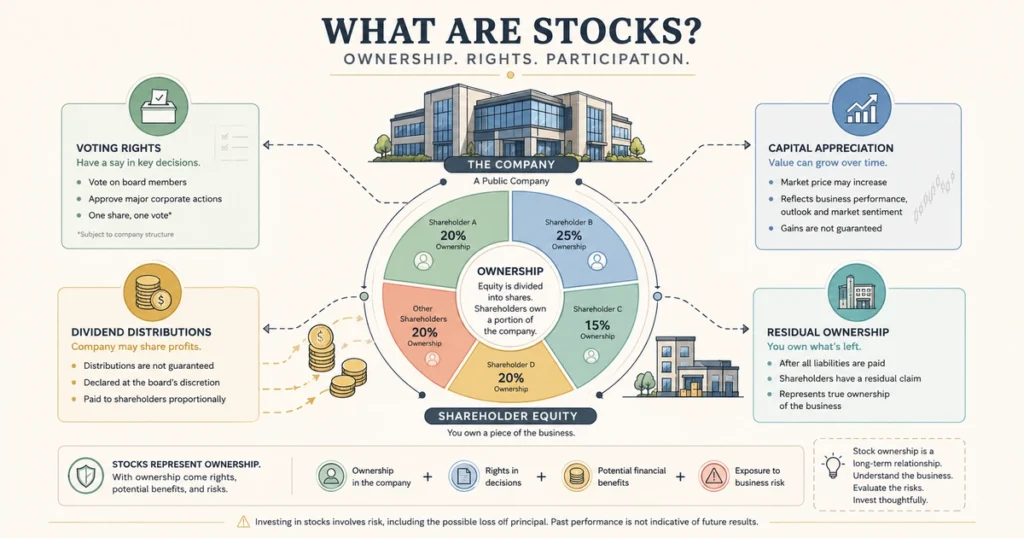
A stock represents an ownership interest in a corporation. Depending on the class of shares and the company’s governing documents, shareholders may receive voting rights, dividend distributions, and a residual claim on corporate assets after higher-priority obligations are satisfied. Unlike debt financing instruments (such as sovereign bonds, corporate debentures, or syndicated bank loans) that require strict contractual interest payments and principal return, stock represents permanent equity capital that carries no mandatory repayment obligation for the corporation. In modern global capital markets, equities serve two important economic functions: they provide operating businesses with permanent risk-sharing capital to fund long-term development, while providing investors with a mechanism for potential wealth generation through capital appreciation and dividend distributions.
The Foundational Core: What Is a Stock?
In financial and corporate-law terms, a stock represents an ownership interest in a corporation, with the specific rights determined by the class of shares and applicable corporate law.
A corporation’s authorized and issued capital is represented through shares, which are individual units of ownership in the company. If a corporation issues one million total shares and an investor purchases ten thousand shares, that investor possesses exactly one percent (1%) of the company’s total equity base.
+-------------------------------------------------------------------------------+
|                       THE ANATOMY OF CORPORATE STOCK OWNERSHIP                |
+----------------------+-----------------------------+--------------------------+
| CORPORATE COMPONENT  | SHAREHOLDER ENTITLEMENT     | OPERATIONAL MECHANISM    |
+----------------------+-----------------------------+--------------------------+
| Underlying Assets    | Residual Claim on Assets    | Post-liquidation surplus |
| Net Profits / Income | Potential Cash Dividends    | Board-approved payouts   |
| Corporate Direction  | Voting Governance           | Proxy voting at AGMs     |
| Corporate Growth     | Share Price Appreciation    | Secondary market trading |
+----------------------+-----------------------------+--------------------------+
The Principle of Limited Liability
The defining legal innovation that enables modern equity investment is limited liability. Under corporate statutes worldwide:
- Shareholders are legally distinct from the corporate entity itself.
- In standard cash purchases of shares, shareholders generally cannot lose more than the amount invested in the stock, as corporate creditors cannot lay claim to the personal assets of stockholders to satisfy unpaid debts.
- However, when market participants utilize specialized derivative structures, margin borrowing (financial leverage), or short selling (borrowing shares to sell with the obligation to repurchase them later), potential losses can exceed the initial cash balance.
The Vocabulary of Equity: Stocks, Shares, Equity, and Tickers
Financial literature and market reporting utilize specialized terms that describe different aspects of corporate ownership. While frequently used interchangeably in everyday conversation, each term carries a distinct structural meaning:
                      ┌─────────────────────────────────────────┐
                      │                 EQUITY                  │
                      │   (Total net worth: Assets - Debt)      │
                      └────────────────────┬────────────────────┘
                                           │
                                           ▼
                      ┌─────────────────────────────────────────┐
                      │                  STOCK                  │
                      │ (The collective asset class / category) │
                      └────────────────────┬────────────────────┘
                                           │
                                           ▼
                      ┌─────────────────────────────────────────┐
                      │                 SHARES                  │
                      │  (Individual countable units of stock)  │
                      └────────────────────┬────────────────────┘
                                           │
                                           ▼
                      ┌─────────────────────────────────────────┐
                      │              TICKER SYMBOL              │
                      │  (Exchange trading code: AAPL, MSFT)    │
                      └─────────────────────────────────────────┘
- Equity: The broad financial and accounting concept representing total ownership value. On a corporate balance sheet, stockholders’ equity equals total assets minus total liabilities ($\text{Equity} = \text{Assets} – \text{Liabilities}$).
- Stock: A general term for equity ownership in one or more corporations. An investor might state that their long-term investment allocation consists of 70% stock and 30% sovereign debt bonds.
- Share: The specific, individual unit of measurement used to quantify an investor’s exact stake in a single named company (e.g., “100 shares of Microsoft stock”).
- Security: A broad legal category encompassing any negotiable financial instrument that holds monetary value, including equities (stocks), debt securities (bonds), and derivative contracts.
- Ticker Symbol: A market identifier used to represent a listed security for trading and quotation on a particular exchange or trading venue (such as
AAPLin the United States orRELIANCEon the National Stock Exchange of India).
Why Equity Exists: The Corporate Capital Formation Engine
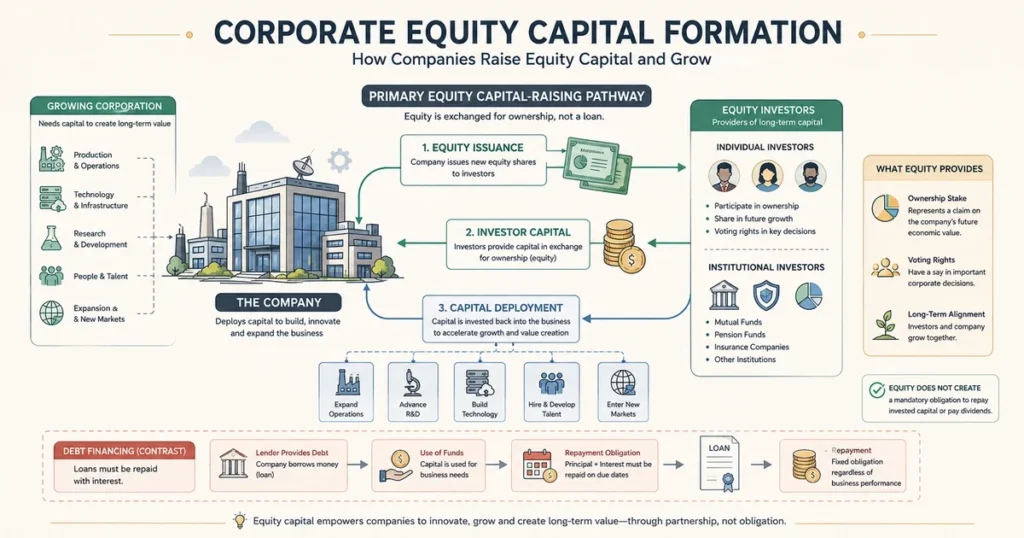
Operating businesses require capital to construct facilities, develop technology, finance research and development (R&D), hire specialized personnel, and expand into new markets.
When raising long-term expansion capital, a corporation evaluates two primary financing mechanisms:
+-------------------------------------------------------------------------------+
|                       DEBT FINANCING vs. EQUITY FINANCING                     |
+----------------------+-----------------------------+--------------------------+
| STRATEGIC DIMENSION  | DEBT FINANCING (BONDS/LOANS)| EQUITY FINANCING (STOCKS)|
+----------------------+-----------------------------+--------------------------+
| Capital Obligation   | Temporary; must be repaid   | Permanent; non-repayable |
| Cash Flow Demand     | Fixed interest payments     | Discretionary dividends  |
| Corporate Control    | Generally does not dilute   | Dilutes existing equity  |
|                      | ordinary ownership, though  | and voting control       |
|                      | debt covenants may restrict |                          |
|                      | certain corporate actions   |                          |
+----------------------+-----------------------------+--------------------------+
| Solvency Impact      | Increases financial leverage| Strengthens solvency     |
| Long-Term Cost       | Contractual cost of debt    | Cost of equity capital   |
+----------------------+-----------------------------+--------------------------+
The Strategic Value of Permanent Capital
Debt instruments impose a contractual financial burden: the borrowing corporation must pay scheduled interest and principal regardless of business profitability. Failure to service debt triggers default and potential insolvency proceedings.
Equity financing removes this structural fragility. When a company issues stock, it secures permanent capital. The company is not contractually obligated to return this capital to shareholders, nor is it legally bound to make fixed periodic dividend payments. In exchange, original owners share future earnings potential and corporate governance rights with new shareholders.
The Lifecycle of a Share: From Private Seed Capital to Public Listing
A stock typically progresses through a structured lifecycle of private and public funding stages:
                      ┌─────────────────────────────────────────┐
                      │      FOUNDER & SEED CAPITAL STAGE       │
                      │  (Initial concept, founders' equity,    │
                      │   angel investors, early incubators)    │
                      └────────────────────┬────────────────────┘
                                           │
                                           ▼
                      ┌─────────────────────────────────────────┐
                      │    VENTURE CAPITAL (SERIES A, B, C)     │
                      │  (Institutional VC funds, private scale-│
                      │   up funding, preferred private shares) │
                      └────────────────────┬────────────────────┘
                                           │
                                           ▼
                      ┌─────────────────────────────────────────┐
                      │     PRIVATE EQUITY & PRE-IPO GROWTH     │
                      │  (Late-stage growth equity, crossover   │
                      │   investors, operational scaling)       │
                      └────────────────────┬────────────────────┘
                                           │
                                           ▼
                      ┌─────────────────────────────────────────┐
                      │    INITIAL PUBLIC OFFERING (IPO)        │
                      │  (Underwriting, regulatory disclosure,  │
                      │   primary capital & secondary shares)   │
                      └────────────────────┬────────────────────┘
                                           │
                                           ▼
                      ┌─────────────────────────────────────────┐
                      │      SECONDARY EXCHANGE TRADING         │
                      │  (Continuous public liquidity across    │
                      │   global institutional networks)        │
                      └─────────────────────────────────────────┘
- Founder & Angel Rounds: Early-stage capital provided by founders and angel investors in exchange for common equity or convertible promissory instruments.
- Venture Capital Expansion (Series A through D+): Institutional venture capital firms inject growth capital in exchange for convertible preferred stock, which often carries specific protective covenants, anti-dilution terms, and liquidation preferences.
- The Initial Public Offering (IPO): An IPO is the process through which a private company becomes publicly traded and may raise capital by issuing new shares; in some offerings, existing shareholders may also sell shares. The issuing company partners with investment bank underwriters who conduct due diligence, draft prospectuses, and price the offering.
- Secondary Market Trading: Following the IPO listing, the company’s shares begin trading continuously on secondary public exchanges, allowing investors to trade shares among themselves.
Mechanics of Price Discovery: Order Books, Bids, Asks, and Spreads
On many modern electronic exchanges, stock prices are formed through the interaction of buy and sell orders within an electronic central limit order book (CLOB), although market structure and execution mechanisms vary by venue.
                      ┌─────────────────────────────────────────┐
                      │       ELECTRONIC ORDER BOOK (CLOB)      │
                      └────────────────────┬────────────────────┘
                                           │
         ┌─────────────────────────────────┴─────────────────────────────────┐
         │                                                                   │
         ▼                                                                   ▼
┌──────────────────────────────────┐               ┌──────────────────────────────────┐
│         THE BID QUEUE            │               │         THE ASK QUEUE            │
│  (Buyers waiting in price order) │               │  (Sellers waiting in price order)│
├──────────────────────────────────┤               ├──────────────────────────────────┤
│ 100 shares @ $149.98             │               │ 200 shares @ $150.02             │
│ 500 shares @ $149.95             │               │ 400 shares @ $150.05             │
│ 1,200 shares @ $149.90           │               │ 800 shares @ $150.10             │
└──────────────────────────────────┘               └──────────────────────────────────┘
                                   │               │
                                   └───────┬───────┘
                                           │
                                    [BID-ASK SPREAD]
                                   ($150.02 - $149.98 = $0.04)
The Key Components of Market Microstructure
- The Bid Price: The highest price that any prospective buyer in the market is currently displaying to purchase a share.
- The Ask (Offer) Price: The lowest price that any prospective seller is currently displaying to sell their share.
- The Bid-Ask Spread: The mathematical difference between the lowest Ask and the highest Bid ($\text{Spread} = \text{Ask} – \text{Bid}$). This spread represents transaction friction and compensates liquidity providers (market makers).
- Market Orders: An instruction to buy or sell immediately at the best available current market price in the order book, prioritizing execution speed over price level.
- Limit Orders: An instruction to buy or sell a share only at a specified price or better, prioritizing price certainty over execution immediacy.
When an aggressive market buy order arrives, it matches against the lowest available Ask in the book. If buying volume persistently consumes resting Ask orders, the displayed price tends to adjust upward. Conversely, when selling volume clears out resting Bid orders, the displayed market price moves downward.
Comprehensive Taxonomy of Stocks
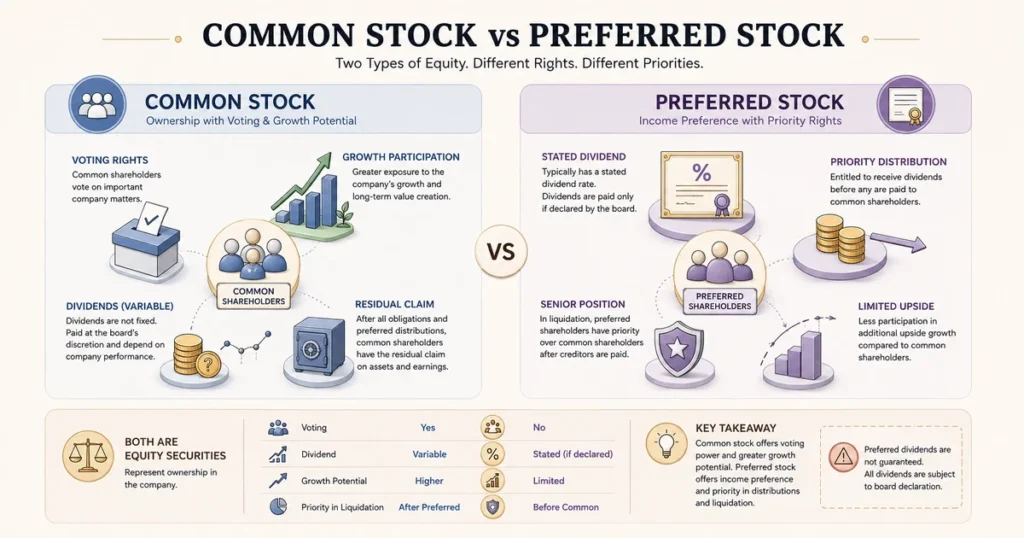
Equity securities are classified across multiple dimensions based on governance structures, balance sheet attributes, corporate maturity, and economic sensitivity:
+-------------------------------------------------------------------------------+
|                       THE MULTI-DIMENSIONAL EQUITY TAXONOMY                   |
+----------------------+-----------------------------+--------------------------+
| TAXONOMY DIMENSION   | PRIMARY CATEGORIES          | CORE DEFINING ATTRIBUTE  |
+----------------------+-----------------------------+--------------------------+
| Legal & Capital Class| Common vs. Preferred        | Voting rights vs. stated |
|                      |                             | dividend priority        |
+----------------------+-----------------------------+--------------------------+
| Company Size         | Mega / Large / Mid / Small  | Relative market cap and  |
|                      |                             | institutional coverage   |
+----------------------+-----------------------------+--------------------------+
| Investment Style     | Growth vs. Value            | Earnings growth rate     |
|                      |                             | vs. valuation multiples  |
+----------------------+-----------------------------+--------------------------+
| Macro Sensitivity    | Cyclical vs. Defensive      | GDP cycle sensitivity vs.|
|                      |                             | inelastic basic demand   |
+----------------------+-----------------------------+--------------------------+
| Geographic Exposure  | Domestic / Developed /      | Sovereign jurisdiction   |
|                      | Emerging / Frontier         | and regulatory framework |
+----------------------+-----------------------------+--------------------------+
1. Common Stock vs. Preferred Stock
- Common Stock: Grants standard voting power, participation in corporate governance, variable dividends, and full exposure to long-term capital growth or operational contraction.
- Preferred Stock: Preferred stock is an equity security with characteristics that can resemble fixed-income instruments, such as stated dividends and priority over common stock in liquidation.
2. Dual-Class Share Structures
Certain corporations issue multi-tier share classes (e.g., Class A and Class B shares):
- Class A Shares: Publicly traded shares typically carrying standard voting rights (e.g., one vote per share).
- Class B Shares: Held by founders, executive leadership, and early insiders, frequently carrying multiple votes per share.
- This structure allows corporate leadership to maintain strategic direction while accessing public capital markets.
3. Market Capitalization Tiers
Market-cap categories such as mega-cap, large-cap, mid-cap, small-cap, and micro-cap are commonly used to describe company size, but the exact capitalization thresholds vary by market, index provider, and data source:
- Mega-Cap & Large-Cap Stocks: Established enterprises with broad market capitalizations, extensive revenue bases, and significant institutional liquidity.
- Mid-Cap Stocks: Medium-sized operating businesses balancing proven operational maturity with ongoing expansion potential.
- Small-Cap & Micro-Cap Stocks: Emerging or niche enterprises offering higher potential growth rates, accompanied by elevated operational and liquidity risks.
4. Growth Stocks vs. Value Stocks
- Growth Stocks: Companies expanding revenues and earnings faster than the broader industry average. These firms often reinvest most operational cash flows into research and expansion, frequently trading at higher valuation multiples.
- Value Stocks: Established businesses trading at valuation multiples that appear discounted relative to underlying assets, earnings streams, or historical averages, often providing recurring dividend yields.
5. Cyclical Stocks vs. Defensive Stocks
- Cyclical Stocks: Operating profitability fluctuates directly with the broader macroeconomic business cycle (e.g., industrials, semiconductors, automotive, consumer discretionary).
- Defensive (Non-Cyclical) Stocks: Companies providing essential products and services with relatively inelastic demand across economic cycles (e.g., regulated utilities, healthcare, consumer staples).
Shareholder Rights, Corporate Governance, and Proxy Voting
Common shareholders may have statutory and contractual rights that vary by jurisdiction, share class, and the company’s governing documents:
                      ┌─────────────────────────────────────────┐
                      │       STATUTORY SHAREHOLDER RIGHTS      │
                      └────────────────────┬────────────────────┘
                                           │
         ┌─────────────────────────────────┼─────────────────────────────────┐
         │                                 │                                 │
         ▼                                 ▼                                 ▼
┌──────────────────┐             ┌──────────────────┐             ┌──────────────────┐
│ VOTING POWER     │             │ INFORMATION &    │             │ PROPORTIONAL     │
│ & GOVERNANCE     │             │ DISCLOSURE       │             │ PARTICIPATION    │
├──────────────────┤             ├──────────────────┤             ├──────────────────┤
│ * Board election │             │ * Audited reports│             │ * Dividends      │
│ * Major M&A votes│             │ * Material events│             │ * Pre-emptive    │
│ * Proxy ballots  │             │ * General meetings│             │   rights (issues)│
└──────────────────┘             └──────────────────┘             └──────────────────┘
- Right to Elect the Board of Directors: Shareholders elect board members who oversee executive management and corporate governance.
- Proxy Voting Mechanisms: Shareholders can cast votes electronically on board nominees, executive compensation frameworks, independent auditor appointments, and shareholder proposals via formal proxy statements.
- Information & Disclosure Rights: Shareholders hold the right to review periodic audited financial statements and material corporate disclosures.
- Pre-emptive Rights: Where provided by corporate charters or national statutes, existing shareholders may receive the opportunity to participate in new share issues to maintain their proportional ownership.
- Derivative Legal Actions: In cases of alleged fiduciary breach or gross misconduct by directors, eligible shareholders may pursue legal remedies on behalf of the corporation under applicable statutory procedures.
Corporate Actions: Splits, Buybacks, Rights Issues, and Bonus Shares
Public corporations execute structural capital adjustments that alter share counts and balance sheet allocations:
+-------------------------------------------------------------------------------+
|                      COMMON CORPORATE ACTIONS & CAPITAL IMPACT                |
+----------------------+-----------------------------+--------------------------+
| ACTION TYPE          | STRUCTURAL EXECUTION        | DIRECT SHAREHOLDER EFFECT|
+----------------------+-----------------------------+--------------------------+
| Forward Stock Split  | Increases share count;      | Adjusts per-share price; |
| (e.g., 2-for-1)      | lowers nominal share price  | total equity unchanged   |
+----------------------+-----------------------------+--------------------------+
| Reverse Stock Split  | Consolidates share count;   | Raises per-share price;  |
| (e.g., 1-for-10)     | raises nominal share price  | total equity unchanged   |
+----------------------+-----------------------------+--------------------------+
| Share Repurchase     | Company acquires own shares | Reduces share count;     |
| (Buyback)            | from open market            | alters capital structure |
+----------------------+-----------------------------+--------------------------+
| Bonus Issue / Stock  | Distributes additional      | Capitalizes reserves;    |
| Dividend             | shares to existing owners   | total equity unchanged   |
+----------------------+-----------------------------+--------------------------+
| Rights Offering      | Grants rights to purchase   | Allows owners to maintain|
|                      | newly issued shares         | proportional ownership   |
+----------------------+-----------------------------+--------------------------+
1. Forward and Reverse Stock Splits
A stock split is an administrative adjustment that changes the number of outstanding shares without altering the company’s overall market capitalization:
- Forward Split: Increases the number of shares while proportionally lowering the price per share, often utilized to make share prices more accessible to individual investors.
- Reverse Split: Consolidates multiple shares into one higher-priced share, often implemented to satisfy exchange minimum bid price requirements.
2. Share Repurchases (Stock Buybacks)
When a corporation generates surplus cash, the board of directors may authorize share buybacks. If net income remains unchanged, reducing the number of shares outstanding mechanically increases EPS, although the overall economic effect of a buyback depends on its price, financing, and alternative uses of capital.
The Dual Return Engine: Capital Appreciation and Dividends
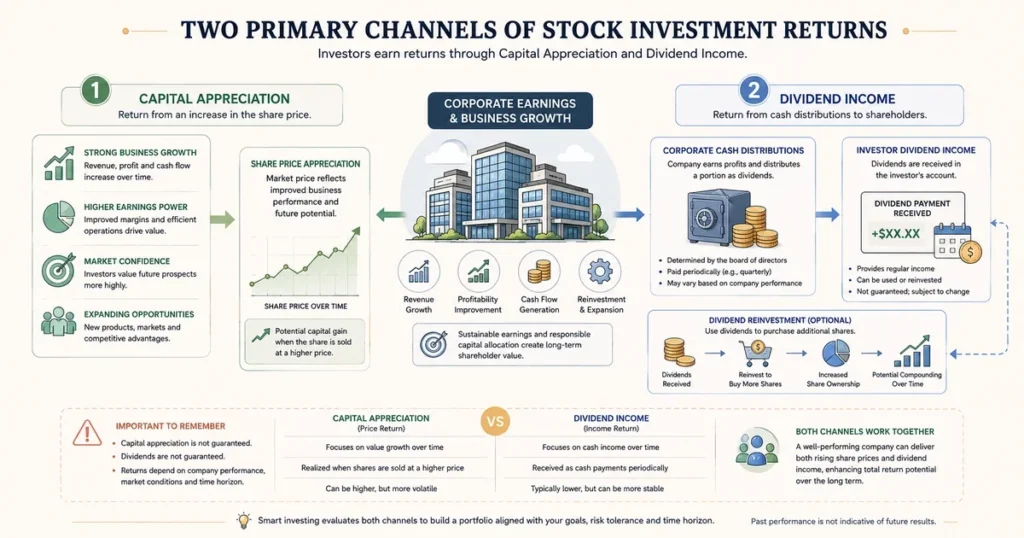
Investors in common equities generate returns through two core financial channels:
                      ┌─────────────────────────────────────────┐
                      │      TOTAL SHAREHOLDER RETURN (TSR)     │
                      └────────────────────┬────────────────────┘
                                           │
         ┌─────────────────────────────────┴─────────────────────────────────┐
         │                                                                   │
         ▼                                                                   ▼
┌──────────────────┐               ┌──────────────────────────────────┐
│       CAPITAL APPRECIATION       │               │        CASH DIVIDEND INCOME      │
│   (Share price increases from    │               │  (Discretionary payouts funded   │
│    earnings growth & valuation)  │               │   from corporate profits)        │
├──────────────────┤               ├──────────────────────────────────┤
│ * Unrealized until sold          │               │ * Cash distributions to account  │
│ * Driven by revenue/margin gains │               │ * Can be reinvested via DRIP     │
│ * Subject to tax rules           │               │ * Provides income yield          │
└──────────────────┘               └──────────────────────────────────┘
1. Capital Appreciation (Capital Gains)
Capital appreciation occurs when the market price of a stock increases above its purchase price:
$$\text{Capital Gain} = P_{\text{Sell}} – P_{\text{Buy}}$$
Capital appreciation is linked fundamentally to the expansion of corporate earnings power, market opportunities, and long-term business execution.
2. Cash Dividends and Compounding
Dividends represent cash distributions of corporate profits transferred to shareholders of record:
- Dividend Yield: The annual dividend payout expressed as a percentage of the current share price:
$$\text{Dividend Yield} = \left( \frac{\text{Annual Dividend Per Share}}{\text{Current Market Price}} \right) \times 100$$
- Dividend Payout Ratio: The proportion of net income distributed as dividends rather than retained for business operations:
$$\text{Payout Ratio} = \left( \frac{\text{Total Dividends Paid}}{\text{Net Income}} \right) \times 100$$
- Dividend Reinvestment Plans (DRIPs): Over long investment horizons, reinvesting dividends can create compounding as additional shares generate future dividend income and potential capital appreciation.
- Simplified Total Return Framework: For a simplified holding-period estimate, total return can be approximated by capital appreciation plus dividend income relative to the original investment:
$$\text{Estimated Total Return} \approx \frac{(P_{\text{End}} – P_{\text{Initial}}) + \text{Dividends Received}}{P_{\text{Initial}}} \times 100$$
Valuation Fundamentals: How Markets Determine Share Value
To evaluate stock pricing, market participants utilize established valuation models:
+-------------------------------------------------------------------------------+
|                       KEY FINANCIAL VALUATION METRICS                         |
+----------------------+-----------------------------+--------------------------+
| VALUATION RATIO      | MATHEMATICAL FORMULA        | ANALYTICAL OBJECTIVE     |
+----------------------+-----------------------------+--------------------------+
| Earnings Per Share   | Net Income - Pref. Divs /   | Measures net profit      |
| (EPS)                | Total Outstanding Shares    | generated per share      |
+----------------------+-----------------------------+--------------------------+
| Price-to-Earnings    | Current Share Price /       | Gauges market valuation  |
| (P/E Ratio)          | Annual Earnings Per Share   | relative to earnings     |
+----------------------+-----------------------------+--------------------------+
| Price-to-Book        | Current Share Price /       | Compares market value to |
| (P/B Ratio)          | Book Value Per Share        | accounting net asset val.|
+----------------------+-----------------------------+--------------------------+
| Enterprise Value to  | Enterprise Value /          | Capital-structure-neutral|
| EBITDA (EV/EBITDA)   | Operating EBITDA            | cash flow valuation      |
+----------------------+-----------------------------+--------------------------+
1. Absolute Valuation: Discounted Cash Flow (DCF)
In a fundamental valuation framework, intrinsic value can be estimated as the present value of expected future cash flows, discounted using a risk-adjusted rate reflecting the cost of capital:
$$\text{Estimated Value} = \sum_{t=1}^{n} \frac{\text{Free Cash Flow}_t}{(1 + r)^t} + \frac{\text{Terminal Value}}{(1 + r)^n}$$
Where $r$ represents the discount rate (such as the Weighted Average Cost of Capital).
2. Relative Valuation Multiples
Relative valuation compares a company’s financial multiples (such as P/E, EV/EBITDA, or Price-to-Sales) against historical trends, industry averages, and peer benchmarks to assess relative pricing.
Capital Structure and the Absolute Priority Rule
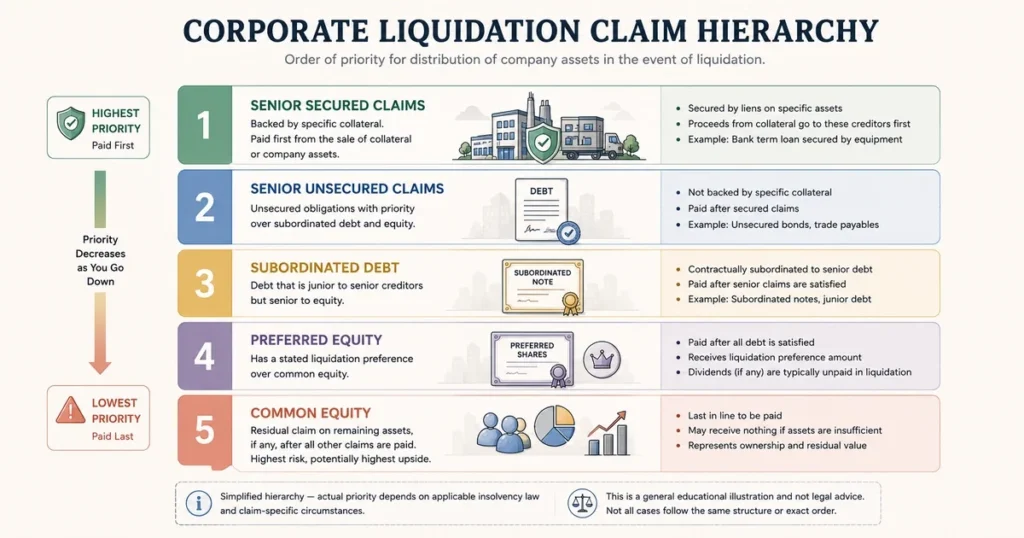
A corporation’s capital structure consists of the combination of debt, preferred instruments, and common equity used to finance operations.
In formal insolvency or liquidation proceedings, asset distribution follows the Absolute Priority Rule:
Simplified illustration; actual claim priority depends on applicable insolvency law, security interests, statutory priorities, and the specific circumstances of the proceeding.
                      ┌─────────────────────────────────────────┐
                      │    TIER 1: SENIOR SECURED DEBTHOLDERS   │
                      │  (Collateralized bank loans, mortgages) │
                      └────────────────────┬────────────────────┘
                                           │ (Senior claim on pledged assets)
                                           ▼
                      ┌─────────────────────────────────────────┐
                      │   TIER 2: SENIOR UNSECURED CREDITORS    │
                      │  (Corporate bonds, trade vendors)       │
                      └────────────────────┬────────────────────┘
                                           │
                                           ▼
                      ┌─────────────────────────────────────────┐
                      │   TIER 3: SUBORDINATED DEBT HOLDERS     │
                      │  (Junior debentures, mezzanine debt)    │
                      └────────────────────┬────────────────────┘
                                           │
                                           ▼
                      ┌─────────────────────────────────────────┐
                      │    TIER 4: PREFERRED STOCKHOLDERS       │
                      │  (Stated liquidation preference payout) │
                      └────────────────────┬────────────────────┘
                                           │
                                           ▼
                      ┌─────────────────────────────────────────┐
                      │     TIER 5: COMMON STOCKHOLDERS         │
                      │  (Residual claimants: highest risk)     │
                      └────────────────────┬────────────────────┘
Because common stockholders occupy the final tier, they hold a residual claim on corporate assets. Debtholders and senior claimants must be satisfied before common equity receives any liquidation proceeds.
Primary vs. Secondary Markets and Exchange Plumbing
Equity transactions operate through a coordinated financial infrastructure:
                      ┌─────────────────────────────────────────┐
                      │             RETAIL / BUY-SIDE           │
                      │   (Individual accounts, asset managers) │
                      └────────────────────┬────────────────────┘
                                           │
                              (Order Routing & Connectivity)
                                           ▼
                      ┌─────────────────────────────────────────┐
                      │          BROKER-DEALER ROUTER           │
                      │   (Smart order routers, internalizers)  │
                      └────────────────────┬────────────────────┘
                                           │
                               (Order Matching Engine Execution)
                                           ▼
                      ┌─────────────────────────────────────────┐
                      │          STOCK EXCHANGE (MATCH)         │
                      │   (Regulated electronic matching venue) │
                      └────────────────────┬────────────────────┘
                                           │
                           (Clearing & Novation Process)
                                           ▼
                      ┌─────────────────────────────────────────┐
                      │      CENTRAL CLEARING HOUSE (CCP)       │
                      │   (Novation & counterparty risk mgmt)   │
                      └────────────────────┬────────────────────┘
                                           │
                             (Book-Entry Ownership Transfer)
                                           ▼
                      ┌─────────────────────────────────────────┐
                      │     CENTRAL DEPOSITORY (CSD / CUSTODY)  │
                      │   (Dematerialized book-entry records)   │
                      └─────────────────────────────────────────┘
Clearing and Settlement
- Execution: The trade matches on a regulated exchange or electronic execution venue.
- Clearing: Where applicable, a Central Counterparty (CCP) becomes the counterparty to cleared trades and manages associated counterparty risk. Not all equity transactions are centrally cleared.
- Settlement: Settlement cycles vary by jurisdiction and security. In markets that operate on a $T+1$ standard, eligible transactions generally settle one business day after the trade date via dematerialized central securities depositories.
Systematic vs. Unsystematic Equity Risks
Institutional risk frameworks divide equity volatility into two primary components:
+-------------------------------------------------------------------------------+
|                       SYSTEMATIC vs. UNSYSTEMATIC RISK DYNAMICS               |
+----------------------+-----------------------------+--------------------------+
| RISK COMPONENT       | SYSTEMATIC RISK (MARKET)    | UNSYSTEMATIC RISK (IDIOS.)|
+----------------------+-----------------------------+--------------------------+
| Scope                | Broad macroeconomic forces  | Company- or sector-      |
|                      |                             | specific factors         |
+----------------------+-----------------------------+--------------------------+
| Key Drivers          | Interest rates, recessions, | Executive changes,       |
|                      | broad liquidity shifts      | product failure, strikes |
+----------------------+-----------------------------+--------------------------+
| Diversification      | Cannot be eliminated by     | Can be substantially     |
| Capability           | holding more equities alone | reduced through asset    |
|                      |                             | diversification          |
+----------------------+-----------------------------+--------------------------+
1. Systematic (Market) Risk
Systematic risk originates from broad macroeconomic developments that affect the entire market simultaneously (such as benchmark interest rate cycles, inflation shocks, or global economic recessions).
2. Unsystematic (Idiosyncratic) Risk
Unsystematic risk refers to factors unique to a specific company or narrow sector. According to the principles of Modern Portfolio Theory, diversification across sufficiently different securities can substantially reduce unsystematic risk, although the degree of diversification achieved depends on the number, correlation, and concentration of holdings.
Macroeconomic Transmission Channels: How Global Forces Move Stocks
Equities respond continuously to broader macroeconomic transmission channels:
                      ┌─────────────────────────────────────────┐
                      │    CENTRAL BANK BENCHMARK POLICY RATES  │
                      └────────────────────┬────────────────────┘
                                           │
         ┌─────────────────────────────────┼─────────────────────────────────┐
         │                                 │                                 │
         ▼                                 ▼                                 ▼
┌──────────────────┐             ┌──────────────────┐             ┌──────────────────┐
│ THE DISCOUNT     │             │ MACRO CONSUMER   │             │ CURRENCY & TRADE │
│  RATE CHANNEL    │             │  DEMAND (GDP)    │             │  COMPETITIVENESS │
├──────────────────┤             ├──────────────────┤             ├──────────────────┤
│ Policy rate shifts|             │ Economic growth  │             │ Exchange rate    │
│ alter borrowing  │             │ patterns impact  │             │ movements affect │
│ costs and hurdle │             │ corporate sales  │             │ multinational    │
│ rate valuations  │             │ and profitability│             │ earnings translation|
└──────────────────┘             └──────────────────┘             └──────────────────┘
- The Discount Rate Channel: Shifts in benchmark policy rates alter risk-free yields, impacting corporate borrowing costs and the discount rates applied to future earnings projections.
- Economic Growth Patterns: Growth in real Gross Domestic Product (GDP) supports corporate revenue and operating profitability across industries.
- Inflation and Cost Structures: Rising raw material, logistics, and labor expenses affect corporate margins, with the ultimate impact depending on a firm’s market pricing power.
- Foreign Exchange Rates: For multinational corporations, currency fluctuations influence international price competitiveness and the translation value of foreign earnings.
Portfolio Implementation: Active Selection vs. Passive Indexation
Investors approach equity markets through two distinct portfolio strategies:
+-------------------------------------------------------------------------------+
|                       ACTIVE SELECTION vs. PASSIVE INDEXATION                 |
+----------------------+-----------------------------+--------------------------+
| STRATEGY DIMENSION   | ACTIVE MANAGEMENT           | PASSIVE INDEXATION       |
+----------------------+-----------------------------+--------------------------+
| Primary Objective    | Seek benchmark outperformance| Match benchmark returns  |
|                      | (Alpha)                     | (Beta)                   |
+----------------------+-----------------------------+--------------------------+
| Vehicle              | Individual stocks, actively | Index funds, broad       |
|                      | managed funds/ETFs          | market ETFs              |
+----------------------+-----------------------------+--------------------------+
| Expense Structure    | Typically higher management | Generally lower expense  |
|                      | and turnover costs          | ratios and lower turnover|
+----------------------+-----------------------------+--------------------------+
- Active Equity Selection: Involves analyzing individual business fundamentals, financial statements, and competitive positioning with the goal of outperforming a specified market index.
- Passive Indexation: Involves holding a broad market index (such as the S&P 500, FTSE 100, or Nifty 50) via exchange-traded funds (ETFs) or index mutual funds to capture overall market returns with low turnover and management costs.
Frequently Asked Questions (Institutional FAQ)
What is the difference between buying a stock and buying a bond?
Buying a stock represents equity ownership in a corporation with entitlement to potential dividends and capital appreciation, alongside residual claim risk. Buying a bond represents lending capital to a corporation or government entity in exchange for contractual interest payments and principal return at maturity.
Can an investor lose more money than they invest in stocks?
In standard cash purchases of shares, an investor generally cannot lose more than the initial capital invested due to limited liability. However, strategies involving leverage, margin borrowing, or short selling can expose investors to losses exceeding the initial deposit.
What causes stock prices to fluctuate continuously during market hours?
In actively traded markets, stock prices move in response to shifting order-book supply and demand. Incoming buy orders at the ask price and sell orders at the bid price continually rebalance prices based on earnings data, economic reports, interest rate expectations, and market sentiment.
Are public corporations required to pay dividends?
No. Dividend distributions are discretionary and decided by the corporate board of directors based on operating earnings, capital requirements, and strategic growth plans.
What is the difference between an IPO and secondary market trading?
An Initial Public Offering (IPO) is the process through which a private company becomes publicly traded and may raise capital by issuing new shares, with the capital proceeds flowing to the issuing company (or selling shareholders). Secondary market trading involves investors trading existing shares among themselves on public exchanges without capital flowing directly to the issuing company.
Strategic Summary & Institutional Takeaways
Understanding what stocks are establishes the groundwork for analyzing corporate finance, institutional markets, and long-term portfolio allocation.
Stocks represent fractional equity ownership in corporate enterprises, converting business innovation and economic productivity into investable assets. By issuing shares, companies access permanent capital to fund operational growth, while secondary electronic exchanges provide continuous liquidity, price discovery, and transparent trading infrastructure.
By understanding share classes, evaluating valuation metrics, and managing market and company-specific risks, investors and analysts can navigate equity markets with clarity, discipline, and macroeconomic perspective.
Next Reading Suggestions
- [Stock Market History: The Evolution of Global Equity Markets and Capital Systems]
- [Currency Exchange Rate: How Foreign Currencies Are Valued and Traded]
- [Inflation and Currency: The Macroeconomic Transmission Mechanism]
- [Interest Rates and Exchange Rates: The Macroeconomic Transmission Mechanism]
Author Box & E-E-A-T Verification
Written By: CurrencyPlans Financial Research Team
Fact-Checked & Reviewed By: Senior Institutional Market Analyst & Equity Strategist
Editorial Integrity & Research Standards: CurrencyPlans publishes institutional-grade research grounded in verified corporate finance principles, academic financial economics, and regulatory disclosures. All capital market structures, shareholder rights, and exchange mechanisms are cross-referenced with primary multilateral institutions and securities regulatory frameworks, including the US Securities and Exchange Commission (SEC), the Financial Industry Regulatory Authority (FINRA), and the World Federation of Exchanges (WFE).
Primary Institutional References & Regulatory Resources
For official regulatory guidelines, market standards, and global securities frameworks, consult primary institutional sources directly:
- Global Exchange Statistics & Market Architecture: World Federation of Exchanges (WFE)
- Investor Education & Securities Regulations: US Securities and Exchange Commission (SEC)
- Capital Market Governance & Regulatory Standards: Financial Industry Regulatory Authority (FINRA)
- Global Macroeconomic & Capital Flow Research: Bank for International Settlements (BIS)
- International Financial Statistics & Capital Market Data: International Monetary Fund (IMF) Data Portal
Educational Disclaimer
This guide is prepared strictly for educational, informational, and research purposes and does not constitute financial, investment, legal, or tax advice. Equities and capital market instruments carry inherent risk of capital loss, price volatility, and business failure. Past performance does not guarantee future results. Always perform independent due diligence and consult a licensed financial advisor before making investment commitments.

