
Introduction
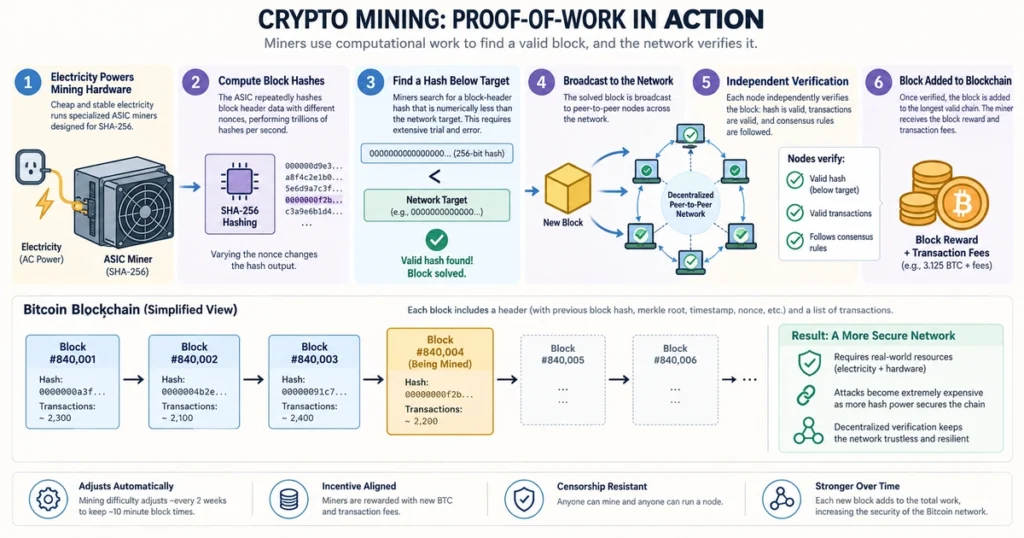
Cryptocurrency mining is the distributed algorithmic process through which Proof-of-Work (PoW) blockchains achieve consensus, enforce state transitions, prevent double-spending, and mint new monetary units. Popular culture frequently mischaracterizes mining as computers “solving complex mathematical puzzles.” In rigorous computer science, Bitcoin mining is a competitive brute-force cryptographic search for a block-header hash that falls below the network’s target threshold.
Invented as the foundational security engine for Bitcoin by Satoshi Nakamoto in 2008, Proof-of-Work binds digital scarcity to physical reality. By requiring miners to expend quantifiable electrical energy and computational capital, the network establishes a physical cost barrier to alter historical records. To rewrite past transactions, an adversary must muster more computational power than the rest of the honest network combined—a defense model that has safeguarded hundreds of billions of dollars across the Bitcoin network without downtime since January 2009.
Modern cryptocurrency mining has evolved from a hobbyist experiment executed on personal computer CPUs into a capital-intensive global computing industry utilizing advanced semiconductors (Application-Specific Integrated Circuits, or ASICs), specialized data facilities, flexible energy off-take agreements, and sophisticated coordination protocols. Understanding mining requires analyzing block header anatomy, the dynamic difficulty adjustment, payout mathematics in mining pools, structural halving cycles, and the nuanced intersection between computation and electrical power grids.
Executive Summary & Core Thesis
Quick Answer: What Is Crypto Mining?
Crypto mining is the computational process used by Proof-of-Work blockchains to verify transactions, organize them into chronological blocks, and secure the network without a central authority. Specialized computing hardware repeatedly hashes block data, searching for a value that meets a strict mathematical threshold set by the protocol. The first miner to find a valid solution earns the right to broadcast the new block to the network, collecting a predetermined reward in newly minted coins (the block subsidy) plus transaction fees paid by users.
Far from being an arbitrary energy drain, mining serves four simultaneous, structural roles within decentralized monetary systems:
- Sybil Resistance: It prevents attackers from creating millions of virtual nodes to hijack the network by tying consensus influence strictly to real-world capital and electrical costs.
- Transaction Ordering & Probabilistic Settlement: It establishes a canonical chain of transaction ordering under the network’s consensus rules, making confirmed transactions increasingly difficult to reverse as additional blocks accumulate.
- Programmatic Monetary Issuance: It fairly distributes newly created currency across market participants according to mathematical supply curves, avoiding central bank discretion.
- Thermodynamic Immutability: It buries settled transactions under an ever-accumulating chain of physical work, making historical ledger alterations economically catastrophic for attackers, as detailed in our guide on what is blockchain.
Foundational Definition: What Is Crypto Mining?
To evaluate cryptocurrency mining with institutional rigor, it must be evaluated across its functional mechanisms rather than popular metaphors:
                      ┌─────────────────────────────────────────┐
                      │    THE QUAD-PARTITE ROLE OF MINING      │
                      └────────────────────┬────────────────────┘
                                           │
         ┌───────────────────┬─────────────┴───────┬───────────────────┐
         ▼                   ▼                     ▼                   ▼
┌─────────────────┐ ┌─────────────────┐   ┌─────────────────┐ ┌─────────────────┐
│ SYBIL           │ │ UNBIASED        │   │ DECENTRALIZED   │ │ THERMODYNAMIC   │
│ RESISTANCE      │ │ STATE ORDERING  │   │ COIN ISSUANCE   │ │ SETTLEMENT      │
├─────────────────┤ ├─────────────────┤   ├─────────────────┤ ├─────────────────┤
│ Forces capital  │ │ Establishes an  │   │ Releases native │ │ Encapsulates    │
│ expenditure so  │ │ objective time- │   │ units on a fixed│ │ past blocks     │
│ identities      │ │ chain without a │   │ mathematical    │ │ behind massive  │
│ cannot be faked │ │ central clock   │   │ supply schedule │ │ energy barriers │
└─────────────────┘ └─────────────────┘   └─────────────────┘ └─────────────────┘
Comparative Architecture: Mining (PoW) vs. Staking (PoS)
Understanding mining requires contrasting it with its primary alternative, Proof of Stake (PoS), which replaced mining on Ethereum during “The Merge” in September 2022:
| Structural Metric | Proof of Work (Crypto Mining) | Proof of Stake (Validator Staking) |
| Consensus Anchor | Physical hardware, semiconductors, and electricity | Bonded financial capital (native protocol tokens) |
| Leading Implementation | Bitcoin (BTC), Litecoin (LTC), Kaspa (KAS) | Ethereum (ETH), Solana (SOL), Cardano (ADA) |
| Sybil Deterrent | Hashrate generation costs (electricity, hardware, and operating costs) | Financial stake that can be penalized through protocol-defined slashing or other economic penalties for certain infractions |
| Hardware Dependency | Application-Specific Integrated Circuits (ASICs) or GPUs, depending on the network | Standard server-grade or commodity computing hardware, depending on the network |
| Energy Consumption | Substantial physical electricity demand; Bitcoin alone is currently estimated at roughly ~0.5% of global electricity consumption | Very low operational energy demand relative to PoW; Ethereum’s transition to PoS reduced its energy consumption by roughly 99.95% |
| Censorship Dynamic | Security depends partly on geographically distributed physical infrastructure and access to electricity | Security depends on distributed economic stake and validator participation; validator concentration can create governance, operational, or regulatory risks |
To understand how consensus mechanisms function within the broader token economy, read our foundational guides on what is bitcoin and what is ethereum.
How Crypto Mining Works: The 6-Stage Consensus Lifecycle
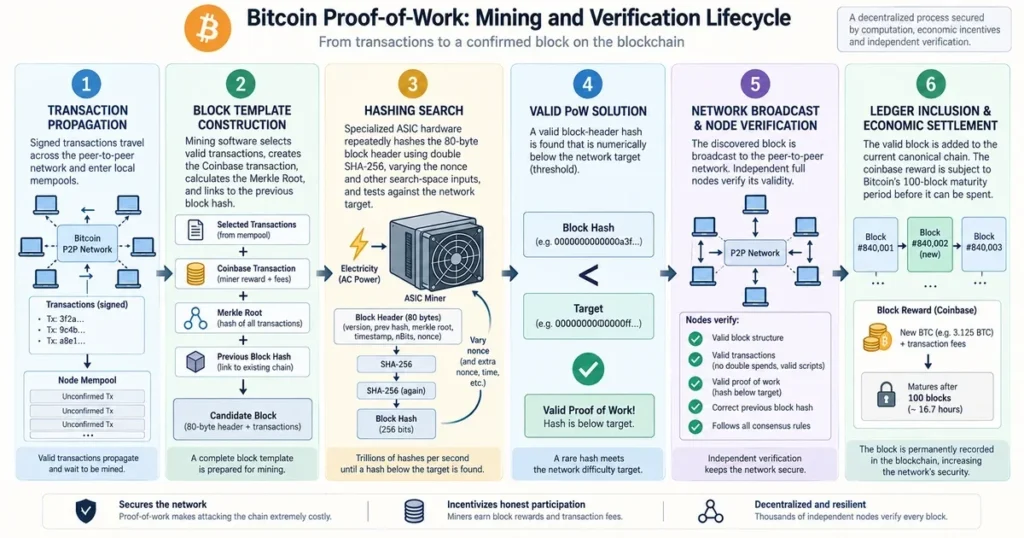
The process of taking an unconfirmed transaction and incorporating it into the current canonical chain of a Proof-of-Work blockchain follows a six-step execution pipeline:
                      ┌─────────────────────────────────────────┐
                      │   STAGE 1: TRANSACTION PROPAGATION      │
                      │  Users broadcast signed transactions;   │
                      │  nodes validate and store in Mempools   │
                      └────────────────────┬────────────────────┘
                                           │
                                 (Candidate Selection)
                                           ▼
                      ┌─────────────────────────────────────────┐
                      │   STAGE 2: BLOCK TEMPLATE CONSTRUCTION  │
                      │  Miner selects transactions, computes   │
                      │  Merkle Root, links Previous Block Hash │
                      └────────────────────┬────────────────────┘
                                           │
                                  (Brute-Force Search)
                                           ▼
                      ┌─────────────────────────────────────────┐
                      │   STAGE 3: THE HASHING SEARCH LOOP      │
                      │  Hardware iterates Nonce + ExtraNonce:  │
                      │  SHA256(SHA256(Block_Header)) < Target? │
                      └────────────────────┬────────────────────┘
                                           │
                              (Valid PoW Solution Found)
                                           ▼
                      ┌─────────────────────────────────────────┐
                      │   STAGE 4: NETWORK BLOCK BROADCAST      │
                      │  Miner discovers valid proof and pushes │
                      │  header and payload to P2P peers        │
                      └────────────────────┬────────────────────┘
                                           │
                                (Independent Validation)
                                           ▼
                      ┌─────────────────────────────────────────┐
                      │   STAGE 5: FULL-NODE RULE ENFORCEMENT   │
                      │  Nodes independently verify PoW validity│
                      │  and append block to local ledgers      │
                      └────────────────────┬────────────────────┘
                                           │
                                (Coinbase Distribution)
                                           ▼
                      ┌─────────────────────────────────────────┐
                      │   STAGE 6: ECONOMIC SETTLEMENT          │
                      │  Miner spends coinbase rewards after the│
                      │  protocol's 100-block maturity period   │
                      └─────────────────────────────────────────┘
- Transaction Broadcast to Mempool: Users sign transactions using private keys, broadcasting them to peer-to-peer nodes. Each node validates signatures and parameters, storing valid pending transactions in their local memory pool (mempool).
- Block Template Construction: Mining software selects a batch of transactions from the mempool, generally prioritizing transactions and transaction packages offering the highest effective fee rates while respecting block-weight and consensus constraints. The miner constructs a Coinbase transaction (which assigns the mining reward to themselves) and organizes all transaction hashes into a cryptographic Merkle tree, producing a 32-byte Merkle Root.
- The Hashing Search Loop: The miner bundles the Merkle Root with other metadata into an 80-byte block header. Specialized ASIC chips then execute an iterative search, testing billions of permutations by altering a 32-bit counter called the Nonce.
- Block Discovery: If an ASIC computes a double-SHA-256 hash output that is numerically lower than the network’s current Difficulty Target, a valid block is discovered.
- Peer-to-Peer Propagation: The miner immediately broadcasts the valid block to adjacent nodes across the peer-to-peer network. Nodes independently verify that the transactions are valid, that the mathematical hash meets the target, and that the block properly references the previous hash pointer.
- Ledger Inclusion & Coinbase Maturity: Honest nodes append the block to their local ledgers and forward it to their peers. The miner’s newly generated coins (the block reward) become spendable only after passing the protocol’s 100-block coinbase maturity period (defined as
COINBASE_MATURITY = 100blocks in Bitcoin Core) to prevent spending funds orphaned during temporary chain reorganizations.
Anatomy of a Block Template: Headers, Targets, and the Nonce Search Space
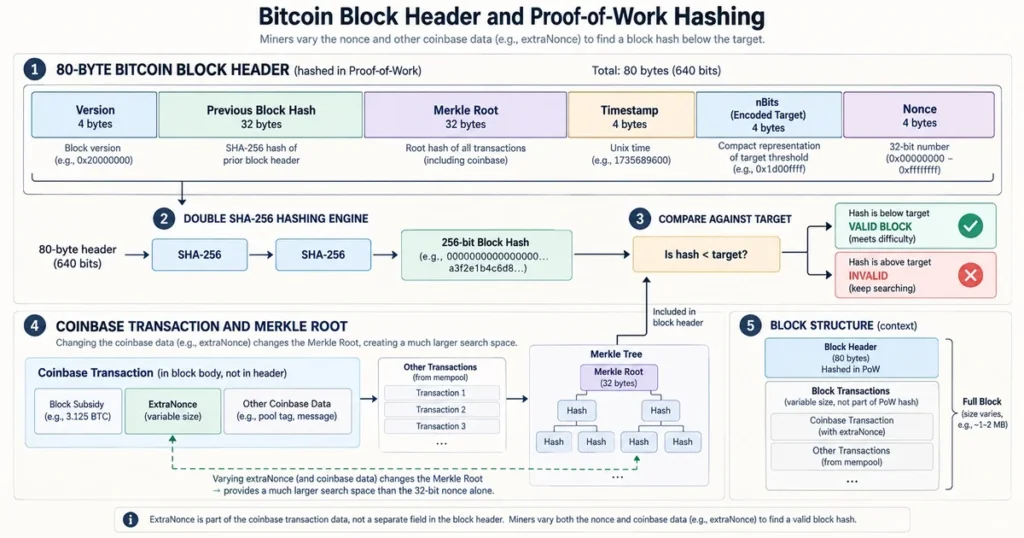
In Bitcoin and classic Proof-of-Work systems, the mining algorithm does not process the entire transaction dataset during each attempt. Instead, it operates exclusively on an 80-byte metadata structure known as the Block Header:
                      ┌─────────────────────────────────────────┐
                      │    BITCOIN BLOCK HEADER (80 BYTES)      │
                      ├─────────────────────────────────────────┤
                      │ Field                 Size (Bytes)      │
                      ├─────────────────────────────────────────┤
                      │ Version Number          4 Bytes         │
                      │ Previous Block Hash    32 Bytes         │
                      │ Merkle Root Hash       32 Bytes         │
                      │ Block Timestamp         4 Bytes         │
                      │ nBits (Encoded Target)  4 Bytes         │
                      │ Nonce Counter           4 Bytes         │
                      └────────────────────┬────────────────────┘
                                           │
                             (Appended into Mining Loop)
                                           ▼
                      ┌─────────────────────────────────────────┐
                      │         COINBASE TRANSACTION            │
                      │  Contains "ExtraNonce" field to provide │
                      │  astronomical search space expansion    │
                      └─────────────────────────────────────────┘
The 80-Byte Header Fields:
- Version (4 bytes): Tracks protocol software updates and soft-fork signaling parameters.
- Previous Block Hash (32 bytes): The 256-bit hash of the preceding block header, linking blocks into the current canonical chain and making historical modification increasingly costly.
- Merkle Root (32 bytes): A cryptographic summary digest of all transactions included in the block body.
- Timestamp (4 bytes): A miner-selected Unix-epoch timestamp that must satisfy Bitcoin’s consensus time constraints, including median-time-past and the permitted future-time limit.
- nBits (4 bytes): The compact encoded representation of the current mathematical target.
- Nonce (4 bytes): A 32-bit integer that the miner freely increments from $0$ to $4,294,967,295$ ($2^{32} – 1$) to generate different hash digests.
The Nonce Exhaustion Problem and the ExtraNonce
Because the 32-bit nonce field contains only $4.29$ billion combinations, a modern ASIC operating at 200 Terahashes per second (200,000,000,000,000 hashes/second) exhausts the entire nonce search space in less than 0.00002 seconds.
To expand the search field, miners modify the ExtraNonce, an arbitrary byte space located within the script signature of the Coinbase transaction. Altering the ExtraNonce alters the Coinbase transaction’s hash, which cascades upward through the Merkle tree, changing the 32-byte Merkle Root in the block header. This resets the 32-bit standard nonce counter, providing an enormous space of distinct block headers for continued hashing.
Proof of Work Demystified: Hashcash, Probability, and Thermodynamic Cost
To understand why Proof of Work relies on physical energy, one must grasp the mathematics of cryptographic hash functions such as SHA-256:
$$\text{Hash} = \text{SHA-256}(\text{SHA-256}(\text{Block\_Header})) < \text{Target}$$
Properties of Cryptographic Hashing:
- Deterministic: The exact same 80-byte header input will always produce the identical 64-character hexadecimal output.
- Pre-Image Resistance: Given a hash digest, recovering an input that produces that digest is designed to be computationally infeasible with currently practical resources.
- The Avalanche Effect: Changing a single bit in the 80-byte header (e.g., incrementing the nonce from 1 to 2) completely randomizes the entire resulting output.
Header with Nonce = 1  --> 7f9a8b1...e4c (Fails Target: Too High)
Header with Nonce = 2  --> a1b2c3d...98f (Fails Target: Too High)
...
Header with Nonce = N  --> 0000000...3f2 (Succeeds: Numerically Below Target)
Because output hashes are distributed uniformly across the 256-bit numerical range (from $0$ to $2^{256} – 1$), the mining process behaves like a high-speed lottery. Finding a hash that begins with a required number of leading zeroes is equivalent to drawing numbers repeatedly until striking a winning ticket.
Why Energy Expenditure Is a Costly Anchor
Critics frequently misunderstand mining as useless calculation. In reality, energy expenditure serves as a costly physical anchor. In the digital world, data can be copied, duplicated, and falsified at near-zero marginal cost.
By requiring miners to burn physical electrical energy to generate valid blocks, Satoshi Nakamoto established an immutable cost barrier. An adversary wishing to rewrite transaction history cannot merely copy data; they must obtain and control sufficient computational power to out-compute the honest network, whether through owned, acquired, or otherwise controlled mining capacity. The electrical energy consumed by miners represents the security collateral protecting past transactions from reversal.
The Difficulty Adjustment Mechanism: Bitcoin’s Thermostatic Clock
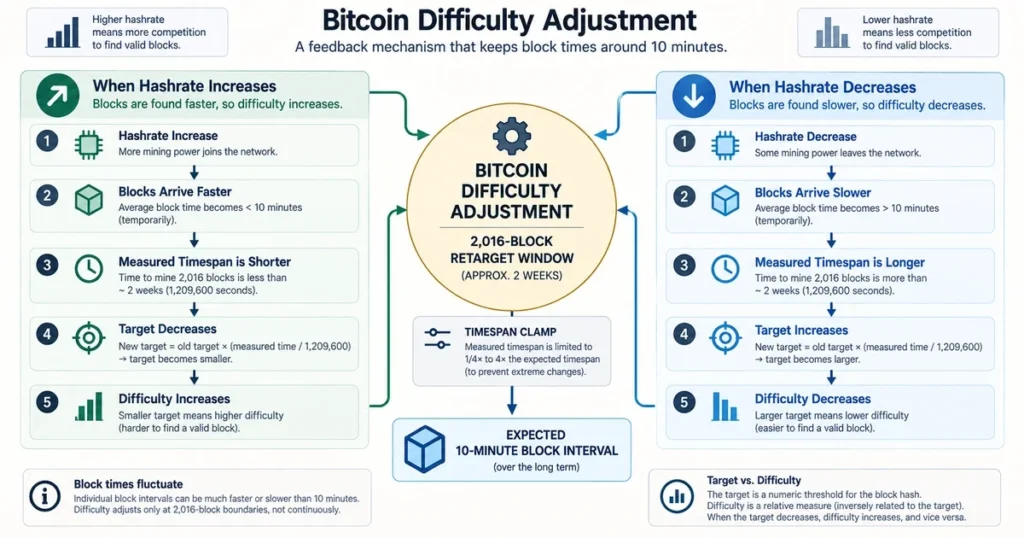
The single most consequential engineering innovation in Proof-of-Work systems is the Difficulty Adjustment Algorithm. Without it, rapid technological improvements in computing hardware would cause blocks to be mined progressively faster, collapsing the planned monetary issuance schedule.
In the Bitcoin protocol, the target is evaluated and recalibrated precisely every 2,016 blocks (approximately every two weeks):
$$\text{New Target} = \text{Current Target} \times \left( \frac{\text{Clamped Actual Timespan}}{20,160\text{ Minutes}} \right)$$
where the measured timespan is constrained by Bitcoin’s consensus limits (clamped between a factor of $\frac{1}{4}$ and $4$) before the new target is calculated.
                      ┌─────────────────────────────────────────┐
                      │    DIFFICULTY RECALIBRATION LOOP        │
                      └────────────────────┬────────────────────┘
                                           │
         ┌─────────────────────────────────┴─────────────────────────────────┐
         │                                                                   │
         ▼                                                                   ▼
┌──────────────────┐               ┌──────────────────────────────────┐
│ HASHPOWER INCREASES              │               │ HASHPOWER DECREASES              │
├──────────────────┤               ├──────────────────────────────────┤
│ * More miners join network       │               │ * Unprofitable miners shut down  │
│ * 2,016 blocks mined in < 14 days│               │ * 2,016 blocks mined in > 14 days│
│ * PROTOCOL ADJUSTS TARGET DOWN   │               │ * PROTOCOL ADJUSTS TARGET UP     │
│ * Difficulty Increases           │               │ * Difficulty Decreases           │
│ * Block cadence targets 10 mins  │               │ * Block cadence targets 10 mins  │
└──────────────────┘               └──────────────────────────────────┘
- The 10-Minute Cadence: The protocol targets an average 10-minute block interval ($2,016 \times 10\text{ minutes} = 20,160\text{ minutes}$ or two weeks). This interval provides sufficient time for newly discovered blocks to propagate globally across international peer-to-peer nodes, minimizing the creation of simultaneous competing blocks that may become stale during short-lived chain reorganizations.
- Self-Regulating Equilibrium: If millions of new miners plug in hardware, blocks might temporarily arrive every 8 minutes. At the 2,016-block checkpoint, the protocol measures the shorter interval and adjusts the target so that the expected block interval moves back toward the 10-minute target.
- Issuance Independence: This dynamic adjustment helps keep Bitcoin’s block production and subsidy issuance largely independent of changes in mining hardware efficiency or aggregate hashrate, although actual calendar-time issuance can vary because block intervals fluctuate between difficulty adjustments.
The Evolution of Mining Hardware: From Laptops to Industrial ASICs
Over a decade and a half, mining hardware underwent one of the fastest efficiency evolutions in the history of computing:
                      ┌─────────────────────────────────────────┐
                      │     THE FOUR COMPUTATIONAL ERAS         │
                      └────────────────────┬────────────────────┘
                                           │
         ┌───────────────────┬─────────────┴───────┬───────────────────┐
         ▼                   ▼                     ▼                   ▼
┌─────────────────┐ ┌─────────────────┐   ┌─────────────────┐ ┌─────────────────┐
│ CPU ERA         │ │ GPU ERA         │   │ FPGA ERA        │ │ ASIC ERA        │
│ (2009 - 2010)   │ │ (2010 - 2011)   │   │ (2011 - 2013)   │ │ (2013 - Pres.)  │
├─────────────────┤ ├─────────────────┤   ├─────────────────┤ ├─────────────────┤
│ Satoshi's PC;   │ │ Graphics cards; │   │ Reconfigurable  │ │ Custom Silicon; │
│ Standard x86    │ │ Massive parallel│   │ logic gate      │ │ Monolithic micro│
│ architecture;   │ │ processing;     │   │ arrays;         │ │ chips optimized │
│ ~1 to 10 MH/s   │ │ ~50 to 500 MH/s │   │ ~1 to 10 GH/s   │ │ for SHA-256 only│
└─────────────────┘ └─────────────────┘   └─────────────────┘ └─────────────────┘
- The CPU Era (2009–2010): In Bitcoin’s earliest days, Satoshi Nakamoto and early cypherpunks ran mining software on standard personal computer Central Processing Units (CPUs). Hashrates ranged from 1 to 10 Megahashes per second (MH/s).
- The GPU Era (2010–2011): Programmers recognized that Graphics Processing Units (GPUs), engineered to render millions of visual pixels in parallel, were vastly superior at executing the identical, repetitive mathematical operations required by SHA-256. A single graphics card could outperform dozens of CPUs while consuming far less energy per hash.
- The FPGA Era (2011–2013): Field Programmable Gate Arrays (FPGAs) allowed miners to configure custom microchip circuit logic specifically for hashing. FPGAs represented the bridge between general-purpose consumer hardware and purpose-built silicon.
- The ASIC Era (2013–Present): Application-Specific Integrated Circuits are microchips hardwired at the silicon foundry level to execute nothing other than a specific cryptographic algorithm (e.g., SHA-256 for Bitcoin or Scrypt for Litecoin). While an ASIC mining rig contains management controllers and firmware to communicate with the network, the hashing ASIC itself is not a general-purpose processor; it can only process hashing loops. This singular design focus yields massive efficiency advantages.
Anatomy of an Industrial ASIC Miner
Today’s enterprise Bitcoin mining operations are dominated by specialized industrial hardware manufactured by silicon specialists like Bitmain (Antminer) and MicroBT (WhatsMiner):
+-------------------------------------------------------------------------------+
|             REPRESENTATIVE 2026 HIGH-EFFICIENCY ASIC RANGE                    |
+----------------------+-----------------------------+--------------------------+
| HARDWARE SPEC        | REVENUE & PERFORMANCE FACTOR| CONTEMPORARY BENCHMARK   |
+----------------------+-----------------------------+--------------------------+
| Hashrate             | Computational throughput    | 180 to 250+ TH/s         |
| Power Consumption    | Direct electrical draw      | 3,000 to 3,500 Watts     |
| Energy Efficiency    | Power used per computation  | 14.0 to 17.5 Joules/TH   |
| Semiconductor Node   | Chip fabrication density    | 3nm / 4nm custom silicon |
| Cooling Architecture | Thermal dissipation method  | Hydro / Liquid Immersion |
+----------------------+-----------------------------+--------------------------+
Note: Specifications vary significantly by model, firmware, operating conditions, and cooling configuration.
Internal Engineering Components:
- The Hashboards: An industrial ASIC typically contains multiple modular hashboards populated with numerous custom hashing chips working in parallel to perform the SHA-256 workload.
- Thermal Management: Dissipating 3,500 Watts of heat requires substantial cooling capacity. Modern commercial facilities increasingly use non-conductive dielectric-fluid immersion cooling, which can eliminate onboard fan requirements, reduce noise, and improve thermal management. However, immersion systems still consume energy through pumps and heat-rejection equipment.
- The Energy Efficiency Metric (J/TH): In commodity mining, raw hashrate is secondary to efficiency, measured in Joules per Terahash (J/TH). The lower the J/TH rating, the less electrical power the unit requires to calculate each trillion hashes, determining whether the machine remains operational or must be switched off during market downturns.
GPU Mining and ASIC-Resistant Blockchains
While Bitcoin’s SHA-256 mining is overwhelmingly dominated by specialized industrial ASICs, other Proof-of-Work cryptocurrencies deliberately employ memory-intensive hashing algorithms designed to resist specialized silicon:
- The Principle of ASIC Resistance: If an algorithm requires substantial memory bandwidth or other resources that reduce the advantage of specialized silicon, designing and deploying an ASIC can become more expensive and less economically attractive. This can make specialized mining hardware less dominant for some algorithms and allow ordinary users with consumer graphics cards to participate in mining.
- The Post-Ethereum Landscape: Prior to September 2022, Ethereum’s Ethash algorithm was a major source of global GPU mining revenue. Following Ethereum’s transition to Proof of Stake, GPU mining migrated toward alternate PoW chains such as Ravencoin (KAWPOW) and Ergo (Autolykos), while some networks that were initially GPU-mineable, such as Kaspa (kHeavyHash), subsequently became ASIC-dominated.
Mining Pools: Architecture, Payout Mechanics, and Stratum Protocols
As global hashrate expanded into hundreds of Exahashes per second ($10^{18}$ hashes/sec), the probability of an individual miner finding a block independently dropped near zero:
$$\text{Solo Block Probability per 10 Mins} = \frac{\text{Miner Hashrate}}{\text{Global Network Hashrate}}$$
If an operator runs a state-of-the-art 200 TH/s ASIC against an 800 Exahash network, their mathematical odds of finding a block are roughly 1 in 4,000,000. Statistically, that solo miner might wait decades to discover a single block.
The Pooling Solution
A Mining Pool coordinates thousands of geographically dispersed hardware operators. The pool acts as a single virtual entity, aggregating their combined hashrate, discovering blocks regularly, and distributing the proceeds proportionally to participants based on computational contributions:
                      ┌─────────────────────────────────────────┐
                      │        CENTRALIZED MINING POOL          │
                      │  Coordinates work, issues templates,   │
                      │  collects and verifies Proof-of-Work    │
                      └────────────────────┬────────────────────┘
                                           │
         ┌─────────────────────────────────┼─────────────────────────────────┐
         │ (Low-Difficulty Shares)         │ (Low-Difficulty Shares)         │ (Low-Difficulty Shares)
         ▼                                 ▼                                 ▼
┌──────────────────┐             ┌──────────────────┐             ┌──────────────────┐
│ MINING WORKER 1  │             │ MINING WORKER 2  │             │ MINING WORKER 3  │
│ Delivers hashrate│             │ Delivers hashrate│             │ Delivers hashrate│
│ from Home Setup  │             │ from Texas Facility│           │ from Hydro Plant │
└──────────────────┘             └──────────────────┘             └──────────────────┘
- Proof of Work via “Shares”: The pool assigns each connected miner a customized, lower difficulty target. The miner submits proofs that meet this lower threshold (shares). While these shares are not valid network blocks, they prove mathematically that the miner’s hardware is expending computational work on behalf of the pool.
- Common Payout Schemes:
- PPS (Pay-Per-Share): The pool pays miners a predetermined payout per valid share under the pool’s payout terms, absorbing much of the block-discovery variance itself. Pool fees vary by operator and payout arrangement.
- FPPS (Full Pay-Per-Share): Similar to PPS, but pays miners both their proportional share of the standard block subsidy and the transaction fees included in blocks.
- PPLNS (Pay-Per-Last-N-Shares): Rewards are calculated based on the number of shares submitted during a fixed window (N) immediately preceding a successful block discovery. PPLNS introduces statistical variance for miners but charges lower fees.
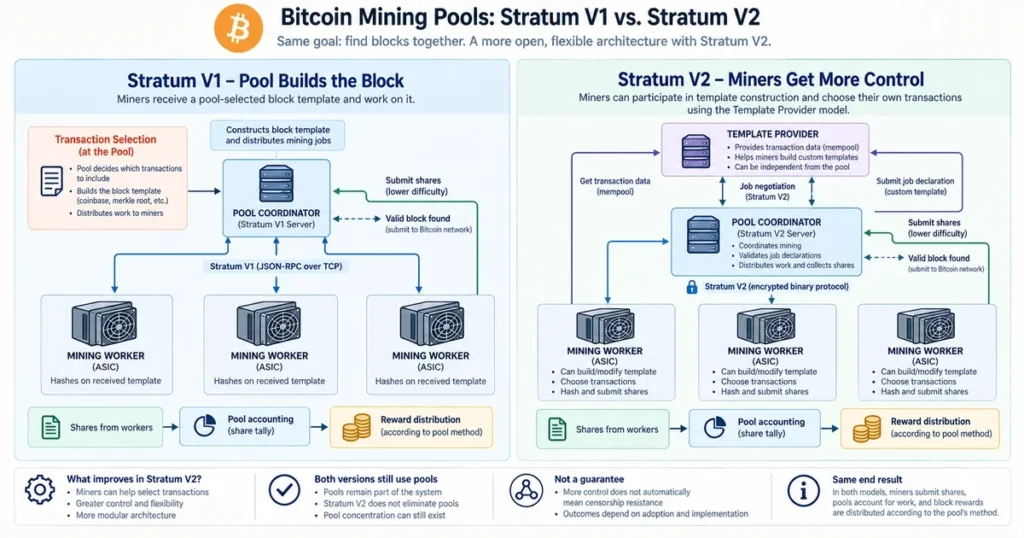
The Evolution of Pool Communication: Stratum V1 vs. Stratum V2
Under early pool infrastructure (Stratum V1), the pool coordinator constructed the entire block template and dictated which transactions were included or excluded, raising concerns that massive pools could be coerced into censoring transactions.
Modern architectures increasingly implement Stratum V2, an open protocol engineered to enhance decentralization:
- Template Provider Protocol: Stratum V2 allows individual mining workers to negotiate and propose their own custom block templates rather than accepting the pool’s pre-packaged transaction list, giving participating miners greater control over transaction selection and reducing the pool’s unilateral control over block templates.
- Efficiency and Security: Stratum V2 introduces encrypted binary communication, reducing bandwidth overhead, improving communication security, and reducing certain risks associated with insecure mining-pool communication.
Solo Mining vs. Pool Mining: The Trade-Off Spectrum
| Mining Strategy | Variance & Cash Flow | Administrative Overhead | Fee Structure | Best Suited For |
| Solo Mining (Enterprise) | High (Stochastic block discovery; expected frequency becomes more predictable only at very large scale) | Extremely High (Full infrastructure management) | 0% Pool Fees | Industrial facilities operating tens of Petahashes |
| Pool Mining (Coordinated) | Predictable (Steady daily payouts) | Low (Plug-and-play network coordination) | 1% to 4% Pool Management Fees | Small-to-medium operators, hobbyists, hosting clients |
| Solo “Lottery” Mining | Extreme (Decades or centuries of expected variance) | Minimal (Simple client software pointed to node) | 0% Fees (Keep 100% of discovered reward) | Enthusiasts running small standalone hardware (e.g., Bitaxe) |
Miner Economics: Subsidies, Transaction Fees, and the Halving
Mining revenue is governed by the programmatic monetary policy encoded into the protocol:
$$\text{Total Block Reward} = \text{Block Subsidy} + \sum \text{Transaction Fees}$$
                      ┌─────────────────────────────────────────┐
                      │       BITCOIN BLOCK SUBSIDY SCHEDULE    │
                      └────────────────────┬────────────────────┘
                                           │
         ┌───────────────────┬─────────────┴───────┬───────────────────┐
         ▼                   ▼                     ▼                   ▼
┌─────────────────┐ ┌─────────────────┐   ┌─────────────────┐ ┌─────────────────┐
│ GENESIS ERA     │ │ 2016 HALVING    │   │ 2020 HALVING    │ │ APR 2024 HALVING│
│ (2009 - 2012)   │ │ (Block 420,000) │   │ (Block 630,000) │ │ (Block 840,000) │
├─────────────────┤ ├─────────────────┤   ├─────────────────┤ ├─────────────────┤
│ 50.0 BTC / Block│ │ 12.5 BTC / Block│   │ 6.25 BTC / Block│ │ 3.125 BTC /Block│
└─────────────────┘ └─────────────────┘   └─────────────────┘ └─────────────────┘
                                                           │
                                             (Next Epoch: ~2028 Halving)
                                                           ▼
                                                  ┌─────────────────┐
                                                  │ 1.5625 BTC/Block│
                                                  └─────────────────┘
- The Block Subsidy: Newly minted coins created in the Coinbase transaction. Bitcoin began with an initial subsidy of 50 BTC per block in 2009.
- The Halving Cycle: Every 210,000 blocks (roughly every four years), the protocol automatically cuts the block subsidy in half. On April 19, 2024 (at block 840,000), the fourth halving reduced the subsidy from 6.25 BTC to 3.125 BTC. Around 2028, it will step down to 1.5625 BTC, continuing until the circulating supply reaches the asymptotic cap of 21,000,000 BTC around the year 2140.
- Transaction Fee Economics: In addition to the subsidy, miners collect the transaction fees included in the blocks they successfully mine. As the block subsidy declines toward zero over coming decades, transaction fees may become an increasingly important economic incentive supporting Proof-of-Work security.
Mining Profitability: The Mathematical Model
An industrial mining investment lives and dies on the margins between electricity costs and operational efficiency:
$$\text{Daily Profit} = \text{Daily Revenue} – \text{Daily Operating Cost}$$
$$\text{Daily Revenue} \approx \left( \frac{\text{Miner Hashrate}}{\text{Global Network Hashrate}} \right) \times (\text{Daily Coins Minted} + \text{Daily Fees}) \times \text{Spot Price}$$
$$\text{Daily Operating Cost} = \left( \frac{\text{Machine Wattage} \times 24}{1,000} \right) \times \text{Electricity Cost per kWh}$$
The Breakeven Power Cost
Low-cost electricity can materially improve mining economics, but profitability depends on the combined effect of electricity price, hardware efficiency, network difficulty, transaction fees, asset price, uptime, and other operating costs:
- Illustrative Low-Cost Range ($0.03 to $0.05/kWh): Historically, this electricity range can provide a strong competitive position for efficient commercial operations, but actual profitability still depends on Bitcoin price, network difficulty, ASIC efficiency, fees, uptime, and other operating costs.
- Illustrative Mid-Cost Range ($0.06 to $0.08/kWh): Operations in this range can remain viable during favorable market conditions but become more sensitive to difficulty increases, fee changes, and asset-price declines.
- Higher-Cost Residential Range ($0.12 to $0.25+/kWh): These electricity rates generally make modern Bitcoin ASIC mining difficult to justify on direct operating economics alone, although results vary with hardware efficiency and market conditions.
The “Mining Death Spiral” Myth Refuted
A recurring financial myth claims that if cryptocurrency prices drop sharply, miners will shut off machines en masse, causing network security to collapse in a self-reinforcing “death spiral.”
Price Drops  -->  High-Cost Miners Switch Off Hardware  -->  Network Hashrate Declines
                                                                     │
                                             (Automatic Protocol Self-Correction)
                                                                     ▼
Difficulty Target Adjusts Downward (At Checkpoint)  <--  Blocks Temporarily Arrive Slower
      │
      ▼
Revenue-Per-Hash Improves for Online Miners  -->  Equilibrium Can Recover
The design of the difficulty adjustment provides a stabilizing mechanism against this scenario:
- When unprofitable miners disconnect their machines, total global hashrate drops.
- At the subsequent 2,016-block checkpoint, the protocol measures the slower block arrivals and automatically reduces the difficulty target.
- After the difficulty adjustment takes effect, each unit of hashrate requires fewer expected hashes to find a valid block, improving the expected revenue-per-hash economics for miners that remain online. This can restore profitability for some operators, but it does not guarantee an equilibrium or eliminate losses. The protocol dynamically balances itself to match whatever hashrate market conditions support.
Security Economics and Attack Vectors: 51% Attacks and Selfish Mining
While Proof of Work provides deep security guarantees, it is bounded by clear physical and economic constraints:
1. The 51% Majority Attack
If an entity or coordinated cartel controls more than 50% of the network’s active hashrate, they break the foundational assumption of Nakamoto consensus:
- What an Attacker CAN Do: They can rewrite recent blocks to execute a double-spend of their own previously spent coins, reorganize recent chain history, and selectively censor specific transactions by orphaning honest blocks.
- What an Attacker CANNOT Do: They cannot forge valid digital signatures, spend coins from arbitrary addresses without the required authorization, or create blocks that violate the network’s consensus rules. A majority hashrate attacker can attempt to reorganize increasingly deep chain history, but the computational and economic cost generally rises sharply with the depth of the attempted reorganization.
- Economic Defense: On large networks like Bitcoin, obtaining majority control of active hashrate would require an enormous amount of specialized computational capacity and sustained electrical power. Depending on the attack strategy, an adversary could rely on owned, newly acquired, or otherwise controlled mining capacity rather than building all of the required infrastructure from scratch. The scale and cost of such an attack create substantial economic and operational barriers.
2. Selfish Mining
Described by researchers Ittay Eyal and Emin Gün Sirer in 2013, selfish mining occurs when a colluding mining pool secretly discovers blocks and withholds them from the public network. By selectively broadcasting their private chain when honest miners discover competing blocks, the selfish pool can mathematically invalidate honest work, earning rewards disproportionate to their actual share of network hashrate. Selfish mining requires substantial hashrate (theoretically viable starting at ~25% to 33% under specific network propagation conditions).
The Environmental Debate: Energy Consumption, Grid Stabilization, and Stranded Gas
The environmental profile of Proof-of-Work mining remains one of the most scrutinized aspects of digital asset technology:
+-------------------------------------------------------------------------------+
|                    BITCOIN ENERGY CONSUMPTION CONTEXT                        |
+----------------------+-----------------------------+--------------------------+
| METRIC               | ESTIMATED VALUE             | CONTEXT                  |
+----------------------+-----------------------------+--------------------------+
| Annualized Electricity| ~138 to 142 TWh/year       | Contemporary Cambridge  |
| Consumption           | (illustrative snapshot)    | CBECI estimate; changes  |
|                       |                             | with network conditions  |
| Network Power Demand  | ~16 GW                      | Approximate continuous   |
|                       |                             | electrical load implied  |
|                       |                             | by the annualized model  |
| Global Share          | ~0.5% of global electricity| Approximate contemporary |
|                       | consumption                | share; methodology and   |
|                       |                             | global demand estimates  |
|                       |                             | can change over time     |
+----------------------+-----------------------------+--------------------------+
Note: Global Bitcoin mining electrical consumption is an illustrative contemporary estimate; methodologies and empirical models change over time.
Contemporary Environmental Dynamics:
- Methane Abatement (Flare Gas Mining): Oil and gas sites can flare or, in some cases, vent excess natural gas when pipeline infrastructure is unavailable. Some mining operations use mobile generators to convert this gas into electricity for mining. Where the alternative would be uncontrolled venting or less-efficient flaring, combustion can reduce methane-related climate impacts, although the net emissions benefit depends on site-specific leakage, equipment efficiency, and the baseline disposal method.
- Grid Balancing and Demand Response: Some large mining facilities participate in demand-response programs, including programs available in ERCOT, allowing them to reduce or interrupt electricity consumption when grid conditions or market prices warrant it. The speed and scale of curtailment depend on the facility, contractual arrangement, and grid program.
- Renewable Co-Location: Research on Bitcoin mining energy use indicates that miners utilize a diverse mix of electricity sources, including hydroelectric, wind, solar, nuclear, natural gas, and other grid-connected generation. Low-cost or otherwise underutilized electricity can create incentives for mining to locate near certain renewable or curtailed-energy resources, but the global mining mix varies by region and over time.
Structural Centralization Risks: Mining Pools and Chip Manufacturing
Despite decentralized protocol designs, Proof-of-Work mining faces tangible centralization pressures across two primary vectors:
                     ┌─────────────────────────────────────────┐
                     │    CENTRALIZATION PRESSURE VECTORS      │
                     └────────────────────┬────────────────────┘
                                          │
        ┌─────────────────────────────────┴─────────────────────────────────┐
        │                                                                   │
        ▼                                                                   ▼
┌──────────────────┐               ┌──────────────────────────────────┐
│ POOL CONCENTRATION RISK          │               │ SEMICONDUCTOR MANUFACTURING      │
├──────────────────┤               ├──────────────────────────────────┤
│ * Top 2-3 mining pools often     │               │ * Global ASIC fabrication relies │
│   account for over 50% of recent │               │   on a handful of foundries      │
│   observed block production      │               │                                  │
│ * Mitigated by: Stratum V2, which│               │ * Mitigated by: Supply chain     │
│   can shift block template       │               │   expansion and open-source      │
│   selection toward individual    │               │   microcontroller hardware       │
│   miners                         │               │                                  │
└──────────────────┘               └──────────────────────────────────┘
- Pool Concentration: A small number of dominant mining pools account for a majority of recent Bitcoin block production. In recent 2026 rolling windows, pools such as Foundry USA, AntPool, and F2Pool have collectively represented more than half of observed blocks. This measures pool-attributed block production rather than direct ownership of the underlying mining hardware. Individual miners can generally redirect their hashrate to another pool, but concentration of transaction-template construction remains an ongoing governance challenge, driving adoption of Stratum V2.
- Silicon Supply Chain Duopoly: The design and manufacture of high-efficiency SHA-256 ASIC chips is heavily concentrated among a small number of specialized companies (primarily Bitmain and MicroBT), whose chip production relies heavily on advanced semiconductor foundries (such as TSMC). Geopolitical disruptions or supply chain constraints present external hardware centralization risks.
How to Mine Cryptocurrency: A Step-by-Step Educational Overview
For individuals and institutions evaluating the mechanics of launching a mining operation:
- Select an Appropriate Asset & Algorithm: Determine whether your operational objective targets an industrial ASIC network (such as Bitcoin on SHA-256) or a GPU-friendly network (such as Ravencoin on KAWPOW).
- Model Capital Expenditure and Operational Costs: Calculate your all-in breakeven cost. Account for hardware purchases, power supply units, industrial electrical drops, active cooling, ventilation infrastructure, and ongoing network difficulty increases.
- Acquire Verified Mining Hardware: Source ASICs directly from verified manufacturers or reputable enterprise distributors. Inspect hardware for chip degradation, hashboard health, and firmware integrity.
- Establish Secure Wallet Infrastructure: Set up cold storage or dedicated self-custodial addresses to receive mining payouts. Never route mining distributions directly to volatile third-party exchange accounts; ensure custody is secured using hardware wallets as detailed in our guide on what is a crypto wallet.
- Configure Network and Pool Connections: Connect the hardware via an Ethernet interface, access the local control board dashboard via its IP address, and input the Stratum URL, worker credentials, and payout address of your chosen mining pool.
- Deploy Real-Time Diagnostics: Monitor operational temperature, chip failure rates, ambient humidity, fan speeds, and hashrate stability through automated diagnostic software.
Global and Indian Regulatory Landscape (2026 Standards)
The legal, environmental, and tax treatment of cryptocurrency mining varies sharply across international borders:
1. United States Regulatory Framework
- Federal Securities Treatment: In a March 20, 2025 staff statement, the SEC’s Division of Corporation Finance expressed the view that certain Proof-of-Work protocol mining activities, including specified solo-mining and mining-pool activities, do not involve the offer or sale of securities under the circumstances described. The statement is non-binding staff guidance, not a statute or SEC rule, and the treatment of a specific arrangement remains dependent on its facts and circumstances.
- Energy Transparency & Local Zoning: Commercial operators are subject to federal and state environmental reporting rules, with prominent hubs like Texas offering structured grid-balancing incentives, while other jurisdictions enforce strict local zoning ordinances.
2. European Union (MiCA Standards)
- Infrastructure Protection: The EU’s Markets in Crypto-Assets (MiCA) regulation regulates commercial service providers and digital asset issuers rather than underlying consensus infrastructure; early legislative efforts to impose a blanket ban on Proof-of-Work mining were explicitly rejected.
- Sustainability Disclosures: MiCA includes sustainability-related disclosure requirements concerning the principal adverse impacts of crypto-asset consensus mechanisms, including information relevant to energy use and environmental effects. Additional corporate sustainability reporting obligations may apply to entities that fall within the scope of broader EU reporting rules.
3. India (For Indian Readers): Legal, Tax, and Economic Reality — Global Article With Local Tax Notes
- Legality of Computation: There is no explicit statutory ban on possessing mining hardware or participating in Proof-of-Work mining in India.
- The Economic Barrier: Commercial Bitcoin ASIC mining is largely economically unviable in India due to prevailing industrial electricity tariffs (typically ₹7 to ₹11 per kWh, equivalent to roughly $0.08 to $0.13+/kWh). Because enterprise miners elsewhere operate at $0.03 to $0.05/kWh, machines operating at Indian commercial retail rates face ongoing operational cash losses.
- Taxation Framework (Section 115BBH): Mined crypto assets that fall within the statutory definition of Virtual Digital Assets (VDAs) are subject to the VDA tax framework when transferred. Section 115BBH applies a 30% tax rate to income arising from the transfer of VDAs, plus applicable surcharge and cess. For income computed under Section 115BBH, deductions for expenditure other than the permitted cost of acquisition are not allowed; accordingly, mining-related costs such as electricity, hardware, and depreciation cannot be deducted against that VDA transfer income under Section 115BBH.
- TDS Compliance (Section 194S): A 1% Tax Deducted at Source (TDS) may apply to consideration paid for the transfer of VDAs under Section 194S, subject to statutory conditions, thresholds, and exemptions. The rule is not limited to transfers conducted on registered platforms.
To examine how institutional markets evaluate macroeconomic liquidity, read our analysis on interest rates and exchange rates.
The Future of Mining: 2026–2030 Structural Trends
The Proof-of-Work landscape over the coming decade could be shaped by four transformative engineering frontiers:
- Sub-2nm Semiconductor Architectures: Custom silicon fabrication is approaching physical limits. As ASIC designs migrate from 3nm down to 2nm nodes, operational efficiency gains are expected to decelerate, potentially extending the operational lifespan of deployed hardware and moderating depreciation cycles for operators.
- Ubiquitous Immersion Cooling: Commercial mining centers are increasingly evaluating liquid immersion cooling, which may allow operators to overclock hardware safely, cut maintenance downtime, and reuse rejected heat to warm industrial greenhouses, district municipal heating loops, or commercial aquaculture facilities.
- Decentralized Pool Protocols (Stratum V2 & DATUM): Broader adoption of next-generation pool protocols could reduce pool operators’ unilateral control over transaction selection, returning block template construction to individual miners and strengthening protocol-level censorship resistance.
- The Post-Subsidy Fee Security Model: Over successive four-year halving epochs, the block subsidy will decline toward negligible levels. Network security will increasingly rely on vibrant transaction fee markets driven by high-value base-layer settlement, institutional clearing, and Layer 2 rollups anchoring commitments to the base chain.
Common Myths vs. Empirical Facts
- Myth: Mining requires solving increasingly complex mathematical riddles.
- Fact: Bitcoin miners repeatedly apply the same double-SHA-256 hashing function to changing block-header inputs. The protocol’s numerical Difficulty Target determines how small the resulting hash must be to qualify as valid.
- Myth: Crypto mining serves no real-world economic purpose.
- Fact: Mining converts real-world thermodynamic energy into irreversible digital auditability, protecting multi-hundred-billion-dollar monetary ledgers from double-spending, state censorship, and historical revision.
- Myth: A home user can mine Bitcoin on a modern gaming laptop.
- Fact: Standard CPUs and GPUs were rendered obsolete for Bitcoin mining in 2013. Pointing a laptop CPU at the Bitcoin network yields an infinitesimally small probability of ever discovering a block, while running the hardware at thermal limits.
- Myth: A drop in Bitcoin price causes a catastrophic network “death spiral.”
- Fact: The protocol’s built-in Difficulty Adjustment recalibrates the target every 2,016 blocks. If miners disconnect due to price declines, the difficulty automatically drops, reducing computational costs and restoring profitability for the remaining efficient operators.
Frequently Asked Questions
1. What is crypto mining in simple terms?
Crypto mining is the computational process used by decentralized networks to verify transactions, append them to a public ledger with increasingly strong settlement as additional blocks accumulate, and prevent fraud without relying on a bank or central administrator, rewarding participants with newly minted digital currency.
2. How does crypto mining work?
Specialized computers bundle unconfirmed transactions into a block and repeatedly run the block’s header data through cryptographic hash functions, changing an arbitrary number (the nonce) until the resulting output is smaller than a target threshold set by the protocol. The first computer to discover a valid hash broadcasts the block for network verification and collects the block reward.
3. What is Proof of Work?
Proof of Work is an algorithmic consensus mechanism that requires participants to expend measurable computational effort and electrical energy to submit valid blocks. This physical cost makes manipulating historical ledger records economically catastrophic for malicious actors.
4. What is the difference between ASIC and GPU mining?
An ASIC is a custom microchip designed exclusively to execute a single cryptographic hashing algorithm (such as SHA-256 for Bitcoin) with maximum electrical efficiency. A GPU is a general-purpose graphics processor capable of executing diverse algorithms, historically used to mine altcoins whose code resists ASIC optimization.
5. What is a crypto mining pool?
A mining pool is an online collective that aggregates the computational hashrate of thousands of individual miners. By working together as a single entity, the pool discovers blocks more regularly and distributes rewards proportionally to participants based on their contributed work, substantially reducing the multi-year variance of solo mining.
6. Is crypto mining profitable in 2026?
Low-cost electricity can materially improve mining economics, but profitability depends on the combined effect of electricity price, hardware efficiency, network difficulty, transaction fees, asset price, uptime, and other operating costs. Operations with access to low-cost industrial power can yield positive margins, while standard residential power rates generally result in operational losses.
7. What is the Bitcoin halving?
The Bitcoin halving is a hardcoded event that occurs every 210,000 blocks (roughly every four years), cutting the block subsidy awarded to miners in half. The fourth halving occurred on April 19, 2024, lowering the reward from 6.25 BTC to 3.125 BTC per block.
8. Is cryptocurrency mining legal in India?
There is no statutory law prohibiting the possession of mining hardware or participating in Proof-of-Work mining in India. However, high domestic electricity tariffs make Bitcoin mining economically difficult, and income arising from the transfer of mined VDAs is taxed under the applicable VDA tax framework, including Section 115BBH where applicable.
9. Can you mine Bitcoin on a smartphone?
No. Modern mobile devices lack the physical semiconductor architecture and power capacity to compete with industrial ASICs. Running mining software on a smartphone will merely overheat the processor and degrade the battery without producing meaningful rewards.
Strategic Summary & Further Reading
Mastering Proof-of-Work mining completes the technical picture of how decentralized ledgers maintain integrity:
- Thermodynamic Grounding: Mining bridges the digital realm to physical reality, using energy expenditure as an unforgeable anchor against ledger manipulation.
- Algorithmic Cadence: The 2,016-block Difficulty Adjustment helps keep Bitcoin’s expected block interval and subsidy issuance largely independent of changes in computing power, although actual block timing and calendar-time issuance can vary.
- Semiconductor Specialization: Hash generation has evolved into a global industrial discipline dominated by high-efficiency custom silicon running at sub-20 J/TH efficiencies.
- Coordinated Scale: Modern mining pools distribute variance risk across global participants, with emerging frameworks like Stratum V2 decentralizing block template selection.
- Economic Equilibrium: Programmatic supply halvings shift the long-term mining security budget from inflation subsidies to dynamic, market-driven transaction fee revenues.
Next Reading Suggestions
- What Is a Crypto Wallet? A Complete Guide to Keys, Security, and Storage Types
- What Is Ethereum? The Complete Guide to Smart Contracts, EVM, Staking, and Layer 2 Rollups
- What Is Blockchain? The Complete Guide to Distributed Ledger Technology, Consensus, and Smart Contracts
- What Is Bitcoin? The Complete Guide to the First Decentralized Digital Currency
- History of Cryptocurrency: The Complete Evolution of Bitcoin, Blockchain, and Digital Assets
- What Is Crypto? The Complete Guide to Cryptocurrency, Blockchain, and Digital Assets
- What Is Gold? The Complete Guide to Real Money, Store of Value & Why It Matters
- What Are Stocks? The Complete Guide to Shares, Equity, and Ownership
- What Is the Stock Market? How Global Equity Markets Work and Allocate Capital
- What Is a Stock Exchange? How Exchanges Work, Trade Stocks, and Settle Transactions
- How Stock Prices Are Determined: Market Microstructure, Supply and Demand, and Valuation
- What Is Market Capitalization? The Complete Guide to Market Cap, Company Size, and Valuation
- How to Invest in Stocks: The Complete Step-by-Step Guide for Beginners and Long-Term Investors
Author Box & E-E-A-T Verification
Written & Researched By: CurrencyPlans Editorial Research Team
Editorial Review: This guide is reviewed against publicly available cryptographic standards, official blockchain documentation, and applicable statutory frameworks. Hashing algorithms, block header structures, difficulty recalibration formulas, and regulatory rules are cross-referenced with primary sources, including the original Bitcoin Whitepaper, the Bitcoin Core source code, the Cambridge Centre for Alternative Finance (CCAF), the US Securities and Exchange Commission (SEC), the European Securities and Markets Authority (ESMA), and the Income Tax Department of India.
Primary Institutional References & Regulatory Resources
For official consensus specifications, energy research, and regulatory disclosures, consult primary institutional sources directly:
- Bitcoin Core Source Code & Consensus Documentation: Bitcoin Core GitHub Repository
- Cambridge Digital Assets Programme & Mining Energy Indices: Cambridge Centre for Alternative Finance (CCAF)
- US Securities and Exchange Commission Regulatory Statements: US Securities and Exchange Commission (SEC)
- European Union Digital Finance & MiCA Framework: European Securities and Markets Authority (ESMA)
- Virtual Digital Asset Statutory Guidelines (Section 115BBH / 194S): Income Tax Department of India
- International Financial Stability & Central Bank Digital Asset Research: Bank for International Settlements (BIS)
Educational Disclaimer
This guide is prepared strictly for educational, informational, and research purposes and does not constitute personalized financial, investment, legal, technical, or tax advice. Cryptocurrency mining involves significant capital expenditure, extreme electrical operating costs, volatile asset prices, and rapid hardware depreciation. Past network difficulty and historical mining profitability do not guarantee future performance. Always conduct independent due diligence and consult a licensed professional before committing capital to cryptocurrency mining hardware or commercial hosting contracts.

