

Introduction
A Bitcoin ETF—commonly used as shorthand for US spot Bitcoin exchange-traded products—is generally structured as a commodity-based trust or grantor trust rather than as a conventional investment company registered under the Investment Company Act of 1940. It enables retail, professional, and institutional market participants to gain exposure to Bitcoin directly through existing securities brokerage accounts, wealth advisory platforms, and eligible retirement accounts without managing cryptographic private keys, hardware devices, or digital asset exchange accounts.
On January 10, 2024, the US Securities and Exchange Commission (SEC) approved exchange applications allowing the initial wave of 11 spot Bitcoin ETPs to be listed and traded. Unlike earlier futures-based funds (which hold derivatives contracts and can experience roll-yield performance divergence), a spot Bitcoin ETP holds physical Bitcoin through institutional custody arrangements, which may include secure cold storage. The regulatory framework matured further on July 29, 2025, when the SEC approved in-kind creations and redemptions for crypto-asset ETPs, bringing crypto ETPs into structural alignment with physical commodity products like gold trusts.
In the years following launch, spot Bitcoin products registered substantial capital accumulation, with flagship funds such as BlackRock’s iShares Bitcoin Trust (IBIT) accumulating tens of billions of dollars in assets under management (AUM). Understanding Bitcoin ETFs requires dissecting the Authorized Participant (AP) arbitrage mechanism across both cash and in-kind pipelines, understanding institutional custody safeguards, evaluating fee drag, and navigating cross-border tax classifications across international jurisdictions.
1. Executive Summary & Core Thesis
Quick Answer: What Is a Bitcoin ETF?
A Bitcoin ETF is an exchange-traded investment vehicle that tracks the price of Bitcoin and trades on traditional stock exchanges like Nasdaq, the New York Stock Exchange (NYSE), or Cboe. Investors buy and sell shares through their existing securities brokerage accounts just like common equities or index funds. Spot Bitcoin ETPs hold Bitcoin as the principal underlying asset through institutional custody arrangements, which may include cold storage; the shares provide indirect economic exposure to the Bitcoin held by the trust, without giving retail investors direct personal possession of or redemption rights to the underlying coins.
To understand why the spot Bitcoin vehicle represents an institutional bridge between traditional finance (TradFi) and digital assets, market participants must distinguish between fundamental access models:
                      ┌─────────────────────────────────────────┐
                      │      CAPITAL ACCESS METHODOLOGIES       │
                      └────────────────────┬────────────────────┘
                                           │
         ┌─────────────────────────────────┴─────────────────────────────────┐
         │                                                                   │
         ▼                                                                   ▼
┌──────────────────────────────────┐               ┌──────────────────────────────────┐
│ DIRECT ON-CHAIN SELF-CUSTODY     │               │ SPOT EXCHANGE-TRADED PRODUCT     │
├──────────────────┤               ├──────────────────────────────────┤
│ * Private key ownership          │               │ * Securities brokerage custody   │
│ * Hardware wallet management     │               │ * Integrated into standard accts │
│ * 24/7 on-chain transferability  │               │ * Brokerage tax reporting        │
│ * Irreversible user error risk   │               │   where applicable               │
│ * Direct interaction with DeFi   │               │ * Institutional custody controls │
│                                  │               │ * Transparent annual sponsor fee │
└──────────────────────────────────┘               └──────────────────────────────────┘
Terminology Note on Legal Structure:
In colloquial financial media, products like IBIT, FBTC, and BITB are commonly referred to as “Bitcoin ETFs.” Technically, however, these vehicles are structured as grantor trusts or commodity-based Exchange-Traded Products (ETPs) registered under the Securities Act of 1933 (Form S-1). They are not registered investment companies under the Investment Company Act of 1940, meaning they operate under different legal and governance frameworks than conventional open-ended mutual funds or 1940 Act index ETFs.
For institutional fiduciaries, registered investment advisors (RIAs), pension trustees, and corporate treasuries, holding native digital assets directly on unregulated exchanges was historically restricted by compliance charters and custody rules. Spot Bitcoin ETPs standardized Bitcoin exposure into a securities-market vehicle that trades and settles through traditional market infrastructure, including DTCC-related clearing and settlement systems, as detailed in our guide on what is bitcoin.
Foundational Definition: What Is an Exchange-Traded Fund (ETF)?
An Exchange-Traded Fund (ETF) is a pooled investment vehicle that trades on a secondary exchange, while Exchange-Traded Product (ETP) is a broader category that includes ETFs and other exchange-traded investment structures (such as commodity grantor trusts) that trade continuously throughout the market day:
                      ┌─────────────────────────────────────────┐
                      │        THE MODERN ETP ECOSYSTEM         │
                      └────────────────────┬────────────────────┘
                                           │
         ┌───────────────────┬─────────────┴───────┬───────────────────┐
         ▼                   ▼                     ▼                   ▼
┌─────────────────┐ ┌─────────────────┐   ┌─────────────────┐ ┌─────────────────┐
│ RETAIL &        │ │ BROKERAGE &     │   │ SECONDARY STOCK │ │ AUTHORIZED      │
│ INSTITUTIONAL   │ │ CLEARING /      │   │ EXCHANGE        │ │ PARTICIPANTS    │
│ INVESTORS       │ │ SETTLEMENT      │   │ (NASDAQ / NYSE) │ │ (APs)           │
│                 │ │ INFRASTRUCTURE  │   │                 │ │                 │
│                 │ │ (DTCC / BROKER) │   │                 │ │                 │
├─────────────────┤ ├─────────────────┤   ├─────────────────┤ ├─────────────────┤
│ Place market and│ │ Route orders,   │   │ Matches buyers  │ │ Financial firms │
│ limit orders via│ │ custody shares, │   │ and sellers in  │ │ executing       │
│ standard brokers│ │ settle trades   │   │ continuous open │ │ creation and    │
│ like Schwab     │ │ across accounts │   │ market trading  │ │ redemption      │
└─────────────────┘ └─────────────────┘   └─────────────────┘ └─────────────────┘
Core Characteristics of the ETP Structure:
- Continuous Secondary Trading: Unlike open-ended mutual funds that are generally priced once per business day at the applicable market close after calculating a single Net Asset Value (NAV), ETP shares are bought and sold in real time during standard exchange trading hours.
- Ongoing Sponsor Fee: ETP investors pay an ongoing sponsor fee that accrues against the fund’s NAV, while avoiding the need for individual asset storage arrangements or retail custody infrastructure.
- Open-Ended Share Creation: Unlike closed-end investment vehicles with static share counts, an ETP’s share supply can expand or contract through the creation and redemption process, with Authorized Participants helping arbitrage differences between market prices and NAV.
The Structural Variants: Spot vs. Futures vs. Legacy Trusts
Understanding Bitcoin exchange-traded instruments requires comparing how different legal structures deliver exposure to the underlying asset:
                      ┌─────────────────────────────────────────┐
                      │    BITCOIN INVESTMENT PRODUCT SPECTRUM  │
                      └────────────────────┬────────────────────┘
                                           │
         ┌───────────────────┬─────────────┴───────┬───────────────────┐
         ▼                   ▼                     ▼                   ▼
┌─────────────────┐ ┌─────────────────┐   ┌─────────────────┐ ┌─────────────────┐
│ SPOT BITCOIN    │ │ FUTURES BITCOIN │   │ CLOSED-END      │ │ DIRECT ON-CHAIN │
│ ETP (e.g. IBIT) │ │ ETF (e.g. BITO) │   │ TRUST (OLD GBTC)│ │ HOLDINGS        │
├─────────────────┤ ├─────────────────┤   ├─────────────────┤ ├─────────────────┤
│ Holds physical  │ │ Holds monthly   │   │ Fixed share     │ │ Holds actual    │
│ Bitcoin in      │ │ CME futures     │   │ supply; no open │ │ UTXOs via       │
│ institutional   │ │ contracts; roll │   │ arbitrage; wide │ │ hardware wallet;│
│ custody vaults; │ │ yield risk      │   │ premium/discount│ │ self-custodial  │
│ ~0.15-0.25% fee │ │                 │   │                 │ │                 │
└─────────────────┘ └─────────────────┘   └─────────────────┘ └─────────────────┘
Comprehensive Vehicle Comparison:
| Structural Metric | Spot Bitcoin ETP (e.g., IBIT, FBTC) | Futures Bitcoin ETF (e.g., BITO) | Legacy Trust Structure (Pre-2024 GBTC) | Direct On-Chain Ownership |
| Underlying Asset | Physical Bitcoin held through institutional custody arrangements, which may include cold storage | Cash-settled CME Bitcoin Futures | Physical Bitcoin held in trust custody | Native on-chain Bitcoin (UTXOs) |
| Primary Regulatory Filing | Securities Act of 1933 (Form S-1); commodity-based trust/ETP structure, generally not registered under the Investment Company Act of 1940 | Investment Company Act of 1940 | Securities Act of 1933 (Form 10) | Decentralized consensus rules |
| Representative Sponsor Fee | 0.15% to 0.25% for many US spot Bitcoin ETPs, before any temporary fee waivers | 0.95% | 1.50% | 0% management fee (network transaction fees apply) |
| Tracking Profile | Generally close to spot performance, less sponsor fees and other tracking costs | Exposed to monthly roll yields | Variable (Historical -50% discount to +40% premium) | Direct exposure to the underlying asset |
| Custody Setup | Regulated institutional custody arrangements, which may include cold storage | Clearinghouses & Treasury margin | Regulated trust custodian | Self-custodial hardware wallet |
| Trading Availability | Standard exchange trading sessions | Standard exchange trading sessions | Secondary exchange / OTC market | 24/7/365 on-chain trading and transfer availability |
| Retirement Accounts | Generally available where the brokerage or retirement plan permits the security | Generally available where the brokerage or retirement plan permits the security | Generally available where the brokerage or retirement plan permits the security | Requires specialized self-directed trusts |
| On-Chain Utility | None (Securities exposure only) | None (Derivatives exposure only) | None (Securities exposure only) | Direct transfers and access to Bitcoin-native or compatible Layer-2 applications |
To understand how underlying cryptographic validation operates, review our manual on what is blockchain.
How Spot Bitcoin ETPs Work: The Dual-Track Creation & Redemption Engine
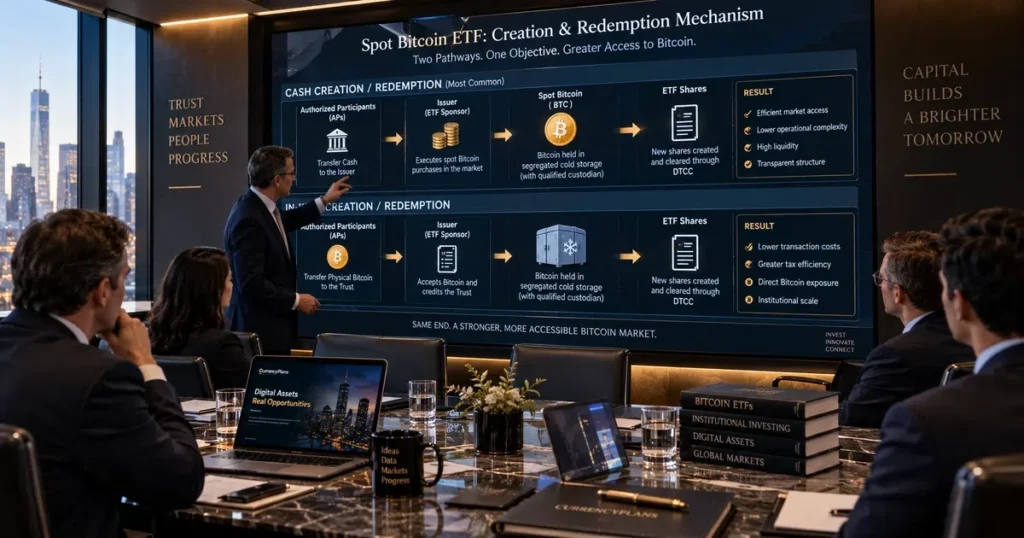
The operational core of an exchange-traded product is the Creation and Redemption Mechanism, operated through institutional Authorized Participants (APs), which are financial institutions that enter into agreements with the fund or trust to facilitate creation and redemption transactions:
                      ┌─────────────────────────────────────────┐
                      │   CREATION AND REDEMPTION ARCHITECTURE  │
                      └────────────────────┬────────────────────┘
                                           │
         ┌─────────────────────────────────┴─────────────────────────────────┐
         │                                                                   │
         ▼                                                                   ▼
┌──────────────────┐               ┌──────────────────────────────────┐
│ OPTION A: IN-KIND PIPELINE       │               │ OPTION B: CASH-SETTLED PIPELINE  │
│ (Approved by SEC in July 2025)   │               │ (Initial January 2024 Model)     │
├──────────────────┤               ├──────────────────────────────────┤
│ 1. AP or permitted counterparty/ │               │ 1. AP deposits USD with Trust    │
│    designee facilitates Bitcoin  │               │ 2. Execution agent buys Bitcoin  │
│    delivery                      │               │ 3. Bitcoin transferred to the    │
│ 2. Bitcoin transferred to the    │               │    Trust's custodial account     │
│    Trust's custodial account     │               │ 4. Trust issues new ETP shares   │
│ 3. Trust issues new ETP shares   │               │                                  │
│ 4. AP distributes on Nasdaq/NYSE │               │                                  │
└──────────────────┘               └──────────────────────────────────┘
The Evolution from Cash-Only to In-Kind Processing
- The Initial 2024 Structure: When the SEC approved the first US spot Bitcoin ETPs in January 2024, the approved structures used cash creations and redemptions. Under this model, Authorized Participants provided cash to the fund, which then used execution arrangements to acquire or dispose of Bitcoin. This differed from the in-kind mechanisms commonly used by many commodity ETPs.
- The July 2025 In-Kind Expansion: On July 29, 2025, the SEC approved regulatory changes permitting in-kind creation and redemption mechanisms for crypto-asset ETPs. Under the updated framework, Authorized Participants and permitted counterparties or designees, where allowed by the individual product’s governing documents, can facilitate in-kind transfers of Bitcoin directly to or from the trust’s custodial accounts in exchange for share blocks (Creation Units).
- Operational Flexibility: In January 2024, the initial US spot Bitcoin ETP approvals were structured around cash creations and redemptions. However, the regulatory framework changed in July 2025 when the SEC approved in-kind creations and redemptions for crypto asset ETPs. As a result, current US spot Bitcoin ETPs may use cash, in-kind, or both creation and redemption mechanisms, depending on the individual fund’s governing documents and regulatory approvals.
Arbitrage Alignment with NAV
AP creation and redemption mechanisms generally help keep the ETF’s market price closely aligned with its NAV, although premiums and discounts can still occur:
- Trading at a Premium: When surging secondary market demand causes ETP shares to trade above NAV, APs create new shares (delivering cash or Bitcoin) and sell them into the secondary market, capturing the spread and pushing the share price back toward NAV.
- Trading at a Discount: When a material discount develops, APs may purchase shares in the secondary market and redeem them with the trust for Bitcoin or cash, depending on the product’s redemption mechanism, reducing outstanding share supply and supporting price parity.
The Regulatory Evolution: From Winklevoss (2013) to Institutional Standardization
The approval of US spot Bitcoin exchange-traded products followed more than a decade of administrative review, legal challenges, and regulatory adaptation:
                      KEY MILESTONES IN US BITCOIN ETP REGULATION

       2013: First spot Bitcoin trust filing submitted by Cameron and Tyler Winklevoss.
         │
       2018: SEC disapproves early filings, citing market manipulation risks and lack of
             surveillance-sharing agreements with regulated markets of significant size.
         │
       OCT 2021: SEC allows first CME Bitcoin *Futures* ETF (BITO) under the 1940 Act.
         │
       AUG 2023: US Court of Appeals for the D.C. Circuit rules in *Grayscale v. SEC*, vacating
                 the SEC's disapproval and remanding the application for reconsideration.
         │
       JAN 10, 2024: SEC approves 11 spot Bitcoin ETP listing applications simultaneously.
         │
       JULY 29, 2025: SEC approves in-kind creation and redemption mechanisms for crypto ETPs.
The Legal Turning Point: Grayscale Investments v. SEC
The legal foundation for spot crypto ETPs crystallized in August 2023, when the US Court of Appeals for the District of Columbia Circuit ruled in Grayscale Investments, LLC v. SEC. Grayscale challenged the SEC’s denial of its application to convert the Grayscale Bitcoin Trust into an exchange-listed ETP.
The court highlighted evidence of extremely high correlation between Bitcoin spot and CME futures prices. The panel held that the SEC’s differential treatment of the spot and futures products was arbitrary and capricious under the Administrative Procedure Act. The court vacated the SEC’s disapproval and remanded the matter to the Commission for further proceedings, after which the SEC reconsidered the spot applications and approved exchange applications allowing the initial wave of spot Bitcoin ETPs to be listed and traded on January 10, 2024.
Institutional Adoption and the Product Landscape
Following the regulatory approvals, spot Bitcoin ETPs became substantial institutional conduits for digital commodity allocation:
+-------------------------------------------------------------------------------+
|                      HISTORIC CAPITAL ACCUMULATION MILESTONES                 |
+----------------------+-----------------------------+--------------------------+
| FINANCIAL PRODUCT    | ASSET CLASS CATEGORY        | NOTABLE GROWTH MILESTONE |
+----------------------+-----------------------------+--------------------------+
| iShares Bitcoin (IBIT)| Digital Commodity Spot ETP  | Reached $10B AUM in      |
|                      |                             | 49 trading days          |
| SPDR Gold (GLD)      | Physical Precious Metal ETF | Previous historical      |
|                      |                             | commodity pace benchmark |
+----------------------+-----------------------------+--------------------------+
Note: Accumulation timelines reflect public exchange disclosures and official fund filings.
Drivers of Institutional Product Dominance:
- Institutional Brand & Distribution: Institutional wealth managers, family offices, and corporate treasuries leveraged established asset management sponsors to satisfy internal fiduciary and governance requirements.
- Secondary Market Liquidity: For institutional allocators, deep secondary-market liquidity and competitive bid-ask spreads can help reduce execution friction on large transactions.
Custody Architecture: How the Underlying Bitcoin Is Secured
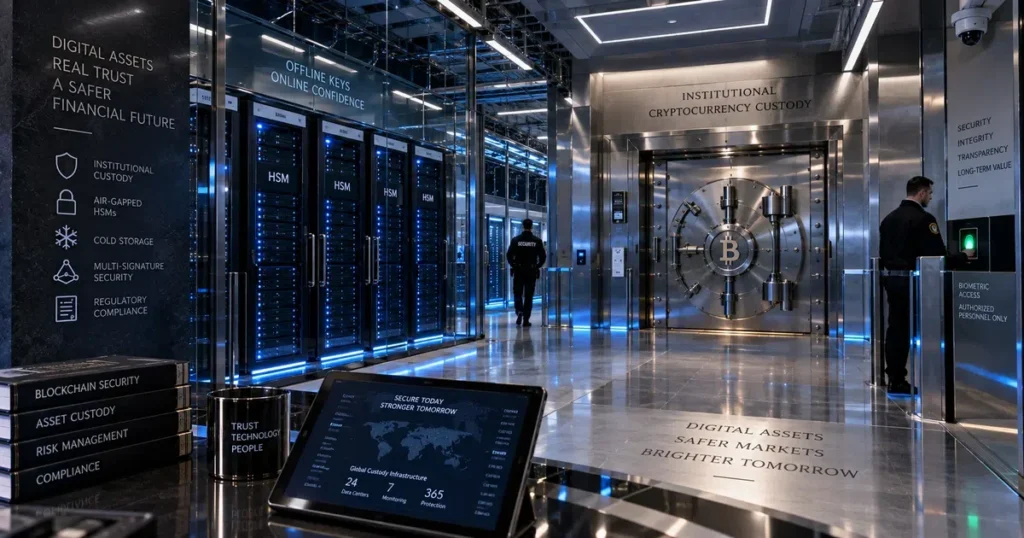
Because Bitcoin is a cryptographic digital bearer asset, safeguarding underlying reserves requires robust physical, digital, and procedural controls across institutional custodians:
                      ┌─────────────────────────────────────────┐
                      │    INSTITUTIONAL CUSTODIAL CONTROLS     │
                      └────────────────────┬────────────────────┘
                                           │
         ┌───────────────────┬─────────────┴───────┬───────────────────┐
         ▼                   ▼                     ▼                   ▼
┌─────────────────┐ ┌─────────────────┐   ┌─────────────────┐ ┌─────────────────┐
│ GEOGRAPHICALLY  │ │ OFFLINE /       │   │ MULTI-PARTY     │ │ OPERATIONAL     │
│ DISTRIBUTED     │ │ HARDWARE        │   │ AUTHORIZATION   │ │ SECURITY        │
│ STORAGE         │ │ SECURITY        │   │ CONTROLS        │ │ CONTROLS        │
├─────────────────┤ ├─────────────────┤   ├─────────────────┤ ├─────────────────┤
│ Multiple secure │ │ Offline key-    │   │ Multiple        │ │ Segregated      │
│ custody         │ │ management and  │   │ approvals or    │ │ workflows,      │
│ locations where │ │ cryptographic   │   │ threshold setups│ │ access controls,│
│ applicable      │ │ controls        │   │ reduce key risk │ │ and monitoring  │
└─────────────────┘ └─────────────────┘   └─────────────────┘ └─────────────────┘
Caption: Specific custody architectures vary by issuer and custodian; these represent common categories of institutional security controls rather than a universal design.
Custodial Infrastructure & Safeguards:
- Custodial Distribution: Coinbase Custody serves as custodian for several major US spot Bitcoin ETPs, while other issuers use different custodial arrangements, including Fidelity Digital Assets, BitGo, or Gemini, depending on the product.
- Asset Segregation & Legal Controls: Custody agreements and applicable regulatory requirements generally require or provide for segregation and control arrangements designed to distinguish trust assets from the custodian’s proprietary assets. The exact legal protections depend on the individual trust, custodian, and governing agreements.
- Custodial Technologies: Custody arrangements may use technologies such as distributed key generation, hardware security modules (HSMs), offline key-management controls, and multi-party or multi-signature authorization, depending on the custodian and product.
To learn how cryptographic key management works at the personal level, read our guide on what a crypto wallet is.
Fees, Expense Ratios, and Tracking Efficiency
The entry of major institutional asset managers established competitive pricing across US spot Bitcoin products:
+---------------------------------------------------------------------------------------------------+
|                        REPRESENTATIVE US SPOT BITCOIN PRODUCTS: SPECIFICATIONS                    |
+--------+----------------------------+-------------+---------------------+-------------------------+
| TICKER | FUND SPONSOR / ISSUER      | BASE SPONSOR| PRIMARY CUSTODIAN   | EXCHANGE LISTING        |
|        |                            | FEE (ANNUAL)|                     |                         |
+--------+----------------------------+-------------+---------------------+-------------------------+
| IBIT   | BlackRock (iShares)        | 0.25%       | Coinbase Custody    | Nasdaq                  |
| FBTC   | Fidelity (Wise Origin)     | 0.25%       | Fidelity Digital    | Cboe BZX                |
| BITB   | Bitwise Asset Management   | 0.20%       | Coinbase Custody    | NYSE Arca               |
| ARKB   | ARK 21Shares               | 0.21%       | Coinbase Custody    | Cboe BZX                |
| EZBC   | Franklin Templeton         | 0.19%       | Coinbase Custody    | Cboe BZX                |
| BTC    | Grayscale Mini Trust       | 0.15%       | Coinbase Custody    | NYSE Arca               |
| GBTC   | Grayscale Bitcoin Trust    | 1.50%       | Coinbase Custody    | NYSE Arca               |
+--------+----------------------------+-------------+---------------------+-------------------------+
Note: Representative base sponsor fees; verify current individual fund prospectuses and regulatory disclosures for any temporary fee waiver terms and updates.
Tracking Efficiency vs. Futures Roll Yields:
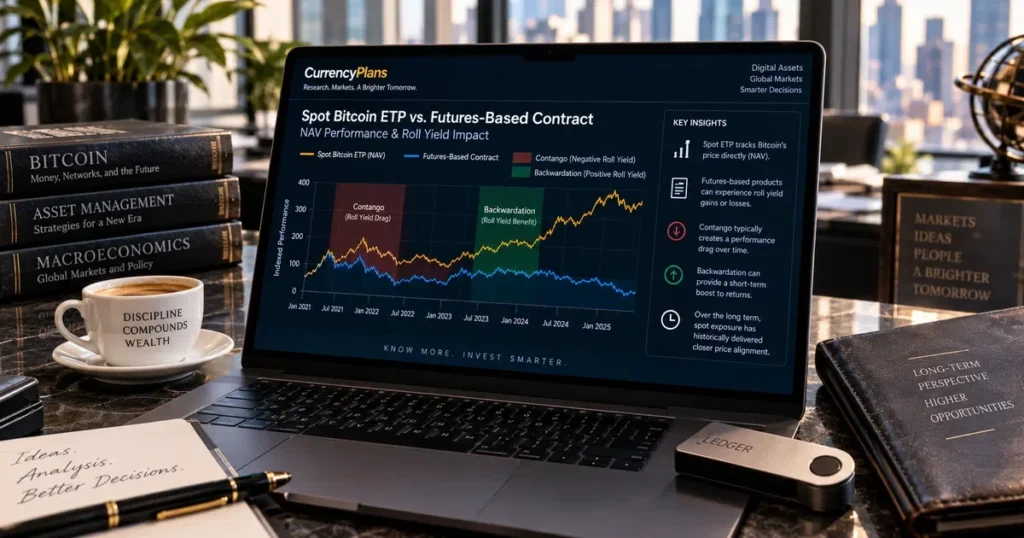
- Spot Product Tracking: Spot Bitcoin ETPs avoid the futures-contract roll mechanism and therefore do not incur futures roll yield from replacing expiring contracts. Tracking differences relative to spot Bitcoin prices can reflect the stated annual sponsor fee, valuation methodologies, portfolio transactions, execution costs, and cash-drag buffers.
- Futures Roll Yield Dynamics: In contrast, futures-based funds (such as BITO) hold derivatives contracts traded on the Chicago Mercantile Exchange (CME). Futures-based Bitcoin products can experience positive or negative roll yield. When the futures curve is in contango (subsequent monthly contract prices exceed expiring contract prices), rolling into more expensive contracts can create a performance drag relative to spot Bitcoin:$$\text{Roll Cost} \approx \text{Next-Month Futures Price} – \text{Expiring Futures Price}$$For example, if an expiring contract trades at $65,000 and the next-month contract trades at $65,800, rolling forward requires selling lower and buying higher, creating an illustrative $800 drag per contract. Conversely, during periods of market backwardation (where subsequent contracts are cheaper than expiring contracts), rolling can generate positive roll yield.
Spot Bitcoin ETP vs. Direct Self-Custody: The Decision Matrix
Choosing between an exchange-traded vehicle and direct on-chain ownership involves balancing regulatory convenience against personal financial sovereignty:
| Dimension | Spot Bitcoin ETP (e.g., IBIT) | Direct On-Chain Ownership |
| Operational Workflow | Standard brokerage execution (market and limit orders) | Self-managed hardware wallet; secure seed phrase backups |
| Asset Rights | Beneficial securities interest in trust; no personal withdrawal rights | Direct bearer ownership of underlying on-chain UTXOs |
| Tax Document Processing | Brokerage tax statements where applicable (e.g., Form 1099-B) | Manual cost-basis tracking across individual on-chain addresses |
| Retirement Plan Access | Generally accessible where the brokerage or plan permits the security | Restricted; requires specialized self-directed trust structures |
| Trading Windows | Standard securities exchange operating hours | 24 hours a day, 7 days a week, 365 days a year |
| On-Chain Usability | None (cannot transfer on-chain, spend, or interact with apps) | Direct transfers and access to Bitcoin-native or compatible Layer-2 applications |
| Censorship Dynamics | Subject to brokerage account freezes, court orders, or platform policies | High at the protocol level: enables transfers without brokerage intermediaries |
| Cost Profile | Ongoing annual sponsor fee (0.15% to 0.25%) deducted from NAV | Trading spreads, exchange fees, withdrawal fees, and Bitcoin network transaction fees |
How to Buy a Bitcoin ETF: Domestic and International Investment Routes

Investing in exchange-traded Bitcoin products follows standard securities purchasing protocols, while international investors must consider cross-border remittance frameworks:
                      ┌─────────────────────────────────────────┐
                      │   SPOT BITCOIN ETP INVESTMENT ROUTES    │
                      └────────────────────┬────────────────────┘
                                           │
         ┌─────────────────────────────────┴─────────────────────────────────┐
         │                                                                   │
         ▼                                                                   ▼
┌──────────────────┐               ┌──────────────────────────────────┐
│ DOMESTIC US INVESTORS            │               │ CROSS-BORDER INVESTORS (INDIA)   │
├──────────────────┤               ├──────────────────────────────────┤
│ 1. Open approved brokerage acct  │               │ 1. Open international investing  │
│    (Schwab, Fidelity, Robinhood) │               │    brokerage (Vested, INDmoney)  │
│ 2. Fund account via ACH or wire  │               │ 2. Remit USD via RBI LRS window  │
│ 3. Enter ticker (e.g., IBIT)     │               │ 3. Track applicable TCS rules    │
│ 4. Execute market or limit order │               │ 4. File local foreign asset ITR  │
└──────────────────┘               └──────────────────────────────────┘
Cross-Border Capital Framework for Indian Investors
As of September 2026, Indian investors do not have a domestically listed spot Bitcoin ETF on the NSE or BSE, so Indian residents seeking US-listed spot Bitcoin ETP exposure generally use permitted international investment routes:
- The Liberalised Remittance Scheme (LRS): Indian residents may be able to obtain exposure to eligible US-listed spot Bitcoin ETPs through permitted overseas investment routes under the LRS, subject to applicable FEMA, RBI, tax, and intermediary requirements, up to the statutory limit of $250,000 USD per financial year.
- Tax Collected at Source (TCS) Rules: For applicable LRS remittances, TCS is generally collected at 20% on the amount exceeding the ₹10 lakh annual statutory threshold for specified other-purpose remittances, subject to applicable tax rules and exemptions. TCS is not an additional tax expense; it functions as an advance tax collection that can be fully credited against regular income tax liability or claimed as a refund during annual return filing.
To understand how interest rate differentials influence currency values and foreign exchange trends, read our analysis on interest rates and exchange rates.
Historical Precedents: Gold ETPs (GLD) and Structural Access
Market historians examine the launch of physical gold ETPs (SPDR Gold Shares, GLD) in November 2004 as an important precedent in financial access:
                      COMMODITY ACCESS EVOLUTION

       2004: Launch of GLD enabled institutional wealth advisors, pension funds,
             and private trusts to allocate to physical gold without requiring
             direct vault logistics, security contracts, or physical delivery.
         │
       2024: Launch of spot Bitcoin ETPs allowed wealth management firms and
             eligible retirement accounts to access digital asset price exposure through
             existing securities infrastructure.
The introduction of GLD did not create the underlying demand for gold, but it served as an important access mechanism that reduced operational friction for institutional allocators. In a similar manner, spot Bitcoin ETPs standardized access to digital asset exposure across modern financial clearinghouses.
Institutional Demand Dynamics: Interpreting Fund Flows
In the exchange-traded digital asset market, primary-market creations and redemptions provide an important measure of changes in ETP share supply and underlying trust assets, while reported fund-flow data can help assess investor demand:
$$\text{Net Share Flow} = \sum \text{Creation Units Issued (Value)} – \sum \text{Creation Units Redeemed (Value)}$$
                      ┌─────────────────────────────────────────┐
                      │      CAPITAL FLOW TRANSMISSION LOOP     │
                      └────────────────────┬────────────────────┘
                                           │
         ┌─────────────────────────────────┴─────────────────────────────────┐
         │                                                                   │
         ▼                                                                   ▼
┌──────────────────┐               ┌──────────────────────────────────┐
│ SUSTAINED NET CREATIONS          │               │ SUSTAINED NET REDEMPTIONS        │
├──────────────────┤               ├──────────────────────────────────┤
│ * Secondary market buying demand │               │ * Portfolio rebalancing or       │
│ * APs create new Creation Units  │               │   institutional risk reduction   │
│ * Trust receives cash/Bitcoin;   │               │ * APs redeem Creation Units      │
│   underlying trust holdings grow │               │ * Trust releases cash/Bitcoin;   │
│ * Informs spot price discovery   │               │   underlying trust holdings drop │
└──────────────────┘               └──────────────────────────────────┘
When sustained net creations occur, the trust issues new shares and receives corresponding cash or Bitcoin, increasing the trust’s Bitcoin holdings or cash-funded Bitcoin exposure. Conversely, during sustained redemptions, trust holdings or cash assets decline as shares are retired. Sustained demand for spot Bitcoin ETP shares can contribute to primary-market creations and corresponding purchases or transfers of Bitcoin, potentially influencing spot-market liquidity and price formation alongside Bitcoin’s programmatic issuance schedule (halved to 3.125 BTC per block in April 2024), as discussed in our guide on what crypto mining is.
The Grayscale Transformation: From Pre-Conversion GBTC Trust to Open ETP
The conversion of the Grayscale Bitcoin Trust (GBTC) highlights the operational distinction between legacy unredeemable trusts and open-ended exchange-traded structures:
                      ┌─────────────────────────────────────────┐
                      │      THE STRUCTURAL CONVERSION          │
                      └────────────────────┬────────────────────┘
                                           │
         ┌─────────────────────────────────┴─────────────────────────────────┐
         │                                                                   │
         ▼                                                                   ▼
┌──────────────────┐               ┌──────────────────────────────────┐
│ PRE-CONVERSION GBTC (2013-2023)  │               │ THE OPEN-ENDED ETP (2024-PRESENT)│
├──────────────────┤               ├──────────────────────────────────┤
│ * Fixed share supply             │               │ * Dynamic creation and redemption│
│ * No daily redemption mechanism  │               │ * Daily AP arbitrage activity    │
│ * Traded at massive premium      │               │ * Share price generally remains  │
│   (+40%) during 2021 bull market │               │   close to NAV                   │
│ * Traded at catastrophic discount│               │ * Structural discounts and       │
│   (-50%) during 2022 market bust │               │   premiums substantially         │
│                                  │               │   compressed                     │
└──────────────────┘               └──────────────────────────────────┘
Before its conversion, GBTC lacked an ongoing redemption mechanism. When institutional demand surged in 2020–2021, secondary market shares traded at a premium exceeding 40% above NAV. During the 2022 market downturn, selling pressure combined with a frozen redemption path contributed to a historic discount exceeding 50% below NAV. The January 2024 conversion to an open-ended ETP introduced a daily creation and redemption mechanism that greatly improved NAV arbitrage and substantially reduced the structural discount associated with the old trust structure.
Regulatory & Tax Realities: Direct Crypto vs. Foreign Securities (India & US)
Tax rules governing direct digital assets differ fundamentally from those applied to exchange-traded foreign securities:
+-------------------------------------------------------------------------------+
|                        TAXATION FRAMEWORK COMPARISON                          |
+----------------------+-----------------------------+--------------------------+
| TAX JURISDICTION /   | DIRECT CRYPTOCURRENCY       | US-LISTED SPOT BITCOIN   |
| INSTRUMENT           | (VIRTUAL DIGITAL ASSETS)    | ETP (FOREIGN SECURITY)   |
+----------------------+-----------------------------+--------------------------+
| **United States**    | Property classification:    | Capital asset:           |
|                      | Capital gains (short-term   | Generally treated as a   |
|                      | up to 37%, long-term up to  | capital asset, subject to|
|                      | 20%). Direct retirement     | holding period and tax   |
|                      | integration complex.        | brackets. Eligible for   |
|                      |                             | tax-sheltered accounts.  |
| **India**            | **VDA Tax Regime:**         | **Foreign Security:**    |
|                      | Special **30% flat tax** on | Analyzed under tax rules |
|                      | transfer income; deductions | applicable to relevant   |
|                      | restricted to cost of       | foreign securities; loss |
|                      | acquisition; special loss   | set-off rules depend on  |
|                      | restrictions apply.         | security classification. |
+----------------------+-----------------------------+--------------------------+
Key Considerations for Indian Taxpayers
- Direct Virtual Digital Assets (VDAs): Under India’s current VDA tax framework, gains from the transfer of VDAs are subject to a 30% tax rate plus applicable surcharge and cess. Deductions are generally restricted to the permitted cost of acquisition, and losses from VDA transfers are subject to special restrictions and generally cannot be set off against income from other heads. The statutory framework transitioned from the Income-tax Act, 1961 to the Income-tax Act, 2025 for transactions governed by the new Act from April 1, 2026 onward.
- Foreign Securities & ETPs: For an Indian resident, gains from a US-listed Bitcoin ETP are generally analyzed under the tax rules applicable to the relevant foreign security and asset classification; the exact holding period and capital-gains treatment should be verified for the relevant tax year. Loss set-off and carry-forward rules applicable to the relevant foreign-security classification may apply, subject to the applicable tax year and provisions. Investors who are required to disclose foreign assets should complete the applicable foreign-asset disclosure schedules, including Schedule FA where applicable.
Structural Risks: Custody, Market Hours, and Systemic Constraints
While spot Bitcoin ETPs offer structural convenience, they carry defined counterparty and operational risks:
                      ┌─────────────────────────────────────────┐
                      │    STRUCTURAL ETP RISK CONSIDERATIONS   │
                      └────────────────────┬────────────────────┘
                                           │
         ┌───────────────────┬─────────────┴───────┬───────────────────┐
         ▼                   ▼                     ▼                   ▼
┌─────────────────┐ ┌─────────────────┐   ┌─────────────────┐ ┌─────────────────┐
│ CUSTODIAL       │ │ TRADING SESSION │   │ ABSENCE OF      │ │ FORK AND        │
│ CONCENTRATION   │ │ GAP RISK        │   │ ON-CHAIN RIGHTS │ │ AIRDROP EXCLUSION│
├─────────────────┤ ├─────────────────┤   ├─────────────────┤ ├─────────────────┤
│ Significant fund│ │ Underlying asset│   │ Beneficial      │ │ Trust documents │
│ volume held by a│ │ trades 24/7;    │   │ security interest;│ generally reserve│
│ small group of  │ │ secondary stock │   │ no ability to   │ discretion; do not│
│ institutional   │ │ exchanges close │   │ sign messages or│ distribute      │
│ custodians      │ │ on weekends     │   │ interact on-chain│ minority tokens  │
└─────────────────┘ └─────────────────┘   └─────────────────┘ └─────────────────┘
- Custodial Concentration: A significant portion of total spot Bitcoin ETP assets is custody-managed by a small group of specialized institutions, notably Coinbase Custody and Fidelity Digital Assets. While custody segregation, security controls, and regulatory oversight can mitigate certain risks, concentration remains a point of institutional scrutiny.
- Weekend Trading Mismatches: Digital asset spot markets trade continuously (24 hours a day, 7 days a week), whereas equity exchanges operate on fixed business schedules. Significant macroeconomic or industry developments occurring over a weekend can cause ETP shares to open on Monday morning with a price gap relative to Friday’s close.
- Forks and Incidental Rights: If the underlying blockchain splits in a contentious hard fork, trust indentures explicitly specify that the sponsor or trustee has sole discretion to decide whether to recognize, claim, or abandon any resulting airdrop or hard-forked asset, with no guarantee that economic value will be passed through to shareholders.
Institutional Horizons: Wealth Management Platforms and Options
The broader significance of spot Bitcoin ETPs lies in their role within the wealth management ecosystem:
                      ┌─────────────────────────────────────────┐
                      │    INSTITUTIONAL INTEGRATION PATHWAY    │
                      └────────────────────┬────────────────────┘
                                           │
         ┌─────────────────────────────────┴─────────────────────────────────┐
         │                                                                   │
         ▼                                                                   ▼
┌──────────────────┐               ┌──────────────────────────────────┐
│ WEALTH MANAGEMENT PLATFORMS      │               │ LISTED OPTIONS CONTRACTS         │
├──────────────────┤               ├──────────────────────────────────┤
│ * Discretionary advisory access  │               │ * Expanded toolkit for dynamic   │
│   across major wirehouses        │               │   hedging and volatility trading │
│ * Model portfolio integration    │               │ * Covered-call strategies for    │
│   with disciplined rebalancing   │               │   institutional income generation│
└──────────────────┘               └──────────────────────────────────┘
- Wealth Advisory Access: Following initial launch phases, major wealth management platforms began clearing spot Bitcoin ETPs for discretionary client portfolios, allowing financial planners to integrate digital assets into diversified investment frameworks.
- Listed Options Markets: The introduction of SEC-approved exchange-listed options on spot Bitcoin products (including IBIT) expanded the toolkit available for institutional hedging, volatility trading, and options-based strategies.
The Global ETP Landscape: Products Beyond the United States
While US exchange-traded products represent the largest capital concentration, digital asset exchange-traded vehicles operate across several global jurisdictions:
+-------------------------------------------------------------------------------+
|                      INTERNATIONAL SPOT CRYPTO PRODUCTS                       |
+----------------------+-----------------------------+--------------------------+
| JURISDICTION         | KEY MILESTONE / STRUCTURE   | REGULATORY ENVIRONMENT   |
+----------------------+-----------------------------+--------------------------+
| **Canada**           | Purpose Bitcoin ETF (BTCC)  | Launched February 2021;  |
|                      |                             | pioneering direct spot   |
|                      |                             | crypto fund model        |
| **Europe**           | Physical Bitcoin ETCs       | Structured as Exchange   |
|                      | (CoinShares, 21Shares)      | Traded Commodities under |
|                      |                             | regional prospectus rules|
| **Hong Kong**        | Spot Bitcoin and Ether ETPs | Approved April 2024;     |
|                      | (ChinaAMC, Harvest, Bosera) | features in-kind model   |
| **Australia**        | Monochrome Bitcoin ETF      | Regulated under direct   |
|                      | (IBTC)                      | Australian Financial     |
|                      |                             | Services licenses        |
+----------------------+-----------------------------+--------------------------+
Common Myths vs. Empirical Facts
- Myth: Spot Bitcoin ETPs do not hold physical Bitcoin.
- Fact: Spot Bitcoin ETPs hold Bitcoin as the principal underlying asset through institutional custody arrangements, which may include cold storage, subject to cash, expenses, liabilities, and the terms of the individual trust.
- Myth: ETP share prices are mathematically locked to exact spot prices at all times.
- Fact: While the Authorized Participant creation and redemption mechanism generally keeps share prices aligned with Net Asset Value, intraday premiums and discounts can still occur due to market volatility and trading liquidity.
- Myth: Holding an ETP gives retail investors the right to redeem for physical Bitcoin.
- Fact: Retail shareholders own securities representing an economic interest in the trust; they cannot request physical delivery of underlying coins. Only Authorized Participants operating in institutional Creation Units can execute redemptions with the trust.
- Myth: An ETP is universally cheaper than buying directly on a crypto exchange.
- Fact: ETP investors pay an annual sponsor fee, while direct Bitcoin investors may incur trading spreads, exchange fees, withdrawal fees, and network transaction fees. The total cost depends on the platform, transaction size, and holding period.
- Myth: Futures Bitcoin ETFs always underperform spot Bitcoin due to contango.
- Fact: While contango causes roll drag when longer-dated contracts are more expensive, futures curves can also shift into backwardation (where future contracts trade below spot), which can generate positive roll yield. Performance depends on curve shape and market conditions.
Frequently Asked Questions
What is a Bitcoin ETF in simple terms?
A Bitcoin ETF is an exchange-traded fund that tracks the price of Bitcoin and trades on traditional stock exchanges. It allows investors to gain price exposure to Bitcoin within standard brokerage and retirement accounts without managing private keys or crypto wallets.
What is the difference between a spot Bitcoin ETP and a futures Bitcoin ETF?
A spot Bitcoin ETP holds physical Bitcoin through institutional custody arrangements, which may include secure cold-storage controls. A futures Bitcoin ETF holds cash-settled futures contracts traded on the Chicago Mercantile Exchange (CME), exposing investors to contract roll yields.
Can in-kind creations and redemptions be used for spot Bitcoin ETPs?
Yes. Following an SEC regulatory approval order on July 29, 2025, spot crypto-asset ETPs can utilize in-kind creation and redemption mechanisms, allowing Authorized Participants to deliver or receive physical Bitcoin alongside traditional cash-settled pathways, subject to each individual fund’s governing documents.
Are spot Bitcoin ETPs regulated by the SEC?
Yes. US spot Bitcoin ETPs are registered under the Securities Act of 1933 and their exchange listings are approved by the SEC. However, they are generally structured as commodity grantor trusts and are not registered investment companies under the Investment Company Act of 1940.
Can I withdraw the underlying Bitcoin from my ETF shares?
No. Retail shareholders own securities representing an economic interest in the trust; they cannot redeem shares for physical Bitcoin. Only Authorized Participants operating in wholesale Creation Units can execute physical redemptions.
What is BlackRock’s IBIT?
IBIT is the ticker symbol for the iShares Bitcoin Trust, a spot Bitcoin ETP sponsored by BlackRock. It is listed on the Nasdaq and holds physical Bitcoin secured in institutional custody.
What are the annual fees for spot Bitcoin ETPs?
Leading US spot Bitcoin products carry annual sponsor fees ranging from 0.15% to 0.25%, while GBTC currently charges a 1.50% sponsor fee.
Can Indian residents invest in US-listed spot Bitcoin ETPs?
Indian residents may be able to obtain exposure to eligible US-listed spot Bitcoin ETPs through permitted overseas investment routes under the Reserve Bank of India’s Liberalised Remittance Scheme (LRS) using international brokerage accounts, subject to the $250,000 annual remittance limit and applicable FEMA, RBI, and TCS guidelines.
How does LRS Tax Collected at Source (TCS) apply to Bitcoin ETP investments?
For applicable LRS remittances, TCS is generally collected at 20% on the amount exceeding the ₹10 lakh annual threshold for specified other-purpose remittances, subject to applicable tax rules and exemptions. This TCS is an advance tax payment that can be adjusted against total income tax liabilities when filing an annual tax return.
How are Bitcoin ETPs taxed compared to direct crypto in India?
Direct crypto in India is taxed under the specialized Virtual Digital Asset (VDA) regime at a flat 30% rate (plus surcharge and cess) on transfer income, with no expense deductions other than acquisition cost, and special restrictions on loss set-off. For an Indian resident, gains from a US-listed Bitcoin ETP are generally analyzed under the tax rules applicable to the relevant foreign security and asset classification; the exact holding period and capital-gains treatment should be verified for the relevant tax year.
What is contango in futures ETFs?
Contango occurs when longer-dated futures contracts trade at higher prices than expiring front-month contracts. When a futures fund repeatedly sells expiring contracts at lower prices to buy more expensive subsequent contracts, this monthly roll cost creates an operational performance drag relative to spot Bitcoin.
Is an ETP better than holding Bitcoin directly?
An ETP is suited for investors prioritizing regulatory integration, tax reporting convenience, and access through retirement accounts. Direct self-custody may be preferable for users who prioritize monetary sovereignty, 24/7 market availability and on-chain transferability, and greater control over peer-to-peer transfers.
Strategic Summary & Core Takeaways
Understanding the mechanics of spot Bitcoin ETPs provides clarity on how institutional capital interacts with digital commodities:
- Exchange-Traded Financial Wrapper: Spot Bitcoin ETPs package physical Bitcoin into standardized securities that trade and settle through traditional market infrastructure, including DTCC-related clearing and settlement systems.
- Dual Creation/Redemption Mechanics: Following regulatory developments in 2024 and 2025, modern crypto ETPs can utilize both cash-settled and in-kind creation and redemption pathways to maintain close alignment with Net Asset Value.
- Physical Custody Infrastructure: Underlying Bitcoin is held through institutional custody arrangements with security and governance controls determined by the individual product and custodian, removing the need for end investors to personally manage private keys and seed-phrase backups.
- Institutional Integration: The launch of spot products unlocked institutional access for wealth advisors, wirehouses, and pension accounts, integrating digital assets into modern portfolio asset allocation.
- Structural Trade-Off: Investors must weigh the administrative simplicity and tax convenience of an exchange-traded product against the self-sovereignty, on-chain utility, and 24/7 market availability and on-chain transferability of direct Bitcoin ownership.
Next Reading Suggestions
- What Is Bitcoin? The Complete Guide to the First Decentralized Digital Currency
- What Is a Crypto Wallet? A Complete Guide to Keys, Security, and Storage Types
- What Is Crypto Mining? A Complete Guide to Proof of Work, ASICs, Pools, and Energy Economics
- What Is Blockchain? The Complete Guide to Distributed Ledger Technology, Consensus, and Smart Contracts
- What Is Crypto? The Complete Guide to Cryptocurrency, Blockchain, and Digital Assets
- What Is Ethereum? The Complete Guide to Smart Contracts, EVM, Staking, and Layer 2 Rollups
- Fed Rate Cuts & Global Liquidity: The Complete Guide to Interest Rates, the Fed Balance Sheet, and Asset Markets
- How Stock Prices Are Determined: Market Microstructure, Supply and Demand, and Valuation
- What Is the Stock Market? How Global Equity Markets Work and Allocate Capital
- What Are Stocks? The Complete Guide to Shares, Equity, and Ownership
- What Is Market Capitalization? The Complete Guide to Market Cap, Company Size, and Valuation
- What Is Gold? The Complete Guide to Real Money, Store of Value & Why It Matters
- Interest Rates and Exchange Rates: The Complete Guide to Global Currency Pricing
Author Box & E-E-A-T Verification
Written & Researched By: CurrencyPlans Editorial Research Team
Editorial Review: This guide is developed in accordance with institutional capital markets standards, regulatory disclosures, and securities law. Fund mechanics, creation/redemption pipelines, custodial protocols, and statutory tax rules are cross-referenced with primary sources, including the US Securities and Exchange Commission (SEC) registration statements and regulatory approval orders, official iShares prospectuses, BlackRock shareholder filings, the Financial Industry Regulatory Authority (FINRA), the Depository Trust & Clearing Corporation (DTCC), the Reserve Bank of India (RBI), and the Income Tax Department of India.
Primary Institutional References & Regulatory Resources
For official prospectuses, regulatory filings, and market datasets, consult primary institutional repositories directly:
- US Securities and Exchange Commission Regulatory Orders & Releases: U.S. Securities and Exchange Commission (SEC)
- BlackRock iShares Bitcoin Trust (IBIT) Prospectus & Disclosures: iShares by BlackRock
- Fidelity Wise Origin Bitcoin Fund (FBTC) Prospectus: Fidelity Investments
- The Depository Trust & Clearing Corporation (DTCC) Securities Clearing: DTCC Repository
- Reserve Bank of India Liberalised Remittance Scheme (LRS) Guidelines: Reserve Bank of India (RBI)
- Income Tax Department of India (Capital Gains & VDA Guidelines): Income Tax Department of India
Educational Disclaimer
This guide is prepared strictly for educational, informational, and research purposes and does not constitute personalized financial, investment, legal, or tax advice. Digital commodities and exchange-traded products involve significant market volatility, tracking risks, and regulatory considerations. Past performance of exchange-traded funds and digital assets does not guarantee future results. Always perform independent due diligence and consult a licensed fiduciary financial advisor and tax specialist before allocating capital to digital asset investment vehicles or cross-border remittance frameworks.

