
Introduction
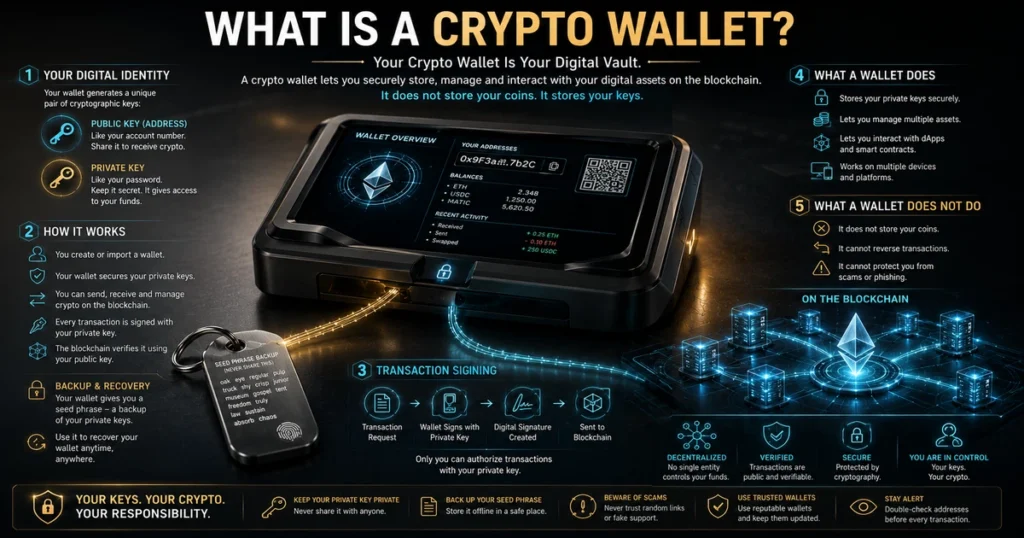
A crypto wallet is a tool that lets you control digital assets on a blockchain. It does not physically store your Bitcoin, Ether, or other tokens. In distributed ledger architecture, tokens never leave the blockchain; they exist permanently as cryptographically verified records on a public, decentralized network.
A crypto wallet is a specialized software application or dedicated hardware device that manages the cryptographic credentials needed to access blockchain accounts and authorize transactions. Depending on its design, this credential management may involve private keys, recovery phrases, multi-party key shares, or programmable smart contract code.
Having cryptocurrency in self-custody does not mean storing files on a phone or computer; it means having access to the cryptographic keys or authorization mechanisms required to sign transactions and reassign unspent transaction outputs or account balances. Substantial capital has been lost or stolen historically not because core blockchain protocols were cracked, but due to user-targeted phishing, clipboard malware, lost backup phrases, or the failure of centralized custodial platforms. Understanding crypto wallets requires evaluating private versus public keys, Hierarchical Deterministic (HD) derivation, hot versus cold storage trade-offs, Multi-Party Computation (MPC), and account abstraction.
What Is a Crypto Wallet? Core Principles
Quick Answer: What Is a Crypto Wallet?
A crypto wallet is a tool for managing cryptographic keys and authorizing blockchain transactions. It does not contain physical or digital coins. Because cryptocurrency balances live permanently on decentralized blockchain ledgers, your wallet manages the credentials (such as private keys or recovery phrases) that prove ownership and sign transfers. With a non-custodial wallet, you hold the keys directly and retain sovereign control; with a custodial wallet (such as on an exchange), a third-party intermediary holds the keys on your behalf.
In traditional banking, an account balance represents a centralized ledger entry maintained by a financial institution that can freeze accounts, reverse transactions, or face corporate insolvency. In non-custodial digital asset management, your crypto wallet acts as:
- Your Account Manager: You manage access credentials directly without needing permission from a central clearinghouse.
- Your Transaction Signer: Cryptographic keys isolated on your device or in dedicated hardware provide mathematical authorization for outgoing transfers.
- Your On-Chain Gateway: Your public address serves as your identifier across decentralized applications (dApps) and decentralized finance (DeFi), as detailed in our guide on what is blockchain.
Foundational Definition: What Is a Crypto Wallet?
To understand a crypto wallet with technical precision, it helps to separate its three distinct operational functions:
                      ┌─────────────────────────────────────────┐
                      │       THE TRIPARTITE WALLET NATURE      │
                      └────────────────────┬────────────────────┘
                                           │
         ┌─────────────────────────────────┼─────────────────────────────────┐
         │                                 │                                 │
         ▼                                 ▼                                 ▼
┌──────────────────┐             ┌──────────────────┐             ┌──────────────────┐
│ CREDENTIAL       │             │ CRYPTOGRAPHIC    │             │ BLOCKCHAIN STATE │
│ MANAGER          │             │ SIGNING ENGINE   │             │ INTERFACE        │
├──────────────────┤             ├──────────────────┤             ├──────────────────┤
│ Generates, holds,│             │ Uses private keys│             │ Queries RPC nodes│
│ or coordinates   │             │ or key shares to │             │ to display live  │
│ signing keys and │             │ construct valid  │             │ balances and     │
│ recovery phrases │             │ digital signatures│            │ broadcast payloads│
└──────────────────┘             └──────────────────┘             └──────────────────┘
- The Core Misconception: Many beginners assume that when they transfer tokens from an exchange to a personal wallet, digital coins are downloaded to their mobile phone or hardware device. This is incorrect. Tokens remain permanently on the blockchain ledger.
- The Practical Reality: The wallet stores or manages the cryptographic credentials required to authorize state changes for those addresses. If your smartphone or physical hardware device is broken or lost, your assets remain safe on the blockchain, accessible as long as you maintain the appropriate recovery credentials.
To examine how transaction balances and states are recorded across different networks, compare the Unspent Transaction Output (UTXO) model in what is bitcoin with the account-based model in what is ethereum.
How a Crypto Wallet Works: The Cryptographic Lifecycle
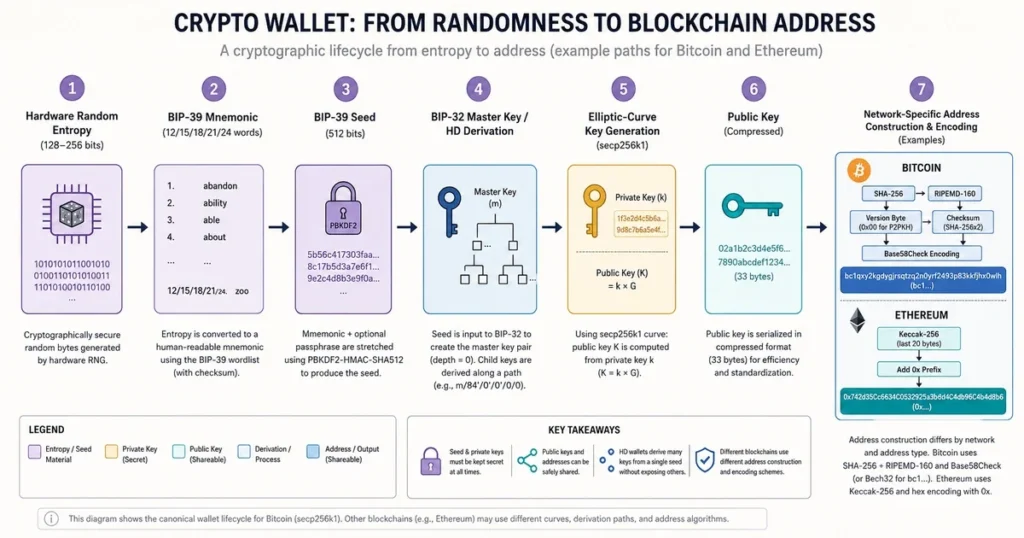
A standard crypto wallet derives keys and addresses using one-way mathematical functions, meaning data flows forward easily but cannot be reversed:
                      ┌─────────────────────────────────────────┐
                      │   STEP 1: CRYPTOGRAPHIC ENTROPY         │
                      │  Randomness generated by system/hardware │
                      │  (Typically 128 to 256 bits)            │
                      └────────────────────┬────────────────────┘
                                           │
                             (Appends Checksum Bits)
                                           ▼
                      ┌─────────────────────────────────────────┐
                      │   STEP 2: BIP-39 RECOVERY PHRASE        │
                      │  Mapped to 12, 15, 18, 21, or 24 words   │
                      │  from the standard 2,048-word dictionary│
                      └────────────────────┬────────────────────┘
                                           │
                             (PBKDF2 HMAC-SHA512 Hashing)
                                           ▼
                      ┌─────────────────────────────────────────┐
                      │   STEP 3: 512-BIT BIP-39 MASTER SEED    │
                      │  Binary master seed used for hierarchical│
                      │  deterministic key derivation (BIP-32)  │
                      └────────────────────┬────────────────────┘
                                           │
                         (BIP-32 / BIP-44 Derivation Tree)
                                           ▼
                      ┌─────────────────────────────────────────┐
                      │   STEP 4: ASYMMETRIC KEY PAIR           │
                      │  * Private Key: Scalar integer (secp)   │
                      │  * Public Key: Curve coordinate point   │
                      └────────────────────┬────────────────────┘
                                           │
                           (Chain-Specific Encoding / Hashing)
                                           ▼
                      ┌─────────────────────────────────────────┐
                      │   STEP 5: BLOCKCHAIN RECEIVING ADDRESS  │
                      │  * Bitcoin: Address-type witness program│
                      │    (P2WPKH -> Bech32; P2TR -> Bech32m)  │
                      │  * Ethereum: Keccak-256 -> 0x Address   │
                      └─────────────────────────────────────────┘
The Step-by-Step Signing Lifecycle:
- Transaction Construction: The wallet interface drafts an unsigned payload specifying the recipient address, amount, and network gas or transaction fee parameters.
- Cryptographic Signing: The wallet uses the network’s required cryptographic signature scheme to authorize the transaction. For example, Ethereum uses secp256k1 ECDSA, while Bitcoin transaction types can use ECDSA or Schnorr signatures depending on the address and spending format.
- Network Broadcast: The signed transaction is sent to a blockchain node via an RPC endpoint and propagated into the public mempool.
- Node Verification: Network nodes use the matching public key to mathematically verify that the signature was generated by the corresponding private key holder, without the private key ever being revealed.
Anatomy: Private Key, Public Key, Address, and Seed Phrase
Managing digital assets safely requires understanding four interrelated cryptographic components:
1. The Private Key
For commonly used elliptic-curve-based networks such as Bitcoin and Ethereum (which use the secp256k1 curve), a private key is typically represented as a 256-bit secret scalar integer. Other blockchain architectures may utilize different cryptographic curves (such as ed25519) and signature schemes.
- Function: It acts as the mathematical proof of authorization for spending or moving funds associated with an address.
- Security Rule: Anyone who gains access to your private key can control the corresponding funds. It must never be entered on untrusted websites, stored in unencrypted digital text files, or photographed.
2. The Public Key
The public key is mathematically derived from the private key via elliptic curve point multiplication:
$$K = k \times G$$
Where $k$ is the private key, $G$ is the generator point on the curve, and $K$ is the derived public key. Because the mathematics rely on the discrete logarithm problem over elliptic curves, deriving the public key from the private key is straightforward, while reversing it is considered computationally infeasible with modern computers.
3. The Public Address
A blockchain address is an identifier used to receive assets; its exact construction depends on the blockchain and address type.
- Function: It works like an account number or payment routing code. You can share your public address freely to receive transfers.
- Format Styles: Bitcoin addresses commonly use Native SegWit (
bc1q...) or Taproot (bc1p...) formats. Ethereum and EVM-compatible networks use a 20-byte hexadecimal string starting with0x.
4. The Seed Phrase (Mnemonic Recovery Phrase)
Standardized by Bitcoin Improvement Proposal 39 (BIP-39), a seed phrase converts random computer-generated entropy (128 to 256 bits) into a sequence of 12, 15, 18, 21, or 24 readable words from a defined 2,048-word dictionary. It serves as a master human-readable backup that wallet software can use as the seed input for deterministic HD key and address derivation, typically through standards such as BIP-32 and compatible derivation schemes.
Comprehensive Taxonomy of Crypto Wallets

Wallets differ in network connectivity, custody structure, and key management architecture:
| Wallet Category | Network Exposure | Key Custody Model | Primary Advantages | Structural Trade-Offs | Common Examples |
| Hot Software Wallet | Signing credentials accessible from internet-connected device (Mobile, Desktop, Extension) | Self-Custodial (User manages keys locally) | Fast, convenient dApp and DeFi access; free software download | Exposed to host operating system malware, clipboard hijacking, and phishing | MetaMask, Phantom, Trust Wallet |
| Cold Hardware Wallet | Isolated signing device (Communication via USB, Bluetooth, or air-gapped QR code) | Self-Custodial (Keys isolated in dedicated hardware environment) | Substantially reduces risk of remote key extraction; offline signing | Physical cost; physical loss risk; device firmware maintenance | Ledger, Trezor, BitBox02 |
| Physical Recovery Backup | Completely offline (Paper printout or metal engraving) | Offline Recovery Credential Backup | Zero electronic attack surface; high physical durability (metal) | Fragile if paper; lack of dynamic signing; operational storage overhead | Cryptosteel, Billfodl, stamped steel plates |
| Custodial (Exchange) | Internet-connected enterprise infrastructure | Third-Party Custodial (Intermediary controls keys) | Familiar login recovery via email/password; integrated fiat rails | Third-party counterparty risk; withdrawal halts; regulatory account freezes | Coinbase, Binance, CoinDCX |
| MPC Wallet | Configurable hybrid architecture | Shared / Distributed Custody (Threshold signatures) | Avoids a single private key point of failure; eliminates seed phrase handling | Relies on provider or network infrastructure for share coordination | ZenGo, Fireblocks institutional systems |
| Smart Contract Account / Account Abstraction | On-chain programmable execution | Code-Governed Account Control (Custody model depends on implementation) | Programmable recovery; batched operations; sponsored gas fees | Higher deployment and transaction gas costs; smart contract code vulnerabilities | Safe, Argent |
Hot Wallets vs. Cold Wallets: The Convenience vs. Security Dilemma
The most practical decision in digital asset storage is choosing between hot and cold storage environments:
                      ┌─────────────────────────────────────────┐
                      │    HOT STORAGE VS. COLD STORAGE         │
                      └────────────────────┬────────────────────┘
                                           │
         ┌─────────────────────────────────┴─────────────────────────────────┐
         │                                 │                                 │
         ▼                                 ▼                                 ▼
┌──────────────────┐               ┌──────────────────────────────────┐
│      HOT WALLETS (SOFTWARE)      │               │     COLD WALLETS (HARDWARE)      │
├──────────────────┤               ├──────────────────────────────────┤
│ * Credentials on internet device │               │ * Credentials isolated in secure │
│ * Instant signing for trading    │               │   signing environment            │
│ * Free and easy to install       │               │ * Air-gapped signing workflow    │
│ * Best for: Daily transactions   │               │ * Best for: Significant long-term│
│   and small operational amounts  │               │   holdings and wealth protection │
└──────────────────┘               └──────────────────────────────────┘
Hardware Isolation Mechanics
Dedicated hardware wallets isolate private key operations from the host computer’s operating system:
- When initiating a transaction, the unsigned payload travels from the computer or mobile app to the hardware wallet over a USB cable, Bluetooth connection, or optical QR code.
- The hardware wallet displays critical transaction parameters (destination address, amount, fee) on its built-in physical screen.
- The cryptographic signature is computed entirely inside the device’s secure signing environment.
- Only the resulting mathematical signature is sent back to the internet-connected computer for network broadcast. Private keys remain isolated from the host computer, substantially reducing the risk of remote key extraction, even if the host computer is infected with malware. Note that hardware architectures vary across manufacturers: some devices utilize certified Secure Elements (such as EAL5+ or EAL6+ chips), while others rely on general-purpose microcontrollers with completely open-source firmware.
Custodial vs. Non-Custodial: “Not Your Keys, Not Your Coins”
Understanding custody is fundamental to managing risk in digital assets:
- Custodial Wallets: When you keep crypto on a centralized exchange, you do not directly control the private keys. The exchange maintains pooled wallets and credits your account on an internal balance sheet. If the exchange suffers insolvency, fraud, or technical halts, your access to funds can be frozen or lost.
- Non-Custodial Wallets: You control the private keys or recovery credentials directly. No bank or exchange can directly freeze assets solely by controlling your non-custodial wallet keys. However, the underlying blockchain, token contract, or application may have its own administrative, compliance, or freezing controls. This self-sovereignty transfers full security responsibility to you: if you lose your recovery phrase or approve a malicious transaction, no customer support desk can recover your funds.
Hierarchical Deterministic (HD) Architecture: BIP-32, BIP-39, and BIP-44
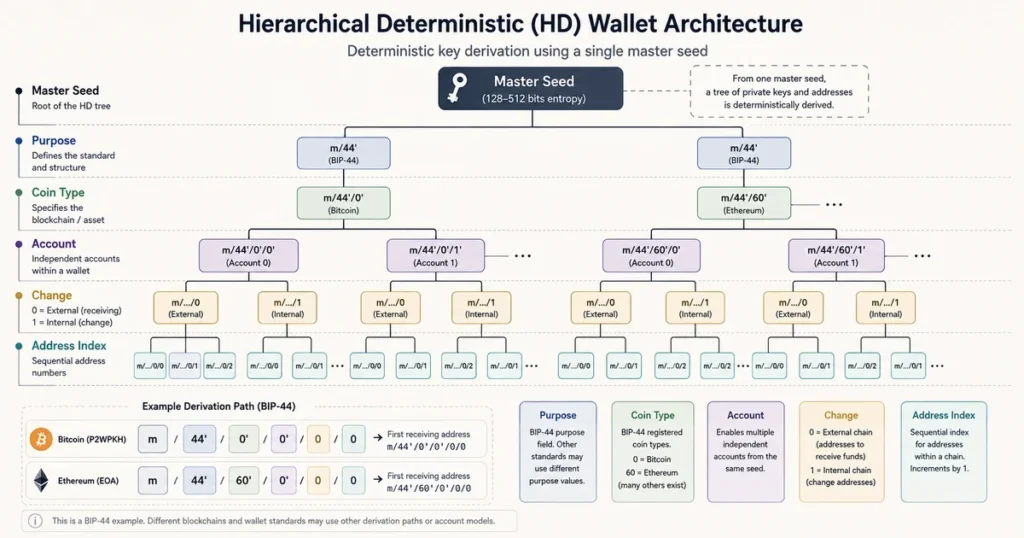
Early cryptocurrency software generated random private keys independently for each new transaction, requiring users to make continuous backups. Modern wallets solve this using Hierarchical Deterministic (HD) standards:
- BIP-32: Defines how a single master seed can deterministically derive an extensive tree of child private and public keys.
- BIP-39: Standardizes the translation of raw computer entropy into human-readable 12, 15, 18, 21, or 24-word mnemonic phrases.
- BIP-44: Establishes a structured derivation path across multiple accounts and blockchains:
$$\text{m} / \text{purpose}’ / \text{coin\_type}’ / \text{account}’ / \text{change} / \text{address\_index}$$
                                  MASTER SEED (m)
                                         │
                                   m/44' (BIP-44)
                                         │
                    ┌────────────────────┴────────────────────┐
                    ▼                                         ▼
            m/44'/0' (Bitcoin)                   Common Ethereum BIP-44 Path:
                    │                                m/44'/60'/0'/0/...
             m/44'/0'/0' (Account 0)                          │
                    │                             m/44'/60'/0' (Account 0)
             m/44'/0'/0'/0 (External)                         │
              ┌─────┴─────┐                        m/44'/60'/0'/0 (External)
              ▼           ▼                         ┌─────────┴─────────┐
           Index 0     Index 1                      ▼                   ▼
          (Address 1) (Address 2)                Index 0             Index 1
                                               (Address 1)         (Address 2)
Through BIP-44, a single master seed can derive Bitcoin addresses (coin_type = 0'), common Ethereum addresses (coin_type = 60'), and accounts for numerous other networks simultaneously.
What Is a Seed Phrase? Practical Backup and Recovery
A seed phrase is the foundational backup for a non-custodial wallet:
1. Entropy and Word Lists
A 12-word seed phrase is generated from 128 bits of entropy plus a 4-bit SHA-256 checksum; a 24-word phrase uses 256 bits of entropy plus an 8-bit checksum (with 15, 18, and 21-word phrases scaling proportionally). The resulting bits are divided into 11-bit segments, each corresponding to an index in the 2,048-word BIP-39 word list. The massive number of possible combinations ($2^{128}$ or $2^{256}$) makes guessing an active seed phrase computationally unfeasible.
2. Durable Physical Backups
Paper backups are vulnerable to water, fire, and physical wear. For significant digital asset holdings, users frequently stamp or engrave their recovery words onto stainless steel or titanium plates, which can withstand extreme heat and corrosion.
3. The BIP-39 Passphrase (“25th Word”)
The BIP-39 specification includes an optional passphrase feature, often informally called the “25th word.” It is an optional cryptographic extension, not literally a 25th word drawn from the standard mnemonic dictionary.
- Separate Vaults: Entering the standard 12 or 24 words restores a primary wallet. Entering the same words plus an optional passphrase derives a completely separate set of accounts.
- Duress Protection: If physically compelled to unlock a device, a user can reveal the primary wallet containing nominal funds, while their primary assets remain in the passphrase-protected vault. Note that a passphrase is an extension of the cryptographic seed, not simply a device unlock PIN; if forgotten, it cannot be recovered.
Private Key Security: Structured Data Signing and Clear Signing
A primary vulnerability in decentralized application interactions is blind signing:
- The Risk: Older or basic wallet interfaces may display unformatted hexadecimal calldata or transaction data rather than clear transaction details. Approving an uninspected transaction can inadvertently authorize a malicious contract to perform an unintended action, including transferring or spending assets when the relevant permissions or allowances are granted.
- Structured Data Signing and Clear Signing: The EIP-712 standard defines a standard for hashing and signing typed, structured data. When wallet and application implementations provide appropriate display metadata and clear-signing support, compatible devices can present human-readable transaction or message details for user verification. However, clear-signing support is implementation-dependent, meaning users must always review what they approve.
Multi-Party Computation (MPC) Wallets: Threshold Cryptography
Quick Answer: What Is an MPC Wallet?
Multi-Party Computation (MPC) wallets secure assets without storing a single complete private key on any one device. MPC protocols distribute signing authority across multiple independent cryptographic key shares held across separate devices (for example, across your phone, a cloud security server, and an independent recovery provider). When sending a transaction, the parties compute a signature collaboratively using threshold cryptography without a complete private key ever needing to exist in a single location.
                      ┌─────────────────────────────────────────┐
                      │    MPC THRESHOLD SIGNATURE SCHEME       │
                      └────────────────────┬────────────────────┘
                                           │
         ┌─────────────────────────────────┼─────────────────────────────────┐
         │                                 │                                 │
         ▼                                 ▼                                 ▼
┌──────────────────┐             ┌──────────────────┐             ┌──────────────────┐
│ KEY SHARE 1      │             │ KEY SHARE 2      │             │ KEY SHARE 3      │
├──────────────────┤             ├──────────────────┤             ├──────────────────┤
│ Stored on User's │             │ Stored on Cloud  │             │ Stored with      │
│ Mobile Device    │             │ Security Server  │             │ Backup Provider  │
│ (Secure Enclave) │             │ (Encrypted Auth) │             │                  │
└──────────────────┘             └──────────────────┘             └──────────────────┘
         │                                 │
         └────────────────┬────────────────┘
                          ▼
            (2-of-3 Threshold Met -> Valid On-Chain Signature Produced)
- Mitigating Single Points of Failure: If an attacker compromises your phone, they obtain only one key share, which cannot sign transactions by itself.
- Key Share Rotation: MPC systems allow key shares to be refreshed periodically without changing the public blockchain address, neutralizing previously compromised shares within the protocol’s threat model.
Smart Contract Wallets and Account Abstraction: ERC-4337
Standard accounts on Ethereum are Externally Owned Accounts (EOAs), directly bound to a private key. Account Abstraction is a broader design concept that allows accounts to operate as programmable Smart Contract Accounts. The ERC-4337 standard provides one specific infrastructure approach to achieve this on Ethereum without modifying the underlying consensus layer:
+-------------------------------------------------------------------------------+
|             EOA VS. SMART CONTRACT ACCOUNT / ACCOUNT ABSTRACTION              |
+----------------------+-----------------------------+--------------------------+
| FEATURE              | EXTERNALLY OWNED ACCOUNT    | SMART CONTRACT ACCOUNT   |
+----------------------+-----------------------------+--------------------------+
| Underlying Identity  | Cryptographic Private Key   | Deployed Smart Contract  |
| Account Recovery     | Depends on key management;  | Programmable Social      |
|                      | traditional EOAs need key   | Recovery via Guardians   |
| Authentication       | Traditionally secp256k1     | Passkeys (WebAuthn),     |
|                      | ECDSA; EIP-7702 can extend  | Multi-Sig, or Session Keys|
|                      | EOA execution delegation    |                          |
| Gas Payment          | Traditionally requires native| Sponsored gas (Paymaster)|
|                      | network ETH; EIP-7702 can   | or ERC-20 token payment  |
|                      | enable sponsored gas        |                          |
| Transaction Handling | Traditional single-call     | Multi-operation batching |
|                      | model; EIP-7702 can enable  |                          |
|                      | batching via delegated code |                          |
+----------------------+-----------------------------+--------------------------+
Note: Account Abstraction represents a broad architectural category; ERC-4337 is one infrastructure implementation. Specific capabilities—such as social recovery, passkeys, multi-sig verification, and sponsored transactions via paymasters—depend on the implementation of the underlying smart-account contract.
Key Capabilities of Smart Contract Accounts:
- Social Recovery: Users can designate trusted contacts, secondary hardware devices, or institutional services as guardians to approve key rotation if access is lost.
- Biometric Passkeys: Transactions can be authorized using device biometrics (such as FaceID or fingerprint readers) via WebAuthn standards, reducing reliance on raw seed phrases.
- Transaction Batching: Multiple operations—such as approving a token and executing an automated market maker swap—can be bundled into a single atomic transaction.
Bitcoin vs. Ethereum Wallet Address Formats
| Network / Format | Address Structure | Underlying Mechanism | Example Pattern |
| Bitcoin Legacy (P2PKH) | Starts with 1 | Base58Check encoding of public key hash | 1BvBMSEYstWetqTFn5Au4m4GFg7xJaNVN2 |
| Bitcoin Native SegWit (Bech32) | Starts with bc1q | Base32 format; witness data separated from base block | bc1qar0srrr7xfkvy5l643lydnw9re59gtzzwf5mdq |
| Bitcoin Taproot (Bech32m) | Starts with bc1p | 32-byte Taproot output key encoded as a Bech32m witness program; Taproot spending uses Schnorr signatures | bc1p5d7rx65gnslx2e4vs3pwc22a890a6jhnbpk4... |
| Ethereum / EVM (EIP-55) | Starts with 0x | 20-byte hexadecimal string with mixed-case checksum | 0x71C...3972 |
- EIP-55 Checksum Verification: Ethereum addresses are case-insensitive at the protocol level, but EIP-55 capitalizes specific letters based on a Keccak-256 hash of the address string. Wallet software may use the EIP-55 checksum to detect likely address-entry errors before a transaction is submitted.
How to Set Up and Operate a Crypto Wallet Safely
A disciplined operational setup reduces common user execution errors:
- Download Exclusively from Official Sources: Download wallet software only from official project websites or verified app stores. For hardware wallets, purchase directly from the manufacturer or authorized resellers to minimize supply-chain tampering risks.
- Record Your Recovery Credentials Offline: Write down your 12-to-24-word recovery phrase on paper or stamp it onto steel in a private setting. Never take a screenshot, save it to cloud storage, or paste it into a digital document.
- Verify Your Backup: Complete the wallet’s confirmation prompt by re-entering the words in order to ensure the backup is accurate.
- Send a Small Test Transaction: Before depositing substantial capital, transfer a small amount (e.g., $5 to $10) to the wallet and confirm receipt on an independent block explorer.
- Practice Recovery with Nominal Value: While holding only test funds, practice wiping and restoring the wallet using your physical recovery phrase to verify that your backup process works.
- Double-Check Recipient Details: Before approving outgoing transfers, verify every character of the destination address and confirm network gas fees on your device screen.
Gas Fees and Transactions: The Wallet’s Role
A crypto wallet communicates with blockchain nodes to manage network fees:
- Fee Estimation: Under Ethereum’s EIP-1559 fee model, wallets and RPC providers use recent block and fee-history data to estimate appropriate Base Fee and Priority Fee parameters. The Base Fee is determined by the protocol and burned, while the Priority Fee is paid to the validator.
- Layer 2 Data Costs: On Layer 2 networks, transaction costs can be affected by data availability mechanisms such as EIP-4844 blobs. Users experience these lower costs directly through the network and application infrastructure rather than manually choosing data parameters.
Connecting to Decentralized Applications (dApps): WalletConnect and Web3 Providers
When interacting with decentralized exchanges, lending pools, or NFT marketplaces, your wallet acts as the communication portal:
- Injected Browser Providers: Browser extensions (such as MetaMask or Phantom) inject an API object (
window.ethereum) into the web page, allowing the dApp to request account connection and present unsigned transaction payloads for approval. - The WalletConnect Protocol: Uses encrypted communication relays and QR codes to link mobile wallets to desktop applications without exposing private keys to browser memory.
Multi-Signature (Multisig) Wallets: Advanced Organizational Custody
While personal wallets typically require one signature (1-of-1), Multi-Signature (Multisig) smart contract accounts require $M$-of-$N$ separate approvals to execute transactions:
                      ┌─────────────────────────────────────────┐
                      │    2-OF-3 MULTI-SIGNATURE SMART VAULT   │
                      └────────────────────┬────────────────────┘
                                           │
         ┌─────────────────────────────────┼─────────────────────────────────┐
         │                                 │                                 │
         ▼                                 ▼                                 ▼
┌──────────────────┐             ┌──────────────────┐             ┌──────────────────┐
│ SIGNER KEY A     │             │ SIGNER KEY B     │             │ SIGNER KEY C     │
│ Held by CFO      │             │ Held by CEO      │             │ Held in Cold     │
│ (Hardware Device)│             │ (Hardware Device)│             │ Backup Escrow    │
└──────────────────┘             └──────────────────┘             └──────────────────┘
         │                                 │
         └────────────────┬────────────────┘
                          ▼
            (2 Signatures Approved -> Treasury Transaction Released)
Widely used across decentralized project treasuries and enterprise operations (using platforms like Safe), multisig setups ensure that if one participant’s device is compromised or lost, treasury capital cannot be moved without secondary approvals.
Common Crypto Wallet Attacks and Security Risks
Many wallet compromises result from user-targeted deception and operational security failures rather than a break of the underlying cryptographic primitives:
- Seed Phrase Phishing: Fraudulent websites, impersonation accounts, and malicious search ads mimic legitimate wallet interfaces, prompting users to enter their recovery phrase to “synchronize” or “update” their wallet.
- Clipboard Hijacking Malware: Malicious software installed on a computer monitors the operating system clipboard for crypto address patterns, replacing a copied destination address with the attacker’s address when pasted.
- Address Poisoning: Attackers send tiny or specially crafted transactions from vanity addresses that match the first and last characters of addresses in your transaction history, hoping you accidentally copy their address from your recent activity.
- Malicious Smart Contract Approvals: Deceptive websites prompt users to sign an
approve()orpermit()transaction that grants the attacker’s smart contract an unlimited allowance to withdraw specific tokens. Users can periodically check and revoke active allowances using tools like Revoke.cash.
The Defense-in-Depth Security Matrix

Applying layered security controls ensures that a single mistake does not result in total capital loss:
- Verify Software Sources: Download software only from official developer domains and verify package checksums where available.
- Consider Dedicated Hardware for Significant Balances: For digital assets whose potential loss would be financially significant to you, consider hardware-backed cold storage to isolate signing keys from internet-connected computers.
- Use Durable Physical Backups: Record master recovery phrases on stainless steel or titanium plates to protect against fire and moisture.
- Separate Backup Locations: Keep backup recovery materials in geographically separate, secure locations (e.g., a home safe and a secure deposit vault).
- Consider an Optional Passphrase: Implement a BIP-39 passphrase to create separate, hidden account structures where appropriate.
- Execute Low-Value Test Transactions: When transferring significant sums to a new address, send a small test amount first to confirm receipt.
- Practice Clear Signing: Verify recipient addresses, token amounts, and network fees on an independent device screen before approving transactions.
- Audit Open Allowances: Periodically review and revoke unneeded smart contract token allowances across connected networks.
- Segment Your Accounts: Use separate wallets for different activities: a disposable hot wallet for testing new dApps, a secondary wallet for regular trading, and cold storage for core assets.
- Diversify Hardware for Shared Treasuries: When configuring multi-signature treasuries, consider sourcing signing devices from different hardware manufacturers to mitigate supply-chain risks.
- Bookmark Official Application URLs: Access decentralized platforms through verified browser bookmarks to avoid search engine phishing links.
- Maintain Device Firmware: Keep wallet software and hardware device firmware updated through official management applications.
Global and Indian Regulatory Landscape (2026 Standards)
The regulatory treatment of crypto wallets depends on the specific functions performed by the software provider or service intermediary:
1. United States (SEC & FinCEN)
U.S. regulatory treatment depends heavily on the specific functions a wallet provider or associated interface performs. Recent SEC materials distinguish self-custodial wallet software and user-directed interfaces from activities involving custody, trade execution, order routing, or other broker-dealer and exchange functions. Centralized custodial providers that accept, transmit, exchange, or otherwise conduct activities falling within FinCEN’s money-transmitter framework may be treated as Money Services Businesses (MSBs) under FinCEN guidance and become subject to applicable Bank Secrecy Act and Anti-Money Laundering (AML) requirements, depending on their specific activities and applicable exemptions.
2. European Union (MiCA & Transfer of Funds Regulation)
Under the EU’s Markets in Crypto-Assets (MiCA) framework and the updated Transfer of Funds Regulation (Regulation (EU) 2023/1113), holding and operating self-hosted addresses is recognized. However, under Article 16 of the Transfer of Funds Regulation, when regulated Crypto-Asset Service Providers (CASPs) facilitate transfers to or from self-hosted addresses exceeding €1,000, they must take risk-based measures to assess whether the address is owned or controlled by the customer.
3. Crypto Wallet Taxation in India
- Legal Context: There is no general statutory prohibition on individuals creating or using non-custodial wallet software in India, although specific activities and service providers are governed by applicable financial and tax laws.
- Taxation (Section 115BBH): Merely transferring assets between your own non-custodial wallets does not trigger a taxable event. However, under Section 115BBH of the Income Tax Act, income arising from the transfer of Virtual Digital Assets (VDAs)—including selling or swapping tokens via decentralized exchange interfaces—is taxed at a flat 30% rate (plus applicable surcharge and 4% cess). Under statutory provisions, no deductions are permitted other than the direct cost of acquisition, and losses incurred from VDA transfers cannot be set off against any other income head or carried forward to subsequent assessment years.
- TDS Compliance (Section 194S): Under Section 194S of the Income Tax Act, a 1% Tax Deducted at Source (TDS) applies on consideration paid for the transfer of VDAs, subject to statutory conditions and annual thresholds (specifically exceeding ₹50,000 in a financial year for specified persons, and ₹10,000 for all other individuals).
- Custodial Compliance (FIU-IND): Covered VDA service providers operating in India may be required to register as reporting entities with the Financial Intelligence Unit – India (FIU-IND) and comply with applicable Anti-Money Laundering (AML), Know Your Customer (KYC), and transaction-reporting obligations under the Prevention of Money Laundering Act (PMLA).
To see how macro interest rate environments influence capital movement across traditional and digital asset classes, explore our guide on interest rates and exchange rates.
Crypto Wallets by Use Case
Different wallet architectures serve distinct user requirements:
| Use Case | Recommended Architecture | Representative Solutions | Selection Criteria |
| Active DeFi & Web3 Interaction | Hot Browser Extension / Mobile App | MetaMask, Phantom | Broad compatibility across decentralized exchanges, lending protocols, and Web3 applications. |
| Long-Term Asset Storage | Hardware Cold Storage | Ledger Nano X / Flex, Trezor Safe 5 | Physical isolation of keys, clear signing displays, and protection against host computer malware. |
| Seedless Mobile Recovery | Multi-Party Computation (MPC) | ZenGo | Eliminates single seed phrase handling by distributing threshold key shares across devices and cloud backups. |
| Organizational Treasuries & DAOs | Multi-Signature Smart Contract | Safe (formerly Gnosis Safe) | Multi-signatory authorization, custom threshold rules, and transparent on-chain governance controls. |
Common Myths vs. Empirical Facts
- Myth: A crypto wallet stores your digital coins.
- Fact: Cryptocurrencies exist permanently on the blockchain. A wallet manages the cryptographic credentials required to access and transfer those balances.
- Myth: If your hardware wallet or phone is lost, your funds are gone.
- Fact: Physical devices are simply access tools. You can generally restore access to compatible accounts using the appropriate recovery credentials and derivation configuration.
- Myth: Hardware wallets make you completely immune to all theft.
- Fact: Hardware wallets protect private keys against remote online extraction. They cannot protect a user who falls victim to phishing deception, enters recovery words on a malicious website, or approves a fraudulent smart contract transaction.
- Myth: Centralized custodial exchange wallets are inherently safer for everyone.
- Fact: While custodial exchanges simplify password resets, they introduce third-party counterparty risk, potential withdrawal freezes, and vulnerability to platform-level insolvency.
- Myth: All crypto wallets operate on the same security model.
- Fact: Wallets use fundamentally different designs: hot wallets store credentials accessible via internet devices; cold hardware wallets isolate keys in dedicated chips; MPC wallets distribute mathematical key shares; and smart accounts govern access through on-chain code.
Frequently Asked Questions
What is a crypto wallet in simple terms?
A crypto wallet is a digital tool that manages your private keys—the cryptographic credentials used to authorize transactions—allowing you to view, send, and receive digital assets on a blockchain
How does a crypto wallet work?
A wallet uses asymmetric cryptography to generate private keys and derive public receiving addresses. When you initiate a transfer, the wallet creates a digital signature using your private key and broadcasts it to network nodes, which verify the signature against your public key and record the transaction on the shared ledger.
What is the difference between a private key and a seed phrase?
A private key is a single secret scalar number that controls a specific blockchain address. A seed phrase (mnemonic phrase) is a sequence of 12 to 24 words that acts as a master backup, deterministically deriving and recovering all the private keys and addresses in an HD wallet.
What is the difference between a hot wallet and a cold wallet?
A hot wallet holds signing credentials accessible on an internet-connected device (such as an app on a smartphone or browser), offering quick convenience for regular transactions but remaining exposed to host computer malware. A cold wallet keeps private keys offline (such as on a dedicated hardware device), providing greater protection against remote digital attacks.
What is a custodial vs. non-custodial wallet?
With a custodial wallet, a third party (such as a centralized exchange) holds and manages the private keys. With a non-custodial wallet, you hold the private keys or recovery credentials directly, giving you sovereign control alongside complete personal responsibility for security.
What happens if I lose my seed phrase?
For a seed-based self-custodial wallet, if you lose the recovery phrase and have no other valid recovery mechanism or backup, access to the corresponding funds may become permanently unrecoverable. Because decentralized blockchains have no central administrator or password reset system, unbacked private keys cannot be restored.
What is an MPC wallet?
A Multi-Party Computation (MPC) wallet replaces single private key storage with multiple distributed mathematical key shares held across separate devices. Transactions are authorized collaboratively using threshold cryptography without assembling the full private key in any single location.
What is a smart contract wallet (ERC-4337)?
A smart contract wallet is an account whose authorization and execution rules are governed directly by deployed smart contract code rather than a static private key. Under the ERC-4337 Account Abstraction standard, specialized infrastructure—including alternative mempools (UserOperations), an EntryPoint contract, bundlers, and optional paymasters—allows smart accounts to operate without requiring consensus-layer protocol changes. Specific capabilities such as social recovery, biometric passkeys, operation batching, and sponsored gas fees depend on the implementation of the underlying smart account.
Is using a crypto wallet legal in India?
There is no general statutory prohibition on individuals creating or holding non-custodial crypto wallets in India. However, under Section 115BBH of the Income Tax Act, income arising from the transfer of Virtual Digital Assets (including qualifying VDA transfers through decentralized applications) is subject to a flat 30% tax, plus applicable surcharge and cess, while qualifying transfers are subject to 1% TDS under Section 194S.
Can a crypto wallet be hacked?
No practical mathematical attack is currently known that allows an attacker to derive a Bitcoin or Ethereum private key from its corresponding public key under standard cryptographic assumptions. Most real-world wallet compromises instead target users, devices, applications, or signing workflows through phishing, clipboard malware, insecure digital seed storage, or malicious smart contract approvals.
Strategic Summary & Further Reading
Mastering cryptographic custody represents the foundational milestone of self-sovereign digital asset management:
- Keys, Not Coins: Cryptocurrencies live on the blockchain; wallets function as cryptographic credential managers and transaction signers.
- The Mnemonic Foundation: A standardized BIP-39 recovery phrase can serve as the human-readable backup for deterministic HD wallet systems, from which compatible wallet software derives keys and addresses.
- Operational Segmentation: Prudent allocators maintain hot wallets for modest on-chain activities and hardware-backed cold storage for significant long-term reserves.
- Emerging Key Architectures: Multi-Party Computation (MPC) and Account Abstraction (ERC-4337 smart contract accounts) are expanding options beyond single-seed models through threshold shares, social recovery, and biometric passkeys.
- Defense-in-Depth Responsibility: Self-custody eliminates reliance on centralized financial intermediaries, but requires disciplined operational practices, physical backup protection, and vigilance against phishing.
Next Reading Suggestions
- What Is Ethereum? The Complete Guide to Smart Contracts, EVM, Staking, and Layer 2 Rollups
- What Is Blockchain? The Complete Guide to Distributed Ledger Technology, Consensus, and Smart Contracts
- What Is Bitcoin? The Complete Guide to the First Decentralized Digital Currency
- History of Cryptocurrency: The Complete Evolution of Bitcoin, Blockchain, and Digital Assets
- What Is Crypto? The Complete Guide to Cryptocurrency, Blockchain, and Digital Assets
- What Is Gold? The Complete Guide to Real Money, Store of Value & Why It Matters
- What Are Stocks? The Complete Guide to Shares, Equity, and Ownership
- What Is the Stock Market? How Global Equity Markets Work and Allocate Capital
- What Is a Stock Exchange? How Exchanges Work, Trade Stocks, and Settle Transactions
- How Stock Prices Are Determined: Market Microstructure, Supply and Demand, and Valuation
- What Is Market Capitalization? The Complete Guide to Market Cap, Company Size, and Valuation
- How to Invest in Stocks: The Complete Step-by-Step Guide for Beginners and Long-Term Investors
Author Box & E-E-A-T Verification
Written & Researched By: CurrencyPlans Editorial Research Team
Editorial Review: This guide is reviewed against publicly available cryptographic standards, official blockchain documentation, and applicable statutory frameworks. Cryptographic specifications, derivation paths, hardware security architectures, and regulatory rules are cross-referenced with primary sources, including Bitcoin Improvement Proposals (BIP-32, BIP-39, BIP-44), Ethereum Improvement Proposals (EIP-712, EIP-4337), Common Criteria security standards, the US Securities and Exchange Commission (SEC), the Financial Crimes Enforcement Network (FinCEN), the European Securities and Markets Authority (ESMA), and the Income Tax Department of India.
Primary Institutional References & Regulatory Resources
For official digital-asset custody guidance, cryptographic standards, and regulatory notices, consult primary institutional sources directly:
- Bitcoin Improvement Proposals & Cryptographic Standards: Bitcoin Core GitHub Repository
- Ethereum Developer Documentation & Account Standards: Ethereum.org Developer Portal
- Digital Asset Custody Guidance & Regulatory Notices: US Securities and Exchange Commission (SEC)
- Virtual Currency Anti-Money Laundering Frameworks: Financial Crimes Enforcement Network (FinCEN)
- European Union Digital Finance & MiCA Framework: European Securities and Markets Authority (ESMA)
- Virtual Digital Asset Taxation Guidelines (Section 115BBH / 194S): Income Tax Department of India
- International Financial Stability & Central Bank Digital Asset Research: Bank for International Settlements (BIS)
Educational Disclaimer
This guide is prepared strictly for educational, informational, and research purposes and does not constitute personalized financial, investment, legal, technical, or tax advice. Digital assets, non-custodial wallets, and cryptographic keys carry personal security responsibilities, potential technical risks, and capital loss vulnerabilities. Past hardware reliability and cryptographic standards do not guarantee absolute protection against emerging attack vectors or user execution errors. Always perform independent due diligence and consult a licensed, fiduciary financial advisor before making investment commitments.

