
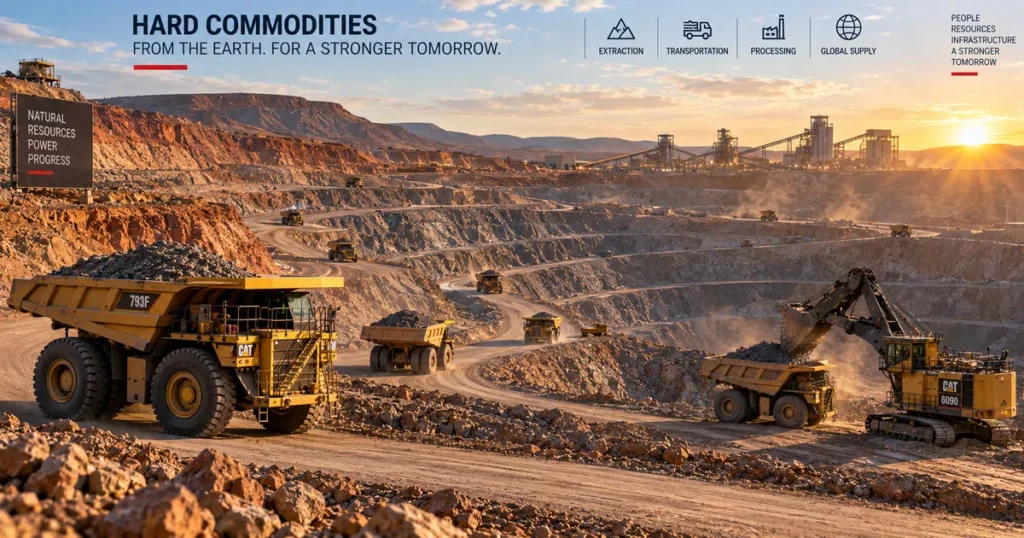
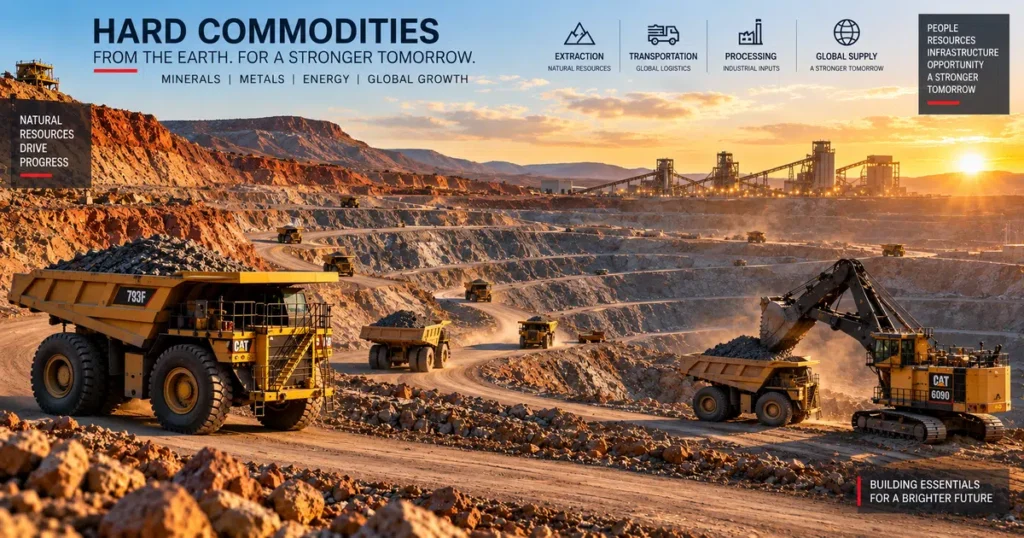
In global economics and financial markets, hard commodities generally refer to commodities derived from mined, drilled, or otherwise extracted natural resources, especially energy products and industrial or precious metals. Encompassing energy hydrocarbons, industrial base metals, and monetary precious metals, these resources provide the primary physical feedstocks for global transportation networks, civil infrastructure, manufacturing assembly, and electrical power generation.
Unlike agricultural soft commodities—which are cultivated, harvested, or ranched according to annual biological and climate cycles—hard commodities are defined by geological extraction constraints, multi-year capital investment horizons, relative physical durability, and low perishability. Extracting crude petroleum and mineral ores, then processing and refining them into commercial products such as gold bullion and copper cathodes, requires substantial capital expenditure, environmental permitting, and advanced industrial processing.
Hard commodities are traded through a combination of physical spot markets, bilateral over-the-counter (OTC) transactions, and standardized futures and options listed on major centralized exchanges such as the Chicago Mercantile Exchange (CME Group), the London Metal Exchange (LME), and the Intercontinental Exchange (ICE). Because they sit at the root of industrial production, shifts in their market values can influence manufacturing costs, trade balances, and inflation through their effects on energy, transportation, and raw-material prices, complementing the pricing principles outlined in our foundational guide on commodity prices.
Executive Summary: What Are Hard Commodities?
Quick Answer: What Are Hard Commodities?
Hard commodities are raw materials and energy products derived from geological deposits through mining, drilling, extraction, and subsequent processing or refining rather than agricultural cultivation. In common commodity-market classification, hard commodities are often grouped into three broad sectors: Energy Commodities (crude oil, natural gas, refined fuels), Base Metals (copper, aluminum, nickel, zinc, lead), and Precious Metals (gold, silver, platinum, palladium). They are characterized by long-term durability, exploration constraints, multi-year project development lead times, and relatively low short-term supply elasticity.
To understand where hard commodities sit within broader economic classifications, consider their structural distinction from cultivated biological goods:
                          ┌──────────────────────────────────────────────┐
                          │         TAXONOMY OF RAW COMMODITIES          │
                          └──────────────────────┬───────────────────────┘
                                                 │
         ┌───────────────────────────────────────┴───────────────────────────────────────┐
         │                                                                               │
         ▼                                                                               ▼
┌────────────────────────────────────────┐                     ┌────────────────────────────────────────┐
│ HARD COMMODITIES (EXTRACTED/REFINED)   │                     │ SOFT COMMODITIES (AGRONOMIC)           │
├────────────────────────────────────────┤                     ├────────────────────────────────────────┤
│ * Origin: Subsurface mining & drilling │                     │ * Origin: Farming, planting & ranching │
│ * Resource Base: Non-renewable geology │                     │ * Resource Base: Renewable biological  │
│ * Supply Lead Time: Multi-year projects│                     │ * Supply Lead Time: Annual / seasonal  │
│ * Durability: High / low perishability │                     │ * Durability: Perishable / biological  │
│ * Examples: Crude Oil, Copper, Gold    │                     │ * Examples: Wheat, Coffee, Live Cattle │
└───────────────────┬────────────────────┘                     └───────────────────┬────────────────────┘
                    │                                                              │
                    └──────────────────────────────┬───────────────────────────────┘
                                                   │
                                                   ▼
                    ┌─────────────────────────────────────────────────────────────┐
                    │ COMMON MARKET INFRASTRUCTURE                                │
                    ├─────────────────────────────────────────────────────────────┤
                    │ * Standardized contract specifications (grade & purity)     │
                    │ * Centralized futures exchanges (CME, LME, ICE)             │
                    │ * Benchmark price discovery and risk transfer (hedging)     │
                    └─────────────────────────────────────────────────────────────┘
The fundamental properties of hard commodities include:
- Geological Finite Reserves: Hard commodities cannot be grown; their extraction depends on the discovery, capital development, and depletion of finite planetary deposits.
- Capital Intensity and Multi-Year Lead Times: Constructing an underground mine shaft or an offshore deepwater platform takes years of planning and substantial capital, causing production to remain relatively inflexible over the short term.
- Low Perishability under Proper Containment: Unlike grains or meat, extracted metals and properly contained hydrocarbons do not spoil or decompose rapidly, allowing commercial inventories to be stored for extended periods to cushion demand swings.
Hard vs. Soft Commodities: Core Structural Differences
Quick Answer: What Is the Difference Between Hard and Soft Commodities?
The primary difference lies in their origin and production cycle: hard commodities are extracted or mined from geological deposits and exhibit multi-year capital development horizons, whereas soft commodities are renewable agricultural goods or livestock grown and harvested according to seasonal climate cycles. Hard commodities are generally non-perishable under appropriate storage, whereas soft commodities require strict moisture and temperature controls to prevent biological decay.
+---------------------------------------------------------------------------------------------------+
|                           HARD COMMODITIES VS. SOFT COMMODITIES                                   |
+---------------------+-----------------------------+-----------------------+-----------------------+
| DIMENSION           | HARD COMMODITIES            | SOFT COMMODITIES      | ECONOMIC SIGNIFICANCE |
+---------------------+-----------------------------+-----------------------+-----------------------+
| **Origin**          | Geological deposits;        | Agricultural farming, | Finite mineral rights |
|                     | subsurface extraction       | plantation cultivation| vs. arable land usage |
+---------------------+-----------------------------+-----------------------+-----------------------+
| **Renewability**    | Non-renewable finite        | Renewable through     | Depletion economics   |
|                     | resource reserves           | seasonal planting     | vs. crop rotation     |
+---------------------+-----------------------------+-----------------------+-----------------------+
| **Supply Cycle**    | Multi-year CapEx investment | Annual crop cycles and| Short-term inelastic  |
|                     | across project phases       | livestock breeding    | vs. annual re-seeding |
+---------------------+-----------------------------+-----------------------+-----------------------+
| **Perishability**   | Non-perishable under        | Perishable; prone to  | Lower storage decay   |
|                     | appropriate storage         | mold, rot, and pests  | vs. strict shelf life |
+---------------------+-----------------------------+-----------------------+-----------------------+
| **Primary Risks**   | Jurisdictional policies,    | Weather patterns,     | Mineral jurisdiction  |
|                     | reserve depletion, energy   | droughts, plant pests,| vs. meteorological    |
|                     | input cost inflation        | biological diseases   | disruptions           |
+---------------------+-----------------------------+-----------------------+-----------------------+
| **Primary Venues**  | NYMEX, COMEX, LME, ICE      | CBOT, Euronext, ICE US| Distinct historical   |
|                     |                             |                       | exchange specialisms  |
+---------------------+-----------------------------+-----------------------+-----------------------+
The Energy Complex: Hydrocarbons and Power Generation
Quick Answer: What Are Energy Commodities?
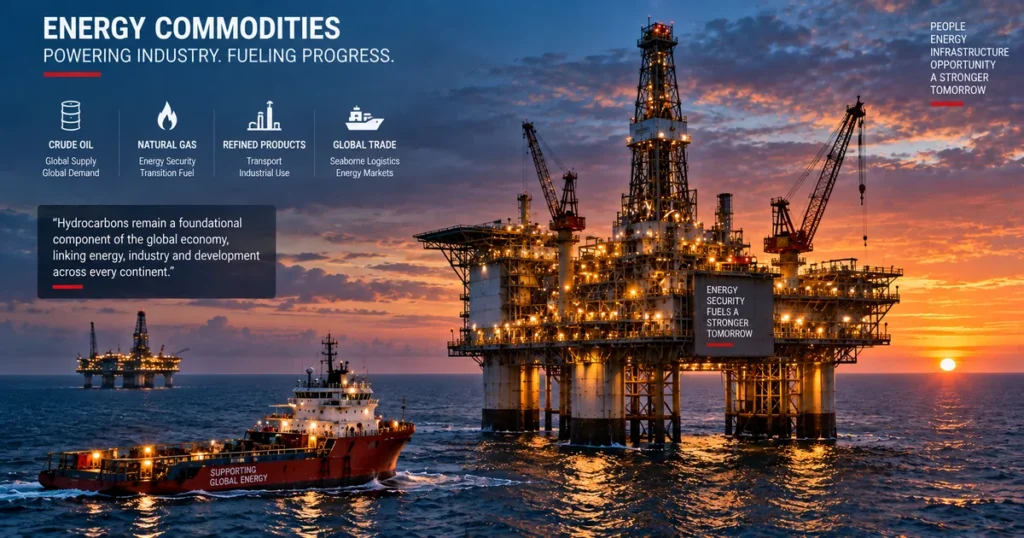
Energy commodities include naturally extracted hydrocarbons such as crude oil and natural gas, as well as refined petroleum products produced from crude oil, including ultra-low sulfur diesel (ULSD) and reformulated gasoline blendstock (RBOB), which provide motive power for transportation, thermal heating, and electrical grid generation.
Energy commodities form a major and highly liquid segment of global commodity markets:
                          ┌──────────────────────────────────────────────┐
                          │         THE GLOBAL ENERGY COMMODITY COMPLEX  │
                          └──────────────────────┬───────────────────────┘
                                                 │
         ┌───────────────────────────────────────┴───────────────────────────────────────┐
         │                                                                               │
         ▼                                                                               ▼
┌────────────────────────────────────────┐                     ┌────────────────────────────────────────┐
│ UPSTREAM PRIMARY EXTRACTION            │                     │ DOWNSTREAM REFINED PRODUCTS            │
├────────────────────────────────────────┤                     ├────────────────────────────────────────┤
│ * Light Sweet Crude Oil (WTI / Brent)  │  ── Refining Units ──► * RBOB Gasoline Blendstock            │
│ * Heavy Sour Crude (Western Canada)    │      (Distillation & │ * Ultra-Low Sulfur Diesel (Transport) │
│ * Natural Gas (Pipeline & Cryogenic)   │      Cracking Units) │ * Jet Fuel & Heating Oil              │
│ * Thermal & Metallurgical Coal         │                     │ * Petrochemical Feedstocks (Naphtha)   │
└────────────────────────────────────────┘                     └────────────────────────────────────────┘
1. Crude Oil Benchmarks: WTI vs. Brent
Crude oil is not a single, uniform substance; it varies significantly in density (measured in API gravity) and sulfur concentration:
- Light Sweet Crude: Low density (high API gravity, typically 37°–42°) and low sulfur content (under 0.42% by weight). It requires minimal catalytic processing to refine into high-value transport fuels. The primary global benchmark is West Texas Intermediate (WTI), traded on the New York Mercantile Exchange (NYMEX) with physical pipeline delivery centered at the Cushing, Oklahoma storage terminal.
- Waterborne Brent Crude: Sourced from North Sea fields, Brent serves as a major international pricing benchmark for waterborne crude oil. Traded on ICE Europe, Brent reflects seaborne shipping logistics and international maritime supply-demand conditions.
2. Refined Petroleum Products
Refineries convert crude oil into standardized secondary energy commodities:
- RBOB Gasoline: Reformulated Blendstock for Oxygenate Blending, a major NYMEX/CME benchmark contract for U.S. gasoline pricing. RBOB is blended with ethanol before reaching the finished-gasoline retail market.
- Ultra-Low Sulfur Diesel (ULSD): Highly refined middle distillate powering commercial freight fleets, maritime coastal shipping, and heavy industrial machinery.
- The Refining Crack Spread: As detailed in our guide on commodity prices, the price spread between crude feedstocks and finished fuels—such as the 3:2:1 crack spread—reflects the short-term economic margin of refining operations.
3. Natural Gas and Liquefied Natural Gas (LNG)
- Pipeline Natural Gas: Primarily composed of methane, natural gas is transported through pressurized continental pipeline grids. A major North American benchmark is Henry Hub in Louisiana, traded on NYMEX. In Europe, the primary reference hub is the Title Transfer Facility (TTF) in the Netherlands.
- Liquefied Natural Gas (LNG): Chilled to -162°C to reduce its volume approximately 600-fold, LNG allows natural gas to be shipped across oceanic routes via cryogenic tankers, connecting isolated extraction fields with global industrial import terminals.
Base and Industrial Metals: Structural Inputs for Modern Industry
Quick Answer: What Are Base Metals?
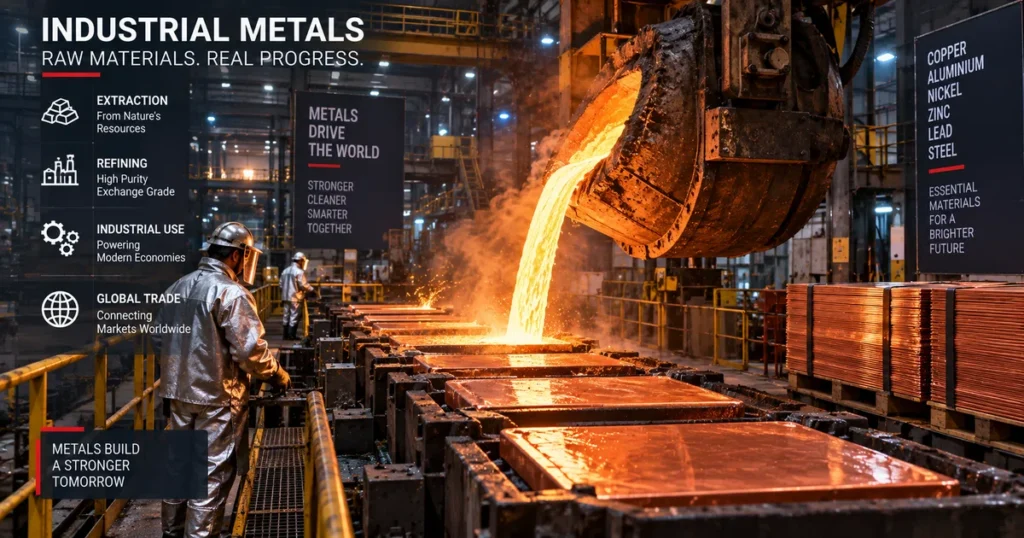
Base metals are non-ferrous industrial metals that oxidize or corrode relatively easily and are used extensively in manufacturing, civil construction, automotive assembly, and electrical engineering. The most widely traded base metals include copper, aluminum, nickel, zinc, and lead, with major international price discovery occurring across venues including the London Metal Exchange (LME), CME/COMEX, and major regional exchanges such as the Shanghai Futures Exchange (SHFE).
Industrial base metals form the physical foundation of urban construction, electrification, and consumer goods manufacturing:
+---------------------------------------------------------------------------------------------------+
|                               BASE METALS COMPARATIVE MATRIX                                      |
+---------------------+-----------------------------+-----------------------+-----------------------+
| METAL               | PRIMARY INDUSTRIAL USAGE    | EXCHANGE BENCHMARKS   | ECONOMIC SENSITIVITY  |
+---------------------+-----------------------------+-----------------------+-----------------------+
| **Copper (`Cu`)**   | Electrical wiring, power    | LME Grade A Copper,   | Macroeconomic output; |
|                     | transformers, motors, HVAC  | COMEX Copper (`HG`)   | global industrial PMI |
+---------------------+-----------------------------+-----------------------+-----------------------+
| **Aluminum (`Al`)** | Aerospace airframes, auto   | LME Primary Aluminum, | Electricity tariffs;  |
|                     | body panels, beverage cans  | CME Aluminum (`ALI`)  | industrial smelting   |
+---------------------+-----------------------------+-----------------------+-----------------------+
| **Nickel (`Ni`)**   | Stainless steel alloys,     | LME Nickel,           | EV battery production;|
|                     | EV battery cathode materials| SHFE Nickel           | stainless steel output|
+---------------------+-----------------------------+-----------------------+-----------------------+
| **Zinc (`Zn`)**     | Galvanization of structural | LME Zinc,             | Construction activity;|
|                     | steel to prevent corrosion  | SHFE Zinc             | automotive fabrication|
+---------------------+-----------------------------+-----------------------+-----------------------+
| **Lead (`Pb`)**     | Starter batteries (SLI) for | LME Lead,             | Automotive replacement|
|                     | vehicles, radiation shields | SHFE Lead             | cycles, energy backup |
+---------------------+-----------------------------+-----------------------+-----------------------+
1. Copper: The Barometer of Global Growth
Featuring superior electrical conductivity and high ductility, refined copper cathodes are essential across electrical transmission grids, telecommunications infrastructure, renewable wind/solar farms, and building plumbing:
- The “Doctor Copper” Economic Proxy: Copper is sometimes nicknamed “Doctor Copper” because market participants often use its price as an informal gauge of industrial activity.
- Smelter Processing Margins: The economics of converting raw mined copper concentrate into deliverable Grade A cathodes is reflected in Treatment and Refining Charges (TC/RCs). Low TC/RCs indicate tight concentrate supply relative to global smelting capacity.
2. Aluminum: The Energy-Intensive Metal
Refined through the Hall-Héroult electrolytic smelting process from bauxite and alumina, aluminum combines structural strength with low density:
- Power-Intensive Cost Structure: According to industrial benchmarks from the International Aluminium Institute (IAI), producing a single metric ton of primary aluminum requires approximately 14,000 to 15,000 kilowatt-hours (kWh) of electrical power. Consequently, aluminum smelting operations locate near competitive hydroelectric or natural gas sources, and aluminum prices often trade with high sensitivity to regional energy tariffs.
3. Nickel and Battery Chemistries
Historically consumed primarily in austenitic stainless steel production, nickel plays an expanding role in energy storage technologies:
- Class 1 vs. Class 2 Nickel: Exchange contracts, such as LME Nickel, specify Class 1 nickel (minimum 99.80% purity), used in advanced aerospace superalloys and high-energy-density electric vehicle (EV) battery chemistries. Lower-grade Class 2 nickel (such as nickel pig iron and ferronickel) is consumed primarily by stainless steel mills.
Precious Metals: Monetary Preserves and Specialized Industrial Inputs
Quick Answer: What Are Precious Metals?
Precious metals are rare, naturally occurring metallic elements with high economic value, exceptional resistance to chemical corrosion, and notable scarcity. The primary precious metals include gold, silver, platinum, and palladium. While gold functions primarily as a monetary reserve asset and store of value, silver, platinum, and palladium serve dual roles as investment assets and indispensable high-technology industrial catalysts.
+---------------------------------------------------------------------------------------------------+
|                              PRECIOUS METALS DUAL UTILITY MATRIX                                  |
+---------------------+-----------------------------+-----------------------+-----------------------+
| METAL               | PRIMARY ECONOMIC ROLE       | DOMINANT USAGE DRIVER | MARKET STRUCTURE      |
+---------------------+-----------------------------+-----------------------+-----------------------+
| **Gold (`Au`)**     | Sovereign monetary reserve; | Central bank reserves;| London OTC Bullion    |
|                     | institutional wealth hedge  | jewelry, investment   | (LBMA), COMEX Futures |
+---------------------+-----------------------------+-----------------------+-----------------------+
| **Silver (`Ag`)**   | Hybrid monetary store and   | Solar photovoltaics,  | COMEX Futures, LBMA   |
|                     | high-tech industrial input  | electronics, jewelry  | Clearing Network      |
+---------------------+-----------------------------+-----------------------+-----------------------+
| **Platinum (`Pt`)** | Automotive emissions catalyst| Diesel catalytic     | NYMEX Futures, London |
|                     | and fine jewelry metal      | converters, chemicals | Platinum Market (LPPM)|
+---------------------+-----------------------------+-----------------------+-----------------------+
| **Palladium (`Pd`)**| Gasoline automotive catalyst| Exhaust emissions     | NYMEX Futures, London |
|                     | and specialized electronics | control, dental alloys| Palladium Market      |
+---------------------+-----------------------------+-----------------------+-----------------------+
1. Gold: Monetary and Reserve Asset
As detailed in our educational guide on what is gold, gold possesses unique chemical inertness: it does not rust, tarnish, or decay. Virtually all the gold mined throughout human history remains in existence in vaulted bullion bars, sovereign reserves, or personal jewelry:
- Relationship with Real Yields: Gold has often shown an inverse relationship with real yields because higher real yields can increase the opportunity cost of holding a non-yielding asset. However, this relationship can weaken or be offset by other factors such as central-bank demand, geopolitical risk sentiment, and currency movements.
- Central Bank Reserve Diversification: Central banks hold and accumulate gold as part of long-term reserve diversification, risk management, and balance sheet protection against sovereign currency volatility.
2. Silver: The Strategic Photovoltaic Conductor
Silver has the highest electrical and thermal conductivity among the metals, occupying an increasingly vital industrial role:
- Industrial Demand Profile: According to The Silver Institute, industrial fabrication accounts for a major proportion of global silver consumption. In recent years, rising industrial demand alongside mine-supply constraints has contributed to recurring market deficits in physical silver balances.
3. Platinum and Palladium: The Platinum Group Metals (PGMs)
Mined primarily in South Africa and Russia, PGMs act as chemical catalysts in automotive catalytic converters, accelerating the conversion of carbon monoxide, unburnt hydrocarbons, and nitrogen oxides into less harmful gases:
- Autocatalyst Engineering: Platinum and palladium are widely used in automotive catalytic systems designed to meet regulated exhaust-emissions standards. Platinum is traditionally utilized in diesel engine exhaust systems, while palladium dominates gasoline passenger vehicles. Relative price spreads and automotive engineering standards periodically induce technical substitution between these sister metals.
The Upstream Value Chain: Exploration, Extraction, and Refining
Quick Answer: How Are Hard Commodities Extracted and Processed?
Hard commodities follow a sequential capital cycle: Exploration and Feasibility (geological surveying and core drilling), Engineering and Mine Construction (heavy civil infrastructure development), Primary Extraction (open-pit mining, underground shafts, or hydrocarbon drilling), and Smelting, Refining, and Assay (processing raw materials into standardized exchange-grade purity).
The physical progression of hard commodities illustrates why upstream supply responses require multi-year project planning:
┌─────────────────┐       ┌─────────────────┐       ┌─────────────────┐       ┌─────────────────┐
│     PHASE 1     │  ──►  │     PHASE 2     │  ──►  │     PHASE 3     │  ──►  │     PHASE 4     │
│ Exploration,    │       │ Engineering,    │       │ Primary Mining  │       │ Smelting,       │
│ Feasibility &   │       │ Financing &     │       │ & Extraction    │       │ Refining & Assay│
│ Permitting      │       │ Construction    │       │ (Operating Mine)│       │ (Exchange Grade)│
│ (Multi-Year)    │       │ (Multi-Year)    │       │                 │       │                 │
└─────────────────┘       └─────────────────┘       └─────────────────┘       └─────────────────┘
- Exploration and Feasibility (Phase 1): Geological teams conduct satellite spectrometry, seismic testing, core drilling, and geochemical assay analysis to identify economic mineral deposits. Environmental reviews and governmental exploitation licensing can take multiple years before ground is broken.
- Engineering and Construction (Phase 2): Developing a commercial open-pit mine, sinking an underground shaft, or fabricating an offshore production platform requires substantial upfront capital. Heavy civil construction, water treatment plants, power links, and transport infrastructure are established.
- Extraction and Concentration (Phase 3): Rock is blasted, crushed, and milled into a fine slurry. For example, in a conventional copper operation, raw ore grades can be below 1% copper; froth flotation is used to produce a concentrate typically containing roughly 20% to 30% copper.
- Smelting, Refining, and Exchange Delivery (Phase 4): Concentrates are smelted in metallurgical furnaces and purified through electrolytic processes. For metals such as copper, electrolytic refining can produce cathodes with purity exceeding 99.99%, while exact deliverable specifications vary by commodity and exchange contract rulebook, as detailed in our guide on what is a commodity.
Physical Storage, Logistics, and Depository Infrastructure
Quick Answer: How Are Hard Commodities Stored and Transported?
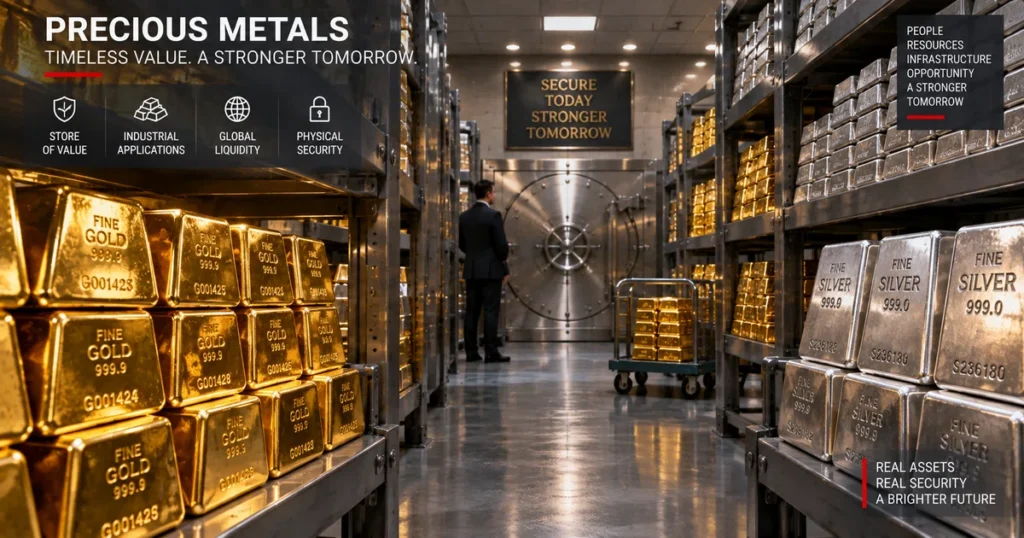
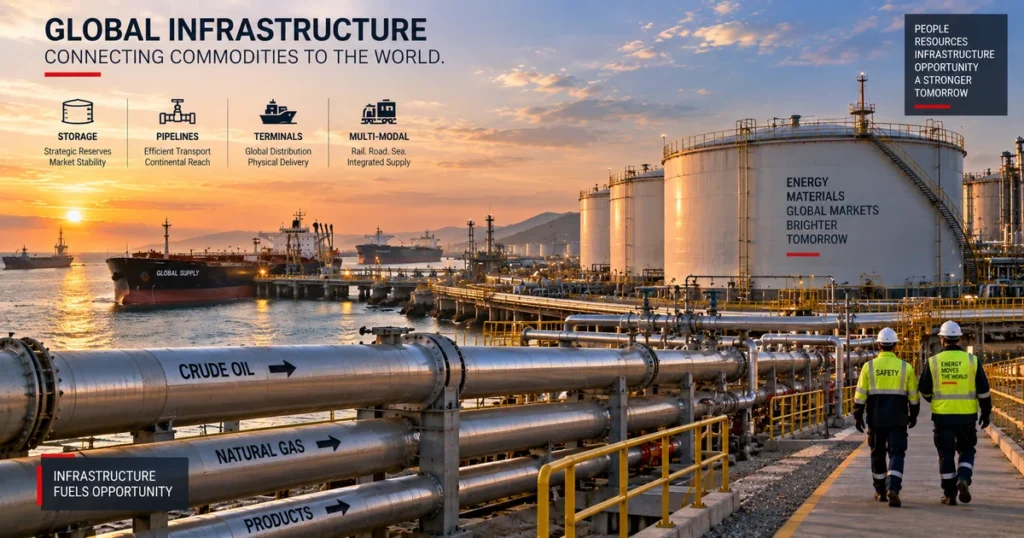
Liquid hydrocarbons are transported via pipeline networks and crude tankers, then stored in cylindrical floating-roof tank terminals. Bulk base metals are shipped via bulk dry-cargo vessels and stacked on pallets in LME-approved warehouses. Precious metals are held in high-security commercial vaults and market-approved depositories under allocated or unallocated custody accounts.
The physical delivery and custody infrastructure of hard commodities anchors financial derivatives pricing to real-world inventory:
1. LME-Approved Warehouses
To support physically deliverable futures contracts, commodity exchanges authorize a global network of specialized storage facilities:
- The LME Storage System: Features hundreds of LME-approved storage facilities across Europe, Asia, and the Americas (including transshipment ports such as Rotterdam, Antwerp, Singapore, and Busan).
- Warehouse Warrants: When a metal producer deposits Grade A copper or primary aluminum into an LME-approved warehouse, the facility records the metal within the LME warrant system and issues an electronic Warehouse Warrant representing the holder’s entitlement to receive the specified metal. As discussed in our overview of commodity exchange mechanics, trading these warrants transfers legal entitlement without requiring physical re-handling of metal slabs.
2. Hydrocarbon Storage and Pipeline Manifolds
- Cushing Storage Terminal: Cushing is a major crude-oil storage and pipeline hub and serves as the physical delivery point for NYMEX WTI futures, linking the futures contract with the underlying cash market.
- Floating Storage: When physical oil markets enter deep contango—where forward futures trade higher than immediate spot prices—market participants may charter Very Large Crude Carriers (VLCCs) as floating storage vessels until delivery economics become favorable.
3. Precious Metals Vaults and Custody
Precious metals are held in high-security commercial vaults and, where relevant, exchange- or market-approved delivery facilities subject to applicable standards:
- Allocated Custody: Specific bullion bars stamped with unique refinery serial numbers, weights, and fineness marks are assigned directly to the client’s legal title.
- Unallocated Accounts: In an unallocated account, the holder has a contractual claim to a quantity of metal rather than title to specifically identified bars.
Market Dynamics: Hedging, Derivatives, and Pricing Benchmarks
Quick Answer: How Do Market Participants Trade Hard Commodities?
Commercial producers and industrial consumers use standardized futures and options contracts on regulated exchanges to hedge against adverse price volatility. Financial participants—including commodity trading advisors (CTAs) and macro hedge funds—provide speculative capital and liquidity by taking the opposite side of commercial hedging positions.
                          ┌──────────────────────────────────────────────┐
                          │         HARD COMMODITY MARKET PARTICIPANTS   │
                          └──────────────────────┬───────────────────────┘
                                                 │
         ┌───────────────────────────────────────┴───────────────────────────────────────┐
         │                                                                               │
         ▼                                                                               ▼
┌────────────────────────────────────────┐                     ┌────────────────────────────────────────┐
│ COMMERCIAL HEDGERS (PRODUCERS/CONSUMERS)                     │ FINANCIAL ALLOCATORS (SPECULATORS)     │
├────────────────────────────────────────┤                     ├────────────────────────────────────────┤
│ * Oil exploration firms (Manage risk)  │                     │ * Commodity Trading Advisors (CTAs)    │
│ * Airlines (Cap jet fuel expenses)     │                     │ * Institutional Macro Hedge Funds      │
│ * Automobile makers (Hedge metals)     │                     │ * Commodity Index Tracker Funds (ETFs) │
│ * Smelters (Hedge processing margins)  │                     │ * Retail Traders & Prop Trading Desks  │
├────────────────────────────────────────┤                     ├────────────────────────────────────────┤
│ OBJECTIVE: Minimize operational price  │                     │ OBJECTIVE: Deploy risk-bearing capital │
│ volatility and secure budget certainty │                     │ for investment return and liquidity.   │
└────────────────────────────────────────┘                     └────────────────────────────────────────┘
1. Commercial Hedging in Action
- The Producer Short Hedge: A copper mining firm with cash production costs of $3.20 per pound seeks to hedge against falling industrial demand. By selling December COMEX Copper futures at $4.20 per pound, the company helps protect its expected sales price and operating margin against a decline in copper prices.
- The Consumer Long Hedge: An automotive manufacturer requiring primary aluminum to fabricate vehicle components purchases LME Aluminum futures to hedge its exposure to rising aluminum prices and reduce uncertainty around its expected raw-material costs.
2. Forward Curve Term Structure: Contango and Backwardation
The forward curve term structure dictates roll returns for futures-based allocators:
- Contango: A forward-curve structure where later-dated futures contracts trade above nearer-dated futures contracts. When futures are also priced above spot, the market trades at a premium to spot, reflecting physical carrying costs (storage, insurance, financing interest). Long positions repeatedly rolling expiring contracts into higher-priced deferred contracts can experience negative roll yield drag.
- Backwardation: A forward-curve structure where later-dated futures contracts trade below nearer-dated futures contracts. When prompt physical delivery commands a premium due to immediate physical tightness, the convenience yield exceeds carrying costs. Persistent backwardation can create a positive roll contribution for a long futures position, although total return also depends on spot price changes and collateral yield, as detailed in our guide on commodity prices.
How to Gain Exposure to Hard Commodities: Investment Vehicles
Quick Answer: How Can Investors Invest in Hard Commodities?
Investors access hard commodities through four primary pathways: Direct Physical Ownership (allocated bullion bars and coins), Exchange-Traded Products (ETPs) (including physically backed precious-metal products and futures-linked commodity funds), Natural Resource Equities (shares of mining, energy, and refining corporations), and Exchange-Traded Futures & Options.
+---------------------------------------------------------------------------------------------------+
|                            HARD COMMODITY INVESTMENT ACCESS PATHWAYS                              |
+----------------------+-----------------------------+-----------------------+-----------------------+
| ACCESS PATHWAY       | REPRESENTATIVE VEHICLES     | PRIMARY ADVANTAGES    | STRUCTURAL LIMITS     |
+----------------------+-----------------------------+-----------------------+-----------------------+
| Physical Bullion     | Allocated bars & coins in   | Direct ownership of   | Storage and insurance |
| Ownership            | secure vaults or             | metal; no roll drag   | fees; no inherent cash|
|                      | depositories                 |                       | yield                 |
+----------------------+-----------------------------+-----------------------+-----------------------+
| Commodity ETPs       | Physically backed trusts;    | High liquidity across | Futures funds face   |
| (Trusts & Funds)   | broad energy futures funds  | standard brokerage    | contango roll drag    |
|                      |                             | accounts              |                       |
+----------------------+-----------------------------+-----------------------+-----------------------+
| Resource Producer    | BHP, Rio Tinto, ExxonMobil, | Operating leverage;   | Equity market beta;   |
| Equities             | Freeport-McMoRan, Newmont   | dividend distributions| corporate governance  |
+----------------------+-----------------------------+-----------------------+-----------------------+
| Exchange-Traded      | CME WTI Crude, COMEX Gold,  | Pure price discovery; | Substantial leverage; |
| Futures & Options  | LME Grade A Copper futures  | capital efficiency    | margin call liability |
+----------------------+-----------------------------+-----------------------+-----------------------+
The Leverage and Risks of Resource Producer Equities
Many institutional allocators buy shares of mining and energy producers—many of which trade on major resource-heavy exchanges such as the Canada TSX and the Australia ASX 200—as an equity proxy for physical hard commodities. These companies provide operational leverage:
- For example, if copper rises from $3.50 to $4.50 per pound (+28.5%), a miner with production costs of $2.50 per pound sees its unit operating margin expand from $1.00 to $2.00 per pound (+100%).
- Note: This simplified unit-margin illustration ignores changes in production volumes, mineral royalties, environmental reclamation liabilities, corporate hedging programs, and equity market drawdowns, dynamics detailed in our treatise on what is market capitalization.
Comparative Analysis: Hard Commodities vs. Soft Commodities, Stocks, and Bonds
Quick Answer: How Do Hard Commodities Compare to Financial Assets?
Hard commodities represent finite physical resources that produce no contractual dividends, coupon payments, or rental income. Unlike corporate equities (claims on corporate cash flows) or government bonds (contractual debt claims), the investment return of hard commodities stems from price appreciation, forward curve roll dynamics, and their historical role as hedges against inflation and currency debasement.
| Dimension / Asset Class | Hard Commodities | Soft Commodities (Agri) | Corporate Equities (Stocks) | Government Bonds |
| Asset Category | Extracted Real Assets | Cultivated Biological Goods | Corporate Ownership Claim | Sovereign Debt Contract |
| Contractual Cash Flow | None inherently | None inherently | Discretionary Dividends | Contractual Coupon Payments |
| Primary Valuation Basis | Marginal Extraction & Carry | Seasonal Crop Yield & Weather | Discounted Cash Flows (DCF) | Yield to Maturity (YTM) |
| Inflation Sensitivity | Often positive, but variable | Varies by crop & food supply | Varies by pricing power | Inflation reduces real yield |
| Supply Elasticity | Highly Inelastic (Multi-Year) | Moderately Inelastic (Annual) | Corporate Capital Output | Sovereign Monetary Policy |
| Primary Risk Drivers | Resource Depletion, CapEx | Drought, Freezes, Diseases | Business Execution, Margins | Interest Rates, Duration |
Common Myths vs. Empirical Facts
- Myth: The world is running out of hard commodities completely.
- Fact: The Earth contains vast geological mineral and hydrocarbon reserves. Resource exhaustion is an economic and technological challenge rather than an immediate physical barrier: higher prices incentivize deeper drilling, improved seismic imaging, and advanced processing methods that transform previously sub-economic deposits into commercial reserves.
- Myth: Buying an energy commodity ETF gives you the exact return of spot crude oil.
- Fact: Because physical crude oil cannot be stored directly inside a standard brokerage fund portfolio, energy exchange-traded products invest in futures contracts. When the forward curve trades in persistent contango, the fund incurs roll yield drag by selling lower-priced expiring contracts and buying higher-priced deferred contracts, causing long-term fund performance to diverge from spot price changes.
- Myth: Higher commodity prices always produce massive profits for mining companies.
- Fact: Mining corporations are major consumers of heavy machinery, diesel fuel, electricity, chemical reagents, and specialized metallurgical engineering labor. If operational input-cost inflation rises at the same pace as raw metal prices, corporate operating profit margins can remain flat or compress.
- Myth: All precious metals derive their value solely from speculative luxury demand.
- Fact: While gold functions primarily as a monetary preserve, silver, platinum, and palladium are critical industrial catalysts. Silver is an indispensable electrical conductor in solar panels and microelectronics, while platinum and palladium are widely used in automotive catalytic systems designed to meet regulated exhaust-emissions standards.
Frequently Asked Questions
What is the simplest definition of a hard commodity?
A hard commodity generally refers to a commodity derived from non-renewable geological resources, including extracted materials such as crude oil, natural gas, gold, silver, and copper, as well as certain processed products such as refined petroleum fuels, used as primary physical inputs in manufacturing, energy generation, and civil construction.
What are the three main categories of hard commodities?
In common market classification, the three broad categories of hard commodities are Energy Commodities (crude oil, natural gas, refined petroleum fuels, coal), Base Metals (copper, aluminum, nickel, zinc, lead), and Precious Metals (gold, silver, platinum, palladium).
Why can hard commodities act as inflation hedges?
Because commodities are priced in real-world market transactions rather than created by monetary authorities, some hard commodities can respond positively during periods of strong inflationary pressure and rising input costs. However, this relationship varies substantially across individual commodities, supply conditions, and macroeconomic regimes.
What makes hard commodity supply inelastic in the short term?
Developing new commercial extraction capacity requires multi-year project cycles: identifying economic deposits, completing feasibility studies, securing environmental permits, sinking mine shafts, and constructing processing facilities takes years of capital deployment. Consequently, producers cannot rapidly scale output in response to sudden demand surges.
How does the US Dollar affect hard commodity prices?
Because many major commodity benchmarks are quoted in U.S. dollars, dollar movements influence the purchasing power of non-U.S. buyers. All else equal, a weaker dollar can provide support to dollar-denominated commodity prices, although individual commodity supply-demand fundamentals can dominate.
Strategic Summary & Core Takeaways
- Foundational Extracted Resources: Hard commodities are primarily derived from non-renewable geological resources and include extracted materials such as crude oil and metals, along with certain processed products such as refined petroleum fuels that form major inputs to global manufacturing, transportation, and energy systems.
- Three Broad Sectors: In common commodity-market classification, the hard commodity complex is grouped into Energy Commodities (crude oil, natural gas, refined fuels), Base Metals (copper, aluminum, nickel, zinc), and Precious Metals (gold, silver, PGMs).
- Supply Inelasticity and Capital Lead Times: Unlike annual agricultural crops, hard commodity supply takes years to develop through geological exploration, mine engineering, and environmental permitting, creating volatile multi-year price cycles.
- Physical Storage and Derivatives Convergence: For physically deliverable contracts, infrastructure such as LME-approved warehouses, pipeline hubs such as Cushing, and commercial bullion vaults can help connect futures pricing with underlying physical-market economics.
- Diverse Exposure Methods: Investors access hard commodities through physical bullion ownership, exchange-traded products, natural resource equities (miners and drillers), or direct exchange-cleared futures contracts.
Next Reading Suggestions
- What Is a Commodity? The Complete Guide to Fungible Goods, Raw Materials, and Global Market Value
- Commodity Prices: How They Are Determined, Key Drivers, and Futures Pricing
- Commodity Exchange: The Complete Guide to Global Trading Hubs, Contract Standardization, and Clearing Mechanics
- What Is Gold? The Complete Guide to Real Money, Store of Value & Why It Matters
- How Stock Prices Are Determined: Market Microstructure, Supply and Demand, and Valuation
- What Is Market Capitalization? The Complete Guide to Market Cap, Company Size, and Valuation
- Interest Rates and Exchange Rates: The Complete Guide to Global Currency Pricing
- Fed Rate Cuts & Global Liquidity: The Complete Guide to Interest Rates, the Fed Balance Sheet, and Asset Markets
- Canada TSX: The Complete Guide to the S&P/TSX Composite Index, Methodology, and Market Structure
- Australia ASX 200: The Complete Guide to the S&P/ASX 200 Index, Methodology, and Market Structure
Author Box & E-E-A-T Verification
Written & Researched By: CurrencyPlans Editorial Research Team
Last Updated & Methodologically Reviewed: September 2026
Editorial Review & Methodological Standards: This educational guide to hard commodities is developed using mining engineering benchmarks, regulatory operating statutes, and primary derivatives exchange specifications. Structural pricing frameworks—including warehouse warrant protocols, refinery crack spreads, base metal assay parameters, and futures roll yield mechanics—are informed by publications and official contract rules from the Commodity Futures Trading Commission (CFTC), CME Grou
p, the London Metal Exchange (LME), the Intercontinental Exchange (ICE), the U.S. Energy Information Administration (EIA), the World Gold Council (WGC), The Silver Institute, and the International Aluminium Institute (IAI).
Educational References & Market Data Sources
For official contract specifications, physical grading parameters, and warehouse delivery rules, consult primary regulatory and statistical portals directly:
- U.S. Commodity Futures Trading Commission (CFTC Market Guidance): CFTC
- CME Group (Energy, Metals, and Product Specifications): CME Group
- London Metal Exchange (Non-Ferrous Industrial Metals & Warehousing): LME
- Intercontinental Exchange (Global Energy and Oil Rules): ICE
- U.S. Energy Information Administration (Petroleum, Gas, and Coal Statistics): EIA
- London Bullion Market Association (Good Delivery Rules for Gold & Silver): LBMA
- World Gold Council (Gold Demand Trends & Central Bank Reserves): WGC
- The Silver Institute (World Silver Survey & Fabrication Demand): The Silver Institute
- International Aluminium Institute (Primary Aluminium Smelting Power Data): IAI
- International Energy Agency (World Energy Outlook & Analysis): IEA
Educational Disclaimer
This guide is prepared strictly for educational, research, and informational purposes and does not constitute personalized financial, investment, trading, or tax advice. Commodity spot markets, derivative futures contracts, and natural resource equities carry substantial market and capital risks. Past market pricing patterns and historical futures forward curve shapes do not guarantee future financial returns. Always conduct independent due diligence and consult a licensed fiduciary financial advisor before allocating investment capital.

