
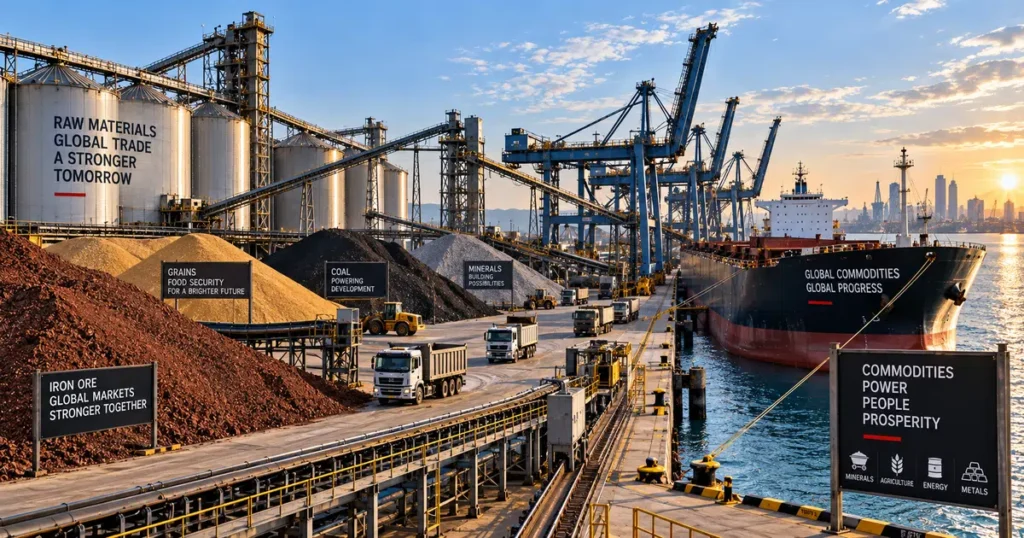
In commercial economics and financial market theory, a commodity is a basic, standardized raw material or primary agricultural product that can be bought, sold, or traded on organized exchanges. Unlike finished consumer goods—where brands, proprietary designs, and marketing establish distinct pricing power—commodities are generally distinguished by standardized specifications and substantial interchangeability within a defined grade and market.
A barrel of light sweet crude oil extracted in Texas, a metric ton of refined copper smelted in Chile, or a bushel of milling wheat harvested in Saskatchewan must conform to standardized chemical and physical specifications. To an industrial consumer, one conforming unit of a specified commodity grade can generally substitute for another conforming unit, subject to applicable quality, location, and delivery terms.
Commodities serve as the foundation of modern manufacturing, transportation, power generation, and food security. They form an asset class whose pricing is governed by extraction economics, weather cycles, transport logistics, and physical supply-demand equilibrium, functioning distinctively from financial assets described in our foundational study on how stock prices are determined.
Executive Summary: Defining the Commodity
Quick Answer: What Is a Commodity?
A commodity is an essential raw material or primary agricultural good that is interchangeable with other commodities of the same type and grade (fungible), standardized according to explicit market criteria, and used as a direct input in the production of other goods or services. In common market classification, commodities are broadly divided into Hard Commodities (natural resources that are extracted or mined, including energy products and metals) and Soft Commodities (agricultural products and livestock that are grown, farmed, or ranched, such as wheat, coffee, and cattle).
To understand where commodities fit within the broader economic spectrum, consider how raw physical goods compare to processed finished goods and paper financial claims:
                          ┌──────────────────────────────────────────────┐
                          │         TAXONOMY OF ECONOMIC GOODS           │
                          └──────────────────────┬───────────────────────┘
                                                 │
         ┌───────────────────────────────────────┴───────────────────────────────────────┐
         │                                                                               │
         ▼                                                                               ▼
┌────────────────────────────────────────┐                     ┌────────────────────────────────────────┐
│ PRIMARY COMMODITIES (RAW INPUTS)       │                     │ DIFFERENTIATED FINISHED GOODS          │
├────────────────────────────────────────┤                     ├────────────────────────────────────────┤
│ * Mined Ores, Crude Oil, Grains        │                     │ * Automobiles, Smartphones, Apparel    │
│ * High Fungibility (Interchangeable)   │                     │ * Low Fungibility (Brand-Specific)     │
│ * Standardized Exchange Grading        │                     │ * Proprietary Design & Features        │
│ * Exchange Benchmark Price Discovery   │                     │ * Segmented Retail Pricing Markups     │
│ * Price-Taking Market Structure        │                     │ * Price Maker / Moat Pricing Power     │
└───────────────────┬────────────────────┘                     └────────────────────────────────────────┘
                    │
                    ▼
┌─────────────────────────────────────────────────────────────┐
│ CAPITAL DERIVATION & VALUE MECHANICS                        │
├─────────────────────────────────────────────────────────────┤
│ * Equities: Valued via enterprise discounted cash flows     │
│ * Fixed Income: Valued via contractual coupon debt yields   │
│ * Commodities: Valued through spot supply-demand conditions,│
│   inventories, production economics, and physical carry     │
└─────────────────────────────────────────────────────────────┘
Standardized commodity markets generally operate around three core characteristics:
- Uniform Baseline Grade: A buyer purchasing a standardized commodity contract does not negotiate individual physical variances; they acquire a certified grade defined by minimum purity, maximum impurity thresholds, or standard moisture contents.
- Limited Brand Differentiation: While a consumer willingly pays a premium for a specific luxury watch or automobile brand, an electrical wire manufacturer pays the prevailing market price for certified Grade A copper cathodes, indifferent to the corporate entity that extracted the ore.
- Upstream Position in the Value Chain: Commodities sit at the beginning of the global value chain. Fluctuations in raw commodity pricing transmit through refining and transport stages, directly impacting consumer price indices and corporate operating margins.
The Defining Characteristics: Fungibility, Standardization, and Grading
Quick Answer: What Makes a Good a Commodity?
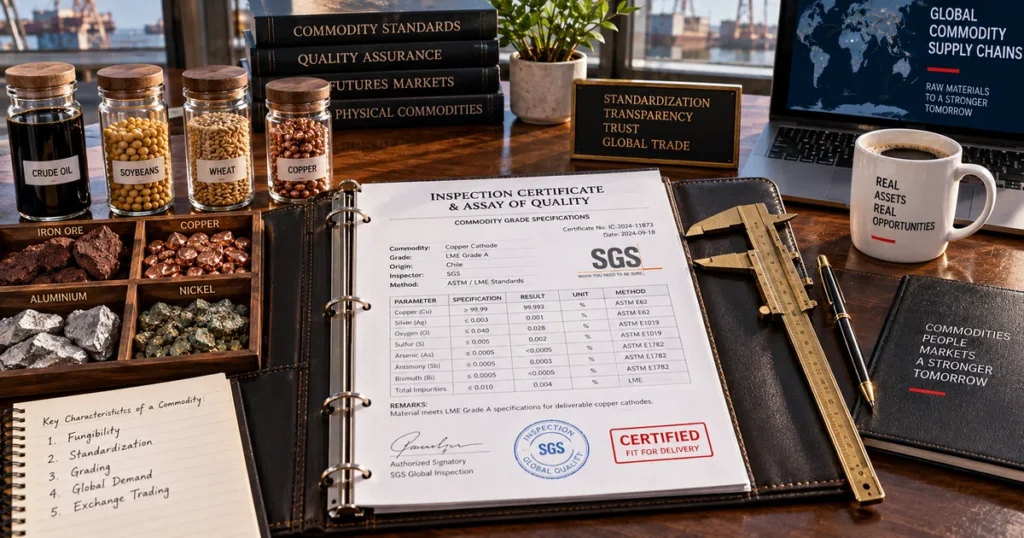
A physical good qualifies as an exchange-traded commodity when it exhibits fungibility (units of the same standardized grade are generally interchangeable for commercial and contractual purposes, subject to applicable exchange or market rules), standardization (governed by recognized weight, volume, and purity parameters), and verifiable grading (assayed by independent inspection bodies to guarantee commercial conformity).
1. The Principle of Fungibility
The defining legal and economic property of a commodity is fungibility. Fungibility means that individual units of a given grade are commercially equivalent:
- If Company A deposits 1,000 bushels of No. 2 Yellow Corn into an exchange-licensed grain elevator in Illinois, it does not expect to withdraw the exact biological kernels it deposited.
- Company A holds legal title to 1,000 bushels of the certified standard grade. When it liquidates its warehouse receipt or warrant, it can deliver that title to any commercial counterparty, who accepts it as full performance.
Non-fungible items, by contrast, possess unique attributes that prevent direct substitution. Real estate parcels, used industrial machinery, customized software, and artwork are non-fungible because physical location, wear, architectural design, and subjective valuation prevent one-for-one replacement without bespoke appraisal.
2. Physical and Contractual Standardization
Without standardization, international trade would stall in perpetual inspection disputes. Centralized commodity exchanges establish clear, universal specifications for deliverable contracts:
| Metric | Standardization Parameter | Rulebook Reference Benchmark (CME / LME / ICE) |
| Contract Size (Unit of Measure) | Fixed physical quantity per contract | 1,000 U.S. Barrels (WTI Crude); 5,000 Bushels (Corn); 25 Metric Tons (LME Copper) |
| Deliverable Quality Grade | Exact physical or chemical purity parameters | Minimum 99.9935% purity for Grade A Copper; API gravity 37°–42° for WTI Crude |
| Impurity Tolerances | Maximum allowable foreign matter or moisture | Maximum 0.42% sulfur content for light sweet crude; maximum 14.0% moisture for standard wheat |
| Delivery Point & Logistics | Designated certified physical pipeline or warehouse hub | Pipeline manifold in Cushing, Oklahoma (WTI); licensed depository warehouses (Metals) |
*Source note: CME Group, LME, and ICE contract specifications; exact deliverable grades and tolerances vary by contract, delivery location, and exchange schedule.
3. Independent Assay and Certification
To ensure commercial integrity, commodities entering institutional storage terminals undergo quantitative laboratory testing. Independent testing bodies sample incoming deliveries, verifying density, contamination, calorific value, and chemical composition. Once verified, the storage facility may issue a warehouse receipt or, where applicable, an exchange-approved warrant representing the stored commodity, which can be bought, sold, or financed across capital markets.
Structural Classification: Hard vs. Soft Commodities
Quick Answer: What Are Hard and Soft Commodities?
In common market classification, Hard Commodities are natural resources that are extracted, drilled, or mined from the earth, including hydrocarbons (crude oil, natural gas) and metals (copper, gold, iron ore). Soft Commodities are agricultural crops or raised livestock that are farmed or ranched, including staple grains (wheat, soybeans, corn), tropical cash crops (coffee, cocoa, sugar), and meats (live cattle, lean hogs).
+---------------------------------------------------------------------------------------------------+
|                           THE TWO PILLARS OF COMMODITY CLASSIFICATION                             |
+---------------------+-----------------------------+-----------------------+-----------------------+
| DIMENSION           | HARD COMMODITIES            | SOFT COMMODITIES      | ECONOMIC DIFFERENCE   |
+---------------------+-----------------------------+-----------------------+-----------------------+
| **Origin / Source** | Geological extraction,      | Agronomic cultivation,| Earth-extracted       |
|                     | subsurface drilling, mining | farming, livestock    | resources vs. annual  |
|                     |                             | husbandry             | biological crops      |
+---------------------+-----------------------------+-----------------------+-----------------------+
| **Supply Cycle**    | Multi-year capital cycles   | Annual / seasonal     | Inelastic multi-year  |
|                     | across mine permitting and  | planting, harvesting, | response vs. annual   |
|                     | upstream development        | and breeding periods  | planting re-allocation|
+---------------------+-----------------------------+-----------------------+-----------------------+
| **Perishability**   | Generally durable under     | Perishable; requires  | Long physical life    |
|                     | appropriate storage         | humidity, temperature,| vs. natural biological|
|                     |                             | and aeration controls | decay and spoilage    |
+---------------------+-----------------------------+-----------------------+-----------------------+
| **Primary Risks**   | Geopolitical nationalization| Weather shocks, pests,| Mineral rights & CapEx|
|                     | resource depletion, CapEx   | droughts, freezes, and| vs. climate cycles    |
|                     | funding constraints         | biological diseases   | and fertilizer prices |
+---------------------+-----------------------------+-----------------------+-----------------------+
Hard Commodities: Extractive Geology and Upstream Capital
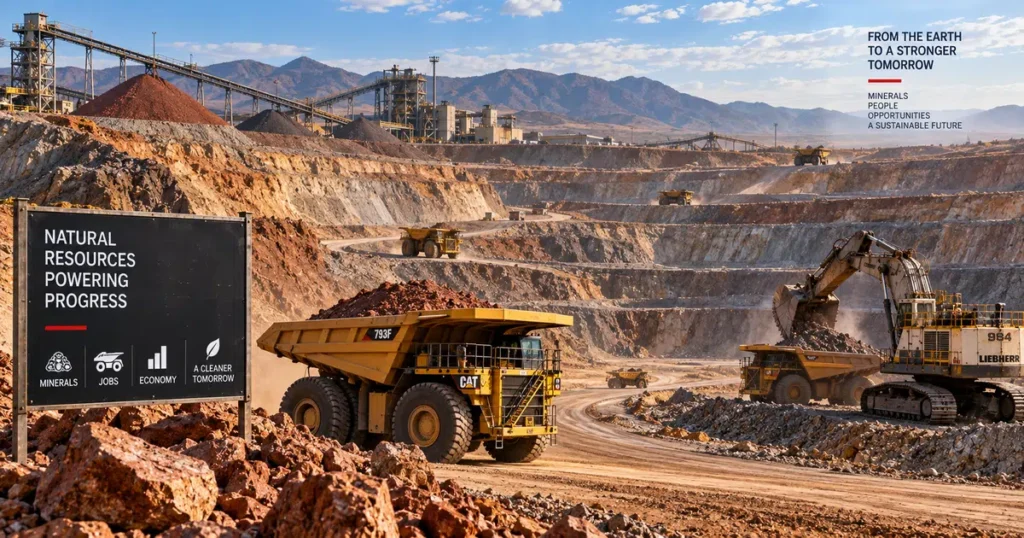
Hard commodities are the industrial inputs of global infrastructure, power generation, and transportation. They are divided into three primary sectors:
1. The Energy Sector: Hydrocarbons
Energy commodities provide the motive power for modern transport, chemical feedstocks, and electricity grids:
- Crude Oil: One of the world’s most widely traded and financially liquid commodity markets. Graded primarily by density (API gravity, separating “light” from “heavy” crudes) and sulfur content (“sweet” crudes carry less than 0.5% sulfur; “sour” crudes contain higher concentrations requiring extensive refining).
- Refined Petroleum Products: Standardized secondary commodities produced by processing crude oil through atmospheric distillation units and catalytic crackers. Key contracts include Ultra-Low Sulfur Diesel (ULSD), Heating Oil, and Reformulated Blendstock for Oxygenate Blending (RBOB Gasoline).
- Natural Gas: Methane transported via pressurized pipelines (e.g., Henry Hub in Louisiana) or cooled to liquid form at -162°C as Liquefied Natural Gas (LNG) for cryogenic maritime transport to international regasification hubs.
2. Industrial and Base Metals
Base metals serve as the structural and electrical backbone of manufacturing and construction:
- Copper: A major electrical conductor used across infrastructure, industrial machinery, and consumer goods. Copper is considered a forward-looking macroeconomic barometer due to its ubiquitous presence throughout industrial supply chains.
- Aluminum: Highly valued for its lightweight strength in aerospace, automotive bodies, and beverage packaging. Produced by refining bauxite ore into alumina, followed by energy-intensive electrolytic smelting.
- Nickel and Zinc: Primary inputs for corrosion-resistant stainless steel fabrication and the galvanization of structural steel, alongside emerging roles in energy-storage battery chemistries.
3. Precious Metals: Monetary Preserves and Special Industrial Materials
Precious metals occupy a unique hybrid role, functioning both as industrial inputs and monetary stores of value:
- Gold: Chemically inert, rare, and durable. Because gold is rarely destroyed or consumed industrially in large fractions, virtually all gold mined throughout human history remains in circulation or vault storage. Gold functions as an institutional currency hedge and sovereign reserve asset, a dynamic detailed in our guide on what is gold.
- Silver: Features the highest electrical and thermal conductivity of any elemental metal. As documented by industry bodies such as The Silver Institute, industrial applications—specifically photovoltaic solar cells, microelectronics, and brazing alloys—account for a major proportion of global physical fabrication demand.
- Platinum and Palladium: Catalytic materials utilized in automotive emissions-control systems, chemical processing, and specialized hydrogen-energy fuel cells.
Soft Commodities: Cultivation, Seasonality, and Biological Life Cycles
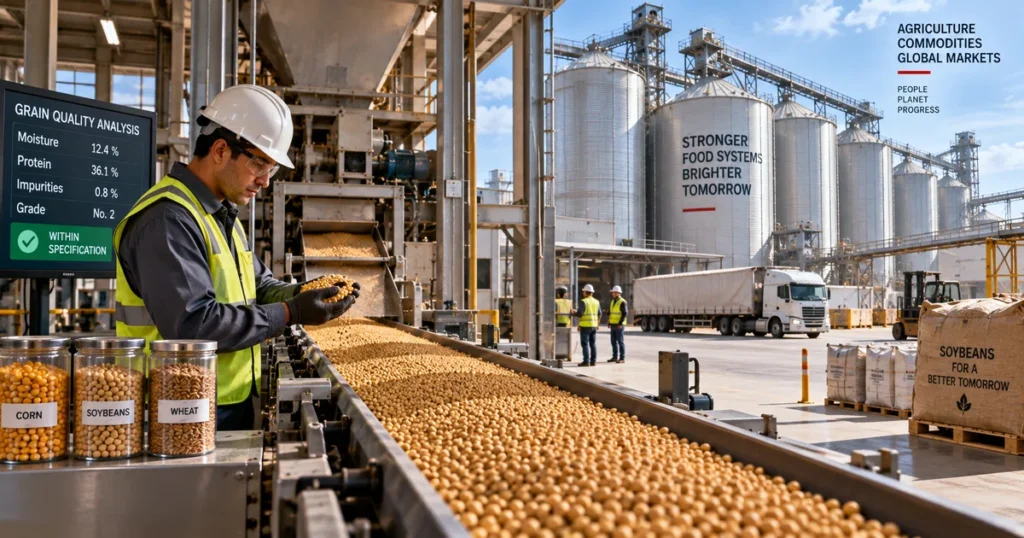
Soft commodities encompass the renewable food, fiber, and livestock production that sustains human populations and textile manufacturing:
1. Grains and Oilseeds
Staple annual crops traded primarily on agricultural exchanges like the Chicago Board of Trade (CBOT) and Euronext:
- Corn (Maize): Primary global source of high-energy livestock feed, industrial starch, and ethanol biofuel blending.
- Soybeans: Crushed to produce two distinct co-products: soybean meal (high-protein animal feed) and soybean oil (culinary oil and renewable diesel feedstock).
- Wheat: Primary human food staple, segmented into distinct market grades based on protein content and harvest seasons (e.g., Hard Red Winter Wheat, Soft Red Winter Wheat, Hard Red Spring Wheat).
2. Tropical Crops (Softs)
Perennial plantation crops grown predominantly in equatorial, emerging-market climates:
- Coffee: The two major commercially traded coffee species are Arabica (Coffea arabica) and Robusta, commonly referring to Coffea canephora. Arabica futures are traded on ICE US, while Robusta futures are traded on ICE Europe.
- Cocoa: Sourced predominantly from coastal West Africa (Ivory Coast, Ghana). Highly vulnerable to viral plant diseases (e.g., swollen shoot virus) and regional rainfall patterns.
- Sugar: Extracted from sugar cane in tropical zones (Brazil, India) and sugar beets in temperate zones (Europe). Acts as an energy source, food preservative, and alternative ethanol feedstock in South America.
- Cotton: Natural fiber utilized across global textile and industrial weaving mills, graded by fiber staple length, color grade, and tensile strength.
3. Livestock and Meat Complexes
Raised animal proteins traded under standardized commercial contract criteria:
- Live Cattle and Feeder Cattle: Traded to hedge the fattening process of young cattle as they transition from open grazing pasture to commercial feedlots consuming grain.
- Lean Hogs: A standardized livestock futures market used by producers, packers, and institutional market participants to manage hog-price risk, with settlement linked directly to the CME Lean Hog Index rather than physical delivery of individual hog carcasses.
The Value Chain: From Raw Commodity to Finished Consumer Good
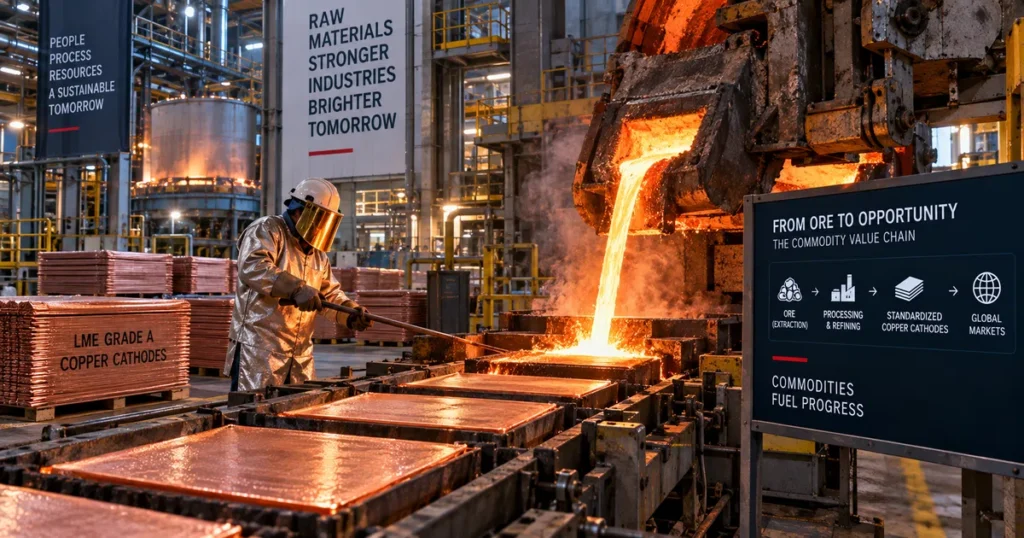
Quick Answer: How Does a Raw Commodity Become a Finished Good?
Raw commodities undergo a four-stage transformation: Extraction or Harvesting (upstream), Bulk Transport and Storage (midstream logistics), Refining and Smelting (intermediate conversion), and Manufacturing and Distribution (downstream consumer goods). Value is added at each step, transforming a generic fungible material into a branded product.
The journey of commodities through global commerce illustrates why finished goods command a significant price premium over raw input costs:
+---------------------------------------------------------------------------------------------------+
|                              THE 4-STAGE COMMODITY TRANSFORMATION PIPELINE                        |
+---------------------+-----------------------------+-----------------------+-----------------------+
| STAGE               | PRIMARY OPERATIONS          | VALUE ADDED           | PRICING DETERMINANT   |
+---------------------+-----------------------------+-----------------------+-----------------------+
| **1. Upstream       | Deep geological drilling,   | Raw extraction of ore | Global supply/demand; |
| Extraction / Ag**   | open-pit mining, crop sowing| unrefined crude, or   | exploration CapEx;    |
|                     | and farm harvesting         | harvested agricultural| weather & geology     |
+---------------------+-----------------------------+-----------------------+-----------------------+
| **2. Midstream      | Pipeline networks, marine   | Place and time utility| Freight shipping rates|
| Logistics & Storage | bulk dry-carriers, grain    | (transporting goods to| terminal storage fees;|
|                     | storage elevators, tanks    | consumption basins)   | financing interest    |
+---------------------+-----------------------------+-----------------------+-----------------------+
| **3. Processing /   | Smelting, chemical cracking,| Conversion into       | Refining "crack" and  |
| Refining**          | milling, distillation,      | standardized usable   | processing "crush"    |
|                     | agricultural crushing       | industrial materials  | operational margins   |
+---------------------+-----------------------------+-----------------------+-----------------------+
| **4. Downstream     | Component assembly, brand   | Proprietary design,   | Consumer marketing;   |
| Manufacturing**     | packaging, retail delivery  | brand identity, and   | corporate pricing     |
|                     | and global distribution     | specialized utility   | power (Price Maker)   |
+---------------------+-----------------------------+-----------------------+-----------------------+
Real-World Value Chain Examples:
- From Crude Oil to Consumer Apparel: Upstream drilling extracts crude oil. Midstream pipelines transport it to refineries and petrochemical facilities. Refining and petrochemical processes convert hydrocarbons into fuels and feedstocks such as ethylene and aromatic compounds including paraxylene. These feedstocks are subsequently polymerized into synthetic fibers like polyester, which downstream textile manufacturers weave into finished consumer apparel sold at retail markups.
- From Bauxite Ore to Aviation Components: Upstream surface mining extracts bauxite ore. Chemical refineries dissolve it into white alumina powder via the Bayer process. Aluminum smelters use electrical currents to cast pure aluminum ingots. Aerospace manufacturing mills machine those ingots into proprietary structural components for commercial airliners.
Market Infrastructure: Spot Markets, Physical Deliveries, and Financial Derivatives
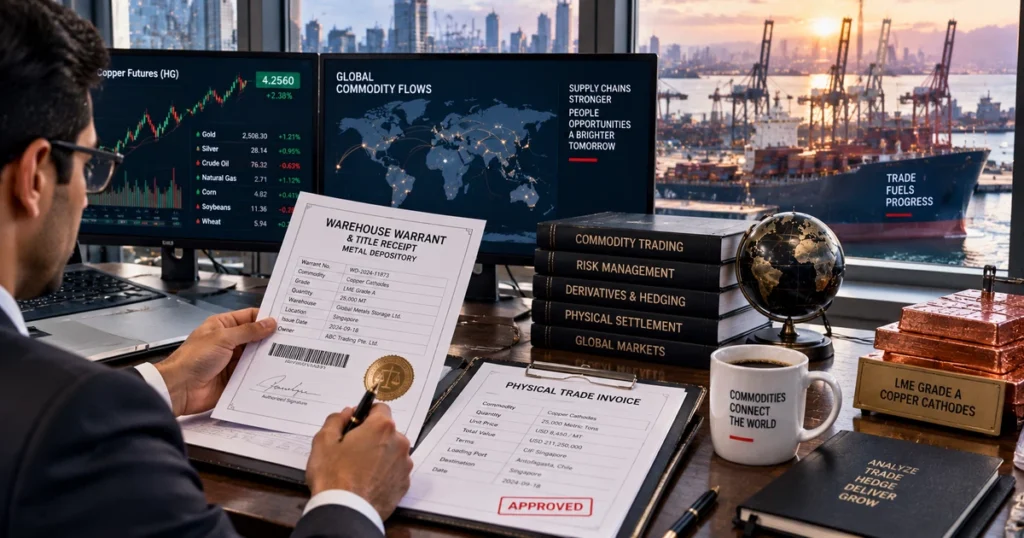
Quick Answer: Where and How Are Commodities Traded?
Commodity markets operate through two broad channels: Physical and OTC Markets (where commercial participants negotiate terms for physical spot delivery or financially linked transactions) and Centralized Derivatives Exchanges (where standardized futures and options are traded electronically on venues like the CME, ICE, and LME). Most exchange participants do not handle physical goods; they use futures to hedge price risks or deploy investment capital.
1. Physical and Over-the-Counter (OTC) Markets
In physical commerce, commercial merchants, grain trading houses, and energy desks transact directly:
- Contracts specify delivery locations and commercial terms, which may include Incoterms such as Free On Board (FOB), along with chemical assays, payment terms, and shipping schedules.
- Physical transactions rely on commercial credit agreements, marine insurance policies, and custom shipping timelines tailored to specific industrial processing requirements.
2. Centralized Futures Exchanges
To hedge volatile physical spot pricing, global commerce relies on centralized futures exchanges that centralize and substantially mitigate bilateral counterparty risk through clearing:
- CME Group (CBOT, NYMEX, COMEX): Derivatives marketplace setting benchmark pricing for WTI crude oil, natural gas, gold, silver, copper, corn, wheat, and livestock.
- London Metal Exchange (LME): The historic global hub for industrial base metals (copper, aluminum, zinc, nickel, lead, tin), utilizing a global network of licensed storage facilities.
- Intercontinental Exchange (ICE): Leading venue for international crude oil (Brent), natural gas (European TTF), and tropical soft commodities (coffee, cocoa, sugar, cotton).
3. Settlement Mechanics: Physical Delivery vs. Cash Settlement
Exchange contracts settle through two primary mechanisms:
- Physical Settlement: In physically settled contracts, delivery is executed according to contract-specific exchange protocols via warehouse warrants, delivery notices, pipeline receipts, or shipping manifests. The buyer pays the final settlement amount and assumes ownership of the stored physical inventory.
- Cash Settlement: Cash settlement is used in certain commodity futures and commodity-linked contracts—including contracts such as CME Feeder Cattle futures and CME Lean Hog futures—where final financial settlement is derived directly from a specified cash or reference index rather than physical transport.
Economic Drivers: What Determines Commodity Prices?
Quick Answer: What Causes Commodity Prices to Rise and Fall?
Commodity prices are determined by the intersection of physical supply and demand, the exchange rate of the US Dollar, real interest rates, geopolitical transit constraints, and marginal production economics. Because demand for basic necessities like energy and food is relatively inelastic, disruptions in supply can trigger significant percentage changes in market prices.
                      ┌─────────────────────────────────────────┐
                      │    CORE DRIVERS OF COMMODITY PRICING    │
                      └────────────────────┬────────────────────┘
                                           │
         ┌─────────────────────────────────┴─────────────────────────────────┐
         │                                                                   │
         ▼                                                                   ▼
┌──────────────────────────────────┐               ┌──────────────────────────────────┐
│ STRUCTURAL DEMAND & MACRO FORCES │               │ PHYSICAL SUPPLY & CONSTRAINTS    │
├──────────────────────────────────┤               ├──────────────────────────────────┤
│ * Global Industrial Output:      │               │ * Marginal Production Economics: │
│   Infrastructure buildout,       │               │   Breakeven operational costs    │
│   manufacturing capacity, and    │   act as economic anchors        │
│   demographic urbanization       │ * Inventory Depletion Rates:     │
│ * Currency Valuation (USD):      │   Low days-of-consumption cover  │
│   Many major commodity contracts │   amplifies price volatility     │
│   denominated in US Dollars      │ * Geopolitical Chokepoints:      │
│ * Real Interest Rate Carrying:   │   Shipping straits, sanctions,   │
│   High rates discourage holding  │   and national export quotas     │
│   expensive physical inventory   │   introduce supply dislocations  │
└──────────────────────────────────┘               └──────────────────────────────────┘
1. Inelastic Demand and Short-Term Supply Inelasticity
For many essential commodities, both supply and demand can be relatively price inelastic over short time horizons:
- Consumers Cannot Immediately Cut Consumption: If retail fuel or food prices rise, households cannot instantly eliminate commuting or stop purchasing food; they absorb the cost, keeping quantity demanded relatively stable over the immediate horizon.
- Producers Cannot Rapidly Increase Supply: A mining corporation cannot open a new copper vein or build a processing facility overnight. Because neither supply nor demand adjusts instantaneously, unexpected shocks force the clearing price to move until supply-demand equilibrium is re-established.
2. Marginal Production Economics as an Economic Anchor
The Marginal Cost of Production—the cost required to extract or cultivate the final, most expensive unit of supply needed to satisfy global demand—can act as an important medium-term economic anchor, although prices can remain below the costs of some producers for extended periods during severe cyclical downturns:
- If prices fall below cash operating costs, high-cost operators may curb output, defer maintenance, or enter financial restructuring.
- The resulting supply contraction eventually draws down commercial inventories, helping reconnect market prices with production economics over longer time horizons.
3. The US Dollar Transmission Channel
Because many major global commodity benchmarks are quoted in US Dollars:
- Dollar Depreciation: Makes dollar-quoted commodities relatively cheaper for foreign buyers holding other currencies, expanding purchasing power and supporting physical demand.
- Dollar Appreciation: Raises the domestic local-currency cost of imported commodities for consuming nations, reducing demand and putting downward pressure on dollar-quoted market prices, a relationship explored in our study on interest rates and exchange rates.
The Futures Curve: Contango, Backwardation, and Carrying Costs
Quick Answer: What Are Contango and Backwardation?
Contango is a market condition where prices for future delivery are higher than the current spot price, producing an upward-sloping forward curve that can reflect financing, storage, insurance, convenience yield, and broader inventory conditions. Backwardation is an inverted market condition where the current spot price is higher than future delivery prices, creating a downward-sloping forward curve that reflects immediate physical scarcity and high convenience yield.
The shape of the futures forward curve dictates how capital allocators experience returns over extended horizons:
Price ($)
  ▲
  │                                      CONTANGO (Futures > Spot)
  │                                     ┌─────────────────────────
  │                                ┌───┘  Upward-sloping curve:
  │                           ┌───┘       Financing and storage carry
  │                      ┌───┘
  ├─────────────────┬───┘
  │  SPOT PRICE     │
  ├─────────────────┴───┐
  │                      └───┐
  │                           └───┐       BACKWARDATION (Spot > Futures)
  │                                └───┐  Downward-sloping curve:
  │                                     └─────────────────────────
  │                                       Immediate physical scarcity & high convenience
  └─────────────────────────────────────────────────────────────────► Time to Expiration
The Cost of Carry Equation
Under continuous financial modeling, the fair forward price $F(t, T)$ of a physical commodity is derived from the Cost of Carry Model:
$$F(t, T) = S(t) \cdot e^{(r + u – y)(T – t)}$$
Where:
- $S(t)$ is the current physical spot price.
- $r$ is the prevailing financing interest rate.
- $u$ is the physical storage, handling, and insurance cost rate.
- $y$ is the Convenience Yield, representing the implicit operational benefit derived from holding real physical inventory rather than a financial futures contract.
- $(T – t)$ represents the time duration remaining until contract expiration.
The Dynamics of Roll Yield:
- Negative Roll Drag in Contango: When an exchange-traded product rolls an expiring long futures contract into a more expensive deferred contract ($F_{\text{front}} < F_{\text{deferred}}$), it sells low and buys high. Over multi-month horizons, persistent contango can erode portfolio returns relative to spot performance.
- Positive Roll Contribution in Backwardation: In a backwardated market, an investor rolls an expiring premium contract into a cheaper deferred contract ($F_{\text{front}} > F_{\text{deferred}}$). As the deferred contract approaches expiration under normal convergence conditions, its price converges toward spot, which can provide a positive contribution to total returns, all else equal.
How to Gain Exposure to Commodities: Investment Vehicles
Quick Answer: How Do Investors Access Commodity Markets?
Investors access commodities through four primary pathways: Direct Physical Ownership (allocated gold and silver bullion), Commodity Exchange-Traded Products (ETPs) (physically backed trusts or futures-tracking funds), Natural Resource Equities (shares of mining, energy, and agribusiness corporations), and Exchange-Traded Futures & Options.
+---------------------------------------------------------------------------------------------------+
|                            COMMODITY INVESTMENT ACCESS PATHWAYS                                   |
+---------------------+-----------------------------+-----------------------+-----------------------+
| ACCESS PATHWAY      | REPRESENTATIVE VEHICLES     | PRIMARY ADVANTAGES    | STRUCTURAL LIMITS     |
+---------------------+-----------------------------+-----------------------+-----------------------+
| **Physical Bullion  | Allocated bars and coins in | Lower direct financial| Storage & insurance   |
| & Direct Ownership**| verified bank depositories  | counterparty exposure | fees; no contractual  |
|                     |                             |                       | corporate cash yield  |
+---------------------+-----------------------------+-----------------------+-----------------------+
| **Commodity ETPs    | Precious metals trusts;     | High liquidity via    | Futures-based products|
| (Trusts & Funds)**  | broad-market futures funds  | standard brokerage    | carry structural roll |
|                     |                             | accounts; no custody  | yield drag in contango|
+---------------------+-----------------------------+-----------------------+-----------------------+
| **Natural Resource  | BHP, Rio Tinto, ExxonMobil, | Operational leverage; | Equity market beta;   |
| Producer Equities** | mining & energy equities    | quarterly dividend    | operational mine costs|
|                     |                             | cash distributions    | and management risks  |
+---------------------+-----------------------------+-----------------------+-----------------------+
| **Centralized       | CME, NYMEX, ICE, and LME    | Pure price discovery; | Substantial leverage; |
| Futures & Options** | standardized derivatives    | exceptional capital   | margin call liability;|
|                     |                             | efficiency and scale  | roll management rules |
+---------------------+-----------------------------+-----------------------+-----------------------+
The Leverage and Risks of Resource Producer Equities
Allocators often choose shares of mining and energy producers—many of which are listed on exchanges such as the Toronto Stock Exchange (TSX) and Australian Securities Exchange (ASX)—as an equity substitute for raw commodities. Resource producers provide operational leverage:
- For instance, in a simplified unit-margin illustration, if copper increases from $3.50 to $4.50 per pound (+28.5%), a producer with all-in sustaining production costs of $2.50 per pound sees its operating margin expand from $1.00 to $2.00 per pound (+100%).
- Note: This simplified unit-margin example ignores changes in production volumes, royalties, taxes, sustaining capital expenditures, corporate hedging programs, and general administrative expenses.
- Furthermore, resource equities introduce broader corporate risks: management execution, environmental permitting delays, operational mine disruptions, and equity market drawdowns, detailed in our guide on what is market capitalization.
Comparative Analysis: Commodities vs. Stocks, Bonds, and Real Estate
Quick Answer: How Do Commodities Differ from Traditional Financial Assets?
Unlike corporate stocks (claims on future corporate profits) and government bonds (contractual debt interest), physical commodities produce no contractual dividends, coupon payments, or rental yields. For investors using futures-based structures, total returns can reflect changes in futures prices, roll yield contributions, and returns on cash collateral; physical commodities themselves do not generate contractual income.
| Dimension / Asset Class | Physical Commodities | Public Equities (Stocks) | Government Bonds | Commercial Real Estate |
| Asset Category | Physical Real Assets | Corporate Equity Claims | Sovereign Debt Contracts | Physical Built Property |
| Contractual Yield | No Contractual Income | Discretionary Dividends | Contractual Coupon Yield | Contractual Rental Income |
| Primary Valuation Basis | Supply-Demand & Carry | Discounted Cash Flow (P/E) | Yield to Maturity (YTM) | Capitalization Rate (Cap) |
| Inflation Response | Often Sensitive | Variable by Industry | Often Negatively Affected | Inflation-Linked Leases |
| Economic Cycle Beta | Often Cyclical | Cyclical / Growth | Counter-Cyclical | Cyclical / Real Growth |
| Primary Risk Factors | Storage, Contango, Weather | Business & Earnings Risk | Duration & Rate Risk | Occupancy & Tenant Risk |
Common Myths vs. Empirical Facts
- Myth: Any raw material or physical product is automatically a commodity.
- Fact: A physical good is more readily treated as a formal commodity when it is sufficiently fungible, standardized, and widely traded in established markets. Uncut diamonds, timber acreage, and custom manufactured goods are not standardized commodities because their individual physical variations require unique, bilateral inspection.
- Myth: Buying a commodity ETP is the exact mathematical equivalent of owning the physical good.
- Fact: Physically backed precious metals trusts hold allocated bullion, but most energy and agricultural exchange-traded products hold futures contracts. Because these products must continuously roll expiring contracts, their long-term performance is driven by forward curve geometry (contango drag or backwardation tailwinds), causing long-term returns to diverge from physical spot price changes.
- Myth: High commodity prices guarantee that commodity-producing companies will experience massive profits.
- Fact: Extraction companies face operating cost inflation (diesel fuel, mining equipment, chemical reagents, and specialized engineering labor). If operational production costs rise at the same rate as the realized commodity market price, corporate profit margins may remain flat.
- Myth: Trading commodity futures will result in physical delivery to your home.
- Fact: Many retail brokerages restrict or liquidate positions approaching physical-delivery obligations, while some products are cash-settled or otherwise structured to avoid physical delivery for retail investors.
Frequently Asked Questions
What is the simplest definition of a commodity?
A commodity is a basic, standardized raw material or agricultural product that is fungible (interchangeable with other units of the same grade) and used as an input to produce other goods and services.
What does “fungible” mean in relation to commodities?
Fungible means that units of a specific standardized grade can generally be substituted for one another for commercial or contractual purposes, subject to the applicable exchange, grade, location, and delivery rules. One bushel of certified No. 2 Yellow Corn can be substituted directly for another conforming delivery.
What are examples of hard and soft commodities?
Hard commodities are natural resources that are mined or extracted from the earth, such as crude oil, natural gas, gold, and copper. Soft commodities are agricultural products that are cultivated or raised, such as wheat, corn, soybeans, coffee, cocoa, and live cattle.
Why do physical commodities pay no dividends or interest?
Commodities are physical raw materials, not operating commercial corporations or debt contracts. Holding physical copper or crude oil incurs storage, financing, and insurance costs rather than generating contractual income or corporate cash distributions.
What is the difference between a commodity and a finished product?
A commodity is a generic, unbranded, fungible raw material sold at an exchange-discovered market clearing price (e.g., raw cotton). A finished product is a differentiated, branded good created through manufacturing, design, and marketing, sold at a retail markup (e.g., a branded cotton designer shirt).
Strategic Summary & Core Takeaways
- Foundational Economic Inputs: Commodities are standardized, fungible raw materials that serve as the physical foundation of global industry, transportation, power, and sustenance.
- The Core Taxonomy: In common market classification, commodities are divided into Hard Commodities (extracted hydrocarbons, industrial base metals, and precious metals) and Soft Commodities (seasonally cultivated grains, tropical softs, and raised livestock).
- The Power of Fungibility: Unlike differentiated finished goods, commodities compete on standardized physical quality specifications rather than brand identity, trading around standardized benchmark prices and contract specifications on organized markets.
- The Cost of Carry Framework: Spot and futures market relationships are governed by the cost of carry equation ($F(t, T) = S(t) \cdot e^{(r+u-y)(T-t)}$), balancing financing rates, physical storage fees, and convenience yields.
- Diverse Exposure Methods: Investors access commodity markets through physical ownership (bullion), exchange-traded products (ETPs), resource producer equities, or exchange-cleared futures contracts, each presenting distinct risk profiles and structural dynamics.
Next Reading Suggestions
- Commodities: The Complete Guide to Commodity Markets, Futures Curves, and Asset Allocation
- What Is Gold? The Complete Guide to Real Money, Store of Value & Why It Matters
- How Stock Prices Are Determined: Market Microstructure, Supply and Demand, and Valuation
- What Is Market Capitalization? The Complete Guide to Market Cap, Company Size, and Valuation
- Interest Rates and Exchange Rates: The Complete Guide to Global Currency Pricing
- Fed Rate Cuts & Global Liquidity: The Complete Guide to Interest Rates, the Fed Balance Sheet, and Asset Markets
- Canada TSX: The Complete Guide to the S&P/TSX Composite Index, Methodology, and Market Structure
- Australia ASX 200: The Complete Guide to the S&P/ASX 200 Index, Methodology, and Market Structure
- USA S&P 500: The Complete Guide to Index Methodology, Market-Cap Weighting, and Global Market Mechanics
Author Box & E-E-A-T Verification
Written & Researched By: CurrencyPlans Editorial Research Team
Editorial Review & Methodological Standards: This commodity market educational manual is compiled from primary exchange operating rulebooks, physical delivery specifications, and official regulatory publications. Quantitative pricing frameworks—including the continuous cost of carry model, futures roll yield mechanics, warehouse warrant delivery protocols, and commercial clearing mechanisms—have been referenced from publications issued by the Commodity Futures Trading Commission (CFTC), CME Group, the London Metal Exchange (LME), and the Intercontinental Exchange (ICE).
Educational References & Market Data Sources
For official contract specifications, physical grading parameters, and warehouse delivery rules, consult primary regulatory and exchange portals directly:
- U.S. Commodity Futures Trading Commission (CFTC Market Guidance): CFTC
- CME Group (Commodity Product Specifications & Educational Portal): CME Group
- London Metal Exchange (Physical Base Metal Contracts & Warehousing): LME
- Intercontinental Exchange (Global Energy & Soft Commodity Rules): ICE
- U.S. Department of Agriculture (Agricultural Grading Standards & WASDE): USDA
- London Bullion Market Association (Good Delivery Precious Metal Standards): LBMA
- The Silver Institute (World Silver Survey & Industrial Demand Data): The Silver Institute
Educational Disclaimer
This guide is prepared strictly for educational, research, and informational purposes and does not constitute personalized financial, investment, trading, or tax advice. Physical commodities, exchange-traded derivatives, and natural resource equities carry substantial market and capital risks. Past price performance and historical futures forward curve shapes do not guarantee future financial returns. Always conduct independent due diligence and consult a licensed fiduciary advisor before allocating investment capital.

