
Executive Summary & Core Thesis
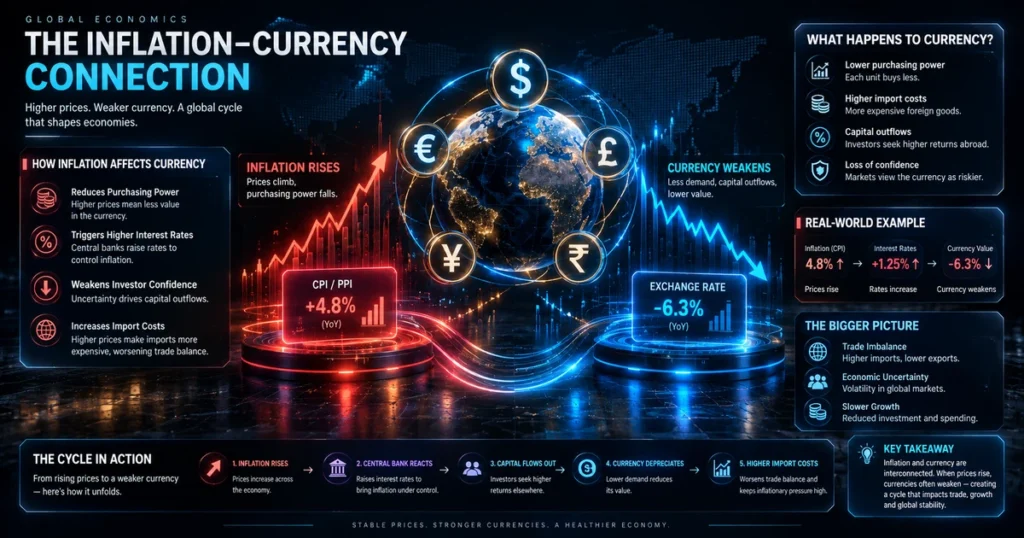
Inflation and currency interact through important macroeconomic transmission channels that influence domestic price stability and international exchange rates. When an economy sustains higher domestic inflation relative to its trading partners, its goods lose price competitiveness, placing structural downward pressure on its currency over time. Conversely, currency depreciation feeds directly back into domestic inflation by raising the local-currency cost of imported energy, food, and industrial inputs—a dynamic quantified through Exchange Rate Pass-Through (ERPT). While long-term valuations tend to reflect Relative Purchasing Power Parity (PPP), short-to-medium-term exchange rates are heavily shaped by central bank benchmark interest-rate differentials, global capital allocation, sovereign fiscal credibility, and international trade balances.
1. The Macroeconomic Transmission Core: How Inflation and Currency Interact
Money performs three foundational functions in any economic system: a unit of account, a medium of exchange, and a store of value. Domestic inflation represents the erosion of money’s internal purchasing power, while the exchange rate reflects its external purchasing power across borders.
In an open global financial system where the foreign exchange market settles over $9.6 trillion daily (as documented by the Bank for International Settlements), international capital flows continuously evaluate which currencies preserve real value:
| Horizon | Dominant Economic Catalyst | Primary Market Impact |
| Short-Term | Central Bank Interest Rate Spreads and Forward Guidance Expectations | Yield-seeking capital inflows / outflows |
| Medium-Term | Exchange Rate Pass-Through (ERPT) and Intermediate Supply Chains | Import costs adjust; CPI impact materializes |
| Long-Term | Relative PPP, productivity differentials, external balances, and structural macroeconomic forces become more important. | Structural exchange rate realignments |
Rather than moving in a simple one-way line, inflation and currency values operate through structural transmission channels that impact trade competitiveness, consumer prices, and central bank policy decisions.
2. The Dual Transmission Channels: How the Feedback Loop Works
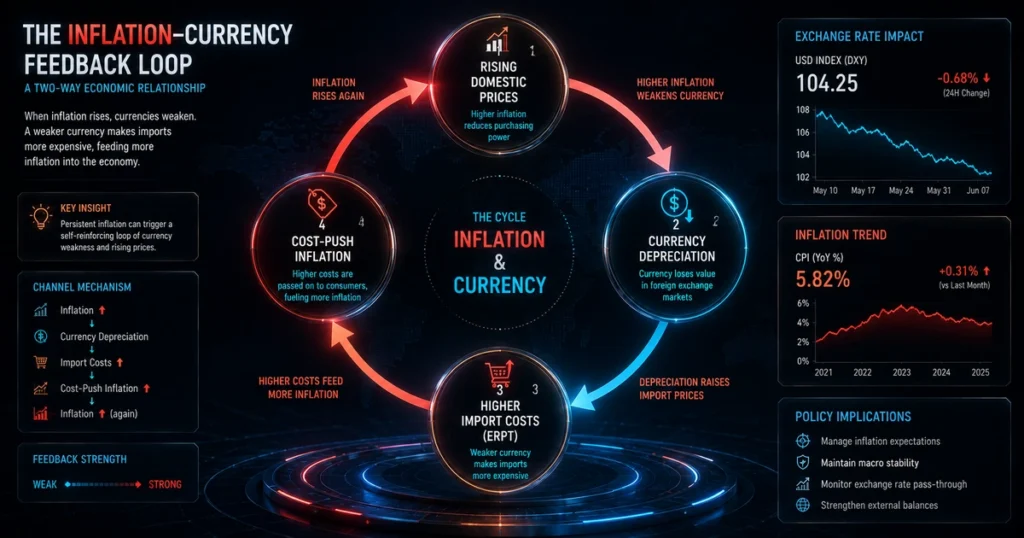
The relationship between price levels and exchange rates operates through two primary economic channels:
Channel A: Inflation $\rightarrow$ Currency Depreciation Pressure
When Country A experiences higher inflation than Country B:
- Export Price Competitiveness Weakens: Domestically produced goods become relatively more expensive for foreign buyers, dampening export revenues and reducing commercial demand for Country A’s currency.
- Import Consumption Expands: Domestic consumers and businesses may find foreign-produced goods relatively more attractive, increasing demand for foreign currency to pay for imports.
- Exchange Rate Adjustment: The reduction in foreign demand for the domestic currency combined with higher domestic demand for foreign currency places downward pressure on the domestic exchange rate under floating regimes.
Channel B: Currency Depreciation $\rightarrow$ Imported Inflation (ERPT)
When a domestic currency depreciates on international foreign exchange markets:
- Landed Import Costs Surge: Globally traded commodities (crude oil, natural gas, agricultural staples, industrial metals) are invoiced primarily in international vehicle currencies (such as the US Dollar). A weaker domestic currency increases the local-currency cost of importing these essentials.
- Intermediate Supply Chain Escalation: Domestic manufacturers that rely on imported capital equipment and intermediate raw materials experience higher input costs, passing these expenses along the supply chain.
- Consumer Price Index (CPI) Impact: Higher landed import prices can feed into the Consumer Price Index, depending on the share of imported goods and inputs in household consumption and domestic production. This can reinforce broader domestic inflationary pressures.
3. Purchasing Power Parity vs. Real Effective Exchange Rates
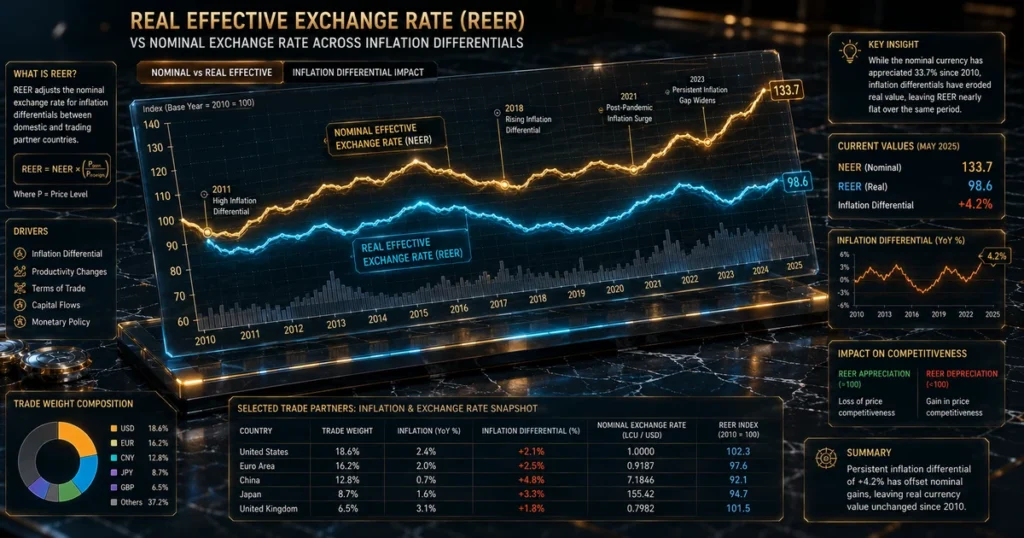
To determine whether an exchange rate adjustment is driven by nominal currency volatility or real changes in competitiveness, institutional macroeconomists evaluate two core frameworks:
Purchasing Power Parity (PPP) Framework
The theory of Relative Purchasing Power Parity provides a long-run benchmark suggesting that exchange-rate movements tend to reflect differences in inflation rates between trading partners, all else being equal:
$$\% \Delta S \approx \pi_{\text{Domestic}} – \pi_{\text{Foreign}}$$
Where $\% \Delta S$ represents the percentage change in the spot exchange rate, and $\pi$ represents the respective domestic and foreign inflation rates.
- Practical Interpretation: If domestic inflation is 6% while foreign partner inflation is 2%, relative PPP implies an approximate 4% depreciation of the domestic currency over the long run, all else being equal. Actual exchange rates can diverge substantially because of capital flows, productivity differentials, trade barriers, transport costs, monetary policy shifts, and risk premia.
Real Effective Exchange Rate (REER) Framework
While nominal exchange rates show the simple face-value conversion ratio between two currencies, the Real Effective Exchange Rate (REER) is constructed from the trade-weighted nominal effective exchange rate (NEER) and relative price or cost indices. The exact formula and direction of interpretation depend on the convention used by the statistical institution. For example, a common conceptual representation is:
$$\text{REER} = \text{NEER} \times \left( \frac{P_{\text{Domestic}}}{P_{\text{Foreign}}} \right)$$
- Rising REER: Indicates that domestic price levels are rising faster than trading partners (or the nominal currency is strengthening faster than inflation warrants), which can erode export competitiveness.
- Falling REER: Indicates that domestic goods are becoming more price-competitive relative to international peers, potentially stimulating real export volumes over the medium term.
4. Exchange Rate Pass-Through (ERPT): The Micro-to-Macro Transmission
Exchange Rate Pass-Through (ERPT) measures the sensitivity of domestic import and consumer prices to percentage changes in nominal exchange rates:
$$\text{ERPT Elasticity} = \frac{\% \Delta P_{\text{Domestic}}}{\% \Delta S}$$
- Full Pass-Through ($\text{ERPT} = 1.0$): A 10% currency depreciation is associated with an approximately 10% increase in the relevant import price, assuming the exchange-rate change is fully passed through. Consumer-price effects can still be smaller because distribution costs, margins, taxes, and domestic substitution affect final retail prices.
- Partial Pass-Through ($\text{ERPT} < 1.0$): Importers absorb a portion of currency depreciation within their operational margins, or domestic consumers substitute imported items with locally produced alternatives.
According to research from the International Monetary Fund (IMF), ERPT ratios are generally lower in advanced economies with credible inflation targets and flexible exchange rates, but higher in emerging market and developing economies (EMDEs) with a high share of imported food, energy, and foreign-currency trade invoicing.
5. Structural Breakdown: The Wage-Price-Currency Spiral

When persistent inflation coincides with continuous currency depreciation, an economy faces the risk of entering an accelerating wage-price-currency spiral:
+-------------------------------------------------------------------------------+
|             THE WAGE-PRICE-CURRENCY DEPRECIATION SPIRAL DYNAMICS              |
+-------------------------------------------------------------------------------+
|  1. Elevated Domestic Price Inflation                                         |
|     ▼                                                                         |
|  2. Domestic Currency Experiences Selling Pressure on Foreign Exchange Markets|
|     ▼                                                                         |
|  3. Landed Costs of Imported Energy, Food, and Components Surge (via ERPT)    |
|     ▼                                                                         |
|  4. Headline CPI Spikes, Squeezing Household Real Purchasing Power            |
|     ▼                                                                         |
|  5. Workers Seek Higher Nominal Wages to Offset the Rising Cost of Living     |
|     ▼                                                                         |
|  6. Businesses Raise Output Prices to Cover Higher Wage and Input Costs       |
|     ▼                                                                         |
|  [Feedback Loop Returns to Step 1 with Higher Structural Inflation]           |
+-------------------------------------------------------------------------------+
Breaking or containing this cycle may require credible monetary and fiscal policies that help anchor inflation expectations, although the appropriate response depends on the underlying shock and country-specific economic conditions.
6. Multi-Variable Macroeconomic Interaction Matrix
The impact of inflation on currency valuation is modulated by multiple structural factors across different economic profiles:
| Macroeconomic Attribute | Low-Inflation / High-Credibility Economy | High-Inflation / Developing Economy |
| Purchasing Power Trajectory | Generally better preserved over long horizons | Generally eroded faster across market cycles |
| Long-Term FX Pressure | May experience less depreciation pressure | Often faces greater structural depreciation pressure |
| Imported Inflation Risk | Lower when currency remains stable or strong | Higher when currency depreciates repeatedly |
| Monetary Policy Stance | Can maintain lower nominal rates if inflation expectations are anchored | May require tighter policy to stabilize inflation |
| Foreign Currency Demand | Depends on reserve-currency status, liquidity, credibility, and safe-haven demand | Often more sensitive to reserve adequacy, external financing needs, and investor confidence |
| Trade Invoicing Dominance | Frequently invoiced in domestic or vehicle currency | Heavy reliance on foreign vehicle currencies (USD/EUR) |
| Sovereign Debt Vulnerability | Debt predominantly denominated in domestic currency | Higher vulnerability if debt is foreign-currency denominated |
7. Central Bank Intervention Architecture: The Interest Rate & Reserve Levers
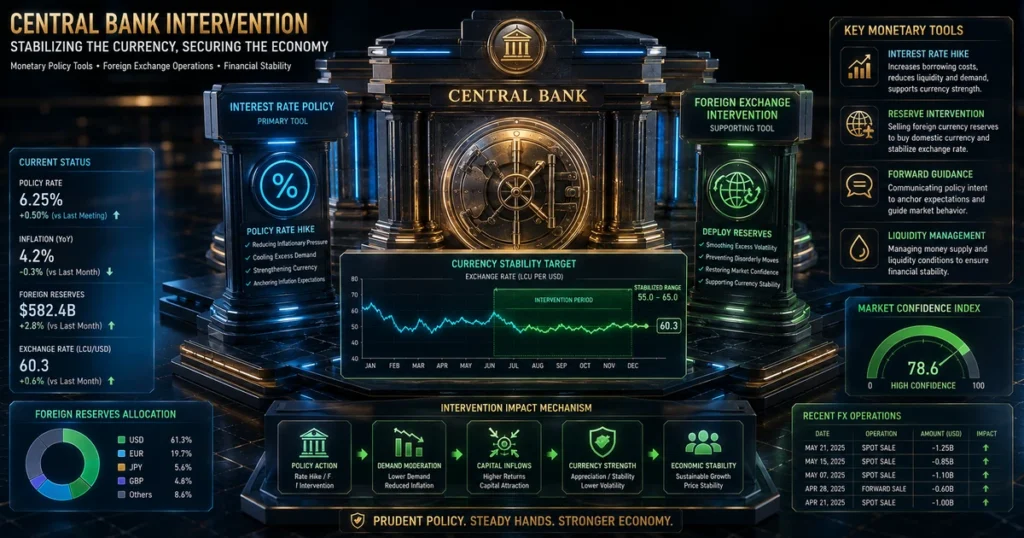
When inflation-driven currency depreciation threatens domestic price stability, sovereign monetary authorities deploy established policy and operational levers:
- Benchmark Policy Rate Adjustments: Raising policy rates can dampen aggregate domestic demand while increasing expected returns on domestic financial assets, potentially attracting foreign capital and supporting the exchange rate, although the response depends on inflation expectations, risk conditions, and global monetary policy.
- Direct Spot FX Market Interventions: Central banks sell foreign exchange reserves (such as US Dollar assets) to purchase domestic currency in open spot markets, absorbing excess domestic currency liquidity and countering depreciation pressure.
- Macroprudential and Capital Measures: Monetary authorities may adjust bank reserve requirements, introduce foreign exchange liquidity facilities, or implement macroprudential rules to stabilize cross-border capital flows.
8. Empirical Macro Case Dissections: Global Shocks & Divergences
Dissection 1: The Federal Reserve Hiking Cycle and the Strong Dollar (2022–2024)
- Macroeconomic Background: Following global supply chain shocks, US inflation rose to multi-decade highs.
- Transmission Mechanism: In response, the US Federal Reserve rapidly raised benchmark interest rates. Despite elevated domestic inflation, the US Dollar experienced broad appreciation against major currencies because US interest rate differentials widened significantly relative to Europe and Japan, supported by shifting risk appetite.
- Core Takeaway: Short-to-medium-term exchange rates are often driven more by central bank policy responses and interest-rate differentials than by inflation figures alone.
Dissection 2: The Turkish Lira and Persistent Inflation Differentials
- Macroeconomic Background: Turkey experienced multi-year periods of elevated domestic inflation.
- Transmission Mechanism: For an extended period, monetary policy did not raise benchmark rates sufficiently to compensate for inflation differentials. As domestic prices surged, the Turkish Lira depreciated substantially against the US Dollar and Euro.
- Core Takeaway: When real interest rates remain deeply negative and inflation differentials persist, market confidence can weaken and substantial nominal currency depreciation can occur. Relative PPP provides a useful long-run benchmark, but actual exchange-rate movements are also shaped by monetary policy, capital flows, reserves, and risk perceptions.
Dissection 3: The Swiss Franc and Low-Inflation Insulation
- Macroeconomic Background: Switzerland has historically maintained domestic inflation rates significantly lower than neighboring Eurozone economies.
- Transmission Mechanism: Supported by low inflation and safe-haven institutional capital inflows, the Swiss Franc (CHF) has shown long-term resilience against major currencies.
- Core Takeaway: A relatively strong and stable currency can reduce the domestic cost of imported energy and goods, helping to limit imported inflation. Switzerland’s experience also shows that safe-haven capital flows and monetary policy can influence the exchange rate alongside domestic inflation.
9. Managing Inflation-Driven FX Risk: Institutional Approaches
Institutional investors, corporate treasuries, and portfolio managers deploy targeted risk-management strategies to navigate the joint risks of domestic inflation and currency depreciation:
- Real Assets & Commodities: Certain real assets and commodities may provide diversification against inflation, but their performance varies significantly across economic and market cycles.
- International Currency Diversification: Holding assets across multiple sovereign reserve currencies (such as USD, CHF, and EUR) reduces concentration risk associated with a single depreciating domestic currency.
- Inflation-Protected Securities: Allocating to sovereign inflation-indexed debt (such as US Treasury Inflation-Protected Securities – TIPS) adjusts principal values with changes in consumer price indices.
- Corporate Derivative Hedging: Multinational enterprises utilize Outright Forward Contracts and FX Options to lock in foreign exchange conversion rates, protecting operating margins from imported input cost inflation.
10. Frequently Asked Questions (Institutional FAQ)
Does high inflation always cause an immediate currency depreciation?
Not necessarily in the short term. While high inflation erodes purchasing power, if market participants anticipate that the central bank will raise interest rates aggressively, foreign capital may flow into the country to capture higher nominal yields, supporting the currency temporarily. Over longer horizons, however, higher relative inflation generally leads to currency depreciation in line with Relative Purchasing Power Parity.
What is the fundamental difference between domestic inflation and currency depreciation?
Domestic inflation measures a broad increase in the general price level of goods and services within a single country, reflecting a loss of internal purchasing power. Currency depreciation measures a decline in the value of a domestic currency relative to foreign currencies on global foreign exchange markets, reflecting a loss of external purchasing power.
How does currency depreciation feed back into domestic inflation?
Currency depreciation increases the landed cost of imported goods, energy, raw materials, and components in local-currency terms. When domestic businesses absorb these higher input costs, they pass them along the supply chain to final retail prices, generating imported cost-push inflation through Exchange Rate Pass-Through (ERPT).
Why has the Swiss Franc historically resisted global inflation pressures?
Switzerland’s low inflation, institutional stability, fiscal discipline, and the Swiss Franc’s safe-haven characteristics can support demand for the currency during periods of global uncertainty. A relatively strong franc can also reduce the domestic cost of imported goods and energy, helping to limit imported inflation.
What role does central bank credibility play in the inflation-currency dynamic?
Central banks with strong institutional credibility and well-anchored inflation targets experience lower Exchange Rate Pass-Through. When businesses and consumers trust that the central bank will maintain long-term price stability, temporary currency fluctuations are less likely to trigger persistent domestic wage and price increases.
11. Strategic Summary & Institutional Takeaways
Understanding inflation and currency dynamics reveals the delicate balance between domestic price stability and international exchange rates.
While higher domestic inflation fundamentally erodes a currency’s purchasing power over time, exchange rates are also continuously shaped by central bank interest rate policies, international capital flows, and global trade dynamics. In turn, currency fluctuations feed directly back into domestic price levels through the mechanics of Exchange Rate Pass-Through.
By analyzing the two-way transmission mechanism, monitoring Relative Purchasing Power Parity and Real Effective Exchange Rates, and tracking central bank policy responses, corporate leaders, macro analysts, and investors can better evaluate foreign exchange risks and position capital across global market cycles.
12. Next Reading Suggestions
- [Understanding Real Effective Exchange Rates (REER) in Global Trade]
- [Central Bank Interventions: Mechanics of Sovereign Currency Management]
- [Purchasing Power Parity (PPP): Theory, Evidence, and Applications]
- [The Structural Role of the US Dollar as the Global Anchor Reserve Asset]
13. Author Box & E-E-A-T Verification
Written By: CurrencyPlans Financial Research Team
Fact-Checked & Reviewed By: Senior Institutional Market Analyst & FX Strategist
Editorial Integrity & Research Standards: CurrencyPlans publishes institutional-grade research grounded in verified macroeconomic data. All exchange rate frameworks, reserve metrics, and inflation indicators are cross-referenced with primary multilateral institutions including the International Monetary Fund (IMF), the Bank for International Settlements (BIS), and sovereign central banks.
14. Primary Institutional References & Data Sources
For verified central bank reference rates, macroeconomic research, and global trade frameworks, consult official institutional sources directly:
- Global Foreign Exchange Turnover & Research: Bank for International Settlements (BIS) Triennial Central Bank Survey
- World Economic Outlook & Inflation Projections: International Monetary Fund (IMF) World Economic Outlook
- US Monetary Policy & Foreign Exchange Rates: Board of Governors of the Federal Reserve System Foreign Exchange Data (H.10)
- Euro Exchange Rate & Price Stability Analytics: European Central Bank (ECB) Reference Rates
- Swiss Monetary Policy & Exchange Rate Assessments: Swiss National Bank (SNB) Monetary Policy
15. Educational Disclaimer
This guide is prepared strictly for educational, informational, and research purposes and does not constitute financial, investment, legal, or tax advice. Foreign exchange rates and inflation metrics fluctuate based on global economic conditions. Always perform independent due diligence and consult a licensed financial advisor before making international financial commitments.

