
Introduction
The Dubai DFM (Dubai Financial Market / سوق دبي المالي) represents one of the principal regulated securities exchanges in the United Arab Emirates. Established in March 2000 as a public institution and later making history as the first exchange in the region to list its own shares, the DFM provides a structured marketplace for public equity, debt, and derivative instruments in the Arabian Gulf.
Its flagship benchmark, the DFM General Index (DFMGI), is a real-time, free-float-adjusted market-capitalization-weighted index tracking eligible equities listed on the exchange. The index serves as a primary benchmark reflecting the performance of DFM-listed equities and their sensitivity to domestic economic conditions, corporate earnings, and regional capital flows across the Emirate of Dubai. For global institutional allocators, regional fund managers, and equity researchers, understanding the index’s Free Float Factor (FFF) calculation, 10% constituent capping rules, eight-sector classification framework, and macroeconomic linkages provides the foundation for analyzing UAE capital markets, complementing broad global equity studies such as our foundational guide on how stock prices are determined.
Executive Summary: Structure of the Dubai Financial Market
Quick Answer: What Is the Dubai DFM and the DFMGI?
The Dubai DFM (Dubai Financial Market) is the public stock exchange of the Emirate of Dubai. Its primary headline benchmark is the DFM General Index (DFMGI), a free-float-adjusted market-capitalization-weighted benchmark tracking eligible DFM-listed equities. Calculated in real time on a Price Return basis, the benchmark applies a 10% single-constituent weighting cap to prevent extreme index concentration. While the DFMGI serves as the general headline index, the market’s sector framework includes sector indices aligned with the Global Industry Classification Standard (GICS).
Operating within the UAE’s federal regulatory framework, the DFM is licensed and supervised by the Securities and Commodities Authority (SCA). While the neighboring Emirate of Abu Dhabi hosts the Abu Dhabi Securities Exchange (ADX), the Dubai Financial Market serves as the dedicated exchange for Dubai’s signature commercial conglomerates, state-backed utility providers, transportation platforms, and leading Islamic and conventional financial institutions.
The exchange operates under three core structural pillars:
- Institutional Index Governance: The benchmark suite is owned by DFM and calculated and maintained by S&P Dow Jones Indices acting as the Index Calculation Agent, employing standardized free-float adjustments, transparent divisors, and quarterly rebalancing.
- Sharia-Compliant Capital Infrastructure: The DFM became the first Islamic Sharia-compliant exchange globally in 2007, and it offers dedicated Sharia-compliant indices alongside its broader market benchmarks.
- Capital Market Diversification: Serving as a central venue for strategic public asset monetizations, the exchange integrates municipal infrastructure, automated road tolls, utilities, and commercial enterprises into public equity markets.
The Structural Evolution: Modernization & Calculation Architecture
Quick Answer: How Has the DFM General Index Evolved?
The DFMGI underwent a major structural modernization when DFM partnered with S&P Dow Jones Indices as its calculation agent. This modernization introduced an institutional 10% constituent capping threshold (reduced from an earlier 20% limit), transitioned to standardized quarterly rebalancing, and mapped constituents into eight distinct GICS sectors.
The architectural development of the DFM reflects the UAE’s progressive alignment of its financial market microstructure with global institutional investment practices:
- March 2000 (Market Founding): The Dubai Financial Market officially commences trading operations as a government-owned public institution.
- November 2006 (Historic IPO): DFM completed an initial public offering (IPO) in which 20% of its paid-up capital was offered to public subscribers.
- March 2007 (Public Listing): Dubai Financial Market Company was formally listed on its own market on March 7, 2007, becoming the region’s first publicly listed stock exchange.
- 2014 (MSCI Emerging Markets Upgrade): The UAE equity market achieved formal reclassification from Frontier to Emerging Market status by MSCI, expanding institutional passive tracking flows.
- January 2022 (Global Trading Week Alignment): The UAE transitioned its national working week from Sunday–Thursday to Monday–Friday, synchronizing DFM trading sessions with global financial centers in Europe, the Americas, and Asia.
- Q4 2022 (S&P Calculation Overhaul): DFM deployed its enhanced index methodology calculated by S&P Dow Jones Indices, capping constituent weights at 10% and implementing official GICS sector indices.
Eligibility & Inclusion Criteria: Benchmark Composition Rules
Quick Answer: Which Securities Qualify for the DFM General Index?
To enter and remain in the DFM General Index, securities must satisfy the DFMGI’s eligibility rules, including the applicable listing and free-float requirements. The index methodology specifies how primary listings, qualifying secondary listings, and newly listed securities are handled during index reviews.
The index framework is governed by the DFM Index Committee alongside technical calculation guidelines established with S&P Dow Jones Indices:
- Eligible Listing Structure: Issuers with a primary share listing on the DFM are eligible for consideration in the DFMGI, subject to the methodology’s inclusion rules. Certain qualifying secondary listings may also be included under specific conditions, while listed bonds, sukuk, ETFs, and other non-equity instruments are excluded from the equity benchmark.
- Free-Float Factor (FFF) Minimums: Securities must maintain an eligible Free Float Factor (FFF) of at least 5% (0.05). Securities with a calculated free-float factor below this 5% threshold are ineligible for inclusion.
- Quarterly Review Schedule: Rebalancings occur on a quarterly cycle (March, June, September, and December). This ensures that constituent share counts, Free Float Factors, and capping limits adjust systematically to corporate capital events and secondary offerings.
- Price Return Basis: The standard headline DFMGI is calculated and disseminated as a Price Return index, meaning that cash dividend distributions are not reinvested into the headline index level, distinguishing it from total-return structures like the Germany DAX 40.
Weighting Architecture, Free Float Factor (FFF), and the 10% Capping Mechanism
Quick Answer: How Are Companies Weighted in the DFMGI?
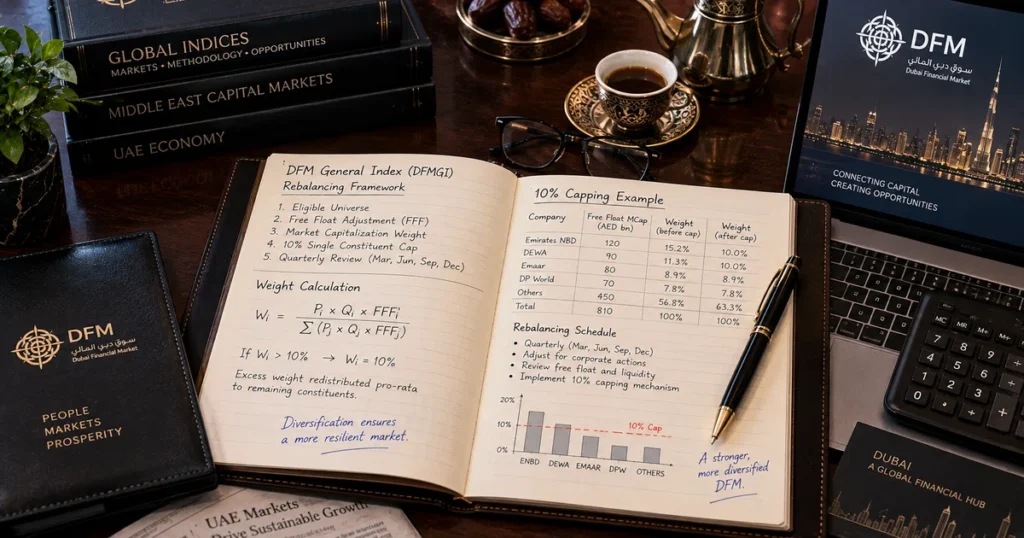
The DFMGI follows a capitalization-weighted index methodology adjusted for free float. The underlying market-capitalization calculation incorporates each constituent’s price, shares outstanding, and Free Float Factor (FFF), while the S&P Dow Jones Indices capping methodology is applied to enforce the 10% constituent-weight limit at scheduled rebalancings.
Constituent float-adjusted capitalization is determined according to official index methodology:
$$\text{Float-Adjusted Market Capitalization}_i = P_i \times Q_i \times \text{FFF}_i$$
Where:
- $P_i$ represents the current market price of constituent $i$.
- $Q_i$ represents the shares outstanding for constituent $i$.
- $\text{FFF}_i$ is the Free Float Factor, reflecting the portion of shares considered freely tradable under DFM methodology. Under DFM rules, government-owned shareholdings and holdings of strategic or major shareholders owning 5% or more are excluded from the free float.
- The applicable S&P Dow Jones Indices capping methodology limits any constituent exceeding 10% to the prescribed maximum at the reference date, with the resulting weights implemented at the rebalance.
- The Divisor maintains continuity of the index following applicable corporate actions and other non-market events, using standard index-divisor mechanics also discussed in our USA S&P 500 methodology guide.
The Rationale for the 10% Weighting Cap
Historically, DFM index rules permitted individual constituents to reach up to 20% of the total index weight. Under that earlier structure, large banking institutions or premier commercial developers could exert an outsized influence on daily benchmark fluctuations. By tightening the single-constituent cap to 10%, the methodology reduces the influence of any single constituent on overall index performance, mitigates excessive concentration, and provides a broader balance across listed sectors.
The Eight Official GICS Sectors on the DFM
Quick Answer: What Industry Sectors Are Represented on the DFM?
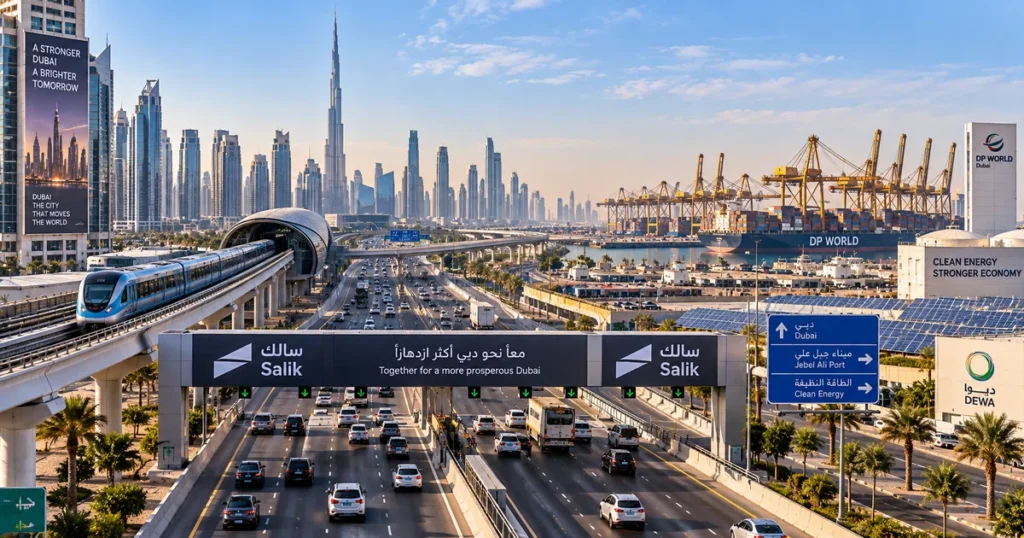
The DFM’s sector index architecture is structured into eight distinct GICS sectors: Financials, Real Estate, Utilities, Industrials, Communication Services, Consumer Staples, Consumer Discretionary, and Materials.
Constituents are categorized under the Global Industry Classification Standard (GICS) into eight verified sector indices:
| GICS Sector | Economic Function | Representative DFM-Listed Companies |
| Financials | Commercial banking, Islamic finance, financial services | Emirates NBD, Dubai Islamic Bank, Commercial Bank of Dubai |
| Real Estate | Property development and real-estate investment | Emaar Properties, Emaar Development, Deyaar Development |
| Utilities | Electricity, water, district cooling, and related infrastructure | DEWA, Empower, Tabreed |
| Industrials | Transportation infrastructure, toll systems, industrial and logistics activities | Salik, Dubai Taxi Company, Aramex |
| Communication Services | Telecommunications and connectivity services | du (Emirates Integrated Telecommunications Company) |
| Consumer Staples | Essential consumer goods and food retail | Spinneys |
| Consumer Discretionary | Consumer-oriented services, retail delivery, and non-essential spending | Talabat Holding |
| Materials | Basic materials and related resources | Eligible DFM-listed materials companies |
Broadening Market Breadth Through Public Asset Monetizations
Between 2022 and 2026, Dubai brought several state-linked and infrastructure businesses to the public market, including DEWA, Salik, Empower, and Dubai Taxi Company. These listings broadened the range of sectors and business models represented on the DFM and expanded the representation of utilities and infrastructure-related companies alongside the established financial and real-estate sectors.
Macroeconomic Drivers: AED Currency Peg, Regional Capital, and Tourism
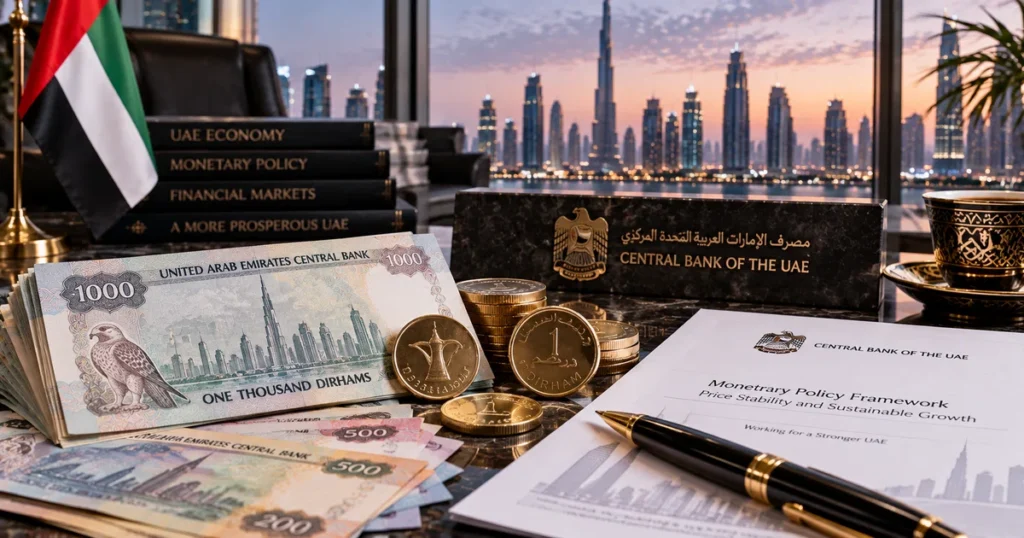
Quick Answer: What Macro Forces Influence the Dubai DFM?
The DFM is influenced by a combination of Central Bank of the UAE interest rate policy (anchored to the US Federal Reserve), global trade and tourism flows, inbound foreign direct investment (FDI), and regional GCC liquidity, aligning with the foundational dynamics examined in our guide oninterest rates and exchange rates.
                      ┌─────────────────────────────────────────┐
                      │    MACRO TRANSMISSION CHANNELS TO DFM   │
                      └────────────────────┬────────────────────┘
                                           │
         ┌─────────────────────────────────┴─────────────────────────────────┐
         │                                                                   │
         ▼                                                                   ▼
┌──────────────────────────────────┐               ┌──────────────────────────────────┐
│ CURRENCY PEG & MONETARY POLICY   │               │ TRADE, REAL ESTATE & TOURISM     │
├──────────────────────────────────┤               ├──────────────────────────────────┤
│ * AED Pegged to US Dollar:       │               │ * Global Tourism & Inbound FDI:  │
│   The Central Bank of the UAE    │               │   Supports earnings in premier   │
│   mirrors Federal Reserve rate   │               │   hospitality and property firms │
│   decisions directly             │               │ * Regional GCC Liquidity:        │
│ * Borrowing Cost Cycles:         │               │   Regional trade surpluses and   │
│   Affect mortgage demand for     │               │   cross-border capital support   │
│   real estate and banking margins│               │   institutional equity flows     │
└──────────────────┘               └──────────────────────────────────┘
1. The Fixed Currency Peg Mechanism
The UAE Dirham (AED) is officially pegged to the US Dollar at a fixed rate of 3.6725 AED per 1 USD. Because of this fixed exchange-rate regime, the Central Bank of the United Arab Emirates (CBUAE) generally adjusts its policy rates in line with US Federal Reserve rate changes to support exchange-rate stability.
- When the Federal Reserve engages in rate-hiking cycles, the CBUAE implements corresponding rate increases, raising borrowing costs across commercial lending channels and influencing mortgage demand within Dubai’s real estate market.
- When the Fed initiates rate cuts, local borrowing costs decline, which can support transaction activity in interest-rate-sensitive sectors such as property development, utilities, and infrastructure, as explored in our study on Fed rate cuts and global liquidity.
2. Diversified Commercial Growth Drivers
Unlike regional markets with substantial direct weightings in upstream oil extraction, Dubai’s domestic economy is largely diversified across services, logistics, retail, aviation, and financial services. As a result, corporate revenues on the DFM are heavily influenced by international passenger traffic, foreign direct investment, commercial business migration, and global wealth inflows into the UAE.
Trading Mechanics: Market Sessions, Auction Times, and Price Limits
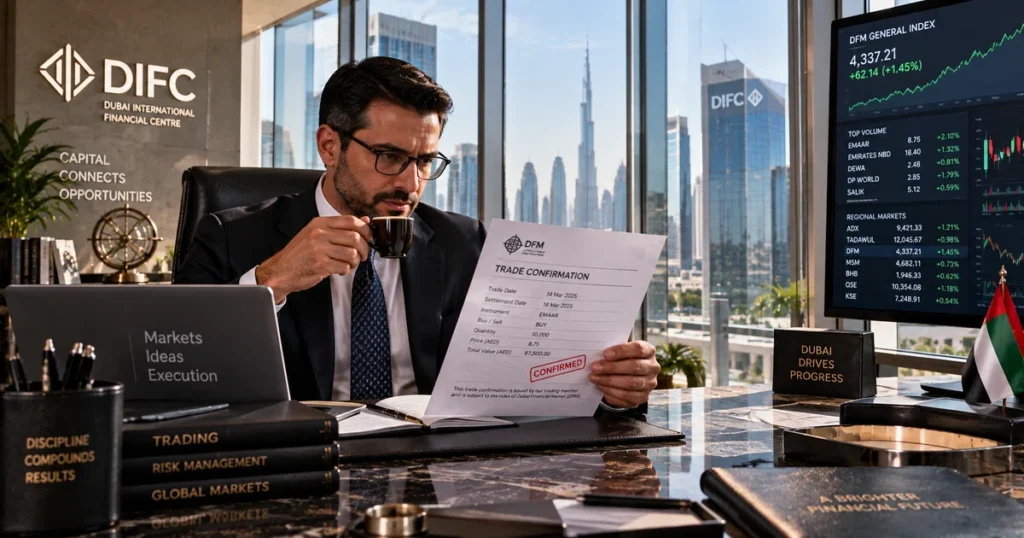
Quick Answer: When Does the Dubai Financial Market Trade?
The DFM operates Monday through Friday, with continuous cash market trading running from 10:00 to 14:45 Gulf Standard Time (GST / UTC+4). The market is closed on Saturdays and Sundays.
Daily Trading Schedule (Gulf Standard Time – GST / UTC+4):
- 09:30 – 10:00 GST (Pre-Trading / Opening Auction): Market participants submit, modify, and cancel orders. No trade executions occur during this window; the matching engine computes an indicative opening price based on order book equilibrium.
- 10:00 GST (Cash Market Open): Continuous trading commences with the execution of matched orders from the opening auction.
- 10:00 – 14:45 GST (Continuous Cash Trading Session): Active continuous order matching based on price and time priority across all listed equities.
- 14:45 – 14:55 GST (Pre-Closing Auction Window): The market enters the closing auction call phase, during which order modifications establish the official daily closing price.
- 14:55 – 15:00 GST (Trade-at-Last / Trade-at-Close Phase): Market participants can execute orders exclusively at the fixed closing price determined during the closing auction.
- 15:00 GST (Trading Close): Official equity trading operations conclude for the day.
Market Microstructure: Price Limits & Index Integrity
To preserve market stability and mitigate extreme intra-day volatility, the DFM maintains structured operational rules:
- Equity Price Limits: DFM-listed equities generally operate within the exchange’s applicable daily price fluctuation limits, historically cited as +15% upward and -10% downward from the relevant reference price, subject to specific security types, corporate actions, and regulatory adjustments.
- Index-Level Integrity: The DFMGI itself is an index and does not operate with a stock-style limit-up/limit-down mechanism; its value is calculated continuously from underlying constituent prices under the index methodology.
How to Gain Market Exposure to the Dubai DFM
Quick Answer: How Do Investors Access the DFM?
Investors who want to hold and trade DFM-listed shares generally need a DFM Investor Number (NIN), followed by establishing a trading relationship with a licensed broker, or access via regional Exchange-Traded Funds (ETFs).
+---------------------------------------------------------------------------------------------------+
|                        DUBAI DFM INVESTMENT & TRADING ACCESS ROUTES                               |
+---------------------+-----------------------------+-----------------------+-----------------------+
| ACCESS VEHICLE      | PRIMARY EXAMPLES            | BEST SUITED FOR       | REGULATORY PATHWAY    |
+---------------------+-----------------------------+-----------------------+-----------------------+
| **Direct Equities** | Individual shares on DFM    | Active investors,     | Requires personal     |
|                     | (e.g., Emaar, Emirates NBD) | long-term stock       | Investor Number (NIN) |
|                     |                             | pickers               | via DFM platform      |
| **Regional ETFs**   | UAE-focused equity ETFs     | Passive allocators,   | Standard brokerage    |
|                     | (e.g., Chimera DFM ETF)     | institutional global  | account on DFM or     |
|                     |                             | funds                 | cross-listed markets  |
| **Global Emerging   | iShares MSCI UAE ETF        | International funds   | Listed on US / global |
| Market Funds**      | (`UAE`), broader GCC funds  | seeking diversified   | exchanges; holds DFM  |
|                     |                             | UAE exposure          | underlying assets     |
+---------------------+-----------------------------+-----------------------+-----------------------+
Investor Number (NIN) Framework
Investors who want to hold and trade DFM-listed shares generally need a DFM Investor Number (NIN), followed by establishing a trading relationship with a licensed broker. Issued by the Dubai Financial Market via its official digital applications and portal, the NIN functions as a central investor identifier linked directly to the Dubai Central Securities Depository (Dubai CSD). Once generated, the investor provides the NIN to an authorized brokerage firm to begin trading cash equities.
Comparative Analysis: Dubai DFMGI vs. Global & Regional Benchmarks
Quick Answer: How Does the DFMGI Compare to ADX, Saudi Tadawul, and S&P 500?
The DFMGI focuses on commercial banking, real estate, utilities, and infrastructure within Dubai. In contrast, the Abu Dhabi ADX features higher sovereign holding company and energy weightings; the Saudi Tadawul (TASI) is dominated by energy and petrochemical producers; and the US S&P 500 represents the large-cap segment of the US equity market.
| Dimension / Metric | Dubai DFMGI | Abu Dhabi (ADX FADX15) | Saudi Arabia (TASI) | USA S&P 500 (SPX) |
| Constituent Scope | Eligible DFM equities | Top 15 liquid ADX stocks | Broad Saudi equity market | 500 Large-Cap US firms |
| Weighting Method | Free-Float Market Cap | Free-Float Market Cap | Free-Float Market Cap | Float-Adjusted MCap |
| Constituent Cap | 10% Maximum Cap | 10% Maximum Cap | 15% Maximum Cap | None (Pure Float) |
| Primary Currency | UAE Dirham (AED) | UAE Dirham (AED) | Saudi Riyal (SAR) | US Dollar (USD) |
| Quoted Return Type | Price Return | Price Return | Price Return | Price Return |
| Trading Week | Monday – Friday | Monday – Friday | Sunday – Thursday | Monday – Friday |
Common Myths vs. Empirical Facts
- Myth: The Dubai Financial Market trades on Sundays like other traditional Middle Eastern exchanges.
- Fact: In January 2022, the UAE transitioned its financial exchanges to a Monday–Friday trading week, fully synchronizing operating schedules with global financial markets.
- Myth: The DFM General Index is an energy and oil extraction benchmark.
- Fact: The DFMGI contains minimal direct oil extraction exposure. The index is weighted across commercial banking, real estate development, utilities, logistics, and transportation infrastructure.
- Myth: A single large enterprise like Emirates NBD can comprise 30% of the DFMGI.
- Fact: S&P calculation rules enforce a strict 10% single-constituent cap at each quarterly rebalancing, preventing any single company from dominating index movements.
- Myth: International investors are prohibited from owning DFM equities.
- Fact: Foreign investors can acquire DFM-listed shares and obtain an Investor Number (NIN). Prominent DFM-listed corporations permit foreign ownership according to their corporate articles and applicable UAE investment regulations.
Frequently Asked Questions
What does “DFM” stand for?
DFM stands for Dubai Financial Market (سوق دبي المالي), the primary public securities exchange based in the Emirate of Dubai, United Arab Emirates.
What is the difference between DFM and Nasdaq Dubai?
Both exchanges operate within Dubai, but DFM is the onshore exchange trading primary local equities denominated in UAE Dirham (AED). Nasdaq Dubai is an international financial exchange located within the Dubai International Financial Centre (DIFC) under the regulation of the DFSA, primarily listing USD-denominated equities, sukuk, and structured derivatives.
Who calculates the DFM General Index?
The DFM General Index is owned by the Dubai Financial Market and calculated and maintained by S&P Dow Jones Indices acting as the Index Calculation Agent.
How often is the DFMGI reviewed and rebalanced?
The benchmark undergoes scheduled quarterly rebalancings in March, June, September, and December to review constituent Free Float Factors (FFF), update share counts, and re-apply the 10% constituent capping limit.
Does the headline DFMGI include dividends?
No. The standard headline DFMGI is calculated on a Price Return basis, tracking equity market prices without reinvesting cash dividends into the headline quote.
Does the DFM offer Islamic / Sharia-compliant indices?
Yes. Alongside the headline DFMGI, the exchange calculates the DFM Shari’a Index (DFMSI), which tracks DFM-listed companies classified as Shari’a-compliant under the DFM’s Shari’a standards and reviewed through its Shari’a governance framework.
How are capital gains taxed on the Dubai Financial Market?
For individuals investing in their personal capacity, UAE Corporate Tax generally does not apply to dividends, capital gains, and other investment income from owning shares or securities. Corporate and cross-border tax considerations can differ depending on the entity’s structure and tax residency.
Strategic Summary & Core Takeaways
- Capital Center of Dubai: The Dubai DFM provides regulated access to Dubai’s physical and commercial economy, spanning real estate, commercial banking, utilities, and infrastructure.
- Institutional Calculation Methodology: Owned by DFM and calculated by S&P Dow Jones Indices, the DFMGI features quarterly rebalancing, Free Float Factor (FFF) adjustments, and official GICS sector indices.
- Capping Constraint: The 10% single-stock weighting cap protects index diversification and prevents single-constituent dominance.
- Synchronized Global Hours: Trading runs Monday through Friday, with continuous cash-market trading from 10:00 to 14:45 GST.
- Macroeconomic Sensitivity: Through the AED’s peg to the US Dollar, local borrowing costs correlate with Federal Reserve monetary policy, impacting valuations across interest-rate-sensitive real estate, utility, and banking sectors.
Next Reading Suggestions
- USA S&P 500: The Complete Guide to Index Methodology, Market-Cap Weighting, and Global Market Mechanics
- Germany DAX 40: The Complete Guide to Components, Total Return Methodology, and Global Market Mechanics
- How Stock Prices Are Determined: Market Microstructure, Supply and Demand, and Valuation
- What Is Market Capitalization? The Complete Guide to Market Cap, Company Size, and Valuation
- Interest Rates and Exchange Rates: The Complete Guide to Global Currency Pricing
- Fed Rate Cuts & Global Liquidity: The Complete Guide to Interest Rates, the Fed Balance Sheet, and Asset Markets
- What Is Gold? The Complete Guide to Real Money, Store of Value & Why It Matters
- Crypto Market Cycles: The Complete Guide to Bitcoin Halvings, Global Liquidity, On-Chain Metrics, and Alt Seasons
Author Box & E-E-A-T Verification
Written & Researched By: CurrencyPlans Editorial Research Team
Editorial Review & Methodological Standards: The guide is based primarily on official Dubai Financial Market (DFM), S&P Dow Jones Indices, Securities and Commodities Authority (SCA), and Central Bank of the UAE (CBUAE) documentation, with methodology, Free Float Factor (FFF) rules, 10% capping limits, and market-structure details cross-checked against available primary regulatory and exchange sources.
Educational References & Market Data Sources
For official index rulebooks, constituent updates, and trading calendars, consult primary regulatory and exchange portals directly:
- Dubai Financial Market (Official Portal & Rulebooks): Dubai Financial Market
- S&P Dow Jones Indices (DFMGI Index Calculation Methodology): S&P Dow Jones Indices
- Securities and Commodities Authority (UAE Federal Market Regulator): SCA UAE
- Central Bank of the United Arab Emirates (Monetary Policy & Exchange Rates): CBUAE
- Dubai Central Securities Depository (Dubai CSD): Dubai CSD
- UAE Federal Tax Authority (Corporate Tax & Investment Guidance): Federal Tax Authority UAE
Educational Disclaimer
This guide is prepared strictly for educational, research, and informational purposes and does not constitute personalized financial, investment, trading, or tax advice. Equities, regional indices, and emerging market securities carry investment risks. Historical returns of the DFM General Index do not guarantee future investment performance. Always conduct independent research and consult a licensed fiduciary financial advisor before committing capital.

