
Introduction
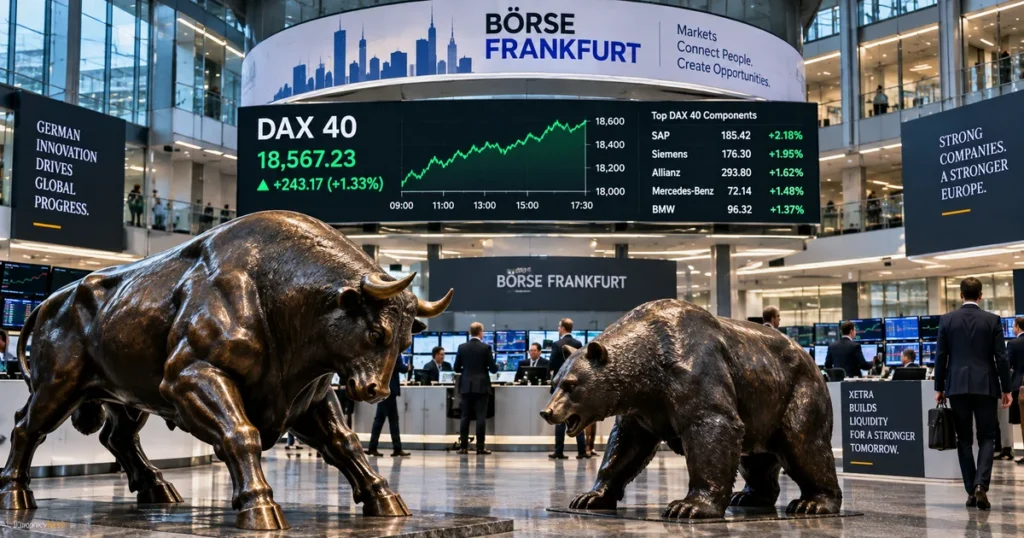
The DAX 40 (Deutscher Aktienindex) is Germany’s premier blue-chip equity benchmark. It tracks the 40 largest eligible companies in the DAX selection universe, listed on the Regulated Market and meeting the index’s eligibility requirements. Constituent selection is primarily based on free-float market capitalization, alongside additional profitability, liquidity, reporting, and governance criteria. Calculated using electronic price discovery from the Xetra platform, the standard headline DAX is a Total Return Performance Index, meaning gross cash dividends distributed by constituent corporations are mathematically factored back into index calculations.
The DAX 40 represents approximately 80% of the market capitalization of listed stock corporations in Germany. Administered within the Deutsche Börse Group ecosystem in Frankfurt—the financial hub of continental Europe and home to the European Central Bank (ECB)—the benchmark serves as an international barometer for industrial automation, automotive engineering, specialty chemicals, and European enterprise technology, complementing broader asset studies such as our foundational guide on how stock prices are determined.
                      ┌─────────────────────────────────────────┐
                      │    GERMANY DAX 40 STRUCTURAL PILLARS    │
                      └────────────────────┬────────────────────┘
                                           │
         ┌───────────────────┬─────────────┴───────┬───────────────────┐
         ▼                   ▼                     ▼                   ▼
┌─────────────────┐ ┌─────────────────┐   ┌─────────────────┐ ┌─────────────────┐
│ 40 BLUE-CHIP    │ │ FREE-FLOAT      │   │ TOTAL RETURN    │ │ XETRA PRICE     │
│ CONSTITUENTS    │ │ MARKET-CAP      │   │ PERFORMANCE     │ │ DISCOVERY       │
│                 │ │ WEIGHTING       │   │ CALCULATION     │ │                 │
├─────────────────┤ ├─────────────────┤   ├─────────────────┤ ├─────────────────┤
│ Selected across │ │ Weighted by     │   │ Dividends are   │ │ DAX calculated  │
│ global industry,│ │ available float;│   │ reinvested;     │ │ from Xetra      │
│ technology, and │ │ 15% single-stock│   │ reflects gross  │ │ prices during   │
│ financial firms │ │ cap ceiling     │   │ holding returns │ │ core trading    │
└─────────────────┘ └─────────────────┘   └─────────────────┘ └─────────────────┘
The Structural Evolution: From DAX 30 to DAX 40
Quick Answer: Why Did the DAX Expand from 30 to 40 Companies?
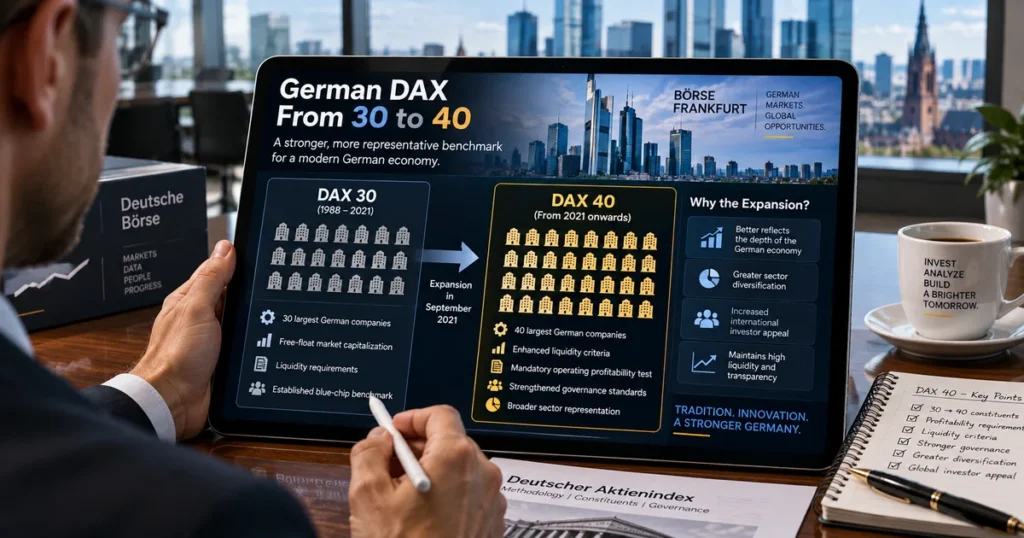
In September 2021, Deutsche Börse Group implemented a major DAX index reform, expanding the constituent roster from 30 to 40 companies. Following the insolvency of financial technology firm Wirecard in 2020, the reform introduced stricter corporate-governance standards, required positive EBITDA in the two most recent fiscal years for new candidate eligibility, and established ranking based on free-float market capitalization.
The index’s architectural evolution spans several structural milestones:
                      STRUCTURAL MILESTONES OF THE DAX INDEX

       JULY 1, 1988: Launch of the DAX 30 (Base Value: 1,000 points; Historical base: Dec 30, 1987)
         │
       JUNE 1999: Xetra electronic platform becomes the primary pricing basis for the index
         │
       SEPTEMBER 2021: Official expansion from 30 to 40 constituents; EBITDA & governance rules applied
         │
       MARCH 2024: Single-constituent weighting cap raised from 10% to 15% during index reviews
Governing Selection & Governance Criteria:
- Operating Profitability (EBITDA Requirement): New DAX candidates must demonstrate positive EBITDA (Earnings Before Interest, Taxes, Depreciation, and Amortization) in their two most recent annual financial statements.
- Corporate Governance Compliance: Companies must meet the applicable corporate-governance requirements specified in the DAX index methodology, including the relevant audit-committee requirements.
- Market Liquidity Minimums: Prospective constituents must meet the applicable liquidity and trading requirements specified in the DAX index methodology.
- Reporting Requirements: Eligible companies must meet the methodology’s requirements for timely publication of audited annual financial reports, half-year financial reports, and quarterly statements, with defined consequences for non-compliance.
Performance Index vs. Price Index: The Total Return Advantage
Quick Answer: Why Does the Quoted DAX Differ From Standard Price Indices Over Time?
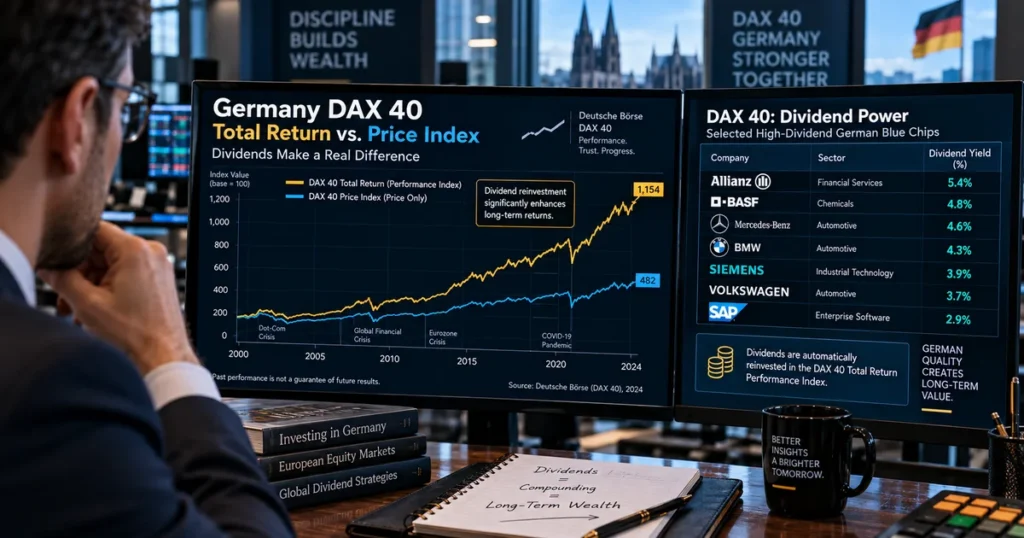
The standard headline DAX is a Performance Index (Total Return Index), whereas standard headline figures for indices such as the S&P 500, Dow Jones, and FTSE 100 are Price Indices. When a constituent distributes a cash dividend, the DAX calculation reinvests those distributions back into the index rather than allowing the headline figure to drop on the ex-dividend date.
                      INDEX CALCULATION MECHANICS COMPARED

       SIMPLIFIED CONCEPTUAL PRICE-INDEX STRUCTURE:
       Index Level = Sum of (Constituent Share Price * Free Float Shares) / Divisor
       *Ex-Dividend Effect: Cash payouts reduce the index value proportionally.*
         │
       SIMPLIFIED CONCEPTUAL TOTAL-RETURN STRUCTURE:
       Total-Return Effect: Gross cash dividends are reinvested into the index
       according to the applicable index methodology.
       *Compounding Effect: Cash dividends are factored back into calculated capital.*
Because dividends are reinvested mathematically in the DAX Performance Index, dividend distributions contribute to the index’s long-term total-return trajectory relative to standalone price-return benchmarks.
Structural Comparison: Performance vs. Price Formats
| Dimension | DAX Performance Index | DAX Price Index | Standard S&P 500 |
| Headline Status | Standard headline DAX | Separate price-return variant | Standard benchmark quote |
| Dividend Accounting | Gross dividends are reinvested | Dividends are not reinvested | Dividends excluded from the standard price index |
| Long-Term Profile | Total-return performance | Price performance only | Price performance only |
| Common Identifiers | DAX / provider-specific codes | DAXK / provider-specific codes | SPX / ^GSPC |
Constituent Weighting and Sector Diversification
Quick Answer: How Are Companies Weighted in the DAX 40?
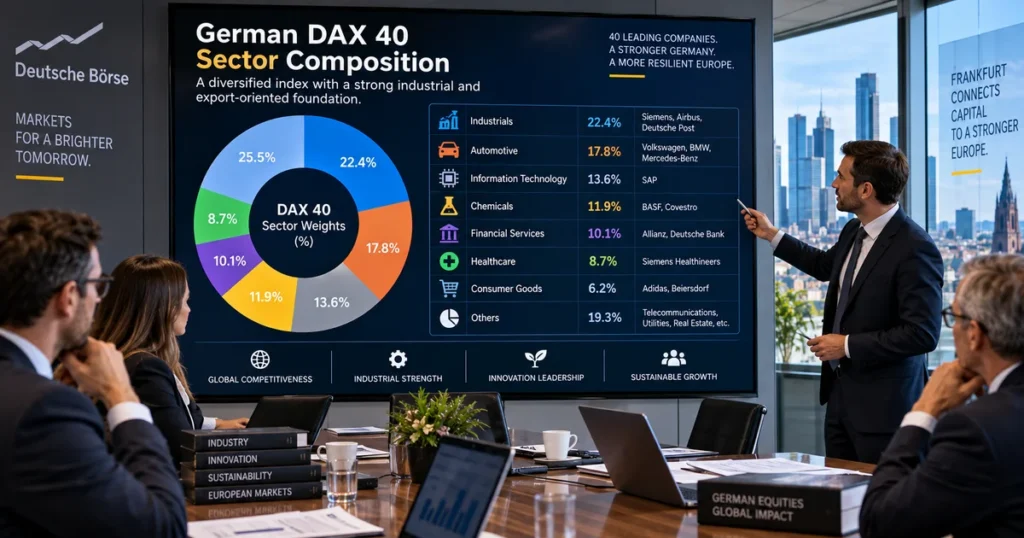
The DAX 40 is weighted by free-float market capitalization, meaning the weighting is based on the portion of shares considered freely available to investors under the DAX index methodology. Individual constituent weights are reviewed periodically, subject to an established 15% single-stock weighting cap, as detailed in our guide onwhat market capitalization is.
                      DAX 40 SECTOR EXPOSURE DYNAMICS (ILLUSTRATIVE)

       Industrial & Capital Goods   [████████████████████] (Siemens, Airbus)
       Information Technology       [██████████████] (SAP)
       Automotive & Mobility        [████████████] (Mercedes-Benz, BMW, VW Group)
       Financial Services & Ins.    [██████████] (Allianz, Munich Re, Deutsche Bank)
       Healthcare & Life Sciences   [████████] (Bayer, Sartorius, Fresenius)
       Chemicals & Materials        [███████] (BASF)
       Consumer, Logistics & Other  [████████████████] (DHL Group, Deutsche Telekom)
The 15% Single-Stock Weighting Cap
Historically, the methodology used a 10% single-constituent cap. In March 2024, the cap was increased to 15%, allowing greater representation for large constituents such as SAP while maintaining a maximum single-constituent weight constraint.
Representative Core Heavyweights of the Benchmark:
| Constituent | Primary Sector | Structural Profile |
| SAP SE | Enterprise Software | Global cloud enterprise resource planning (ERP) provider |
| Siemens AG | Industrial Automation | Benchmark for factory electrification, digitization, and infrastructure |
| Allianz SE | Insurance & Asset Management | Global insurance and asset-management group |
| Airbus SE | Aerospace & Defense | Commercial aircraft manufacturing and defense systems |
| Mercedes-Benz Group | Automotive Engineering | Luxury automotive manufacturer with global dealer networks |
| Deutsche Telekom | Telecommunications | Global telecommunications group with major US operations |
| Munich Re | Reinsurance Underwriting | Global reinsurer covering property, casualty, life, health, and other specialized risks |
| BASF SE | Specialty Chemicals | Integrated chemical conglomerate supplying basic materials |
Macroeconomic Catalysts: ECB Policy, EUR/USD, and Global Exports
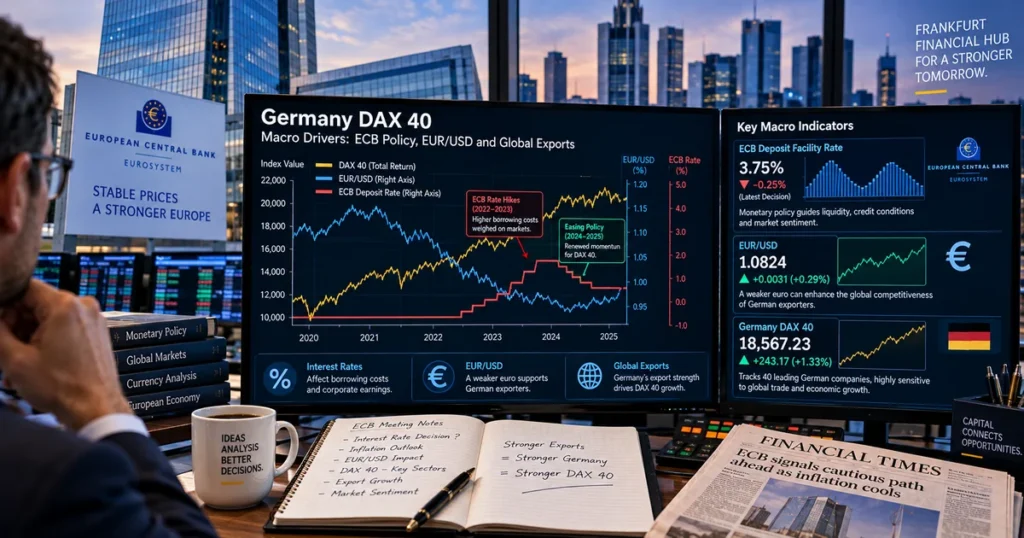
Quick Answer: What Economic Drivers Influence the DAX 40?
Key influences on the DAX 40 include European Central Bank (ECB) policy, currency exchange-rate movements (EUR/USD), global demand, corporate earnings, and broader financial-market conditions, similar to the macro relationships explored in our guide on [interest rates and exchange rates.
                      ┌─────────────────────────────────────────┐
                      │    MACRO TRANSMISSION CHANNELS TO DAX   │
                      └────────────────────┬────────────────────┘
                                           │
         ┌─────────────────────────────────┴─────────────────────────────────┐
         │                                                                   │
         ▼                                                                   ▼
┌──────────────────────────────────┐               ┌──────────────────────────────────┐
│ CURRENCY CHANNEL (EUR/USD)       │               │ MONETARY POLICY CHANNEL (ECB)    │
├──────────────────┤               ├──────────────────────────────────┤
│ * Weak Euro (EUR Depreciation):  │               │ * Interest rate cuts:            │
│   Can support translated foreign │               │   Can reduce financing costs and │
│   earnings and price competitive-│               │   support equity valuations,     │
│   ness, subject to hedging       │               │   subject to economic expectations│
│ * Strong Euro (EUR Appreciation):│               │ * Rate hikes / Tightening:       │
│   Can reduce the EUR value of    │               │   Can raise financing costs and  │
│   foreign revenues and may       │               │   place pressure on valuations   │
│   pressure export margins        │               │   and aggregate demand           │
└──────────────────┘               └──────────────────────────────────┘
The International Revenue Profile
A distinguishing feature of the DAX 40 is that domestic economic conditions within Germany do not exclusively dictate constituent corporate performance. A large majority of aggregate revenues generated by DAX 40 companies originate outside Germany. Consequently:
- Expansions in global capital expenditure, North American commercial infrastructure, and Asian consumer markets can support DAX corporate earnings even during sluggish domestic industrial periods.
- Changes in currency valuations alter export dynamics: a weaker Euro can make European engineering exports more competitive overseas and elevate translated international earnings, depending on company-specific costs, pricing power, and hedging strategies.
Trading Mechanics: Xetra Sessions, L/E-DAX, and Global Liquidity
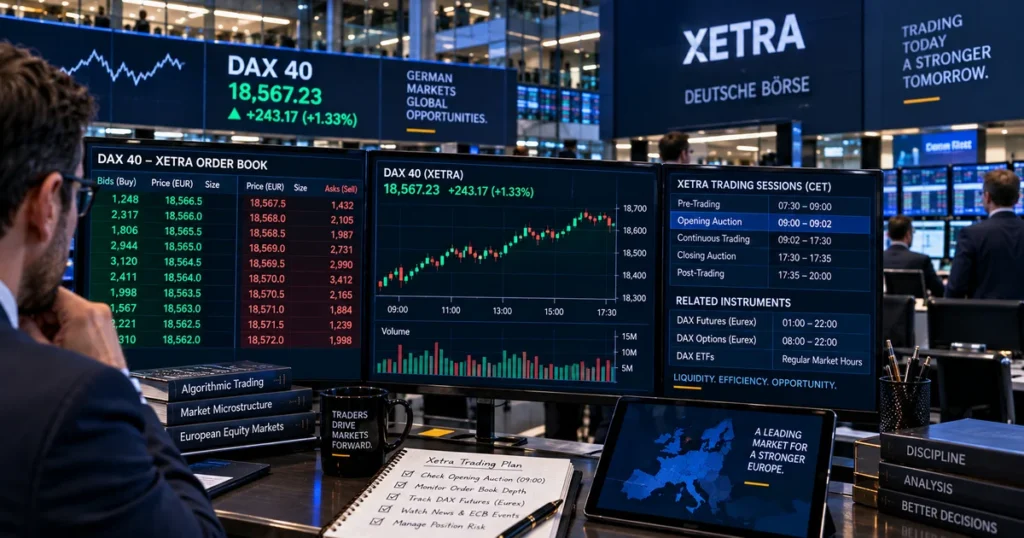
Quick Answer: When and How Is the DAX 40 Traded?
The official Xetra cash-market session runs from 09:00 to 17:30 Central European local time (CET/CEST), Monday through Friday. Outside the core Xetra cash session, investors may encounter extended retail trading, Frankfurt Stock Exchange trading, late/early DAX indicators, and derivatives markets with separate trading hours.
DAX TRADING SESSIONS & INDICATIVE PERIODS (LOCAL CE TIME)trading hours on Eurex
01:10 - 22:00 CET / 02:10 - 22:00 CEST: DAX Futures
│
08:00 - 09:00 CET / CEST: Early indicator window; L/E-DAX calculation active
│
09:00 - 17:30 CET / CEST: CORE XETRA CASH-TRADING SESSION
│ * DAX calculation begins once opening prices are established (or 09:06 at latest)
│ * US equity-market open: typically 15:30 CET/CEST, with temporary DST-related shifts
│
17:30 - ~17:35 CET / CEST: Xetra closing auction begins (variable auction close)
│ * Followed by Trade-at-Close window (~17:35 - 17:40) for relevant instruments
│ * Final DAX index tick is disseminated at 18:00 CET / CEST
│
17:45 - 20:00 CET / CEST: Late indicator window; L/E-DAX tracks late trading activity
Navigating Key Trading Windows:
- The 09:00 Central European Open: The official Xetra opening auction establishes opening prices for cash equities. DAX index calculation begins once opening prices for components are established (or by 09:06 at the latest), bringing a surge of volume and price discovery as overnight news is absorbed.
- The US-Europe Overlap Session: When New York equity exchanges open (typically 15:30 Central European local time, with temporary shifts during daylight-saving transitions), European and American trading hours coincide. The final portion of the Xetra session often experiences elevated trading activity and liquidity as European and US markets interact.
- Closing Auction & Trade-at-Close: At 17:30 Central European local time, the continuous cash trading session ends and the Xetra closing auction begins, with closing auction prices determined around 17:35. This is followed by the Trade-at-Close window (approximately 17:35 to 17:40 for relevant DAX instruments), while the final DAX index tick is disseminated at 18:00.
- Extended Indicators (L/E-DAX): Outside the core Xetra session, the Late/Early DAX provides indicative DAX levels based on eligible Frankfurt trading data during the applicable late (17:45–20:00) and early (08:00–09:00) calculation periods.
- Derivatives Continuous Window: DAX futures trade on Eurex from 01:10 to 22:00 CET (02:10–22:00 CEST), while retail CFD brokers may offer longer trading windows depending on the provider.
How to Gain Market Exposure to the DAX 40
Quick Answer: What Instruments Are Used to Access the DAX 40?
Market participants can gain exposure to the DAX 40 through vehicles such as Exchange-Traded Funds (ETFs), futures and options, and broker-specific derivatives such as CFDs, with availability and suitability depending on the investor’s jurisdiction, broker, and investment objective.
+---------------------------------------------------------------------------------------------------+
|                        DAX 40 INVESTMENT & TRADING INSTRUMENTS                                    |
+---------------------+-----------------------------+-----------------------+-----------------------+
| VEHICLE CATEGORY    | COMMON INSTRUMENTS          | PRIMARY FOCUS         | KEY ATTRIBUTES        |
+---------------------+-----------------------------+-----------------------+-----------------------+
| **DAX-Tracking      | UCITS-compliant index funds | Long-term allocation, | Replication method    |
| ETFs**              | (e.g., iShares, Xtrackers)  | balance-sheet capital | and costs depend on   |
|                     |                             |                       | the individual fund   |
| **Index Futures**   | FDAX (Standard contract)    | Institutional funds,  | Standardized specs;   |
|                     | FDXM (Mini-DAX contract)    | hedging portfolios    | cleared via Eurex;    |
|                     |                             |                       | quarterly expiries    |
| **Index Derivatives**| Broker indices (e.g., `GER40`| Active short-term     | Flexible sizing;      |
|                     | or `DE40` instruments)      | trading strategies    | leverage capabilities;|
|                     |                             |                       | financing rates apply |
+---------------------+-----------------------------+-----------------------+-----------------------+
Comparative Analysis: Germany DAX 40 vs. Global Equity Benchmarks
Quick Answer: How Does the DAX 40 Compare to the S&P 500 and Euro Stoxx 50?
The DAX 40 is more concentrated than the broad US S&P 500 and exhibits greater structural exposure to industrial and manufacturing cycles. Relative to the regional Euro Stoxx 50, the DAX focuses strictly on German-listed corporations while offering deeper weighting in engineering and software.
| Metric / Feature | Germany DAX 40 | US S&P 500 | Euro Stoxx 50 |
| Constituent Count | 40 Companies | 500-company benchmark | 50 Companies |
| Quoted Return Type | Total Return (Performance) | Price Return (standard index) | Price Return (standard index) |
| Primary Sector Bias | Industrials, Tech & Auto | Technology & Services | Diversified European sectors |
| Single-Stock Cap | 15% Cap Ceiling | Modified market cap | Index capping rules |
| Economic Exposure | Heavy Export Orientation | Domestic & Multinat’l | Broad Eurozone Blend |
| Primary Price Basis | Electronic Xetra platform | Major US exchanges | Multiple European venues |
Common Myths vs. Empirical Facts
- Myth: The DAX exclusively tracks the domestic German retail economy.
- Fact: The DAX 40 is primarily an international export index. A large majority of aggregate corporate revenues are generated abroad, making corporate earnings dependent on international trade, cross-border corporate investments, and global macroeconomic demand.
- Myth: A strengthening domestic German economy automatically causes the DAX to rally.
- Fact: Domestic economic growth can coincide with a strengthening Euro, which can compress exporter profit margins and lower translated foreign earnings, showing that domestic GDP and multinational equity performance can decouple.
- Myth: The standard DAX is calculated from floor trading at Börse Frankfurt.
- Fact: The standard DAX is calculated from Xetra prices, while supplementary late/early indices such as L/E-DAX use separate Frankfurt trading data outside Xetra operating hours.
- Myth: Expanding to 40 stocks diluted the quality of the benchmark.
- Fact: The expansion introduced additional profitability, financial-reporting, liquidity, and governance requirements while increasing the number of constituents from 30 to 40.
Frequently Asked Questions
What does “DAX” stand for?
DAX stands for Deutscher Aktienindex, which translates from German to English as the “German Stock Index.”
Why do some trading platforms list the DAX as GER40 or DE40?
Retail brokers and CFD providers commonly use labels such as GER40 or DE40 for products designed to track the DAX 40. These are typically derivatives or broker-specific instruments rather than the official DAX index itself.
What happened to the historical DAX 30?
In September 2021, Deutsche Börse expanded the DAX from 30 to 40 constituents as part of its major index reform, with new profitability, liquidity, reporting, governance, and selection rules.
How often are DAX constituents reviewed and rebalanced?
Deutsche Börse reviews DAX composition quarterly, using Fast Entry and Fast Exit rules as well as the Regular Entry and Regular Exit rules at the applicable review dates to account for major shifts in market capitalization and eligibility.
Does the headline DAX 40 include dividends?
Yes. The standard headline DAX is a performance index that mathematically factors gross dividend distributions back into index calculations. A separate DAX Price Index is also calculated to track price performance without reinvesting dividends.
What is the difference between Xetra and Börse Frankfurt?
Börse Frankfurt is the Frankfurt Stock Exchange trading venue, while Xetra is Deutsche Börse’s electronic trading platform and the primary price source for the standard DAX. Certain supplementary indicators, such as L/E-DAX, use eligible Frankfurt trading data outside the core Xetra session.
Can non-European investors gain exposure to the DAX 40?
Yes. International participants can gain DAX exposure through exchange-traded funds (ETFs) registered in relevant jurisdictions or exchange-traded DAX derivatives. Investors can also buy individual shares or American Depositary Receipts (ADRs) of some constituent companies, but those provide company-specific exposure rather than direct DAX index exposure.
Strategic Summary & Core Takeaways
- European Industrial Anchor: The Germany DAX 40 provides concentrated exposure to European industrial manufacturing, automation, automotive technology, and enterprise software.
- Total Return Index Architecture: Unlike standard price-only indices, the headline DAX compounds corporate distributions directly into its calculated performance.
- Institutional Governance Standards: Inclusion requires demonstrated operating profitability (EBITDA), formal corporate governance structures, and strict financial reporting compliance.
- Export-Driven Macro Profile: Because constituent revenues are generated primarily outside Germany, the benchmark can serve as a macro gauge of international trade flows and global corporate demand.
- Core Liquidity Regimes: Primary cash market liquidity occurs during Xetra hours from 09:00 to 17:30 Central European local time (CET/CEST), with peak trading activity coinciding with the US-Europe market overlap.
Next Reading Suggestions
- How Stock Prices Are Determined: Market Microstructure, Supply and Demand, and Valuation
- What Is Market Capitalization? The Complete Guide to Market Cap, Company Size, and Valuation
- Interest Rates and Exchange Rates: The Complete Guide to Global Currency Pricing
- Fed Rate Cuts & Global Liquidity: The Complete Guide to Interest Rates, the Fed Balance Sheet, and Asset Markets
- What Is Gold? The Complete Guide to Real Money, Store of Value & Why It Matters
- Crypto Market Cycles: The Complete Guide to Bitcoin Halvings, Global Liquidity, On-Chain Metrics, and Alt Seasons
Author Box & E-E-A-T Verification
Written & Researched By: CurrencyPlans Editorial Research Team
Editorial Review & Methodological Standards: This equity benchmark manual is produced in compliance with quantitative finance, index governance, and capital markets research standards. Index selection rules, EBITDA profitability thresholds, dividend compounding algorithms (Total Return vs. Price return), and electronic trading mechanics (Xetra auctions, closing parameters, and Eurex derivative settlement) are independently verified against primary regulatory documentation from STOXX Ltd., Deutsche Börse Group, Eurex Exchange, and the European Central Bank (ECB).
Educational References & Market Data Sources
For index specifications, rulebooks, and trading hours, consult primary market repositories and regulatory authorities directly:
- Deutsche Börse Group (Index Methodology & Rulebooks): Deutsche Börse
- Xetra Electronic Trading Platform: Xetra Exchange
- Eurex Derivatives Exchange (DAX Futures Specifications): Eurex Exchange
- European Central Bank (Monetary Policy & Statistics): European Central Bank
- Federal Financial Supervisory Authority (BaFin Regulatory Repository): BaFin
Educational Disclaimer
This guide is prepared strictly for educational, research, and informational purposes and does not constitute personalized financial, investment, trading, or tax advice. Global equity indices, derivatives, and related financial products carry financial risks. Historical performance of the DAX 40 does not guarantee future results. Always conduct independent due diligence and consult a licensed financial professional before committing capital.

