

Introduction
ORCL stock rallied more than 7% in after-hours trading as Oracle Corporation (NYSE: ORCL) delivered an earnings beat in its fiscal first-quarter report. Driven by sustained enterprise demand for cloud computing and artificial intelligence workloads, Oracle’s latest quarterly performance demonstrated substantial expansion in its cloud infrastructure operations.
As a prominent constituent within the USA S&P 500, the post-earnings rally reflected stronger investor sentiment toward enterprise AI and cloud infrastructure demand, reinforcing broader market engagement across large-scale enterprise technology providers.
The Q1 Scorecard: Revenue, EPS, and Cloud Outperformance
Quick Answer: Did Oracle Beat Earnings Expectations?
Yes. For the fiscal first quarter, Oracle posted non-GAAP earnings per share (EPS) of $1.92, surpassing Wall Street consensus estimates of approximately $1.74 to $1.75. Total quarterly revenue expanded 30% year-over-year to $19.35 billion, topping analyst forecasts of roughly $19.13 to $19.14 billion.
The quarter’s outperformance was characterized by expanding operating income alongside top-line acceleration:
| Financial Metric | Q1 Actual | Analyst Consensus | Year-over-Year Change |
| Total Revenue | $19.35 Billion | $19.13 – $19.14 Billion | +29.6% (~30%) |
| Non-GAAP EPS | $1.92 | $1.74 – $1.75 | +30.0% |
| Total Cloud Revenue (IaaS + SaaS) | $11.60 Billion | ~$11.35 Billion | +62.0% |
| Cloud Infrastructure (OCI / IaaS) | $7.40 Billion | ~$7.19 Billion | +121.0% |
| Remaining Performance Obligations (RPO) | $664.0 Billion | ~$639.9 Billion | +$26B QoQ Expansion |
| GAAP Net Income | $4.76 Billion | ~$4.20 Billion | +63.0% |
The Primary Catalyst: OCI Skyrockets 121% as RPO Climbs to $664B

Quick Answer: Why Did ORCL Stock Move So Sharply?
The primary catalyst was the acceleration in Oracle Cloud Infrastructure (OCI), which grew 121% year-over-year to $7.4 billion. In addition, Oracle booked over $30 billion in additional AI cloud contracts during the quarter, bringing its total contracted backlog (Remaining Performance Obligations) to $664 billion.
Unlike traditional on-premises software models, Oracle Cloud Infrastructure (OCI) is expanding rapidly as enterprises increase spending on AI training and inferencing infrastructure. Oracle’s Q1 results showed OCI revenue growing 121% year over year to $7.4 billion, reflecting robust deployment of computing capacity, although the earnings release itself does not establish a specific market-share gain or attribute that growth to a single networking architecture.
Oracle’s Multicloud strategy is also expanding, with Oracle AI Database services available across AWS, Microsoft Azure, and Google Cloud. These offerings combine Oracle database services with hyperscaler environments through dedicated infrastructure and private cloud-to-cloud connectivity, helping enterprises run applications and Oracle databases across multiple cloud platforms with lower networking and migration friction.
The CapEx Dynamics: Infrastructure Buildout and Customer Prepayments
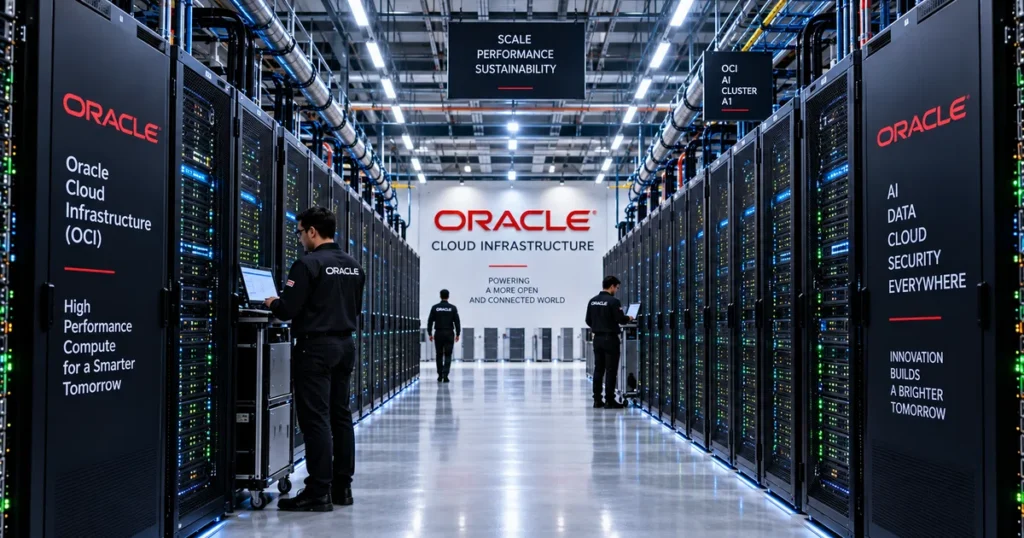
Quick Answer: How Is Oracle Managing High Data Center Capital Expenditures?
While Oracle incurred $28.5 billion in capital expenditures during the quarter—resulting in negative free cash flow of approximately $5.4 billion—customer prepayments with significant financing components reduced the net cash outlay associated with capital spending by approximately $11.4 billion.
Capital spending remains an important operational focus for the company:
- Full-Year Capital Spending: Oracle is expected to spend approximately $90 billion to $95 billion on capital expenditures in fiscal 2027, according to current financial reporting. The spending is primarily aimed at expanding AI-focused data-center capacity, including GPUs, land, power infrastructure, and related facilities.
- Funding Architecture: The funding structure helped address concerns regarding the cash requirements of Oracle’s accelerated data-center investment program. Customer prepayments and contract terms helped support these capital requirements without creating an incremental impact on Oracle’s capital-raising plans, an operational consideration relevant to broader debt costs examined in our guide on interest rates and exchange rates.
Forward Guidance & Wall Street Outlook: What Lies Ahead?

Quick Answer: What Is Oracle’s Outlook for the Fiscal Year?
Management officially updated its full-year fiscal earnings target, projecting non-GAAP EPS of $8.10 (up from $8.05) and full-year revenue of at least $90 billion. For the upcoming second quarter, Oracle expects total revenue growth between 30% and 34%.
The strong growth in Cloud Infrastructure is increasingly offsetting pressure in Oracle’s traditional software business, with total software revenue declining 3% year over year in Q1 as customers continue migrating from on-premises software toward cloud-based services. This operational shift reflects fundamental capital reallocation mechanisms discussed in how stock prices are determined.
Key Execution Factors to Monitor:
- Power and Infrastructure Capacity: Power availability and data-center capacity remain key execution constraints for commissioning facilities on schedule.
- Contract Conversion: The $664 billion RPO represents contracted future performance obligations, but the timing of revenue recognition depends on contract execution, service delivery, and applicable revenue-recognition requirements over time.
- Macroeconomic Conditions: Sustained higher interest rates could influence long-term capital expenditure financing across corporate tech budgets.
Frequently Asked Questions
Why did ORCL stock jump after earnings?
ORCL shares rallied because Oracle beat Q1 revenue and non-GAAP EPS consensus estimates, reported 121% growth in OCI cloud infrastructure revenue, and saw its Remaining Performance Obligations expand to $664 billion.
What was Oracle’s reported EPS and revenue in Q1?
Oracle reported non-GAAP EPS of $1.92 (surpassing consensus estimates of $1.74 to $1.75) on total revenue of $19.35 billion (topping expectations of roughly $19.13 to $19.14 billion), representing approximately 30% year-over-year growth.
Does Oracle stock pay a dividend?
Yes. Oracle maintained its regular quarterly cash dividend at $0.50 per share. The implied dividend yield varies with the market price of ORCL stock.
What is Oracle’s cloud backlog (RPO)?
At the end of Q1, Oracle’s Remaining Performance Obligations reached $664 billion, supported by more than $30 billion of additional AI cloud contracts signed during the period.
Strategic Summary & Core Takeaways
- Earnings Beat: Oracle exceeded Wall Street consensus on both total revenue ($19.35B) and non-GAAP earnings ($1.92 per share).
- OCI Growth Acceleration: Cloud infrastructure revenue expanded by 121% year-over-year to $7.4 billion, reinforcing Oracle’s growing role in AI cloud infrastructure.
- Record Contracted Backlog: Remaining Performance Obligations reached $664 billion, providing substantial visibility into future contracted revenue while still depending on contract execution, service delivery, and revenue-recognition timing.
- CapEx and Cash Flows: CapEx of $28.5B led to negative free cash flow of $5.4B, though customer prepayments reduced the net capital outlay by roughly $11.4B.
- Full-Year Outlook Raised: Fiscal 2027 non-GAAP EPS was lifted to $8.10 with total projected revenue of at least $90 billion, supporting management’s broader outlook for continued AI-driven cloud infrastructure growth in fiscal 2027.
Next Reading Suggestions
- USA S&P 500: The Complete Guide to Index Methodology, Market-Cap Weighting, and Global Market Mechanics
- How Stock Prices Are Determined: Market Microstructure, Supply and Demand, and Valuation
- What Is Market Capitalization? The Complete Guide to Market Cap, Company Size, and Valuation
- Interest Rates and Exchange Rates: The Complete Guide to Global Currency Pricing
- Fed Rate Cuts & Global Liquidity: The Complete Guide to Interest Rates, the Fed Balance Sheet, and Asset Markets
- Germany DAX 40: The Complete Guide to Components, Total Return Methodology, and Global Market Mechanics
- Dubai Financial Market (DFM): The Complete Guide to the DFMGI Index, Methodology, and Market Structure
Author Box & E-E-A-T Verification
Written & Researched By: CurrencyPlans Editorial Research Team
Editorial Review & Market Analysis Standards: This market update is based primarily on Oracle Corporation’s official financial disclosures, SEC filings, company statements, and current market reporting. Financial figures are cross-checked against primary-source disclosures wherever available, while analyst consensus and market-reaction data are identified as external market estimates or reporting.
Educational References & Market Data Sources
- Oracle Investor Relations (Q1 Earnings Releases & Conference Calls): Oracle Investor Relations
- U.S. Securities and Exchange Commission (EDGAR Disclosures – ORCL): SEC EDGAR
- New York Stock Exchange (ORCL Directory): NYSE
Educational Disclaimer
This market analysis is prepared strictly for educational, research, and journalistic reporting purposes and does not constitute personalized financial, investment, or trading advice. Single-stock equity investments carry inherent market risks. Past quarterly performance does not guarantee future financial returns. Always consult an independent licensed financial advisor before deploying investment capital.

