
Introduction
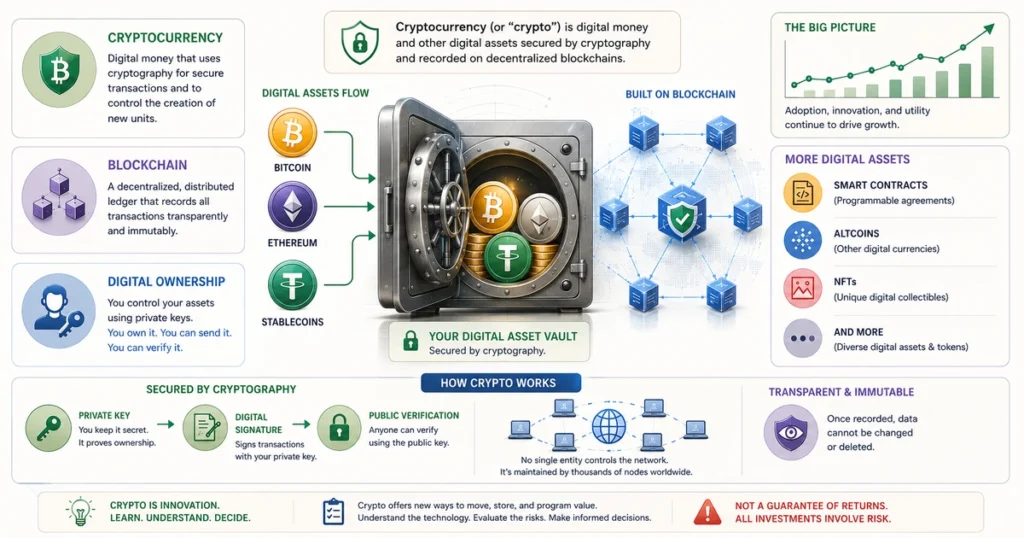
Cryptocurrency, commonly called crypto, is a broad category of digital or virtual assets that use cryptography to secure transactions, verify ownership, and, depending on the network, regulate the creation or transfer of digital units.
Many cryptocurrencies operate on public blockchain networks: distributed ledgers maintained by participating computers rather than a single central administrator. Bitcoin is the best-known example. Ethereum extends the idea further by providing a programmable blockchain on which smart contracts and decentralized applications can operate.
However, crypto is not one uniform asset class. The ecosystem includes decentralized monetary assets such as Bitcoin, smart-contract platforms such as Ethereum and Solana, Layer 2 networks, stablecoins such as USDC and USDT, governance and utility tokens, and decentralized finance (DeFi) protocols.
That distinction matters because the risks, economic purpose, governance structure, and regulatory treatment of different digital assets can be very different.
At a high level, crypto combines four major technologies and economic mechanisms:
- Cryptography — protects private keys and verifies digital signatures.
- Distributed ledgers — record transactions across participating network infrastructure.
- Consensus mechanisms — determine which transactions and blocks are accepted.
- Economic incentives — reward honest participation and make attacks costly.
Understanding crypto therefore requires more than knowing that Bitcoin exists. It requires understanding how blockchains prevent double spending, how private keys authorize transactions, how Proof of Work and Proof of Stake secure networks, how smart contracts execute code, how token supply affects valuation, and how users manage custody and financial risk.
The Foundational Definition: What Is Cryptocurrency?
Quick Answer: What Is Crypto?
Cryptocurrency is a digital asset that uses cryptographic techniques to secure transactions and verify ownership. Some cryptocurrencies function primarily as monetary or settlement assets, while others provide programmable infrastructure, stable-value payments, governance rights, or access to blockchain-based applications.
Bitcoin operates on a decentralized public blockchain. Other digital assets may depend on centralized issuers, foundations, smart contracts, custodians, or other infrastructure.
A useful definition is:
Crypto is a broad ecosystem of cryptographically secured digital assets and blockchain-based networks that enable digital ownership, transfer, and programmable financial or computational activity.
A public blockchain functions as a shared, append-only ledger. Transactions are digitally signed, broadcast through the network, validated according to protocol rules, and ordered into blocks.
Under normal consensus operation, historical records are designed to be highly resistant to alteration. This does not mean that every blockchain record is metaphysically “immutable”; rather, changing finalized or deeply confirmed history can be computationally, economically, or cryptographically difficult depending on the network’s design.
Cryptocurrency therefore represents an intersection of:
- Computer science
- Cryptography
- Distributed systems
- Monetary economics
- Game theory
- Financial markets
Unlike sovereign fiat currencies such as the U.S. dollar, euro, yen, or pound, decentralized cryptocurrencies do not require a central bank to maintain their native ledger. Instead, their rules are implemented through software and enforced by network participants.
That said, not every crypto asset is decentralized.
Stablecoins, for example, may be issued by companies and backed by reserves. A token may depend heavily on a development team, foundation, DAO, smart contract, or centralized service provider.
This distinction is critical when evaluating crypto risk.
Traditional Financial Infrastructure vs. Public Blockchain Networks
| Traditional Financial Infrastructure | Public Blockchain Network |
|---|---|
| Institutional ledger infrastructure | Distributed ledger infrastructure |
| Banks and financial intermediaries | Network participants and protocol rules |
| Centralized or permissioned administration | Often open participation |
| Institutional settlement processes | Protocol-based transaction settlement |
| Monetary policy controlled by authorities | Rules determined by protocol governance and consensus |
| Records can be changed through institutional processes | Historical records are generally resistant to alteration under consensus |
The fundamental innovation of public blockchain networks is that they can reduce reliance on traditional settlement intermediaries.
A Bitcoin transaction, for example, does not require a commercial bank to maintain a centralized Bitcoin balance sheet. The Bitcoin network validates and records the transaction according to its consensus rules.
However, users can reintroduce intermediaries by holding crypto on centralized exchanges, using custodial services, or interacting with centralized bridges and other infrastructure.
So the more accurate statement is:
Blockchain can reduce certain forms of intermediary dependence; it does not eliminate every form of counterparty or operational risk.
For comparison with traditional tangible assets, see our guide on what gold is and our guide to what stocks are.
The Double-Spending Breakthrough: How Bitcoin Solved Digital Cash
Quick Answer: What Is the Double-Spending Problem?
The double-spending problem is the challenge of preventing the same digital unit from being copied and spent more than once.
Digital information can normally be copied almost perfectly. A photograph, document, or computer file can be duplicated without destroying the original.
Physical cash works differently.
If Alice gives Bob a physical $100 banknote, Alice no longer possesses that particular physical note.
Digital cash needs an equivalent mechanism for determining which transaction is valid when the same digital balance is presented in competing transactions.
Before Bitcoin
Earlier digital-cash systems explored different ways to solve this problem.
Important historical contributions included:
- David Chaum’s DigiCash
- Adam Back’s Hashcash
- Wei Dai’s b-money
- Nick Szabo’s bit gold
These projects contributed important ideas involving cryptography, digital scarcity, proof-of-work, and electronic money.
The breakthrough associated with Bitcoin was the combination of these ideas into an open network that could establish transaction ordering without relying on a central clearing institution.
In October 2008, the pseudonymous developer or group known as Satoshi Nakamoto published the Bitcoin whitepaper, Bitcoin: A Peer-to-Peer Electronic Cash System.
Bitcoin combined:
- Peer-to-peer networking
- Public-key cryptography
- Cryptographic hashing
- Proof of Work
- A chain of timestamped blocks
- Economic incentives
This produced a decentralized system capable of maintaining a shared transaction history.
How Bitcoin Prevents Double Spending
Suppose Alice attempts to spend the same Bitcoin in two conflicting transactions:
Transaction A: Alice → Bob
Transaction B: Alice → Charlie
The network must determine which transaction becomes part of the accepted history.
Bitcoin’s consensus mechanism provides a way for the network to converge on one transaction history.
Once a transaction is included in a sufficiently confirmed chain, replacing it requires an attacker to produce an alternative chain with sufficient cumulative Proof-of-Work.
This makes fraudulent rewriting economically difficult under normal network conditions.
The key innovation was therefore not simply “digital money.”
It was:
A decentralized mechanism for establishing transaction order and preventing digital units from being spent twice without requiring a central clearing authority.
The Architecture of a Distributed Blockchain Ledger
Quick Answer: How Does a Blockchain Work?
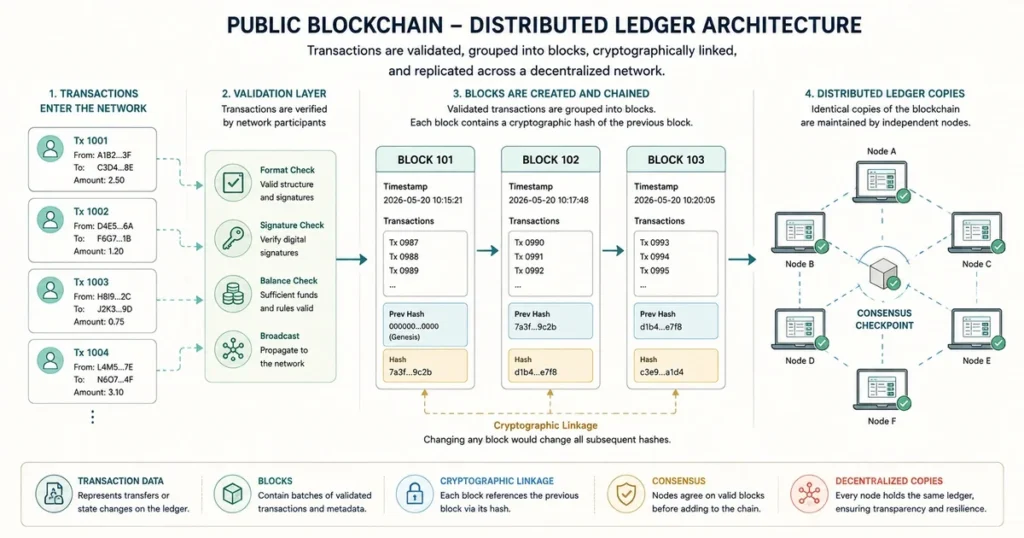
A blockchain is a digital ledger that organizes data into cryptographically linked blocks.
Transactions are grouped into blocks, validated according to network rules, and linked to previous blocks.
The exact structure varies significantly between blockchains.
Bitcoin’s classical Proof-of-Work architecture is therefore useful as a foundational example, but it should not be treated as the universal design of every blockchain.
Bitcoin Block Architecture
A simplified Bitcoin block consists of:
Block Header → Transaction Data → Next Block
The Bitcoin block header contains six principal fields:
- Version
- Previous block-header hash
- Merkle root
- Timestamp
- Target/difficulty
- Nonce
The previous block-header hash creates the cryptographic link between blocks.
If an attacker changes an earlier block’s contents, its hash changes. That invalidates the previous-block reference stored in the following block.
The attacker would therefore need to reconstruct the altered chain and produce sufficient Proof-of-Work to make the alternative chain competitive under Bitcoin’s consensus rules.
The Bitcoin Block Header
A Bitcoin block header is 80 bytes and includes:
- Version
- Previous block-header hash
- Merkle root
- Timestamp
- Target encoded through
nBits - Nonce
The target defines the numerical threshold that a valid block hash must meet.
A lower target means a more difficult mining condition.
The nonce is a 32-bit field miners can modify while searching for a valid block hash. Miners also modify other portions of the candidate block when necessary, such as the coinbase transaction, which changes the Merkle root.
What Is a Merkle Tree?
A Merkle tree summarizes transaction hashes into a single Merkle root.
Instead of storing every transaction hash inside the block header, Bitcoin stores one root representing the transaction set.
This structure allows lightweight clients to verify that a transaction belongs to a block using a Merkle inclusion proof without downloading the entire historical blockchain.
Full Nodes vs. Lightweight Clients
Full nodes independently download and validate blockchain data according to consensus rules.
They can reject invalid blocks even if a large amount of computing power or economic capital supports those blocks.
Lightweight or SPV clients download block headers and use Merkle proofs to verify transaction inclusion while relying on network peers for broader transaction and block data.
This creates an important distinction:
Running a full node provides independent validation; using a lightweight client provides greater efficiency at the cost of relying more heavily on external network data.
Cryptographic Foundations: Public Keys, Private Keys, and Digital Signatures
Quick Answer: Public Key vs. Private Key
A private key is secret cryptographic signing material.
It is used to generate digital signatures that network participants can verify without revealing the private key.
A public key is mathematically derived from the private key and allows signatures to be verified.
A blockchain-specific public address is an identifier derived from or associated with public-key material and used to receive assets.
The Basic Relationship
Private Key
     ↓
Public Key
     ↓
Network-Specific Address
The private key must remain confidential.
The public address can generally be shared.
This distinction is one of the most important concepts for cryptocurrency beginners.
Why Private Keys Matter
Owning cryptocurrency does not mean storing physical coins inside a wallet.
The blockchain records asset balances or ownership states.
The wallet stores or manages the cryptographic keys needed to authorize transactions.
A simplified model is:
Blockchain = public record
Private key = authorization capability
If someone gains control of the private key, they may be able to authorize transactions from the associated account.
If the private key or recovery phrase is permanently lost, access to the corresponding assets may also be permanently lost.
Bitcoin vs. Ethereum Address Derivation
Address formats vary by blockchain.
Bitcoin
Bitcoin address generation can involve:
Public Key → SHA-256 → RIPEMD-160 → Address Encoding
Modern Bitcoin addresses may use formats such as:
- Legacy/Base58Check
- SegWit/Bech32
- Bech32m
Ethereum
Ethereum derives an account address from the Keccak-256 hash of the uncompressed public-key material, excluding the 0x04 format prefix, and uses the final 20 bytes with a 0x prefix.
Therefore:
A Bitcoin address and an Ethereum address are not generated through the same address-encoding pipeline.
Elliptic Curve Cryptography
Bitcoin and Ethereum’s traditional externally controlled account/signing systems use secp256k1-based cryptography, while other blockchain networks may use different schemes.
Other blockchain networks use different cryptographic schemes. Solana, for example, uses Ed25519-based signatures.
The underlying principle is similar:
It is computationally easy to derive a public key from a properly generated private key, but computationally infeasible with currently known classical methods to recover the private key from the public key.
The security assumption depends on the cryptographic algorithm, key generation quality, implementation, and the continued validity of the underlying mathematical assumptions.
Digital Signatures
When a user authorizes a transaction:
- The wallet constructs the transaction.
- The private key signs the transaction data.
- The resulting signature is broadcast.
- Network participants verify the signature.
- The private key itself is never revealed to the network.
This is what allows a blockchain to verify authorization without requiring users to transmit passwords or secret keys publicly.
Consensus Mechanisms: Proof of Work vs. Proof of Stake
Quick Answer: PoW vs. PoS
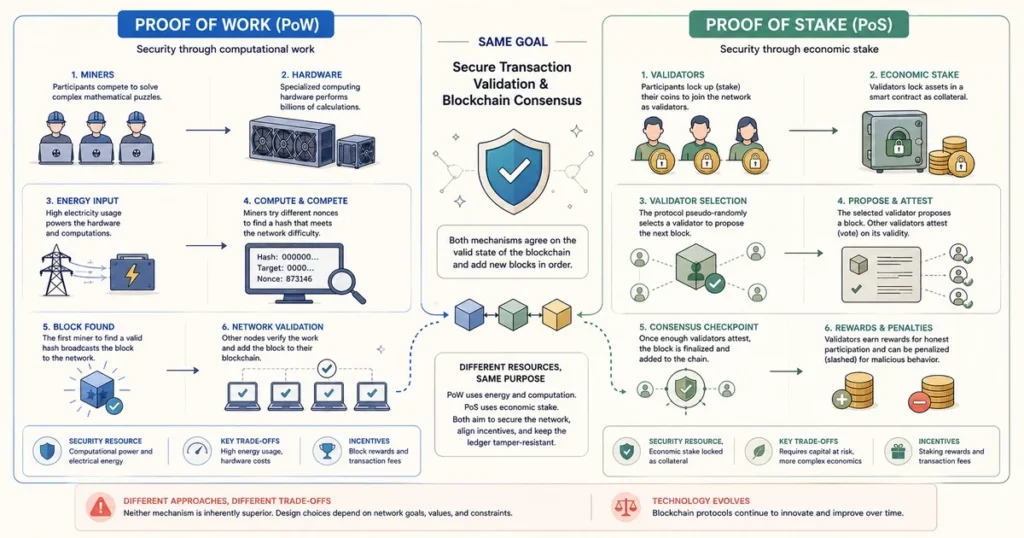
A consensus mechanism determines how a decentralized blockchain reaches agreement on valid transaction history.
Proof of Work (PoW) uses computational work and electricity expenditure to make attacks costly.
Proof of Stake (PoS) uses economic capital as collateral and rewards or penalizes validators according to protocol rules.
Proof of Work
In a Proof-of-Work network, miners repeatedly calculate cryptographic hashes.
They search for a block header whose hash satisfies the network’s target.
Because finding a valid hash requires repeated computation, an attacker needs substantial computational resources to consistently overpower honest miners.
Bitcoin periodically adjusts its difficulty to maintain an average block interval of approximately ten minutes.
Bitcoin’s difficulty adjustment occurs every 2,016 blocks, roughly every two weeks under normal block timing.
Why Proof of Work Costs Energy
The energy expenditure is not an accidental side effect.
It is part of the security mechanism.
To attack a PoW blockchain, an attacker needs physical resources such as:
- Mining hardware
- Electricity
- Cooling
- Infrastructure
- Capital
The cost of producing competing blocks creates an economic barrier to rewriting history.
Proof of Stake
Proof of Stake replaces competitive hashing with economic collateral.
Instead of miners competing primarily through computational work, validators commit capital to participate in consensus.
On Ethereum, an independent protocol validator requires a 32 ETH deposit. Pooled or delegated services can allow users to participate with smaller economic amounts, but those arrangements can introduce additional counterparty, smart-contract, or trust risks.
Ethereum validators:
- Propose blocks
- Attest to blocks proposed by peers
- Participate in consensus
- Receive protocol rewards
- Can be penalized for certain violations
What Is Slashing?
Slashing is a protocol-level penalty for specific provable consensus violations.
Examples on Ethereum include:
- Proposing conflicting blocks
- Double voting
- Surround voting
Slashing can cause a validator to lose part of its stake and be removed from the active validator set.
Under severe correlated conditions, the economic penalty can become substantially larger.
PoW vs. PoS Comparison
| Dimension | Proof of Work | Proof of Stake |
|---|---|---|
| Security resource | Computation + electricity | Economic stake |
| Participants | Miners | Validators |
| Main attack cost | Hardware and electricity | Capital at risk |
| Primary example | Bitcoin | Ethereum |
| Energy profile | High relative energy use | Much lower energy use |
| Main penalty mechanism | Economic cost of failed mining | Protocol penalties/slashing |
| Sybil resistance | Computational work | Economic collateral |
Neither mechanism is simply “better.”
They represent different approaches to decentralized security.
Smart Contracts and the Programmable State Machine
Quick Answer: What Is a Smart Contract?
A smart contract is software deployed to a blockchain that executes according to predefined rules.
Unlike a traditional application hosted on a centralized server, a blockchain smart contract can execute through a decentralized network of nodes.
Ethereum popularized general-purpose smart contracts and provides the Ethereum Virtual Machine (EVM) as a decentralized execution environment.
From Digital Money to Programmable Networks
Bitcoin primarily focuses on decentralized monetary settlement.
Ethereum expanded blockchain functionality by allowing developers to deploy programs that can:
- Hold assets
- Transfer tokens
- Execute swaps
- Manage collateral
- Issue tokens
- Coordinate DAOs
- Operate lending markets
- Support games and digital applications
The EVM processes transactions and applies deterministic state transitions according to Ethereum’s consensus rules.
How Smart Contracts Work
A developer writes code using languages such as:
- Solidity
- Vyper
The code is compiled into EVM bytecode and deployed to a blockchain address.
Users interact with the contract through transactions.
The network executes the contract and updates blockchain state according to the contract’s logic and consensus rules.
What Is Gas?
Gas measures computational resources consumed by Ethereum transactions.
Every operation consumes a specified amount of gas.
Gas exists partly to prevent unrestricted computation and denial-of-service attacks.
Under EIP-1559, Ethereum transaction fees contain:
- Base fee — algorithmically determined and burned
- Priority fee — optional tip paid to the block proposer
If a transaction runs out of gas during execution, the state changes revert, but the gas already consumed is not returned.
This is an important distinction:
A failed transaction can still cost money because computational resources were consumed.
The Digital Asset Taxonomy: Layer 1s, Layer 2s, DeFi, and Stablecoins
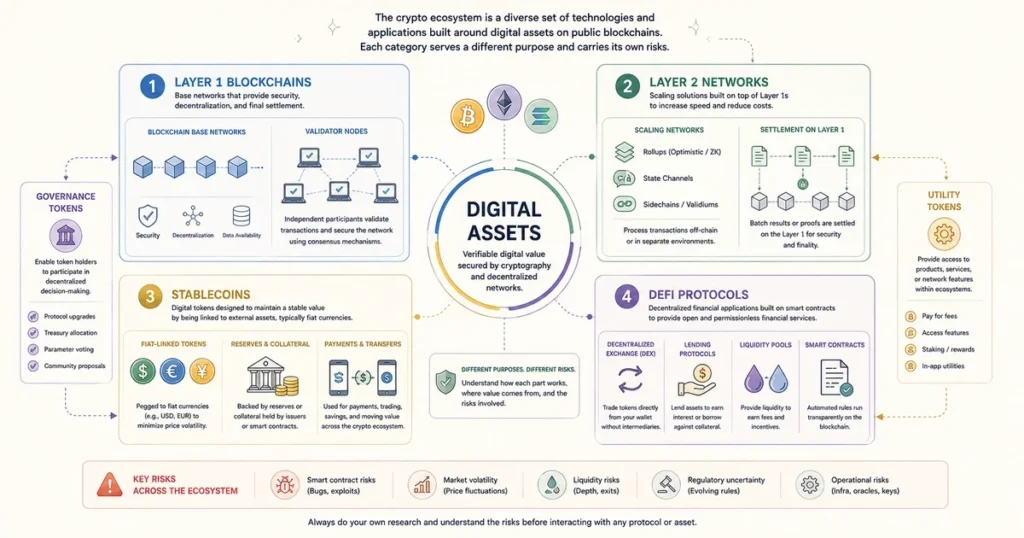
There is no single universal way to classify every digital asset.
A useful functional and technological taxonomy includes five broad categories.
1. Digital Commodities / Monetary Assets
Examples:
- Bitcoin
- Litecoin
These assets are primarily associated with monetary scarcity, settlement, and decentralized network security.
Bitcoin’s supply is governed by protocol rules and is capped at approximately 21 million BTC.
2. Smart-Contract Layer 1s
Examples:
- Ethereum
- Solana
- Avalanche
These networks provide base-layer execution and settlement infrastructure for decentralized applications.
Their native assets can be used for:
- Transaction fees
- Network security
- Staking
- Economic coordination
3. Layer 2 Rollups
Examples:
- Arbitrum
- Optimism
- Base
Layer 2 rollups execute transactions outside the Layer 1 execution environment and publish relevant transaction or state data back to the underlying Layer 1 according to the rollup’s architecture.
4. Stablecoins
Examples:
- USDC
- USDT
Stablecoins attempt to maintain a relatively stable value, commonly relative to a sovereign currency such as the U.S. dollar.
Their structures vary.
Some rely heavily on reserves held by centralized entities, while others use crypto collateral or algorithmic mechanisms.
Therefore:
A stablecoin can be blockchain-native while still carrying substantial issuer, reserve, custody, or depeg risk.
5. DeFi Protocols
Examples:
- Uniswap
- Aave
- Maker
DeFi protocols use smart contracts to provide financial functions such as:
- Trading
- Lending
- Borrowing
- Collateral management
- Derivatives
- Liquidity provision
These categories can overlap.
For example, ETH is the native asset of a Layer 1, while applications running on Ethereum may issue tokens and provide DeFi services.
Decentralized Finance: AMMs and Lending Protocols
What Is DeFi?
Decentralized Finance (DeFi) refers to financial protocols built on blockchain networks that implement certain financial functions through smart contracts rather than relying exclusively on traditional intermediaries.
Common DeFi applications include:
- Decentralized exchanges
- Lending markets
- Borrowing protocols
- Stablecoin systems
- Derivatives
- Automated market makers
Automated Market Makers
Traditional exchanges often use order books.
An AMM instead uses liquidity pools governed by mathematical formulas.
A classic Uniswap v2-style constant-product AMM uses:
x × y = k
Where:
- x = quantity of Token A
- y = quantity of Token B
- k = invariant
When a trader buys one token from the pool, the relative quantities change.
That changes the execution price.
Modern AMMs are more sophisticated.
For example, concentrated-liquidity models allow liquidity providers to specify price ranges rather than distributing liquidity uniformly across all possible prices.
Therefore:
x × y = k is a foundational AMM model, not a universal formula for every modern decentralized exchange.
DeFi Lending
Protocols such as Aave allow users to:
- Deposit assets
- Earn interest
- Borrow assets
- Use collateral
Crypto lending is commonly overcollateralized because blockchain protocols generally cannot assess traditional creditworthiness or enforce off-chain legal recourse in the same way as conventional lenders.
For example:
A user may deposit $150 worth of ETH to borrow $100 of USDC.
If ETH’s value falls sufficiently, the protocol may allow liquidation.
Third-party liquidators can repay part of the debt and receive discounted collateral.
This mechanism helps maintain protocol solvency but introduces risks involving:
- Oracle prices
- Smart contracts
- Liquidation cascades
- Market volatility
- Stablecoin depegs
Crypto vs. Fiat Currency vs. Stocks vs. Gold
Crypto becomes easier to understand when compared with traditional asset classes.
| Dimension | Fiat Currency | Stocks | Physical Gold | Crypto |
|---|---|---|---|---|
| Issuer | Sovereign/central-bank system | Corporation | No central issuer | Varies by asset |
| Supply | No fixed protocol cap | Corporate share structure | Geologically constrained | Protocol-dependent |
| Main ownership record | Institutional ledgers | Securities infrastructure | Physical possession/custody | Blockchain ledger |
| Cash flow | Interest depends on holdings/instruments | Corporate earnings/dividends | None inherently | Asset-dependent |
| Main risks | Inflation, banking/system risk | Business/market risk | Price/storage risk | Market, protocol, custody, regulatory risks |
| Trading | Depends on banking/payment system | Exchange hours | Market-dependent | Often 24/7 |
| Counterparty exposure | Varies by institution | Corporate and financial-system exposure | Low direct issuer exposure | Depends heavily on asset and custody |
Crypto vs. Fiat
Fiat currency is issued within a sovereign monetary system.
Central banks influence monetary conditions through tools such as:
- Interest rates
- Reserve policy
- Asset purchases
- Liquidity operations
Crypto monetary policy varies by protocol.
Bitcoin has a fixed maximum supply.
Ethereum uses a programmatic issuance and fee-burn system rather than a fixed 21-million cap.
Crypto vs. Stocks
A stock represents an ownership interest in a corporation.
That ownership may provide:
- Voting rights
- Dividends
- Residual claims on corporate assets
- Exposure to corporate earnings
A cryptocurrency does not automatically represent ownership of a company.
A token may instead represent:
- Network utility
- Governance rights
- Access rights
- Economic claims
- Stable-value payment functionality
- Nothing beyond speculative market value
Crypto vs. Gold
Gold is a naturally occurring physical commodity with no central issuer.
Its supply is constrained by geology and extraction economics.
Crypto differs because digital scarcity is created through software and consensus rules.
Bitcoin’s scarcity is therefore protocol-defined rather than geological.
Neither asset has a guaranteed return.
Tokenomics: Supply, Halving, Staking, and Burning
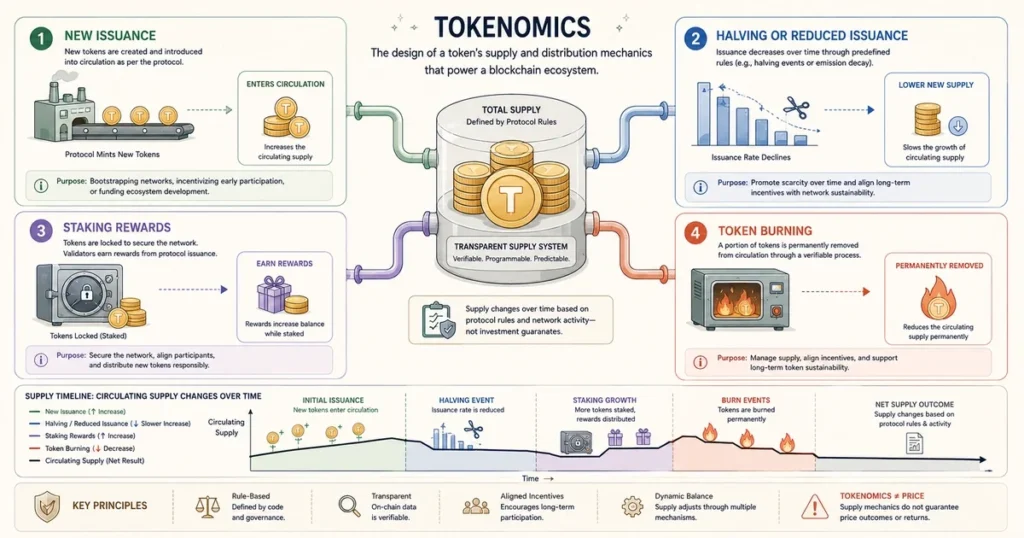
What Is Tokenomics?
Tokenomics refers to the economic rules governing a digital asset’s:
- Supply
- Issuance
- Distribution
- Emissions
- Vesting
- Staking
- Burning
- Incentives
Important tokenomic variables include:
- Maximum supply
- Circulating supply
- Fully diluted valuation
- Emission schedule
- Insider allocations
- Investor vesting
- Validator rewards
- Token burns
Supply Expansion vs. Effective Supply Reduction
Supply expansion can result from:
- Mining rewards
- Validator issuance
- Staking emissions
- Team or investor unlocks
Effective supply reduction can result from:
- Protocol fee burns
- Certain slashing mechanisms
- Permanently inaccessible tokens
Lost tokens should be described carefully.
A lost private key does not necessarily cause the protocol’s official total supply to decrease. Instead, those tokens may become economically inaccessible.
Bitcoin Halving
Bitcoin’s block subsidy decreases by 50% every 210,000 blocks.
The historical schedule includes:
- 2009: 50 BTC
- 2012: 25 BTC
- 2016: 12.5 BTC
- 2020: 6.25 BTC
- 2024: 3.125 BTC
- Expected after the 2028 halving: 1.5625 BTC
This declining issuance schedule contributes to Bitcoin’s protocol-defined scarcity.
The maximum supply is approximately 21 million BTC, with the final fractions expected to be mined around the year 2140 under current consensus rules.
Ethereum and EIP-1559
Ethereum’s economics are different.
EIP-1559 introduced a base-fee burn mechanism.
When network demand is high, the amount of ETH burned can exceed newly issued ETH for a period.
In such periods, Ethereum’s net supply can become deflationary.
This does not mean ETH has a permanently fixed supply.
Its supply dynamics depend on:
- Validator issuance
- Network activity
- Base-fee burn
- Consensus changes
Crypto Custody: Hot Wallets, Cold Storage, HD Wallets, and Multisig
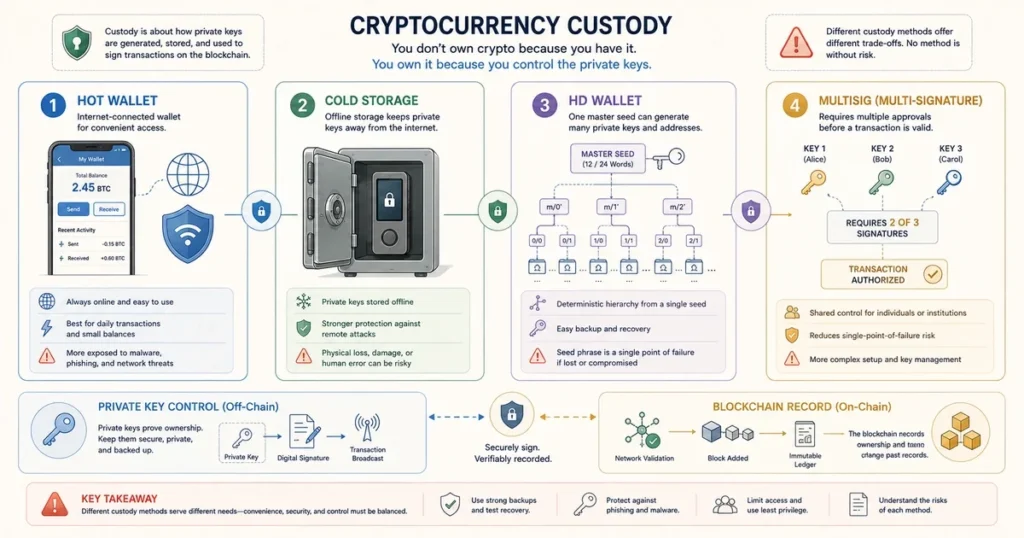
Quick Answer: What Is a Crypto Wallet?
A crypto wallet generally manages the cryptographic keys used to authorize blockchain transactions.
The assets themselves remain recorded on the blockchain.
Hot Wallets
A hot wallet is software connected to an internet-enabled environment.
Advantages:
- Convenient
- Fast
- Easy for frequent transactions
- Useful for DeFi applications
Risks:
- Malware
- Phishing
- Malicious websites
- Compromised computers
- Transaction-signing attacks
Cold Storage
Hardware wallets isolate private-key operations from ordinary internet-connected computing environments.
They can substantially reduce certain online attack risks.
However, they do not eliminate:
- Physical theft
- Social engineering
- Seed-phrase compromise
- Malicious transaction approval
- Firmware or supply-chain risks
Custodial vs. Self-Custody
Custodial model:
A third party controls the private keys.
Advantages can include:
- Account recovery
- Institutional controls
- Compliance infrastructure
- Operational support
Risks include:
- Custodian insolvency
- Withdrawal restrictions
- Counterparty risk
- Regulatory intervention
Self-custody:
The user controls the private keys.
Advantages include:
- Direct control
- No custodian dependency for the key itself
Risks include:
- Lost keys
- Theft
- Operational mistakes
- Phishing
- Irrecoverable transactions
Neither model is universally superior.
The correct choice depends on the user’s technical expertise, asset size, operational requirements, and jurisdiction.
HD Wallets
Hierarchical deterministic wallets use standards such as:
BIP-39: mnemonic seed phrases
BIP-32: hierarchical deterministic key derivation
BIP-44: standardized derivation paths for multiple accounts and assets
BIP-39 mnemonic phrases can commonly contain:
- 12 words
- 15 words
- 18 words
- 21 words
- 24 words
Multisignature Wallets
A multisig wallet requires multiple authorized keys to approve a transaction.
For example:
2-of-3 multisig
means two of three authorized keys must approve a transaction.
This can reduce single-key failure risk and is particularly useful for:
- Corporate treasuries
- Institutional funds
- DAO governance
- Family offices
Account Abstraction
ERC-4337 enables smart-contract-based accounts with programmable authorization logic.
Potential features include:
- Transaction batching
- Recovery mechanisms
- Custom authorization
- Sponsored transactions
- More flexible account management
It does not simply “convert” ordinary EOAs into smart-contract wallets; rather, it provides infrastructure for smart-account architectures without requiring a consensus-layer change.
Blockchain Scaling: Layer 2 Rollups and Modular Architecture
What Is the Blockchain Trilemma?
The blockchain trilemma is a widely used conceptual framework describing trade-offs among:
- Decentralization
- Security
- Scalability
It is not a mathematical theorem stating that every blockchain can only achieve two of these properties.
Why Layer 2 Networks Exist
A Layer 1 blockchain must coordinate consensus and data availability among its participating infrastructure.
If every transaction requires extensive work by the base layer, throughput can become constrained.
Layer 2 systems attempt to move some transaction execution outside the Layer 1 execution environment while still anchoring important state or data to the underlying Layer 1.
Rollups
Rollups generally:
- Execute transactions on Layer 2.
- Aggregate transaction/state information.
- Publish relevant data or commitments to Layer 1.
- Use a verification or dispute mechanism to establish the validity of the resulting state.
A useful conceptual model is:
Layer 2 → Execution
Layer 1 → Settlement, consensus, and security anchoring
Optimistic Rollups
Examples include:
- Arbitrum
- Optimism
Optimistic rollups generally assume posted state claims are valid unless challenged.
They use dispute mechanisms that allow invalid claims to be challenged.
Some optimistic rollups use challenge periods of roughly seven days, although the exact period and withdrawal architecture vary by network.
Zero-Knowledge Rollups
ZK rollups generate cryptographic validity proofs for state transitions.
Common proof systems include:
- ZK-SNARKs
- ZK-STARKs
Once the validity proof is accepted by Layer 1, the corresponding state transition can receive L1-backed finality without the long fraud-proof challenge period associated with optimistic rollups.
This does not mean every ZK system has identical withdrawal times or architecture.
Modular Blockchain Architecture
A modular blockchain system can separate functions such as:
- Execution
- Consensus
- Settlement
- Data availability
Instead of requiring one blockchain to perform every function simultaneously, different layers can specialize.
This is one of the major architectural directions in blockchain scaling.
Crypto Risks, Attack Vectors, and Market Microstructure
Crypto offers new technical capabilities, but it also introduces distinctive risks.
1. Extreme Price Volatility
Crypto markets can experience very large price movements.
A digital asset can lose a substantial percentage of its market value during a market downturn.
Smaller tokens can experience even larger drawdowns and may become illiquid.
2. Private-Key Loss
Blockchain transactions can be difficult or impossible to reverse.
If a user permanently loses access to the private key or recovery mechanism, the associated assets may become inaccessible.
3. Smart Contract Vulnerabilities
Smart contracts can contain programming errors.
A reentrancy vulnerability, for example, can occur when external execution re-enters a function before the contract updates critical internal state.
Other vulnerabilities include:
- Oracle manipulation
- Access-control failures
- Integer/accounting errors
- Logic bugs
- Flash-loan-assisted attacks
4. Cross-Chain Bridge Risk
Different blockchain networks do not automatically share a common state.
Bridges can therefore introduce additional infrastructure.
Depending on the design, a bridge may rely on:
- Smart contracts
- Validator committees
- Oracles
- Multisignature systems
- Custodial reserves
Because bridges can control or coordinate substantial amounts of value, they can become high-value attack targets.
5. MEV
Maximal Extractable Value (MEV) refers to value that can potentially be extracted by transaction ordering and block construction.
On networks using public mempools, searchers may inspect pending transactions.
Certain strategies can include:
- Arbitrage
- Liquidations
- Sandwich attacks
- Transaction reordering
This can increase execution costs for ordinary users.
6. Regulatory Risk
Crypto regulation can affect:
- Exchange availability
- Tax treatment
- Token classification
- Custody
- Stablecoin operations
- DeFi services
- Institutional participation
Because regulations continue to evolve, legal analysis should always be jurisdiction-specific and date-specific.
Crypto Regulation and Taxation in Major Jurisdictions
Current Regulatory Snapshot — Updated September 2026: Regulatory information in this section is time-sensitive and should be rechecked when this article is updated.
Crypto regulation is not globally uniform.
The legal treatment of a particular asset can depend on:
- Jurisdiction
- Asset structure
- How it is offered
- How it is marketed
- Whether it represents an investment contract
- Whether a regulated intermediary is involved
- Whether derivatives are involved
United States
The U.S. framework has evolved significantly during 2026.
SEC and Crypto Assets
On March 17, 2026, the SEC issued an interpretation concerning the application of federal securities laws to certain crypto assets and transactions involving them.
The interpretation established a five-category taxonomy:
- Digital commodities
- Digital collectibles
- Digital tools
- Stablecoins
- Digital securities
The SEC’s interpretation also clarified how a crypto asset that is not itself a security can nevertheless become involved in an investment contract depending on the circumstances in which it is offered or sold. The interpretation is an interpretive release rather than a statute, and its conclusions remain subject to future regulatory, legislative, or judicial developments.
Regulation Crypto Assets
On August 18, 2026, the SEC proposed Regulation Crypto Assets, a framework for certain investment contracts involving crypto assets.
The proposal includes potential exemptions for qualifying offerings and a conditional safe harbor related to the definition of an investment contract.
As of September 1, 2026, this is proposed rulemaking, not final law. The SEC’s listed comment deadline is October 20, 2026.
Therefore, articles describing Regulation Crypto Assets should not present it as an implemented regulatory regime.
CFTC and Crypto Commodities
Bitcoin and certain other digital assets can fall within the commodity framework under U.S. law.
The CFTC has significant authority over commodity derivatives, including futures and options, and has certain anti-fraud and anti-manipulation enforcement authority in underlying spot commodity markets.
Its direct regulatory authority over non-derivative cash markets is more limited than its derivatives jurisdiction.
European Union: MiCA
The European Union’s Markets in Crypto-Assets (MiCA) framework establishes a harmonized regulatory framework for crypto-asset markets.
MiCA distinguishes categories such as:
- Asset-Referenced Tokens
- Electronic Money Tokens
- Other crypto-assets
It also establishes requirements for crypto-asset service providers, including licensing, governance, disclosure, and consumer-protection obligations.
Crypto Taxation
Tax treatment varies substantially by country.
In many jurisdictions:
- Selling crypto can create a taxable event.
- Exchanging one crypto asset for another can create a taxable event.
- Spending crypto can create a taxable disposal.
- Staking rewards may create income.
- Mining rewards may create income.
- Later disposal can create a separate gain or loss.
However, the exact rules for:
- Cost basis
- Holding periods
- Capital gains
- Income recognition
- Staking
- Mining
- Gifts
- Transfers
- Losses
- Reporting
are jurisdiction-specific.
Therefore:
Never assume that crypto tax treatment in one country applies automatically in another.
Digital Assets in Multi-Asset Portfolios
Crypto should generally be evaluated as a high-volatility alternative asset, not as a direct substitute for cash, government bonds, or productive businesses.
Historical correlation with traditional assets has varied across market regimes.
Some institutional research has analyzed low-single-digit Bitcoin allocations from a portfolio-risk perspective.
Such models should not be interpreted as universal investment recommendations.
An Illustrative Portfolio Framework
A conceptual portfolio might contain:
- Productive equities
- Defensive assets such as bonds and cash equivalents
- A smaller digital-asset allocation
The appropriate allocation depends on:
- Risk tolerance
- Time horizon
- Liquidity needs
- Income requirements
- Existing assets
- Tax situation
- Investment objectives
Why Rebalancing Matters
Suppose a portfolio has a target digital-asset allocation of 5%.
If crypto appreciates dramatically and becomes 10% of the portfolio, the investor may rebalance toward the original target.
If crypto falls sharply and becomes 2%, the investor may rebalance toward the target if their investment policy permits it.
Rebalancing can:
- Maintain target risk exposure
- Reduce concentration
- Create a systematic process
- Reduce dependence on market timing
But rebalancing does not guarantee higher returns or “alpha.”
A Beginner’s Security and Investing Framework
Step 1: Establish Financial Foundations
Before considering highly volatile assets, investors should evaluate whether they have:
- Adequate emergency liquidity
- Manageable high-cost debt
- Appropriate insurance
- A diversified financial foundation
A common emergency-fund framework is approximately three to six months of essential expenses, but individual needs vary.
Step 2: Select a Compliant Platform
When using a centralized exchange or service provider, examine:
- Regulatory status
- Custody arrangements
- Security controls
- Withdrawal policies
- Fee structure
- Asset segregation
- Transparency
- Incident history
Proof of reserves can provide useful point-in-time information about assets, but it does not automatically prove complete solvency, liabilities, or legal segregation of customer property.
Step 3: Choose a Custody Model
Evaluate:
Third-party custody versus self-custody.
For larger portfolios, institutional-grade custody may provide operational controls that are difficult for individuals to reproduce.
For self-custody, hardware wallets can reduce exposure to certain online attacks.
Step 4: Protect the Recovery Phrase
If using a wallet that relies on a recovery phrase:
- Keep it offline.
- Store physical backups securely.
- Consider geographically separated backups.
- Never type it into an ordinary website.
- Never send it through email.
- Never upload it to cloud storage.
- Never photograph it if doing so creates a digital copy you cannot adequately secure.
A legitimate support representative should not need your recovery phrase.
Step 5: Consider Dollar-Cost Averaging
Dollar-cost averaging (DCA) means investing predetermined amounts at regular intervals.
Its primary benefit is that it reduces dependence on a single entry date.
It does not guarantee:
- Profit
- Lower average purchase price
- Protection from bear markets
It is simply a systematic way to distribute purchases over time.
Frequently Asked Questions
What is the simplest definition of cryptocurrency?
Cryptocurrency is a digital asset that uses cryptography to secure transactions, verify ownership, and, depending on the network, regulate the creation or transfer of digital units.
How does Bitcoin differ from traditional fiat money?
Traditional fiat money operates within a sovereign monetary system and is managed through monetary authorities and financial institutions.
Bitcoin operates on a decentralized public blockchain and follows protocol-defined monetary rules, including a maximum supply of approximately 21 million BTC.
What gives cryptocurrency its value?
Crypto value is primarily determined by market supply and demand.
Factors that can influence demand include:
- Network utility
- Scarcity
- Security
- Adoption
- Liquidity
- Developer activity
- Governance
- Expectations about future use
Different assets have different value drivers.
What is the difference between a crypto coin and a token?
In common crypto terminology, a coin is the native asset of a blockchain, such as BTC on Bitcoin or ETH on Ethereum.
A token is generally issued on an existing blockchain and may represent utility, governance, access, stable-value claims, or another application-specific function.
These terms are useful conventions rather than universal formal legal classifications.
Is cryptocurrency decentralized?
Some cryptocurrencies are highly decentralized, while others depend heavily on centralized issuers, foundations, validators, custodians, or service providers.
Decentralization should therefore be evaluated as a spectrum rather than assumed from the word “crypto.”
Is cryptocurrency legal and taxable?
The answer depends on the jurisdiction.
Many countries permit some forms of crypto ownership and trading while imposing AML, licensing, consumer-protection, or tax obligations.
Other jurisdictions impose greater restrictions.
Tax treatment also varies substantially.
Is crypto safe?
Crypto is not inherently safe or unsafe.
Its risk profile depends on:
- Asset
- Network
- Custody
- Smart contracts
- Liquidity
- Regulation
- Market conditions
- User security practices
A decentralized network can reduce some intermediary risks while introducing new technological and operational risks.
Can crypto transactions be reversed?
Many blockchain transactions are designed to be difficult or impossible to reverse once sufficiently confirmed.
That is why private-key security and transaction verification are critical.
Strategic Summary and Institutional Takeaways
Understanding what crypto is requires understanding both its technology and its economic structure.
Cryptocurrency is not simply “digital money.”
It is an ecosystem combining:
- Cryptographic ownership
- Distributed ledgers
- Consensus mechanisms
- Programmable software
- Digital scarcity
- Financial protocols
- Market infrastructure
Bitcoin demonstrated how a decentralized network could address the double-spending problem without relying on a central clearing institution.
Ethereum demonstrated how blockchain networks could become programmable execution environments.
Layer 2 systems attempt to scale these networks.
Stablecoins connect blockchain infrastructure with fiat-denominated value.
DeFi uses smart contracts to implement financial functions such as trading and lending.
Tokenomics determines how digital assets are issued, distributed, and potentially burned.
Custody determines who controls the cryptographic keys.
Regulation determines how governments classify, supervise, tax, and restrict different activities.
The central lesson is therefore:
Crypto should be evaluated asset by asset, network by network, and jurisdiction by jurisdiction.
The technology may reduce dependence on certain traditional intermediaries, but it does not eliminate risk.
Instead, it changes the type of risk users must understand.
Authoritative Crypto & Digital Asset Resources
For authoritative information on cryptocurrency, blockchain technology, and digital-asset regulation, explore these primary sources:
- Bitcoin: A Peer-to-Peer Electronic Cash System — Original Bitcoin Whitepaper
- Ethereum.org Learning Hub — Ethereum, Smart Contracts, and Blockchain Basics
- U.S. Securities and Exchange Commission — Crypto Assets and Investor Information
- U.S. Commodity Futures Trading Commission — Digital Assets Resources
- FATF — Virtual Assets and Virtual Asset Service Providers
- Bank for International Settlements — Cryptoassets and Digital Finance
Further Reading
For a broader financial framework, continue with:
- What Is Gold? The Complete Guide to Real Money, Store of Value & Why It Matters
- What Are Stocks? The Complete Guide to Shares, Equity, and Ownership
- What Is the Stock Market? How Global Equity Markets Work and Allocate Capital
- What Is a Stock Exchange? How Exchanges Work, Trade Stocks, and Settle Transactions
- How Stock Prices Are Determined: Market Microstructure, Supply and Demand, and Valuation
- What Is Market Capitalization? The Complete Guide to Market Cap, Company Size, and Valuation
- What Are Blue Chip Stocks? The Complete Guide to Quality, Dividends, and Long-Term Investing
- What Are Dividends? A Complete Guide to Dividend Investing, Payouts, and Yield
- How to Invest in Stocks: The Complete Step-by-Step Guide
Sources and Editorial Methodology
This guide is designed as educational financial and technical research rather than personalized investment advice.
For technical blockchain concepts, primary documentation should be preferred wherever possible, including Bitcoin and Ethereum documentation.
For U.S. regulatory developments, the article relies on current SEC and CFTC materials. In particular, the SEC’s March 2026 interpretive release and August 2026 Regulation Crypto Assets proposal are treated separately because the former is interpretive guidance while the latter remains proposed rulemaking.
For European regulation, readers should consult current European Union and supervisory authority publications concerning MiCA and crypto-asset service providers.
Regulatory and tax information can change. Readers should verify the current rules applicable to their own country before making financial or compliance decisions.
Educational Disclaimer
This guide is provided strictly for educational, informational, and research purposes.
It does not constitute personalized financial, investment, legal, accounting, or tax advice.
Cryptocurrencies and digital assets can experience extreme volatility and substantial or total loss of capital. Technological failures, smart-contract vulnerabilities, custody failures, regulatory changes, market manipulation, liquidity constraints, and other risks can materially affect outcomes.
Historical performance, network adoption, token scarcity, or previous market cycles do not guarantee future results.
Before making an investment or tax decision, conduct independent due diligence and consult an appropriately licensed financial, legal, or tax professional where appropriate.

