
Introduction
If you want to learn how to invest in commodities, you must first understand how physical constraints drive real-world market values. Imagine walking into your local grocery market on a weekday afternoon. A severe regional transport bottleneck has temporarily halted supply deliveries, and only two cartons of cooking oil remain on the shelf. The retail price has surged compared to the previous week, yet buyers remain eager to purchase. Why? Because economic life requires physical matter: you cannot consume corporate quarterly presentations, you cannot fuel vehicle fleets with software applications, and electrical grids cannot be constructed from digital promises.
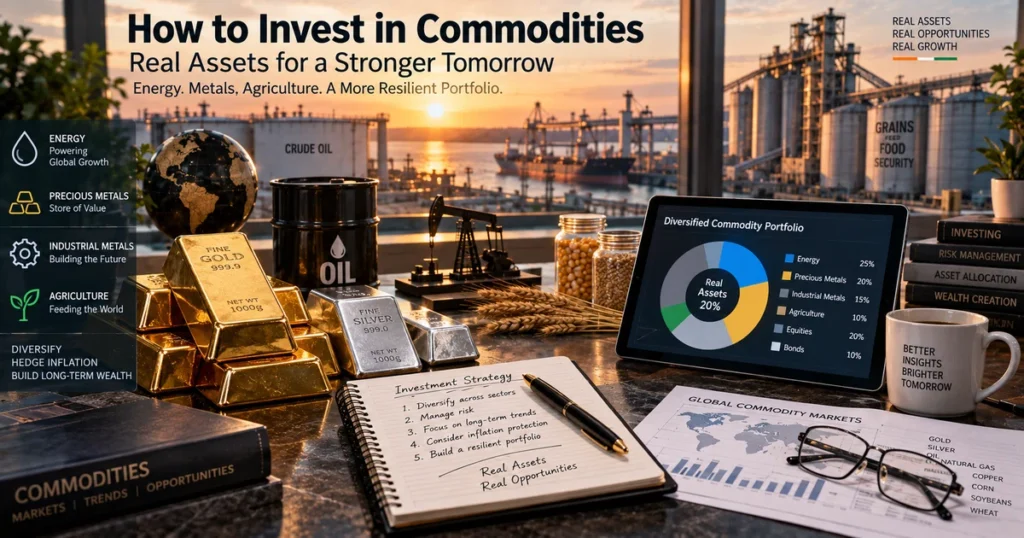
When stripped of technical jargon, commodities are the physical building blocks of the global economy. They comprise the raw materials—crude oil, copper, gold, wheat, natural gas, and soybeans—that underpin manufacturing, power generation, infrastructure, and human sustenance.
Yet, for individual investors and allocators, evaluating commodities requires a shift in analytical mindset. Traditional equity and fixed-income investing focuses on evaluating operational cash flows, collecting corporate dividends, and reinvesting bond coupons. A physical gold bar stored in a secure depository generates no organic earnings, and storing industrial energy or base metals incurs ongoing carrying, transport, and insurance expenses.
Why, then, do institutional allocators and long-term portfolio frameworks frequently include commodities? Some portfolio frameworks use a modest commodity allocation, often in the 5% to 15% range, depending on the investor’s objectives, risk tolerance, time horizon, and existing exposures. During periods of persistent raw material supply constraints or accelerating inflation, commodities can provide tangible diversification benefits. However, committing capital without distinguishing between physical bullion, equity producers, exchange-traded products, and derivatives can lead to unintended portfolio drag.
This guide outlines the core commodity sectors, analyzes the primary investment vehicles and their real-world trade-offs, examines the mechanics of roll yield, and provides structured frameworks for evaluating commodities within a diversified portfolio, building upon our foundational guides on commodity prices and hard commodities.
Quick Snapshot: What Are the Four Commodity Sectors?
Before putting your money into commodities, remember they aren’t a single group. Think of them as four completely different worlds:
- Energy: The fuel that keeps the world moving (Crude Oil, Natural Gas).
- Precious Metals: The chaos-protectors (Gold, Silver).
- Industrial Base Metals: The physical spine of cities (Copper, Aluminum).
- Agriculture: The food on our plates (Wheat, Coffee, Sugar).
Why separate them? Because a drought in Brazil will skyrocket your morning coffee price, but it won’t do a single thing to the price of copper wires in an electric car. Energy acts as the economic bloodstream, driving multi-year capital deployment. Gold and silver act as monetary trust assets, balancing interest rates and safe-haven demand. Industrial metals like copper are the structural building blocks for global urbanization, while agricultural soft commodities depend heavily on weather patterns.
Before committing capital, investors should recognize that commodities do not behave as a uniform asset class. The fundamental supply-demand drivers of agricultural crops differ substantially from the factors influencing industrial metals or energy hydrocarbons.
                          ┌──────────────────────────────────────────────┐
                          │       THE FOUR COMMODITY SUPER-SECTORS       │
                          └──────────────────────┬───────────────────────┘
                                                 │
         ┌──────────────────┬────────────────────┴───────────────────┬──────────────────┐
         │                  │                                        │                  │
         ▼                  ▼                                        ▼                  ▼
┌──────────────────┐┌──────────────────┐                    ┌──────────────────┐┌──────────────────┐
│     ENERGY       ││ PRECIOUS METALS  │                    │INDUSTRIAL METALS ││   AGRICULTURE    │
├──────────────────┤├──────────────────┤                    ├──────────────────┤├──────────────────┤
│ * Crude Oil (WTI)││ * Physical Gold  │                    │ * Copper (Wiring)││ * Wheat & Corn   │
│ * Natural Gas    ││ * Silver Bullion │                    │ * Aluminum (Auto)││ * Soybeans (Feed)│
│ * Refined Fuels  ││ * Platinum Group │                    │ * Nickel & Zinc  ││ * Coffee & Sugar │
├──────────────────┤├──────────────────┤                    ├──────────────────┤├──────────────────┤
│ DRIVER: Transport││ DRIVER: Monetary │                    │ DRIVER: Infra &  ││ DRIVER: Weather &│
│ & Geopolitics    ││ trust & Real Ylds│                    │ Electrification  ││ Biological Cycles│
└──────────────────┘└──────────────────┘                    └──────────────────┘└──────────────────┘
- Energy (The Economic Bloodstream): Crude oil and natural gas fuel global logistics, agricultural transport, and thermal electricity. Energy markets can experience sharp price movements because primary extraction and refining capacity require multi-year capital deployment, while short-term consumption can be relatively inflexible, as detailed in our guide on crude oil.
- Precious Metals (Monetary Assets & Industrial Uses): Gold has strong monetary and investment demand in addition to industrial uses, while silver balances monetary interest with extensive solar and electrical manufacturing applications. Gold can be sensitive to real interest rates, the U.S. dollar, monetary conditions, and investor demand for safe-haven assets.
- Industrial Base Metals (Infrastructure & Electrification): Copper, aluminum, and nickel provide the physical wiring, structural materials, and battery inputs for global urbanization and energy transition infrastructure. Copper prices are often monitored as a market indicator because of copper’s extensive use in construction, manufacturing, electrical equipment, and infrastructure.
- Agriculture (Biological Production): Food staples and cash crops depend on agronomic weather phenomena, seasonal planting acreage, fertilizer availability, and biological harvest schedules, as explored in our guide on soft commodities.
Why Invest in Commodities? Three Structural Portfolio Considerations
Quick Answer: Why Do Investors Consider Commodities?
Investors typically evaluate commodities based on three portfolio characteristics:
- Inflation Sensitivity: Raw material price shifts can feed directly into consumer and producer price indexes.
- Diversification Potential: Commodity returns can behave differently from equities and fixed income across specific economic environments.
- Long-Term Supply Constraints & Capital Cycles: Multi-year capital investment lags in extraction assets can contribute to structural periods of tight physical supply.
+---------------------------------------------------------------------------------------------------+
|                        THREE CORE PORTFOLIO CHARACTERISTICS OF COMMODITIES                        |
+---------------------+-----------------------------+-----------------------+-----------------------+
| PORTFOLIO FACTOR    | OPERATIONAL MECHANISM       | TRADITIONAL CHALLENGE | PRACTICAL DYNAMIC     |
+---------------------+-----------------------------+-----------------------+-----------------------+
| **Inflation         | Raw materials represent core| Fixed-income coupons  | Commodity price shocks|
| Sensitivity**       | inputs into headline CPI and| lose purchasing power | can feed directly into|
|                     | industrial PPI measures     | during high inflation | consumer energy/food  |
+---------------------+-----------------------------+-----------------------+-----------------------+
| **Diversification   | Driven by weather, geology, | 60/40 portfolios can  | Raw materials can     |
| Potential**         | and logistical constraints, | see stocks and bonds  | move independently of |
|                     | not corporate earnings calls| fall together in shocks| broad equity trends   |
+---------------------+-----------------------------+-----------------------+-----------------------+
| **Supply Cycles &   | Capital-intensive projects  | Equity valuations face| Multi-year project    |
| Capital Constraints**| require multi-year lead times| multiple compression  | lags can sustain tight|
|                     | to bring output online      | during rate tightening| physical market balance|
+---------------------+-----------------------------+-----------------------+-----------------------+
1. Inflation Sensitivity and Price Pressures
Commodity price shocks can contribute directly to headline inflation because energy, food, and raw materials feed into consumer and producer prices:
- Fixed-rate bonds experience real capital erosion when inflation outpaces nominal yields.
- Corporate equities can encounter margin compression if input procurement expenses outpace near-term product pricing adjustments.
- Commodities can provide inflation sensitivity and may perform well during some inflationary shocks, although the relationship varies by commodity and time period. For example, crude oil or agricultural supply shortfalls directly impact downstream retail prices, as examined in our guide on interest rates and exchange rates.
2. Diversification Potential
Commodity returns can behave differently from stocks and bonds over certain market regimes, potentially improving diversification. Because physical raw material balances depend on real-world factors—such as precipitation patterns across grain belts, localized mining disruptions, or shipping chokepoint delays—commodity spot prices frequently track underlying physical availability rather than broader corporate equity market cycles.
3. Long-Term Supply Constraints and Capital Cycles
In some commodities, prolonged underinvestment in mines, wells, refining, or processing capacity can contribute to tighter long-term supply. When resource exploration budgets are curtailed over consecutive fiscal years, natural reservoir and mine depletion gradually reduces spare capacity, meaning subsequent demand increases can encounter limited near-term physical supply responses.
The 4 Ways to Invest: Vehicles, Mechanics, and Trade-Offs
Institutional and private investors generally do not find it practical to take physical delivery of industrial bulk materials—such as many tonnes of cathode copper or thousands of barrels of liquid hydrocarbons.
To deploy capital practically, investors select among four primary investment pathways:
                          ┌──────────────────────────────────────────────┐
                          │      THE 4 COMMODITY INVESTMENT VEHICLES     │
                          └──────────────────────┬───────────────────────┘
                                                 │
         ┌──────────────────┬────────────────────┴───────────────────┬──────────────────┐
         │                  │                                        │                  │
         ▼                  ▼                                        ▼                  ▼
┌──────────────────┐┌──────────────────┐                    ┌──────────────────┐┌──────────────────┐
│ VEHICLE 1:       ││ VEHICLE 2:       │                    │ VEHICLE 3:       ││ VEHICLE 4:       │
│ Physical Bullion ││ Producer Equities│                    │ Commodity ETPs   ││ Direct Futures   │
├──────────────────┤├──────────────────┤                    ├──────────────────┤├──────────────────┤
│ Vaulted coins,   ││ Shares in mining │                    │ Exchange-traded  ││ Standardized     │
│ bars, and custody|│ operators and    │                    │ funds tracking   ││ contracts traded │
│ storage accounts ││ energy companies │                    │ physical or future| on CME, ICE, MCX │
├──────────────────┤├──────────────────┤                    ├──────────────────┤├──────────────────┤
│ PRO: Low issuer  ││ PRO: Operating   │                    │ PRO: Highly      ││ PRO: Capital     │
│ credit exposure  ││ leverage & div   │                    │ liquid brokerage ││ efficiency, direct│
│ CON: Storage fees││ CON: Management  │                    │ CON: Roll costs  ││ CON: Active margin|
│ and dealer spread││ and business risk│                    │ in contango      ││ and mark-to-market|
└──────────────────┘└──────────────────┘                    └──────────────────┘└──────────────────┘
Vehicle 1: Physical Ownership (Bullion, Vaults, and Practical Limits)

Quick Answer: When Should Investors Consider Physical Ownership?
For most retail investors, physical ownership is most practical in precious metals such as gold and silver. Physical ownership provides low issuer credit exposure because the asset is held directly, but it requires accounting for dealer bid-ask markups, insurance, transport, and recurring custodial vaulting expenses.
Direct physical custody represents the oldest method of holding tangible wealth:
Operational Mechanism:
- Sovereign Bullion Coins & Bars: Investors purchase standardized legal-tender coins (such as American Gold Eagles or Canadian Maple Leafs) or serialized investment bars bearing verified assay stamps from accredited refiners.
- Insured Custodial Vaults: For larger allocations, investors may use professionally insured vaulting facilities located in established jurisdictions (such as Zurich, London, Singapore, or Toronto) to avoid home security liabilities.
Key Advantages:
- Low Issuer Counterparty Exposure: You directly own the physical asset rather than a financial claim against a corporate issuer or intermediary bank.
- Direct Wealth Store: Physical bullion carries no corporate restructuring, bankruptcy, or debt dilution risk.
Practical Frictions:
- Dealer Markups and Spreads: Retail bullion is normally purchased above spot, with the premium varying by metal, product, quantity, dealer, and market conditions. When liquidating, dealers typically bid slightly below or at spot, creating a bid-ask transaction hurdle.
- Custodial and Insurance Fees: Professional insured vaulting charges an ongoing custodial fee that varies by provider, facility location, and total asset value.
- Physical Limitations of Industrial Commodities: Storing a standard CME copper futures contract, representing 25,000 pounds (about 11.3 metric tonnes), requires industrial-scale warehouse space, rendering physical storage impractical for non-precious raw materials.
Vehicle 2: Commodity Equities (Mining Giants, Energy Supermajors, and Royalties)
Quick Answer: What Are Commodity Equities and How Do They Function?
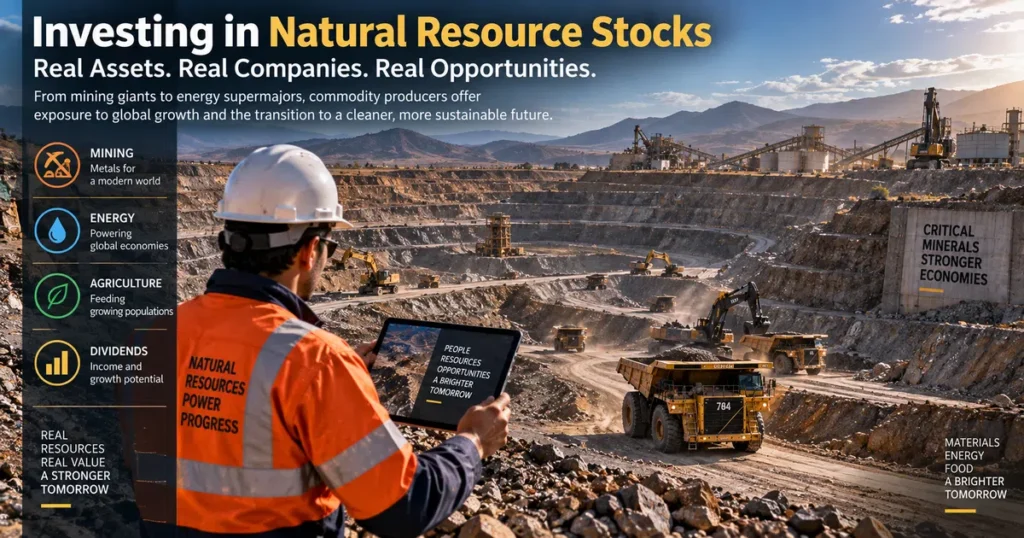
Commodity equities represent shares in corporations that explore, extract, process, or finance natural resources—such as integrated oil companies, diversified mining houses, and royalty/streaming firms. They trade on standard equity exchanges, some pay cash dividends, and their operational profits can exhibit leverage relative to underlying commodity price movements.
For many investors, resource equities provide accessible commodity exposure through traditional brokerage accounts. However, commodity equities provide indirect commodity exposure because company earnings also depend on costs, debt, management, capital allocation, geopolitics, taxes, and broader equity-market conditions.
Operating Leverage in Natural Resource Extraction:
Because mining and energy producers operate with substantial fixed capital assets (drilling platforms, processing mills, and extraction equipment), changes in market commodity prices can have an outsized impact on corporate operating cash flows.
Consider this illustrative operational scenario:
- Assume a mining producer maintains an all-in production cost of $3.00 per unit.
- If the commodity sells at $4.00 per unit, the operational margin is $1.00 per unit.
- If market demand increases the realized selling price to $5.00 per unit (+25%), the operational cash margin expands from $1.00 to $2.00 per unit (+100%).
- In this scenario, a 25% change in raw material price leads to a 100% expansion in unit operating margin.
+---------------------------------------------------------------------------------------------------+
|                        NATURAL RESOURCE EQUITY CATEGORIES                                         |
+---------------------+-----------------------------+-----------------------+-----------------------+
| CATEGORY            | NOTABLE GLOBAL OPERATORS    | PRIMARY STRENGTH      | PRIMARY STRUCTURAL RISK|
+---------------------+-----------------------------+-----------------------+-----------------------+
| **Integrated Energy | ExxonMobil, Chevron, Shell, | Broad downstream and  | Broad equity market   |
| Supermajors**       | TotalEnergies, BP           | refining cash flows;  | beta; long-term CapEx |
|                     |                             | dividend potential    | allocation risks      |
+---------------------+-----------------------------+-----------------------+-----------------------+
| **Diversified Mining| BHP Group, Rio Tinto,       | Scale across multiple | Labor negotiations,   |
| Producers**         | Freeport-McMoRan, Glencore  | industrial metals     | jurisdictional permit |
|                     |                             | and bulk materials    | delays, mine floods   |
+---------------------+-----------------------------+-----------------------+-----------------------+
| **Royalty &         | Franco-Nevada, Wheaton      | High gross margins;   | Valuation multiples   |
| Streaming Houses**  | Precious Metals, Royal Gold | contracts insulate    | can trade at high     |
|                     |                             | from cost inflation   | historical premiums   |
+---------------------+-----------------------------+-----------------------+-----------------------+
The Royalty and Streaming Model:
Royalty and streaming companies provide upfront financing to mining operators to fund mine development. In return:
- Some streaming agreements give the streaming company the right to purchase a defined amount of future production at a predetermined or contractually defined price, usually well below prevailing market prices.
- This model avoids direct operating and sustaining capital expenditure inflation, providing commodity leverage while insulating the financial structure from mine-site cost overruns.
Corporate Execution Considerations:
Holding natural resource equities means assuming business risk. Even during periods of rising raw material prices, individual operating companies can underperform if they face operational disruptions, unexpected tax increases, or capital allocation challenges, as explored in our guide on what is market capitalization.
Vehicle 3: Commodity ETPs & The Roll Yield Mechanism
Quick Answer: What Is the Difference Between Physical and Futures-Based Commodity ETPs?
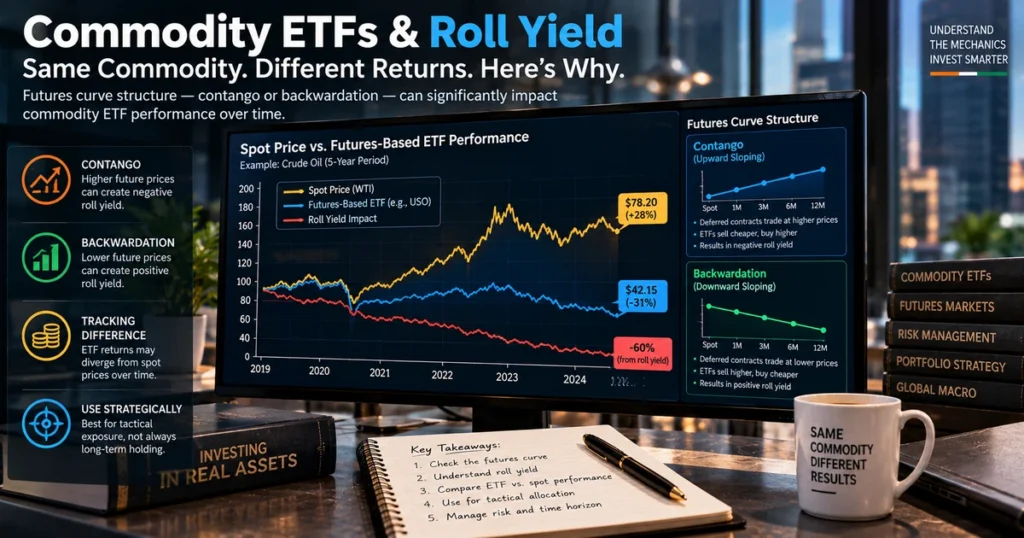
Physically backed ETPs (common for precious metals) store certified bullion in secure vaults, closely tracking physical spot prices minus an expense ratio. Futures-based ETPs (common for energy, industrial metals, and agriculture) hold derivatives contracts that must be rolled forward periodically. When a market is in contango, this roll process can create an adverse roll differential that causes fund returns to diverge from spot price changes over time.
Exchange-traded products (ETPs) provide liquid market access, but understanding their underlying structure is critical to managing tracking risk.
1. Physically-Backed ETPs: Direct Metal Exposure
Physically backed products hold allocated or unallocated bullion in audited commercial depositories. When investors purchase shares of a physically backed gold or silver trust, the fund issues shares backed by metal stored in accredited vaults. The fund charges an annual expense ratio that varies by product, and shares typically track spot prices with minimal structural friction.
2. Futures-Based ETPs & The Roll Yield Dynamic
Because holding physical barrels of oil or metric tons of agricultural commodities is operationally impractical for retail fund structures, non-metal ETPs typically invest in commodity futures contracts.
Futures contracts possess finite expiration dates. To maintain continuous market exposure without taking physical delivery, fund managers must routinely sell expiring near-term contracts and purchase contracts with later delivery dates—a process known as rolling the contract.
Price ($)
  ▲
  │                                      CONTANGO (Futures > Spot)
  │                                     ┌─────────────────────────
  │                                ┌───┘  Upward-sloping curve:
  │                           ┌───┘       Reflects storage, insurance, and carry factors;
  │                      ┌───┘            Can create an adverse roll differential over time.
  ├─────────────────┬───┘
  │  SPOT PRICE     │
  ├─────────────────┴───┐
  │                      └───┐
  │                           └───┐       BACKWARDATION (Spot > Futures)
  │                                └───┐  Downward-sloping curve:
  │                                     └─────────────────────────
  │                                       Reflects prompt demand and convenience yield;
  │                                       Can provide a positive roll yield contribution.
  └─────────────────────────────────────────────────────────────────► Time to Expiration
Understanding the Roll Mechanism:
- Contango Conditions ($F > S$): When deferred futures trade at a premium to near-term contracts (reflecting physical storage, financing, and insurance costs), selling a lower-priced expiring contract to purchase a higher-priced deferred contract creates an adverse roll differential. For example, all else equal, buying a deferred contract $2 above the expiring contract creates a $2-per-barrel adverse roll differential before considering subsequent price movements and other costs.
- Long-Term Performance Divergence: Over extended periods of persistent contango, recurring contract roll differentials can cause a futures-based ETP to underperform physical spot price benchmarks.
Practitioner Consideration: Single-commodity futures-based ETPs can be difficult to use as long-term holdings because roll costs, futures-curve shape, fees, and tracking differences can materially affect returns. They are often utilized as tactical, shorter-term instruments rather than multi-decade buy-and-hold vehicles.
Vehicle 4: Direct Futures & Options (CME, ICE, and MCX)
Quick Answer: What Are the Characteristics of Direct Futures Trading?
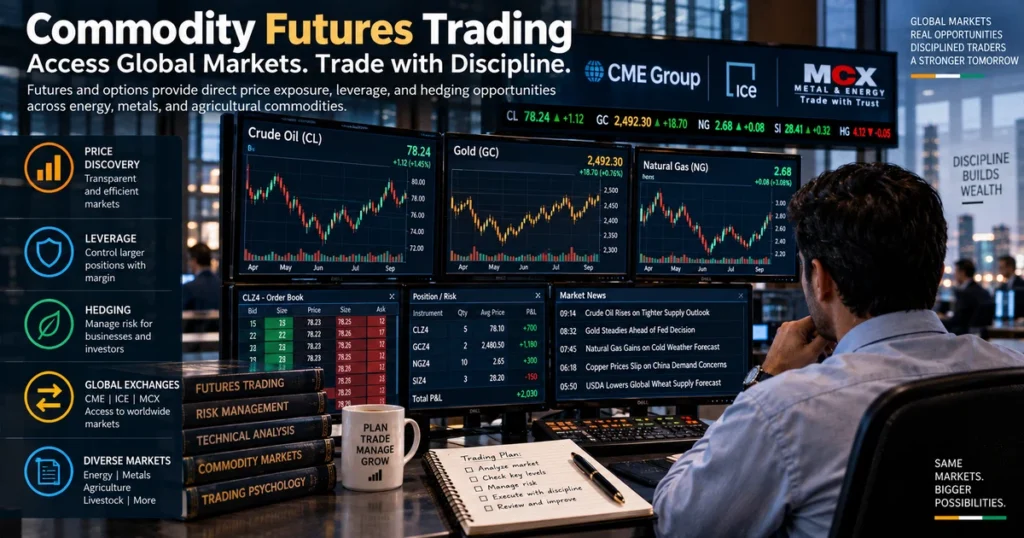
Direct futures trading on venues like the CME, NYMEX, ICE, or India’s MCX provides capital efficiency and direct market exposure. Futures markets are major venues for institutional commodity price discovery, hedging, and risk transfer, but require active management to navigate contract specifications, expiration schedules, and daily mark-to-market margin requirements.
Futures contracts represent standardized agreements to deliver or settle a specific quantity and grade of a commodity at a defined future date:
+---------------------------------------------------------------------------------------------------+
|                        BENCHMARK COMMODITY FUTURES SPECIFICATIONS                                 |
+---------------------+-----------------------------+-----------------------+-----------------------+
| CONTRACT BENCHMARK  | VENUE / TICKER SYMBOL       | CONTRACT QUANTITY     | SETTLEMENT TYPE       |
+---------------------+-----------------------------+-----------------------+-----------------------+
| **Light Sweet Crude | NYMEX / CME Group (`CL`)    | 1,000 Barrels         | Physical Delivery     |
| Oil (WTI)**         |                             | (42,000 US Gallons)   | at Cushing, Oklahoma  |
+---------------------+-----------------------------+-----------------------+-----------------------+
| **Gold Futures**    | COMEX / CME Group (`GC`)    | 100 Troy Ounces       | Physical Delivery     |
|                     |                             | (Assay 0.995 Fine)    | of Certified Bars     |
+---------------------+-----------------------------+-----------------------+-----------------------+
| **High Grade Copper | COMEX / CME Group (`HG`)    | 25,000 Pounds         | Physical Delivery     |
| Futures**           |                             | (~11.3 Metric Tons)   | at Licensed Depots    |
+---------------------+-----------------------------+-----------------------+-----------------------+
| **MCX Crude Oil**   | Multi Commodity Exchange    | 100 Barrels           | Cash-Settled against  |
| (India Benchmark)   | of India (`CRUDEOIL`)       | (Domestic Hedging)    | NYMEX WTI Price       |
+---------------------+-----------------------------+-----------------------+-----------------------+
Margin Mechanics and Capital Efficiency:
Trading direct futures does not require paying the full face value of the underlying contract. Instead, clearinghouses require an Initial Margin deposit to serve as a performance bond:
- Initial margin varies by contract, market volatility, exchange requirements, and broker policies. It should not be treated as a fixed percentage of contract value.
- Illustrative example only: For a 100-ounce gold futures contract, actual notional value and margin requirements change with market prices and exchange or broker determinations. While margin allows market participants to manage large physical exposures with modest initial capital, it magnifies both potential gains and potential losses.
Daily Mark-to-Market Settlement:
Futures positions are marked to market daily, with gains and losses reflected in the trading account through the clearing and margin system.
- If a position moves against an investor, The loss is reflected as a debit to the trading account’s margin equity.
- If account equity drops below the Maintenance Margin threshold, the broker issues a variation margin call, requiring prompt capital injection to maintain the open position. Failure to meet margin requirements can result in the broker or clearing intermediary liquidating the position, potentially without waiting for the investor’s approval.
Portfolio Construction: Allocation Frameworks and Considerations
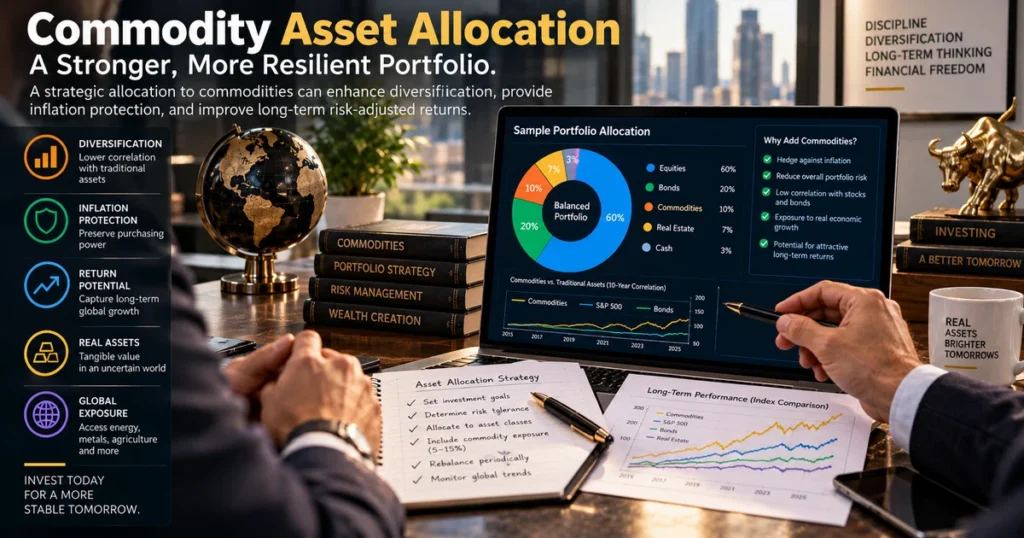
Quick Answer: How Do Allocators Approach Commodity Weightings?
There is no universally optimal commodity allocation. Research and practitioner frameworks have explored allocations in the single-digit to mid-teens range, but the appropriate exposure depends on portfolio composition, objectives, risk tolerance, liquidity needs, and existing indirect exposure.
Commodity weightings reflect an investor’s time horizon, macro outlook, and need for inflation sensitivity:
+---------------------------------------------------------------------------------------------------+
|                        ILLUSTRATIVE ALLOCATION EXAMPLES — NOT PERSONAL INVESTMENT RECOMMENDATIONS |
+---------------------+-----------------------------+-----------------------+-----------------------+
| INVESTOR PROFILE    | ILLUSTRATIVE TARGET SLEEVE  | TYPICAL CORE FOCUS    | ALLOCATION RATIONALE  |
+---------------------+-----------------------------+-----------------------+-----------------------+
| **Conservative /    | 3% to 7% of Investment     | Physically backed gold| Emphasizes store-of-  |
| Capital Preservation| Assets                      | bullion or ETP trusts | value assets with low |
|                     |                             |                       | direct corporate risk |
+---------------------+-----------------------------+-----------------------+-----------------------+
| **Moderate /        | 5% to 12% of Investment     | Balanced split: gold, | Blends capital        |
| Balanced Growth**   | Assets                      | energy supermajors,   | preservation with cash|
|                     |                             | diversified miners    | dividend generation   |
+---------------------+-----------------------------+-----------------------+-----------------------+
| **Resource-Focused /| 10% to 18% of Investment    | Broad exposure across | Seeks higher cyclical |
| Inflation-Focused** | Assets                      | miners, royalties, and| leverage across global|
|                     |                             | physical precious met | industrial expansions |
+---------------------+-----------------------------+-----------------------+-----------------------+
Interactive Asset Allocation: Model a Multi-Asset Sleeve
To understand how real asset exposure integrates alongside traditional holdings, use the illustrative portfolio modeling tool below. Explore the balance between core global equities, fixed-income instruments, precious metal reserves, and natural resource equities:
4 Common Commodity Investing Misconceptions
- Assuming Futures-Linked ETPs Track Spot Prices Over Multi-Year Periods: Futures-based commodity products must roll expiring contracts. In upward-sloping contango markets, recurring contract roll differentials can cause fund performance to diverge from spot physical prices over long horizons.
- Equating Producer Equities Directly with Physical Commodities: Resource stocks provide indirect commodity exposure. Mining and energy company valuations reflect management decisions, debt service costs, environmental compliance, labor stability, and general equity market volatility.
- Concentrating Entirely in a Single Resource: Sizing an entire commodity sleeve into one material (such as crude oil or silver) introduces substantial single-commodity risk. Unanticipated production quota shifts or local demand slowdowns can impact individual markets independently.
- Overlooking Physical Holding Costs: Purchasing physical bullion coins or bars requires factoring in dealer bid-ask spreads, verification expenses, and ongoing secure custodial vaulting or insurance costs.
Step-by-Step Implementation Framework
Investors establishing a commodity sleeve within a multi-asset portfolio typically follow a disciplined, phased approach:
┌─────────────────┐       ┌─────────────────┐       ┌─────────────────┐       ┌─────────────────┐
│     PHASE 1     │  ──►  │     PHASE 2     │  ──►  │     PHASE 3     │  ──►  │     PHASE 4     │
│ Define Sizing   │       │ Core Physical   │       │ Layer Productive│       │ Periodic        │
│ and Objectives  │       │ or Bullion ETPs │       │ Equities        │       │ Rebalancing     │
└─────────────────┘       └─────────────────┘       └─────────────────┘       └─────────────────┘
- Phase 1: Establish Sizing and Objectives: Define target portfolio weighting based on personal liquidity needs, volatility tolerance, and existing equity exposure. Clarify whether the allocation is primarily intended for inflation sensitivity, income potential, or tactical trading.
- Phase 2: Establish Core Tangible Reserves: Allocate the foundational portion of the real asset sleeve toward precious metals. Investors prioritizing simplicity and liquidity often utilize physically backed bullion ETPs, while those seeking unencumbered direct ownership may select allocated, professionally vaulted physical bars.
- Phase 3: Incorporate Natural Resource Producers: Broaden exposure through established energy supermajors, diversified mining producers, or royalty and streaming companies. Some of these companies pay cash dividends, which may increase when stronger commodity prices improve cash generation, although dividends remain dependent on company policy and financial conditions.
- Phase 4: Implement Periodic Rebalancing: Because commodity markets experience cyclical expansions and contractions, maintain discipline by periodically reviewing asset weightings and rebalancing positions when commodity exposures move materially away from their target allocations. This helps keep the commodity sleeve aligned with the portfolio’s broader objectives without relying on short-term market timing.
Frequently Asked Questions (FAQ)
What is the most accessible way for an individual to invest in commodities?
For many individual investors, the most accessible pathways are physically backed precious metal ETPs or diversified natural resource equities (such as energy and mining funds) traded on standard stock exchanges. These instruments provide liquidity and standard brokerage reporting without requiring management of direct futures contracts, margin calls, or physical transport logistics.
Do physical commodities generate dividend income?
Physical commodities (such as vaulted gold bars or crude oil barrels) produce no operational cash flow and do not pay dividends; storing them incurs holding, insurance, and custodial expenses. However, commodity equities (the mining operators, energy producers, and agricultural processors that extract and market raw materials) can pay cash dividends based on corporate profitability and board policy.
Why do commodity prices often exhibit sensitivity to the US Dollar?
Many globally traded commodities are priced in U.S. dollars, so changes in the dollar can influence their affordability for non-U.S. buyers. When the dollar weakens, raw materials can become relatively more accessible in foreign currency terms, which can support international purchasing power. However, commodity prices also respond to physical supply, industrial demand, inventory buffers, interest rates, geopolitics, and other macroeconomic factors.
What is the primary difference between investing in gold versus copper?
Gold has strong monetary and investment demand in addition to industrial uses, with its price influenced by real interest rates, currency valuation, and safe-haven investment flows. Copper has a much stronger industrial-demand profile, with its price closely linked to manufacturing activity, construction, electrical equipment, and power transmission infrastructure.
Can you hold certain physical precious metals in a U.S. IRA?
Yes. Under U.S. tax regulations, self-directed Individual Retirement Accounts (SDIRAs) can hold specific IRS-approved gold, silver, platinum, and palladium bullion coins and bars meeting minimum purity specifications. The physical bullion must be held by an IRS-approved qualified custodian and stored in an accredited depository facility.
Strategic Summary & Core Takeaways
- Foundational Economic Building Blocks: Commodities represent essential physical inputs across energy, metals, and agricultural sectors, providing real-asset exposure within broader investment portfolios.
- Distinct Sector Characteristics: Energy, precious metals, industrial metals, and agricultural crops are governed by distinct geological, seasonal, and macroeconomic drivers.
- Vehicle-Specific Trade-Offs: Physical bullion minimizes issuer credit exposure but carries custodial expenses; natural resource equities offer operating leverage and dividend potential but carry operational business risk; futures-linked ETPs require careful evaluation of roll yield dynamics in contango markets.
- Disciplined Portfolio Weighting: Allocators typically evaluate modest allocations to balance inflation sensitivity and diversification benefits while maintaining alignment with the portfolio’s broader long-term objectives.
Next Reading Suggestions
- Commodity Prices: How They Are Determined, Key Drivers, and Futures Pricing
- Hard Commodities: The Complete Guide to Extracted Resources, Energy Markets, and Industrial Metals
- Soft Commodities: The Complete Guide to Agricultural Futures, Tropical Crops, and Market Drivers
- Crude Oil: The Complete Guide to Global Benchmarks, Pricing Mechanics, and Geopolitics
- Supply and Demand in Commodities: The Complete Guide to Market Balances, Elasticity, and Price Formation
- Commodity Exchange: The Complete Guide to Global Trading Hubs, Contract Standardization, and Clearing Mechanics
- What Is a Commodity? The Complete Guide to Fungible Goods, Raw Materials, and Global Market Value
- Interest Rates and Exchange Rates: The Complete Guide to Global Currency Pricing
- How Stock Prices Are Determined: Market Microstructure, Supply and Demand, and Valuation
- What Is Market Capitalization? The Complete Guide to Market Cap, Company Size, and Valuation
Author Box & E-E-A-T Verification
Written & Researched By: CurrencyPlans Editorial Research Team
Last Updated & Methodologically Reviewed: September 2026
Editorial Review & Methodological Standards: This educational guide to commodity investing is developed using institutional portfolio frameworks, derivatives exchange specifications, and primary regulatory documentation. Operational mechanics—including futures curve structures, roll yields, margin requirements, and physical storage parameters—are informed by publications and official guidelines from CME Group, the London Metal Exchange (LME), the Commodity Futures Trading Commission (CFTC), the U.S. Securities and Exchange Commission (SEC), and the World Gold Council.
Educational References & Market Data Sources
For official contract specifications, physical bullion storage guidelines, and regulatory frameworks, consult primary industry institutions directly:
- CME Group (Commodity Products, Margins, and Specifications): CME Group
- London Metal Exchange (Physical Delivery & Approved Warehouses): LME
- U.S. Commodity Futures Trading Commission (Futures Margin & COT Reports): CFTC
- World Gold Council (Gold Demand Trends & Custody Infrastructure): World Gold Council
- Intercontinental Exchange (Energy & Agricultural Futures Contracts): ICE
- Multi Commodity Exchange of India (Domestic Futures Specifications): MCX India
Educational Disclaimer
This guide is prepared strictly for educational, research, and informational purposes and does not constitute personalized financial, investment, legal, or tax advice. Commodity spot markets, physical asset storage, derivative futures contracts, and natural resource equities carry substantial capital and market risk. Past performance and historical futures forward curve shapes do not guarantee future returns. Always conduct independent due diligence and consult a licensed fiduciary financial advisor before allocating investment capital.

