
A commodity exchange is a regulated marketplace where standardized commodity futures, options, and, in some markets, physically settled or spot-related contracts are traded. Operating as an institutional bridge connecting physical resource producers, commercial processors, and financial market participants, a commodity exchange provides standardized financial contracts whose terms are linked to underlying physical commodities—such as unrefined crude oil, raw copper ore, or agricultural staples.
Before the development of formal exchanges, commerce in raw materials faced severe friction: bilateral counterparty default risks, subjective grading disputes, fragmented local pricing, and seasonal logistics bottlenecks. Modern commodity marketplaces address these challenges through transparent rulebooks, uniform contract terms, continuous electronic price discovery, and centralized clearing houses. Today, major commodity marketplaces provide global infrastructure for commercial hedging, price discovery, and derivatives trading.
Understanding how a commodity exchange functions requires analyzing the mechanics of contract standardization, the operational role of central counterparty novation, mark-to-market settlement cycles, and the structural links between derivatives and physical deliveries, complementing foundational valuation principles detailed in our guide on how stock prices are determined.
Executive Summary: What Is a Commodity Exchange?
Quick Answer: What Is a Commodity Exchange?
A commodity exchange is an organized, regulated marketplace that provides a centralized venue for trading standardized contracts based on underlying physical raw materials. Rather than negotiating bespoke bilateral terms, market participants trade standardized contracts specifying defined terms such as contract size, quality, delivery or settlement method, eligible delivery locations where applicable, and expiration or settlement dates. The exchange provides the trading venue, while an affiliated Central Counterparty Clearing House (CCP) performs central clearing and risk management, stepping between buyers and sellers via novation to substantially reduce bilateral counterparty credit risk.
To understand the unique function of a commodity exchange within the global capital architecture, consider its relationship with participants across commercial industry and financial asset management:
                          ┌──────────────────────────────────────────────┐
                          │          GLOBAL COMMODITY EXCHANGE           │
                          │        (Trading Venue & Execution)           │
                          └──────────────────────┬───────────────────────┘
                                                 │
                                                 ▼
                          ┌──────────────────────────────────────────────┐
                          │   CENTRAL COUNTERPARTY CLEARING HOUSE (CCP)  │
                          │   (Novation, Margining & Default Safeguards) │
                          └──────────────────────┬───────────────────────┘
                                                 │
         ┌───────────────────────────────────────┴───────────────────────────────────────┐
         │                                                                               │
         ▼                                                                               ▼
┌────────────────────────────────────────┐                     ┌────────────────────────────────────────┐
│ COMMERCIAL PARTICIPANTS (HEDGERS)      │                     │ FINANCIAL PARTICIPANTS (SPECULATORS)   │
├────────────────────────────────────────┤                     ├────────────────────────────────────────┤
│ * Mining Corporations & Oil Drillers   │                     │ * Commodity Trading Advisors (CTAs)    │
│ * Agricultural Cooperatives & Farmers  │                     │ * Global Macro Hedge Funds             │
│ * Commercial Airlines & Freight Fleets │                     │ * Pension Funds & Commodity Asset Mgrs │
│ * Industrial Smelters & Manufacturers  │                     │ * Proprietary Trading Desks            │
├────────────────────────────────────────┤                     ├────────────────────────────────────────┤
│ OBJECTIVE: Lock in forward prices,     │                     │ OBJECTIVE: Provide risk-bearing        │
│ mitigate physical cost volatility,     │                     │ capital and liquidity, absorbing price │
│ and secure operating balance sheets.   │                     │ exposure across market cycles.         │
└────────────────────────────────────────┘                     └────────────────────────────────────────┘
                    │                                                              │
                    └──────────────────────────────┬───────────────────────────────┘
                                                   │
                                                   ▼
                    ┌─────────────────────────────────────────────────────────────┐
                    │ THE CORE INTERSECTION: ECONOMIC UTILITY                     │
                    ├─────────────────────────────────────────────────────────────┤
                    │ * Price Discovery: Continuous, transparent benchmark pricing│
                    │ * Risk Transfer: Reallocating price volatility from hedgers │
                    │   to liquidity providers willing to bear it                 │
                    │ * Capital Efficiency: Regulated leverage via margin deposits│
                    └─────────────────────────────────────────────────────────────┘
A commodity exchange framework operates on three foundational economic pillars:
- Centralized Order Matching: Electronic order books are a major execution mechanism on modern commodity exchanges, complemented in some markets by block trades, negotiated transactions, inter-office trading, and open-outcry venues.
- Contract Standardization: Contract rules eliminate subjective quality negotiations; market participants trade certified deliverable grades, as detailed in our guide on what is a commodity.
- Central Clearing and Performance Safeguards: Through margin requirements, continuous position tracking, and institutional default-management resources, clearing houses help protect the financial integrity of cleared trades.
How Does a Commodity Exchange Work? The 4-Step Lifecycle
Quick Answer: How Does a Commodity Exchange Work?
A commodity exchange operates through an integrated, four-step institutional process: Order Submission via registered brokerage accounts, Order Matching within electronic execution engines, Central Counterparty Novation and daily margin clearing, and final Settlement or Physical Delivery at contract maturity.
Understanding the continuous mechanics of a modern commodity transaction clarifies how physical trade connects with electronic clearing:
┌─────────────────┐       ┌─────────────────┐       ┌─────────────────┐       ┌─────────────────┐
│     STEP 1      │  ──►  │     STEP 2      │  ──►  │     STEP 3      │  ──►  │     STEP 4      │
│ Order Routing   │       │ Order Matching  │       │ Central Novation│       │ Settlement or   │
│ & Pre-Trade Risk│       │ & Execution     │       │ & Daily Margin  │       │ Delivery Window │
└─────────────────┘       └─────────────────┘       └─────────────────┘       └─────────────────┘
- Step 1: Order Routing & Pre-Trade Risk Checks: Market participants, including commercial hedgers and institutional traders, submit orders through an authorized broker, clearing member, or other permitted intermediary, depending on the jurisdiction and market structure. Pre-trade risk controls can check factors such as available margin or credit, order size, position limits, and other exchange or intermediary-specific risk parameters before an order is accepted or routed for execution.
- Step 2: Electronic Order Matching & Execution: Orders enter the exchange’s matching engine, where they are matched according to the published matching algorithm and priority rules applicable to the specific contract. Depending on the market and product, these rules may include price/time priority, FIFO, pro-rata allocation, or other exchange-defined algorithms. Once compatible orders are matched, the system generates an execution confirmation.
- Step 3: Central Counterparty Novation & Daily Margin Management: Once executed, the transaction flows to the clearing house. Through novation, the clearing house interposes itself as the buyer to the seller and the seller to the buyer. Initial Margin collateral is confirmed, and positions are marked to market across scheduled clearing cycles via cash Variation Margin.
- Step 4: Position Offset, Cash Settlement, or Physical Delivery: Prior to expiration, the vast majority of market participants offset (liquidate) their positions by executing an equal and opposite trade. Contracts held through termination undergo formal settlement: cash-settled contracts balance against an official index, while deliverable contracts initiate the transfer of certified warehouse receipts or delivery instruments.
The Historical Evolution: From Dojima and CBOT to Algorithmic Datacenters
Quick Answer: How Did Commodity Exchanges Evolve?
Modern commodity exchanges developed from informal merchant gatherings into structured corporate clearing institutions. A foundational milestone occurred with the establishment of the Chicago Board of Trade (CBOT) in 1848, which organized physical grain commerce and subsequently developed standardized forward and futures contracts to manage seasonal Midwest agricultural price shocks.
The operational history of global commodity exchanges tracks key milestones in market modernization:
- 1697 (The Dojima Rice Exchange, Osaka): The Dojima Rice Exchange in Osaka became an important early organized marketplace for rice-related forward trading and account-based settlement, becoming an important historical precursor to modern futures markets.
- 1848 (The Chicago Board of Trade): CBOT was established to organize grain trading and later developed standardized forward and futures contracts, helping create the institutional foundations of modern agricultural futures markets. Over subsequent decades, formal grading standards and centralized clearing mechanisms were integrated to support market scale.
- 1877 (The London Metal Exchange): Britain’s Industrial Revolution required substantial imports of copper, tin, and lead from South America and Asia. Merchants formed the LME, famously conducting trade in a sawdust circle (“The Ring”) to coordinate purchase orders with the arrival schedules of merchant sailing vessels.
- 1872 (The New York Mercantile Exchange – NYMEX): Originally founded as the Butter and Cheese Exchange, NYMEX evolved into a premier industrial marketplace, launching heating oil futures in 1978 and its flagship light sweet crude oil (WTI) futures contract in 1983.
- 2000s–Present (Demutualization and Electronic Matching): Historic member-owned non-profit utility exchanges transitioned into publicly listed, technology-focused corporations (such as CME Group and ICE). Open-outcry physical trading pits were largely superseded by high-throughput electronic execution engines hosted in secure data centers, enabling algorithmic market makers and quantitative trading firms to provide continuous multi-asset liquidity.
The Defining Functions: Centralized Liquidity, Standardization, and Price Discovery
Quick Answer: What Crucial Functions Does a Commodity Exchange Serve?
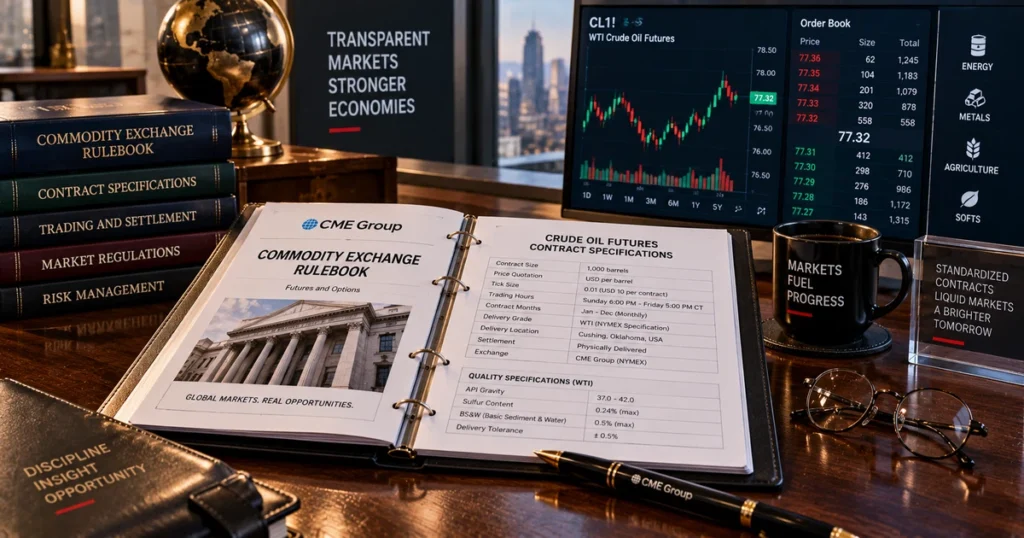
A commodity exchange provides three primary economic functions: transparent price discovery (establishing transparent reference prices that can serve as benchmarks for particular commodities, regions, or commercial markets), commercial risk transfer (hedging) (allowing enterprises to lock in revenue and input costs), and contract standardization (ensuring all participants trade identical physical and financial terms).
1. Transparent Reference Price Discovery
Without a centralized exchange, commodity pricing remains fragmented, opaque, and dependent on localized bilateral dealer quotes. For electronic order-book markets, the exchange aggregates bids and offers into a centralized trading system, while permitted block, negotiated, or other off-order-book transactions may follow separate execution procedures.
The resulting settlement prices can serve as important benchmarks or reference prices for physical contracts, long-term supply agreements, valuation, and other commercial transactions.
2. The Mechanics of Contract Standardization
To generate high market liquidity, an exchange eliminates the need for counterparties to negotiate bespoke contractual clauses for every transaction. Each listed contract is governed by a defined specification covering the parameters relevant to that instrument:
| Standardization Dimension | Exchange Definition | Operational Role |
| Contract Multiplier (Size) | Explicit, fixed unit of underlying physical volume | Determines total financial exposure (e.g., 1 contract = 1,000 barrels of crude oil, 5,000 bushels of grain). |
| Minimum Tick Size & Value | Smallest permissible price movement | Establishes price granularity (e.g., $0.01 per barrel = $10.00 per contract on benchmark WTI). |
| Deliverable Quality Grade | Chemical, physical, and purity specifications | Protects commercial buyers from receiving non-conforming industrial materials. |
| Delivery Mechanism & Point | Certified pipeline junction, warehouse, or cash index | Concentrates physical delivery logistics at recognized commercial infrastructure hubs. |
| Trading & Expiration Schedule | Designated trading hours and expiration deadlines | Establishes the exact timeline where open positions must be closed, rolled, or settled. |
3. Commercial Risk Transfer (Hedging)
The primary economic utility of a commodity exchange is the transfer of price risk:
- Short Hedgers (Producers): Agricultural cooperatives and mining firms sell futures contracts to lock in sales prices months ahead of physical harvest or extraction, protecting operational margins against falling market prices.
- Long Hedgers (Consumers): Airlines, utility companies, and industrial manufacturers buy futures contracts to cap input fuel and raw material costs, insulating corporate budgets from sudden geopolitical or supply-driven price spikes.
Financial participants provide additional risk-bearing capital and liquidity, allowing commercial participants to transfer price risk through the market continuously.
The Clearing House & Novation: Mitigating Bilateral Counterparty Risk
Quick Answer: How Does a Commodity Exchange Manage Counterparty Default Risk?
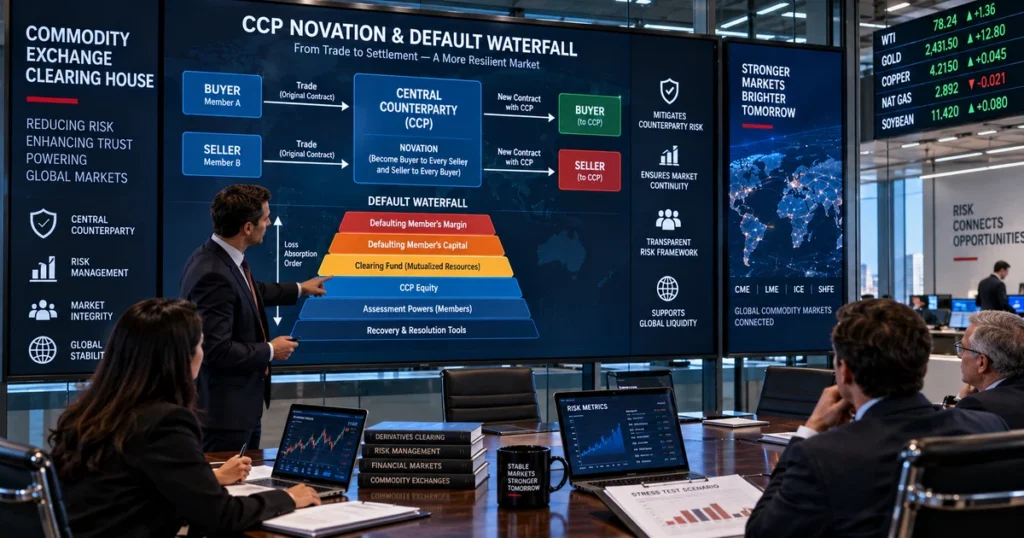
A commodity exchange manages performance risk through an associated Central Counterparty Clearing House (CCP) using a legal process known as novation. Following trade execution, the clearing house legally steps between the trading parties, becoming the buyer to every seller and the seller to every buyer. This structural substitution substantially reduces bilateral credit risk: market participants rely on the financial safeguards and default resources of the clearing house rather than the balance sheet of the original trading partner.
The Mechanics of Novation
In an unregulated bilateral forward agreement, if Company A purchases copper from Company B for delivery in six months, Company A assumes full credit exposure to Company B. If Company B experiences financial insolvency before the delivery date, Company A faces significant contractual and operational losses.
On a centralized commodity exchange, the clearing framework reallocates that risk:
BILATERAL EXECUTION (MATCHING ENGINE):
[Buyer: Industrial Consumer]  ────── (Trade Executed at $4.00/lb) ──────  [Seller: Mining Producer]

LEGAL NOVATION BY THE CLEARING HOUSE:
                              ┌────────────────────────┐
                              │  CENTRAL COUNTERPARTY  │
                              │     CLEARING HOUSE     │
                              │         (CCP)          │
                              └───────────┬────────────┘
                                          │
                  ┌───────────────────────┴───────────────────────┐
                  ▼                                               ▼
     [Buyer: Industrial Consumer]                   [Seller: Mining Producer]
  Clearing house becomes the Seller              Clearing house becomes the Buyer
    to the original long position                  to the original short position
Through novation, the original bilateral link is severed. Rather than monitoring the solvency of hundreds of trading counterparties, market participants interface directly with the clearing house through authorized clearing members.
Illustrative CCP Default Waterfall
To ensure it can honor all cleared contracts even during severe member insolvencies, a central counterparty maintains a prioritized sequence of financial resources known as the Default Waterfall:
+---------------------------------------------------------------------------------------------------+
|               ILLUSTRATIVE CCP DEFAULT WATERFALL (MODERN INSTITUTIONAL PRACTICES)                 |
+---------------------+-----------------------------+-----------------------+-----------------------+
| WATERFALL TIER      | CAPITAL SOURCE              | APPLICATION TRIGGER   | SYSTEMIC OBJECTIVE    |
+---------------------+-----------------------------+-----------------------+-----------------------+
| **1. Defaulter's    | Cash & high-grade collateral| Immediate upon trade  | Absorbs initial losses|
| Margin Assets**     | posted by defaulting member | or settlement failure | of the failed member  |
+---------------------+-----------------------------+-----------------------+-----------------------+
| **2. Defaulter's    | Pre-funded guaranty capital | Secondary exhaustion  | Fully liquidates the  |
| Guaranty Deposit**  | deposited by the defaulter  | of initial margin     | defaulter's capital   |
+---------------------+-----------------------------+-----------------------+-----------------------+
| **3. CCP Dedicated  | Capital contributed under   | Applied before mutual | Clearing house "skin  |
| Capital Tranche**   | financial safeguard rules   | member funds are used | in the game" buffer   |
+---------------------+-----------------------------+-----------------------+-----------------------+
| **4. Mutualized     | Shared capital deposited by | Applied during severe | Mutualized clearing   |
| Guaranty Fund**     | non-defaulting clearing mem.| multi-member shocks   | solvency protection   |
+---------------------+-----------------------------+-----------------------+-----------------------+
| **5. Assessment     | Emergency capital calls upon| Final statutory       | Prevents systemic     |
| Powers**            | surviving clearing members  | recovery procedure    | derivative defaults   |
+---------------------+-----------------------------+-----------------------+-----------------------+
*Note: Exact waterfall structure, sequencing, and available resources vary by clearing house, regulatory framework, and jurisdiction. The above represents a simplified institutional example based broadly on modern CCP practices such as those utilized by CME Clearing and LME Clear.
Margin Architecture: Initial Margin, Maintenance Margin, and Variation-Margin Settlement
Quick Answer: How Do Margins Work on a Commodity Exchange?
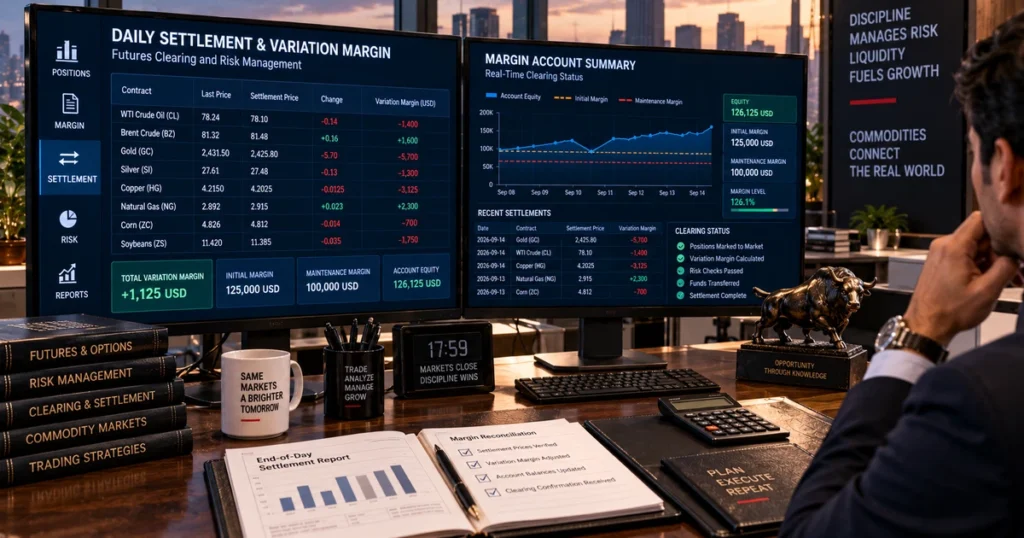
Commodity derivatives utilize performance collateral rather than borrowed money. Participants deposit Initial Margin to establish a position and must maintain account equity above a Maintenance Margin threshold. Positions are marked to market through the clearing process, with cash Variation Margin payments applied according to the clearing schedule to settle daily or intraday gains and losses.
Unlike equities margin—which involves borrowing cash from a broker to buy shares and paying interest on the borrowed funds—futures margin on a commodity exchange is a collateral performance bond held in segregated accounts to ensure that trading obligations can be fulfilled.
Core Margin Components:
- Initial Margin: The collateral required to open a new futures position. Determined by exchange risk algorithms (such as CME SPAN or SPAN 2), initial margin can represent a relatively small percentage of a contract’s notional value, but the exact requirement varies substantially by product, market volatility, portfolio composition, clearing rules, and individual broker policies. Risk models are designed to cover potential adverse price movements over the applicable margin horizon at a high statistical confidence level.
- Maintenance Margin: The minimum level of account equity required to keep a leveraged position open. It is often set below the initial margin requirement, but the exact relationship varies by product, exchange schedule, and broker.
- Variation-Margin Settlement (Mark-to-Market): Positions are marked to market through the clearing process, with settlement and variation-margin requirements applied according to the exchange and clearing schedule (with many modern clearing houses running multiple intraday and end-of-day settlement cycles):
- Profits: Credited to the account through the settlement process, subject to applicable clearing and broker procedures.
- Losses: Debited directly from the account collateral balance.
                  ┌────────────────────────────────────────────────────────┐
                  │          INITIAL MARGIN DEPOSITED ($10,000)            │
                  │   Position Opens: 1 WTI Crude Contract ($70,000 Val)   │
                  └───────────────────────────┬────────────────────────────┘
                                              │
                      ┌───────────────────────┴───────────────────────┐
                      │                                               │
                      ▼                                               ▼
         [MARKET MOVES IN FAVOR]                         [MARKET MOVES AGAINST]
   Session 1: Oil Rises +$2.00 (+$2,000)           Session 1: Oil Falls -$2.50 (-$2,500)
                      │                                               │
                      ▼                                               ▼
      Account Equity = $12,000                        Account Equity = $7,500
   +$2,000 cash credited via mark-to-market.       Equity drops below Maintenance Margin
   Available subject to account rules.             Threshold ($8,000).
                                                                      │
                                                                      ▼
                                                      ┌────────────────────────────────┐
                                                      │       MARGIN CALL ISSUED       │
                                                      │ Trader must deposit $2,500 cash│
                                                      │ to restore the account to the  │
                                                      │ full Initial Margin ($10,000). │
                                                      └────────────────┬───────────────┘
                                                                       │
                                                      Fails to meet? ──┴───► Position liquidated
                                                                             by clearing broker.
*Note: Illustrative example only; actual margin requirements, price changes, and maintenance thresholds vary by contract, market volatility, and broker.
Physical Settlement: Delivery Instruments, Vaults, and Facilities
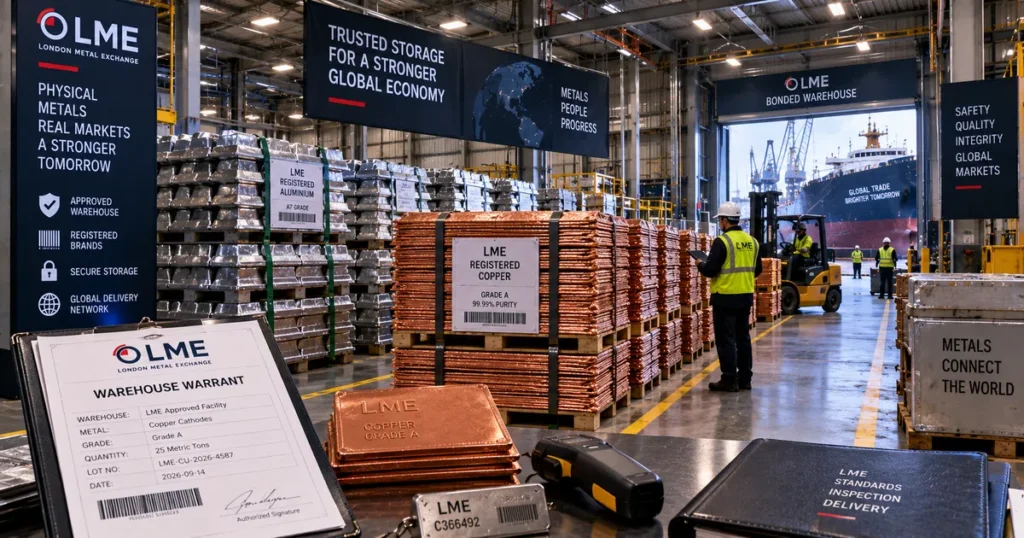
Quick Answer: How Does Delivery Work on a Commodity Exchange?
For physically deliverable contracts, fulfillment occurs through exchange-approved procedures, including the transfer of electronic Warehouse Receipts, Warrants, or Pipeline Allocation Certificates representing assayed goods held in certified facilities. For many actively traded futures markets, only a small fraction of contracts ultimately result in physical delivery, as most participants close or roll their positions before expiration.
Although the vast majority of financial participants close out positions prior to expiration, the physical delivery mechanism remains essential: for physically deliverable contracts, the delivery mechanism provides an important anchor for convergence between futures and physical-market prices near expiration.
The Physical Delivery Cycle:
- Notice of Delivery: As a deliverable contract approaches expiration, an eligible seller issues an official notice through the clearing house specifying deliverable inventory located in an exchange-approved facility.
- Clearing Assignment: The clearing house matches delivery intentions with eligible long positions according to the applicable exchange allocation and assignment rules.
- Delivery Instruments: Depending on the contract, physical delivery may involve warehouse receipts, shipping certificates, warrants, delivery orders, pipeline allocations, or other exchange-specified delivery mechanisms.
- Ownership Transfer: The buyer pays the final settlement amount through the clearing system and takes legal ownership of the certified delivery instrument, assuming subsequent storage, insurance, and handling responsibilities.
Physical Delivery vs. Cash Settlement
- Physically Delivered Contracts: Common in bulk commodities with established commercial storage infrastructure (e.g., NYMEX WTI crude oil at Cushing, CME corn, LME copper).
- Cash-Settled Contracts: Employed where physical transportation is logistically complex, highly perishable, or geographically dispersed. Contracts settle financially against a verified spot index price (e.g., CME Feeder Cattle and CME Lean Hogs), a structure explored in our comprehensive guide to commodities.
The Major Global Commodity Exchanges: CME, LME, ICE, and Regional Powerhouses
Quick Answer: What Are the Primary Global Commodity Exchanges?
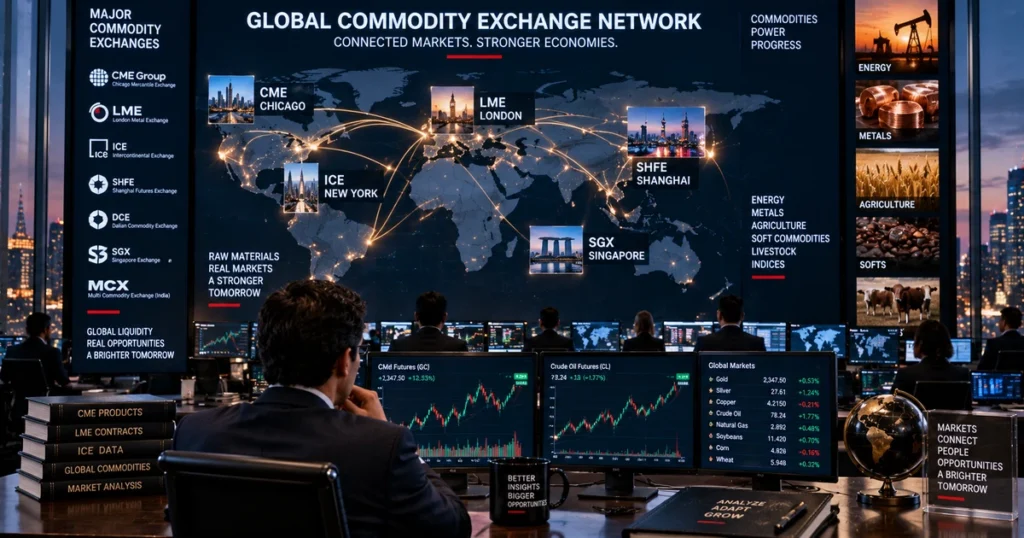
The primary global commodity exchanges include CME Group (headquartered in Chicago, USA), The London Metal Exchange (LME) (London, UK), and Intercontinental Exchange (ICE) (Atlanta, New York, and London). In Asia, major hubs include the Shanghai Futures Exchange (SHFE), the Dalian Commodity Exchange (DCE), and India’s Multi Commodity Exchange (MCX).
+---------------------------------------------------------------------------------------------------+
|                              THE GLOBAL COMMODITY EXCHANGE ECOSYSTEM                              |
+---------------------+-----------------------------+-----------------------+-----------------------+
| EXCHANGE / GROUP    | HEADQUARTERS & VENUES       | DOMINANT COMMODITY    | FLAGSHIP BENCHMARK    |
|                     |                             | COMPLEXES             | CONTRACTS             |
+---------------------+-----------------------------+-----------------------+-----------------------+
| **CME Group**       | Chicago, USA                | Energy, Precious &    | WTI Crude Oil (`CL`), |
| (CBOT, NYMEX, COMEX)| (Trading: Chicago & NY;     | Base Metals, Grains,  | Gold (`GC`), Corn     |
|                     | Electronic: CME Globex)     | Livestock             | (`ZC`), Copper (`HG`) |
+---------------------+-----------------------------+-----------------------+-----------------------+
| **London Metal      | London, United Kingdom      | Industrial Non-Ferrous| LME Copper Grade A,   |
| Exchange (LME)**    | (Electronic: LMEselect;     | Base Metals           | Primary Aluminum,     |
|                     | Physical Floor: The Ring)   |                       | Nickel, Zinc, Lead    |
+---------------------+-----------------------------+-----------------------+-----------------------+
| **Intercontinental  | Atlanta, New York & London  | Global Seaborne Energy| Brent Crude (`B`),    |
| Exchange (ICE)**    | (Electronic: ICE Platform)  | European Gas, Tropical| Dutch TTF Gas, Coffee |
|                     |                             | Softs (Cocoa, Sugar)  | Arabica, Sugar No. 11 |
+---------------------+-----------------------------+-----------------------+-----------------------+
| **Shanghai Futures  | Shanghai, China             | Industrial Metals,    | SHFE Copper, Fuel Oil,|
| Exchange (SHFE)**   | (Mainland China Onshore)    | Energy, Rubber,       | Rebar, Natural Rubber |
|                     |                             | Chemical Products     | (Traded in CNY)       |
+---------------------+-----------------------------+-----------------------+-----------------------+
| **Multi Commodity   | Mumbai, India               | Precious Metals,      | MCX Gold, Crude Oil,  |
| Exchange (MCX)**    | (Electronic Platform)       | Energy, Industrial    | Natural Gas, Silver   |
|                     |                             | Base Metals           | (Traded in INR)       |
+---------------------+-----------------------------+-----------------------+-----------------------+
| **Dalian Commodity  | Dalian, China               | Bulk Agriculture,     | DCE Iron Ore, Soybean |
| Exchange (DCE)**    | (Mainland China Onshore)    | Ferrous Metals,       | Meal, Metallurgical   |
|                     |                             | Plastics              | Coking Coal           |
+---------------------+-----------------------------+-----------------------+-----------------------+
CME Group: Multi-Asset Scale
Formed through mergers combining the Chicago Mercantile Exchange (CME), the Chicago Board of Trade (CBOT), the New York Mercantile Exchange (NYMEX), and the Commodity Exchange (COMEX), CME Group offers around-the-clock electronic trading via its CME Globex platform across agricultural, energy, interest rate, and metals contracts.
The London Metal Exchange (LME): Physical Industrial Specialization
Established in 1877, the LME is an international hub for non-ferrous metals trading. The exchange utilizes a prompt-date structure designed around physical commercial shipping schedules, backed by an international network of exchange-approved storage warehouses across Asia, Europe, and the United States.
Intercontinental Exchange (ICE): International Energy and Softs
Founded in 2000, ICE expanded through the acquisition of the International Petroleum Exchange (IPE) and the New York Board of Trade (NYBOT). ICE hosts Brent Crude, an international waterborne pricing benchmark, alongside European natural gas benchmarks and agricultural soft commodities.
Commodity Exchanges in India: MCX, NCDEX, and SEBI Oversight
Quick Answer: How Do Commodity Exchanges Operate in India?
In India, commodity derivatives trading is regulated by the Securities and Exchange Board of India (SEBI). The domestic market includes major electronic venues such as the Multi Commodity Exchange of India (MCX), which has a strong focus on non-agricultural derivatives including gold, silver, crude oil, and base metals, and the National Commodity & Derivatives Exchange (NCDEX), which is particularly focused on agricultural commodity derivatives such as guar seed, spices, pulses, and oilseeds.
India is a major physical consumption and import market for gold, edible oils, energy, and pulses. Its domestic exchange framework provides hedging infrastructure tailored to regional commercial standards:
+---------------------------------------------------------------------------------------------------+
|                            THE INDIAN COMMODITY DERIVATIVES FRAMEWORK                             |
+---------------------+-----------------------------+-----------------------+-----------------------+
| EXCHANGE VENUE      | HEADQUARTERS & TRADING      | DOMINANT COMMODITY    | KEY BENCHMARK         |
|                     | PLATFORM                    | FOCUS                 | CONTRACTS             |
+---------------------+-----------------------------+-----------------------+-----------------------+
| **Multi Commodity   | Mumbai, Maharashtra         | Precious Metals,      | Gold, Silver,         |
| Exchange (MCX)**    | (Electronic Matching Engine)| Energy, Base Metals   | Crude Oil, Natural Gas|
+---------------------+-----------------------------+-----------------------+-----------------------+
| **National Commodity| Mumbai, Maharashtra         | Agricultural Staples, | Guar Seed, Jeera,     |
| & Derivatives Exch. | (Electronic Matching Engine)| Oilseeds, Spices,     | Turmeric, Chana,      |
| (NCDEX)**           |                             | Grains & Pulses       | Castor Seed           |
+---------------------+-----------------------------+-----------------------+-----------------------+
Regulatory Architecture and Market Access in India:
- SEBI Regulatory Framework: Following the merger of the Forward Markets Commission (FMC) into SEBI in September 2015, the regulation of commodity derivatives was unified under the capital market regulator. SEBI establishes margin requirements, enforces position limits, conducts real-time market surveillance, and oversees contract design and settlement protocols.
- Domestic Physical Delivery and Clearing: Trades on Indian exchanges clear through dedicated clearing entities—such as the Multi Commodity Exchange Clearing Corporation (MCXCCL) and the National Commodity Clearing Limited (NCCL). Physical deliveries are handled via an accredited network of domestic certified depositories and delivery centers (e.g., gold vaulting facilities in Ahmedabad and base metal centers in Thane/Bhiwandi).
- Retail and Institutional Participation: Domestic retail traders, proprietary trading firms, and commercial corporations can access MCX and NCDEX commodity derivatives through registered intermediaries and brokers, subject to applicable SEBI and exchange rules. Institutional participation is also permitted under defined regulatory frameworks, including participation by eligible mutual funds and SEBI-registered Foreign Portfolio Investors (FPIs) in exchange-traded commodity derivatives.
Market Regulation: The Role of the CFTC, Position Limits, and Market Surveillance
Quick Answer: Who Regulates Commodity Exchanges?
In the United States, commodity derivatives are regulated primarily under the Commodity Futures Trading Commission (CFTC) framework. In the United Kingdom, the Financial Conduct Authority (FCA) oversees the relevant commodity-derivatives regulatory regime. In the European Union, national competent authorities apply the MiFID II/MiFIR framework, with the European Securities and Markets Authority (ESMA) providing the EU-level supervisory and regulatory framework. Regulators mandate capital standards, review exchange rulebooks, and establish speculative position limits and accountability levels to mitigate market manipulation risks.
Regulatory authorities oversee commodity derivatives trading through structured statutory tools:
1. Speculative Position Limits and Accountability Levels
To prevent single market participants from establishing excessive market power that could distort cash or derivatives pricing, regulators establish Position Limits:
- Spot-Month Limits: Impose strict ceilings on the number of contracts a speculative entity can hold in the days immediately prior to expiration, helping prevent physical squeeze scenarios.
- Accountability Levels: Thresholds that prompt exchange surveillance inquiries, requiring traders to provide documentation regarding commercial intent and financial resources.
2. Market Surveillance and Dynamic Circuit Breakers
Exchanges operate automated surveillance systems to monitor order flows and identify abnormal price movements:
- Velocity Logic and Halts: When rapid, unorderly price swings occur within short time windows, matching systems can trigger automated trading pauses, providing market participants time to assess order depth.
- Daily Price Limits: Daily price limits vary by contract and can expand or adjust under exchange rules to manage extreme intraday price volatility.
Comparative Analysis: Commodity Exchanges vs. Stock and Forex Markets
Quick Answer: How Does a Commodity Exchange Differ from a Stock Exchange?
While stock exchanges list equity shares representing ongoing corporate ownership, commodity exchanges trade standardized contracts based on physical raw materials. Commodity derivatives feature contract expiration dates, utilize performance margins rather than borrowed capital, and exhibit matched long and short open interest.
| Structural Dimension | Commodity Futures Exchange | Stock Exchange (Equities) | Foreign Exchange Market (Forex) |
| Primary Instruments | Standardized Futures & Options | Common & Preferred Shares | Currency Pairs & Forwards |
| Market Architecture | Electronic Order Books & Venues + CCP | Exchange order book + centralized clearing in many major markets | Decentralized OTC Interbank |
| Contract Cash Flow | No equity-style dividend; returns depend on price, carry & roll | Discretionary Dividends | Overnight Interest (Carry Yield) |
| Contract Horizon | Strict Expiration Schedule | Indefinite (Perpetual Equity) | Spot / Customized Forwards |
| Contract Issuance | Matched Longs and Shorts | Positive Corporate Share Count | Matched Currency Exchange |
| Leverage Mechanism | Often substantial; varies by product, margin rules & broker | Regulated Margin Loan (e.g., Reg T) | Broker-Provided Margin |
| Physical Settlement? | Yes (Approved facilities & delivery instruments) | Digital Share Custody | Electronic Currency Balances |
Understanding these structural differences is essential for allocators assessing resource-heavy benchmarks such as the Canada TSX and the Australia ASX 200, alongside corporate large-cap indices like the USA S&P 500.
Common Myths vs. Empirical Facts
- Myth: Trading on a commodity exchange means raw materials will be delivered to a retail trader’s home.
- Fact: Many retail brokers require customers to close or roll physically deliverable futures before the broker’s delivery cutoff, while eligible commercial or institutional participants may proceed through the formal delivery process.
- Myth: Commodity exchanges set global commodity prices.
- Fact: Exchanges do not set prices; they provide the neutral electronic marketplace where buyers and sellers transact. Market prices reflect broader supply-demand fundamentals, geopolitical events, weather cycles, and production economics.
- Myth: Central clearing eliminates all market risk.
- Fact: Central clearing reduces bilateral counterparty credit risk through novation, but market price risk remains. Adverse price movements require accounts to satisfy variation margin obligations.
- Myth: Only physical commodities can be traded on commodity exchanges.
- Fact: While physical commodities underpin the market, commodity exchanges also list financial derivatives, cash-settled indices, and options contracts that do not involve physical goods.
Frequently Asked Questions
What is the primary purpose of a commodity exchange?
A commodity exchange provides a regulated, centralized marketplace for transparent price discovery, commercial risk hedging, and contract standardization across major global raw materials.
How do commodity exchanges generate revenue?
Exchange groups and their affiliated clearing businesses generate revenue from transaction and clearing services, market data licensing feeds, connectivity infrastructure, and contract listing services.
What is novation in commodity derivatives clearing?
Novation is the legal process where the clearing house substitutes itself into an executed trade, becoming the buyer to every seller and the seller to every buyer, thereby mitigating bilateral counterparty credit risk.
Can an individual retail investor trade directly on a commodity exchange?
No. Retail traders generally access exchange-traded commodity derivatives through a registered broker or Futures Commission Merchant (FCM), rather than connecting directly to the exchange’s matching engine.
What happens when a futures contract reaches expiration?
If a position remains open past the expiration deadline, physically deliverable contracts proceed to delivery under exchange rules, while cash-settled contracts are balanced financially based on an official final settlement index.
Strategic Summary & Core Takeaways
- Centralized Market Venue: A commodity exchange is a regulated marketplace providing standardized contracts, transparent price discovery, and institutional liquidity for raw materials.
- Contract Standardization: Exchanges remove bilateral negotiation friction by defining uniform contract sizes, deliverable quality thresholds, and approved delivery mechanisms.
- The Function of Central Clearing: Central Counterparty Clearing Houses utilize legal novation to become the counterparty to cleared trades, managing systemic risks through structured default waterfalls.
- Margin Disciplines: Exchanges mandate Initial Margin collateral and settle Variation Margin through scheduled mark-to-market cycles, preventing uncollateralized debt accumulation.
- Physical Market Alignment: For physically deliverable contracts, delivery procedures across approved facilities ensure financial futures prices converge with physical spot markets upon expiration.
Next Reading Suggestions
- What Is a Commodity? The Complete Guide to Fungible Goods, Raw Materials, and Global Market Value
- What Is Gold? The Complete Guide to Real Money, Store of Value & Why It Matters
- How Stock Prices Are Determined: Market Microstructure, Supply and Demand, and Valuation
- What Is Market Capitalization? The Complete Guide to Market Cap, Company Size, and Valuation
- Interest Rates and Exchange Rates: The Complete Guide to Global Currency Pricing
- Fed Rate Cuts & Global Liquidity: The Complete Guide to Interest Rates, the Fed Balance Sheet, and Asset Markets
- Canada TSX: The Complete Guide to the S&P/TSX Composite Index, Methodology, and Market Structure
- Australia ASX 200: The Complete Guide to the S&P/ASX 200 Index, Methodology, and Market Structure
Author Box & E-E-A-T Verification
Written & Researched By: CurrencyPlans Editorial Research Team
Editorial Review & Methodological Standards: This commodity exchange educational guide is developed using regulatory statutes, exchange operating rulebooks, and clearing house risk protocols, informed by official publications from the Commodity Futures Trading Commission (CFTC), CME Group, the London Metal Exchange (LME), and the Intercontinental Exchange (ICE).
Educational References & Market Data Sources
For official exchange rulebooks, clearing house risk parameters, and regulatory frameworks, consult primary regulatory and exchange portals directly:
- U.S. Commodity Futures Trading Commission (CFTC Regulatory Portal): CFTC
- CME Group (Exchange Rulebooks, Product Specs & Clearing Manual): CME Group
- London Metal Exchange (LME Rulebook & Warehouse Network Data): LME
- Intercontinental Exchange (ICE Operations, Clearing Rules & Margins): ICE
- Securities and Exchange Board of India (SEBI Commodity Derivatives Regulations): SEBI
- Multi Commodity Exchange of India (MCX Market Operations & Rules): MCX India
- Bank for International Settlements (CPMI-IOSCO Principles for Financial Market Infrastructures): BIS
- Financial Conduct Authority (UK Market Oversight & Derivative Rules): FCA
- European Securities and Markets Authority (Commodity Derivatives Framework): ESMA
Educational Disclaimer
This guide is prepared strictly for educational, research, and informational purposes and does not constitute personalized financial, investment, trading, or tax advice. Commodity spot markets, derivative futures contracts, and exchange trading involve significant capital risk and substantial leverage. Past exchange pricing performance and historical basis patterns do not guarantee future financial results. Always conduct independent research and consult a licensed fiduciary financial advisor before allocating trading capital.

