

Introduction
Imagine buying a brand-new delivery truck, driving it for a single delivery, and then rolling it straight off a pier into the ocean. Nobody would run a business like that—buying a new vehicle every morning would bankrupt any company on Earth. Yet, for decades, space rockets were treated as disposable, single-use hardware that ended up at the bottom of the sea.
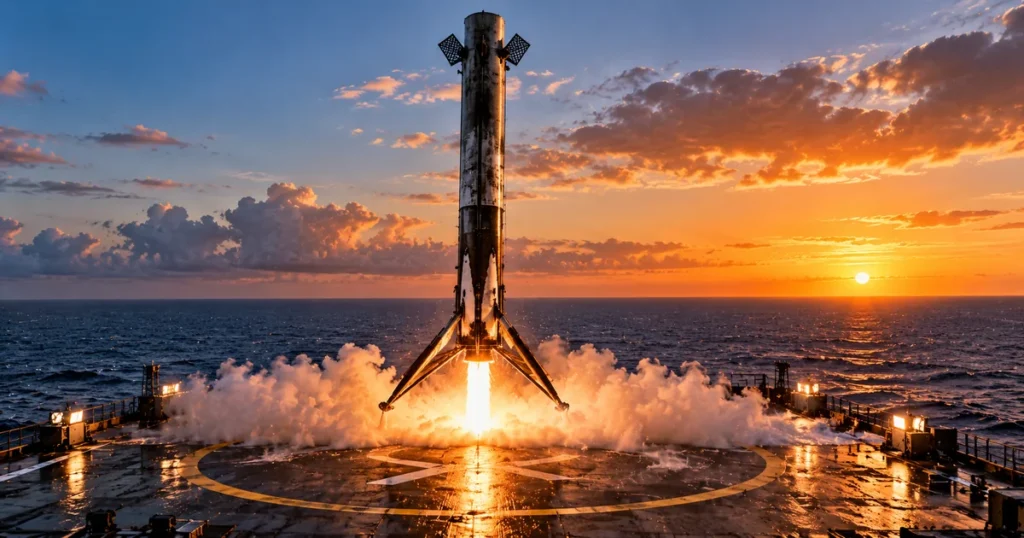
SpaceX flipped that entire logic on its head by showing that a first-stage booster could land softly on its feet and fly again.
That shift in launch economics paved the way for its high-profile public listing on the Nasdaq under the ticker SPCX. With spcx stock trading around $148.68 in late September 2026 and supporting a market valuation near $2.02 trillion, retail and institutional traders alike are keeping a close watch. Here is a straightforward, plain-English look at how the business actually makes money, what moves spcx stock, and how everyday investors can approach it.
How Does SpaceX Actually Make Money?
While SpaceX is widely known for orbital rocketry, its corporate filings disclose three primary operating business segments:
1. Space (Launch Operations & Development)
This is the commercial delivery arm of the business. NASA contracts SpaceX to fly astronauts and cargo to the International Space Station, while commercial satellite operators and international agencies purchase payload space on Falcon 9 and Falcon Heavy rockets. By recovering and reusing first-stage boosters across dozens of flights, the company minimizes the cost of building new primary hardware. In official filings for Q2 2026, the Space segment generated $962 million in quarterly revenue, comprising $648 million from Launch Services and $314 million from Launch and Development.
2. Connectivity (Starlink Broadband)
Deploying physical fiber cables through rural terrain, across open oceans, and into remote settlements is slow and capital-intensive. Starlink bypasses terrestrial ground cables by operating a low-Earth orbit satellite network. Customers install an external satellite terminal to connect directly to the constellation.
According to regulatory disclosures and industry data cited by the FCC, Starlink’s global subscriber base reached 12 million by June 30, 2026. For Q2 2026, the Connectivity segment generated $4.291 billion in revenue, divided between $2.485 billion in Consumer services and $1.806 billion in Enterprise and Government accounts. This makes Connectivity SpaceX’s largest revenue-generating segment.
3. AI & Compute Infrastructure
Following the acquisition of xAI in early 2026, SpaceX integrated artificial intelligence and computing infrastructure into its third primary reporting division. This segment spans Grok AI models, specialized enterprise AI solutions, operations tied to the X platform, and large-scale AI data center capacity. AI segment revenue is derived from software subscriptions, enterprise data licensing, platform advertising, developer API access, and cloud compute services, generating approximately $2.561 billion in revenue during Q2 2026.

What Factors Can Influence SPCX’s Valuation?
Like any newly listed technology and aerospace enterprise, spcx stock experiences operational and market-driven price movement. Several core business drivers shape sentiment:
- Growth and Revenue Catalysts:
- Connectivity Expansion: Continued additions to the global Starlink subscriber base across consumer, maritime, and airline sectors support quarterly recurring revenue.
- Long-Term Government Contracts: Long-term federal procurement provides contracted revenue visibility. In Q2 2026 disclosures, SpaceX reported more than $6 billion in multi-year U.S. government contracts for its Starshield defense communications program.
- Commercial Payload Volume: Sustained commercial launch cadence and institutional contracts provide ongoing demand for the Space division.
- Capital Intensity and Financial Headwinds:
- High Research and Capital Outlays: Developing heavy orbital systems like Starship and scaling computing clusters requires substantial capital. SEC disclosures show SpaceX spent roughly $3.004 billion on Starship research and development during 2025. Across all business units, segment capital expenditures reached $18.369 billion in Q2 2026, while the company reported a net loss of $541 million for the quarter.
- Regulatory Approvals: Rocket launches and satellite constellations require strict compliance, licensing, and spectrum rights from regulatory bodies like the FAA and FCC. Administrative or environmental reviews can alter operational timelines.
- Macroeconomic Conditions: Changes in central bank interest rates, sovereign bond yields, and broader equity market sentiment directly influence valuation multiples for high-growth tech companies.
How Everyday Investors Should Look at Space Companies
For those analyzing public aerospace and satellite equities, maintaining a balanced framework is essential:
- Account for High Volatility: Stocks in capital-intensive development sectors rarely move in a smooth trend. Quarterly earnings variations, regulatory rulings, or technical flight anomalies can trigger swift share price swings.
- Maintain Portfolio Diversification: Concentrating excessive capital into any single high-valuation company elevates investment risk. Sizing decisions should reflect your personal financial situation, risk tolerance, investment timeline, and broad asset allocation.
- Monitor Unit Economics Over Social Hype: High-profile flight tests draw attention, but underlying balance sheet health is evaluated through subscriber retention, operating cash flows, and capital expenditure discipline.
CurrencyPlans Market Fetcher — 15-Minute Model Snapshot
- Ticker / Exchange: NASDAQ: SPCX
- Session Reference: September 25, 2026 (16:00 EDT Market Close)
- Model Inputs: Multi-factor confluence (VWAP, EMA20, Order Flow Volume Imbalance)
- Model Score: 55 Upside Bias / 45 Neutral-Consolidation
- Evaluation Window: Next 1–3 15-minute bars (approximately 15–45 minutes)
Note: This indicator represents a mathematical output derived from our terminal’s algorithmic model on a 15-minute timeframe. It does not measure the absolute probability of market gains, and it is not a personalized investment recommendation.
Frequently Asked Questions (FAQ)
What company trades under the ticker symbol SPCX?
The ticker SPCX belongs to Space Exploration Technologies Corp. (SpaceX), a publicly listed company on the Nasdaq that operates commercial launch services, the Starlink global satellite constellation, and enterprise AI and computing infrastructure.
How does SpaceX generate its primary revenue?
SpaceX reports revenue across three main operating divisions: Connectivity (Starlink broadband subscriptions and enterprise services), AI (computational infrastructure, subscriptions, advertising, and API licensing), and Space (commercial, civil, and defense launch logistics).
Does SpaceX pay a cash dividend on SPCX stock?
No dividends had been declared on SpaceX Common Stock through June 30, 2026, according to the company’s SEC filings. Available operational capital and financing are reinvested into vehicle manufacturing, network infrastructure, and computational capacity.
What are the main business risks associated with SPCX stock?
Primary investment risks include large capital expenditure requirements across computing and rocket programs, quarterly net operating losses, regulatory and spectrum licensing oversight, and broad equity market volatility.
Next Reading Suggestions
- How Stock Prices Are Determined: Market Microstructure, Supply and Demand, and Valuation
- What Is Market Capitalization? The Complete Guide to Market Cap, Company Size, and Valuation
- Hard Commodities: The Complete Guide to Extracted Resources, Energy Markets, and Industrial Metals
- Interest Rates and Exchange Rates: The Complete Guide to Global Currency Pricing
- Commodity Prices: How They Are Determined, Key Drivers, and Futures Pricing
Author Box & E-E-A-T Verification
Written & Researched By: CurrencyPlans Editorial Research Team
Editorial Review & Methodology: This corporate explainer compiles public equity data, regulatory disclosures, and operational filings. Financial performance figures, segment revenue splits, and capital spending metrics are verified directly against SpaceX’s SEC Form 10-Q filings and quarterly earnings disclosures. Satellite subscriber totals and commercial launch authorizations are cross-referenced with public documents from the Federal Communications Commission (FCC) and the Federal Aviation Administration (FAA).
Educational References & Primary Sources
- U.S. Securities and Exchange Commission (SpaceX Public Filings & Form 10-Q): https://www.sec.gov/edgar/browse/?CIK=0001181412
- Federal Communications Commission (Satellite Licensing & Starlink Metrics): https://www.fcc.gov/
- Federal Aviation Administration (Commercial Space Transportation): https://www.faa.gov/space
- Nasdaq Market Quotes & Historical SPCX Data: https://www.nasdaq.com/market-activity/stocks/spcx
Educational Disclaimer
This publication is prepared strictly for educational, research, and informational purposes. Nothing contained herein constitutes personal financial, investment, legal, or tax advice. Investing in individual equities involves financial risk, including the possible loss of principal. Historical operating milestones and launch achievements do not guarantee future stock performance. Consider speaking with a qualified financial professional before making investment decisions.

