

The capital preservation frameworks of global finance did not achieve institutional dominance by accident. They were forged through centuries of currency collapses, debt hyper-expansions, and sovereign wealth re-allocations that continuously dictated the rules of capital survival. To master the operational dynamics of portfolio protection, market participants must study the strategic layers outlined in this definitive Gold Investment Guide.
What began as raw physical bullion exchanges in ancient marketplaces has morphed into a multi-trillion-dollar liquidity complex operating seamlessly across physical vaults, paper derivatives, sovereign debt instruments, and digital spot execution platforms. This evolution provides institutional desks, high-net-worth individuals (HNWIs), and retail investors with unprecedented flexibility. However, navigating this vast ecosystem requires a granular understanding of counterparty risks, taxation structures, tracking errors, and physical delivery mechanics.
Every modern allocation framework—whether designed to shield capital against currency debasement or to optimize risk-adjusted portfolio returns—relies on the core principles detailed in this Gold Investment Guide. Understanding how physical spot pricing translates into ETF units, sovereign paper, and digital tokens is the single most critical advantage an investor can possess in an era defined by global monetary volatility.
Featured Snippet Block
A comprehensive Gold Investment Guide establishes that gold functions primarily as a zero-counterparty-risk monetary anchor, rather than a speculative yield-generating asset. By diversifying across physical bullion (bars/coins), paper assets (Gold ETFs/Sovereign Bonds), and digital execution platforms, investors can effectively hedge against fiat inflation, systemic banking crises, and currency devaluations while maintaining intra-day portfolio liquidity.
Key Takeaways from the Gold Investment Guide
- Zero Counterparty Risk: Direct physical gold ownership represents an unencumbered monetary asset free from corporate default liabilities.
- Systemic Inflation Shield: Gold historically maintains real purchasing power across multi-decade currency debasement cycles (Source: World Gold Council).
- Diverse Ownership Pipelines: Allocation can be executed via physical bullion, paper ETFs, sovereign bonds, or digital spot protocols.
- Portfolio Volatility Reduction: A strategic 5% to 15% allocation reduces total portfolio drawdown during severe equity bear markets.
The Macroeconomic Engine: Why Does Gold Command Modern Portfolio Allocations?
Inflation Hedging and Fiat Devaluation Dynamics
Throughout monetary history, paper currencies managed by central authorities have systematically lost purchasing power due to expansionary money supply policies. Any rigorous Gold Investment Guide begins by illustrating gold’s unique mathematical scarcity. Unlike fiat paper, which can be issued at zero marginal cost, gold requires substantial physical capital, energy, and labor to extract and refine.

Figure 2: Central banks globally maintain physical gold reserves to anchor sovereign balance sheets against inflation (Source: World Gold Council Data).
When central banks expand M2 money supply, the nominal prices of finite physical assets adjust upward. Over multi-decade cycles, gold acts as a pure purchasing power stabilizer. While equities fluctuate based on earnings reports and corporate debt structures, gold prices reflect the real-time dilution of fiat currency units, making it the primary defensive asset for long-term capital preservation.
💡 Simple Meaning: Fiat Devaluation
Fiat Devaluation ka seedha matlab hai Jab government ya central bank zaroorat se zyada kagazi note (paper money) print karti hai, toh har ek note ki value kam ho jaati hai. Gold finite hai (ise print nahi kiya ja sakta), isliye jab paper currency sasti hoti hai, gold ka price automatically badh jata hai.
Central Bank Accumulation and Sovereign Debt Reserves
To understand why retail and institutional participants require a Gold Investment Guide, one must analyze the balance sheet behaviors of global central banks. Official institutional data from the World Gold Council (WGC) and the International Monetary Fund (IMF) confirms that sovereign institutions—including the Federal Reserve, the European Central Bank, the Reserve Bank of India (RBI), and the People’s Bank of China—hold massive percentages of their foreign exchange reserves in physical gold bullion.
During periods of geopolitical fragmentation and sovereign debt expansion, central banks accelerate their net gold purchases. This institutional accumulation creates a structural bid beneath the global spot market. When sovereign entities systematically swap paper debt liabilities for physical gold, they validate gold’s position as the ultimate tier-1 reserve asset in international finance.
🔗 Read Our Complete Guide: To explore official institutional vault holdings and country-wise breakdown, read our dedicated breakdown on [Global Central Bank Gold Reserves].
The Vehicles of Ownership: Analyzing Physical, Paper, and Digital Gold Pipelines
Physical Bullion, Bars, and Coins: Storage, Purity, and Liquidity Risk
For purists seeking total independence from the financial system, direct physical ownership remains the gold standard. As emphasized in every institutional Gold Investment Guide, physical gold must meet strict purity thresholds—typically 99.9% (24-karat) for investment-grade bars and minted bullion coins certified by accredited refiners (such as LBMA-approved facilities).

Figure 3: Direct physical gold ownership provides complete counterparty-free asset protection during market stress.
- Advantages: Zero counterparty risk; complete insulation from banking network closures or digital outages; absolute physical control.
- Disadvantages: Storage overheads (secure home vaults or private bank lockers); insurance costs; potential buy-sell spread costs (making charges and assay fees) upon liquidation.
💡 Simple Meaning: Counterparty Risk
Counterparty Risk = Agar samne wali company, bank, ya broker bankrupt/band ho jaye, toh kya aapka paisa doob jayega? Physical gold aapke haath me hota hai, isme ZERO counterparty risk hai. Par ETFs ya Digital Gold me aap bank/broker par depend rehte ho.
Sovereign Gold Bonds (SGBs) and Sovereign Debt Guarantees
Sovereign Gold Bonds represent a unique paper vehicle issued directly by sovereign entities (such as the Government of India through the Reserve Bank of India). Designed to convert physical gold demand into productive financial capital, these instruments track the domestic spot price of gold while providing an additional annual fixed interest coupon.
- Advantages: Complete elimination of storage and purity risks; annual fixed interest payouts; full exemption from capital gains tax if held until maturity.
- Disadvantages: Fixed lock-in periods (typically 5 to 8 years); secondary market illiquidity before maturity; exposure to sovereign policy shifts.
🔗 Read Our Complete Guide: Check domestic tax exemption rules and yield schedules in our deep dive on [Sovereign Gold Bond Tax & Maturity Rules].
Gold Exchange Traded Funds (ETFs) and Mutual Funds: Tracking Error & Expense Ratios
For active traders and tactical asset allocators, Gold ETFs offer the ideal middle ground between physical exposure and instant market execution. As detailed in this Gold Investment Guide, a Gold ETF holds physical 99.5%+ pure bullion in secure institutional vaults, issuing units on stock exchanges that track the real-time price of spot gold.

Figure 4: Digital platforms and ETFs provide seamless intra-day execution and liquidity without physical storage overheads.
- Advantages: Instant intra-day liquidity on stock exchanges; low transaction costs; no physical storage or security concerns for the holder.
- Disadvantages: Annual management expense ratios (TER); minor tracking errors due to cash buffers and fund fees; reliance on fund custodians and depository networks.
💡 Simple Meaning: Tracking Error
Tracking Error matlab exact gold ke market price aur aapke ETF unit ke price ke beech ka chhota sa farq. Ye farq fund manager ki fees (Expense Ratio) aur cash buffer rakhne ki wajah se aata hai.
🔗 Read Our Complete Guide: Want to compare top-performing Gold ETFs with the lowest expense ratios? Read our step-by-step [Complete Gold ETF Guide].
Digital Gold & Derivatives: High-Speed Spot Execution Protocols
Modern financial technology has democratized access through digital gold platforms and derivative contracts (futures and options). Digital gold allows fractional ownership, enabling investors to purchase micro-amounts of gold backed by physical bullion stored in audited vault networks.
- Advantages: Micro-investment flexibility; 24/7 digital accessibility via mobile platforms; seamless conversion options into physical jewelry or coins.
- Disadvantages: Lack of unified central exchange regulation across certain jurisdictions; potential holding fees after specified timeframes; platform counterparty reliance.
🔗 Read Our Complete Guide: To learn about fractional trading and security audits, explore our detailed analysis on [Digital Gold vs Physical Gold].
Comparative Architecture of Gold Investment Vehicles
Choosing the right ownership pipeline depends entirely on an investor’s timeline, liquidity needs, and risk tolerance. The following scannable matrix provided by our Gold Investment Guide breaks down the structural differences:
| Ownership Vehicle | Best For 🎯 | Primary Risk Factor | Annual Holding Costs | Liquidity Level | Tax Efficiency |
| Physical Bullion 👑 | Long-Term / Wealth Preservation | Physical Theft / Storage Risk | Vault/Locker Fees + Insurance | Medium (Local Dealers/Banks) | Capital Gains Tax Applicable |
| Sovereign Bonds 📜 | Low-Risk Passive Investors | Sovereign Policy Lock-in Risk | Zero (Pays Fixed Coupon) | Low on Exchanges (High at Maturity) | Tax-Exempt at Full Maturity |
| Gold ETFs / Funds 📈 | Active Traders & Arbitrageurs | Fund Custody / Counterparty Risk | Expense Ratio (0.2% – 0.8%) | Ultra-High (Stock Exchanges) | Debt Capital Gains Treatment |
| Digital Gold 📱 | Micro Beginners & SIP Buyers | Platform Custody / Regulatory Risk | Fractional Storage Fees | High (Mobile App Networks) | Capital Gains Tax Applicable |
| Futures & Options ⚡ | Institutional Speculators | Leverage & Margin Call Risk | Contract Roll Costs | Ultra-High (Derivatives Floor) | Business Income / Short-Term Tax |
Market Microstructure: How Spot Gold Prices Are Engineered Globally
London Bullion Market Association (LBMA) vs COMEX Futures
A critical chapter in any advanced Gold Investment Guide involves understanding price discovery. Spot gold pricing is determined through a continuous global loop dominated by two primary institutional hubs:
- The London Bullion Market Association (LBMA): The global center for Over-The-Counter (OTC) physical gold trading. The LBMA conducts daily electronic price auctions (the LBMA Gold Price) that serve as the global benchmark for producers, central banks, and refiners.
- The New York Mercantile Exchange (COMEX – CME Group): The world’s primary futures and options exchange for gold. COMEX prices reflect leveraged paper derivative trading, where institutional desks manage price risk through futures contracts.

Figure 5: Spot gold prices ($XAUUSD$) are continuously settled across London physical OTC markets (LBMA) and New York futures clearinghouses (COMEX).
The interaction between physical arbitrage in London and derivative leverage in New York drives the continuous spot ticker ($XAUUSD$) seen on trading screens worldwide.
💡 Simple Meaning: LBMA vs COMEX
LBMA (London) real physical gold bars ka bazaar hai jahan actual gold transfer hota hai. COMEX (New York) paper contracts (Futures/Options) ka bazaar hai jahan traders price ke upar-neeche hone par satebaazi aur hedging karte hain.
🔗 Read Our Complete Guide: To master trading order books and leverage limits, read our specialized breakdown on [Gold Futures & Options Trading Strategy].
Currency Pair Interplay: Spot Gold ($XAUUSD$) vs Domestic Currency Swaps
Because international spot gold is denominated in United States Dollars ($USD$), non-USD investors face a double-layered pricing dynamic. When evaluating local gold prices through this Gold Investment Guide, investors must calculate both global spot moves and domestic foreign exchange ($FX$) fluctuations:
$$\text{Local Gold Price} = (\text{Global Spot } XAUUSD \times \text{Domestic Currency Exchange Rate}) + \text{Import Tariffs/Taxes}$$
If spot gold prices remain flat in US Dollar terms, but a domestic currency depreciates against the USD, local gold prices will rise automatically. This currency conversion effect makes gold an exceptional dual-hedge against both global market volatility and domestic currency devaluation.
Advanced Portfolio Allocation Models & Risk Management Systems
The 5% to 15% Strategic Buffer: Rebalancing Trajectories During Market Panic
How much capital should an investor allocate to gold? Modern Portfolio Theory (MPT) and historical stress testing indicate that maintaining a 5% to 15% gold buffer optimizes the Sharpe ratio of a traditional equity-bond portfolio.
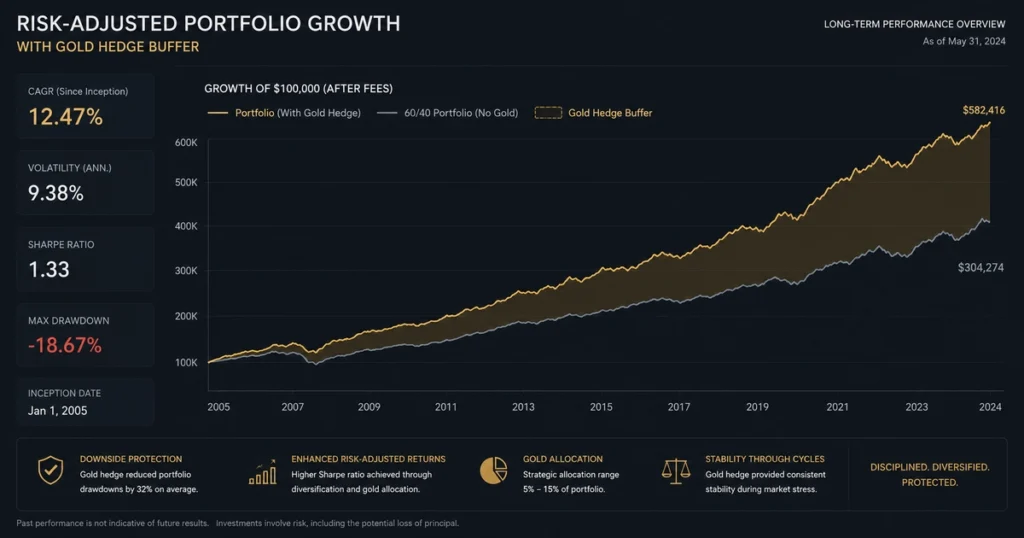
Figure 6: Allocating between 5% and 15% of total portfolio value to gold significantly reduces overall systemic portfolio drawdowns.
During severe economic shocks or liquidity freezes, equities and high-yield corporate bonds often experience correlated sell-offs. Gold, possessing a low-to-negative correlation with equities during panic phases, tends to appreciate or hold value. Rebalancing capital from outperforming gold holdings back into discounted equities during market troughs allows investors to systematically buy low and sell high.
Tax Optimization Frameworks and Long-Term Capital Gains (LTCG) Impact
Tax efficiency is a vital component of this Gold Investment Guide. Taxation rules vary significantly by jurisdiction, but understanding the classification of gains prevents unexpected yield erosion:
- Physical Gold & Digital Gold: Generally treated as capital assets subject to Short-Term Capital Gains (STCG) or Long-Term Capital Gains (LTCG) based on the holding period (typically 24 to 36 months).
- Gold ETFs: Taxed under prevailing capital gains regulations governing non-equity or debt-oriented fund structures in respective countries.
- Sovereign Debt Vehicles: Often offer structured tax incentives, where holding the instrument to full maturity completely eliminates capital gains tax liabilities.
🔗 Read Our Complete Guide: For exact jurisdiction slab rates and indexation benefits, read our updated manual on [Gold Investment Tax Rules].
Live Market Integration: Connecting Strategy to Real-Time Spot Prices
Strategic planning requires real-time execution context. While this Gold Investment Guide provides the structural allocation framework, monitoring intraday spot price movements ($XAUUSD$) and domestic bullion rates ensures optimal entry timing.
Before executing any portfolio rebalancing or physical bullion purchase, investors should cross-reference technical value areas, moving averages, and current import duty adjustments.
📊 Live Price Benchmark: To view real-time live spot rates, technical intraday support levels, and local conversion calculators, visit our dedicated tracking page: [Live Gold Price Today & Market Ticker].
Structural Flow of Global Physical Gold Liquidity Pipelines
The following technical flowchart illustrates the journey of gold from primary mine extraction to end-user portfolio allocation:
[Primary Gold Mining / Scrap Recycling]
                  │
                  ▼
   [LBMA Accredited Refineries (999.9 Purity)]
                  │
                  ▼
   [Global Wholesale Vaults (London / Zurich)]
                  │
        ┌─────────┴─────────┐
        ▼                   ▼
[Institutional Over-The-Counter]   [Exchange Vaults (COMEX / MCX)]
        │                   │
        ├───────────────────┼───────────────────┐
        ▼                   ▼                   ▼
[Physical Minting]    [Gold ETF Vaults]   [Central Bank Reserves]
        │                   │                   │
        ▼                   ▼                   ▼
[Jewelers / Retail]   [Demat / Brokerage] [Sovereign Balance Sheets]
Frequently Asked Questions About the Gold Investment Guide
Is physical gold better than paper gold ETFs for long-term investors?
Neither is universally “better”; choice depends on investment objectives. Physical gold provides absolute security against systemic financial system failures but incurs storage costs. Gold ETFs offer superior liquidity, zero storage hassle, and tighter buy-sell spreads, making them ideal for active portfolio rebalancing.
How does rising interest rate policy affect gold prices?
Gold is a non-yielding asset that does not pay interest or dividends. Traditionally, when real interest rates (nominal rates minus inflation) rise, the opportunity cost of holding gold increases, creating short-term headwinds. However, if rate hikes trigger economic recessions or credit crises, safe-haven demand for gold frequently overrides rate sensitivity.
What is the difference between 24K, 22K, and 18K gold in investments?
24K gold represents 99.9% pure gold and is the required standard for investment bullion bars, coins, and digital gold. 22K (91.6% pure) and 18K (75% pure) contain alloy metals like copper or silver to increase durability, making them standard for jewelry crafting rather than pure financial investment.
Can digital gold be converted into physical gold at any time?
Yes, most regulated digital gold platforms allow investors to convert accumulated digital balances into physical 24K coins or bars, provided the user meets the minimum weight requirements (typically starting at 0.5 grams or 1 gram) and pays nominal minting and delivery charges.
Why do central banks continue to hoard gold if paper fiat currency is official tender?
Central banks accumulate gold because it is a neutral asset without credit or counterparty risk (Source: World Gold Council). In international diplomacy and macroeconomics, gold represents the ultimate tier-1 settlement asset that cannot be frozen, inflated, or defaulted on by foreign governments.
Terminal Wrap-Up & Structural Allocation Checklist
Mastering the strategies outlined in this Gold Investment Guide empowers investors to transform a passive monetary asset into an active capital preservation engine. Whether your objective is shielding family wealth from persistent inflation, tactical intra-day trading, or structural portfolio diversification, gold remains the foundational anchor of risk management.
Investor Allocation Checklist:
- Define Goal: Determine whether your priority is emergency insurance (Physical), long-term tax-free wealth creation (Sovereign Bonds), or liquid trading (ETFs).
- Verify Purity: Ensure all physical purchases carry official hallmark/assay certifications (999.9 purity).
- Check Expense Ratios: Compare management fees across Gold ETFs to minimize tracking error drag.
- Establish Allocation Size: Maintain a disciplined 5% to 15% portfolio weight based on your broader risk tolerance.
How is your asset allocation framework balancing physical security against paper liquidity in today’s macroeconomic climate? Share your portfolio strategies and insights in the comments section below!
Educational Financial Disclaimer
This article is written entirely for educational, research, and historical context. It does not constitute financial advice, investment recommendations, or an endorsement to buy or sell any specific asset class or commodity. Precious metals carry market risks and price volatility. Past historical performance is never a guarantee of future market results.

