

The history of gold mirrors the astonishing transformations human civilization has witnessed over the past 5,000 years. While mighty empires have crumbled into dust, magnificent cities have been reclaimed by nature, and thousands of paper currencies have flared into existence only to vanish into worthlessness, gold has stood the test of time. Throughout this chaotic march of history, this single tangible asset has steadfastly preserved its purchasing power, cultural prestige, and absolute authority.
Gold is far more than a lustrous, dense chemical element. It functions as the ultimate architectural anchor of human trust, wealth, and geopolitical leverage. From the sacred rituals of ancient river valley civilizations to the complex algorithmic architectures of modern electronic financial networks, gold has consistently served as the world’s premier monetary baseline. Unlike fiat banknotes or digital ledger entries—both of which rely entirely on the perceived stability and legal enforcement of issuing governments—gold’s value remains self-contained. It is firmly rooted in its absolute geological scarcity, physical indestructibility, and universal, boundary-transcending acceptance.
Even in today’s hyper-financialized global economy, which is heavily populated by sovereign debt instruments, derivatives, and algorithmic cryptocurrencies, central banks are quietly accumulating physical gold bars at historic rates. Institutional and retail investors worldwide look to it as the definitive safe-haven shield against systemic inflation, banking crises, and currency debasement. To understand why this ancient element remains one of the most critical structural pillars of global finance, one must meticulously retrace its extraordinary journey across millennia.

Gold at a Glance: A Historical Snapshot
Before exploring the deep chronological narrative of gold, the following analytical matrix summarizes the crucial milestones, metrics, and structural shifts that defined the metal’s evolution from a sacred ornament into an institutional asset class:
| Metric / Structural Milestone | Historical Insight & Systemic Significance |
| First Recorded Extraction | Circa 3,000 BCE in Ancient Egypt (Nile Valley and Nubian deserts). |
| Primary Cultural & Natural Symbolism | Absolute wealth, divine immortality, pure sovereignty, and solar power. |
| Inauguration as Official Currency | Circa 700 BCE by the Kingdom of Lydia (Modern-day Anatolia, Turkey). |
| Global Monetary Standard Era | 1870–1971 (Marking the peak and eventual dismantling of formal gold backing). |
| Modern Macroeconomic Role | Ultimate sovereign reserve asset, systemic risk hedge, and safe-haven anchor. |
| Dominant Global Custodians | G10 Central Banks, Sovereign Wealth Funds, and the International Monetary Fund (IMF). |
The Origins of Gold in Ancient Civilizations
Gold’s profound relationship with humanity began the moment early miners extracted the pristine, un-oxidized yellow metal directly from riverbeds and shallow veins. Because it occurs naturally in an elemental, highly pure state, it did not require advanced smelting techniques to reveal its breathtaking brilliance.

1. Ancient Egypt: The Sacred Flesh of the Gods
The foundational chapter of gold’s history was written along the banks of the Nile. Around 3,000 BCE, the rulers of Ancient Egypt established highly organized mining operations across the eastern deserts and deep into Nubia (a name derived from nub, the ancient Egyptian word for gold). For the Egyptians, gold was not a medium of commercial exchange; it was an deeply spiritual substance.
Egyptian theological doctrine dictated that gold was the literal flesh of the gods, specifically associated with the sun god Ra. Because gold does not tarnish, rust, or corrode when exposed to air, water, or soil, it became the ultimate material manifestation of immortality and cosmic permanence. Pharaohs utilized gold extensively to construct temples, sheathe obelisks, and craft funerary regalia. The world-renowned death mask of Pharaoh Tutankhamun, meticulously beaten from over 100 kilograms of solid gold, stands as a timeless testament to this era. In the ancient Egyptian mindset, gold was a bridge between the mortal world and the eternal realm of the divine.
2. Mesopotamia, the Indus Valley, and Early Imperial China
Simultaneously, across other primary cradles of civilization, gold was establishing its place at the apex of material culture:
- Mesopotamia (Modern Iraq): The Sumerians, Babylonians, and Assyrians utilized gold to create complex jewelry and ornamental offerings for their ziggurats. Gold weight-standards (measured in shekels) were developed, allowing elite merchants to use raw gold rings and ingots as a high-tier barter medium for cross-border transactions.
- The Indus Valley Civilization (Saraswati-Sindhu): Archaeological excavations at Harappa and Mohenjo-daro have unearthed intricately crafted gold beads, bangles, and amulets. This confirms that the Indian subcontinent’s profound cultural affinity for gold spans more than five millennia.
- Early Imperial China: While the Chinese monetary ecosystem relied heavily on cast bronze and copper coins for daily commerce, gold was reserved exclusively for imperial presentation pieces, elite regalia, and high-value international trade settlements with western nomadic tribes.
3. Ancient Greece: The Transition from Mythology to Geopolitics
As classical Greek civilization flourished, gold transitioned from the realm of pure mythology into a vital tool of statecraft and military mobilization. The Greeks recognized the unique physical attributes of gold described by philosophers like Aristotle: portability, infinite durability, extreme scarcity, and easy divisibility. The control of gold mines, such as those in Mount Pangaion in Thrace, provided Philip II of Macedon with the vast financial resources required to unify Greece and fund the global conquests of his son, Alexander the Great.
How Gold Became Money: The Lydian Revolution
While gold was universally recognized as an exceptional store of wealth, it suffered from a major transactional inefficiency prior to the 7th century BCE: it lacked standardization. When an ancient merchant wished to accept gold as payment for commodities, horses, or land, every single transaction required a tedious, error-prone process. The gold had to be weighed on precision scales and subjected to primitive testing methods to verify its metallurgical purity.
The Turning Point: The Kingdom of Lydia (Circa 700 BCE)
This friction was permanently eliminated in the early 7th century BCE by King Alyattes of Lydia, a wealthy commercial kingdom situated in modern-day western Turkey. The Lydians realized that international commerce could be accelerated if the sovereign authority pre-verified the weight and purity of the metal.
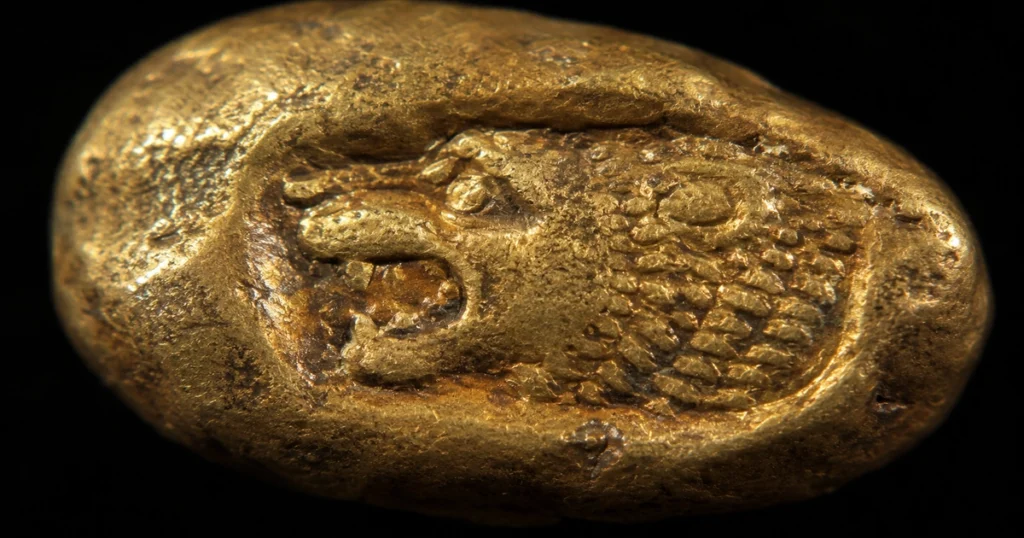
To achieve this, the Lydian state minted the world’s first official coins utilizing Electrum, a naturally occurring alloy of gold and silver discovered in local riverbeds. Each coin was stamped with a royal insignia—most famously the roaring head of a lion. This stamp served as a binding sovereign guarantee. If a coin bore the royal mark, its weight and value were legally certified by the crown. The implications of this invention were revolutionary:
- Elimination of Transactional Friction: Merchants no longer needed scales or touchstones at the point of sale. Trade could occur instantly via simple piece counting.
- Standardized Pricing Architecture: The creation of uniform coinage allowed markets to establish clear, stable pricing mechanisms for consumer goods and services.
- Efficient State Administration: The Lydian crown could now efficiently collect standardized taxes, fund large-scale infrastructure projects, and pay professional military forces with reliable wages.
The Lydian innovation spread rapidly across the Mediterranean basin. The Persian Empire quickly adopted the concept, minting the legendary pure gold Daric, while the Greek city-states developed their own iconic silver and gold currencies. Gold had successfully evolved from a passive ornament into the active, beating heart of global commerce.
Gold in the Roman Empire: The First Monetary Machine
If the Lydians invented standardized gold currency, the Roman Empire industrialized it on a scale never before seen. The Romans recognized that maintaining a sprawling, multi-continental empire required an absolute uniformity of value across their vast territories.
To feed their massive mints, the Romans deployed advanced hydraulic mining techniques across their provinces, particularly in Las Medulas in Spain and parts of Dacia (modern Romania). By using massive aqueducts to unleash controlled torrents of water down mountainsides, they washed away entire hillsides to expose rich gold veins, extracting thousands of tons of the precious metal.
The Aureus and the Pax Romana
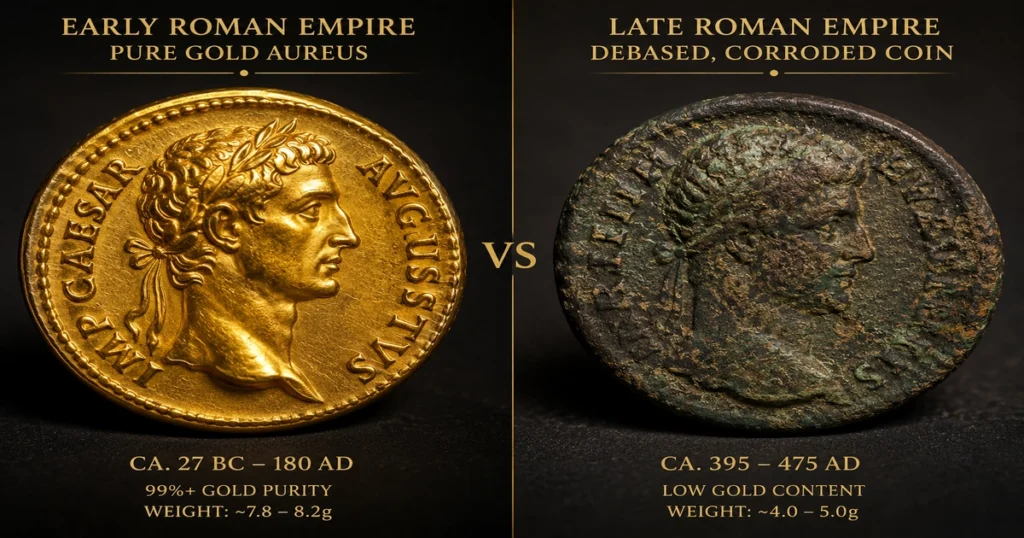
Under the Emperor Augustus, the Roman monetary architecture was formally systematized, with the Aureus serving as the premier gold coin of the empire. A Roman citizen, merchant, or soldier could carry the Aureus from the rainy frontiers of Britannia all the way to the trading ports of Alexandria, confident that its purchasing power remained completely unchanged. This absolute monetary stability laid the economic foundation for the Pax Romana—a centuries-long period of relative relative peace and unprecedented commercial prosperity across the western world.
The Fatal Lesson of Currency Debasement
However, Rome also provided future generations with a stark, catastrophic lesson in monetary mismanagement: the phenomenon of Currency Debasement. As the costs of maintaining defensive borders, expansive welfare systems, and corrupt imperial courts escalated, Rome ran out of physical gold reserves.
Rather than curbing state spending, successive emperors resorted to financial trickery. They ordered the imperial mints to secretly mix cheaper base metals, such as copper and iron, into the gold Aureus and the silver Denarius while demanding the coins maintain their original legal face value.
- During the reign of Nero: The Aureus was highly pure, containing roughly 99% pure gold.
- By the mid-3rd Century CE: The gold content within Roman coins had collapsed to negligible levels, turning the currency into a debased alloy.
The free market reacted exactly as economic laws dictate. Recognizing that the state was issuing over-printed, worthless metal, merchants aggressively hiked prices, triggering severe hyperinflation. Citizens completely lost confidence in the official paper-thin Roman coins. They began hoarding older, pure gold coins in secret vaults and refused to accept the new debased state currency. This systemic collapse of the monetary framework severely crippled domestic trade, starved the military of real pay, and ultimately accelerated the internal rot and final collapse of the Western Roman Empire.
The Medieval Gold Economy and Global Trade Routes
Following the fall of Rome, Western Europe plunged into a highly localized, fragmented feudal economy. However, the flame of gold monetary sophistication did not die; it shifted eastward to Byzantium and the rising Islamic empires of the Middle East.
1. The Byzantine Solidus and the Islamic Gold Dinar
The Eastern Roman (Byzantine) Empire preserved its monetary integrity by minting the Solidus, a highly dependable gold coin that remained the dominant international currency across the Mediterranean for nearly 700 years.
Concurrently, by the late 7th century, the Umayyad Caliphate introduced the Islamic Gold Dinar. Minted with a meticulous dedication to weight uniformity and metallurgical purity, the Dinar became the undisputed financial backbone of the medieval global trade network. It was the trusted unit of account used to clear transactions stretching across the vast trans-Saharan caravan routes, the busy ports of the Indian Ocean, and the treacherous paths of the Silk Road connecting Europe to Imperial China.
2. The Golden Splendor of West Africa and Mansa Musa
No discussion of the medieval gold economy is complete without highlighting the immense wealth of West Africa. During this era, the empires of Ghana and Mali sat atop the world’s most productive gold deposits.
The historical consensus points to Mansa Musa, the 14th-century ruler of the Mali Empire, as arguably the wealthiest individual in human history. In 1324, Mansa Musa embarked on a legendary pilgrimage to Mecca. His caravan consisted of tens of thousands of heralds, soldiers, and merchants, accompanied by dozens of camels laden with thousands of pounds of pure gold. As he passed through Cairo, Medina, and Mecca, his vast, open-handed distributions of gold charity were so immense that he accidentally flooded the local markets, severely devaluing the price of gold across the Middle East for over a decade.
The Gold Rush Era: Mass Economic Fuel
By the mid-19th century, gold shifted away from being an asset controlled exclusively by imperial monarchs, elite aristocrats, and central trading guilds. The discovery of immense, untapped alluvial and subterranean gold deposits across the globe triggered the era of the great Gold Rushes—a period that democratized wealth acquisition and drastically accelerated the geographic expansion of the modern world.
The Great Migrations and Industrial Exploitation
- The California Gold Rush (1848): The discovery of gold flakes by James W. Marshall at Sutter’s Mill in Coloma, California, ignited a global phenomenon. Over 300,000 adventurous immigrants, nicknamed “Forty-Niners,” braved perilous journeys across oceans and continents to reach the American West. This massive influx of labor and capital transformed San Francisco from a sleepy, isolated village into a world-class financial metropolis, funded the transcontinental railroad network, and compressed a century’s worth of economic development into a single decade.
- The Australian Gold Rush (1851): Major discoveries in New South Wales and Victoria fundamentally altered Australia’s demographic and political landscape. It quickly transitioned the territory from a remote British penal colony into a wealthy, rapidly modernizing, and highly autonomous nation.
- The South African Witwatersrand Discovery (1886): This was the largest single gold discovery in human history. The Witwatersrand Basin uncovered massive, deeply buried gold reefs that required advanced industrial corporate mining infrastructure to exploit. This discovery transformed South Africa into the epicentre of global gold production, fueled the industrial ambitions of the British Empire, and altered the geopolitical landscape of the region, ultimately culminating in the Anglo-Boer War.

The following matrix provides a historical breakdown of these transformative mining migrations:
| Geography | Ignition Year | Long-Term Macroeconomic & Geopolitical Consequences |
| California, USA | 1848 | Massively accelerated the industrialization of the American West; established San Francisco as a banking powerhouse. |
| Victoria, Australia | 1851 | Spurred massive free-citizen immigration; funded rapid infrastructure development and railway expansion. |
| Witwatersrand, South Africa | 1886 | Exposed the largest deep-level gold deposits on earth; provided the foundational backing for the British financial system. |
| Klondike, Yukon, Canada | 1896 | Opened up the sub-arctic northern wilderness; drove rapid advancements in cold-weather logistics and transport. |
The Classical Gold Standard Era (1870–1914)
The immense surge in global gold supplies resulting from the 19th-century gold rushes provided nations with the liquidity necessary to build a unified, highly integrated global monetary architecture: The Classical Gold Standard.
Adopted by Great Britain, Germany, France, the United States, and eventually most developed nations by the late 19th century, this system represented the absolute peak of monetary stability. Under the Classical Gold Standard, paper bank notes were no longer arbitrary instruments; they were legally binding property receipts for a precise, physical weight of gold held securely in government vaults.
The Foundational Mandate of the Gold Standard: “Any individual could walk into a commercial or central banking institution, present a paper banknote, and legally demand that the bank exchange it on the spot for an equivalent, fixed amount of physical gold coins or bars.”
Why this Era Fostered Unprecedented Economic Growth:
- Absolute Suppression of Hyperinflation: Governments lost the arbitrary power to print unbacked fiat currency. If a nation wished to expand its circulating paper money supply, it was legally required to first acquire an equivalent amount of physical gold reserves to back those notes.
- Predictable International Trade Exchange Rates: Because every major global currency—whether the British Pound Sterling, the US Dollar, or the German Mark—was tied directly to gold, international exchange rates were essentially fixed. A merchant in Tokyo trading with a firm in London faced zero currency fluctuation risk. This predictability sparked an unprecedented boom in cross-border capital investment and global industrial trade.
The Collapse of the Gold Standard: How Money Became Fiat
This era of strict monetary discipline collapsed under the immense financial pressures of the twentieth century. The catalyst for this destruction was the outbreak of World War I in 1914.
Faced with the existential need to field massive armies and purchase unprecedented amounts of industrial weaponry, European governments quickly realized that their physical gold reserves were wholly inadequate to cover the staggering costs of total warfare. Almost overnight, combatant nations suspended the gold convertibility of their currencies. They decoupled their printing presses from their gold vaults, printing vast amounts of unbacked paper money to fund their military machines. The predictable result was widespread inflation and the permanent fracturing of global monetary trust.
The Bretton Woods Agreement (1944)
As World War II neared its conclusion, delegates from 44 Allied nations gathered at the Mount Washington Hotel in Bretton Woods, New Hampshire, to design a stable post-war international financial system.

Recognizing that the United States now held the overwhelming majority of the world’s sovereign gold reserves (securely stored in impregnable vaults like Fort Knox), the delegates constructed a compromise system:
- The currencies of the rest of the world were pegged directly to the value of the US Dollar.
- The US Dollar, in turn, was uniquely pegged directly to physical gold at a fixed statutory rate of $35 per troy ounce.
- Foreign central banks retained the right to exchange their excess US Dollar holdings for physical gold from the US Treasury at this fixed rate.
The Nixon Shock (1971): The Final Decoupling
By the late 1960s, the Bretton Woods system faced immense pressure. To fund the mounting costs of the Vietnam War and expansive domestic social programs, the United States printed far more paper dollars than could be realistically backed by its shrinking gold reserves.
European nations, led by France, grew deeply skeptical of America’s financial discipline. They began aggressively exporting their excess US paper dollars back to American shores, demanding physical gold bars in return. As US gold reserves depleted rapidly, President Richard Nixon took drastic action. On August 15, 1971, he delivered a televised address announcing the unilateral suspension of the US Dollar’s convertibility into gold for foreign governments.
This monumental event, known as the Nixon Shock, permanently severed the last formal link between global currencies and the physical world. From that day forward, every currency on earth became Fiat Currency—money backed not by gold or silver, but solely by decree, taxation power, and public faith in government stability.
Gold During Modern Economic Crises: The Ultimate Insurance
When the gold standard was abandoned in 1971, many traditional economists predicted that gold would fade into financial irrelevance, becoming a mere industrial commodity. The reality proved to be precisely the opposite. Freed from artificial government price caps, gold transformed into a highly dynamic, free-floating market asset, and its market value skyrocketed over the subsequent decades.
Gold’s primary modern characteristic is its performance as an anti-fragile safe haven. When traditional stock markets collapse, when corporate bonds default, and when fiat currencies lose value due to aggressive central bank printing, gold acts as reliable financial insurance.

Case Studies in Modern Systemic Protection:
- The 2008 Global Financial Crisis: The collapse of the US subprime mortgage market triggered a systemic failure that brought down storied Wall Street institutions like Lehman Brothers. As global equities and real estate values collapsed, investors scrambled for liquidity. Gold staged a historic rally, surging from roughly $800 per ounce to peak at over $1,900 per ounce, strongly outperforming traditional asset portfolios.
- The 2020 COVID-19 Pandemic: The onset of global pandemic lockdowns ground real-world commerce to a sudden halt. To prevent a total economic depression, global central banks injected trillions of unbacked fiat dollars into the financial system overnight. Fearing severe currency devaluation, institutional capital flooded into gold, driving it to new all-time nominal highs.
- The 2022 Post-Pandemic Inflationary Wave & Geopolitical Conflicts: The eruption of direct conflict in Ukraine, combined with severe global supply chain distortions, triggered the highest consumer price inflation across western nations in over forty years. Amid this heightened geopolitical and economic uncertainty, safe-haven demand pushed gold prices back toward historic highs.
- Regional Banking Failures: The sudden collapses of prominent financial institutions like Silicon Valley Bank, Signature Bank, and the forced rescue of Credit Suisse reminded global investors of a fundamental truth: bank deposits are ultimately just unsecured liabilities on a highly leveraged corporate balance sheet. Whenever banking panics erupt, capital flows out of vulnerable electronic banking ledgers and directly into physical gold or gold-backed exchange-traded funds (ETFs).
Why Central Banks Still Buy Gold: The Sovereign Anchor
If gold is simply an obsolete relic of a bygone era, a fundamental question must be addressed: Why are the world’s most sophisticated, well-funded central banking institutions quietly accumulating physical gold reserves at a record pace?
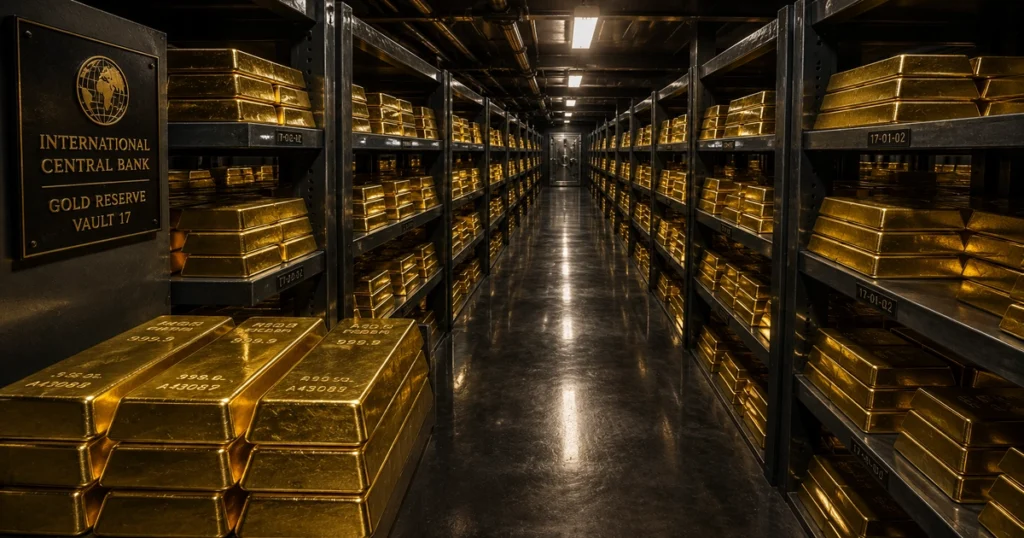
The Federal Reserve, the Bundesbank, the Reserve Bank of India, and the People’s Bank of China collectively hold thousands of metric tons of gold deep within high-security subterranean vaults. They do so for several key strategic reasons:
1. De-Dollarization and Geopolitical Insulation
For decades, the US Dollar has reigned supreme as the world’s unchallenged global reserve currency. However, the weaponization of the SWIFT banking network and the freezing of foreign sovereign fiat reserves have served as a wake-up call for non-western nations.
Central banks realize that dollar balances held in foreign digital networks can be frozen or confiscated at the stroke of a pen. Gold, by contrast, is a purely physical asset. When stored within a country’s own borders, it is completely immune to foreign sanctions, digital blockades, or political manipulation. It represents absolute monetary sovereignty.
2. The Ultimate Neutral Counter-Weight to Inflation
Central banks understand the mechanics of currency printing intimately because they control the presses. They know that an endless expansion of the fiat money supply inevitably erodes the real purchasing power of their paper reserves. Gold cannot be created out of thin air via an algorithmic command. Its finite physical supply acts as a reliable long-term anchor for a nation’s balance sheet.
3. Absolute Emergency Liquidity
During severe national crises—such as total war, hyperinflation, or a collapse of international trade relations—a country’s paper currency may be completely rejected by foreign counterparties. Gold, however, remains universally accepted tender. A clear historical example occurred in 1991, when India, facing a severe balance of payments crisis and on the verge of defaulting on its international obligations, airlifted tons of its physical gold reserves to London and Zurich as collateral to secure crucial foreign currency loans. Sona—as gold is known across India—saved the nation from financial ruin.
Gold vs Modern Assets: A Comparative Analysis
For the modern global investor trying to navigate volatile macroeconomic cycles, choosing the right asset allocation is a critical task. The matrix below contrasts how gold compares structurally against other major investment asset classes:
| Asset Class | Systemic Risk Profile | Long-Term Inflation Protection | Volatility Metrics | Multi-Millennial Institutional Trust? |
| Gold | Low to Medium | Exceptionally Strong | Low to Moderate | Yes (5,000+ Years of Continuity) |
| Stocks (Equities) | High | Moderate to Good | High | No (Modern stock markets are ~400 years old) |
| Bonds (Sovereign) | Medium | Highly Vulnerable | Low to Moderate | No (Entirely dependent on government solvency) |
| Bitcoin / Cryptocurrencies | Very High | Uncertain / Unproven | Extremely High | No (Emergent digital asset class created in 2009) |
| Real Estate | Medium | Strong | Low | Yes (Land holds permanent baseline value) |
- Gold vs. Bitcoin (Digital Scarcity vs. Physical Trust): Bitcoin is frequently hailed by its proponents as “Digital Gold” due to its hard-coded supply limit of 21 million tokens. While it offers unparalleled transaction speed across digital networks, it remains a highly speculative, highly volatile asset class that lacks historical longevity. Gold offers a physical, time-tested asset profile that cannot be hacked, suffers zero digital obsolescence risk, and possesses a five-millennium track record of weathering the complete collapse of human civilizations.
- Gold vs. Stocks: Equities are an exceptional engine for wealth generation during periods of economic expansion and corporate innovation. However, individual corporations are vulnerable to technological disruption, shifting consumer preferences, and accounting fraud. Equity value can plunge to absolute zero. Physical gold carries no counterparty risk; it is no one else’s liability, meaning it can never default or go bankrupt.
Gold in the Digital Age: Ancient Value, Modern Technology
The arrival of the digital age has not marginalized gold; rather, it has transformed how this ancient asset is bought, sold, held, and transacted. Investors no longer need to maintain expensive personal home safes or worry about the security risks of transporting heavy metals.
Modern Channels for Global Gold Allocation:
- Gold ETFs (Exchange Traded Funds): Pioneered in the early 2000s, Gold ETFs allow retail and institutional investors to purchase shares on public stock exchanges that perfectly track the spot price of gold. Each share is directly backed by fractional ownership of physical gold bullion held securely in audited institutional bank vaults.
- Sovereign Gold Bonds (SGBs): Issued directly by national governments (such as the Reserve Bank of India), these bonds allow citizens to invest in paper securities tied directly to the price of gold. Crucially, they eliminate capital gains taxes upon maturity and provide investors with a steady annual interest payout, fixing the traditional drawback of gold being a non-yielding asset.
- Digital Gold and Fractional Fintech Platforms: Modern mobile applications allow retail consumers to purchase verified physical gold for fractions of a dollar. The platform instantly buys institutional-grade bullion on behalf of the user, storing it securely in high-security, insured global vaulting networks.
- Tokenized Gold on the Blockchain: Emerging blockchain protocols allow physical gold bars to be tokenized. Each digital token on the public ledger represents direct legal ownership of one gram of a highly audited, physically segregated gold bar, combining the legal security of gold with the fractional, borders-defying efficiency of cryptocurrency networks.

Conclusion: The Unbroken Chain of Value
Retracing the complete history of gold reveals an unmistakable macroeconomic truth: Gold is not merely a commodity; it is humanity’s ultimate long-term financial consensus.
Empires have come and gone, global trade routes have completely shifted, and the very definition of money has been engineered from solid metal to paper sheets and digital pixels. Yet, gold’s foundational role as a structural anchor of wealth, stability, and trust has remained entirely intact. As long as human beings continue to value physical scarcity, seek protection against systemic risk, and require an asset independent of government competence, the warm, unchanging luster of gold will continue to define the ultimate standard of human wealth.
FAQ Section (Frequently Asked Questions)
Q1. Why has gold historically been more valuable than other plentiful metals?
Gold’s value is driven by an ideal combination of physical characteristics. It is geologically scarce, meaning its supply cannot be expanded rapidly; it is chemically inert, meaning it does not oxidize, rust, or dissolve over time; it is malleable and divisible, allowing it to be easily shaped into uniform denominations; and its distinctive color makes it instantly recognizable.
Q2. Is gold still legally classified as money in today’s economy?
Not in the daily transactional sense. You cannot utilize a gold coin to purchase everyday items like groceries or gas. However, it remains the ultimate form of Sovereign Money. Central banks continue to classify their massive gold reserves as a primary monetary asset on their official balance sheets.
Q3. Why does gold consistently outperform cash during periods of high inflation?
When a central bank prints an excessive amount of paper money, the purchasing power of each individual unit of cash rapidly declines. Because the earth’s total supply of gold is strictly limited by geology and requires immense energy and capital to mine, its price naturally adjusts upward as the value of the surrounding paper currency depreciates, effectively preserving the real wealth of the holder.
Q4. Can Bitcoin realistically replace gold as the world’s premier safe haven?
While Bitcoin shares the property of absolute scarcity, it lacks the critical elements of historical longevity and deep institutional stability. Gold has successfully survived every major financial collapse, hyperinflationary crisis, and world war in recorded human history. Bitcoin remains an innovative but highly volatile asset that has yet to prove its resilience across an extended, decades-long global economic depression.
Q5. What percentage of a standard investment portfolio should be allocated to gold?
While individual risk profiles vary based on age and financial goals, the overwhelming consensus among traditional portfolio managers and risk experts is that maintaining a permanent allocation of 5% to 15% of a portfolio’s total value in gold provides an ideal structural shield against severe market drawdowns, currency shocks, and systemic banking panics.

