

Featured Snippet
What Is Gold ETF? A Gold ETF (Exchange-Traded Fund) is a commodity-backed investment fund that tracks the real-time spot price of physical gold. Each unit of a Gold ETF represents a specific weight of 99.5% pure physical gold bullion stored securely in institutional bank vaults. Traded on public stock exchanges like regular shares, Gold ETFs allow investors to buy and sell gold exposure instantly through traditional brokerage accounts without physical handling or storage fees.
Key Takeaways
- Direct Spot Price Tracking: Gold-backed ETFs track the live domestic or international spot price of 99.5% pure physical gold bullion.
- Exchange Liquidity: You can instantly buy or sell ETF units during regular market hours using any standard stock trading account.
- Zero Storage Friction: Eliminates bank locker charges, insurance premiums, theft concerns, and jeweler making charges.
- Fractional Accumulation: Allows entry with small capital amounts, often representing as little as 0.01 grams or 1/10th of a gram of physical metal.
- Institutional Security: Fully backed by physical bullion held in high-security vaults and regularly audited by independent accounting firms.
- Portfolio Stabilizer: Acts as an established hedge against stock market volatility, currency devaluation, and rising inflation.
Introduction
For thousands of years, purchasing physical gold required visiting a dealer or jeweler to buy coins, bars, or ornaments. While holding physical metal offers personal comfort, it introduces significant practical friction: steep dealer markups (“making charges”), purity doubts, vault rental fees, and the constant threat of theft.
Modern financial markets solved these challenges with a single question: What is Gold ETF?
A Gold Exchange-Traded Fund is an open-ended investment fund that pools capital to purchase physical gold bars of standard purity. Instead of storing heavy bullion yourself, the fund holds the metal in audited vaults and issues electronic shares representing beneficial ownership. You gain full exposure to gold price movements directly inside your regular investment portfolio.
Whether you want to protect your wealth against inflation, cushion your stock portfolio against market drawdowns, or build a disciplined monthly accumulation plan, understanding what is Gold ETF is one of the most effective steps in modern asset management.
CurrencyPlans Market Insight
📊 Macro & Institutional Analysis
Historically, institutional capital flows into exchange-traded gold funds surge during specific macroeconomic shifts. Across global market cycles, demand for Gold ETFs consistently accelerates during:
- Persistent Inflationary Cycles: When real interest rates (nominal interest rate minus inflation) turn negative or remain deeply suppressed.
- Central Bank Monetary Easing: Periods when major central banks cut benchmark interest rates, reducing the opportunity cost of holding non-yielding gold.
- Geopolitical Uncertainty & Currency Devaluation: When investors seek liquid, currency-neutral safe havens to protect capital against sudden market drawdowns.
CurrencyPlans View: A strategic allocation of 5% to 10% in physical Gold ETFs provides an optimal balance between downside protection and long-term equity growth.
How Does a Gold ETF Work?
To understand what is Gold ETF, it helps to look at the institutional mechanics operating quietly behind your trading terminal.

1. High-Purity Physical Bullion
By regulatory mandate, physical Gold ETFs must back their issued shares with physical gold bars of 99.5% purity or higher (typically conforming to London Bullion Market Association – LBMA standards).
2. Vault Custodians and Independent Audits
The gold bullion does not reside in a broker’s office. It is held in secure, insured vaults operated by institutional custodian banks (such as JPMorgan Chase or HSBC). Independent accounting firms perform regular surprise audits to verify that every ounce of gold in the vault matches the fund’s outstanding shares.
3. Creation, Redemption, and Price Pegging
How does a Gold ETF maintain its price alignment with spot gold? Through specialized market participants called Authorized Participants (APs).
When demand for ETF units rises, APs deliver physical gold bars to the fund in exchange for newly created ETF units. When market demand falls, APs return ETF units to the fund and redeem physical bullion. This arbitrage mechanism prevents ETF prices from drifting far from real-time spot gold prices.
Simple Meaning Box: Net Asset Value (NAV)
Net Asset Value (NAV) is the intrinsic cash value of one single ETF unit. It is calculated by taking the total value of all physical gold held in the vault (minus minor management fees) and dividing it by the total number of outstanding ETF shares.
Types of Gold-Related ETFs
When investors ask what is Gold ETF, they are usually referring to funds holding physical bullion. However, the financial industry offers three distinct categories of gold funds:
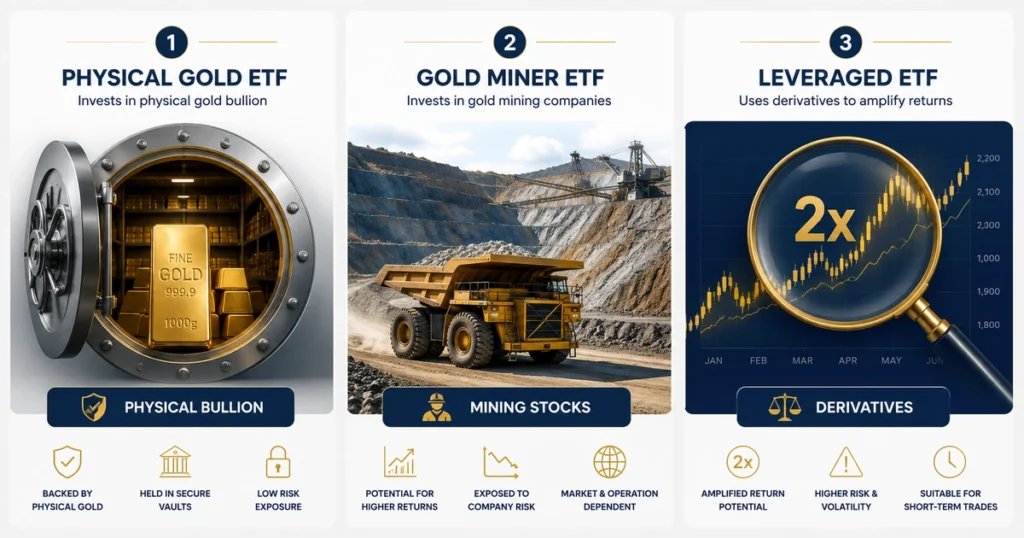
1. Physical Gold ETFs (The Standard)
These funds invest directly in physical gold bars stored in vaults. Their primary goal is to replicate spot gold price returns minus a small annual expense ratio.
- Best for: Core portfolio building, capital preservation, and inflation hedging.
- Examples: SPDR Gold Shares (GLD), iShares Gold Trust (IAU).
2. Gold Mining Equity ETFs
Instead of physical bullion, these funds hold shares in publicly traded companies that mine, refine, and produce gold.
- Key Characteristic: Mining stocks act as a leveraged play on gold prices. When gold prices rise, mining profits can expand rapidly; when gold drops, operational overhead can compress margins sharply.
- Best for: Growth-oriented investors willing to accept equity market risk alongside commodity trends.
3. Leveraged and Inverse Gold ETFs
These complex trading tools use financial derivatives (futures and options) to deliver 2x or 3x the daily price movement of gold, or the inverse (-1x, -2x) of gold’s movement.
- Key Characteristic: High volatility and compounding decay over time make these unsuitable for multi-month holding periods.
- Best for: Experienced short-term day traders managing active hedging strategies.
Comparison: Gold ETF vs. Physical Gold vs. Sovereign Gold Bonds
To fully grasp what is Gold ETF and where it fits in your strategy, compare its core attributes against traditional gold coins and government paper options like Sovereign Gold Bonds (SGBs).
| Feature / Metric | Physical Gold (Coins/Bars) | Physical Gold ETF | Sovereign Gold Bonds (SGB) |
| Primary Asset | Tangible metal in hand | Electronic / Demat shares | Government debt linked to gold price |
| Purity Standard | Varies by dealer (18k – 24k) | Guaranteed 99.5%+ Pure | Assured 99.9% equivalent |
| Liquidity | Low to Moderate (Requires dealer visit) | Very High (Instant exchange trading) | Low (5–8 year lock-in period) |
| Overhead & Making Costs | High (5%–25% making fees + locker rent) | None (Only small expense ratio) | Zero |
| Annual Cash Income | None | None | ~2.50% p.a. Interest |
| Theft & Security Risk | High physical risk | Zero (Vaulted & insured) | Zero (Digital record) |
| Minimum Ticket Size | ~1 Gram (~$70–$90) | ~0.01 to 0.1 Gram (~$5–$10) | 1 Gram |
Note: Regulatory features, sovereign guarantees, and tax treatements vary by regional jurisdiction.
Simple Meaning Box: Tracking Error
Tracking Error measures the minor percentage difference between the performance of the live spot gold price and the performance of the Gold ETF. A lower tracking error indicates that the fund manager is accurately reflecting real-world gold prices.
Real-World Examples: How Investors Use Gold ETFs

Scenario A: Systematic Monthly Accumulation
- Investor Profile: Rahul, a 29-year-old financial analyst.
- Strategy: Rahul sets up an automated monthly order to buy $150 worth of a physical exchange-traded gold fund on the first trading day of every month.
- Outcome: Over five years, he smoothly dollar-cost averages his entry price through market rises and dips, accumulating substantial gold backing without paying locker fees or dealer premiums.
Scenario B: Dynamic Portfolio Rebalancing
- Investor Profile: Sarah, a self-directed retail investor managing a retirement portfolio.
- Strategy: When equity markets rally strongly and push her stock allocation higher than target levels, Sarah trims a portion of her stock gains and buys a liquid Gold ETF.
- Outcome: During the next market drawdown, her gold allocation holds its value, giving her available liquidity to rebalance back into discounted equities.
Pros and Cons of Gold ETFs
Weighing the advantages against the limitations helps determine whether a Gold-backed ETF aligns with your financial plan.
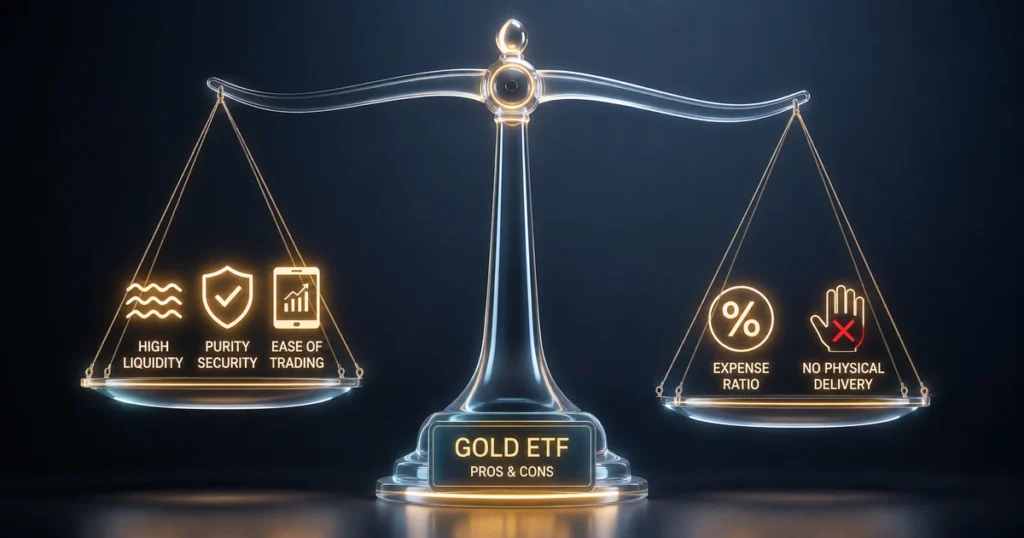
Pros (Advantages)
- Exceptional Liquidity: Convert units back into cash instantly at transparent exchange prices during market hours.
- Cost Efficiency: Eliminate jeweler making charges, vault rentals, and transit insurance fees.
- Guaranteed Purity: Every unit is backed by audited 99.5% pure physical bullion.
- Fractional Access: Start building a gold position with modest capital outlay.
- No Theft or Storage Risk: Complete protection from physical burglary, home safety worries, or lost certificates.
Cons (Limitations)
- Expense Ratio Drag: Funds charge an annual fee (typically 0.10% to 0.50%) that slightly reduces compounding returns over multi-decade horizons.
- No Physical Handover for Retailers: You cannot walk up to a fund manager and request a small gold coin; retail redemptions settle in cash upon selling on the exchange.
- No Yield or Dividends: Gold is a non-yielding asset that does not generate interest or corporate earnings.
- Trading Costs: Standard brokerage fees or minor bid-ask spreads apply during execution.
Simple Meaning Box: Expense Ratio
An Expense Ratio is the annual operational percentage fee charged by an asset management company. For instance, an expense ratio of 0.20% means $20 is deducted per year for every $10,000 invested to cover vault maintenance, insurance, and management overhead.
Who Should Invest in a Gold ETF?
A gold-backed exchange-traded fund is a versatile building block ideal for:
- Beginner Investors: Anyone seeking a simple, low-cost path into commodity markets without navigating complex physical bullion trading.
- Long-Term Wealth Builders: Investors who want an inflation-resistant store of value within a multi-asset portfolio.
- Conservative Allocators: Individuals using gold’s historically low correlation with stocks to reduce total portfolio risk.
- Disciplined Saver: Investors using automated monthly systematic plans (SIPs) to accumulate gold over time.
Risks and Limitations to Keep in Mind
Even safe-haven assets carry specific structural and market risks:
- Market Price Fluctuations: Gold spot prices fluctuate based on macroeconomic shifts, central bank interest rate decisions, and foreign exchange rates.
- Counterparty & Custodial Oversight: Investors depend on the operational security of custodian bank vaults, fund management integrity, and stock exchange infrastructure.
- Regional Taxation Rules: Tax treatment for paper gold varies across countries. Short-term and long-term capital gains tax rates may differ from standard equity funds, so consult a qualified tax advisor.
How to Buy Your First Gold ETF: Step-by-Step
Purchasing a unit of an exchange-traded gold fund follows the exact same process as buying standard company shares:
- Open a Demat or Brokerage Account: Register with a licensed online stock broker in your region.
- Complete KYC Verification: Fulfill standard identity and address documentation requirements.
- Fund Your Account: Transfer capital into your trading balance via electronic bank transfer.
- Search the Ticker Symbol: Locate reputable physical Gold ETFs on your platform (e.g., GLD, IAU, or domestic equivalents).
- Place Your Order: Choose between a Market Order (executes instantly at the current price) or a Limit Order (executes at your defined price target).
- Track Your Investment: Your purchased units will settle into your investment portfolio digitally.
Frequently Asked Questions (FAQs)
1. What is a Gold ETF in simple terms?
In simple terms, a Gold ETF is a digital investment fund traded on a stock exchange that tracks the live market price of physical gold stored safely inside secure bank vaults.
2. Can I exchange my Gold ETF units for physical gold coins?
For individual retail investors, generally no. Physical delivery is restricted to Authorized Participants redeeming institutional quantities (often several kilograms). Retail investors simply sell their units on the stock exchange for cash, which can then be used to buy physical gold locally if preferred.
3. Is investing in a Gold ETF safer than buying physical gold?
From a physical safety perspective, yes. Gold ETFs remove risks associated with home burglaries, counterfeit metal, and costly bank lockers. However, market price risk remains identical to physical gold spot movements.
4. What percentage of my portfolio should be in Gold ETFs?
Financial planners and institutional asset managers generally recommend allocating 5% to 10% of a total investment portfolio to gold as a risk-management hedge.
5. Do Gold ETFs pay dividends or interest?
No. Physical gold generates no internal income, interest, or corporate dividends. Total returns depend entirely on gold spot price changes over time.
Conclusion
Answering what is Gold ETF reveals one of the most practical innovations in personal finance. By combining the safe-haven properties of audited physical gold bullion with the digital speed of modern stock exchanges, Gold ETFs offer an efficient, transparent, and accessible gateway to commodity ownership.
Whether you are looking to hedge against inflation, buffer stock market drawdowns, or build a disciplined multi-asset strategy, a physical Gold ETF provides institutional-grade gold exposure at the click of a button.
Continue Reading
Explore these related guides to deepen your understanding of gold investing and portfolio diversification:
- [Gold ETF vs Physical Gold: Which Asset Suits Your Strategy?]
- [Sovereign Gold Bonds: The Complete High-Yield Guide]
- [How to Build an Inflation-Resilient Portfolio]
- [Understanding Asset Allocation: Balancing Stocks, Bonds, and Commodities]
About the Author
This article was researched and written by the CurrencyPlans Editorial Team, specializing in global financial markets, commodities, stocks, cryptocurrencies, currencies, and macroeconomic research.
Our editorial team continuously monitors market developments to ensure our educational content remains accurate, relevant, and up to date.
Institutional References & External Links
For real-time gold market data, supply reports, and regulatory frameworks, consult these accredited global institutions:
- Global Gold Demand & Reserve Data: World Gold Council
- Bullion Quality & Vaulting Standards: London Bullion Market Association (LBMA)
- Exchange Oversight & Regulatory Filings: U.S. Securities and Exchange Commission (SEC)
Educational Disclaimer
This article is provided strictly for educational and informational purposes and does not constitute financial, investment, legal, or tax advice. Financial instruments, including commodity-backed exchange-traded funds, carry market risks, including the potential loss of principal capital. Always perform your own research and consult a licensed financial advisor before making investment decisions.

