
Executive Summary & Core Thesis
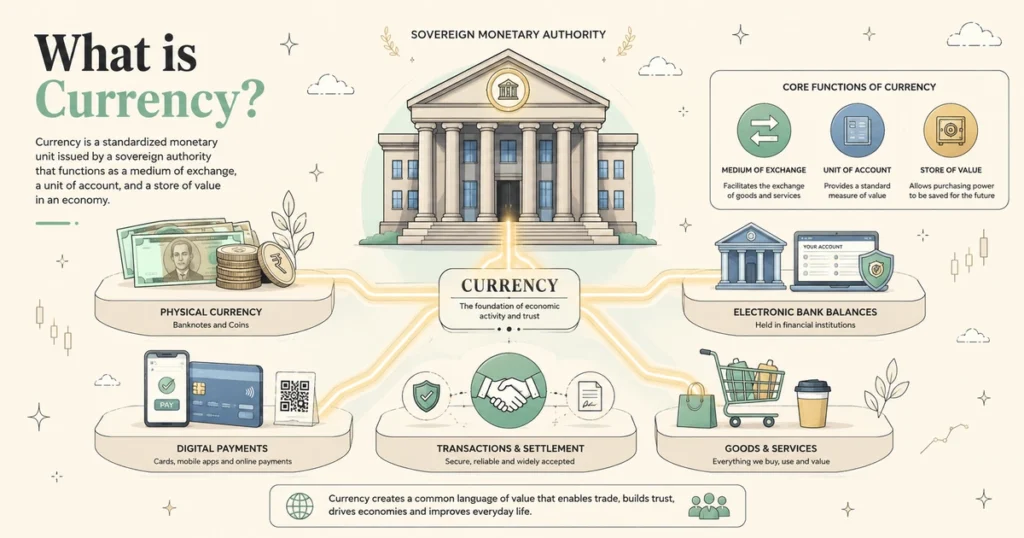
Currency is a standardized, legally authorized system of money issued by a sovereign government or monetary authority to serve as a medium of exchange, unit of account, and store of value. Unlike primitive barter or commodity-based exchange, modern sovereign currencies are predominantly fiat money—instruments that hold no intrinsic physical value of their own, but derive purchasing power from legal tender laws, institutional trust, economic productivity, and the taxing authority of the state. In a modern global economy where cross-border foreign exchange turnover exceeds $9.6 trillion per day (as documented by the Bank for International Settlements), national currencies link domestic price levels to international trade balances, central bank interest rate policies, and the international financial architecture.
The Foundational Definition: What Is Currency?
In economic theory, currency is a specific monetary unit issued and recognized by a sovereign government or monetary authority and used in circulation for transactions and financial settlement. It serves as a medium of exchange, unit of account, and store of value, while its purchasing power is influenced by institutional credibility, economic conditions, and monetary policy.
While the terms “money” and “currency” are frequently used interchangeably, economists maintain a clear distinction:
- Money: The broad, intangible economic concept encompassing any asset that can be used to settle transactions, measure value, and store purchasing power (including physical cash, demand deposits, savings accounts, and short-term liquid claims).
- Currency: The specific, tangible or digital unit of money authorized and circulated by a sovereign authority (such as the US Dollar, the Euro, the British Pound, or the Japanese Yen).
+-------------------------------------------------------------------------------+
|                       MONEY vs. CURRENCY: THE DISTINCTION                     |
+----------------------+-----------------------------+--------------------------+
| ATTRIBUTE            | MONEY (BROAD CONCEPT)       | CURRENCY (SOVEREIGN UNIT)|
+----------------------+-----------------------------+--------------------------+
| Nature               | Intangible economic system  | Specific authorized unit |
| Forms Included       | Bank deposits, credit, cash | Banknotes, coins, CBDCs  |
| Scope                | Universal economic concept  | Nationally bounded claim |
| Governance           | Market and banking system   | Central bank legal decree|
+----------------------+-----------------------------+--------------------------+
Every sovereign state establishes an official unit of account to enable price discovery, organize commercial contracts, collect tax obligations, and anchor domestic financial markets.
The Core Macroeconomic Functions of Currency
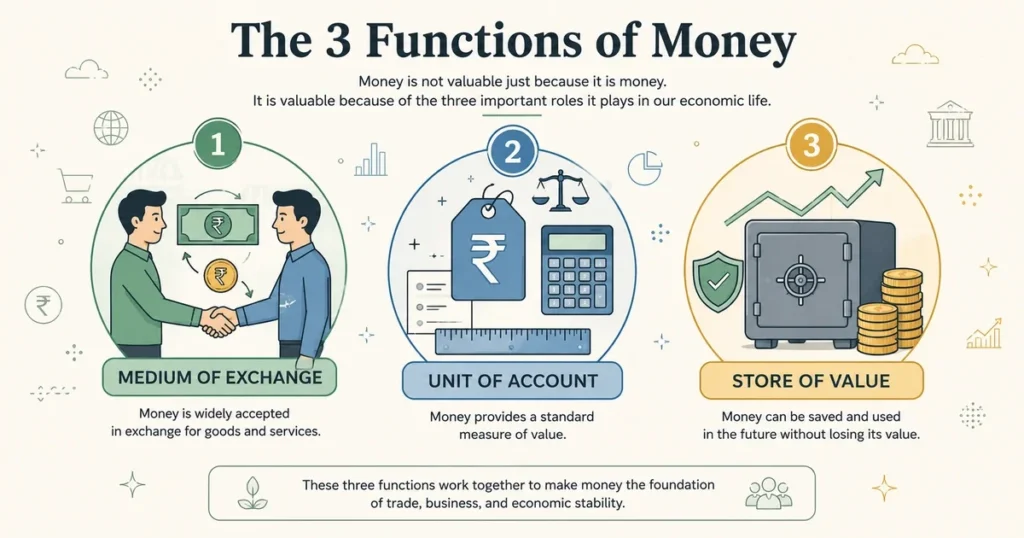
To operate effectively within an economy, a currency must fulfill three classical macroeconomic functions:
1. Medium of Exchange
Currency eliminates the inefficiency of the “double coincidence of wants” inherent in barter systems. Instead of having to find a trading partner who has what you want and wants what you have, Currency provides a widely recognized medium of exchange that market participants can use to purchase goods, services, and assets.
2. Unit of Account
Currency provides a common, standardized denominator to measure and compare the value of disparate goods, services, corporate revenues, and debt obligations. By quoting prices in a single sovereign unit (e.g., pricing bread, labor, and housing in dollars or euros), an economy minimizes transaction calculation costs.
3. Store of Value
Currency allows individuals, businesses, and governments to transfer purchasing power from the present into the future. While domestic inflation gradually erodes nominal purchasing power over time, a sound currency retains sufficient stability to enable long-term commercial contracts, saving, and capital investment.
The Essential Economic Properties of Sound Currency
For an asset to successfully function as circulating currency, it must possess key physical and institutional characteristics:
| Economic Property | Functional Description | Macroeconomic Rationale |
| Fungibility | Every unit is identical and interchangeable with any other unit. | Ensures one unit of currency is accepted equally with any other identical note or coin. |
| Durability | Material structure withstands repeated physical use and circulation. | Prevents physical decay and destruction during commercial exchange. |
| Portability | High value-to-weight ratio; easily transported and transferred. | Facilitates frictionless domestic and international transactions. |
| Divisibility | Can be subdivided into smaller fractional units without losing value. | Enables pricing and settlement of micro-transactions (e.g., cents, pence). |
| Scarcity & Controlled Supply | Issuance is regulated by an authorized monetary framework. | Prevents runaway inflation and maintains long-term purchasing power credibility. |
| Recognizability | Difficult to counterfeit; easily verified by market participants. | Maintains public trust in authenticity and security of legal tender. |
The Historical Evolution: From Barter to Digital Fiat
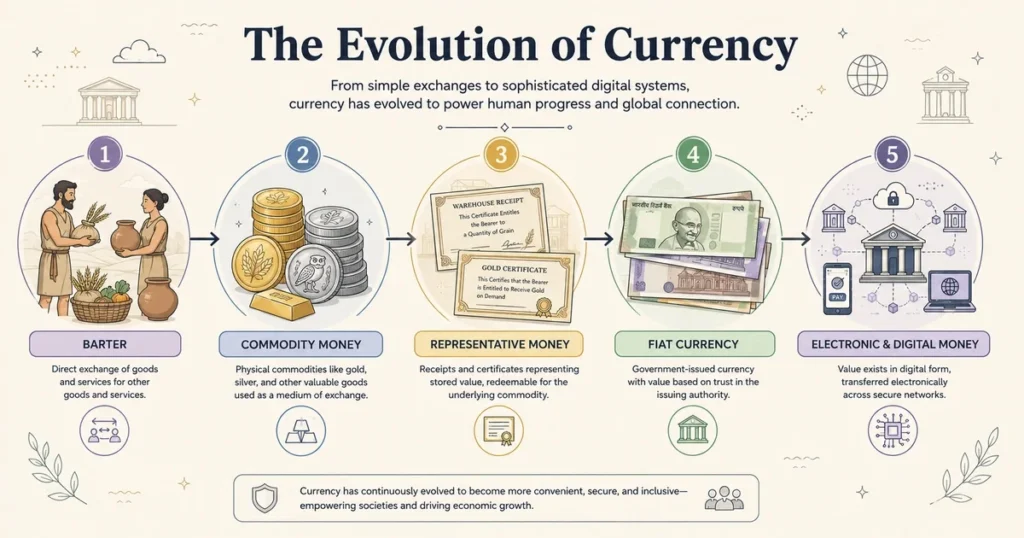
The development of currency reflects a continuous historical progression toward greater transaction efficiency and liquidity:
                      ┌─────────────────────────────────────────┐
                      │              BARTER SYSTEM              │
                      │   (Direct exchange of goods & labor)    │
                      └────────────────────┬────────────────────┘
                                           │
                                           ▼
                      ┌─────────────────────────────────────────┐
                      │            COMMODITY MONEY              │
                      │     (Salt, cattle, gold & silver coins) │
                      └────────────────────┬────────────────────┘
                                           │
                                           ▼
                      ┌─────────────────────────────────────────┐
                      │          REPRESENTATIVE MONEY           │
                      │  (Paper notes backed by physical gold)  │
                      └────────────────────┬────────────────────┘
                                           │
                                           ▼
                      ┌─────────────────────────────────────────┐
                      │            MODERN FIAT MONEY            │
                      │ (Unbacked legal tender by central banks)│
                      └────────────────────┬────────────────────┘
                                           │
                                           ▼
                      ┌─────────────────────────────────────────┐
                      │      ELECTRONIC & DIGITAL CURRENCY      │
                      │  (Interbank ledgers, RTGS, and CBDCs)   │
                      └─────────────────────────────────────────┘
- Barter Economy: Direct exchange of commodities; constrained by the lack of a standardized unit and the requirement for mutual coincidence of wants.
- Commodity Money: The adoption of items with intrinsic value (such as gold, silver, copper, and salt) as universal mediums of exchange.
- Representative Money: The introduction of paper receipts and certificates issued by banks and national treasuries, backed by and redeemable for a fixed quantity of physical gold or silver bullion.
- Fiat Currency: The transition toward paper and electronic currency unbacked by physical commodities, deriving its value from state legal decree, economic output, and public confidence.
- Electronic & Digital Money: Modern economies increasingly rely on electronic ledger balances held through commercial banks and central-bank settlement systems, alongside physical cash.
Types of Currency: Commodity, Representative, and Fiat Systems
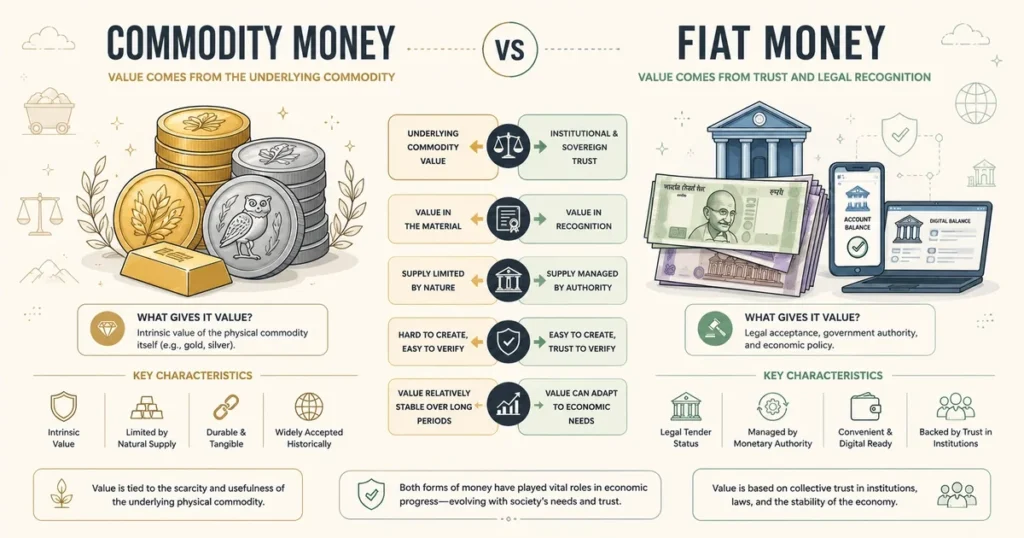
Historically, sovereign monetary systems have operated under three distinct structural models:
1. Commodity Money
Money whose value comes from the intrinsic physical worth of the material from which it is made. Minted gold, silver, and bronze coins are classic examples. Gold, silver, and other commodity-based forms of money derive value from the underlying material, although their market value may differ from the monetary denomination assigned to the coin.
2. Representative Money
Paper currency or tokens that have little or no intrinsic physical value themselves, but represent a direct claim on an underlying physical commodity stored in a secure vault (such as the historical Gold Standard and Bretton Woods exchange system).
3. Fiat Money
The standard model for modern sovereign currencies. Fiat money has no intrinsic physical value and is not redeemable for physical gold or silver. Its value is anchored by the issuing government’s declaration that it is legal tender, backed by the macroeconomic productivity of the national economy and regulated by the sovereign central bank.
Multi-Variable Matrix: Structural Comparison of Currency Types
| Structural Dimension | Commodity Money | Representative Money | Modern Fiat Currency |
| Intrinsic Physical Value | High (Valuable metal or commodity) | None (Paper certificate) | None (Paper, polymer, electronic digits) |
| Redeemability | Self-redeeming (Contains raw asset) | Redeemable for fixed gold/silver | Non-redeemable for fixed commodities |
| Supply Flexibility | Inelastic (Constrained by mining) | Constrained by metal reserves | Flexible (Managed by central bank policy) |
| Inflation Vulnerability | Supply constrained by availability of the underlying commodity | Low (Bound to reserve growth) | Variable (Dependent on monetary discipline) |
| Macroeconomic Utility | High transaction friction and cost | Moderate transaction friction | High liquidity; frictionless digital settlement |
How Currency Is Created and Regulated: The Role of Central Banks
In modern market economies, currency creation operates through a two-tiered banking architecture involving the sovereign central bank and the commercial banking sector:
                      ┌─────────────────────────────────────────┐
                      │          SOVEREIGN CENTRAL BANK         │
                      │  (Issues Base Money / M0 / Banknotes)   │
                      └────────────────────┬────────────────────┘
                                           │
                           (Reserve Requirements & Policy Rates)
                                           ▼
                      ┌─────────────────────────────────────────┐
                      │        COMMERCIAL BANKING SECTOR        │
                      │  (Creates Broad Money via Credit/Loans) │
                      └────────────────────┬────────────────────┘
                                           │
                             (Commercial Lending & Deposits)
                                           ▼
                      ┌─────────────────────────────────────────┐
                      │       PUBLIC & CORPORATE ECONOMY        │
                      │ (Uses Currency for Daily Transactions)  │
                      └─────────────────────────────────────────┘
- Central Bank Monetary Base (M0): The central bank issues physical currency and provides electronic reserve balances to commercial banks and other eligible institutions.
- Commercial Bank Credit Creation (Broad Money / $M1$, $M2$): When commercial banks issue loans to businesses and consumers, they credit the borrower’s demand deposit account, creating new broad money within the financial system.
- Monetary Regulation: Central banks regulate the overall volume and price of currency in circulation through benchmark interest rates, open-market operations, and commercial bank reserve requirements.
Legal Tender, Sovereign Authority, and the State Theory of Money
A foundational legal concept of modern currency is Legal Tender.
Legal tender is a form of payment recognized by law for settling specified financial obligations within the issuing jurisdiction, subject to the applicable legal rules and statutory exceptions.
According to the State Theory of Money (Chartalism), currency derives its widespread acceptance from the sovereign state’s authority to:
- Declare a national unit of account by law.
- Designate the national currency as legally recognized for public and private debt settlement.
- Require that all domestic taxes, duties, and statutory obligations be paid exclusively in the sovereign currency.
Because citizens and corporations must acquire the sovereign currency to settle their tax liabilities with the state, continuous economic demand for the national currency is structurally maintained.
Currency on the World Stage: National vs. Reserve Currencies
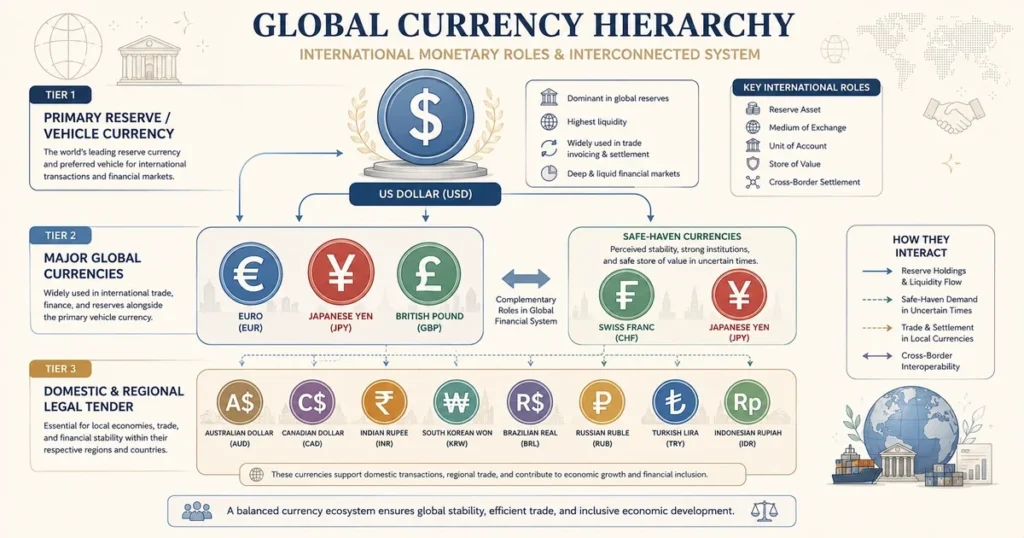
While every sovereign nation issues domestic currency for local commerce, international trade and finance require currencies with deep liquidity, stable legal frameworks, and global acceptance:
+-------------------------------------------------------------------------------+
|               THE GLOBAL CURRENCY HIERARCHY & SETTLEMENT TIERS                |
+----------------------+-----------------------------+--------------------------+
| CURRENCY TIER        | REPRESENTATIVE CURRENCIES   | INTERNATIONAL ROLE       |
+----------------------+-----------------------------+--------------------------+
| Primary Reserve      | US Dollar (USD)             | Global trade invoicing,  |
|                      |                             | central bank reserves    |
+----------------------+-----------------------------+--------------------------+
| Secondary Global     | Euro (EUR), Yen (JPY),      | Regional trade, deep     |
|                      | British Pound (GBP)         | cross-border liquidity   |
+----------------------+-----------------------------+--------------------------+
| Safe-Haven Assets    | Swiss Franc (CHF), JPY      | Capital preservation in  |
|                      |                             | global market downturns  |
+----------------------+-----------------------------+--------------------------+
| Domestic Currencies  | Emerging Market Units       | Local legal tender and   |
|                      | (e.g., INR, BRL, ZAR)       | regional commerce        |
+----------------------+-----------------------------+--------------------------+
- Global Vehicle Currencies: According to the Bank for International Settlements (BIS), the US Dollar is on one side of approximately 89.2% of all global foreign exchange transactions, serving as the primary vehicle currency for international energy pricing, cross-border debt issuance, and global trade settlement.
- Central Bank Foreign Exchange Reserves: Sovereign central banks hold diversified portfolios of foreign currencies, including major reserve currencies such as the US dollar and euro, to defend exchange rate stability, facilitate international payments, and maintain sovereign liquidity.
Macroeconomic Case Dissections: Currency Transformations & Reforms
Dissection 1: The Demise of the Bretton Woods Gold Standard (1971)
- Historical Context: Under the post-WWII Bretton Woods Agreement, global currencies were pegged to the US Dollar, which was convertibly backed by physical gold at $35 per ounce.
- The Structural Shock: Expanding US trade deficits and international demand for gold redemption created severe strain on US sovereign gold reserves.
- The Outcome: On August 15, 1971, the United States suspended dollar convertibility into gold, accelerating the transition away from the Bretton Woods fixed-exchange-rate framework toward the modern international monetary system of predominantly fiat currencies and more flexible exchange-rate regimes.
Dissection 2: The Creation of the Euro (1999–2002)
- Historical Context: European nations sought to eliminate cross-border exchange rate volatility and reduce transaction costs within the Single Market.
- The Structural Reform: Sovereign nations surrendered national monetary independence (retiring the Deutsche Mark, French Franc, and Italian Lira) to adopt a shared multinational currency—the Euro—governed by a single monetary authority, the European Central Bank (ECB).
- Core Takeaway: Currency can transcend national borders through multinational treaties, creating regional currency unions backed by collective institutional frameworks.
The Future of Currency: Digital Payments and Central Bank Digital Currencies (CBDCs)
The evolution of currency continues to accelerate as financial architecture migrates from physical banknotes to digital ledgers:
- Cashless Settlement Systems: Real-Time Gross Settlement (RTGS) networks, fast-payment rails, and mobile payment applications process the vast majority of consumer and corporate transactions globally.
- Central Bank Digital Currencies (CBDCs): Sovereign monetary authorities are actively researching and piloting CBDCs—digital forms of sovereign central bank money that combine the convenience of digital payments with the direct legal liability and security of central bank money.
- Decentralized Digital Assets vs. Sovereign Fiat: While non-sovereign digital assets have emerged, sovereign fiat currencies remain the cornerstone of global economic commerce due to their legal tender status, broad price stability mandates, and sovereign tax-backing authority.
Frequently Asked Questions (Institutional FAQ)
What gives fiat currency its value if it is not backed by gold?
Fiat currency derives its value from legal tender laws, the taxing authority of the issuing government, the economic productivity of the nation, and public trust in the central bank’s ability to maintain price stability and regulate the money supply.
What is the difference between physical cash and broad money?
Physical cash (banknotes and coins) represents base money ($M0$) issued directly by the central bank. Broad money ($M1$, $M2$) includes physical cash plus electronic demand deposits, savings accounts, and money-market claims created primarily through commercial bank lending.
Why do countries not simply create unlimited amounts of currency?
Rapid monetary expansion that persistently outpaces the economy’s capacity to produce goods and services can create inflationary pressure, especially when aggregate demand exceeds available supply, eroding the purchasing power of money.
What is a legal tender currency?
Legal tender is a form of payment recognized by law for settling specified financial obligations within the issuing jurisdiction, subject to the applicable legal rules and statutory exceptions.
Why does the US Dollar dominate international currency transactions?
The US Dollar dominates global commerce because of the size of the US economy, the liquidity and openness of US financial and Treasury markets, its historical role as a trade invoicing currency (particularly for commodities like crude oil), and the institutional credibility of US legal frameworks.
Strategic Summary & Institutional Takeaways
Understanding what currency is provides the foundation for analyzing international finance, macroeconomics, and global foreign exchange markets.
Currency has evolved from physical commodity money into sophisticated sovereign fiat and digital reserve systems. While its core functions—serving as a medium of exchange, unit of account, and store of value—remain constant, modern currencies derive their stability from institutional credibility, disciplined central bank monetary policy, and sovereign legal authority.
By analyzing the structure of money, central bank issuance mechanisms, and the global reserve currency hierarchy, financial professionals and market participants can better understand the forces governing domestic price stability and international capital flows.
Next Reading Suggestions
- [Currency Exchange Rate: How Foreign Currencies Are Valued and Traded]
- [Inflation and Currency: The Macroeconomic Transmission Mechanism]
- [Interest Rates and Exchange Rates: The Macroeconomic Transmission Mechanism]
- [The Structural Role of the US Dollar as the Global Anchor Reserve Asset]
Author Box & E-E-A-T Verification
Written By: CurrencyPlans Financial Research Team
Fact-Checked & Reviewed By: Senior Institutional Market Analyst & FX Strategist
Editorial Integrity & Research Standards: CurrencyPlans publishes institutional-grade research grounded in verified macroeconomic data. All monetary frameworks, reserve statistics, and central bank metrics are cross-referenced with primary multilateral institutions including the International Monetary Fund (IMF), the Bank for International Settlements (BIS), and sovereign central banks.
Primary Institutional References & Official Resources
For primary central bank research, monetary statistics, and international financial frameworks, consult official institutional sources directly:
- Global Foreign Exchange Turnover & Settlement Data: Bank for International Settlements (BIS) Triennial Central Bank Survey
- International Financial Statistics & Monetary Frameworks: International Monetary Fund (IMF) Data Portal
- US Currency, Monetary Policy & Base Money Data: Board of Governors of the Federal Reserve System Monetary Policy
- Eurozone Currency Issuance & Price Stability Frameworks: European Central Bank (ECB)
- Global Central Bank Digital Currency (CBDC) Research: Bank for International Settlements (BIS) Innovation Hub
Educational Disclaimer
This guide is prepared strictly for educational, informational, and research purposes and does not constitute financial, investment, legal, or tax advice. Monetary policy frameworks and sovereign currency regulations fluctuate based on global economic conditions. Always perform independent due diligence and consult a licensed financial advisor before making international financial commitments.

