

history of money reveals how currency shapes everything. It controls trade, powers economies, funds wars, builds nations, and drives global financial systems. But money didn’t begin as paper notes, plastic cards, or digital balances glowing on a smartphone screen.
Its roots go much deeper into the fabric of human psychology and social organization.
Long before currencies existed, humans relied on direct exchange. Goods were traded for goods. Services for services. Value was deeply personal, highly unstable, and incredibly difficult to measure. That system worked—until human civilization outbroke the boundaries of small, tribal villages.
As societies expanded, trade demanded structure. That structural demand is precisely where money was born.
The history of money is not simply the history of currency tokens. It is the story of human trust, economic evolution, and civilization itself. From ancient barter systems to gleaming gold coins, from silver-backed empires to modern fiat currencies, central banking interventions, and digital cryptographic networks, money has constantly transformed. To truly understand today’s global currency and Forex markets, we must first pull back the layers of history to see exactly where money came from.
The history of money at a glance
| Metric | Historical Insight | Modern Economic Significance |
| First Trade System | Barter System (Pre-history) | Formed the baseline of reciprocal human survival. |
| First Metal Money | Around 1200 BCE (Proto-currency) | Introduced durability and unforgeable scarcity. |
| First Official Coinage | Lydia, Asia Minor (c. 700 BCE) | Standardized value, eliminated the scale, birthed state commerce. |
| Paper Currency Origin | China (Tang & Song Dynasties, 7th–11th Century) | Separated intrinsic material value from representative value. |
| Gold Standard Era | 1870–1971 (Formalized global system) | Tied international trade to physical, limited asset reserves. |
| Modern System | Fiat Currency (Post-1971 Nixon Shock) | Built entirely on institutional trust, debt issuance, and credit. |
| Future Trend | Digital Assets, UPI, & CBDCs | Programmable money, algorithmic settlement, and cashless societies. |
1. The Barter System: The First Form of Money
Before the very concept of a unit of account entered the human subconscious, early hominids and ancient agrarian tribes relied entirely on barter. Barter is the direct exchange of one commodity or service for another of perceived equal value.
- A nomadic hunter trades a freshly skinned deer hide for a basket of wild berries gathered by a neighbor.
- A sedentary farmer exchanges a portion of his wheat harvest for a blacksmith’s primitive bronze plow.
On a hyper-local, tribal scale where every individual knew their neighbor, this system was functional. It was personal, transparent, and direct. However, as human settlements transformed into towns and urban city-states, the barter system revealed massive, systemic inefficiencies.
The Double Coincidence of Wants
The fatal flaw of the barter system is a structural economic problem known as the double coincidence of wants. For a successful transaction to occur without money, two distinct trade actors must possess the exact item the other desires, at the exact same moment, and in mutually agreeable quantities.
If you own an excess of grain and desperately need leather sandals, your ability to survive depends entirely on finding a shoemaker who happens to be hungry for grain. If the only available shoemaker demands livestock instead, the entire transaction collapses. Trade stalls, production halts, and economic specialized division of labor becomes impossible.
Divisibility, Portability, and Perishability
Barter also failed due to three structural crises:
- Divisibility: How does a livestock herder purchase a single loaf of bread if his only asset is a living cow? Cutting the cow in half destroys the asset’s primary value.
- Portability: Dragging tons of stone tools, timber, or grain across mountain passes to engage in trade was physically exhausting and highly inefficient.
- Perishability: If a fisherman catches more fish than his family can consume, his accumulated wealth has a strict expiration date. Within days, his “wealth” rots away, turning into an unmarketable liability.

As ancient civilizations grew larger, more complex, and increasingly interconnected through early migration and trade routes, the barter system became a bottleneck to survival. The world required a universal medium—an intermediary item that everyone trusted, valued, and accepted without hesitation.
2. Commodity Money: The First Real Money
To bypass the friction of the barter system, societies naturally drifted toward commodity money. A commodity money system elevates a specific, highly desired physical item to serve as the standard medium of exchange for all other goods.
Crucially, these items possessed intrinsic value—they were useful, scarce, or deeply desired on their own merits, independent of their function as a trading token.
The Most Common Historical Commodities
Depending on geography, climate, and cultural development, different civilizations selected unique commodities to act as their foundational currency:
- Salt: In the ancient Mediterranean and across parts of Africa, salt was highly prized for its ability to preserve meat and sustain human biological life. Roman legions were famously paid a portion of their wages in salt, giving rise to the Latin term salarium, which directly evolved into the modern English word salary.
- Cowrie Shells: Harvested predominantly from the warm waters of the Indian Ocean, these small, durable, and highly uniform shells became one of the longest-lasting currencies in human history, widely adopted across China, Southeast Asia, and massive stretches of the African continent.
- Livestock (Cattle): Across Europe and early Vedic India, wealth was measured explicitly by the size of one’s herd. The structural roots of this survive in our language today; the word pecuniary (relating to money) originates directly from the Latin pecus, meaning cattle.
- Grain & Barley: In the fertile crescent of Mesopotamia, ancient Sumerians utilized structured measures of barley as currency. Deposits of grain stored in secure temple vaults were recorded on clay tablets, creating the world’s earliest proto-banking ledger systems.
Common Commodity Money Systems by Region
| Commodity | Primary Regions of Use | Economic Advantage | Main Vulnerability |
| Salt | Roman Empire, North Africa | High utility, preservation value | Water exposure dissolves the asset |
| Cowrie Shells | China, India, West Africa | Light, hard to counterfeit, uniform | Hyper-inflation if new shores discovered |
| Cattle | Early Europe, Vedic India | Productive asset (milk, meat, labor) | High maintenance, non-divisible |
| Tea Bricks | China, Mongolia, Siberia | Compact, consumable, antibacterial | Wear and tear breaks the value |
Did You Know? The phrase “not worth his salt” stems directly from ancient Rome, where an inefficient or lazy soldier would have his salarium (salt allowance) cut as punishment for substandard performance.
The Inherent Failure of Commodities
While commodity money solved the double coincidence of wants, it introduced serious structural problems that limited economic expansion:
- Volumetric Instability: A rainy season could rot a harvest of grain currency, bankrupting an entire region overnight.
- Lack of Uniformity: No two cows are exactly identical in health, weight, or age. Arguments over the baseline quality of the commodity money caused constant trade friction.
- Transportation Friction: Moving thousands of pounds of tea bricks or salt across vast empires required enormous security, animals, and logistics, leaving merchants exposed to bandits and environmental degradation.
3. The Rise of Metal Money
As human metallurgy advanced out of the Stone Age into the Bronze and Iron Ages, civilizations stumbled upon the ultimate solution to the commodity crisis: precious metals. Around 1200 BCE, civilizations in the Mediterranean, the Near East, and Asia began transitioning away from organic commodities toward unshaped ingots, rings, and wires made of copper, bronze, silver, and gold.
Precious metals immediately satisfied the core requirements of a perfect monetary medium:
- Durability: Gold does not tarnish, rust, oxidize, or decay. A gold ingot buried at sea for a thousand years emerges completely unchanged.
- Portability: Metals pack a tremendous amount of concentrated human purchasing power into a relatively small, dense mass.
- Divisibility: Unlike a cow or a pristine shell, a block of silver can be melted down, cut, or beaten into tiny fragments and recombined without losing its underlying elemental value.
- Scarcity: Gold and silver cannot be grown or easily found. Their extraction requires intense physical labor, creating a natural shield against currency devaluation.

Initially, metal money was traded in raw, unworked forms known as hacksilver or crude ingots. Every single transaction required the merchants to pull out two vital tools: a balancing scale and a touchstone to test the purity of the metal.
If a merchant wanted to buy a horse, he had to physically weigh out the silver, verify it wasn’t diluted with lead or copper, and reach a mutual agreement on the mass. This constant weighing slowed down commerce at city gates and ports. The world needed standardization.
4. The First Coins in Human History
The ultimate commercial breakthrough occurred around 700 BCE in the Kingdom of Lydia (modern-day western Turkey). Under the rule of King Alyattes (and later his famously wealthy son, King Croesus), Lydian metalworkers realized they could pre-weigh portions of metal, strike them with an official royal stamp, and guarantee their value to the public.
These first official coins were made of electrum, a naturally occurring alloy of gold and silver found in local riverbeds. The royal stamp—often featuring the roaring face of a lion—was a sacred oath from the king himself. It declared: “This piece of metal is of exact weight and pure quality. If anyone questions its value, they question the state.”
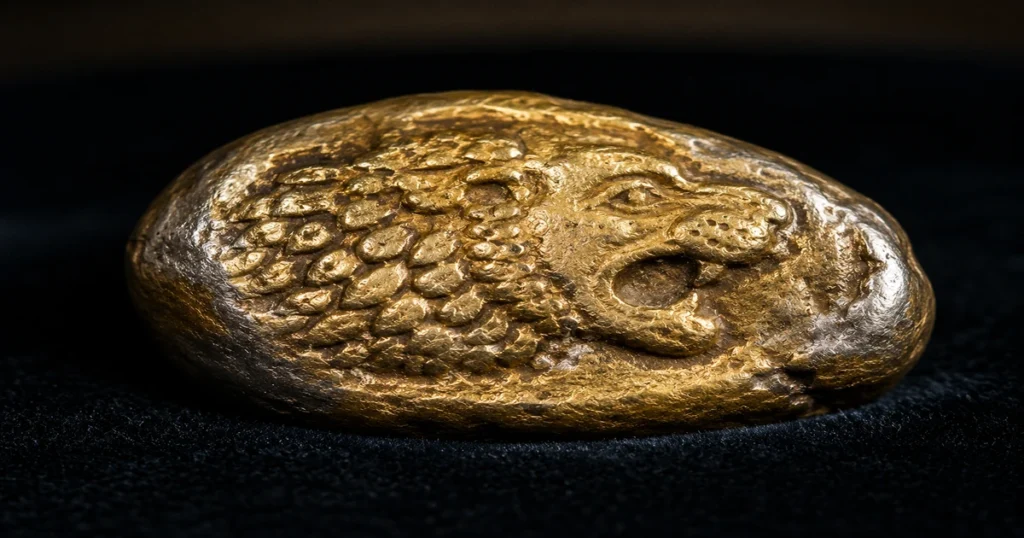
This seemingly simple innovation sparked a massive economic revolution across the globe. Standardized coinage completely eliminated the scale from the marketplace.
Commerce accelerated at unprecedented speeds. Merchants could now count coins instead of weighing raw chunks of metal. Trust was institutionalized.
The Rapid Global Expansion of Coinage
The Lydian invention spread across major trade networks, adopted and modified by massive civilizations simultaneously:
- Ancient Greece: The Greek city-states embraced the concept, issuing the iconic silver Tetradrachm, stamped with the owl of Athena. It became the dominant international trade currency of the Mediterranean, accepted from Athens to the shores of Spain.
- The Persian Empire: King Darius the Great introduced the gold Daric and the silver Siglos, building a highly uniform imperial monetary system that funded the construction of the Royal Road and massive military deployments.
- Ancient India: Around the 6th century BCE, the Mahajanapadas (oligarchic republics) developed punch-marked silver coins (Puranas or Karshapanas), utilizing localized geometric, animal, and solar symbols to validate commerce independently of Western influence.
5. Currency in Ancient Rome: A Masterclass in Monetary Scale and Inflation
No ancient civilization understood or leveraged the raw power of currency quite like the Roman Empire. Rome transformed coinage from a mere localized marketplace tool into a weapon of geopolitical expansion, engineering, and psychological control.
At the absolute peak of the Pax Romana, the entire empire ran on a highly structured, bimetallic system centered around two primary coins:
- The Denarius: A high-purity silver coin used for daily commerce, merchant trading, and the standard wage of laborers and soldiers.
- The Aureus: A premium, heavy gold coin utilized for large-scale real estate transactions, international commerce, and state treasury management.
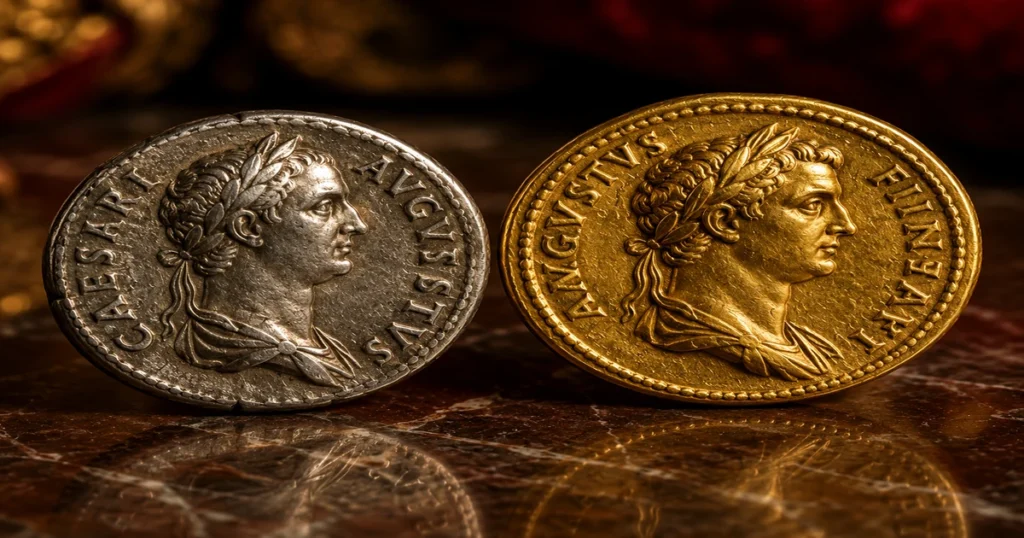
Rome used its mints to pay its legionaries stationed on the distant borders of Britannia and Germania, collect taxes from citizens across North Africa, and finance monumental architectural feats like the Colosseum and the Aqueducts.
Crucially, Roman coins acted as the mass media of their day; because they were stamped with the face of the reigning Emperor, they served as political propaganda, reminding every slave, merchant, and citizen exactly who ruled the known world.
The Great Fall: Currency Debasement and the Collapse of Trust
As Rome entered the 3rd century CE, it encountered massive economic crises. The cost of maintaining an oversized military, fighting endless border wars, and funding expansive public welfare programs drained the imperial treasury.
Rather than raising taxes—which risked sparking violent domestic rebellions—Roman Emperors chose a devious alternative: currency debasement.
Emperors ordered the mints to melt down pure silver coins and mix them with cheap base metals like copper and tin. This allowed the state to mint more coins out of the same volume of silver, creating an illusion of wealth.
The strategy backfired spectacularly:
- Hyperinflation: Merchants immediately noticed the coins were lighter and changed color. They adjusted by demanding significantly more coins for basic goods.
- Loss of Trust: The public lost all faith in the state’s money.
- Gresham’s Law: People hoarded old, high-purity silver coins and rushed to spend the newly minted, diluted coins as fast as humanly possible. Bad money drove good money out of circulation.
By the time the Western Roman Empire collapsed in 476 CE, the silver Denarius was little more than a cheap copper token washed in a microscopically thin layer of silver. The destruction of Rome’s currency paved the way for the fragmentation of Europe into fractured, feudal dark-age economies.
6. The Birth of Paper Money: A Chinese Revolution
While medieval Europe remained trapped in localized feudal economies, exchanging crude silver pennies, China’s Tang and Song Dynasties engineered a massive monetary leap forward: the invention of paper money.
The root cause of this transition was purely logistical. During the Tang Dynasty (618–907 CE), merchants operating across China’s immense landmass relied on base-metal coins made of iron and bronze. These coins possessed a low intrinsic value, meaning large transactions required thousands of coins strung together through central holes on heavy cords.
A wealthy merchant looking to purchase a warehouse of silk had to transport multiple carts heavily laden with tons of base-metal coins—making them slow targets for highway bandits.
From “Flying Money” to Jiaozi
To mitigate this risk, merchants began leaving their heavy metal coins with trusted deposit houses in exchange for paper receipts. These documents were known as Feiqian (Flying Money) because they were incredibly light and could move rapidly across provinces.
Realizing the profound efficiency of this system, the subsequent Song Dynasty formalized it in the 11th century, issuing the world’s first true government-regulated paper currency, known as the Jiaozi.
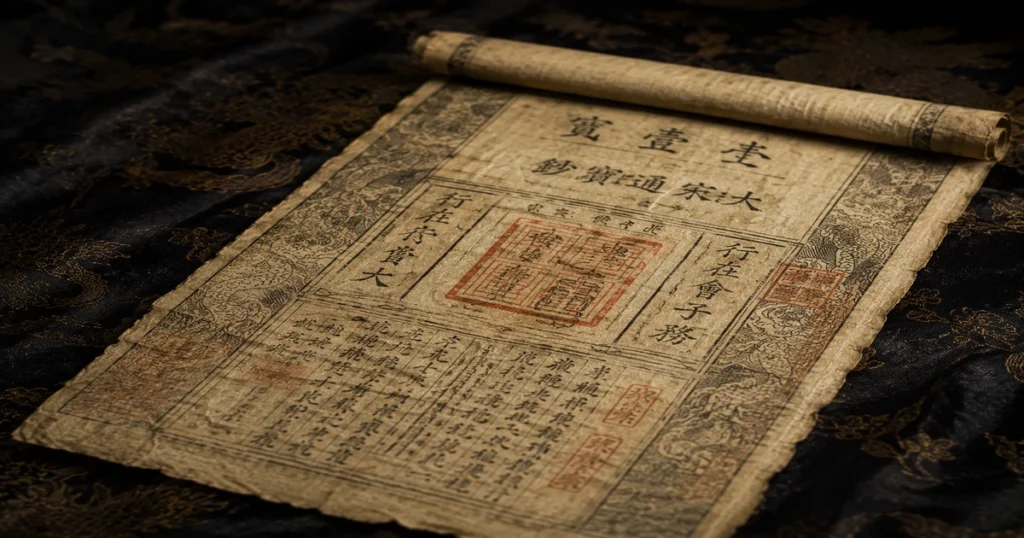
When Venetian merchant Marco Polo traveled to China in the 13th century, he was absolutely astounded by this concept. He wrote detailed accounts to an incredulous European audience, explaining how the Great Kublai Khan could command his subjects to treat worthless pieces of tree bark as if they were pure gold, under penalty of death.
The European Transition to Promissory Notes
Europe did not adopt paper currency until the 17th century, driven by the rise of early modern banking. In London, wealthy merchants traditionally stored their physical gold bullion in the high-security vaults of the Royal Mint. However, in 1640, King Charles I forcibly seized the merchants’ private gold to finance his military campaigns.
Terrified of royal theft, merchants began depositing their precious metals into the private, heavily guarded vaults of local goldsmiths.
The goldsmiths issued paper promissory notes promising to return the exact weight of gold to whoever presented the note. Much like the Chinese experience, merchants quickly realized it was far easier to trade the paper notes directly than to repeatedly withdraw and lug physical gold bars back and forth.
These goldsmith receipts became the direct ancestors of the modern banknote. In 1694, the newly founded Bank of England became the first western central bank to issue permanent, standardized paper banknotes to the public, setting the stage for industrial capitalism.
7. The Gold Standard Era
By the late 19th century, global trade was expanding at a breakneck pace due to the Industrial Revolution. Steamships, railways, and telegraph lines connected distant continents. To facilitate smooth, international commerce without dealing with wild, daily fluctuations between silver-based countries and gold-based countries, the world adopted the International Gold Standard Era (1870–1914).
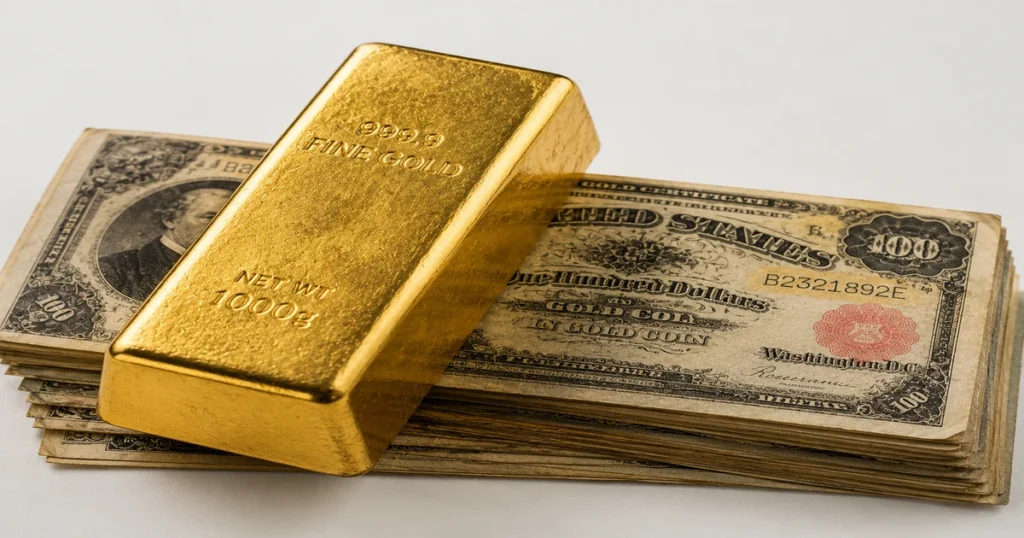
Under a strict Gold Standard, a nation’s government explicitly anchors the value of its paper currency directly to a precise, physical weight of gold. Crucially, any citizen or foreign trade partner could walk into a commercial bank and legally demand to exchange their paper banknotes for physical gold coins or bars at the fixed statutory rate.
The Anchor of Global Stability
The Gold Standard turned out to be an incredible anchor for global economic stability. It imposed a severe, unyielding discipline on politicians and central banks.
A nation could not print excess paper money out of thin air to cover political favors or domestic deficits unless they physically acquired more gold reserves to back those notes. If a country over-printed its currency, foreign nations would immediately lose confidence, present the paper notes at the border, draw down the country’s physical gold reserves, and force the domestic economy into deflationary correction.
The Gold Standard Timeline
The Destruction of the Standard
This self-correcting global system functioned smoothly until the outbreak of World War I in 1914. Faced with the astronomical, existential costs of modern mechanized warfare, European superpowers suspended gold convertibility almost immediately. They turned on their printing presses to manufacture massive amounts of unbacked paper currency to buy ammunition, artillery, and provisions. This wave of unbacked printing triggered devastating hyperinflation throughout post-war Europe—most notoriously in the German Weimar Republic, where money became so completely worthless that citizens burned stacks of paper currency in stoves just to keep their homes warm.
In 1944, as World War II drew to a close, delegates from 44 Allied nations gathered at a resort town in New Hampshire to construct the Bretton Woods Agreement. Recognizing that the global economy needed stability, they established a hybrid gold standard.
Under this new global architecture, the US Dollar (USD) was anointed as the world’s primary global reserve currency, backed explicitly by physical gold at a fixed rate of $35 per ounce. Every other major global currency (the British Pound, French Franc, German Mark) was then pegged directly to the value of the US Dollar. The entire global financial framework rested cleanly on the deep vaults of Fort Knox.
8. Fiat Currency: The Modern Monetary System
The Bretton Woods system worked remarkably well during the post-war boom, but it contained an fundamental vulnerability: the United States was printing more dollars than it had gold to back them up, primarily to fund expanding domestic social programs and the costly escalation of the Vietnam War.
By the late 1960s, foreign nations—particularly France—became highly skeptical of America’s true financial health. They began aggressively exporting their surplus paper US dollars back to American shores, demanding the US Treasury hand over physical gold bars in return.
America’s gold reserves rapidly plummeted. Realizing that a run on the US Treasury would bankrupt the nation, President Richard Nixon made a historic announcement on August 15, 1971.
“I have directed Secretary Connally to suspend temporarily the convertibility of the dollar into gold or other reserve assets.” — President Richard Nixon
This event, known colloquially as the Nixon Shock, permanently severed the final tie between global currency and the physical world. Overnight, the world moved onto a pure Fiat Currency system.
What is Fiat Money?
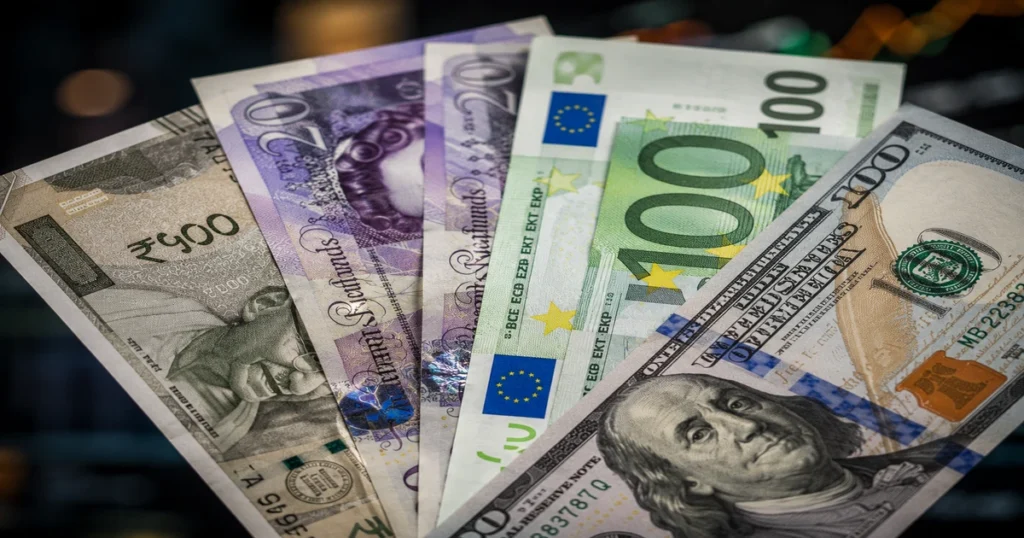
The word fiat is a Latin term meaning “let it be done” or “by decree.” Fiat money possesses absolutely zero intrinsic material value. It cannot be redeemed for gold, silver, salt, or shells.
A $100 bill is functionally a worthless piece of printed cotton-linen fiber; a digital bank balance is nothing more than a few bytes stored on a bank’s server.
Fiat money works purely because of three interconnected pillars:
- Legal Tender Decrees: Governments legally dictate that the national currency must be accepted as payment for all debts, public and private.
- Tax Obligations: The state demands that citizens pay their taxes exclusively in the national currency, forcing an artificial, inescapable demand for that specific money.
- Collective Human Trust: We accept fiat money simply because we are entirely confident that the next person we meet will accept it from us tomorrow. It is a shared psychological social construct.
Major Fiat Currencies Driving Global Commerce
| Currency Code | Currency Name | Issuing Authority | Global Strategic Role |
| USD | US Dollar | Federal Reserve | Principal global reserve asset, pricing mechanism for oil and commodities. |
| EUR | Euro | European Central Bank | Shared currency for 20 eurozone member states, deep liquidity. |
| GBP | British Pound | Bank of England | Historic trade currency, core asset within London financial networks. |
| JPY | Japanese Yen | Bank of Japan | Anchors Asian trade, historically utilized as a major global carry-trade safe haven. |
| INR | Indian Rupee | Reserve Bank of India | Powering one of the world’s fastest-growing domestic consumer markets. |
The Systemic Risk of the Fiat Framework
The primary advantage of fiat money is its incredible flexibility. Central banks can easily expand or contract the money supply to combat economic recessions, inject vital liquidity during global banking panics, or fund large-scale national infrastructure projects.
However, this flexibility is a double-edged sword. Because there is no longer a physical gold anchor limiting the creation of money, governments face an endless temptation to overprint currency to finance escalating national debts. This continuous expansion of the money supply structurally erodes the purchasing power of the currency over time, resulting in the stealth tax known as inflation.
9. The Birth of Forex Markets
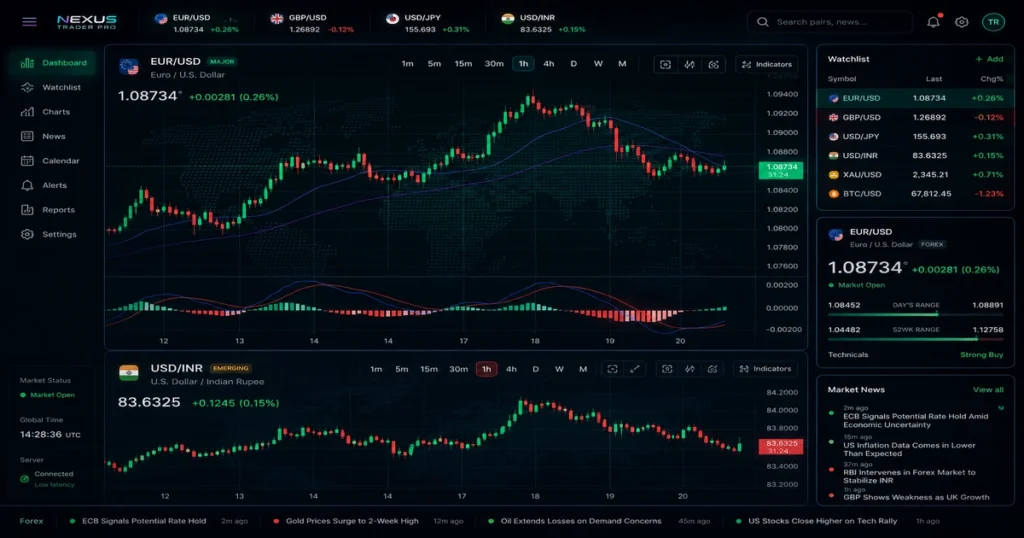
Once the world abandoned the fixed exchange rates of the Bretton Woods gold peg in 1971, currencies began to float freely against one another. The value of a dollar, a pound, or a yen was no longer determined by law; it was decided every second by the harsh forces of global supply and demand. This radical economic shift gave rise to the modern Foreign Exchange Market (Forex).
Forex is the decentralized global marketplace where market participants buy, sell, exchange, and speculate on national currencies. Unlike traditional stock exchanges like the New York Stock Exchange, the Forex market has no physical building or centralized clearinghouse. Instead, it operates via a massive global electronic network of investment banks, commercial banks, institutional hedge funds, and retail brokers.
The Largest Financial Marketplace on Earth
Today, the Forex market is the absolute lifeblood of international trade and capital flows. It is vastly superior in scale to any equity or bond market on Earth. Daily trading volume regularly exceeds $7 trillion, dwarfing the daily trading volumes of all the world’s stock markets combined.
Currencies are always traded in pairs because every single foreign exchange transaction requires the simultaneous purchase of one nation’s currency and the sale of another:
- EUR/USD: Reflects the ongoing economic balance of power between the European Union and the United States.
- USD/JPY: Represents the complex flow of capital between American debt markets and Asian safe-haven assets.
- Price Discovery: If a country raises its interest rates, experiences a major technological boom, or maintains low inflation, global investors rush to buy that currency, driving its exchange rate up on the Forex market. Conversely, political instability, unchecked money printing, or economic recessions cause investors to dump the currency, lowering its global purchasing power.
10. How Central Banks Control Currency
In our modern fiat economy, the value of money is actively managed by technocrats operating within Central Banks. A central bank is a unique state-aligned institution that holds a legal monopoly over the creation, distribution, and regulation of a nation’s money supply.
Central banks do not interact with everyday retail consumers. Instead, they act as the “banker’s bank,” overseeing commercial banking institutions and guiding the macroeconomic ship through the implementation of monetary policy.
                           ┌─────────────────┐
                           │  CENTRAL BANK   │
                           └────────┬────────┘
                                    │ Controls
                      ┌─────────────┴─────────────┐
                      ▼                           ▼
            [ Interest Rates ]             [ Money Supply ]
           Alters the cost of             Quantitative Easing
           borrowing money.               or tightening cycles.
The Three Core Levers of Central Banking Power
Central banks rely on three primary mechanisms to influence currency markets, control domestic inflation, and manage employment levels:
- Interest Rate Manipulation: Central banks set the baseline benchmark overnight lending rate (e.g., the Federal Funds Rate in the US). When a central bank raises interest rates, borrowing money becomes expensive for consumers and corporations, which cools down economic growth and tempers inflation. Concurrently, higher interest rates attract global investors seeking yields, strengthening the domestic currency on the Forex market.
- Open Market Operations & Quantitative Easing (QE): During severe economic crises, central banks can engage in Quantitative Easing—injecting trillions of units of newly created fiat currency directly into the financial system by purchasing government bonds and corporate debt instruments from commercial banks. While this prevents a systemic credit collapse, it expands the central bank’s balance sheet and risks long-term currency devaluation.
- Reserve Requirements: Central banks dictate exactly what percentage of customer deposits a commercial bank must hold securely in its vaults or at the central bank repository. Under the modern system of fractional reserve banking, commercial banks are only required to hold a tiny fraction (often 10% or less) of their depositors’ funds, allowing them to lend out the remaining 90% into the economy, effectively creating new credit money out of thin air.
Key Global Central Banks and Their Currencies
| Central Bank | Native Currency | Global Macroeconomic Responsibility |
| Federal Reserve (The Fed) | US Dollar (USD) | Manages the global reserve asset via its dual mandate of maximum employment and price stability. |
| European Central Bank (ECB) | Euro (EUR) | Maintains price stability across the economically diverse Eurozone member states. |
| Bank of England (BoE) | British Pound (GBP) | Regulates the United Kingdom’s financial architecture from Threadneedle Street. |
| Bank of Japan (BoJ) | Japanese Yen (JPY) | Historically pioneered negative interest rate policies to combat structural deflation. |
| Reserve Bank of India (RBI) | Indian Rupee (INR) | Actively balances domestic economic growth targets with stable rupee exchange rate volatility. |
11. The Strongest Currencies Today
In the modern financial landscape, not all fiat currencies are created equal. A currency’s strength is defined by its liquidity, its widespread adoption as a safe haven, and its dominance within central bank foreign exchange reserves.
The top global currencies dictate the flow of international trade invoicing, commodity pricing, and debt settlement.
The Top 10 Dominant Currencies in Global Finance
- US Dollar (USD): The undisputed global reserve currency. The US Dollar is involved in nearly 90% of all global Forex transactions and accounts for the largest share of global central bank reserves.
- Euro (EUR): The second most traded currency globally, representing the combined economic output of Europe’s industrial powerhouse nations.
- British Pound (GBP): A highly liquid, historic currency that remains a pillar of global banking, asset management, and trade financing.
- Japanese Yen (JPY): Widely utilized as a critical funding currency due to Japan’s historically low interest rates and massive foreign asset holdings.
- Swiss Franc (CHF): The ultimate safe-haven currency. Backed by Switzerland’s historic neutrality, political stability, and secretive, secure banking traditions.
- Canadian Dollar (CAD): A major commodity currency, highly sensitive to global energy cycles and oil pricing.
- Australian Dollar (AUD): A liquid proxy for global growth trends, highly dependent on mining exports and raw material demands from Asia.
- Indian Rupee (INR): A massive emerging market currency, rapidly transitioning into a major engine of domestic consumer trade and services.
- Chinese Yuan (CNY): Emerging as a challenger to Western trade dominance, expanding its international use through cross-border trade settlements.
- Singapore Dollar (SGD): A rock-solid currency managed via an exchange rate basket, backed by Singapore’s status as Asia’s premier transparent financial hub.
12. Digital Money and the Future of Currency
Money is changing once again. We are currently living through the initial phases of the most profound monetary transformation since the Song Dynasty rolled out paper bills in China centuries ago. Physical paper currency is rapidly disappearing from daily life, replaced by a hyper-connected, cashless digital architecture.
The Rise of Cashless Infrastructure
Across modern societies, the vast majority of all fiat money transactions are already entirely digital. When an employee receives their monthly salary via direct deposit, no paper money changes hands. The transaction consists entirely of updating entries on a centralized banking ledger.
Systems like UPI (Unified Payments Interface) in India, mobile wallets like Apple Pay and WeChat Pay, and instant settlement networks have reduced payment friction down to zero. Transactions happen instantly via QR code scans and biometric authentication.

The Cryptographic Disruption
In 2009, an anonymous programmer named Satoshi Nakamoto launched Bitcoin, introducing the concept of cryptocurrency to the world. Bitcoin solved a fundamental computer science problem: how to create digital scarcity without relying on a central authority like a bank or government.
Unlike fiat currency, which can be printed endlessly by central banks, Bitcoin has a hard-capped supply limit of exactly 21 million units written into its open-source code. It operates on a decentralized blockchain ledger maintained by a global network of computers. This introduces a digital return to the principles of the gold standard—an unforgeable, scarce digital asset operating independently of state monetary policies.
Central Bank Digital Currencies (CBDCs)
Recognizing the competitive threat posed by decentralized cryptocurrencies and private corporate payment networks, global central banks are now developing their own institutional counter-weapons: Central Bank Digital Currencies (CBDCs).
A CBDC is not cryptocurrency. Rather, it is a digital version of a nation’s existing fiat currency, issued and controlled directly by the central bank.
- How it works: Instead of citizens holding accounts at intermediary commercial banks, individuals could maintain a direct digital wallet directly with the central bank.
- The Implications: CBDCs promise to radically lower transaction friction, completely eliminate the cost of printing physical cash, and streamline tax collection. However, they also introduce unprecedented capabilities for state surveillance and control, giving central banks the power to trace every transaction, program expiration dates onto money, or restrict spending behavior algorithmically.
Key Historical Observations
- Money Began as Barter: Direct commodity swapping formed the primitive blueprint for human survival but failed due to the double coincidence of wants.
- Commodities Built the Baseline: Salt, shells, and grain solved early trade friction but were limited by their perishability and transportation costs.
- Metals Created Durable Wealth: Copper, silver, and gold brought durability, high divisibility, and natural element-based scarcity into the marketplace.
- Coins Standardized Public Value: The Kingdom of Lydia eliminated the scale from trade, replacing time-consuming weighing with institutional state trust.
- Paper Accelerated Large-Scale Trade: China bypassed the weight of base metals, inventing light banknotes that later laid the groundwork for modern banking.
- Gold Standard Created Stability: Linking paper bills directly to physical gold reserves restricted political spending and stabilized global industrial markets.
- Fiat Unleashed Systemic Flexibility: Severing ties to gold in 1971 turned money into an entirely credit-driven asset based on state power and collective trust.
- Forex Created Global Price Discovery: Floating exchange rates turned the international currency market into a $7+ trillion daily mechanism.
- Digital Networks Form the Next Frontier: The convergence of cashless payments, decentralized cryptographic assets, and sovereign CBDCs is reshaping the definition of value.
FAQ Section
What was the absolute first form of money?
Before money existed, early human groups engaged in the barter system, directly swapping goods like meat, tools, and skins. The earliest true proto-monetary assets were highly desired commodities, such as barley in ancient Mesopotamia and cowrie shells throughout Asia and Africa.
Who actually invented currency?
The Kingdom of Lydia (located in modern-day Turkey) minted the world’s first official coins around 700 BCE using a natural gold-and-silver alloy called electrum. These stamped coins established a standardized weight and value guaranteed by the state.
Why did paper money eventually replace gold?
Paper money replaced physical gold coins because it was far lighter, easier to transport over long distances, and significantly more efficient for scaling up large industrial economies. Carrying heavy gold bullion left merchants exposed to logistical friction and theft.
What exactly is fiat money?
Fiat money is currency that has zero intrinsic value and is not backed by a physical commodity like gold or silver. Its value is derived entirely from government decrees (legal tender laws), state tax demands, and the collective trust of the population using it.
What is the largest financial market in the world?
The Foreign Exchange (Forex) Market is by far the largest financial market on Earth, generating a daily trading volume that exceeds $7 trillion. It operates as a decentralized, 24-hour network where national fiat currencies are traded against one another.
Why does the US Dollar remain the world’s dominant currency?
The US Dollar dominates global finance because it is backed by the world’s largest economy, its most powerful military, and deeply liquid financial markets. Following the Bretton Woods agreement and the creation of the “Petrodollar” system, the USD became the primary invoicing currency for global trade, energy commodities, and central bank foreign reserves.
Final Perspective
Money is not just a piece of paper, a base-metal token, or a collection of digital code flashing across a banking database. It is one of humanity’s greatest, most profound social inventions.
Money transformed primitive survival into advanced civilization. It allowed humans to specialize in their labor, trade across vast oceans, construct massive modern cities, and coordinate complex economic actions across millions of individuals who have never met one another face-to-face. It has funded historic voyages of exploration, sustained massive wars, built global empires, and triggered devastating economic collapses when mismanaged by states.
From the ancient barter systems of the distant past to the upcoming digital frontiers of programmable money and decentralized networks, the physical form of currency has changed continuously to meet the scale of human needs.
Yet, throughout thousands of years of evolution, the core engine of money has remained entirely unchanged: Trust.
Whether it is a roaring lion stamped onto an ancient Lydian electrum coin, a paper banknote issued by a Western central bank, or a digital ledger balance, money only works because we all collectively agree that it works. That single, shared illusion is the foundation that powers the entire modern financial world today—and it will continue to shape the future of human civilization tomorrow.

