

Direct Definition & Summary
The Gold Standard was a monetary system in which a country’s currency was directly linked to a fixed amount of physical gold. Between 1870 and 1971, major economies used various forms of the gold standard to stabilize currencies, control inflation, and facilitate international trade. The system ultimately ended after the 1971 Nixon Shock, when the United States suspended gold convertibility and ushered in the modern fiat currency era.
In this guide, we examine how the Gold Standard worked, why it was considered stable, the factors that caused its collapse, and how its legacy continues to influence modern monetary policy.
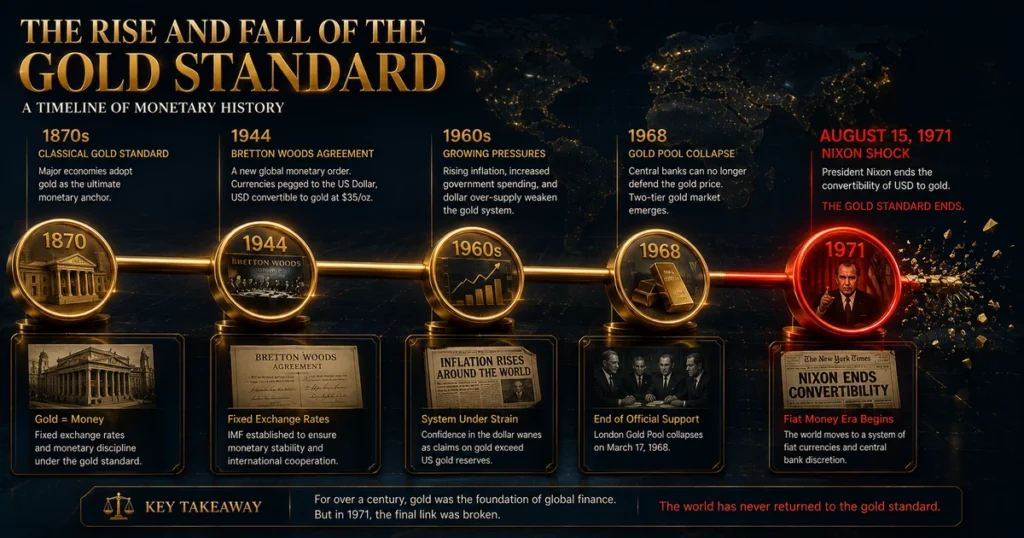
Historical Timeline Matrix
| Year | Key Historical Event | System Impact |
| 1870 | Classical Gold Standard Begins | Major global economies fix currencies to physical gold. |
| 1914 | WWI Suspends Convertibility | Nations print unbacked paper money to fund military expenditures. |
| 1931 | Britain Leaves Gold Standard | The UK abandons gold convertibility amidst Great Depression pressure. |
| 1933 | Executive Order 6102 | US confiscates private domestic monetary gold at $20.67/oz. |
| 1944 | Bretton Woods Agreement | World currencies peg to USD; USD pegs to gold at $35/oz. |
| 1971 | The Nixon Shock (August 15) | US closes the gold window, initiating the modern fiat money system. |
The Breaking Point: August 15, 1971
Simple Answer:
The collapse of the Gold Standard occurred on August 15, 1971, when US President Richard Nixon closed the gold window. Facing severe gold reserve drains from foreign central banks, the US unilaterally ended the $35/oz convertibility rate, transitioning the global economy into a unbacked, floating fiat currency regime.
[1944: Bretton Woods Established] ──► [US Dollar Pegged to Gold @ $35/oz]
                                               │
[1960s: US Overprints USD for Vietnam War] ────┘
                                               │
[1970: France Demands Physical Gold Redemption] ──► [US Gold Reserves Drain 55%]
                                               │
[August 15, 1971: Nixon Suspends Gold Convertibility] ──► [Modern Fiat Era Begins]
On a Sunday evening in August 1971, US President Richard Nixon interrupted pre-empted television broadcasts to make an emergency announcement that changed global economics forever.
Without consulting foreign allies or international monetary bodies, Nixon unilaterally suspended the convertibility of the US Dollar into physical gold for foreign central banks.
Known as the Nixon Shock, this single event severed the final physical link between paper money and real assets, bringing an end to a century-old monetary experiment.
Understanding why this system was created—and why it eventually collapsed—is essential for any macro analyst evaluating currency debasement, global gold reserves, and long-term inflation.
The Core Engine: How Physical Gold Controlled Central Banks
Simple Answer:
The Gold Standard controlled central banks by tying paper money issuance strictly to physical vault gold reserves. Central banks could not print excess currency without acquiring corresponding bullion, capping inflation, anchoring exchange rates, and restricting arbitrary monetary expansion.
[Central Bank Vault Storage (Physical Bullion)]
                       ▲
                       │ (1:1 Legal Convertibility)
[Paper Notes in Circulation (Public Currency)]
Under a pure gold standard, a government could not print paper notes simply by decree. Every dollar, pound, or franc in circulation was legally anchored to real physical metal stored inside central bank vaults.
3-Layer Mechanism Breakdown:
- Quick Answer: The gold standard tied currency creation directly to physical vault inventory.
- Simple Explanation: Imagine a coat-check system at a theater: the paper receipt is worthless on its own, but it proves you own a real coat in the back room. Paper currency worked the exact same way for gold bars.
- Professional Explanation: The monetary base ($M_0$) was bounded strictly by physical gold stock ($\text{Gold Reserve} \times \text{Fixed Statutory Rate}$). This constrained credit expansion and eliminated arbitrary central bank balance sheet inflation.
The Price-Specie Flow Equilibrium
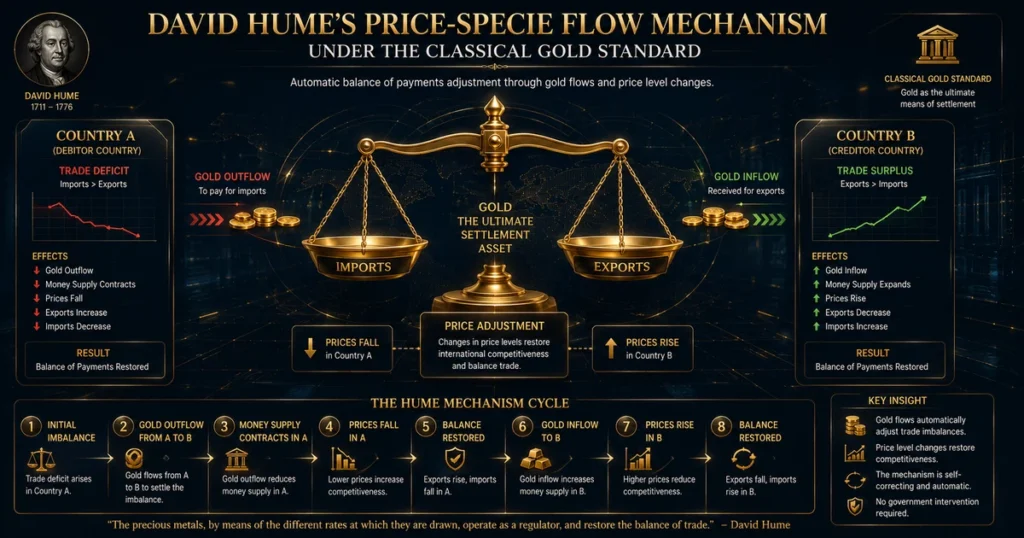
Economist David Hume identified the self-correcting trade mechanism inherent in gold-backed money:
[Country A Runs Trade Deficit] ──► Exports Physical Gold to Country B
                                         │
[Country A Money Supply Drops] ◄─────────┴───────► [Country B Money Supply Rises]
             │                                              │
             ▼                                              ▼
Domestic Prices Fall (Deflation)                Domestic Prices Rise (Inflation)
             │                                              │
             └──────► Country A Exports Become Cheaper ◄───┘
- If a nation imported more goods than it exported, it had to pay the difference by shipping physical gold bars abroad.
- The loss of physical vault gold forced the domestic central bank to reduce paper money in circulation.
- Lower money supply reduced domestic price levels, making that country’s goods cheaper globally, automatically restoring international trade balance.
Chapter 1: The Classical Era (1870–1914) — The Golden Age
Simple Answer:
The Classical Gold Standard (1870–1914) was a period of global monetary stability led by the British Pound. Currencies were freely convertible into gold coins for individuals and institutions, producing near-zero long-term inflation and seamless international trade until World War I forced its suspension.
Classical System Rules:
1. Full Convertibility   : Citizens & banks could swap paper cash for gold coins on demand.
2. Unrestricted Mobility: Zero capital controls on international gold shipments.
3. 100% Mint Parity      : Currencies pegged to exact weights (e.g., £1 = 0.25 oz gold, $1 = 0.05 oz gold).
- The Economic Impact: Global inflation averaged near 0% across 40 years. International trade boomed without foreign exchange risk.
- The Fatal Flaw: The system required absolute government restraint. When World War I broke out in 1914, European powers suspended gold convertibility overnight so they could print unbacked paper money to fund military operations.
Chapter 2: The Interwar Fracture (1919–1939) & Great Depression
Simple Answer:
During the Interwar Period (1919–1939), nations adopted a flawed “Gold Exchange Standard” that exacerbated the Great Depression. Bound by gold coverage ratios, central banks could not provide emergency liquidity to failing banks, forcing countries to abandon gold convertibility to inflate their economies.
Interwar Fractional System:
[Paper Cash in Circulation] ──► Redeemable ONLY in 400 oz Industrial Gold Bars (No Coins)
                                            │
[Central Bank Reserves]     ──► Backed by Gold AND Foreign Paper Currencies (USD / GBP)
Why Gold Worsened the Great Depression:
When stock markets crashed in 1929, terrified depositors rushed to banks to convert paper notes into physical gold.
- Under gold standard rules, central banks could not act as lenders of last resort or print emergency liquidity without breaking legal gold coverage ratios.
- To protect their gold vaults from draining, central banks were forced to raise interest rates during a severe depression, triggering massive bank failures and economic collapse.
- Nations abandoned the system one by one to survive: Great Britain exited in 1931; US President Franklin D. Roosevelt confiscated domestic private gold in 1933 via Executive Order 6102.
Chapter 3: The Bretton Woods Illusion (1944–1971)
Simple Answer:
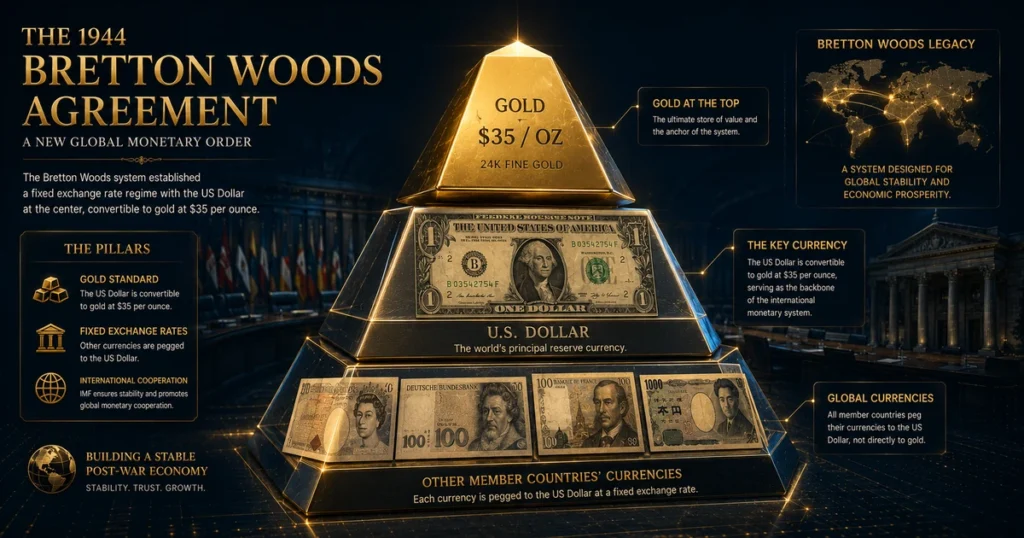
The Bretton Woods System (1944–1971) created a dollar-centric gold standard. Global currencies pegged their exchange rates to the US Dollar, which was backed by physical gold at $35 per ounce. Convertibility was restricted strictly to foreign central banks, excluding individual citizens.
The Bretton Woods Anchor Structure:
                   [ Physical Gold Vaults ]
                              ▲
                              │ ($35 / Troy Ounce)
                   [ United States Dollar ]
                              ▲
                              │ (Fixed Foreign Exchange Pegs)
 [ Global Currencies: British Pound, German Mark, French Franc, Japanese Yen ]
In 1944, delegates from 44 Allied nations met at Bretton Woods, New Hampshire, establishing the US Dollar as the primary global reserve asset, pegged directly to physical gold at $35 per troy ounce.
The Triffin Dilemma: The Fatal Math Error
Simple Answer:
The Triffin Dilemma was a structural flaw in the Bretton Woods system. To provide enough dollars for global trade, the United States had to create more dollars than its gold reserves could support. Over time, this imbalance undermined confidence in dollar convertibility and contributed to the collapse of Bretton Woods.
US Gold Reserve Drain Leading to Nixon Shock:
1950 US Gold Reserves : [████████████████████████] ~20,000 Metric Tonnes
1970 US Gold Reserves : [██████████] ~9,000 Metric Tonnes
                       (Massive Flight of Physical Bullion to Europe)
- Global Need: To supply liquidity for expanding world trade, the US ran constant trade deficits, exporting billions of paper dollars globally.
- Mathematical Reality: Total overseas paper dollar liabilities eventually exceeded the physical gold stored at Fort Knox and the FRBNY.
- The Gold Run: Realizing the US was over-leveraged, French President Charles de Gaulle sent warships to New York in the late 1960s to exchange paper dollars for physical gold bars, draining American gold reserves by over 50%.
The Aftermath: 1971 vs. Modern Fiat Inflation Data
Simple Answer:
Since closing the gold window in 1971, global currencies have operated on a 100% unbacked floating fiat system. This transition removed hard caps on sovereign debt, leading to an 86%+ loss in US Dollar purchasing power while driving historical gold price performance up over 6,700%.
US Dollar Purchasing Power Decay vs. Gold Price Expansion (1971 - 2026)

USD Purchasing Power : [██████████░░░░░░░░░░░░░░░] -86% Loss Since 1971
Gold Spot Price      : [█████████████████████████] $35/oz ──► $2,400+/oz (+6,700% Gain)
Structural Shifts Post-1971:
- Uncapped Debt Expansion: Without gold coverage limits, global sovereign debt surged past $300 Trillion USD.
- Persistent Structural Inflation: Consumer Price Index (CPI) volatility replaced the long-term price stability of the 19th century.
- Central Bank Vault Stacking: Despite demonetizing gold legally, central banks retain over 35,000 metric tonnes of physical bullion as an unencumbered Tier-1 reserve asset. (For modern institutional execution, see our gold futures market guide).
Regime Matrix: Classical vs. Bretton Woods vs. Floating Fiat
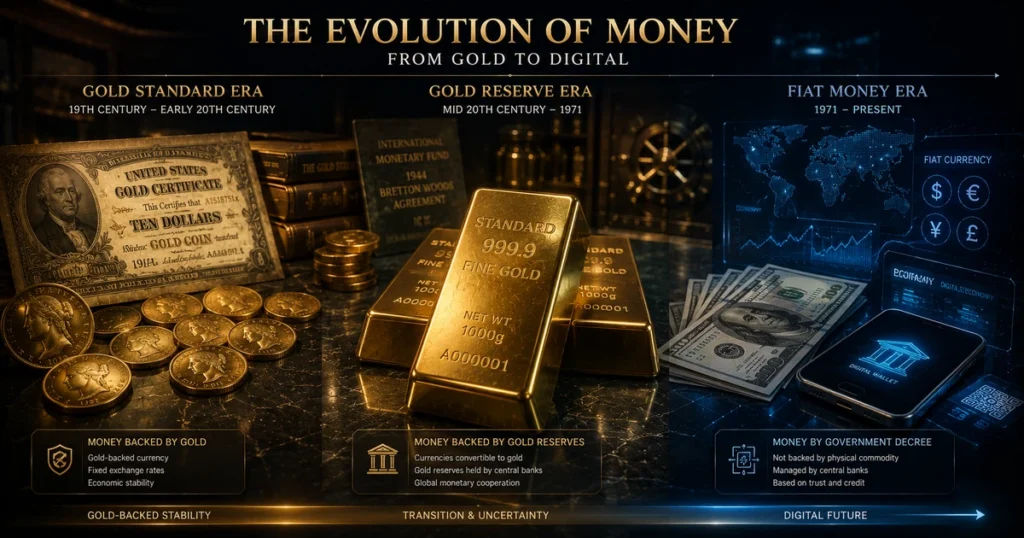
| Feature / Metric | Classical Gold Standard (1870–1914) | Bretton Woods System (1944–1971) | Floating Fiat System (1971–Present) |
| Monetary Backing | 100% Physical Gold | Indirect (USD pegged to Gold) | None (Government Decree) |
| Convertibility | Full Access for All Citizens | Central Banks Only | Zero Convertibility |
| Exchange Rate Model | Permanently Fixed | Fixed but Adjustable Pegs | Free-Floating Market Rates |
| Long-Term Inflation | ~0% Average | Moderate Controlled Inflation | Structural Fiat Devaluation |
| Money Supply Growth | Bound by Global Mining Output | Bound by US Fort Knox Reserves | Uncapped (Central Bank Policy) |
| Central Bank Power | Strictly Limited | Moderate Oversight | Ultra-High (Quantitative Easing) |
| Primary Reserve Asset | Physical Gold Bullion | US Dollars & Gold | US Treasuries & Forex Reserves |
Related Monetary Concepts
To help search engines and macro researchers navigate knowledge graph connections, this foundation asset anchors the following core financial entities:
┌────────────────────────────────────────────────────────────────────────┐
│ 🏛️ KNOWLEDGE GRAPH ENTITY INDEX                                        │
│                                                                        │
│ • Gold Standard           • Bretton Woods System     • Fiat Currency   │
│ • Central Bank Reserves   • Inflation & Deflation    • Triffin Dilemma │
│ • The Nixon Shock (1971)  • Fort Knox Depository     • Monetary Policy │
│ • Executive Order 6102    • Price-Specie Flow        • M2 Money Supply │
└────────────────────────────────────────────────────────────────────────┘
4 Common Myths About Gold Standard History
Avoid these widespread historical errors when analyzing monetary regimes:
- Myth 1: “The Gold Standard prevented all economic recessions.”
- Fact: While the system controlled long-term inflation, it suffered severe banking panics and deflationary supply shocks (e.g., the Panic of 1893).
- Myth 2: “Governments can easily return to a 100% Gold Standard tomorrow.”
- Fact: Re-anchoring global M2 money supply and sovereign debt to physical gold would require revaluing gold prices to tens of thousands of dollars per ounce to match liabilities.
- Myth 3: “Bretton Woods allowed individual citizens to redeem dollars for gold.”
- Fact: US citizens were prohibited from holding monetary gold under FDR’s Executive Order 6102. Only foreign central banks could request official redemption.
- Myth 4: “Gold lost its monetary purpose after 1971.”
- Fact: Central banks never sold off their gold. Under Basel III banking rules, physical gold is classified as a zero-risk Tier-1 capital asset. (Investors can also access gold via modern gold investment vehicles).
🎓 Expert Note: “The abandonment of the Gold Standard in 1971 did not destroy gold’s value; it unleashed it. When paper money lost its physical anchor, gold transformed from a fixed $35 peg into a dynamic, free-floating hedge against unbacked fiat expansion.” — CurrencyPlans Macro History Desk
Frequently Asked Questions (FAQs)
Q1. Why did President Nixon close the gold window in 1971?
Ans: Nixon closed the gold window because the US printed significantly more paper dollars to fund the Vietnam War and social spending than it had physical gold in reserves. When foreign nations (led by France) began redeeming paper dollars for Fort Knox gold, US gold supplies dropped by 55%, forcing an emergency suspension.
Q2. Is the Gold Standard still used anywhere in the world today?
Ans: No country currently uses a Gold Standard. All global economies operate on unbacked, floating fiat currency systems managed by central banks. However, central banks continue to accumulate record physical gold reserves as an ultimate sovereign reserve buffer.
Q3. Which countries currently hold the largest gold reserves?
Ans: The United States holds the world’s largest gold reserves (~8,133.5 metric tonnes), followed by Germany (~3,351.5 tonnes), Italy (~2,451.8 tonnes), France (~2,436.9 tonnes), and Russia (~2,332.7 tonnes). (Read our full global gold reserves guide for detailed rankings).
Q4. What was Executive Order 6102?
Ans: Executive Order 6102 was a decree signed by US President Franklin D. Roosevelt in April 1933 during the Great Depression. It criminalized private ownership of monetary gold coins, bullion, and paper certificates for American citizens, forcing them to sell gold to the Federal Reserve at $20.67 per ounce so the government could inflate the money supply.
Q5. What was the London Gold Pool?
Ans: The London Gold Pool (1961–1968) was a syndicate of eight Western central banks (led by the US) that pooled their physical gold reserves to defend the fixed $35/oz price on the open London market. The pool collapsed in 1968 when private market demand for gold overwhelmed central bank supplies.
Conclusion & Strategic Verdict
The Gold Standard remains one of the most influential monetary experiments in modern economic history. While it delivered long-term price stability and fiscal discipline, it also limited governments’ ability to respond to financial crises and wars. Its collapse in 1971 fundamentally reshaped the global financial system and introduced the floating fiat era that still exists today.
For investors, economists, and policy analysts, understanding the rise and fall of the Gold Standard provides valuable insight into inflation, currency debasement, sovereign debt expansion, and the continued importance of central bank gold reserves.
Recommended Action Plan:
- Recognize Fiat Devaluation: Paper currencies naturally lose purchasing power over long horizons as central banks expand balance sheets.
- Observe Central Bank Strategy: Although operating on fiat systems, central banks continue to accumulate record physical gold reserves as ultimate systemic insurance.
About the Author & Editorial Team
This article was researched and prepared by the CurrencyPlans Macro History Desk, specializing in monetary history, central bank reserve systems, exchange rate regimes, and global macroeconomic developments.
Our editorial process involves reviewing historical timelines, monetary frameworks, government policies, and central bank records to ensure accuracy and factual consistency. Information is cross-referenced using publicly available archival sources, research publications, and institutional reports from leading financial organizations.
Every article undergoes editorial review and periodic updates to reflect newly available research, revised economic data, and historical clarifications where applicable.
Editorial Focus Areas:
- Monetary History
- Gold Standard & Bretton Woods System
- Central Bank Reserve Management
- Global Currency Systems
- Inflation & Monetary Policy
- International Financial Markets
Review Policy: Content is reviewed and updated periodically to maintain historical accuracy, relevance, and research quality.
Official References & Citations
- Federal Reserve History Archives: The Nixon Shock & The End of Bretton Woods
- International Monetary Fund (IMF): History of the IMF & Bretton Woods Framework
- Bank for International Settlements (BIS): Historical Evolution of Sovereign Reserve Currencies
- National Bureau of Economic Research (NBER): The Classical Gold Standard: A Historical Analysis
Regulatory Disclaimer
Disclaimer: The information provided in this historical guide is strictly for educational and informational purposes only. It does not constitute financial, investment, or legal advice. Historical market performance is no guarantee of future financial results. Always consult a certified financial advisor before making asset allocation decisions. CurrencyPlans does not provide execution or financial advice.

