

Introduction
In an era defined by expanding sovereign debt, geopolitical fragmentation, and currency debasement, gold reserves serve as the ultimate anchor of international financial trust.
While commercial banks trade spot contracts and derivatives for short-term yield, central banks and sovereign wealth funds hold physical gold reserves off-balance-sheet as a non-sovereign, zero-counterparty risk asset.
Understanding gold reserves requires analyzing how central banks acquire, audit, and vault physical bullion. From the massive underground vaults at the Federal Reserve Bank of New York and the Bank of England to sovereign repatriation efforts across Europe and Asia, gold reserves remain the bedrock of national monetary defense.
In this master foundation guide, you will learn what gold reserves are, examine the top sovereign holders globally, explore how central banks use bullion to back currency stability, and analyze the macroeconomic impact of massive central bank gold buying.
💡 In Simple Words: A gold reserve is a massive stockpile of 24K physical gold bars held by a country’s central bank or government. It acts as a national financial emergency fund, backing the country’s currency value, boosting international creditworthiness, and protecting the economy during global crises.
Gold Reserve Snapshot
| Parameter | Sovereign & Institutional Standards |
| Primary Focus Keyword | Gold Reserve |
| Global Industry Benchmark | World Gold Council (WGC) & IMF International Financial Statistics (IFS) |
| Top Global Sovereign Holder | United States (~8,133.5 Metric Tonnes) |
| Primary Institutional Vaults | FRBNY (New York), Bank of England (London), Bundesbank (Frankfurt) |
| Purity & Bar Specifications | LBMA Good Delivery Standard (400 troy oz bars; 99.5%+ fine gold) |
| Key Macro Ratio | Gold-to-Foreign Forex Reserves Ratio (%) |
| Primary Oversight Bodies | International Monetary Fund (IMF), Bank for International Settlements (BIS) |
⚡ AI Overview & Quick Answer
A gold reserve is a nation’s official stockpile of physical gold bullion maintained by its central bank or monetary authority. These reserves function as a sovereign risk buffer, hedge against fiat currency devaluation, and asset of last resort during geopolitical or financial crises. Gold reserves are non-sovereign assets, meaning their legal value is not dependent on any foreign government’s promise or credit rating.
What is a Gold Reserve and Why Do Central Banks Hold It?
Quick Answer: A gold reserve is a national stockpile of physical bullion held by a central bank. Central banks hold gold reserves because gold carries zero counterparty risk, cannot be frozen or defaulted on by foreign governments, acts as an inflation hedge, and provides liquidity during global financial shocks.
1. Zero Counterparty & Sovereign Default Risk
💡 Simple Meaning: “Counterparty Risk” means the risk that the other party breaks their promise to pay you back. Physical gold in your vault has zero counterparty risk because it is a physical asset, not a paper promise from another government.
Unlike foreign Treasury bonds or foreign fiat currencies held in foreign accounts, physical gold in a central bank’s vault is an absolute, independent asset. It does not depend on another nation’s solvency or willingness to honor debt obligations.
2. Diversification of Foreign Exchange (Forex) Reserves
Central banks manage multi-billion dollar Foreign Exchange (Forex) portfolios containing US Dollars, Euros, Yen, and sovereign debt.
Holding physical gold balances out exposures to fiat currencies that naturally lose purchasing power over time due to inflation, rate cuts, and rising government debt.
3. De-Dollarization & International Monetary Trust
Gold reserves strengthen a nation’s international credit rating.
During periods of geopolitical sanctions or global monetary shocks, countries with substantial gold reserves can use their bullion to settle international trade, secure emergency loans, or back local currency stability. (Learn more about offshore vaulting in our Global Digital Gold Guide).

⚡ Quick Recap: Why Hold Gold Reserves?
- ✔ Zero Default Risk: Independent of foreign government creditworthiness.
- ✔ Inflation Hedge: Preserves long-term national purchasing power.
- ✔ Strategic Autonomy: Settles international obligations during financial sanctions.
Top 10 Countries by Gold Reserves (2026 Official WGC Data)
Quick Answer: The United States holds the world’s largest official gold reserve at over 8,133 metric tonnes, followed by Germany, Italy, France, and Russia. Together, central banks hold over 35,000 metric tonnes of physical gold worldwide.
The table below reflects official sovereign holdings tracked by the World Gold Council (WGC) and the International Monetary Fund (IMF):
| Rank | Country / Entity | Official Gold Reserves (Metric Tonnes) | Share of Total Foreign Forex Reserves (%) | Primary Storage Location(s) |
| #1 | United States | 8,133.5 Tonnes | ~69.8% | Fort Knox (KY), West Point (NY), FRBNY |
| #2 | Germany | 3,351.5 Tonnes | ~68.5% | Bundesbank (Frankfurt), BoE (London), FRBNY |
| #3 | IMF (International Entity) | 2,814.0 Tonnes | N/A (International Institution) | Designated Member Vaults |
| #4 | Italy | 2,451.8 Tonnes | ~65.2% | Banca d’Italia (Rome), Swiss National Bank |
| #5 | France | 2,436.9 Tonnes | ~66.1% | Banque de France (Paris – La Souterraine) |
| #6 | Russia | 2,332.7 Tonnes | ~26.0% | Central Bank of Russia (Moscow, St. Petersburg) |
| #7 | China (PBoC) | 2,262.4 Tonnes | ~4.6% | People’s Bank of China (Beijing) |
| #8 | Switzerland | 1,040.0 Tonnes | ~7.8% | Swiss National Bank (Berne, Zurich) |
| #9 | Japan | 846.0 Tonnes | ~4.4% | Bank of Japan (Tokyo) |
| #10 | India (RBI) | 822.1 Tonnes | ~8.7% | RBI Vaults (Mumbai, Nagpur), BoE (London) |
📊 Global Sovereign Gold Holdings Share (Visual Scale):

United States : [████████████████████████████████] 8,133 T
Germany       : [█████████████] 3,351 T
Italy         : [█████████] 2,451 T
France        : [█████████] 2,436 T
Russia        : [████████] 2,332 T
China (PBoC)  : [████████] 2,262 T
India (RBI)   : [███] 822 T
Key Trends in Global Reserve Accumulation:
- Western Heavy Allocations: Developed nations (US, Germany, Italy, France) hold over 60% of their total reserves in gold, signaling deep monetary reliance on physical bullion.
- Eastern Aggressive Accumulation: Emerging market central banks (China, India, Turkey, Poland) have been the world’s largest net buyers over the last decade to diversify away from US Dollar concentration.
📌 Pro Tip: When analyzing gold market fundamentals, watch the Share of Forex Reserves (%). Countries with lower percentages (like China at ~4.6% or India at ~8.7%) have massive structural room to buy gold for years to come.
⚡ Quick Recap: Sovereign Rankings
- ✔ Top Holder: US leads globally with 8,133+ metric tonnes.
- ✔ Strategic Reserve Ratios: Western nations hold 65%+ of reserves in gold.
- ✔ Net Buyers: Emerging markets (China, India, Poland) are actively stacking bullion.
Where Are Global Gold Reserves Stored? (Vault Geography)
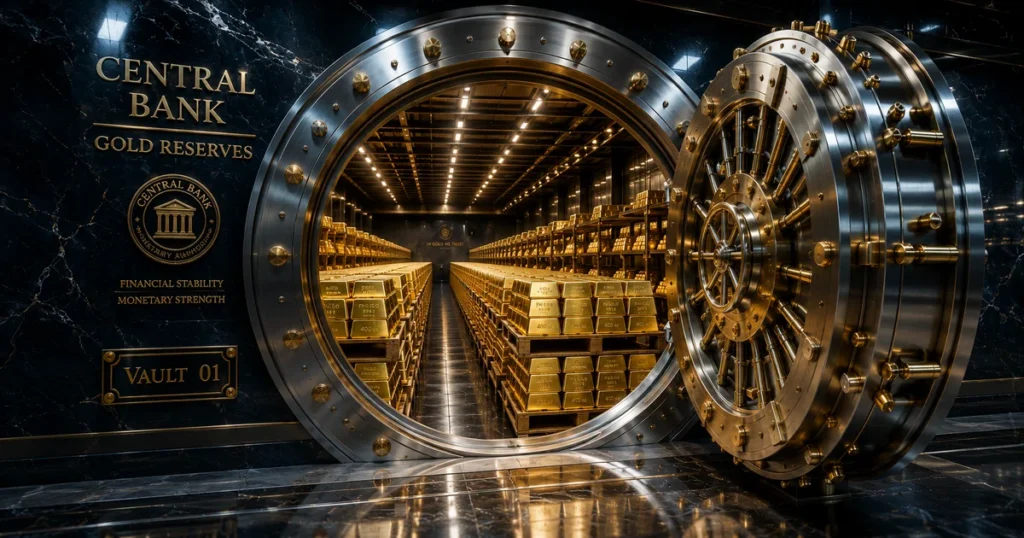
Quick Answer: Official gold reserves are stored in ultra-secure underground vaults. The world’s largest gold vault is located at the Federal Reserve Bank of New York (FRBNY), followed by the United States Bullion Depository at Fort Knox and the Bank of England in London.
Major Global Sovereign Gold Vault Locations:
[ United States: Fort Knox & FRBNY ] ──► Stores US National Gold + International Custody Gold
[ United Kingdom: Bank of England ] ──► Primary Global Bullion Clearing Hub (LBMA)
[ Europe: Banque de France & Bundesbank ] ──► Deep Underground Vaults (Paris & Frankfurt)
1. Fort Knox (Kentucky, USA)
- Storage Volume: Houses over 4,500 metric tonnes of US national gold.
- Security Protocol: Multi-layered military perimeter protection, bomb-proof granite vaults, operated by the US Mint Police.
2. Federal Reserve Bank of New York (FRBNY – Manhattan)
- Storage Volume: Situated 80 feet below street level in Manhattan bedrock.
- Custody Function: Acts as the world’s largest gold custodian, holding gold for over 30 foreign central banks and international institutions.
3. Bank of England (London, UK)
- Storage Volume: Holds over 5,000 tonnes of physical gold beneath London.
- Clearing Function: Operates as the physical clearing hub for the London Bullion Market Association (LBMA).
4. Sovereign Repatriation Trends
In recent years, central banks (including Germany’s Bundesbank, Netherlands, Austria, and India’s RBI) have executed major repatriation movements, physically flying hundreds of tonnes of gold back to their home vaults to ensure 100% domestic physical control.

⚡ Quick Recap: Vault Geography
- ✔ Fort Knox: Primary storage facility for US national bullion.
- ✔ FRBNY & London: Major international custodial and clearing vault hubs.
- ✔ Repatriation: Nations are moving physical gold back to home vaults for security.
How Central Banks Buy Gold & Set Price Floors
Quick Answer: Central banks buy physical gold through official refiners, the Bank for International Settlements (BIS), or directly from domestic mining production. Central bank buying removes physical supply from circulation, establishing a strong floor under global gold spot prices.
Central Bank Gold Acquisition & Price Floor Mechanism:
[ Central Bank Places Buy Order via BIS / Refineries ]
                         │
                         ▼
[ Physical Bullion Allocated & Transferred to Vault ]
                         │
                         ▼
[ Supply Removed from Commercial Market ──► Global Gold Spot Price Floor Raised ]
1. Acquisition Channels (BIS & Refineries)
Central banks do not open retail trading accounts. They acquire gold through specialized channels:
- Bank for International Settlements (BIS): Facilitates confidential location swaps and bullion transfers between central banks.
- Domestic Mine Off-Take: Central banks in mining countries (e.g., Russia, China, Uzbekistan) buy physical gold directly from domestic miners using local currency.
- LBMA Accredited Refineries: Sourcing 400 oz Good Delivery bars directly from Swiss (Zurich) or London refineries.
2. The Perpetual Buyer Price Floor
When central banks buy gold, they take physical delivery and lock it in vaults for decades.
Unlike retail or institutional traders who buy and sell frequently, central banks are perpetual long-term holders. This removes physical float from commercial markets, creating a rising structural price floor during economic pullbacks. (For shorter-term trading setups, see our Gold Trading Guide and Gold Futures Guide).
Central Bank Gold vs. Sovereign Wealth Funds vs. Retail Bullion
Understanding how different entities hold gold clarifies the global precious metals market structure:
| Feature / Metric | Central Bank Gold Reserves | Sovereign Wealth Funds (SWFs) | Retail Physical Bullion |
| Primary Objective | Monetary Stability & Reserve Backing | Capital Growth & High Yield | Wealth Protection & Savings |
| Holding Horizon | Decades / Permanent | 5 to 20 Years | 1 to 10 Years |
| Bar Standard | LBMA 400 oz Good Delivery Bars | Standard Bars & Gold ETFs | 1 oz Coins / Small Bars (100g) |
| Counterparty Risk | Absolute Zero (Physical Vaulted) | Low to Moderate (Funds/ETFs) | Zero (In Hand / Vaulted) |
| Reporting Body | IMF & World Gold Council | Public Institutional Filings | Private Individual |
| Market Impact | Sets Global Price Floor | High Volatility Inflows/Outflows | Retail Sentiment Indicator |
4 Common Myths About Gold Reserves
Avoid these four widespread misconceptions about sovereign gold holdings:
- Myth 1: “Currencies are still backed by Gold (Gold Standard).”
- Fact: The global Gold Standard ended in 1971 when US President Nixon closed the gold window. Today, currencies are fiat, backed by government decree. Central bank gold acts as a reserve buffer, not a direct fixed-rate backing.
- Myth 2: “Fort Knox hasn’t had any gold for decades.”
- Fact: Fort Knox is audited regularly by the US Treasury Inspector General. While physical access is restricted, official audits confirm physical holdings.
- Myth 3: “Central banks sell gold whenever prices spike.”
- Fact: Central banks rarely sell gold for short-term profits. Over the last decade, central banks have been net buyers of gold for 14 consecutive years.
- Myth 4: “Gold reserves are held in paper certificates.”
- Fact: Sovereign reserves tracked by the IMF consist strictly of physical, allocated 24K bullion bars stamped with certified serial numbers.
🎓 Expert Note: “Central bank gold purchases represent the ultimate long-term smart money indicator. When central banks buy gold at record rates, they are preparing for currency realignment and long-term inflation.” — CurrencyPlans Central Bank Desk
Step-by-Step Guide: How Investors Can Track Gold Reserve Data
Quick Answer: To track sovereign gold reserve trends: 1) Monitor monthly World Gold Council data, 2) Review IMF International Financial Statistics, 3) Analyze central bank balance sheet updates, and 4) Track institutional market flows.
Step 1: Check World Gold Council (WGC) Monthly Reports ──► Step 2: Cross-Reference IMF IFS Data
                                                                           │
Step 4: Align Portfolio Allocation Models ◄── Step 3: Analyze Central Bank Purchasing Trends ◄──┘
Actionable Tracking Roadmap:
- Monitor World Gold Council (WGC) Monthly Data:
- Visit the official WGC portal to access monthly updates on central bank buying, sovereign reserve rankings, and net monthly changes.
- Cross-Reference IMF International Financial Statistics (IFS):
- Access official country balance sheet submissions filed with the IMF to verify central bank gold declarations.
- Follow Central Bank Monthly Statements:
- Track monthly foreign reserve releases from major buyers like the People’s Bank of China (PBoC), Reserve Bank of India (RBI), and National Bank of Poland.
- Align Asset Allocation Strategies:
- Use sovereign accumulation trends as a macro confirmation filter when making long-term precious metal portfolio allocations.
⚡ Quick Recap: Tracking Data
- ✔ World Gold Council: Primary source for monthly sovereign purchasing reports.
- ✔ IMF Data: Official verification of central bank reserve declarations.
- ✔ Macro Signal: Follow central bank buying as a long-term inflation hedge indicator.
Internal Linking & Related Cluster Articles
Expand your macroeconomic and precious metals knowledge across the CurrencyPlans Cluster:
- Trading & Execution: Read our technical market guide on Gold Futures Explained: Contract Specifications and Strategies.
- Active Market Strategies: Explore our guide on Gold Trading Guide: Strategies, Instruments, and Risk Management.
- Foundation Guide: Read our flagship overview on Digital Gold Explained: How Global Vaulted Gold Works, Benefits, Risks, and Taxes.
- Taxation Strategy: Review cross-border rules in Global Gold Taxation: IRS, HMRC, and VAT Rules Explained.
Frequently Asked Questions (FAQs)
Q1. Are gold reserves halal for central banks and sovereign wealth funds?
Ans: Yes. Physical gold reserves held by central banks or institutions qualify as 100% physical allocated gold, satisfying AAOIFI Shariah compliance standards because there is no deferred counterparty debt or interest (Riba) involved.
Q2. Can a government print money based on its gold reserve?
Ans: Under modern fiat currency systems, central banks print money based on economic policy, government debt issuance, and inflation targets, not gold reserves. However, large gold reserves strengthen international market confidence in a country’s currency and debt rating.
Q3. What is the difference between Allocated Gold and Central Bank Gold Reserves?
Ans: Central Bank Gold Reserves represent the sovereign physical gold holdings of a country’s monetary authority. Allocated Gold is a general legal term meaning specific physical gold bars with unique serial numbers belong to a specific owner (whether a central bank, institution, or individual) and are kept off the vault keeper’s balance sheet.
Q4. Why doesn’t the US sell its gold reserves to pay off national debt?
Ans: While the US holds over 8,133 tonnes of gold, its market value (around $600–$700 billion USD) is only a small fraction of the $34+ trillion US national debt. Selling gold would panic global currency markets and weaken trust in the US Dollar without solving structural deficit issues.
Q5. Which central bank bought the most gold in recent years?
Ans: In recent years, the People’s Bank of China (PBoC), the National Bank of Poland, the Central Bank of Turkey, and the Reserve Bank of India (RBI) have consistently ranked among the largest official net buyers of physical gold reserves globally.
Conclusion & Strategic Verdict
Gold reserves remain the ultimate sovereign insurance policy against currency devaluation, geopolitical sanctions, and systemic debt crises. By maintaining physical, unencumbered bullion in high-security vaults, central banks preserve monetary credibility and establish a permanent structural foundation beneath global gold markets.
Recommended Takeaway:
- Follow Smart Money: Central bank buying trends serve as the most reliable long-term macro indicator for gold’s ongoing role in capital preservation.
- Prioritize Physical/Allocated Gold: Just as central banks insist on unencumbered physical gold in vaults, private investors seeking safety should prioritize physical bullion or fully allocated, audit-verified digital gold structures.
Author Profile & E-E-A-T Trust Signals
┌────────────────────────────────────────────────────────────────────────┐
│ 👤 ABOUT THE AUTHOR & EDITORIAL TEAM                                   │
│                                                                        │
│ Senior Macroeconomic Analyst & Central Bank Strategist                 │
│ Lead Researcher @ CurrencyPlans Macro Desk                             │
│                                                                        │
│ Expertise: Macroeconomic Monetary Policy, Central Bank Reserves,       │
│ Sovereign Debt Dynamics, and Precious Metal Liquidity Systems.         │
│                                                                        │
│ 🛡️ Editorial Methodology: Every quantitative reserve metric, country   │
│ ranking, and vault specification is cross-verified against official    │
│ monthly filings from the World Gold Council (WGC), the International   │
│ Monetary Fund (IMF), and individual central bank balance sheets.      │
│                                                                        │
│ 📅 Review Schedule: Audited quarterly for data precision.              │
└────────────────────────────────────────────────────────────────────────┘
Official References & Citations
- World Gold Council (WGC): Central Bank Gold Reserves Monthly Data & Statistics
- International Monetary Fund (IMF): International Financial Statistics (IFS) Reserve Data
- Federal Reserve Bank of New York (FRBNY): Central Bank Vaulting & Custody Operations
- Bank of England (BoE): Precious Metals Custody Services & LBMA Clearing
Regulatory Disclaimer
Disclaimer: The information provided in this guide is strictly for educational and informational purposes only. It does not constitute legal, tax, or investment advice. Foreign exchange and precious metal markets carry inherent macroeconomic risks. Always consult a certified financial advisor before making asset allocation decisions. CurrencyPlans does not provide financial or execution advice.

