

Introduction
Over 85% of institutional gold volume flows through centralized commodity futures exchanges rather than retail spot brokers.
While retail traders speculate on spot currency pairs, commercial mining firms, central banks, and hedge funds rely on gold futures for price discovery, transparent order-flow volume, and cross-border risk hedging.
Navigating the gold futures market requires mastering exchange-cleared mechanics, standardized lot sizes, daily mark-to-market settlements, and contract roll curves.
What You Will Master in This Guide:
- Exchange Architecture: How COMEX clearing houses eliminate counterparty default risk.
- Contract Specifications: Detailed breakdown of Standard (GC), E-mini (QO), and Micro (MGC) contracts.
- Curve Dynamics: How Contango and Backwardation impact your long-term rollover yields.
- Institutional Strategies: Order-flow volume profile breakouts, Gold/Silver ratio spreads, and Fed yield curve trading.
- Risk & Margins: Exact formulas for Initial vs. Maintenance margins and dynamic position sizing.
💡 In Simple Words: A gold futures contract is a formal agreement on a central exchange to buy or sell physical gold at a fixed price on a future date. Instead of buying physical gold bars, traders use futures to speculate or hedge using margin leverage on a regulated exchange.
Gold Futures Snapshot
| Parameter | COMEX Institutional Standards |
| Primary Focus Keyword | Gold Futures |
| Primary Ticker Symbol | GC (Full Contract) & MGC (Micro Contract) on CME Globex |
| Exchange Clearing House | COMEX (Commodity Exchange, Inc. / CME Group) |
| Standard Contract Size | 100 Troy Ounces (995 Fine Gold minimum purity) |
| Micro Contract Size | 10 Troy Ounces (MGC) |
| Tick Size & Value | $0.10 per troy ounce = $10.00 per standard contract |
| Margin Requirement | Exchange Initial & Maintenance Margin (Set by CME Group) |
| Primary Regulatory Bodies | CFTC (USA), NFA (USA), FCA (UK) |
Quick Answer
Gold futures are standardized, exchange-cleared financial contracts traded on central commodities platforms like COMEX (CME Group). They legally bind buyers and sellers to exchange 24K gold at a set price on a future expiration date. Gold futures provide institutional volume transparency, zero overnight swap fees, and centralized clearing, making them the benchmark for global precious metal price discovery.
Understanding Gold Futures: How They Work
Quick Answer: Gold futures work through a centralized exchange clearing model where buyers and sellers trade standardized contracts. Trades are marked-to-market daily, meaning profits and losses are settled in cash into the trader’s margin account at the end of every trading session.
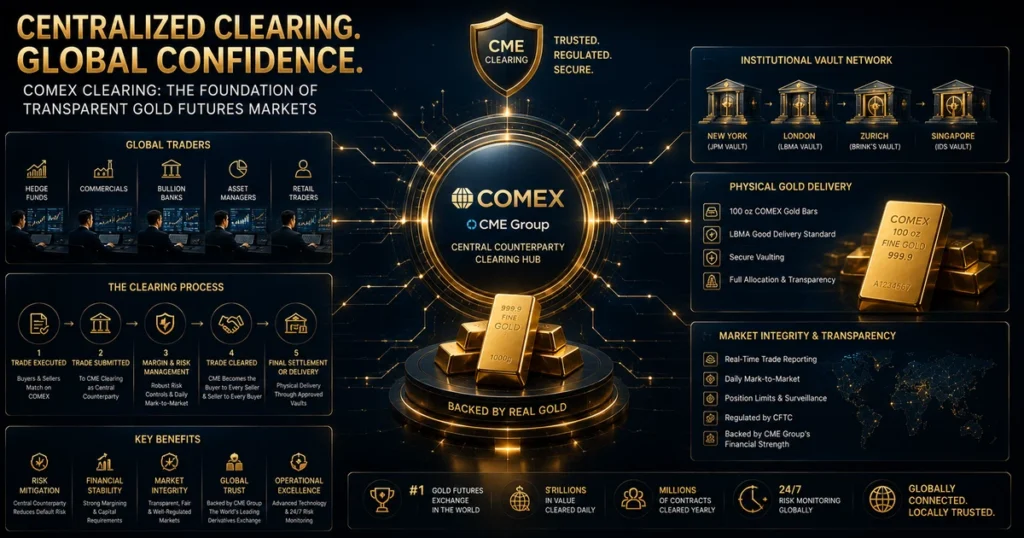
1. Centralized Exchange Clearing (COMEX)
Unlike Over-the-Counter (OTC) spot gold traded via forex brokers, gold futures trade on a single centralized exchange: the COMEX division of the CME Group in Chicago (with secondary venues on ICE – Intercontinental Exchange).
- Central Order Book: Every buyer and seller sees the exact same bid, ask, and volume data globally.
- Counterparty Guarantee: The CME Clearing House acts as the buyer to every seller and seller to every buyer, virtually eliminating counterparty default risk.
- Trading Hours: Trades nearly 24 hours a day (Sunday to Friday, 6:00 p.m. to 5:00 p.m. ET next day).
2. Daily Mark-to-Market Settlement
Futures accounts do not wait until contract expiration to settle gains and losses. At the end of every trading day, the exchange determines a daily Settlement Price.
- Cash Adjustment: If gold moves in your favor, cash is credited directly to your margin account overnight.
- Margin Maintenance: If gold moves against your position, cash is debited from your account. If equity drops below the Maintenance Margin, a margin call is issued.
3. Expiration Dates & Roll Yield
Gold futures contracts are identified by their expiration month code (e.g., GCG6 for February 2026 or GCQ6 for August 2026).
- Active Months: February (G), April (J), June (M), August (Q), October (V), and December (Z).
- Contract Rolling: Most traders do not take physical gold delivery. They “roll” their position into the next active month before the First Notice Day. (For a deeper look at non-expiring options, read our Spot Gold vs Futures Guide).
Quick Answer: Futures Mechanics
- ✔ Central Clearing: All trades go through COMEX/CME Group with transparent volume.
- ✔ Daily Settlement: Gains and losses are credited or debited to your account daily.
- ✔ Contract Months: Positions must be closed or rolled prior to expiration to avoid physical delivery.
COMEX Gold Futures Contract Specifications
Quick Answer: COMEX offers three primary gold futures contracts: Full Gold Futures (GC) (100 oz), E-mini Gold Futures (QO) (50 oz), and Micro Gold Futures (MGC) (10 oz). Each contract has standardized tick sizes, values, and margin requirements.
Selecting the correct contract size is essential for proper risk management:
| Contract Specification | Standard Gold Futures (GC) | E-mini Gold Futures (QO) | Micro Gold Futures (MGC) |
| Exchange Ticker | GC | QO | MGC |
| Contract Size | 100 Troy Ounces | 50 Troy Ounces | 10 Troy Ounces |
| Tick Size (Minimum Move) | $0.10 per troy ounce | $0.25 per troy ounce | $0.10 per troy ounce |
| Tick Value | $10.00 USD | $12.50 USD | $1.00 USD |
| Point Value ($1.00 Move) | $100.00 USD | $50.00 USD | $10.00 USD |
| Settlement Type | Physical Delivery / Cash | Financial Cash Settlement | Physical / Financial Cash |
| Target Trader Profile | Institutional & Commercial | Professional Retail Traders | Growing Accounts & Beginners |
How Ticks and Points Work in Practice
Understanding contract math prevents accidental over-leveraging:
- Standard Contract (GC):
- If gold moves from $2,400.00 to $2,410.00 ($10.00 price increase):
- Calculation: $\$10.00 \times 100\text{ oz} = +\$1,000.00\text{ USD}$ profit per contract.
- Micro Contract (MGC):
- If gold moves from $2,400.00 to $2,410.00 ($10.00 price increase):
- Calculation: $\$10.00 \times 10\text{ oz} = +\$100.00\text{ USD}$ profit per contract.
Pro Tip: Beginners transitioning from forex or stocks to futures should always start with Micro Gold Futures (MGC). With a $1.00 tick value per $0.10 move, MGC allows precise position sizing without exposing small accounts to severe volatility.
Quick Recap: Contract Specs
- ✔ GC (100 oz): $1.00 price move = $100 profit/loss.
- ✔ MGC (10 oz): $1.00 price move = $10 profit/loss.
- ✔ Tick Size: Minimum price fluctuation is $0.10 per troy ounce.
Contango vs. Backwardation in Gold Futures
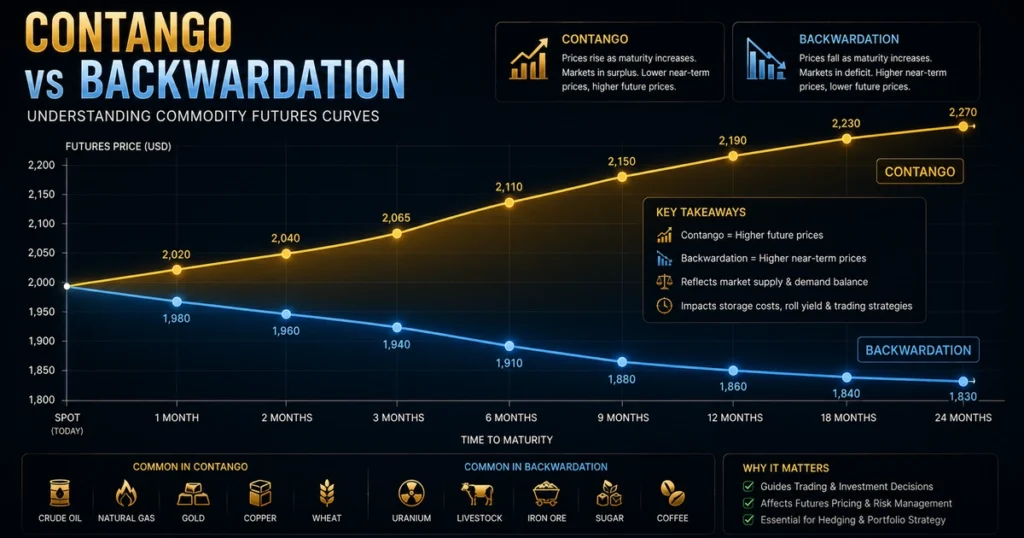
Quick Answer: Contango occurs when future gold prices are higher than the current spot price due to storage, insurance, and interest costs (cost of carry). Backwardation happens when future gold prices are lower than spot prices, signaling immediate supply shortages or high market stress.
Contango Market Structure (Normal Condition):
[ Spot Gold Price: $2,400 ] ──► [ 3-Month Futures: $2,415 ] ──► [ 6-Month Futures: $2,430 ]
                                 (Includes Cost of Carry: Storage + Interest)

Backwardation Market Structure (High Stress Condition):
[ Spot Gold Price: $2,400 ] ──► [ 3-Month Futures: $2,385 ] ──► [ 6-Month Futures: $2,370 ]
                                 (Reflects Immediate Physical Shortage)
The Cost of Carry Concept
Under normal market conditions, gold futures trade in Contango. This premium reflects the Cost of Carry:
$$\text{Futures Price} = \text{Spot Price} + \text{Storage Costs} + \text{Insurance} + \text{Interest Rates (Financing)}$$
- Contango Impact: If you hold a long gold futures contract and roll it month after month, you pay a small “roll yield” cost because the next month’s contract is priced higher than the expiring contract.
- Backwardation Impact: Rare in gold markets. When it occurs, it signals severe institutional demand for physical delivery right now over future paper delivery. (Learn more about physical vaulting in our Digital Vaulted Gold Guide).
Quick Recap: Market Curves
- ✔ Contango: Futures Price > Spot Price (Normal state due to storage & interest).
- ✔ Backwardation: Futures Price < Spot Price (Signals physical supply stress).
- ✔ Roll Drag: Long-term futures holders face minor rollover costs in contango markets.
High-Probability Gold Futures Trading Strategies
Quick Answer: Effective gold futures strategies combine exchange volume analysis with macroeconomic indicators. Key setups include Volume Profile Order-Flow Breakouts, Gold/Silver Ratio Arbitrage, and FOMC Interest Rate Trend Following.
1. Volume Profile & Order-Flow Breakout Strategy
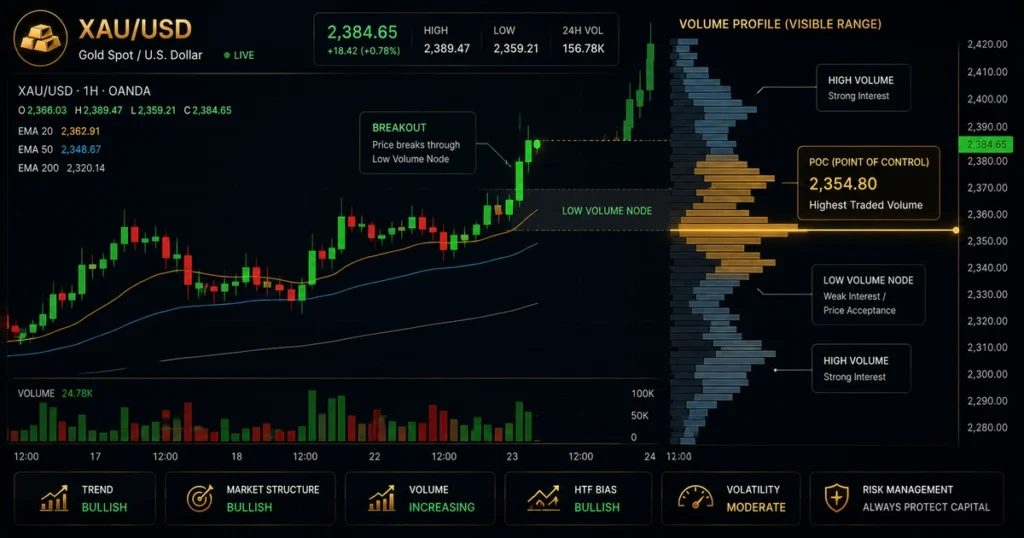
Because futures trade on a central exchange, traders have access to true Volume Profile and Point of Control (POC) data.
Volume Profile Trading Setup:
[ High Volume Node (HVN) / Value Area ] ──► Price Consolidation / Accumulation
                                                 │
[ Low Volume Node (LVN) Breakout ]     ──► ⚡ Explosive Directional Expansion Triggered
- Setup: Identify the Value Area High (VAH) and Value Area Low (VAL) from the previous session’s volume profile on the 30-minute chart.
- Trigger: Look for a 15-minute candle to close completely outside the Value Area into a Low Volume Node (LVN).
- Entry: Enter in the direction of the breakout as price accelerates through low volume areas.
- Stop-Loss: Place the stop-loss back inside the Value Area High or Low.
2. The Gold/Silver Ratio Spread Strategy (Pairs Trading)
The Gold/Silver Ratio (GSR) measures how many ounces of silver it takes to buy one ounce of gold.
$$\text{Gold/Silver Ratio} = \frac{\text{Gold Futures Price (GC)}}{\text{Silver Futures Price (SI)}}$$
- Mean Reversion Concept: Historically, the ratio oscillates between 60 and 90.
- Ratio Above 85–90 (Gold Overvalued vs. Silver): Sell Gold Futures (GC) and Buy Silver Futures (SI).
- Ratio Below 60–65 (Silver Overvalued vs. Gold): Buy Gold Futures (GC) and Sell Silver Futures (SI).
3. Fed Rate Expectations & Yield Curve Momentum
Gold futures are hypersensitive to central bank monetary policy shifts tracked by the Federal Reserve, Bank for International Settlements (BIS), and World Gold Council.
- Bullish Catalyst: Declining US 10-Year Treasury real yields combined with Federal Reserve interest rate cut expectations.
- Execution: Go long GC / MGC when 10-Year Real Yields drop below key technical support levels, confirming dynamic macroeconomic momentum.
Quick Recap: Futures Strategies
- ✔ Volume Profile: Use exchange volume (POC/VAH/VAL) to spot high-probability breakouts.
- ✔ Gold/Silver Ratio: Trade mean-reversion spreads when the ratio reaches extreme levels (85+ or <60).
- ✔ Real Yields: Align technical setups with US 10-Year real interest rate movements.
Comprehensive Comparison: Gold Futures vs. CFDs vs. Options vs. ETFs
Selecting the proper instrument depends on your trading style, jurisdiction, and strategy:
| Feature / Metric | Gold Futures (COMEX: GC) | Gold CFDs | Gold Options | Gold ETFs (e.g., GLD) |
| Trading Venue | Centralized Exchange (CME) | OTC / Forex Brokers | CME / Cboe Exchanges | Stock Exchanges (NYSE) |
| Volume Transparency | 100% Real Exchange Volume | Broker Aggregated | Real Options Order Book | Stock Market Volume |
| Overnight Swap Fees | Zero Swaps | Daily Swap Charges Apply | None (Premium Risk) | Expense Ratio (~0.40% p.a.) |
| Expiration Date | Fixed Expiration | None (Hold Indefinitely) | Fixed Options Expiry | None |
| Margin Requirement | Fixed Exchange Margin (CME) | Variable Broker Leverage | Fixed Premium Amount | 100% Cash / Reg T Margin |
| Primary Regulator | CFTC / NFA (USA) | FCA, ASIC, CySEC | CFTC / SEC (USA) | SEC (USA) |
| Best Used For | Intraday & Swing Traders | Small Account Growth | Hedging Macro Tail Risk | Long-Term Passive Portfolios |
Futures Margin & Risk Management Framework
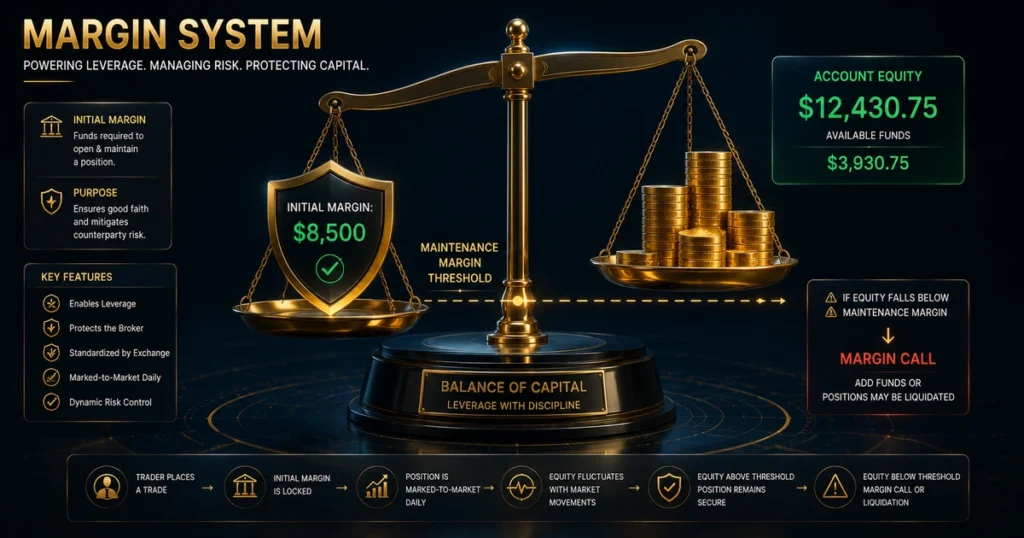
Quick Answer: Futures trading utilizes two margin thresholds set by the exchange: Initial Margin (the equity required to open a contract) and Maintenance Margin (the minimum equity required to keep the position open).
⚠️ Warning Box: Futures leverage is a double-edged sword. Never risk more than 1% to 2% of your overall account equity on a single gold futures position, and always maintain extra buffer cash above the CME Maintenance Margin limit.
Understanding Futures Margin Types
- Initial Margin:
- The deposit required by the exchange (or broker) to open a single contract.
- Example: If CME sets GC Initial Margin at $8,500, you must have at least $8,500 in free equity to enter 1 standard contract.
- Maintenance Margin:
- The minimum equity balance you must maintain as the market moves.
- Example: If Maintenance Margin is $7,700 and your account equity drops to $7,500 due to an adverse price move, you receive an immediate Margin Call.
- Intraday vs. Overnight Margin:
- Many futures brokers offer reduced Day Trading Margins (e.g., $1,000 for GC or $100 for MGC) as long as positions are closed before the daily session close (5:00 p.m. ET).
Quick Recap: Margin Management
- ✔ Initial Margin: Minimum equity required to open a contract.
- ✔ Maintenance Margin: Minimum balance required to keep a contract open overnight.
- ✔ Day Trading Margins: Reduced intraday margin requirements offered by specialized futures brokers.
5 Critical Mistakes Retail Traders Make in Gold Futures
Avoid these costly operational errors when trading commodities contracts:
- Failing to Roll Contracts Before First Notice Day: Holding an expiring contract past First Notice Day exposes you to physical delivery procedures or steep broker penalty liquidation fees.
- Confusing Pip Values Between GC and MGC: Trading a standard contract (GC) with a $100/point move when you intended to trade a micro contract (MGC) with a $10/point move can wipe out an account in minutes.
- Holding Through Settlement Close Without Overnight Margin: If your account holds a position into the 5:00 p.m. ET close without meeting full CME overnight margin requirements, your broker will force-liquidate the position.
- Ignoring Central Order Book Liquidity Gaps: Trading electronic futures contracts during thin Sunday evening openings can lead to slippage due to wider bid-ask spreads.
- Over-Leveraging Equity Above 1% Limits: Treating futures leverage as free money rather than borrowed purchasing power leads to high margin calls during volatile Fed rate news.
🎓 Expert Note: “Gold futures are the cleanest pure-price vehicle in precious metals because of volume transparency. But success depends entirely on managing tick values and keeping your equity well above maintenance margins.” — CurrencyPlans Derivatives Desk
Step-by-Step Professional Execution Workflow
Quick Answer: To trade gold futures safely: 1) Select a CFTC-registered Futures Commission Merchant (FCM), 2) Connect a professional futures platform (NinjaTrader/CQG), 3) Practice on demo paper trading for 30+ days, and 4) Start live trading with Micro Contracts (MGC).
Step 1: Open Account with CFTC/NFA Broker ──► Step 2: Choose Platform (NinjaTrader/CQG/Tradovate)
                                                                    │
Step 4: Live Trade Micro Contracts (MGC) ◄── Step 3: Demo Paper Trade for 30+ Days ◄──┘
Actionable Setup Roadmap:
- Select a Commodity Futures Broker (FCM):
- Choose a broker registered as a Futures Commission Merchant (FCM) with the CFTC and NFA (e.g., NinjaTrader Brokerage, Tradovate, Interactive Brokers, AMP Futures).
- Select a Futures Trading Platform:
- Connect data feeds (e.g., CQG, Rithmic) to specialized execution platforms providing level-2 order books and volume profile indicators.
- Practice on a Real-Time Demo Feed:
- Paper trade Micro Gold Futures (MGC) for at least 30 days to master order execution types (Limit, Stop-Market, Join Bid) and contract math.
- Draft a Written Futures Plan:
- Establish strict risk parameters: maximum 1% risk per trade, defined daily loss limits, and contract rolling procedures.
- Start Small with Micro Contracts (MGC):
- Begin live execution with 1 Micro contract ($1.00 per $0.10 tick) to adapt to real market executions before scaling up to standard GC contracts.
Quick Recap: Execution Checklist
- ✔ Regulated Broker: Ensure CFTC/NFA registration.
- ✔ Start with MGC: Micro contracts allow precise risk control for growing accounts.
- ✔ Demo First: Practice level-2 order entry on real exchange data feeds before risking real capital.
Internal Linking & Related Cluster Articles
Expand your derivatives and precious metals expertise across the CurrencyPlans Cluster:
- Trading Strategies: Read our complete technical guide on Gold Trading Guide: Strategies, Instruments, and Risk Management.
- Foundation Guide: Explore our master overview on Digital Gold Explained: How Global Vaulted Gold Works, Benefits, Risks, and Taxes.
- Cross-Border Tax Rules: Review tax frameworks in Global Gold Taxation: IRS, HMRC, and VAT Rules Explained.
- Macro Drivers: Analyze how currency movements drive bullion in How the US Dollar Index (DXY) Drives Commodity Prices.
Frequently Asked Questions (FAQs)
Q1. Can a retail trader take physical delivery of gold through COMEX futures?
Ans: While COMEX contracts are physically deliverable in theory, most retail futures brokers automatically close out retail long positions prior to the First Notice Day to prevent physical delivery processes. Physical delivery involves warrant transfers, vault storage fees, and 100 oz capital requirements ($240,000+ USD).
Q2. What is the difference between Gold Futures (GC) and Spot Gold (XAU/USD)?
Ans: Gold Futures (GC) trade on a centralized exchange (COMEX) with standardized contract specs, transparent volume data, fixed expiration dates, and zero overnight swap fees. Spot Gold (XAU/USD) trades Over-the-Counter across decentralized broker networks, has no expiration date, but incurs daily overnight swap charges.
Q3. Are gold futures compliant with Islamic Halal principles?
Ans: Conventional gold futures are generally considered non-compliant (Haraam) by major Islamic jurisprudence boards (such as AAOIFI) due to deferred delivery (Riba al-Nasi’ah) and leveraged margin interest. Muslim traders requiring Shariah compliance typically utilize Spot Halal Allocated Gold platforms or zero-swap physical accounts.
Q4. Can Indian residents trade COMEX Gold Futures directly?
Ans: Under the Reserve Bank of India’s (RBI) Liberalised Remittance Scheme (LRS), Indian residents are prohibited from remitting funds abroad for overseas margin trading or speculative derivatives (including COMEX futures). Indian traders typically utilize MCX (Multi Commodity Exchange of India) Gold Futures regulated by SEBI.
Q5. Which brokers offer the best execution for gold futures?
Ans: Top CFTC/NFA registered brokers for futures trading include NinjaTrader Brokerage, Tradovate, Interactive Brokers, and AMP Futures, known for low intraday margin requirements, low commission rates, and direct access to CQG/Rithmic market data feeds.
Conclusion & Strategic Verdict
Trading gold futures provides institutional transparency, central exchange volume data, and precise leverage control. By selecting the appropriate contract size (GC vs. MGC), understanding contango cost curves, and enforcing strict margin buffers, traders can capitalize on gold’s global market volatility without counterparty uncertainty.
Recommended Action Plan:
- Focus on Micro Gold (MGC): Master tick calculations and order execution using Micro contracts before attempting standard 100 oz contracts.
- Utilize Volume Profile: Leverage central exchange volume data (POC, Value Areas) to identify high-probability breakout levels.
- Maintain Equity Buffers: Keep account balances well above the CME Maintenance Margin threshold to eliminate margin call risks.
Why Trust Us & Editorial Board Signals
At CurrencyPlans, our content is produced by institutional derivatives analysts and reviewed by certified financial market professionals.
- Review Methodology: Every quantitative metric, contract specification, and margin requirement is cross-verified against official filings from the CME Group, COMEX, CFTC, and LBMA.
- Content Update Policy: We audit our derivatives guides quarterly to adjust for changing exchange initial margins, regulatory updates, and contract specification revisions.
- Written By: Senior Technical Market Analyst & Derivatives Strategist (CurrencyPlans Research Team)
- Reviewed By: Certified Financial Technician (CFT®) & Chartered Financial Analyst (CFA®) Board
Official References & Citations
- CME Group (COMEX): Gold Futures (GC) Contract Specifications & Margins
- U.S. Commodity Futures Trading Commission (CFTC): Futures Trading & Commodity Pool Disclosures
- National Futures Association (NFA): Regulatory Standards for Futures Commission Merchants
- London Bullion Market Association (LBMA): Precious Metals Clearing & Good Delivery Standards
Regulatory Disclaimer
Disclaimer: Trading gold futures and commodity derivatives involves substantial risk of loss and is not suitable for all investors. Futures leverage can work against you as well as for you. Past performance is not indicative of future results. Always consult an accredited financial advisor before allocating capital to leveraged derivatives markets. CurrencyPlans does not provide execution or financial advice.

