

The top world currency asset classes are fundamentally misunderstood by retail market participants who often mistake localized transactional volume for absolute individual unit value. While the US Dollar serves as the undisputed bedrock of cross-border financial settlements, accounting for the vast majority of international bank invoices, it does not hold the highest numerical face value on foreign exchange boards. Instead, a complex macroeconomic mix of hyper-concentrated natural resources, sovereign monetary pegs, and historical G10 banking systems determines which state-backed assets emerge as the highest-priced values globally. Decoding this structure requires moving beyond simplistic price trackers and looking straight into the actual purchasing power parity that links these currencies directly to the greenback.
Top world currency
| Global Rank & Currency Name | Asset Code | Live Value (vs 1 USD) | Systemic Strength Parameter |
| 1. Kuwaiti Dinar | KWD | 1 KWD ≈ $3.21 USD | Driven by massive hydrocarbon exports and a tightly managed sovereign basket peg. |
| 2. Bahraini Dinar | BHD | 1 BHD ≈ $2.65 USD | Backed by a high-yield regional financial hub and a fixed dollar peg since 1980. |
| 3. Omani Rial | OMR | 1 OMR ≈ $2.58 USD | Maintained by resource-heavy export surpluses and aggressive central bank cash reserves. |
| 4. Jordanian Dinar | JOD | 1 JOD ≈ $1.41 USD | Structured around a fixed peg insulated by deep international liquid reserve assets. |
| 5. British Pound | GBP | 1 GBP ≈ $1.33 USD | Supported by G10 transactional depth and London’s historical capital dominance. |
The Macro Dynamics of Top World Currency Rankings
If we look at how global markets price value, a fiat asset secures its status as a top world currency through two primary pathways: massive structural trade surpluses or direct central bank stabilization loops. The global foreign exchange ecosystem functions as an interconnected relative balancing mechanism, where capital continuously moves to jurisdictions offering structural security and steady underlying demand.
When a sovereign country consistently exports more commodities than it imports, it accumulates massive foreign reserves. Rather than allowing their domestic currency to float freely and experience massive speculative volatility, their central banks engineered controlled pegs. This ensures that their high nominal purchasing power remains completely insulated from the rapid price shifts that typically destabilize traditional developing economies.
Middle Eastern Hydrocarbon Hegemony: The Sovereign Fixed Pegs
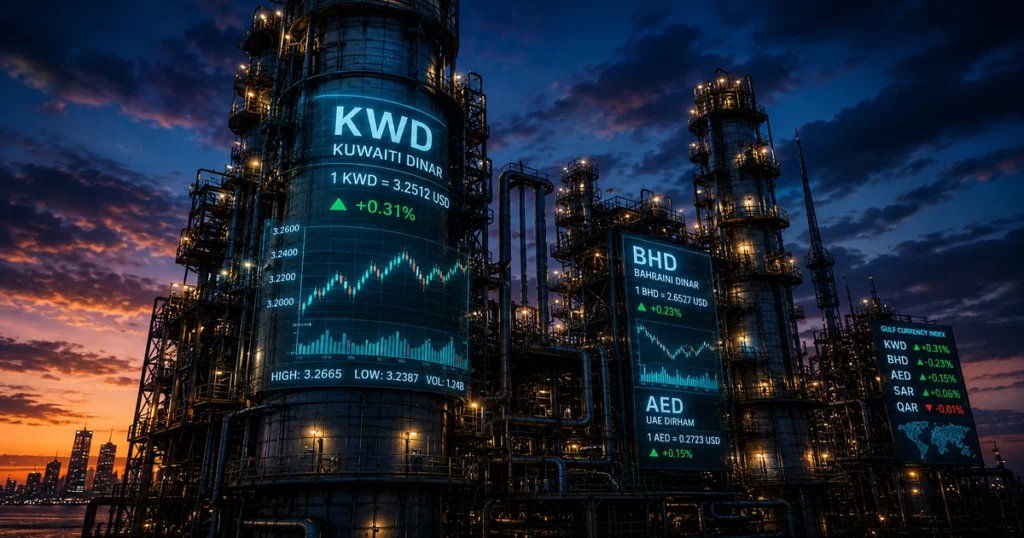
When you look at the raw exchange data, the upper echelon of the top world currency leaderboard is completely dominated by Middle Eastern economies. The Kuwaiti Dinar (KWD) sits comfortably at the absolute peak of this pyramid, with 1 KWD fetching roughly $3.21 USD. The underlying mechanic here is a masterclass in wealth preservation: Kuwait holds massive crude oil reserves, and its central bank decodes its valuation through a confidential, weighted basket of global currencies.
“By de-linking its currency from a single fiat variable and balancing it across a basket of international trade assets, Kuwait has preserved a high-value domestic ecosystem that shields its local purchasing power from external inflation spikes.”
Following closely behind is the Bahraini Dinar (BHD), trading at a fixed value of approximately $2.65 USD. Bahrain has successfully positioned its economy as an elite regional financial hub, backing its long-standing fixed dollar arrangement with a disciplined domestic monetary framework.
Similarly, the Omani Rial (OMR) sits at $2.58 USD, while the Jordanian Dinar (JOD) maintains its structural baseline at $1.41 USD. Jordan’s model is particularly fascinating because, unlike its resource-rich neighbors, it achieves its currency premium by maintaining deep, liquid foreign exchange reserves that guarantee its fixed conversion rate against the US dollar remains entirely unbroken.
The G10 Float Elite: Legacy Financial Powerhouses
Moving away from fixed resource pegs, the next tier of the top world currency ecosystem consists of mature, freely floating G10 sovereign assets. The British Pound Sterling (GBP) remains a dominant force, trading near $1.33 USD. London’s financial district processes a massive share of daily global currency transactions, giving the Pound deep structural liquidity and an enduring institutional premium.
The Swiss Franc (CHF) follows a similar premium trajectory, trading firmly around $1.25 USD. The Swiss National Bank has long benefited from its country’s reputation as the ultimate safe haven. During times of global geopolitical uncertainty or widespread market corrections, international capital flows aggressively into Swiss vaults, consistently driving up the valuation of the Franc.
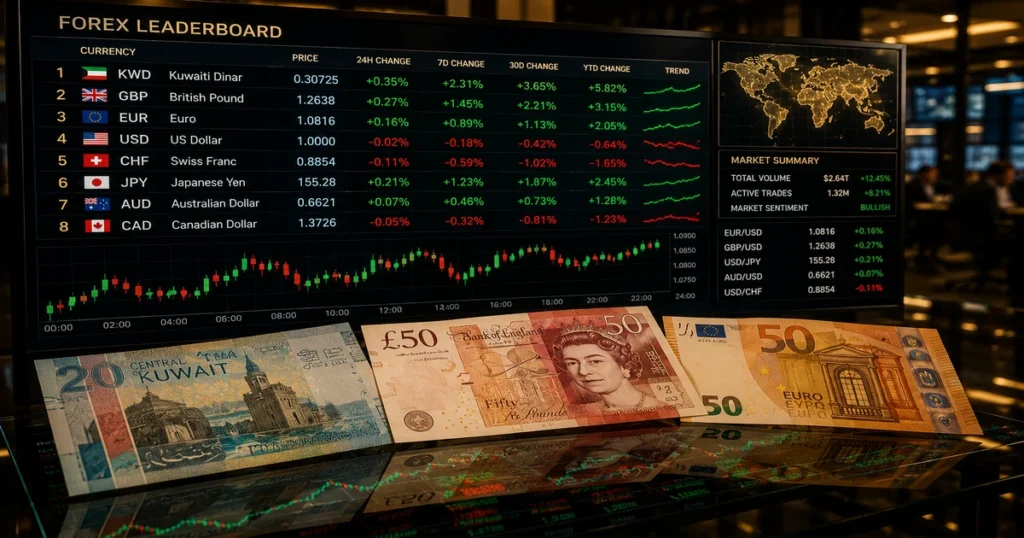
Concurrently, the Euro (EUR) trades at a steady baseline of approximately $1.15 USD, reflecting the shared economic output of its 20 member states. To see exactly how these high-value systems match up against the baseline global reserve asset, we can invert the calculations:
- Pound to USD Conversion: $1 \div 0.75 \text{ GBP} \approx \$1.33 \text{ USD}$
- Franc to USD Conversion: $1 \div 0.80 \text{ CHF} \approx \$1.25 \text{ USD}$
- Euro to USD Conversion: $1 \div 0.87 \text{ EUR} \approx \$1.15 \text{ USD}$
These values prove that despite rapid shifts in global manufacturing supply chains, these mature European hubs continue to command exceptional international purchasing power.
Systemic Comparison: High Value vs. True Global Utility
There is a vital technical distinction that global software developers, digital entrepreneurs, and asset managers must understand: nominal unit price does not equal global dominance. A currency can command a high individual face value while representing only a tiny fraction of international trade volume.
Contextual Analysis: Value vs Liquidity Matrix
| Currency Unit | Nominal Exchange Rate Premium | Global Liquidity Share (SWIFT) | Primary International Utility |
| Kuwaiti Dinar (KWD) | Highest Numerical Value | Very Low (<0.5%) | Wealth preservation and regional energy clearing. |
| US Dollar (USD) | Baseline Benchmark ($1.00) | Highest in the World (~85%+) | Global reserve currency, commodity invoicing, trade debt ledger. |
| Euro (EUR) | Balanced Premium (~$1.15) | Second Highest (~30%+) | Core transaction clearing across the European single market block. |
| Swiss Franc (CHF) | Safe-Haven Premium (~$1.25) | Moderate | Capital protection during macroeconomic systemic shocks. |
This clear divide proves that while a high unit value looks impressive on paper, real economic influence belongs to currencies like the US Dollar and the Euro. These assets provide the massive market depth and institutional liquidity required to process trillions of dollars in daily cross-border transactions without causing destabilizing price slippage.
Emerging Market Integration: The Position of the Rupee
When analyzing the broader international landscape, we must look at major manufacturing hubs that operate under different structural rules. The Indian Rupee (INR), for instance, sits at a different point in the global framework, trading near 95.22 per 1 USD. From a structural standpoint, India operates as a fast-growing developing economy, rather than a fixed commodity peg or a traditional G10 sovereign capital hub.
The current valuation of the Rupee is not an indicator of domestic economic weakness. Instead, it reflects a high-growth production cycle. India imports vast quantities of crude oil and industrial technology, which must be settled in US dollars. This constant commercial demand for greenbacks creates a natural structural pressure on the local spot market. To balance this dynamic, the central bank carefully manages its massive foreign currency reserves to absorb sudden global shocks, ensuring that domestic inflation remains well-controlled while keeping the country’s technology and manufacturing exports highly competitive on the world stage.
Risk Mitigation Strategies for Global Digital Businesses
For modern digital operators running software-as-a-service (SaaS) platforms, digital tools distribution, or cross-border development teams, currency fluctuations present a real financial challenge to operating margins. Relying solely on a single currency exposes a business to unnecessary risk. Implementing a disciplined diversification framework helps protect your bottom line:
- Multi-Currency Vault Structuring: Avoid converting all international revenues into a single local asset immediately. Utilize modern digital banking infrastructure to hold separate balances in USD, EUR, and GBP, allowing you to settle international vendor invoices without paying repeated conversion fees.
- Strategic Invoice Hedging: When signing multi-month corporate contracts with foreign clients, fix your transaction values in highly liquid G10 currencies to eliminate the risk of a sudden drop in value during highly volatile trading periods.
- Tranche-Based Conversion Schedules: Rather than moving large sums of capital across borders in a single transaction, spread your transfers across regular intervals. This dollar-cost averaging approach protects your business from executing major conversions during isolated market peaks.
Frequently Asked Questions
Which specific asset holds the title of the top world currency by face value?
The Kuwaiti Dinar (KWD) officially holds the highest face value in the global foreign exchange market, with a single dinar exchanging for approximately $3.21 US Dollars.
Does a higher exchange rate mean a country possesses a more powerful economy?
No, it does not. A high nominal exchange rate simply means the currency’s circulating supply is tightly managed relative to its export revenues. The world’s most powerful economic engines, such as the United States and the Eurozone, prioritize deep market liquidity and high transaction volumes over a high individual unit price.
Why does the British Pound maintain a higher value than the US Dollar?
The British Pound’s premium is rooted in historical monetary design and London’s long-standing position as a dominant global financial hub, which helps sustain steady institutional demand for G10 capital allocations.
How do Middle Eastern nations keep their currency values so consistently high?
These economies rely on massive sovereign wealth funds and consistent trade surpluses generated by crude oil and natural gas exports. This steady inflow of foreign capital allows their central banks to easily maintain their fixed exchange rate pegs.
Can alternative digital assets eventually replace these elite fiat currencies?
While decentralized digital assets serve as an effective long-term hedge against inflation, their high day-to-day volatility prevents them from functioning as a stable unit of account for complex corporate supply chains, which continue to rely on state-backed fiat infrastructure.
Where can professional operators find accurate, un-marked mid-market rates?
Clean, real-time mid-market exchange rates can be tracked directly through institutional market data networks like Bloomberg, Reuters Eikon, or transparent consumer financial feeds like Wise Live Rates.
Final Perspective: Navigating the Global Flow of Capital
Ultimately, the global currency board functions much like a sophisticated financial chess match, where each sovereign asset is optimized for a specific economic purpose. Some currencies are engineered to protect domestic oil wealth and preserve local purchasing power, while others are built to maximize liquidity and drive international commerce. By looking past surface-level ticker prices and understanding the underlying structural mechanics, digital entrepreneurs and investors can better protect their international operations, navigate currency volatility with confidence, and position their portfolios to thrive in the global economy.

