
Introduction
Back in the late 1990s, when the commercial internet was taking off, Cisco Systems sat right at the center of the technology sector. Cisco built the digital plumbing—the routers and switches that directed traffic across the early web. As telecommunications providers rushed to lay down miles of fiber-optic networks, Cisco’s market value expanded rapidly, briefly turning it into the most valuable public corporation on Earth. But when the dot-com spending cycle cooled in 2000, those telecom giants realized an uncomfortable truth: they had built far more networking capacity than immediate end-user demand justified. Capital expenditures dried up, and Cisco entered an extended multi-year valuation reset.
Fast-forward to October 2026, and investors are asking whether this Nvidia Stock Analysis 2026 points to another aggressive infrastructure buildup ahead of real-world monetization, or if Nvidia represents durable economic infrastructure for the accelerated computing era. Trading near $233.95 with a market capitalization hovering around $5.65 trillion, Nvidia stands as the world’s largest publicly traded company. Evaluating the business today requires looking past headline hype to assess hardware cadences, software switching costs, customer capital allocation, and the operational chokepoints that introduce structural risk.
Technical Foundations in This Nvidia Stock Analysis 2026
Many semiconductor products have historically followed multi-year development and upgrade cycles. Nvidia has accelerated its Data Center product cadence by moving toward a one-year roadmap. Under this roadmap, Nvidia aims to introduce and scale new architectures at a faster pace than traditional semiconductor product cycles.
       [2024–2025: Blackwell Architecture]
       └── B100 / B200 / GB300 NVL72 Rack Systems
       └── Established liquid-cooled high-density data center standards

                   ▼  (Accelerated 1-Year Upgrade Cadence)

       [2026: Rubin Architecture]
       └── 3nm Process Node + Next-Gen HBM4 High-Bandwidth Memory
       └── Vera CPU + Rubin GPU Integration (Ultra-Scale AI Clusters)
       └── Designed to reduce training time and inference costs for large-scale AI workloads
1. Scaling Blackwell Ultra and the Rubin Architecture
The rollout of the Nvidia Blackwell GPU family accelerated the adoption of liquid-cooled, rack-scale AI computing. In 2026, the introduction of the Nvidia Rubin Architecture builds on the foundation established by these deployments:
- Next-Generation Memory (HBM4): Advanced multi-modal and reasoning systems are bounded by memory bandwidth. Rubin pairs TSMC’s 3nm manufacturing processes with HBM4 memory, expanding interconnect throughput and easing the latency bottlenecks that limit large-scale cluster execution.
- Energy and Thermal Density: Power availability is a primary operational constraint for utility grids and tier-one data centers. The Rubin platform is engineered to deliver improved compute density per megawatt, allowing operators to scale model inference throughput within existing substation power envelopes.
- Rack-Scale Engineering: Rather than offering discrete server components, Nvidia emphasizes full-rack integration like the Vera Rubin NVL72. These liquid-cooled enclosures integrate proprietary NVLink switching fabrics, high-speed copper interconnects, and balanced compute nodes into a unified computing fabric that delivers upwards of 260 TB/s of rack-level NVLink bandwidth.
2. Software Ecosystem and Switching Costs
Hardware specifications drive benchmark comparisons, but developer retention is heavily anchored in software: specifically CUDA (Compute Unified Device Architecture).
When Nvidia initiated software investments in CUDA nearly two decades ago, the spending pressured near-term operating margins. Today, that investment has created one of Nvidia’s strongest competitive advantages:
- According to Nvidia disclosures, more than 6 million developers use CUDA, reflecting the scale of its software ecosystem across AI, research, and accelerated computing.acceleration primitives.
- Porting complex, enterprise-scale production workloads to alternative silicon from AMD, Intel, or cloud-native ASICs requires significant software rewrites, runtime optimization, and qualification testing.
- The operational expense of engineering downtime and migration risk creates significant switching costs and strengthens Nvidia’s competitive position in AI computing.
Customers frequently deploy Nvidia infrastructure because the broader enterprise machine learning ecosystem—from orchestration tools to open-weight model weights—is optimized to run on it with minimal deployment friction.
The Financial Engine: Hyperscalers and Data Center Revenue
Nvidia’s financial performance is anchored directly to hyperscaler capital spending. Microsoft, Alphabet, Amazon AWS, and Meta allocate substantial quarterly capital expenditures (CapEx) toward server hardware, power delivery, and high-speed networking fabrics. A primary portion of these investments is booked directly as Nvidia Data Center revenue.
For the full fiscal year 2026 (FY2026), Nvidia generated $215.938 billion in total revenue, driven decisively by accelerated computing:
| Segment | FY2026 Reported Revenue | Share of Total | Primary Driver / Description |
|---|---|---|---|
| Data Center | $193.737 Billion | 89.7% | AI model training clusters and production enterprise inference accelerators |
| Gaming | $16.042 Billion | 7.4% | GeForce RTX series desktop and laptop GPUs for consumers and AI PC workstations |
| Professional Visualization | $3.191 Billion | 1.5% | Enterprise workstations, industrial digital twins, and Omniverse seats |
| Automotive | $2.349 Billion | 1.1% | Autonomous vehicle DRIVE processors and intelligent cockpit systems |
| OEM and Other | $0.619 Billion | 0.3% | OEM and other revenue |
| Total Company Revenue | $215.938 Billion | 100.0% | Full-year audited financial performance (SEC Form 10-K) |
Momentum continued into the following fiscal year. In its reported Q2 FY2027 financial release (reported August 26, 2026), Nvidia announced record quarterly total revenue of $96.2 billion, with the Data Center segment generating $89.0 billion—representing a 117% increase year-over-year.
Compute demand has also broadened functionally. In 2026, inference has become an increasingly important source of AI compute demand as models move into everyday production use. Unlike finite model training runs, customer inference workloads operate on a continuous 24/7 basis across web platforms, automated business tools, and customer-facing software, supporting sustained server utilization.

Beyond LLMs: Autonomous Vehicles and Humanoid Robotics
While server accelerators generate the bulk of operational cash flow, Nvidia is directing engineering resources toward physical computing environments where software interacts with real-world mechanical systems.
1. Autonomous Vehicles (Nvidia DRIVE)
Modern vehicle design is shifting toward centralized compute architecture, replacing isolated microcontrollers with unified system-on-chip (SoC) solutions. Nvidia’s DRIVE Thor platform is engineered to serve as the unified compute core for software-defined vehicles:
- DRIVE Thor consolidates automated driving, lane guidance, active safety, and internal digital cockpit displays onto a single platform.
- Nvidia’s automotive platform supports cloud-based AI development and deployment workflows for software-defined vehicles.
2. Physical AI & Robotics (Project GR00T and Omniverse)
Deploying automated physical machinery requires extensive virtual testing before operational integration:
- Digital Twin Simulation (Omniverse): Industrial operators construct physics-accurate digital environments within Omniverse to simulate factory workflows, logistics routing, and robotic kinematics before deploying equipment on real-world floors.
- Project GR00T: A foundational model framework engineered to enable humanoid robots to interpret multimodal sensor inputs, adapt to unexpected physical obstacles, and replicate complex motor movements learned through simulated reinforcement environments.
By integrating simulation platforms (Omniverse) with edge computing modules (Jetson Thor), Nvidia is establishing a structured hardware-software stack for industrial robotics analogous to its cloud computing footprint.
The Bear Case: 3 Serious Risks to Watch
Any rigorous equity analysis must evaluate the structural challenges that could pressure operating results and market multiples. Several critical risks remain central to Nvidia’s long-term operating environment:
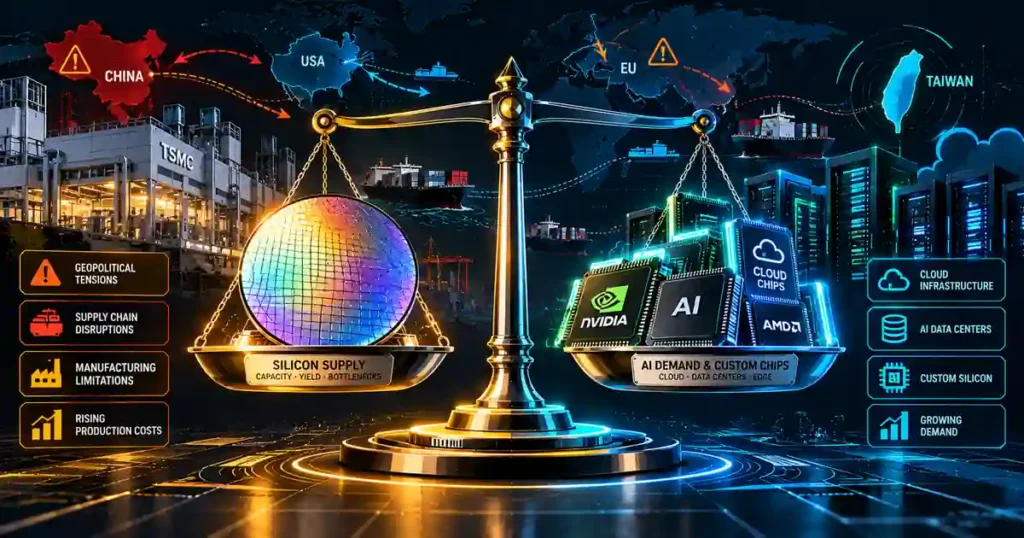
1. TSMC Supply Chain Risk (Manufacturing Concentration)
Nvidia operates as a fabless semiconductor designer. It focuses on internal microarchitecture development and software, while outsourcing physical production:
- Nvidia relies heavily on TSMC and other manufacturing and packaging partners for its advanced chips.
- Advanced wafer manufacturing and specialized packaging technologies (such as CoWoS) remain clustered within Taiwanese fabrication centers.
- This creates exposure to geopolitical, manufacturing, and supply-chain disruptions across Taiwan and the wider semiconductor ecosystem, which could severely disrupt Nvidia’s ability to manufacture, package, and ship advanced products.
2. The Customer-Competitor Paradox
Nvidia’s primary cloud customers are concurrently developing proprietary, internal silicon alternatives:
- Alphabet (Google) directs extensive machine learning workloads through internal deployments of its Tensor Processing Units (TPUs).
- Amazon AWS actively markets its custom Trainium and Inferentia silicon to cloud clients to lower computing expenses.
- Meta continues to expand deployments of its custom Meta Training and Inference Accelerator (MTIA) across ad generation and recommendation pipelines.
While these cloud providers purchase significant quantities of Nvidia systems to meet external enterprise hosting demand, their internal silicon initiatives are explicitly intended to moderate long-term capital allocation to third-party chip suppliers.
3. Hyperscaler CapEx Returns and Enterprise Adoption
Enterprise organizations continue to evaluate whether generative AI deployments deliver sufficient return on investment (ROI) to justify ongoing software integration costs.
A meaningful reduction in hyperscaler infrastructure spending could weaken demand expectations for Nvidia’s Data Center products and put pressure on future earnings estimates and valuation multiples. If enterprise end-users slow their application rollout cycles, tier-one cloud providers may adjust the timing and scale of their forward hardware procurement.
How Investors Can Evaluate NVDA Stock in 2026
When evaluating an allocation to Nvidia, investors typically frame their analysis across valuation metrics, growth sustainability, and risk tolerance:
- The Bull Thesis: Accelerated computing is replacing legacy general-purpose server architectures across enterprise data centers. With the Rubin platform expanding performance capabilities, CUDA sustaining customer retention, and robotics opening physical computing markets, Nvidia remains uniquely positioned to capture the economic value of high-performance compute infrastructure.
- The Bear Thesis: At a market capitalization near $5.65 trillion and a trading level of $233.95 (trading at ~29.58x trailing and ~19.41x forward earnings), current multiples assume sustained high revenue growth and operating margins. Any packaging constraints, internal silicon displacement from major cloud clients, or macro cooling in AI capital spending could lead to multiple compression and increased share price volatility.
Evaluating Risk and Execution
Semiconductor equities historically exhibit cyclical characteristics driven by capital investment schedules and macroeconomic trends.
One approach some investors use is Dollar-Cost Averaging (DCA):
- Rather than allocating capital in a single lump-sum purchase, investors distribute purchases in predetermined tranches across multiple months or quarters.
- This execution structure can help mitigate the impact of short-term volatility around quarterly financial disclosures while establishing an allocation aligned with long-term technology adoption trends.
Strategic Summary & Core Takeaways
- Architectural Transition: The rapid move from Blackwell Ultra to Rubin is designed to maintain Nvidia’s performance and efficiency position in accelerated computing.
- Software Ecosystem: CUDA creates high switching costs, making architectural migration complex and resource-intensive for enterprise engineering teams.
- Revenue Concentration: Data Center is Nvidia’s dominant revenue source (accounting for 89.7% of FY2026 revenue), making the company highly exposed to AI infrastructure spending and the investment plans of major technology and cloud customers.
- Growth Expansion: Embedded automotive solutions (DRIVE Thor) and physical simulation tools (Omniverse / Project GR00T) represent medium-to-long-term diversification avenues.
- Operational Sensitivities: Foundry concentration at TSMC, cloud provider custom silicon projects, and data center CapEx cycles are the primary structural risks to track.
- Valuation Baseline: With the company valued at ~$5.65T at $233.95 per share (~29.58x trailing P/E and ~19.41x forward P/E), fundamental execution and capital discipline remain central to evaluating investment risk.
Frequently Asked Questions (FAQ)
What makes the Nvidia Rubin architecture different from Blackwell?
The Rubin platform combines next-generation Rubin GPUs, HBM4 memory, and Vera CPUs to support large-scale AI training and inference, including very large reasoning models. It integrates TSMC’s 3nm node and improved rack-level power efficiency compared to earlier Blackwell generation deployments.
Why is CUDA considered Nvidia’s biggest competitive advantage?
CUDA is Nvidia’s proprietary parallel computing software platform. Because developers have built machine learning libraries, research frameworks, and production enterprise workflows on CUDA for nearly twenty years, migrating complex applications to alternative silicon involves substantial engineering expenses, software rewrites, and performance tuning.
What are the major risks facing Nvidia stock in 2026?
The primary risks include high reliance on TSMC for semiconductor fabrication and advanced packaging, customer concentration among hyperscalers who are also designing in-house silicon (such as Google TPUs and AWS Trainium), potential moderation in corporate AI capital expenditures, and valuation sensitivity at a multi-trillion-dollar market cap.
How does dollar-cost averaging compare with a lump-sum investment for NVDA?
Semiconductor equities frequently experience notable price swings around macro shifts and earnings announcements. For long-term investors looking to build a position, dollar-cost averaging (DCA) is an educational strategy used to reduce market-timing risk by spreading capital allocations across regular intervals rather than deploying capital all at once.
Next Reading Suggestions
- How Stock Prices Are Determined: Market Microstructure, Supply and Demand, and Valuation
- What Is Market Capitalization? The Complete Guide to Market Cap, Company Size, and Valuation
- Hard Commodities: The Complete Guide to Extracted Resources, Energy Markets, and Industrial Metals
- Interest Rates and Exchange Rates: The Complete Guide to Global Currency Pricing
- Commodity Prices: How They Are Determined, Key Drivers, and Futures Pricing
Author Box & E-E-A-T Verification
Written & Researched By: CurrencyPlans Technology & Equity Research Team
Last Updated: October 4, 2026
Market Data Checked: October 4, 2026
Editorial Review & Methodology: This equity analysis evaluates market pricing and trading data captured as of October 2–4, 2026 ($233.95 close / ~$5.65T market cap / 29.58 Trailing P/E / 19.41 Forward P/E). Corporate disclosures reference official regulatory filings with the US Securities and Exchange Commission (SEC Form 10-K / 10-Q), technical specifications presented at Nvidia GTC, and third-party semiconductor supply chain data from TSMC. Enterprise cloud CapEx figures are cross-referenced with public financial earnings releases from Microsoft, Alphabet, Meta, and Amazon AWS.
Educational References & Primary Sources
- Nvidia Corporation Investor Relations (Quarterly Earnings & SEC Filings): https://investor.nvidia.com/
- US Securities and Exchange Commission (EDGAR System — NVDA Filings): https://www.sec.gov/edgar/searchedgar/companysearch
- Taiwan Semiconductor Manufacturing Company (Advanced Packaging & Foundry Data): https://www.tsmc.com/english
- Investopedia (Understanding Semiconductor Business Models & Economic Moats): https://www.investopedia.com/terms/e/economicmoat.asp
Educational Disclaimer
This equity analysis is published strictly for educational, research, and informational purposes. It does not constitute personal financial, investment, legal, or tax advice. Equities and semiconductor stocks carry substantial capital risk, including the loss of principal. Past financial performance does not guarantee future market returns. Always consult a certified financial advisor before making investment decisions.

