
Quick Answer
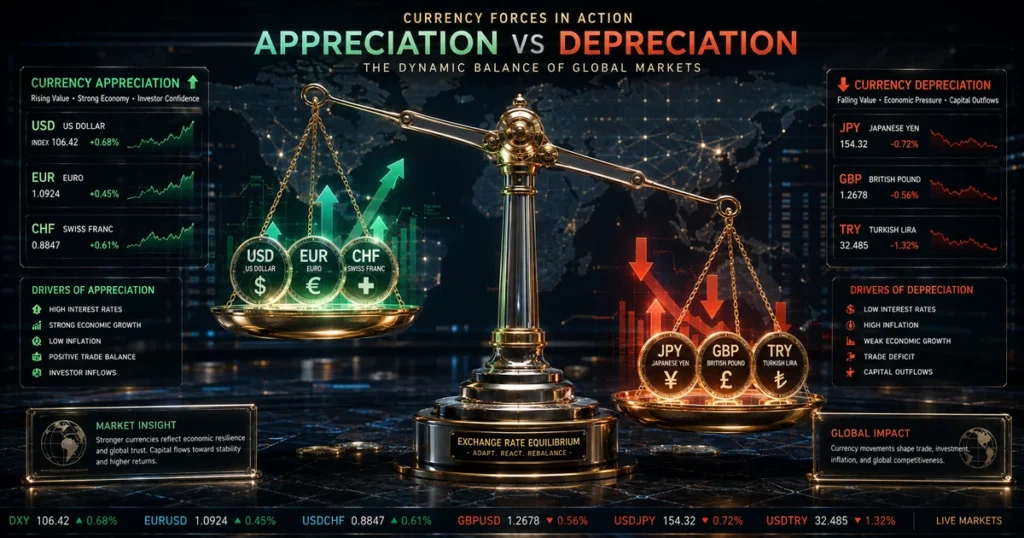
Currency Appreciation and Depreciation describes how the value of a currency changes relative to foreign currencies in the global foreign exchange market. Currency appreciation occurs when a currency gains value relative to another currency, while currency depreciation occurs when it loses value. These movements affect import costs, export competitiveness, inflation, investment flows, and international debt obligations.
- Appreciation Effects: Makes imported goods cheaper, lowers domestic inflation pressure, but makes exports more expensive for foreign buyers.
- Depreciation Effects: Makes domestic exports cheaper and more price-competitive globally, but increases the cost of imported goods, potentially causing imported inflation.
- Primary Drivers: Central bank interest rate decisions, relative inflation rates, current account balances, sovereign debt sustainability, and geopolitical capital flows.
- Key Distinction: Depreciation and appreciation occur naturally in floating exchange rate markets, whereas devaluation and revaluation are formal administrative actions taken by governments in fixed exchange rate regimes.
Featured Snippet
Currency appreciation refers to an increase in the value of one currency relative to another in foreign exchange markets, meaning one unit of domestic currency can purchase more units of a foreign currency. Currency depreciation is the decline in a currency’s purchasing power relative to another currency. In floating exchange rate systems, both processes occur organically due to market supply and demand, influenced by interest rate differentials, inflation, trade balances, and cross-border investment flows.
Key Takeaways
- Relative Market Value: A currency never moves in isolation; appreciation in one currency inherently corresponds to depreciation in another within a currency pair.
- Trade Balance Double-Edged Sword: An appreciating currency reduces the cost of imported raw materials but can compress export price competitiveness abroad. A depreciating currency stimulates export demand but raises import costs.
- Inflation Transmission Channel: Currency depreciation can import inflation by increasing the local price of foreign energy, raw materials, and consumer goods.
- Floating vs. Fixed Distinction: Depreciation and appreciation describe market-driven movements in floating regimes. Devaluation and revaluation describe official administrative rate adjustments by monetary authorities in fixed exchange regimes.
- The Role of Capital Flows: Currencies are influenced by trade flows as well as cross-border capital reallocation driven by central bank benchmark interest-rate differentials.
- Adjustment Lag: The trade balance response to currency depreciation often follows the J-Curve Effect, worsening initially before improving as commercial trade contracts and volumes adjust over time.
Introduction: The Dynamics of Global Exchange Rates
In an interconnected global economy, currency exchange rates are among the most influential macroeconomic prices. They shape everything from the price of imported energy and household electronics to corporate profit margins, sovereign debt sustainability, and global investment returns.
Every day, the $9.6 trillion-per-day global foreign exchange market continuously re-evaluates sovereign currencies against one another.
When economic fundamentals shift—whether through central bank interest rate decisions, inflation releases, commodity supply shocks, or geopolitical developments—currencies experience appreciation or depreciation.
Understanding the causes and structural consequences of these movements is vital for corporate treasurers hedging foreign currency exposure, macroeconomic analysts evaluating sovereign risk, and investors managing global assets.
CurrencyPlans Market Insight: The Global FX Valuation Equilibrium
Macro & Institutional Analysis
In international finance, exchange rates can act as an important adjustment mechanism for a nation’s balance of payments.
The Global Exchange Rate Balance:
-------------------------------------------------------------------------
[CURRENCY APPRECIATION]                      [CURRENCY DEPRECIATION]
* Stronger purchasing power abroad           * Cheaper, more competitive exports
* Reduced imported inflation pressures       * Boost to domestic tourism & industry
* Reduced export price competitiveness       * Increased imported cost-push inflation
* Capital inflows seeking yield/safety       * Heavier foreign debt servicing burden
-------------------------------------------------------------------------
Transmission Horizon:
1. Short-Term: Capital flows & interest rate expectations dominate.
2. Medium-Term: Real trade balances and contracts adjust (J-Curve response).
3. Long-Term: Relative inflation, productivity, external balances, and
   PPP-related forces become more important.
-------------------------------------------------------------------------
*Source: Bank for International Settlements (BIS) & IMF Economic Research*
CurrencyPlans View: Neither appreciation nor depreciation is purely positive or negative. A strong currency benefits consumers and capital-importing economies, whereas a weaker currency supports export-driven industrial sectors. Central banks continually balance these competing economic effects.
The Core Mechanics of Currency Fluctuations

Because foreign exchange trades in currency pairs (such as EUR/USD or USD/JPY), currency value is fundamentally relative. When one currency appreciates, its counterpart in the pair depreciates.
What Is Currency Appreciation?
Currency appreciation is an increase in the market exchange value of a domestic currency against a foreign currency in a floating exchange rate system.
- Example: If the exchange rate moves from
1 EUR = 1.05 USDto1 EUR = 1.15 USD, the Euro has appreciated against the US Dollar. - Practical Implication: European businesses and consumers require fewer Euros to buy goods priced in US Dollars, making imported electronics, oil, and American software cheaper in Europe. Conversely, American buyers must spend more Dollars to purchase European cars or machinery.
What Is Currency Depreciation?
Currency depreciation is a decrease in the market exchange value of a domestic currency against a foreign currency in a floating exchange rate system.
- Example: If the exchange rate shifts from
1 USD = 130 JPYto1 USD = 155 JPY, the Japanese Yen has depreciated against the US Dollar (because more Yen are now required to buy one Dollar). - Practical Implication: Japanese goods become more affordable and price-competitive in overseas markets, supporting Japanese exporters like automakers. However, foreign energy and imported food commodities become significantly more expensive in Japan.
Simple Meaning Box: Nominal vs. Real Exchange Rates
- Nominal Exchange Rate: The raw price ratio at which two currencies trade in the foreign exchange market (e.g., $1 = ¥150).
- Real Exchange Rate (RER): The nominal exchange rate adjusted for relative price levels (inflation rates) between the two countries. It measures the true purchasing power and trade competitiveness of a currency.
Mathematical Breakdown: Calculating Exchange Rate Percentage Changes
To evaluate currency percentage movements accurately, analysts separate the percentage change in the base currency from the percentage change in the inverse quote rate.
Percentage Change in the Base Currency:
$$\% \Delta \text{ Base Currency} = \left( \frac{\text{New Rate} – \text{Old Rate}}{\text{Old Rate}} \right) \times 100$$
- Scenario: EUR/USD rises from
1.0800to1.1340. - $\text{Calculation:} \left( \frac{1.1340 – 1.0800}{1.0800} \right) \times 100 = +5.0\%$
- Result: The Euro (base currency) has appreciated by +5.0% against the US Dollar.
Percentage Change in the Inverse Exchange Rate:
Because exchange rates are quoted as currency pairs, the percentage change in the inverse rate can differ from the percentage change in the original quote. The implied rate of the quote currency in terms of the base currency is $\frac{1}{\text{Rate}}$:
$$\% \Delta \text{ Inverse Rate} = \left( \frac{\frac{1}{\text{New Rate}} – \frac{1}{\text{Old Rate}}}{\frac{1}{\text{Old Rate}}} \right) \times 100$$
- Scenario: When EUR/USD rises from
1.0800to1.1340, the value of $1 USD in EUR falls from€0.9259to€0.8818. - $\text{Calculation:} \left( \frac{0.8818 – 0.9259}{0.9259} \right) \times 100 \approx -4.76\%$
- Result: The implied USD value in euros falls by approximately 4.8%, not 5.0%.
Depreciation vs. Devaluation: The Structural Difference
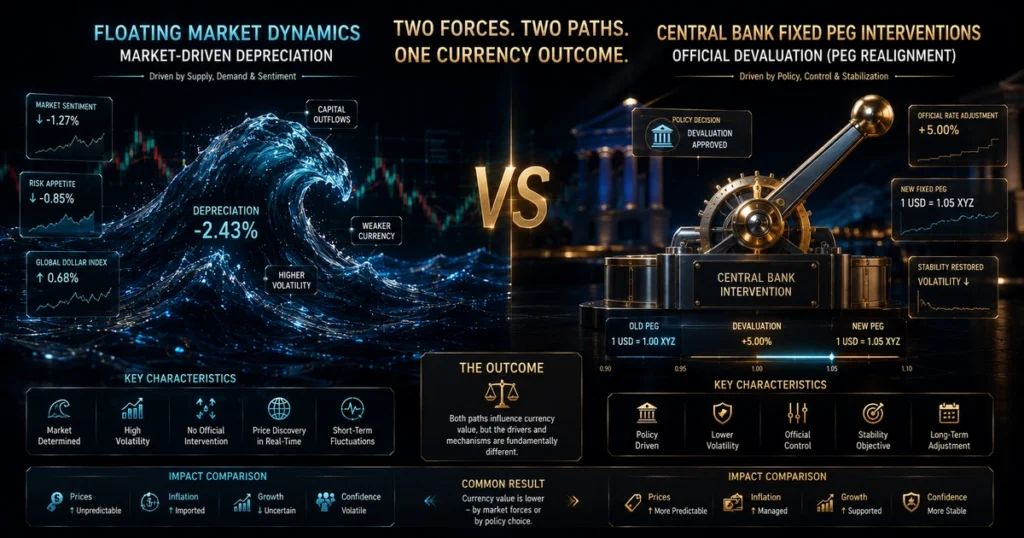
While often used interchangeably in popular media, depreciation and devaluation have distinct institutional meanings in international economics:
+-------------------------------------------------------------------------------+
|                 DEPRECIATION vs. DEVALUATION: THE CORE DIFFERENCE             |
+----------------------+-----------------------------+--------------------------+
| ATTRIBUTE            | CURRENCY DEPRECIATION       | CURRENCY DEVALUATION     |
+----------------------+-----------------------------+--------------------------+
| Exchange Rate Regime | Free-Floating / Managed     | Fixed / Pegged Regimes   |
| Primary Driver       | Market Supply & Demand      | Official Central Bank Act|
| Occurrence           | Continuous & Real-Time      | Discrete Policy Decision |
| Opposite Term        | Currency Appreciation       | Currency Revaluation     |
| Examples             | Daily EUR/USD or JPY shifts | Official peg resets      |
+----------------------+-----------------------------+--------------------------+
- Currency Depreciation: Occurs organically on open financial markets as private and institutional participants adjust their buying and selling based on economic fundamentals.
- Currency Devaluation: Occurs when a government or monetary authority maintaining a fixed exchange rate officially lowers the statutory pegged value of its domestic currency relative to an anchor currency or basket.
Comprehensive Comparison: Appreciation vs. Depreciation Side-by-Side
| Economic Variable | Currency Appreciation | Currency Depreciation |
| Export Competitiveness | Decreases (Exports become more expensive abroad) | Increases (Exports become cheaper for foreign buyers) |
| Import Affordability | Increases (Foreign goods become cheaper locally) | Decreases (Foreign goods become more expensive) |
| Domestic Inflation | Tends to fall (Lower imported energy/goods prices) | Tends to rise (Imported cost-push inflation) |
| Current Account Balance | May deteriorate toward deficit over time | May improve toward surplus (subject to trade elasticity) |
| Foreign Debt Burden | Easier to service foreign-currency-denominated debt | Harder to service foreign-currency debt in local terms |
| Foreign Tourism Inflows | Decreases (Country becomes expensive for tourists) | Increases (Country becomes an affordable destination) |
| Domestic Asset Values | Foreign purchasing of local assets slows | Local equities and real estate appear discounted to foreign capital |
Simple Meaning Box: The Marshall-Lerner Condition
The Marshall-Lerner Condition states that a currency depreciation will only improve a nation’s trade balance if the sum of price elasticities of demand for its exports and imports is greater than 1 ($\vert{}e_x + e_m\vert{} > 1$). If global demand for a country’s exports is inelastic, depreciation may not reduce a trade deficit immediately.
Key Drivers of Currency Appreciation and Depreciation

Exchange rates adjust dynamically in response to several core macroeconomic catalysts:
                      ┌─────────────────────────────────────────┐
                      │    CENTRAL BANK INTEREST RATES & POLICIES│
                      └────────────────────┬────────────────────┘
                                           │
         ┌─────────────────────────────────┼─────────────────────────────────┐
         │                                 │                                 │
         ▼                                 ▼                                 ▼
┌──────────────────┐             ┌──────────────────┐             ┌──────────────────┐
│ INFLATION & PPP  │             │ CURRENT ACCOUNT  │             │ TERMS OF TRADE & │
│  DIFFERENTIALS   │             │ & TRADE BALANCES │             │ COMMODITY PRICES │
└──────────────────┘             └──────────────────┘             └──────────────────┘
1. Interest Rate Differentials and Central Bank Policy
Central banks control benchmark interest rates to manage domestic inflation and macroeconomic stability.
- Upward Support (Appreciation): A relative increase in interest rates can support a currency by improving the expected return on domestic assets, although the exchange-rate response also depends on inflation expectations, risk, fiscal conditions, and market expectations.
- Downward Pressure (Depreciation): Lower interest rates reduce yields relative to foreign alternatives, which can encourage capital outflows toward higher-yielding markets.
2. Relative Inflation Rates and Purchasing Power Parity
According to the economic theory of Purchasing Power Parity (PPP), exchange rates adjust over the long term to reflect differences in price levels between nations.
- Low Relative Inflation $\rightarrow$ Appreciation Tendency: A country with consistently low inflation preserves its currency’s purchasing power, supporting its long-term external exchange value.
- High Relative Inflation $\rightarrow$ Depreciation Tendency: Rapidly rising domestic prices erode purchasing power. Foreign buyers require more domestic units to purchase the same volume of goods, leading to downward currency pressure.
3. Current Account Balances and Trade Flows
The current account reflects the net balance of a nation’s international trade in goods, services, and cross-border income transfers.
- A persistent current-account deficit can create underlying pressure on a currency, although the exchange-rate outcome also depends on capital flows, financing conditions, monetary policy, and investor expectations.
- Structural current-account surpluses can support external demand for a country’s currency, although the exchange-rate outcome also depends on capital flows, monetary policy, valuation, and investor expectations.
4. Sovereign Debt and Fiscal Stability
- Large government deficits and expanding public debt-to-GDP ratios can deter foreign direct investment and institutional bond buyers.
- If markets suspect that sovereign debt sustainability is weakening or that fiscal deficits will require expansionary monetary financing, international investors reallocate capital, precipitating currency depreciation.
5. Terms of Trade and Commodity Price Cycles
Terms of Trade is the economic ratio comparing a nation’s export prices to its import prices.
- Commodity-exporting economies such as Australia, Canada, and Norway can experience currency appreciation when global prices for major export commodities rise, particularly when stronger export earnings improve the external balance and attract capital.
- Conversely, commodity-importing nations face trade balance deterioration and currency depreciation when global energy and raw material prices spike.
6. Geopolitical Stability and Safe-Haven Capital Flows
During periods of global financial stress or geopolitical conflict, institutional capital often shifts from emerging or risk-sensitive markets into established safe-haven currencies (such as the US Dollar and Swiss Franc), causing them to appreciate regardless of domestic growth metrics.
Macroeconomic Impacts Across the Real Economy
Exchange rate adjustments send direct economic impulses through consumer, business, and government balance sheets:
Impact on Importers and Exporters
- Domestic Exporters: A depreciating currency makes domestic manufacturing and agricultural goods more price-competitive overseas, supporting export volumes and corporate revenues. An appreciating currency narrows export profit margins unless businesses compete on specialized quality rather than price.
- Domestic Importers: Importers of capital equipment, intermediate manufacturing parts, and consumer technology benefit from an appreciating currency, which reduces acquisition costs. Depreciation directly raises the local cost of imported inputs.
Impact on Domestic Inflation and Cost of Living
Exchange rate fluctuations pass directly into domestic consumer price indices via the Exchange Rate Pass-Through (ERPT) mechanism:
- Depreciation: Increases the landed cost of imported fuels, fertilizer, and consumer staples, generating imported cost-push inflation.
- Appreciation: Acts as a disinflationary force by lowering import costs and placing competitive pressure on domestic consumer goods.
Impact on Sovereign Foreign Debt Servicing
- Many emerging market governments and corporations issue debt denominated in foreign currencies (primarily US Dollars or Euros).
- When the domestic currency depreciates against the borrowing currency, the local-currency cost of servicing principal and interest increases, straining national budgets and raising sovereign credit risk.
The J-Curve Effect and International Trade Balance
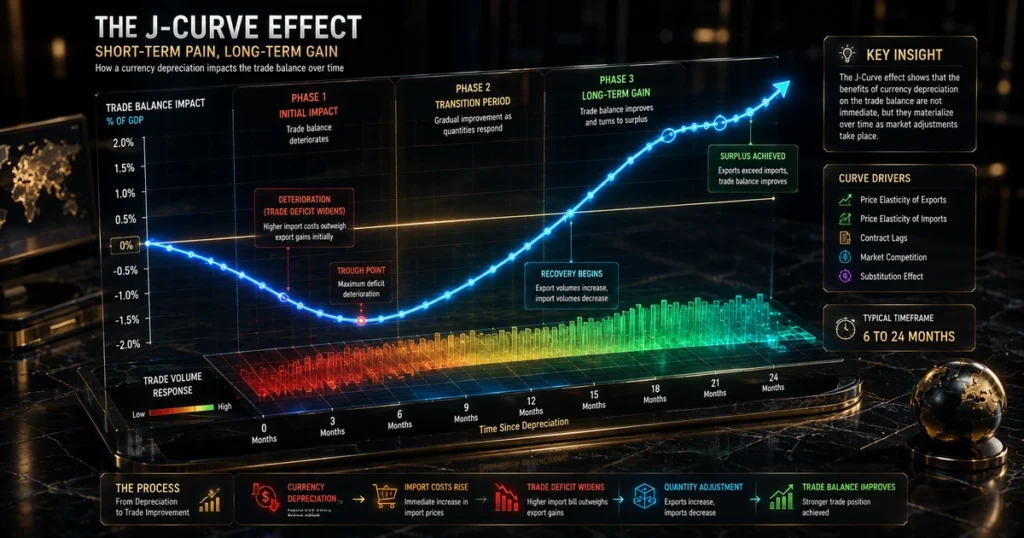
When a nation’s currency undergoes a sharp depreciation, classical economic theory suggests that its trade deficit should immediately improve as exports become cheaper and imports more expensive.
However, in practice, the trade balance often follows the J-Curve Effect:
Trade Balance ($)
   ▲
   │                           / (Phase 3: Potential Trade-Balance Improvement)
   │                          /
───┼─────────────────────────/──────────────────────────► Time
   │ \                      /
   │  \                    /
   │   \__________________/ (Phase 2: Contract Reset & Volume Adjustment)
   │    (Phase 1: Immediate Deficit Deterioration)
   ▼
- Phase 1: Immediate Deterioration (The Downward Hook): In the short term, international trade volumes are locked in by existing commercial contracts. The country continues to import the same volume of goods, but at higher local-currency costs due to depreciation. As a result, the trade deficit temporarily widens.
- Phase 2: Volume Adjustment & Contract Renegotiation: Over subsequent months, as existing contracts reset, domestic businesses and consumers adjust to higher import prices by seeking local alternatives, while foreign buyers recognize the lower export prices and increase purchase orders.
- Phase 3: Potential Trade-Balance Improvement: As export volumes respond and import demand adjusts, the trade balance may improve if the relevant trade elasticities are sufficiently strong (satisfying the Marshall-Lerner condition) and other external conditions remain supportive.
Real-World Global Case Studies
Case Study 1: The US Dollar Surge and Global Spillover (2022–2024)
- Macro Catalyst: Rapid benchmark interest rate increases by the Federal Reserve to curb domestic inflation widened interest rate differentials with global peers.
- The Movement: The US Dollar experienced broad appreciation against the Euro, British Pound, and emerging market currencies.
- Global Economic Impact: Global commodities (predominantly priced in USD) became significantly more expensive for foreign buyers, exporting inflation globally. Developing economies holding USD-denominated sovereign debt faced sharply higher debt-servicing costs.
Case Study 2: The Japanese Yen’s Historic Multi-Year Depreciation
- Macro Catalyst: The Bank of Japan (BOJ) maintained ultra-loose monetary policy and yield curve control, while other major central banks rapidly raised policy rates.
- The Movement: The USD/JPY exchange rate depreciated from approximately
¥115per USD to over¥160per USD, reaching historic multi-decade lows in nominal terms. - Economic Trade-Off: The depreciation generated record operating profits for major Japanese multinational exporters (such as automakers) and stimulated inbound tourism revenues, but placed substantial cost pressures on domestic households reliant on imported energy and food staples.
Case Study 3: The Swiss Franc Safe-Haven Flight
- Macro Catalyst: Global inflationary pressures and geopolitical instability in Europe prompted sustained institutional safe-haven capital inflows into Switzerland.
- The Movement: The Swiss Franc came under sustained appreciation pressure against major currencies, supported by safe-haven demand and the SNB’s policy of allowing some appreciation to limit imported inflation.
- Policy Response: The Swiss National Bank (SNB) accommodated appreciation and utilized foreign currency sales to reinforce domestic price stability, keeping Swiss inflation consistently below neighboring economies.
How Central Banks Intervene in Currency Movements
When rapid exchange rate movements threaten macroeconomic stability, sovereign central banks deploy established monetary and operational tools:
                      ┌─────────────────────────────────────────┐
                      │      CENTRAL BANK INTERVENTION TOOLS    │
                      └────────────────────┬────────────────────┘
                                           │
         ┌─────────────────────────────────┼─────────────────────────────────┐
         │                                 │                                 │
         ▼                                 ▼                                 ▼
┌──────────────────┐             ┌──────────────────┐             ┌──────────────────┐
│ DIRECT SPOT FX   │             │ MONETARY POLICY  │             │ CAPITAL CONTROLS │
│  INTERVENTIONS   │             │  RATE ADJUSTMENT │             │ & MACROPRUDENTIAL│
└──────────────────┘             └──────────────────┘             └──────────────────┘
- Direct Spot FX Market Intervention: A central bank buys domestic currency using foreign exchange reserves (to counter depreciation) or sells domestic currency to purchase foreign assets (to counter appreciation).
- Monetary Policy Rate Adjustments: Raising benchmark interest rates to attract international capital inflows and support a weakening currency, or cutting rates to curb excessive appreciation.
- Verbal Intervention (“Jawboning”): Official public statements issued by finance ministries and central bank governors signaling readiness to intervene, designed to influence speculative market positioning.
- Capital Controls and Macroprudential Limits: Implementing regulations that limit the volume of domestic capital that can be transferred abroad or restricting foreign capital access to short-term domestic money markets.
Frequently Asked Questions (FAQs)
1. Is currency appreciation always beneficial for an economy?
No. While appreciation increases domestic consumer purchasing power and reduces the cost of imported goods, it also makes domestic exports more expensive on international markets. For export-dependent economies, an overly strong currency can slow manufacturing growth, compress corporate profit margins, and reduce employment in export sectors.
2. What is the fundamental difference between depreciation and devaluation?
Depreciation is the natural decline in a currency’s market exchange rate determined by open-market supply and demand in a floating exchange regime. Devaluation is a formal, administrative downward adjustment of a fixed exchange rate enacted by a central bank or government authority.
3. How does high inflation cause a currency to depreciate?
High domestic inflation erodes the real purchasing power of money. According to Purchasing Power Parity, as domestic prices rise faster than foreign prices, domestic goods become less price-competitive, reducing foreign demand for the currency while increasing domestic demand for foreign goods, leading to downward currency pressure.
4. How does currency depreciation affect the everyday consumer?
Depreciation makes imported goods—including fuel, electronics, imported food items, and international travel—more expensive in local currency terms. However, consumers working in export industries, domestic tourism, or receiving foreign remittances may benefit from improved sector competitiveness and higher local-currency income.
5. Why do safe-haven currencies appreciate during global economic crises?
During times of geopolitical instability or financial market volatility, institutional investors prioritize capital preservation over high yields. Capital flows out of riskier, emerging-market assets and into sovereign currencies backed by stable legal institutions, strong creditor status, and deep liquid bond markets (such as the US Dollar and Swiss Franc).
Conclusion
Currency appreciation and depreciation are important exchange-rate adjustment mechanisms through which changes in relative prices, trade competitiveness, inflation, and international capital flows affect the global economy.
While a stronger currency delivers purchasing power benefits to consumers and lowers import costs, a weaker currency provides vital price competitiveness to domestic export manufacturers and tourism sectors.
By understanding the underlying macroeconomic drivers—from interest rate differentials and trade balances to geopolitical capital flows and central bank interventions—market participants and corporate decision-makers can navigate international foreign exchange markets with strategic clarity and analytical precision.
Next Reading Suggestions
To deepen your understanding of international macroeconomic policy and foreign exchange mechanics, explore our related guides:
- [Understanding Real Effective Exchange Rates (REER) in Global Trade]
- [Central Bank Interventions: Mechanics of Sovereign Currency Management]
- [Purchasing Power Parity (PPP): Theory, Evidence, and Limitations]
- [The Structural Role of the US Dollar as the Global Anchor Reserve Asset]
Author Box & E-E-A-T Verification
Written By: CurrencyPlans Financial Research Team
Fact-Checked & Reviewed By: Senior Institutional Market Analyst & FX Strategist
Editorial Integrity & Research Standards: CurrencyPlans publishes institutional-grade research grounded in verified macroeconomic data. All exchange rate frameworks, reserve data, and central bank statistics are cross-referenced with primary multilateral institutions including the International Monetary Fund (IMF), the Bank for International Settlements (BIS), and sovereign central banks.
Institutional References & Official Resources
For primary central bank reference rates, macroeconomic research, and global trade frameworks, consult official institutional sources directly:
- Global Foreign Exchange Turnover & Research: Bank for International Settlements (BIS) Triennial Central Bank Survey
- Balance of Payments & Real Effective Exchange Rate Data: International Monetary Fund (IMF) Data Portal
- US Monetary Policy & Foreign Exchange Rates: Board of Governors of the Federal Reserve System Foreign Exchange Data (H.10)
- Euro Exchange Rate & Price Stability Analytics: European Central Bank (ECB) Euro Foreign Exchange Reference Rates
- Foreign Exchange Interventions & Monetary Policy: Swiss National Bank (SNB) Monetary Policy Assessments
Educational Disclaimer
This guide is prepared strictly for educational, informational, and research purposes and does not constitute financial, investment, legal, or tax advice. Foreign exchange rates and macroeconomic valuations fluctuate based on market conditions. Always perform independent due diligence and consult a licensed financial advisor before making international financial commitments.

