
Quick Answer (At a Glance)
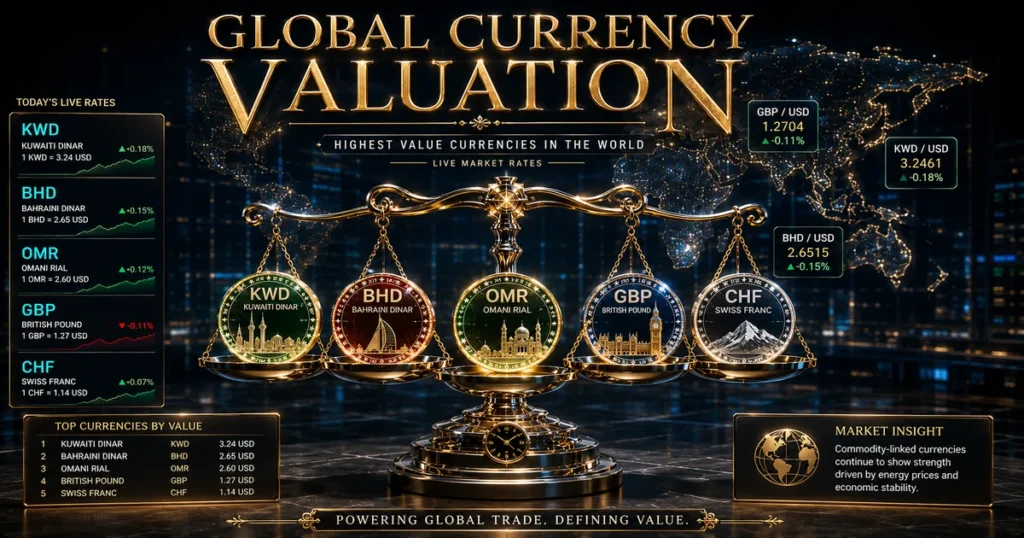
Global Currency Value refers to the relative purchasing power and exchange value of one sovereign currency against international benchmarks (primarily the US Dollar).
- Top Ranked Currency: The Kuwaiti Dinar (KWD) ranks as the world’s most valuable currency unit (1 KWD ≈ $3.25 USD).
- Why They Rank High: The top-ranked currencies by face value maintain high exchange rates through massive sovereign hydrocarbon reserves, conservative fiscal policy, or strictly managed currency pegs.
- Value vs. Power: High unit value does not equate to global dominance. While the Kuwaiti Dinar holds the highest face value, the US Dollar (USD) and Euro (EUR) dominate global foreign exchange liquidity and central bank reserves.
Featured Snippet
What Is Global Currency Value? Global currency value is the measure of a nation’s currency relative to foreign currencies, determined by nominal exchange rates, terms of trade, and balance-of-payments fundamentals. The highest-valued currencies per unit—led globally by the Kuwaiti Dinar (KWD), Bahraini Dinar (BHD), and Omani Rial (OMR)—maintain elevated exchange valuations through vast sovereign wealth reserves, strategic oil export surpluses, and disciplined peg regimes tied to weighted currency baskets or the US Dollar.
Key Takeaways
- Middle Eastern Dominance: The world’s top four highest-valued currency units belong to Middle Eastern nations (Kuwait, Bahrain, Oman, and Jordan) supported by hydrocarbon revenue or strict currency pegs.
- Highest-Valued Unit: The Kuwaiti Dinar (KWD) remains the single most valuable currency unit in the world, trading at over $3.20+ USD per dinar.
- Free-Floating Heavyweights: The British Pound (GBP) and Swiss Franc (CHF) represent the highest-valued free-floating currencies issued by major industrialized economies.
- Nominal Value $\neq$ Reserve Dominance: A high exchange rate per single unit reflects historical denomination and monetary management, not the size of an economy or global market liquidity.
- Peg Stability vs. Diversification: High-value pegged currencies rely heavily on foreign currency reserve buffers to defend against macroeconomic shifts and oil price cycles.
Introduction: Defining Global Currency Value
In international finance, currency value is commonly evaluated in two distinct ways:
- Nominal Exchange Value: How much foreign currency a single unit of domestic money can purchase (e.g., 1 KWD buying ~3.25 USD).
- Economic & Reserve Value: How widely a currency is held in central bank reserves, used in international trade invoicing, and traded across global foreign exchange markets.
While the public often assumes that the US Dollar, the Euro, or the British Pound are the most expensive single currency units in the world, the nominal ranking is dominated by resource-rich nations with specialized monetary systems.
Understanding what drives global currency value clarifies the difference between high face-value currencies and global reserve currencies, revealing the macroeconomic mechanics behind exchange rates.
CurrencyPlans Market Insight: Unit Value vs. Reserve Dominance
Macro & Institutional Analysis
A common misconception in retail finance is that a country with a high unit currency value possesses the strongest overall economy.
Currency Face Value vs. Global FX Market Activity:
-------------------------------------------------------------------------
Rank 1 (By Value):   Kuwaiti Dinar (KWD)   -> <0.1% of Global FX Turnover
Rank 5 (By Value):   British Pound (GBP)   -> ~13% of Global FX Turnover
Rank 10 (By Value):  US Dollar (USD)       -> ~89% of Global FX Turnover
-------------------------------------------------------------------------
*Source: Bank for International Settlements (BIS) & IMF COFER Data*
CurrencyPlans View: High nominal currency value reflects historical denominational choices, terms of trade, and central bank pegging policies. True global currency power, however, is measured by international reserve share, market depth, and global transaction liquidity.
Nominal Exchange Value vs. Economic Power
To analyze currency markets accurately, institutional analysts separate nominal unit value from macroeconomic liquidity:
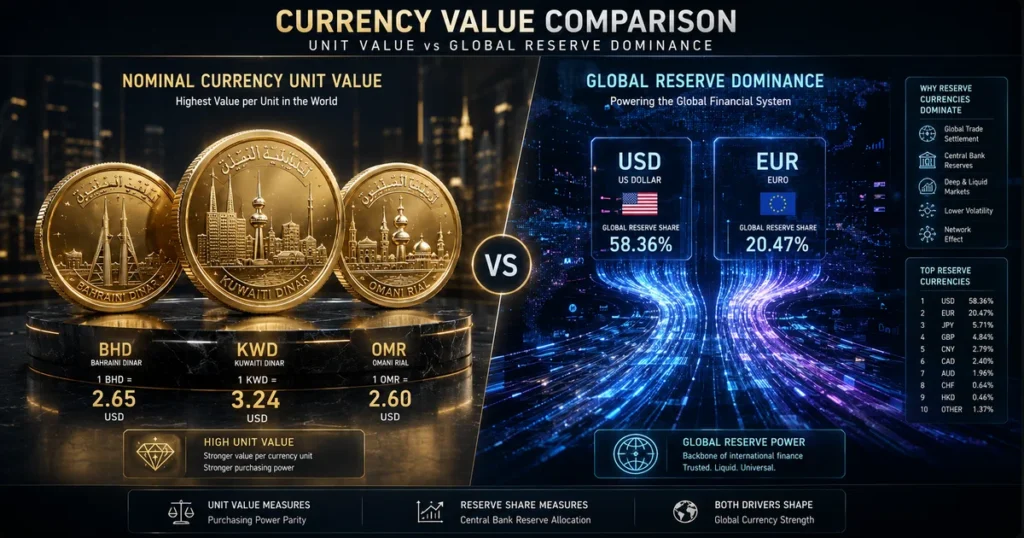
- Nominal Exchange Value: If Country A decides that 1 unit of its currency equals 3 US Dollars, it maintains that rate by adjusting domestic money supply and holding sovereign reserves. This makes each note valuable, but does not dictate the size of Country A’s GDP.
- Reserve and Transaction Status: According to IMF COFER data, the US Dollar accounted for 57.13% of allocated global foreign exchange reserves in 2026 Q1, while the Euro accounted for around 20%.
The Comprehensive Top 7 Global Currency Rankings
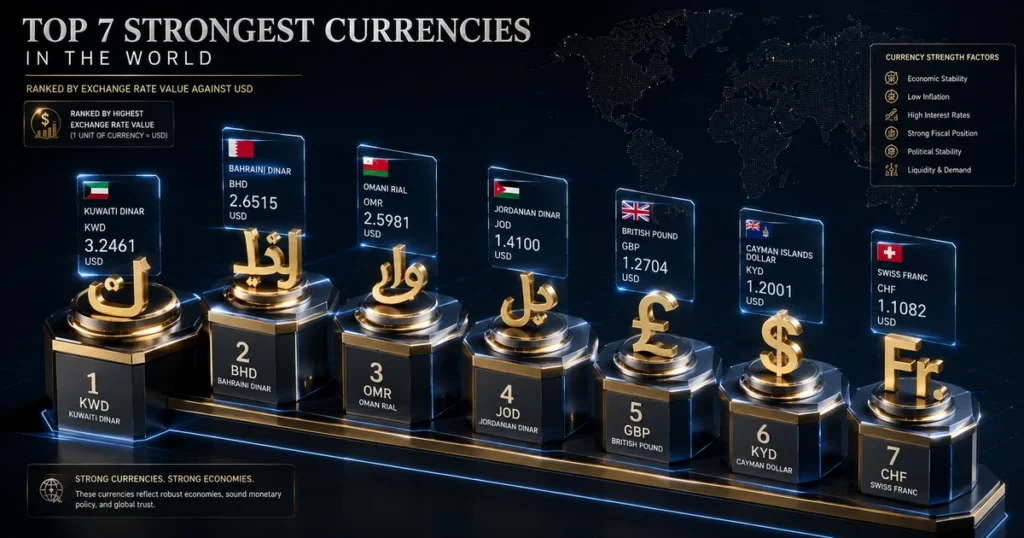
Below are the Top 7 Highest-Valued Currency Units by Nominal Exchange Rate, evaluated against the global standard benchmark—the US Dollar (USD):
+------------------------------------------------------------------------+
|           TOP 7 HIGHEST-VALUED CURRENCY UNITS BY NOMINAL VALUE        |
+------+--------------------------+------+-----------------+-------------+
| RANK | CURRENCY NAME            | CODE | VALUE IN USD    | REGIME      |
+------+--------------------------+------+-----------------+-------------+
|  1   | Kuwaiti Dinar            | KWD  | ~$3.25          | Basket Peg  |
|  2   | Bahraini Dinar           | BHD  | ~$2.66          | Fixed Peg   |
|  3   | Omani Rial               | OMR  | ~$2.60          | Fixed Peg   |
|  4   | Jordanian Dinar          | JOD  | ~$1.41          | Fixed Peg   |
|  5   | British Pound Sterling   | GBP  | ~$1.35          | Free Float  |
|  6   | Gibraltar Pound          | GIP  | ~GBP Parity     | GBP Peg     |
|  7   | Cayman Islands Dollar   | KYD  | ~$1.23          | USD Peg     |
+------+--------------------------+------+-----------------+-------------+
*Values are approximate and can change with market exchange rates.
*GIP is tied to the Pound Sterling; KYD is maintained at a fixed USD
 rate. Ranking is based on nominal value per currency unit, not economic
 strength or global reserve status.
(Note: Exchange values reflect approximate baseline reference rates and fluctuate based on market movements and peg adjustments).
In-Depth Analysis: The World’s Top 7 Highest-Valued Currencies
1. Kuwaiti Dinar (KWD)
- Approximate Value: 1 KWD $\approx$ 3.25 USD
- Monetary Framework: Managed peg against an undisclosed weighted basket of international currencies.
- Economic Foundation: The Kuwaiti Dinar has maintained its status as the world’s highest-valued currency unit for decades. Kuwait holds approximately 6% of global proven crude oil reserves combined with a relatively small population and extensive sovereign wealth assets managed by the Kuwait Investment Authority (KIA). Rather than pegging exclusively to the USD, Kuwait uses a trade-weighted basket to limit imported inflation.
2. Bahraini Dinar (BHD)
- Approximate Value: 1 BHD $\approx$ 2.65 USD
- Monetary Framework: Officially pegged to the US Dollar at a fixed rate of 1 USD = 0.376 BHD.
- Economic Foundation: Situated in the Persian Gulf, Bahrain’s economy combines hydrocarbon exports with a developed offshore financial and banking services sector. The fixed peg provides foreign direct investors with currency predictability and anchors domestic monetary policy.
3. Omani Rial (OMR)
- Approximate Value: 1 OMR $\approx$ 2.60 USD
- Monetary Framework: Officially pegged to the US Dollar at 1 OMR = 2.6008 USD.
- Economic Foundation: In place since 1986, Oman’s peg is among the longest-running unchanged exchange rate arrangements globally. The Rial’s value is supported by natural gas and petroleum exports, coupled with ongoing economic diversification initiatives under Oman Vision 2040.
4. Jordanian Dinar (JOD)
- Approximate Value: 1 JOD $\approx$ 1.41 USD
- Monetary Framework: Formally pegged to the US Dollar.
- Economic Foundation: Unlike its Gulf peers, Jordan does not possess massive oil reserves. The Central Bank of Jordan maintains its strong currency peg through substantial foreign currency reserve buffers, international financial support, and a diversified trade and services economy to maintain regional financial stability.
5. British Pound Sterling (GBP)
- Approximate Value: 1 GBP $\approx$ 1.28 – 1.34 USD
- Monetary Framework: Free-Floating.
- Economic Foundation: The British Pound is the oldest sovereign currency still in continuous circulation and the highest-valued free-floating currency among major industrialized economies. London’s role as an international financial and foreign exchange trading hub generates ongoing global demand for Sterling.
6. Cayman Islands Dollar (KYD) / Gibraltar Pound (GIP)
- Approximate Value: 1 KYD $\approx$ 1.25 USD / 1 GIP $\approx$ 1.28 – 1.34 USD (Parity with GBP)
- Monetary Framework: Fixed Peg.
- Economic Foundation: The Cayman Islands Dollar is anchored by its position as an offshore financial and investment fund jurisdiction. Similarly, the Gibraltar Pound maintains strict 1:1 parity with the British Pound Sterling, reflecting the territory’s financial services and maritime economy.
7. Swiss Franc (CHF)
- Approximate Value: 1 CHF $\approx$ 1.12 – 1.25 USD
- Monetary Framework: Free-Floating (Active Central Bank Monitoring).
- Economic Foundation: The Swiss Franc is widely regarded as a major safe-haven currency, supported by Switzerland’s low-inflation history, institutional stability, strong legal framework, and fiscal credibility.
Comprehensive Comparison: Top 7 Currencies Side-by-Side
| Currency | ISO Code | Value vs. USD (Nominal) | Monetary Regime | Primary Economic Support | Global Liquidity Tier |
| Kuwaiti Dinar | KWD | ~$3.25 | Weighted Basket Peg | Sovereign Oil Wealth & Reserves | Regional / Specialized |
| Bahraini Dinar | BHD | ~$2.65 – $2.66 | Fixed USD Peg | Petroleum & Offshore Banking | Regional / Specialized |
| Omani Rial | OMR | ~$2.60 | Fixed USD Peg | Natural Gas & Oil Exports | Regional / Specialized |
| Jordanian Dinar | JOD | ~$1.41 | Fixed USD Peg | Trade, Remittances, Reserves | Regional / Specialized |
| British Pound | GBP | ~$1.28 – $1.34 | Free-Floating | Global Financial Services & Trade | Tier-1 Major (G10) |
| Cayman Dollar | KYD | ~$1.25 | Fixed USD Peg | Offshore Fund Domicile & Finance | Specialized Offshore |
| Swiss Franc | CHF | ~$1.12 – $1.25 | Free-Floating | Safe-Haven Assets & Low Inflation | Tier-1 Major (G10) |
Simple Meaning Box: What Is a Currency Basket Peg?
Instead of tying a national currency to just one foreign currency (like the US Dollar), a Currency Basket Peg links the domestic rate to a weighted group of multiple major trading currencies (such as the USD, Euro, Yen, and Pound). This smooths out sharp fluctuations caused by single-currency movements.
Key Macroeconomic Drivers of Currency Value

Sovereign currency values are shaped by five primary economic mechanisms:
- Terms of Trade and Resource Endowments: Persistent trade surpluses and strong commodity exports can support external demand for a country’s currency, although exchange rates are also influenced by capital flows, monetary policy, inflation, and market expectations.
- Central Bank Monetary Policy: Interest-rate differentials influence international capital flows, while domestic inflation control preserves long-term purchasing power.
- Sovereign Foreign Exchange Reserves: Countries maintaining pegged regimes must hold sufficient foreign exchange reserves to defend the peg during periods of capital outflow.
- Institutional Quality & Sovereign Solvency: Legal stability, low public debt ratios, and predictable governance build international investor confidence (e.g., Switzerland).
- Historical Denomination Choices: The initial face value assigned when a currency is established affects its baseline unit calculation without necessarily changing total national wealth.
Exchange Rate Regimes Behind High-Value Currencies
Sovereign nations use different policy architectures to manage their currency values:
                      ┌─────────────────────────────────────────┐
                      │      SOVEREIGN EXCHANGE RATE REGIMES    │
                      └────────────────────┬────────────────────┘
                                           │
         ┌─────────────────────────────────┼─────────────────────────────────┐
         │                                 │                                 │
         ▼                                 ▼                                 ▼
┌──────────────────┐             ┌──────────────────┐             ┌──────────────────┐
│   FIXED PEGS     │             │  BASKET PEGS     │             │  FREE-FLOATING   │
│  (BHD, OMR, JOD) │             │      (KWD)       │             │   (GBP, CHF)     │
└──────────────────┘             └──────────────────┘             └──────────────────┘
- Fixed Currency Peg: The central bank guarantees conversion at a set rate against an anchor currency (e.g., BHD, OMR, JOD pegged to USD).
- Currency Basket Peg: The central bank adjusts its rate against a weighted portfolio of global trade partner currencies (e.g., KWD).
- Free-Floating System: Exchange rates adjust continuously based on private market supply and demand, influenced by macro fundamentals and trade flows (e.g., GBP, CHF).
Understanding Real Effective Exchange Rates (REER) & Purchasing Power Parity (PPP)

To evaluate whether a high-value currency is fundamentally strong or artificially expensive, institutional economists rely on two metrics:
1. Purchasing Power Parity (PPP)
PPP suggests that exchange rates between currencies are in equilibrium when their domestic purchasing power is equivalent for the same basket of goods. If $100 buys a standard basket in the US while the equivalent dinars buy double that basket locally, the nominal exchange rate diverges from purchasing parity.
2. Real Effective Exchange Rate (REER)
The REER measures the weighted average of a nation’s currency relative to an index of major trading partners, adjusted for domestic inflation differentials.
- A rising REER indicates that a country’s exports are becoming more expensive relative to trading partners, potentially impacting trade competitiveness.
- A stable REER indicates that nominal currency strength is supported by low domestic inflation.
Institutional Case Studies: Sovereign Value Anchors
Case Study 1: The Kuwaiti Dinar’s Basket Diversification
- Background: Kuwait previously pegged solely to the US Dollar before shifting to an undisclosed weighted basket in 2007.
- Mechanism: When the US Dollar depreciated globally, single-peg economies faced imported inflation on goods sourced from Europe and Asia. Kuwait’s basket system mitigates dollar-specific swings, helping stabilize domestic price levels.
Case Study 2: The Swiss Franc Safe-Haven Flight
- Background: During global financial instability, institutional capital frequently reallocates to Swiss assets.
- Mechanism: Switzerland’s structural current account surplus, low sovereign debt, and legal stability make the CHF an attractive store of value during market downturns, supporting long-term appreciation.
Advantages and Strategic Vulnerabilities of High-Value Currencies
Advantages
- Lower Import Costs: Strong nominal value reduces the domestic cost of imported goods, technology, and food commodities.
- Monetary Stability: Credible peg regimes provide certainty for cross-border trade contracts and foreign investment.
- Inflation Control: High unit values and disciplined currency management help protect consumer purchasing power.
Vulnerabilities
- Export Competitiveness Drag: High currency values can make non-resource domestic exports more expensive in foreign markets.
- Reserve Depletion Risk (Pegged Regimes): Defending a fixed exchange rate during economic shocks requires significant central bank foreign exchange reserves.
- Monetary Policy Dependency: Nations with strict US Dollar pegs must closely track Federal Reserve interest rate policy, regardless of their own domestic economic cycles.
Frequently Asked Questions (FAQs)
1. Why is the Kuwaiti Dinar more valuable than the US Dollar?
The Kuwaiti Dinar holds a higher nominal value per unit due to Kuwait’s large oil revenues, substantial sovereign wealth reserves, small population, and a disciplined currency basket peg managed by the Central Bank of Kuwait.
2. Does a higher currency value mean a country has a stronger economy?
No. A high nominal exchange rate per unit reflects how a country’s currency was historically denominated and managed. Larger economies like the United States and the Eurozone have lower unit exchange rates but possess far larger economic scale, market depth, and global reserve status.
3. Which is the highest-valued free-floating currency in the world?
The British Pound Sterling (GBP) is the highest-valued free-floating currency among major economies, followed closely by the Swiss Franc (CHF).
4. Why are so many of the top-valued currencies from the Middle East?
Gulf countries (Kuwait, Bahrain, Oman) maintain strong trade balances from hydrocarbon exports, accumulate large sovereign wealth funds, and use fixed or managed pegs tied to the US Dollar or currency baskets.
5. Why is the US Dollar not at the top of the highest currency list?
The US Dollar serves as the primary global reserve and transaction currency, but its nominal unit value ($1.00) is a historical baseline. Economic influence is measured by total transaction volume and reserve share rather than the face value of a single unit.
Conclusion
Global currency value reflects a balance between historical monetary denomination, sovereign resource backing, and exchange rate governance. While the Kuwaiti Dinar, Bahraini Dinar, and Omani Rial hold the world’s highest nominal unit valuations, major currencies like the British Pound, Swiss Franc, and US Dollar provide the liquidity and market depth that drive global commerce.
Understanding the distinction between unit exchange value and macroeconomic liquidity provides a clear view of how sovereign exchange rates operate across the global financial system.
Next Reading Suggestions
- [Understanding Real Effective Exchange Rates (REER) in Global Trade]
- [Currency Pegs vs. Free Floats: How Central Banks Choose Regimes]
- [The Mechanics of Sovereign Wealth Funds and FX Reserves]
- [The US Dollar’s Structural Role as the Global Anchor Reserve Asset]
Author Box & E-E-A-T Verification
Written By: CurrencyPlans Financial Research Team
Fact-Checked & Reviewed By: Senior Institutional Market Analyst & FX Strategist
Editorial Integrity & Research Standards: CurrencyPlans publishes institutional-grade research grounded in verified macroeconomic data. All exchange rate frameworks, reserve data, and central bank statistics are cross-referenced with primary multilateral institutions including the International Monetary Fund (IMF), the Bank for International Settlements (BIS), and national central banks.
Institutional References & Official Resources
For verified central bank reference rates, reserve statistics, and global trade frameworks:
- Official Foreign Exchange Reserve Statistics (COFER): International Monetary Fund (IMF) Reserve Data
- Global Currency Turnover and FX Market Data: Bank for International Settlements (BIS)
- Kuwait Monetary and Currency Basket Policy: Central Bank of Kuwait
- Swiss Monetary Policy & Exchange Rate Assessments: Swiss National Bank (SNB)
- UK Monetary Framework and Sterling Analytics: Bank of England (BoE)
Educational Disclaimer
This guide is prepared strictly for educational, informational, and research purposes and does not constitute financial, investment, legal, or tax advice. Currency values and exchange rates are subject to market volatility and policy adjustments. Always perform independent research and consult a licensed financial advisor before making international financial commitments.

