

Featured Snippet
What Is Foreign Exchange? Foreign exchange—commonly abbreviated as Forex or FX—is the decentralized global marketplace for pricing, converting, and settling national currencies against one another. With an average daily turnover of approximately $9.6 trillion, it represents the largest and most liquid financial market in the world economy. Foreign exchange enables international cross-border trade, corporate balance-sheet hedging, central bank reserve management, and currency speculation across commercial banks, institutional asset managers, and retail participants.
Key Takeaways
- Unrivaled Scale and Liquidity: The foreign exchange market operates as a decentralized, Over-the-Counter (OTC) financial network with daily turnover exceeding $9.6 trillion.
- Dual Currency Quotations: Currencies are priced and transacted simultaneously in pairs (e.g., EUR/USD, USD/JPY), where one currency serves as the base and the other as the quote.
- Continuous Global Trading: The global FX market operates around the clock from Sunday evening through Friday evening, following the major financial-center time zones across Sydney, Tokyo, London, and New York.
- Driven by Macro Fundamentals: Currency exchange rates reflect relative monetary policies, interest-rate differentials, trade balances, inflation expectations, and sovereign geopolitical stability.
- Diversified Product Suite: Institutional and retail markets utilize distinct instruments, including Spot FX, Outright Forwards, Foreign Exchange Swaps, Currency Options, and Exchange-Traded Futures.
- Essential Balance-Sheet Risk Management: Global corporations and institutional asset managers rely on forward contracts and FX swaps to hedge operational foreign currency risk.
Introduction: The Backbone of the Global Financial System
Every cross-border economic action—from multinational supply chain procurement and sovereign debt issuance to international travel and electronic commerce—relies directly on foreign exchange.
When a manufacturer in Tokyo imports industrial raw materials priced in US Dollars, when a sovereign wealth fund in Abu Dhabi invests in European sovereign bonds, or when an international traveler exchanges currency at an airport, a foreign exchange transaction takes place.
Unlike equity markets that rely on centralized physical exchanges like the New York Stock Exchange (NYSE) or London Stock Exchange (LSE), the foreign exchange market functions as an interconnected, electronic Over-the-Counter (OTC) network. Commercial banks, central banks, institutional market makers, corporate treasuries, and retail brokerages form a unified worldwide pricing grid.
Understanding foreign exchange is foundational for institutional treasurers, macro investors, and retail traders operating in an interconnected global economy.
CurrencyPlans Market Insight: Global FX Turnover Distribution
Macro & Institutional Analysis
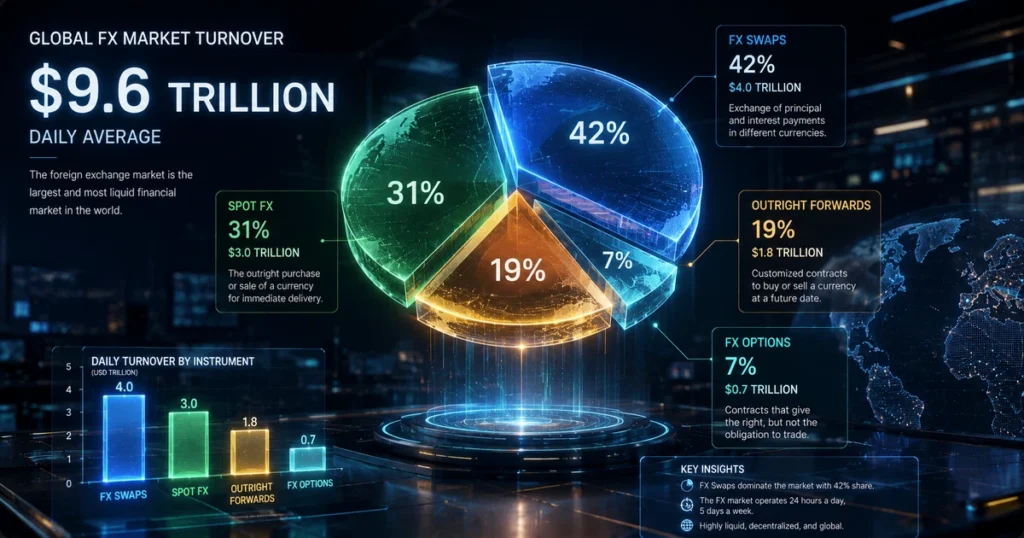
According to benchmark data from the Bank for International Settlements (BIS) Triennial Central Bank Survey, global foreign exchange market turnover averages $9.6 trillion per day.
Global FX Market Daily Turnover Distribution by Instrument:
----------------------------------------------------------------------
FX Swaps:               ~42% ($4.03 Trillion / day) [Funding & Liquidity]
Spot Transactions:      ~31% ($2.98 Trillion / day) [Immediate Delivery]
Outright Forwards:      ~19% ($1.82 Trillion / day) [Corporate Hedging]
FX Options & Others:    ~7%  ($0.67 Trillion / day) [Asymmetric Protection]
Currency Swaps:         ~2%  ($0.19 Trillion / day) [Long-Term Funding]
----------------------------------------------------------------------
*Benchmark Source: Bank for International Settlements (BIS) Triennial Survey*
CurrencyPlans View: The overwhelming institutional volume in FX Swaps and Outright Forwards (~61% combined) illustrates that the foreign exchange market functions primarily as a cross-border funding, liquidity management, and balance-sheet risk mitigation system for international banking institutions and corporate treasuries—far exceeding retail speculative volume.
How Foreign Exchange Works: The Mechanics
Foreign exchange does not trade assets in isolation. Because acquiring one currency requires tendering another, all transactions are executed as a currency pair.
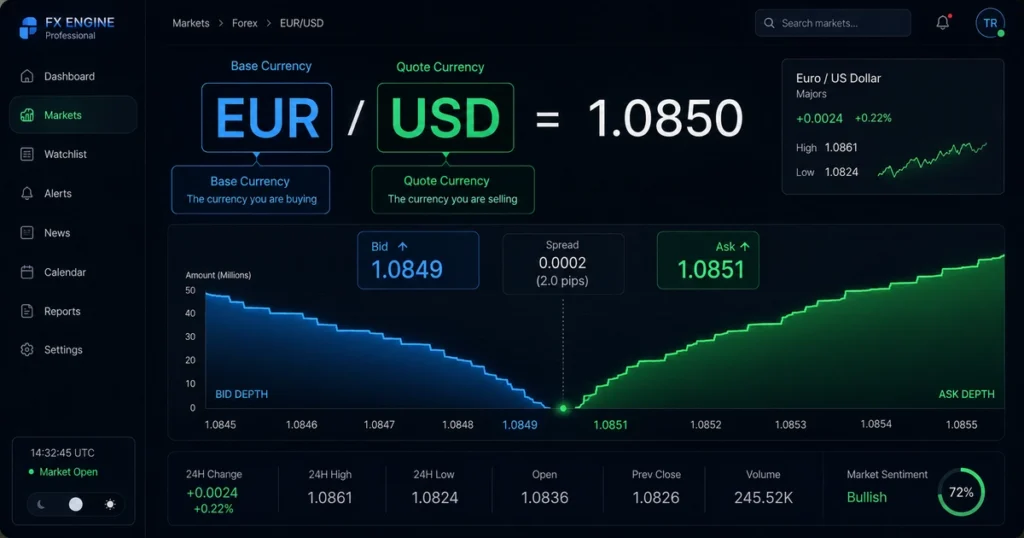
Base Currency vs. Quote Currency
Foreign exchange rates are standardized using three-letter ISO currency codes:
$$\text{EUR / USD} = 1.0850$$
- Base Currency (Left): The primary currency being purchased or sold in an exact quantity of 1 unit (here, 1 Euro).
- Quote / Term Currency (Right): The amount of secondary currency required to purchase one unit of the base currency (here, $1.0850 US Dollars).
If the quote shifts from 1.0850 to 1.0950, the Euro has appreciated (strengthened) against the Dollar because 1 Euro now purchases more Dollars. If the quote declines to 1.0750, the Euro has depreciated (weakened).
The Bid-Ask Spread and Pips Explained
In institutional and retail pricing, two prices are quoted simultaneously:
- Bid Price: The price at which market makers are prepared to buy the base currency from you.
- Ask (Offer) Price: The price at which market makers are prepared to sell the base currency to you.
- The Spread: The mathematical variance between the Ask and Bid price, serving as compensation for the liquidity provider and representing transaction friction for the buyer.
$$\text{Spread} = \text{Ask Price} – \text{Bid Price}$$
Simple Meaning Box: What Is a “Pip”?
A Pip (Percentage in Point or Price Interest Point) is the standard unit of measurement expressing the smallest conventional increment of price change in an exchange rate.
- For most currency pairs (e.g., EUR/USD, GBP/USD), 1 pip equals 0.0001 (the fourth decimal place).
- For Japanese Yen currency pairs (e.g., USD/JPY, EUR/JPY), 1 pip equals 0.01 (the second decimal place).
- Example: If GBP/USD moves from
1.2720to1.2728, the exchange rate has appreciated by 8 pips.
Structure of the Foreign Exchange Market
The global foreign exchange ecosystem functions as a multi-layered Over-the-Counter network rather than a single physical exchange floor.

+-------------------------------------------------------------------------------+
|                           TIER 1: INTERBANK MARKET                            |
| (JPMorgan, Citigroup, UBS, Deutsche Bank, HSBC, BNP Paribas, Barclays)        |
|               Matching via EBS, Refinitiv FXall, Bloomberg FIT                |
+-------------------------------------------------------------------------------+
                                       ▲
                                       │
+-------------------------------------------------------------------------------+
|                 TIER 2: INSTITUTIONAL CLIENTS & LIQUIDITY USERS               |
|      (Central Banks, Sovereign Wealth Funds, Hedge Funds, Global MNCs)        |
+-------------------------------------------------------------------------------+
                                       ▲
                                       │
+-------------------------------------------------------------------------------+
|                    TIER 3: RETAIL BROKERS & AGGREGATORS                       |
|           (Prime-of-Prime Brokers, Non-Bank Market Makers, ECNs)              |
+-------------------------------------------------------------------------------+
                                       ▲
                                       │
+-------------------------------------------------------------------------------+
|                        TIER 4: END-USERS & TRADERS                            |
|             (Retail Speculators, Small Importers/Exporters, Tourists)         |
+-------------------------------------------------------------------------------+
The Institutional Interbank Network
At the apex sits the Interbank Market, where the world’s primary commercial and investment banks exchange currency balances directly or via specialized institutional electronic communication networks (such as EBS Market and Refinitiv). Interbank ticket sizes routinely range from $5 million to $50 million+ with narrow spreads.
Continuous Global Over-the-Counter (OTC) Trading Sessions
The global FX market operates around the clock from Sunday evening through Friday evening, following the major financial-center time zones across four principal regions:
- Sydney Session (22:00–07:00 UTC): Initiates the trading week; heavy focus on AUD and NZD crosses.
- Tokyo / Asian Session (00:00–09:00 UTC): Core pricing session for JPY, AUD, SGD, and offshore Chinese Yuan (CNH).
- London / European Session (08:00–17:00 UTC): The largest trading hub by volume; creates deep liquidity during overlaps with late Tokyo and early New York sessions.
- New York / North American Session (13:00–22:00 UTC): High liquidity driven by US macroeconomic indicators, Federal Reserve monetary policy releases, and USD-denominated commodity trade settlements.
Categorization of Currency Pairs
Currencies trade across three major categories based on sovereign economic stability, institutional liquidity, and transaction volume:
1. Major Currency Pairs
Pairs comprising the US Dollar (USD) on one side paired with the currency of another major industrialized economy. According to BIS survey metrics, the US Dollar is on one side of roughly 89% of all foreign exchange transactions worldwide.
- EUR/USD: Euro vs. US Dollar (The world’s most traded currency pair according to official BIS Triennial Survey data)
- USD/JPY: US Dollar vs. Japanese Yen
- GBP/USD: British Pound vs. US Dollar (Historically designated as “Cable”)
- USD/CHF: US Dollar vs. Swiss Franc (Designated as the “Swissie”)
- AUD/USD & USD/CAD: Australian Dollar & Canadian Dollar (“Commodity Currencies”)
2. Minor and Cross-Currency Pairs
Pairs consisting of two major currencies that do not include the US Dollar.
- EUR/GBP: Euro vs. British Pound
- EUR/JPY: Euro vs. Japanese Yen
- GBP/JPY: British Pound vs. Japanese Yen (Characterized by elevated intraday price ranges)
- AUD/NZD: Australian Dollar vs. New Zealand Dollar
3. Emerging Market Exotic Pairs
A major currency paired with the currency of a developing, emerging, or smaller regional economy. Exotic pairs carry wider bid-ask spreads, lower institutional market depth, and higher sovereign policy risk.
- USD/INR: US Dollar vs. Indian Rupee
- USD/BRL: US Dollar vs. Brazilian Real
- USD/ZAR: US Dollar vs. South African Rand
- USD/TRY: US Dollar vs. Turkish Lira
Core Foreign Exchange Instruments: Spot, Forwards, Swaps & Futures
1. Spot Foreign Exchange
A spot contract is an agreement to purchase or sell a currency at the prevailing market exchange rate for near-immediate delivery (conventionally $T+2$ business days, with USD/CAD settling on $T+1$). Spot trading accounts for approximately 31% of daily global FX turnover.
2. Outright Forwards
An outright forward locks in a legally binding exchange rate today for financial settlement on a designated date in the future (such as 30, 90, or 180 days). No cash changes hands at inception. Forwards account for 19% of global turnover, serving primarily as corporate balance-sheet hedging vehicles.
3. Foreign Exchange Swaps (FX Swaps)
An FX swap consists of two simultaneous legs: exchanging one currency for another at the current spot rate, while simultaneously agreeing to reverse the transaction at a predetermined forward rate on a future date. Accounting for roughly 42% of global turnover, swaps allow institutions to source foreign currency liquidity without bearing structural currency exchange risk.
4. Currency Futures
Standardized exchange-traded derivatives traded on centralized platforms such as the Chicago Mercantile Exchange (CME). Futures specify standard contract sizes, minimum tick fluctuations, and set quarterly settlement dates.
5. Currency Options
Derivative contracts that grant the purchaser the right, but not the legal obligation, to buy (Call) or sell (Put) a designated currency pair at an agreed strike price on or before an expiration date. Options represent approximately 7% of daily market volume.
Comprehensive Institutional Comparison: FX Market Instruments
| Instrument | Trading Venue | Standard Settlement | Primary Institutional User | Counterparty Risk Profile | Contract Customization |
| Spot FX | Over-the-Counter (OTC) | Immediate ($T+1$ / $T+2$) | Commercial banks, MNCs, Traders | Low to Moderate (Bilateral bank tier) | Flexible |
| Outright Forwards | Over-the-Counter (OTC) | Future Date ($> 2$ Days) | Corporate treasurers, Exporters | Bilateral credit dependency | Fully Tailored |
| FX Swaps | Over-the-Counter (OTC) | Spot + Future Reverse Leg | Institutional asset managers, Banks | Low (CLS settlement / Collateralized) | Customized |
| Currency Futures | Centralized Exchanges | Standard Quarterly Dates | Systematic funds, Retail traders | Substantially reduced via Central Counterparty (CCP) clearing* | Highly Standardized |
| Currency Options | OTC & Listed Exchanges | At Expiration Date | Volatility funds, Corporate hedgers | Bilateral for OTC; CCP-cleared for listed | Hybrid (Custom OTC or Standard Listed) |
*Note: Central counterparty clearing substantially reduces bilateral counterparty risk, but does not eliminate all market, liquidity, margin, clearing-member, or systemic risks.
Simple Meaning Box: Purchasing Power Parity (PPP)
Purchasing Power Parity (PPP) is an economic theory stating that, absent trade barriers and transaction costs, an identical basket of goods should cost the same across two countries when priced in a shared currency. PPP helps economists evaluate long-term equilibrium exchange rate valuations versus short-term market fluctuations.
Key Macroeconomic Drivers of Exchange Rates
Exchange rates reflect changing macroeconomic fundamentals, monetary policy developments, and international capital flows:
                      ┌─────────────────────────────────────────┐
                      │    CENTRAL BANK INTEREST RATES & POLICIES│
                      └────────────────────┬────────────────────┘
                                           │
         ┌─────────────────────────────────┼─────────────────────────────────┐
         │                                 │                                 │
         ▼                                 ▼                                 ▼
┌──────────────────┐             ┌──────────────────┐             ┌──────────────────┐
│ INFLATION & PPP  │             │ CURRENT ACCOUNT  │             │ GEOPOLITICAL &   │
│  DIFFERENTIALS   │             │ & TRADE BALANCES │             │ SOVEREIGN CREDIT │
└──────────────────┘             └──────────────────┘             └──────────────────┘
- Interest-Rate Differentials & Policy Expectations: Central bank policy rates shape capital allocation. Interest-rate differentials can influence cross-border capital flows and carry-trade incentives, but exchange-rate expectations, risk premia, hedging costs, and broader market conditions also affect currency demand.
- Relative Inflation Rates: Economies exhibiting low, predictable inflation preserve purchasing power over time, typically supporting long-term currency stability compared to higher-inflation peers.
- Current Account & Balance of Trade: Persistent trade surpluses (where export revenues exceed import outlays) generate structural commercial demand for a nation’s currency.
- Sovereign Fiscal Health & Solvency: Heavy national debt burdens and fiscal deficits can increase sovereign risk premia, heighten currency volatility, and discourage long-term foreign direct investment.
- Terms of Trade: The economic ratio of export prices relative to import prices. Favorable terms of trade increase national capital inflows, supporting currency valuation.
Exchange Rate Regimes: Floating vs. Fixed vs. Managed Pegs
Sovereign central banks and finance ministries organize their domestic currencies under three structural frameworks:
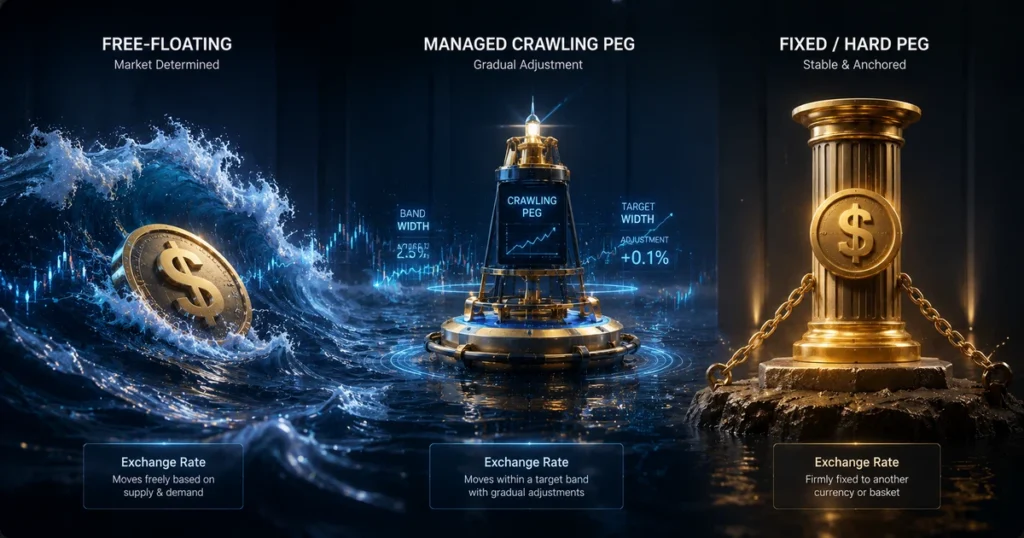
1. Free-Floating Exchange Rate
Currency values are primarily determined by market supply and demand, with exchange rates influenced by monetary policy, capital flows, trade conditions, expectations, and other market factors.
- Primary Examples: US Dollar (USD), Euro (EUR), British Pound (GBP), Japanese Yen (JPY), Australian Dollar (AUD).
2. Fixed Peg / Currency Board System
A government links its domestic currency directly to a foreign anchor currency (commonly the USD) or a basket of currencies, utilizing foreign exchange reserves to maintain the fixed rate.
- Primary Example: Hong Kong Dollar (pegged within a statutory band of 7.75–7.85 HKD per USD managed by the Hong Kong Monetary Authority).
3. Managed Float (“Crawling Peg”)
The central bank allows the currency to fluctuate within an informal target band, intervening directly in spot and forward markets when volatility threatens broader macroeconomic stability.
- Primary Examples: Indian Rupee (Reserve Bank of India market interventions), Chinese Renminbi (People’s Bank of China Daily Reference Rates).
Real-World Institutional and Corporate Case Studies
Case Study 1: Cross-Border Corporate Balance-Sheet Hedging
- Corporation: European Aerospace Manufacturer.
- Commercial Exposure: Sells aircraft priced in US Dollars ($), but pays engineering and manufacturing expenses in Euros (€).
- Currency Risk: If EUR/USD appreciates from
1.05to1.20, USD revenues translate into significantly fewer Euros, reducing operating margins. - Institutional Execution: The treasury department enters into Outright Forward Contracts locking in forward exchange rates for $1 billion in projected USD receivables over a 24-month horizon, removing currency volatility from its corporate operating budget.
Case Study 2: The Institutional Currency Carry Trade
- Market Participant: Global Macro Asset Management Fund.
- Mechanism: The fund borrows capital in a low-interest-rate currency (e.g., funding via JPY at 0.25% base rate) and deploys that capital into sovereign debt instruments of a higher-yielding economy (e.g., US Treasury notes yielding 4.25%).
- Economic Trade-Off: The investor collects the positive interest rate differential (the net carry), while accepting the structural market risk that an appreciation in the funding currency or unexpected volatility shifts could erode returns.
Opportunities & Advantages of Foreign Exchange Markets
- Unrivaled Liquidity: High order execution speed and minimal price slippage on major currency pairs, even during large institutional transactions.
- Two-Way Market Flexibility: Participants can take long positions (anticipating appreciation) or short positions (anticipating depreciation) without the borrowing constraints often found in stock short-selling.
- Continuous Global Access: The global FX market operates around the clock from Sunday evening through Friday evening, giving market participants uninterrupted capacity to respond to international developments.
- Tight Transaction Spreads: Intense competition among Tier-1 interbank market makers keeps bid-ask spreads narrow on major currency pairs.
- Versatile Corporate Risk Management: Comprehensive forward and options structures allow multinational corporations to stabilize international supply chains and operational budgets.
Risks, Limitations, and Structural Realities
Engaging in the foreign exchange market requires managing several unique financial and structural risks:
- Excessive Leverage & Margin Liquidation (Retail FX): In retail derivative trading, brokers frequently offer leverage ratios ranging from 1:30 to 1:500. While leverage amplifies nominal trade size, minor adverse market moves can cause rapid capital loss.
- Macroeconomic Shocks & Flash Liquidity Events: Sudden policy shifts by central banks (such as unexpected rate hikes or currency floor removals) can cause rapid price gaps and temporary liquidity shortfalls.
- Decentralized Counterparty & Brokerage Risk: In Over-the-Counter trading, the safety of funds depends on counterparty solvency and regulatory compliance. Operating with unregulated entities introduces serious counterparty default risk.
- Multifactor Analytical Complexity: Forecasting exchange rate movements requires analyzing central bank policies, sovereign yield curves, inflation metrics, trade flows, and geopolitical dynamics simultaneously.
Frequently Asked Questions (FAQs)
1. What is the difference between Forex and the Stock Market?
Stock markets trade equity shares of individual publicly listed companies on centralized national exchanges (e.g., NYSE, LSE, NSE) during set regional trading hours. The foreign exchange market trades sovereign currency pairs over-the-counter across a decentralized global banking network running continuously from Sunday evening through Friday evening.
2. Who is the largest participant in the foreign exchange market?
Commercial and investment banks (such as JPMorgan Chase, Citigroup, UBS, and Deutsche Bank) handle the largest volume via the interbank market. Central banks (such as the Federal Reserve, the European Central Bank, and the Bank of Japan) exert the greatest structural influence through monetary policy, interest-rate decisions, and direct foreign exchange interventions.
3. What is the most traded currency pair globally?
According to official Bank for International Settlements (BIS) Triennial Survey data, the US Dollar–Euro (EUR/USD) pair remains the world’s most traded currency pair, followed by USD/JPY and GBP/USD.
4. Can an investor lose more than their initial deposit in FX trading?
In physical cash foreign exchange, losses are limited to changes in purchasing power. However, in leveraged derivative products (such as margin FX or CFDs), rapid market moves can lead to losses that exceed initial capital unless the broker operates under a regulatory regime that mandates Negative Balance Protection.
5. Why is the US Dollar involved in nearly 90% of global FX transactions?
The US Dollar functions as the primary international reserve currency, the main pricing denomination for global commodities (including crude oil and gold), and the leading vehicle currency for international trade invoicing and cross-border bank settlements.
Conclusion
Foreign exchange is more than a trading arena—it is the foundational plumbing of international commerce and global finance. From multinational enterprises managing cross-border supply chains to sovereign central banks maintaining reserve stability and institutional funds managing macro portfolios, the FX market provides essential liquidity, pricing, and risk management tools.
Understanding the mechanics of currency pricing, market structure, and macroeconomic catalysts enables market participants and corporate treasurers to navigate global capital markets with precision and confidence.
Next Reading Suggestions
To build your expertise in macroeconomic analysis and institutional currency strategies, explore our related guides:
- [Understanding Interest Rate Parity and Institutional FX Carry Trades]
- [Central Bank Interventions: Mechanics of Sovereign Currency Management]
- [Spot vs. Forwards vs. Futures: Selecting the Optimal Hedging Instrument]
- [The Structural Role of the US Dollar as the Global Anchor Reserve Currency]
Author Box & E-E-A-T Verification
Written By: CurrencyPlans Financial Research Team
Fact-Checked & Reviewed By: Senior Institutional Market Analyst & FX Strategist
Editorial Integrity & Research Standards: CurrencyPlans publishes research grounded in verifiable macroeconomic data. Global turnover statistics, reserve allocations, and regulatory disclosures are cross-referenced with primary multilateral institutions including the Bank for International Settlements (BIS), the International Monetary Fund (IMF), and sovereign central banks.
Institutional References & Official Resources
For primary data on global market turnover, central bank reserve assets, and international regulatory frameworks, consult official institutional sources:
- Global Market Turnover & Derivatives Data: Bank for International Settlements (BIS) Triennial Central Bank Survey
- Global Official Foreign Exchange Reserves (COFER Data): International Monetary Fund (IMF) Currency Composition of Official Foreign Exchange Reserves
- Monetary Policy Frameworks & FX Operations: Board of Governors of the Federal Reserve System Foreign Exchange Rates & Data
- European Exchange Rate & Reserve Management: European Central Bank (ECB) Euro Foreign Exchange Reference Rates
- UK FX Market Governance & Oversight: Bank of England (BoE) Foreign Exchange Joint Standing Committee
Educational Disclaimer
This guide is prepared strictly for educational, informational, and research purposes and does not constitute financial, investment, legal, or tax advice. Foreign exchange and leveraged currency instruments carry substantial risk of capital loss and are not suitable for all investors. Always perform independent due diligence and consult a licensed financial advisor before allocating capital to financial markets.

