
Executive Summary & Core Thesis
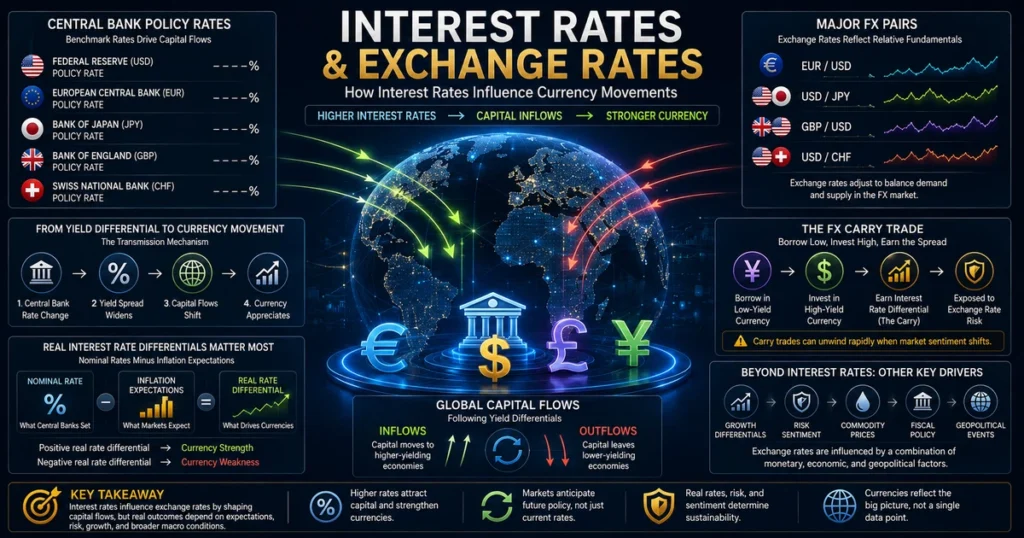
Interest rates and exchange rates form one of the most influential pricing relationships in global financial markets. Benchmark policy interest rates determine the yield on short-term deposits and sovereign bonds, directly guiding multi-trillion-dollar cross-border capital flows. In international finance, higher relative interest rates can support currency appreciation by attracting global investment capital seeking higher yields, provided inflation expectations remain anchored and credit risk is contained. Conversely, unexpected policy rate cuts or widening negative yield differentials can prompt capital reallocation and downward currency pressure. Across market horizons, this dynamic is formalized through Covered and Uncovered Interest Rate Parity, executed through institutional Currency Carry Trades, and continuously modulated by Real (inflation-adjusted) Interest Rate Differentials.
1. The Macroeconomic Core: Why Interest Rates Drive Currency Markets
In global capital markets, money is dynamic and mobile. Institutional asset managers, sovereign wealth funds, multinational bank treasuries, and hedge funds continuously scan the international landscape to allocate capital toward the most attractive risk-adjusted real yields.
The primary mechanism establishing these yields is the benchmark interest rate set by sovereign central banks. When central banks shift their monetary policy stance, they alter the relative return profile of an entire economy’s sovereign debt and money-market instruments:
| Time Horizon | Dominant Market Catalyst | Primary Exchange Rate Channel |
| Short-Term (Intraday to Weeks) | Central Bank Announcements & Forward Guidance Surprises | Policy rate expectations and repricing of short-end swap curves |
| Medium-Term (Months to Quarters) | Sovereign Bond Yield Spreads & The FX Carry Trade | Cross-border capital reallocation seeking positive net carry |
| Long-Term (Multi-Year Cycles) | Real Interest Rate Differentials & Macroeconomic Balances | Structural real exchange rate adjustments and balance-of-payments financing |
Because currencies trade in pairs (such as EUR/USD or USD/JPY), currency valuations depend not on the absolute level of domestic interest rates, but on the interest rate differential—the spread between the base currency’s rate and the quote currency’s rate.
2. The Core Transmission Mechanism: Yield Spreads to Capital Flows
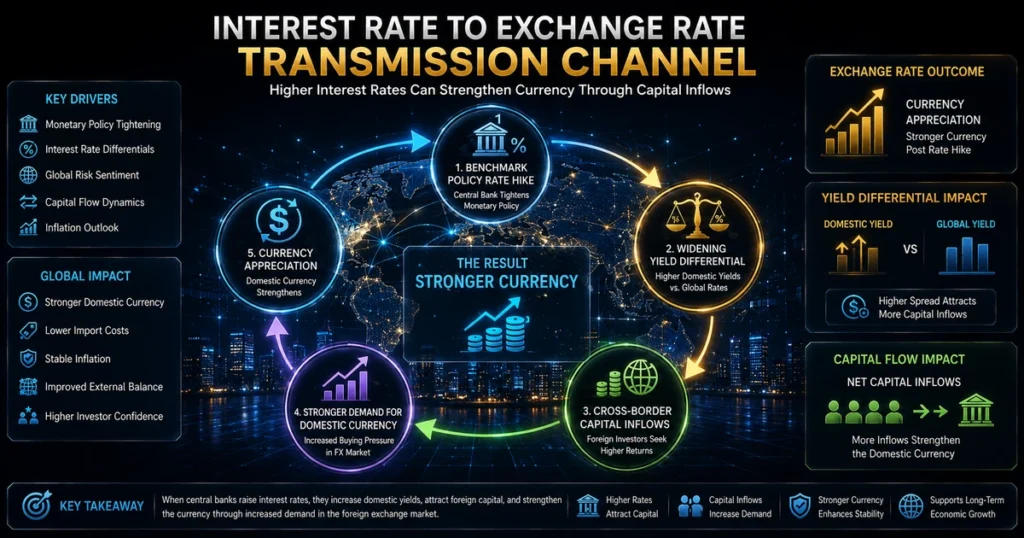
The economic pathway connecting a central bank interest rate decision to an open-market exchange rate adjustment operates through a clear transmission sequence:
                      ┌─────────────────────────────────────────┐
                      │    CENTRAL BANK RAISES POLICY RATE      │
                      └────────────────────┬────────────────────┘
                                           │
                           (Widens Sovereign Yield Spread)
                                           ▼
                      ┌─────────────────────────────────────────┐
                      │  DOMESTIC FIXED-INCOME YIELDS INCREASE  │
                      └────────────────────┬────────────────────┘
                                           │
                           (Attracts Cross-Border Capital)
                                           ▼
                      ┌─────────────────────────────────────────┐
                      │  INCREASED DEMAND FOR DOMESTIC CURRENCY │
                      └────────────────────┬────────────────────┘
                                           │
                             (Open-Market FX Execution)
                                           ▼
                      ┌─────────────────────────────────────────┐
                      │      DOMESTIC CURRENCY APPRECIATES      │
                      └─────────────────────────────────────────┘
- Monetary Tightening: A central bank raises its policy interest rate to manage domestic inflation or normalize policy settings.
- Sovereign Yield Spread Expansion: Short-term government bond yields, commercial paper rates, and interbank deposit rates rise relative to foreign trading partners.
- Cross-Border Capital Inflows: International portfolio investors and sovereign entities convert foreign holdings into the domestic currency to buy higher-yielding sovereign debt or deposit instruments.
- Exchange Rate Pressure: The increased transactional demand for the domestic currency creates upward pressure on its exchange rate in open, floating foreign exchange markets.
Crucial Macroeconomic Qualification: This transmission mechanism functions as described provided that inflation expectations remain anchored, sovereign credit risk is stable, and international risk appetite is supportive. If rate hikes are driven by panic over fiscal instability or unanchored inflation, the currency may face selling pressure despite higher nominal rates.
3. Interest Rate Parity: Covered vs. Uncovered Frameworks
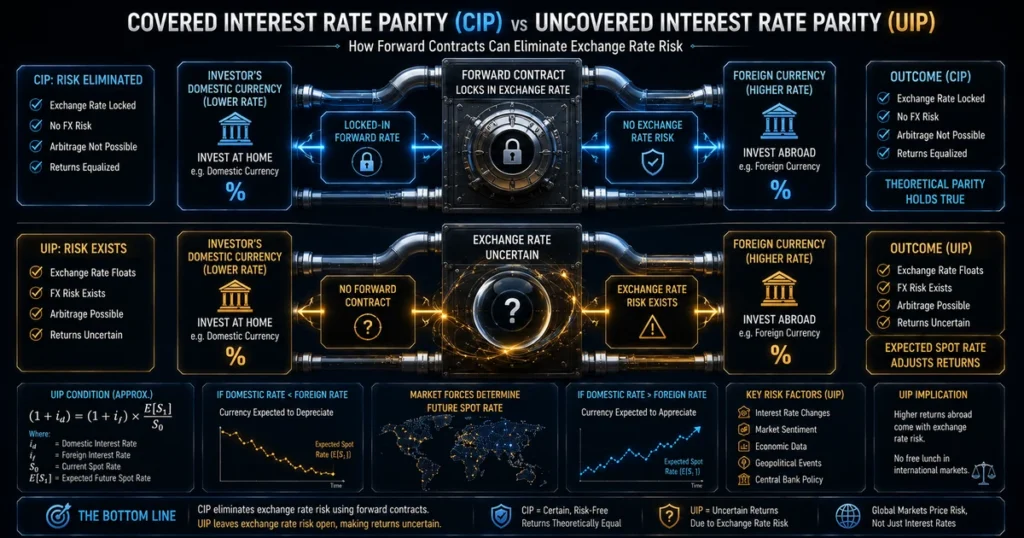
The cornerstone theoretical framework connecting interest rates to foreign exchange pricing is the concept of Interest Rate Parity (IRP). It exists in two distinct institutional forms:
Covered Interest Rate Parity (CIRP)
Covered Interest Rate Parity (CIRP) establishes a no-arbitrage relationship between spot and forward exchange rates and the interest rates of two currencies for the same maturity. Under standard simple-interest assumptions, the forward/spot ratio reflects the corresponding interest-rate differential:
$$\left(1 + i_{\text{Domestic}} \times \tau\right) = \frac{F}{S} \left(1 + i_{\text{Foreign}} \times \tau\right)$$
Where $S$ is the spot exchange rate, $F$ is the forward exchange rate, $i_{\text{Domestic}}$ and $i_{\text{Foreign}}$ are the respective interest rates, and $\tau$ represents the applicable year fraction under the relevant money-market day-count convention.
- Institutional Application: CIRP forms the mathematical basis for pricing forward foreign exchange contracts and currency swaps. When market participants use forward contracts to lock in exchange rates, any deviation creates an arbitrage opportunity that interbank dealers quickly trade away under normal financial conditions.
Uncovered Interest Rate Parity (UIP)
Uncovered Interest Rate Parity assumes that investors do not hedge foreign currency risk using forward contracts. Instead, it posits that the expected change in the spot exchange rate over the investment horizon will offset the interest rate differential between two currencies:
$$\frac{E\left(S_{t+k}\right) – S_t}{S_t} \approx i_{\text{Domestic}} – i_{\text{Foreign}}$$
Where $E(S_{t+k})$ is the expected future spot exchange rate.
- Empirical Reality & The Forward Rate Puzzle: In open financial markets, Uncovered Interest Rate Parity often fails to hold over short-to-medium horizons. Rather than depreciating as UIP predicts, high-yielding currencies frequently appreciate or remain stable for extended periods because global capital flows chase higher returns, giving rise to the FX Carry Trade.
4. The Forward Exchange Rate Formula & Forward Points
Because of Covered Interest Rate Parity, forward pricing reflects relative interest rate differentials across currencies.
The Forward Pricing Equation:
$$F = S \times \left( \frac{1 + i_{\text{Domestic}} \times \tau_{\text{Domestic}}}{1 + i_{\text{Foreign}} \times \tau_{\text{Foreign}}} \right)$$
Where $\tau$ represents the applicable year fraction under the relevant money-market day-count convention (such as Actual/360 or Actual/365).
Forward Points and Quotation Mechanics:
$$\text{Forward Points} = F – S$$
Forward Points are the difference between the forward and spot exchange rates ($F – S$). Their sign and the interpretation of a forward premium or discount depend on the currency quotation convention. Under Covered Interest Rate Parity, the currency with the higher interest rate generally trades at a forward discount relative to the lower-interest-rate currency.
Practical Example (180-Day Tenor, 360-Day Count Basis): Assume spot EUR/USD ($S$) is 1.0800. The US dollar interest rate ($i_{\text{USD}}$) is 5.00\%, and the euro interest rate ($i_{\text{EUR}}$) is 3.00\%.
- $\tau = \frac{180}{360} = 0.5$
- $F = 1.0800 \times \left( \frac{1 + 0.05 \times 0.5}{1 + 0.03 \times 0.5} \right) = 1.0800 \times \left( \frac{1.025}{1.015} \right) \approx 1.0906$
- $\text{Forward Points} = 1.0906 – 1.0800 = +0.0106 \text{ (or } +106 \text{ pips)}$
In this quotation format, the forward rate ($F$) is higher than the spot rate ($S$), reflecting the lower euro interest rate and balancing returns to prevent risk-free cross-border arbitrage.
5. The FX Carry Trade: Mechanics, Yields, and Liquidation Traps
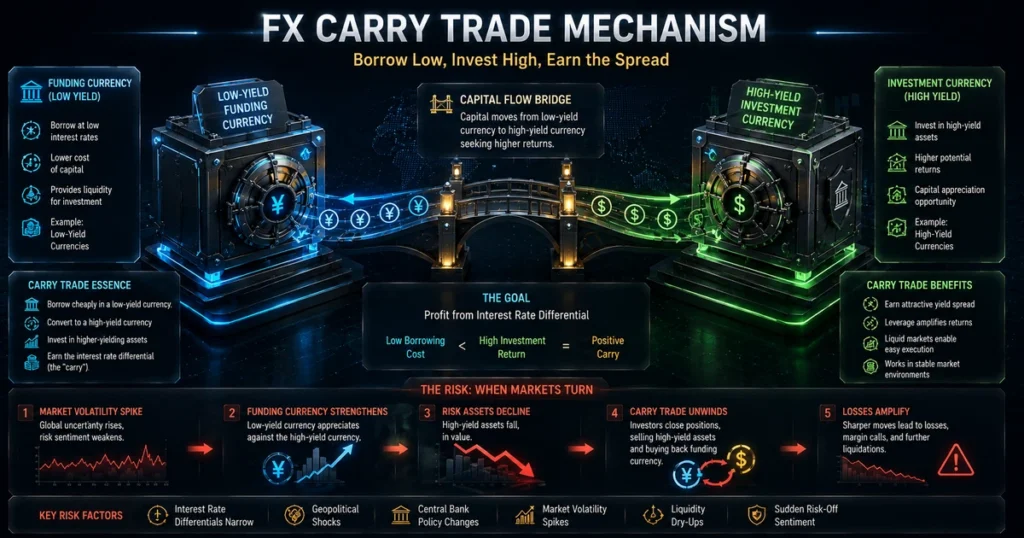
The systematic divergence from Uncovered Interest Rate Parity enables one of the most prominent institutional strategies in global foreign exchange: the FX Carry Trade.
+-------------------------------------------------------------------------------+
|                       THE DYNAMICS OF AN FX CARRY TRADE                       |
+-------------------------------------------------------------------------------+
|  1. Investor borrows in a low-interest-rate currency (e.g., JPY)              |
|     ▼                                                                         |
|  2. Converts borrowed funds into a high-interest-rate currency (e.g., USD)    |
|     ▼                                                                         |
|  3. Invests in high-yielding short-term sovereign debt / deposits             |
|     ▼                                                                         |
|  4. Captures the net interest rate spread (the "Carry")                       |
|     ▼                                                                         |
|  [Risk Exposure: Sudden appreciation in the funding currency or market shock] |
+-------------------------------------------------------------------------------+
The Mechanism of the Carry Trade
- Funding Currency: A currency characterized by low interest rates, high domestic liquidity, and accommodative central bank policy (historically the Japanese Yen or Swiss Franc).
- Target Currency: A currency offering elevated benchmark interest rates (such as the US Dollar, Mexican Peso, or Australian Dollar during rate-expansion cycles).
- Profit Formula: Net Carry = $\text{Yield}_{\text{Target}} – \text{Borrowing Cost}_{\text{Funding}} \pm \text{Spot FX Price Movement}$.
The Structural Risk: The Carry Unwind Trap
The carry trade is asymmetrical: it tends to generate steady returns during low-volatility, stable market environments, but faces sharp tail-risk drawdowns when market conditions shift.
When global market volatility spikes, when central banks unexpectedly narrow interest rate differentials, or when risk aversion rises, carry trade participants simultaneously liquidate target positions and buy back the funding currency to close their debt obligations.
This coordinated exit triggers rapid appreciation in the funding currency and sharp depreciation in the target currency—a dynamic known as a Carry Trade Unwind.
6. Multi-Variable Interaction Matrix: Rate Shifts Across Economic Regimes
The impact of central bank interest rate adjustments on exchange rates depends heavily on broader macroeconomic conditions:
| Macroeconomic Environment | Central Bank Action | Primary Currency Response | Structural Transmission Catalyst |
| Anchored Inflation / Stable Growth | Policy Rate Hike | Currency Appreciation | Widening real yield spread attracts institutional capital inflows. |
| High / Unanchored Inflation | Policy Rate Hike | Mixed / Neutral | Rate hike may be viewed as insufficient if real interest rates remain negative. |
| Severe Domestic Recession | Policy Rate Cut | Currency Depreciation | Lower asset yields encourage capital allocation to foreign markets. |
| Global Financial Crisis / Panic | Policy Rate Cut (Safe-Haven) | Safe-Haven Appreciation | Capital flows into deep, liquid markets (e.g., USD, CHF) regardless of low yields. |
| Fiscal Deficit / Debt Sustainability Concern | Emergency Rate Hike | Potential Depreciation | Markets interpret emergency rate hikes as signs of structural fiscal stress. |
| Forward Market Pricing | High-Interest vs. Low-Interest Currency | Forward Discount / Premium | Higher-rate currency generally trades at a forward discount relative to the lower-rate currency. |
7. The Fisher Effect: Real vs. Nominal Interest Rate Differentials
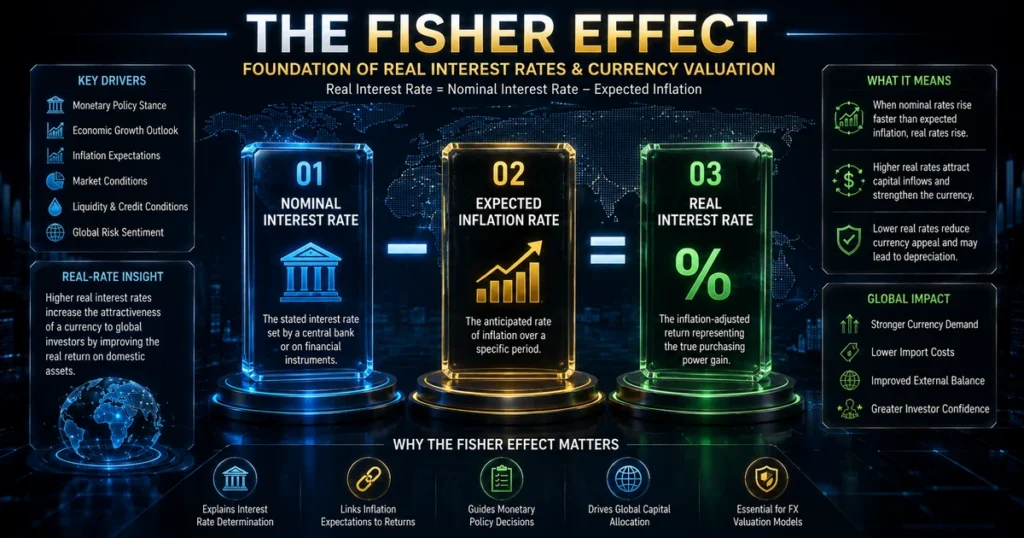
A common misconception in retail market analysis is that high nominal interest rates automatically produce a strong currency. Institutional macro analysis relies instead on the Fisher Effect and Real Interest Rate Differentials.
The Fisher Equation:
$$r \approx i – \pi^e$$
Where $r$ is the real interest rate, $i$ is the nominal interest rate, and $\pi^e$ is expected inflation.
The Real Interest Rate Differential ($\Delta r$):
$$\Delta r = \left(i_{\text{Domestic}} – \pi^e_{\text{Domestic}}\right) – \left(i_{\text{Foreign}} – \pi^e_{\text{Foreign}}\right)$$
Nominal vs. Real Yield Comparison:
-----------------------------------------------------------------
Country A: Nominal Rate = 10.0%  |  Expected Inflation = 12.0% |  Real Yield = -2.0%
Country B: Nominal Rate =  4.0%  |  Expected Inflation =  1.5% |  Real Yield = +2.5%
-----------------------------------------------------------------
Macro Takeaway: Even though Country A offers a nominal rate of 10%, its real rate
is approximately -2%, while Country B offers an estimated real rate of +2.5%.
Higher expected real returns can support capital inflows, but actual exchange-rate
outcomes also depend on risk premia, liquidity, growth expectations, fiscal conditions,
and expected currency movements.
International investors often consider expected real returns when allocating capital across currencies. Positive real interest-rate differentials can support capital inflows, but actual currency performance also depends on exchange-rate expectations, risk premia, liquidity, growth prospects, fiscal conditions, and broader market sentiment.
8. Empirical Macro Case Dissections: Global Rate Cycles & Divergences
Dissection 1: The Federal Reserve Aggressive Tightening Cycle (2022–2024)
- Macroeconomic Context: Confronted with elevated inflation, the US Federal Reserve initiated one of the fastest monetary tightening cycles in modern history, raising the federal funds target range from
0–0.25\%to5.25–5.50\%. - Transmission Dynamics: As US short-term and long-term bond yields rose faster than those in the Eurozone and Japan, the real interest rate differential widened significantly in favor of the US Dollar.
- Exchange Rate Outcome: The US Dollar Index (DXY) rallied to multi-decade highs, supported by wider US interest-rate differentials, relatively strong US economic conditions, and periods of broader safe-haven demand
Dissection 2: The Bank of Japan Negative Interest Rate Regime and the Yen
- Macroeconomic Context: During 2022–early 2024, while many major central banks were raising interest rates rapidly, the Bank of Japan maintained a negative policy rate of
-0.10\%and its Yield Curve Control framework. The BOJ ended both frameworks in March 2024 as it shifted to short-term interest-rate guidance as its primary policy tool. - Transmission Dynamics: The yield spread between the US 10-year Treasury note and the Japanese 10-year government bond widened to several hundred basis points, creating an incentive for institutional and retail carry trade operations.
- Exchange Rate Outcome: The Japanese Yen depreciated significantly against the US Dollar and Euro, moving from approximately
¥115per USD to over¥160per USD before policy normalization and market repricing emerged.
Dissection 3: The Swiss National Bank Policy Normalization
- Macroeconomic Context: The Swiss National Bank (SNB) navigated historical negative policy rates (reaching
-0.75\%to reduce the attractiveness of CHF investments) before raising rates back into positive territory during 2022–2023. - Transmission Dynamics: Switzerland’s structurally low domestic inflation meant that even modest nominal policy adjustments produced stable real yields relative to European peers.
- Exchange Rate Outcome: The Swiss Franc experienced periods of appreciation against major currencies despite deeply negative policy rates, illustrating that safe-haven demand, current-account conditions, inflation differentials, and capital flows can sometimes outweigh the direct effect of interest-rate differentials.
9. Central Bank Communication, Forward Guidance, and Rate Expectations
In modern foreign exchange markets, exchange rates adjust not only when a central bank formally changes policy rates, but whenever market expectations of future rates change.
                      ┌─────────────────────────────────────────┐
                      │    CENTRAL BANK FORWARD GUIDANCE        │
                      └────────────────────┬────────────────────┘
                                           │
                        (Shifts Market-Implied Rate Curves)
                                           ▼
                      ┌─────────────────────────────────────────┐
                      │   OVERNIGHT INDEX SWAP (OIS) PRICING    │
                      └────────────────────┬────────────────────┘
                                           │
                         (Instantaneous Market Repricing)
                                           ▼
                      ┌─────────────────────────────────────────┐
                      │    IMMEDIATE SPOT EXCHANGE RATE MOVE    │
                      └────────────────────┬────────────────────┘
- Forward Guidance & Dot Plots: Central bank press conferences, economic projections, and policy statements signal the future trajectory of interest rates over upcoming quarters.
- Overnight Index Swap (OIS) Pricing: Institutional derivatives markets continuously price the probability of upcoming central bank rate hikes or cuts.
- Instantaneous Exchange Rate Adjustment: Spot foreign exchange rates move immediately when incoming economic data (such as inflation or employment reports) shifts market expectations of future central bank policy, often well before an actual rate adjustment occurs.
10. Institutional FX Risk Management Under Changing Rate Environments
Corporate treasuries and institutional asset managers deploy specialized strategies to manage the foreign exchange risks associated with shifting interest rate cycles:
- FX Forwards & Swaps: Corporate treasuries use FX forwards to lock exchange rates for future cash flows, while FX swaps can be used to manage short-term currency funding, liquidity, and rollover requirements.
- Cross-Currency Basis Swaps: Sourcing funding in one currency while managing long-term foreign currency debt exposure through institutional swap markets.
- Dynamic Currency Overlay Strategies: Adjusting hedge ratios based on interest rate differentials, increasing hedge protection on high-rate currencies vulnerable to carry unwinds while managing lower-cost hedges on low-rate currencies.
- Volatility Hedging via FX Options: Purchasing structured foreign exchange options (such as Collars or Put Options) to protect against tail-risk volatility during major central bank policy transition periods.
11. Frequently Asked Questions (Institutional FAQ)
How does an interest rate increase typically affect a currency’s exchange rate?
An increase in a central bank’s policy rate generally raises yields on domestic fixed-income and money-market assets. If domestic inflation expectations remain well-anchored and sovereign credit conditions are stable, the wider interest rate differential can attract international capital inflows, creating upward market support for the domestic currency.
What is the role of real interest rate differentials in currency valuation?
Real interest-rate differentials compare inflation-adjusted returns across currencies. They can influence international capital allocation, but investors also consider exchange-rate expectations, credit risk, liquidity, growth prospects, and broader market conditions.
Why does Uncovered Interest Rate Parity (UIP) often fail in practice?
Uncovered Interest Rate Parity predicts that high-interest-rate currencies will depreciate to offset their yield advantage. In practice, UIP frequently fails over short-to-medium horizons because global investors actively chase positive yield differentials through carry trades, creating ongoing buying pressure on high-rate currencies until market volatility or risk conditions reverse.
What is an FX Carry Trade unwind?
An FX carry trade unwind occurs when market volatility rises or interest rate spreads narrow, prompting investors holding high-yielding target currencies to rapidly sell those assets and buy back the low-yielding funding currency to repay their loans. This simultaneous exit causes sharp appreciation in the funding currency and sudden depreciation in the target currency.
What are Forward Points in foreign exchange trading?
Forward Points are the difference between the forward and spot exchange rates ($F – S$). Their sign and the interpretation of a forward premium or discount depend on the currency quotation convention. Under Covered Interest Rate Parity, the currency with the higher interest rate generally trades at a forward discount relative to the lower-interest-rate currency.
12. Strategic Summary & Institutional Takeaways
The dynamic between interest rates and exchange rates forms the primary transmission mechanism for global capital allocation and sovereign currency valuation.
While central bank benchmark rate increases can provide strong structural support for a currency by expanding interest rate differentials, exchange rate outcomes are fundamentally governed by real yields, inflation expectations, forward market pricing, and global risk appetite. Furthermore, structural market strategies like the FX carry trade illustrate how interest rate spreads shape real-world foreign exchange liquidity and volatility.
By evaluating both nominal and real yield differentials, monitoring central bank communication, and understanding the mechanics of Interest Rate Parity, corporate leaders, macro analysts, and investors can better interpret currency trends and manage cross-border financial risk.
13. Next Reading Suggestions
- [Understanding Covered and Uncovered Interest Rate Parity in Practice]
- [Central Bank Forward Guidance: How Monetary Policy Expectations Move Markets]
- [The Mechanics and Tail Risks of Global FX Carry Trade Strategies]
- [Real Effective Exchange Rates (REER): Measuring True Trade Competitiveness]
14. Author Box & E-E-A-T Verification
Written By: CurrencyPlans Financial Research Team
Fact-Checked & Reviewed By: Senior Institutional Market Analyst & FX Strategist
Editorial Integrity & Research Standards: CurrencyPlans publishes institutional-grade research grounded in verified macroeconomic data. All exchange rate frameworks, yield analytics, and central bank policy metrics are cross-referenced with primary multilateral institutions including the International Monetary Fund (IMF), the Bank for International Settlements (BIS), and sovereign central banks.
Institutional References & Official Resources
For primary central bank policy rates, foreign exchange turnover data, and macroeconomic research, consult official institutional sources directly:
- Global FX Turnover & Derivatives Statistics: Bank for International Settlements (BIS) Triennial Central Bank Survey
- International Financial Statistics & Monetary Policy Data: International Monetary Fund (IMF) Data Portal
- US Monetary Policy & Policy Implementation: Board of Governors of the Federal Reserve System Policy Tools
- Euro Area Monetary Policy & Decisions: European Central Bank (ECB) Monetary Policy Decisions
- Monetary Policy Frameworks & Interest Rate Data: Bank of Japan (BOJ) Monetary Policy
- Swiss Monetary Policy & Exchange Rate Assessments: Swiss National Bank (SNB) Monetary Policy
Educational Disclaimer
This guide is prepared strictly for educational, informational, and research purposes and does not constitute financial, investment, legal, or tax advice. Foreign exchange rates, benchmark interest rates, and yield spreads fluctuate based on global economic conditions. Always perform independent due diligence and consult a licensed financial advisor before making international financial commitments.

