
Featured Snippet
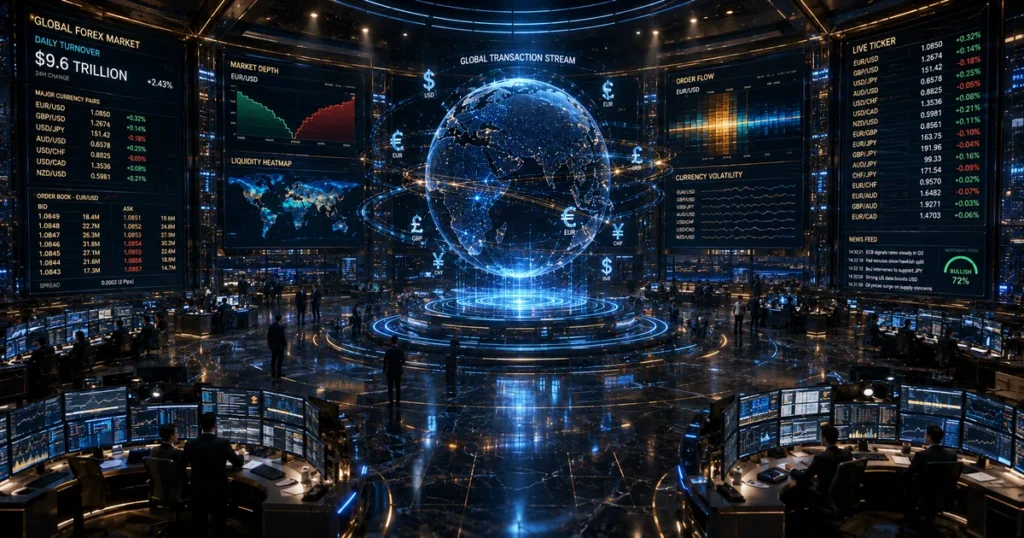
The Global Forex Market is the decentralized international network for pricing, exchanging, and settling national currencies. With daily trading volume exceeding $9.6 trillion, it is the largest, most liquid financial ecosystem on Earth. Operating around the clock from Sunday evening through Friday evening across financial hubs including London, New York, Singapore, and Tokyo, the global forex market underpins international trade, cross-border corporate investments, sovereign monetary policy, and macro currency speculation.
Key Takeaways
- Unmatched Financial Scale: Daily volume exceeds $9.6 trillion, according to data from the Bank for International Settlements (BIS).
- Continuous Global Operations: The global FX market operates around the clock from Sunday evening through Friday evening, following major financial-center time zones across Asia-Pacific, Europe, and North America.
- Two-Sided Currency Pricing: Every trade involves the simultaneous purchase of one currency and sale of another within a standardized pair (e.g., EUR/USD, USD/JPY).
- The Dollar’s Structural Anchor: The US Dollar participates in approximately 89.2% of all global foreign exchange transactions.
- Dominance of Institutional Derivatives: FX Swaps (~42%) and Outright Forwards (~19%) make up the majority of global volume, serving institutional balance-sheet funding and corporate risk hedging.
- Multifactor Macro Drivers: Exchange rates fluctuate based on central bank monetary policies, interest-rate differentials, inflation rates, current account balances, and geopolitical stability.
Introduction: The Epicenter of Global Capital
Every cross-border transaction in the modern economy connects directly to the global forex market.
When an American retailer purchases consumer electronics manufactured in South Korea, when a Japanese pension fund invests in Australian sovereign debt, or when a multinational energy corporation settles a crude oil cargo in US Dollars, national currencies must be priced and converted.
Unlike equity markets that rely on physical or centralized exchange venues—such as the New York Stock Exchange (NYSE) or London Stock Exchange (LSE)—the global forex market operates as a decentralized, Over-the-Counter (OTC) network. It links central banks, multinational commercial banks, institutional asset managers, sovereign wealth funds, corporate treasuries, and retail brokerages into an unbroken international financial system.
Understanding how the global forex market functions provides essential perspective on how capital flows across borders, how exchange rates are set, and how macroeconomic developments shape international financial markets.
CurrencyPlans Market Insight: Global FX Turnover in Numbers
Global Macro & Institutional Architecture
Benchmark data from the Bank for International Settlements (BIS) Triennial Central Bank Survey illustrates the concentration and distribution of the global forex market:
Global FX Daily Turnover Breakdown ($9.6 Trillion Total):
-------------------------------------------------------------------------
1. FX Swaps:               ~42% ($4.03 Trillion / day)  [Bank Funding & Hedging]
2. Spot Transactions:      ~31% ($2.98 Trillion / day)  [Immediate Settlement]
3. Outright Forwards:      ~19% ($1.82 Trillion / day)  [Corporate Hedging]
4. FX Options:             ~7%  ($0.67 Trillion / day)  [Asymmetric Protection]
5. Currency Swaps:         ~2%  ($0.19 Trillion / day)  [Long-Term Debt Funding]
-------------------------------------------------------------------------
Geographic Turnover Concentration:
* The United Kingdom, United States, Singapore, and Hong Kong SAR together
  accounted for approximately 75% of global FX trading on a net-gross basis.
* Singapore alone reached 11.8% of global turnover.
------------------------------------------------------------------------

*Benchmark Data Source: Bank for International Settlements (BIS) Triennial Survey*
------------------------------------------------------------------------

Note: Percentages are rounded and may not sum exactly to 100%
CurrencyPlans View: The concentration of volume in major international financial centers and the dominance of FX Swaps and Outright Forwards (~61% combined) illustrate that the foreign exchange market functions primarily as a cross-border funding, liquidity management, and balance-sheet risk mitigation system for international banking institutions and corporate treasuries.
How Currencies Are Priced on the World Stage
In foreign exchange, money is both the asset being traded and the medium used to purchase it. As a result, currencies are priced in relative currency pairs.
The Mechanics of Currency Pairs
Every global exchange quotation uses three-letter ISO currency codes:
$$\text{GBP / USD} = 1.2850$$
- Base Currency (Left): The primary currency being purchased or sold in a unit of 1 (here, 1 British Pound).
- Quote / Term Currency (Right): The amount of secondary currency required to acquire one unit of the base currency (here, $1.2850 US Dollars).
If market conditions cause the exchange rate to rise to 1.2950, the British Pound has appreciated against the Dollar. If the rate falls to 1.2750, the Pound has depreciated.
Pricing Precision: Bid, Ask, Spreads, and Pips
Global market makers quote two concurrent prices for any currency pair:
- Bid Price: The highest price the market maker will pay to buy the base currency from you.
- Ask (Offer) Price: The lowest price the market maker will accept to sell the base currency to you.
- The Spread: The difference between Ask and Bid, representing market-maker compensation and transaction costs.
$$\text{Spread} = \text{Ask Price} – \text{Bid Price}$$
Simple Meaning Box: What Is a Pip and a Fractional Pipette?
A Pip (Percentage in Point) is the standard unit used to measure changes in an exchange rate.
- For most currency pairs, 1 pip equals 0.0001 (the fourth decimal place).
- For Japanese Yen pairs, 1 pip equals 0.01 (the second decimal place).
- Institutional pricing often adds a 5th decimal place (0.00001), called a Pipette or fractional pip, allowing for tighter spreads during high-liquidity market sessions.
The Continuous Global Trading Architecture
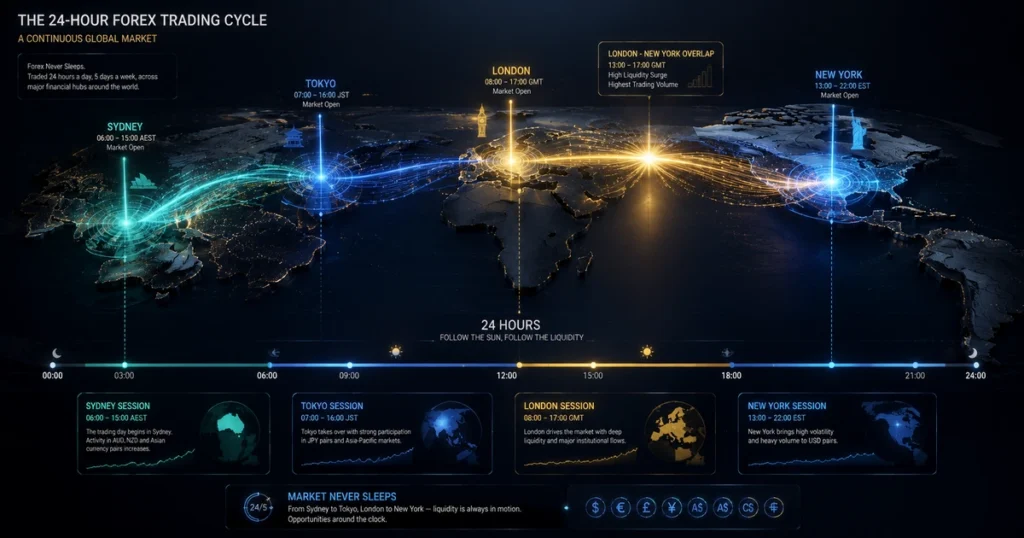
The global FX market operates around the clock from Sunday evening through Friday evening, following the major financial-center time zones.
Regional Trading Hubs & Session Dynamics
+-----------------------------------------------------------------------+
|  SYDNEY & TOKYO (ASIAN SESSION)       | 22:00 – 09:00 UTC            |
|  * Focus: JPY, AUD, NZD, SGD, CNH      | * Regional trade & central    |
|                                        |   bank fixings                |
+-----------------------------------------------------------------------+
                                   │
                                   ▼
+-----------------------------------------------------------------------+
|  LONDON (EUROPEAN SESSION)            | 08:00 – 17:00 UTC            |
|  * Focus: EUR, GBP, CHF, USD          | * Major international         |
|                                        |   liquidity hub               |
+-----------------------------------------------------------------------+
                                   │
                                   ▼
+-----------------------------------------------------------------------+
|  NEW YORK (NORTH AMERICAN SESSION)    | 13:00 – 22:00 UTC            |
|  * Focus: USD, CAD, LatAm Currencies  | * Fed announcements, US data, |
|                                        |   and commodity settlement    |
+-----------------------------------------------------------------------+
The Power of Session Overlaps
The most liquid period in the 24-hour cycle occurs during the London–New York Overlap (13:00 to 17:00 UTC). During this window, major European and North American financial centers trade concurrently, processing substantial spot transactions, forward contracts, and corporate order flows.
Market Infrastructure: From Interbank to Retail
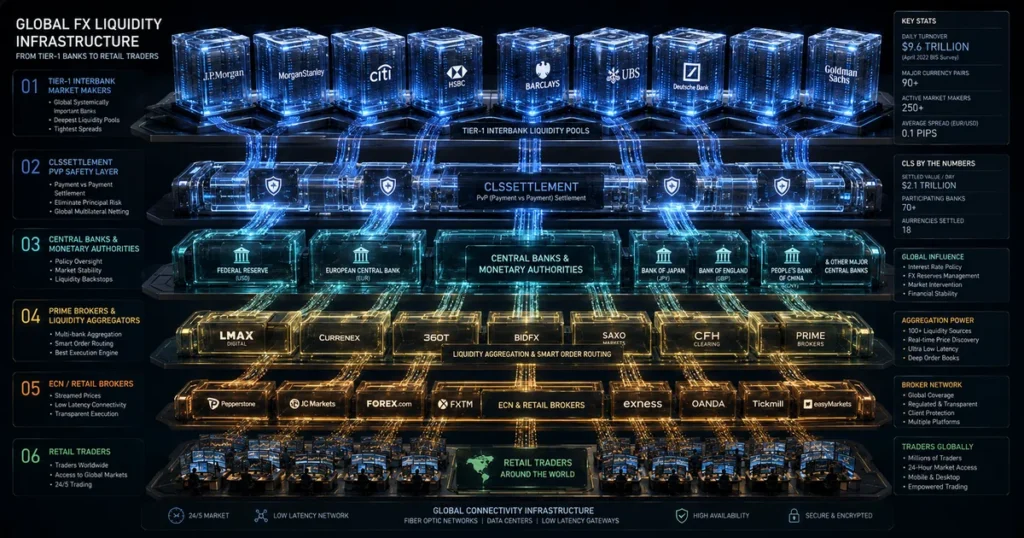
The global forex market is organized across institutional tiers, moving from sovereign and dealer-to-dealer transactions down to retail accounts.
The Institutional Interbank Core
At the top of the global structure sits the Tier-1 Interbank Market. This is a credit-based network connecting major international investment and commercial banks—including JPMorgan Chase, Citigroup, UBS, Deutsche Bank, HSBC, BNP Paribas, and Barclays.
Institutional FX transactions can involve very large notional amounts, with liquidity accessed through bilateral dealer relationships and electronic trading networks such as EBS Market and LSEG FXall.
CLSSettlement and Payment-versus-Payment (PvP) Safety
Historically, cross-border currency trading carried significant Herstatt Risk (settlement risk where one counterparty delivers funds in its local time zone, but the other counterparty defaults before reciprocating).
To address this structural risk across the global financial system, CLSSettlement substantially reduces FX settlement risk for eligible transactions by using payment-versus-payment (PvP) settlement across 18 major currencies. While non-eligible currencies and transactions remain outside PvP settlement, the system provides systemic stability for the world’s most active currency flows.
Categorization of Global Currencies
For educational purposes, currencies can be grouped broadly by liquidity, market depth, trading activity, and market accessibility:
1. Major Currency Pairs and G10 Currencies
The G10 currencies represent heavily traded currencies associated with major developed economies (such as USD, EUR, JPY, GBP, CHF, CAD, AUD, NZD, SEK, and NOK). Major currency pairs involve the US Dollar paired with another G10 currency:
- EUR/USD (Euro / US Dollar): The US dollar–euro pair remains the world’s most traded currency pair, according to BIS Triennial Survey data.
- USD/JPY (US Dollar / Japanese Yen): The primary benchmark for Asian capital flows and global interest-rate carry trades.
- GBP/USD (British Pound / US Dollar): Historically referred to as “Cable,” reflecting the transatlantic telegraph cables that linked London and New York markets.
- USD/CHF (US Dollar / Swiss Franc): A widely utilized European currency pair often sought during periods of financial uncertainty.
- AUD/USD & USD/CAD: Major commodity-linked currency pairs that reflect international demand for industrial metals and energy products.
2. Cross-Currency Pairs (Minors)
Cross pairs consist of major currencies trading directly against one another without involving the US Dollar (e.g., EUR/GBP, EUR/JPY, GBP/JPY, AUD/NZD). They allow market participants to express views on regional economic divergences directly.
3. Emerging and Developing-Market Currencies
These pairs trade a major currency against the currency of an emerging or developing economy (e.g., USD/INR, USD/BRL, USD/ZAR, USD/TRY). They generally feature wider bid-ask spreads, lower secondary liquidity, and higher sensitivity to domestic monetary policies and global risk appetite.
Financial Instruments Powering the Global FX Market
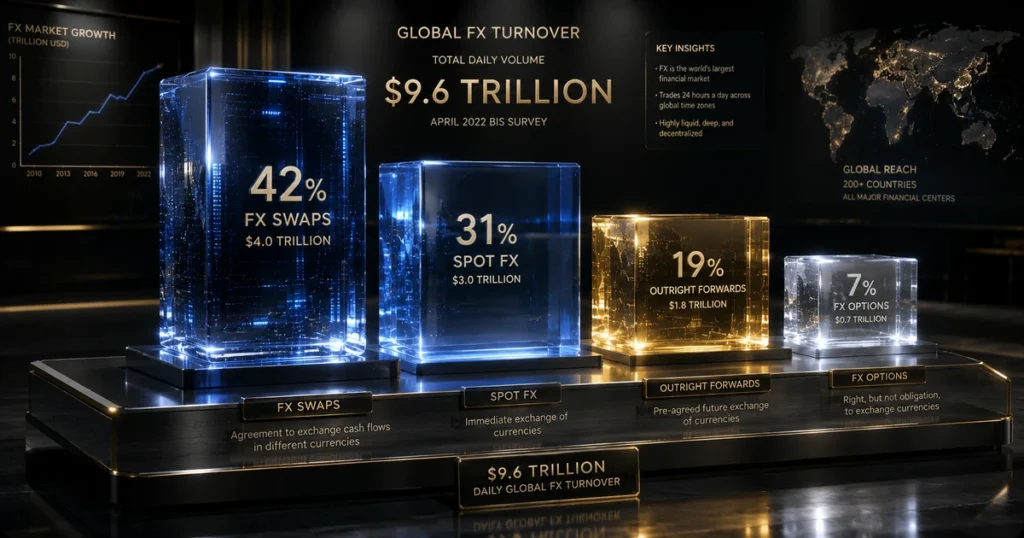
- Spot FX Transactions (~31% of daily volume): Agreements to exchange currencies at the prevailing market rate for near-immediate delivery (typically $T+2$ business days, with USD/CAD settling on $T+1$).
- Foreign Exchange Swaps (~42% of daily volume): FX swaps combine a spot transaction with an agreed reverse transaction at a future date and are widely used for FX funding liquidity and balance-sheet hedging.
- Outright Forwards (~19% of daily volume): Over-the-counter contracts that lock in an exchange rate today for financial settlement on a specific future date (e.g., 30, 90, or 360 days ahead), protecting corporate profit margins against currency swings.
- Exchange-Traded Currency Futures: Standardized contracts traded on regulated derivatives exchanges (such as CME Group), featuring set sizes and centralized clearinghouse settlement.
- Currency Options (~7% of daily volume): Derivative contracts giving the buyer the right, but not the obligation, to buy (Call) or sell (Put) a currency pair at a predetermined strike price on or before expiration.
Comparison: Global FX Instruments Side-by-Side
| Financial Instrument | Trading Venue | Standard Settlement | Primary Institutional Objective | Counterparty Risk Profile | Customization Level |
| Spot FX | Over-the-Counter (OTC) | Immediate ($T+1$ / $T+2$) | Cash conversion, dynamic trading | Low to Moderate (Dealer tier) | Flexible |
| FX Swaps | Over-the-Counter (OTC) | Spot + Future Reverse Leg | Multi-currency liquidity management | Low (CLS / Collateralized) | Tailored |
| Outright Forwards | Over-the-Counter (OTC) | Future Date ($> 2$ Days) | Corporate revenue & supply chain hedging | Bilateral credit dependency | Fully Customized |
| Currency Futures | Centralized Exchanges (CME) | Standard Quarterly Dates | Portfolio hedging, trend speculation | Substantially reduced via Central Counterparty (CCP) clearing* | Highly Standardized |
| Currency Options | OTC & Listed Exchanges | At Expiration Date | Asymmetric downside volatility protection | Bilateral (OTC) / CCP (Listed) | Hybrid |
*Note: Central counterparty clearing substantially reduces bilateral counterparty risk, but does not eliminate all market, liquidity, margin, clearing-member, or systemic risks.
The US Dollar, Reserve Assets, and Global Currency Power
The US Dollar (USD) occupies a central position within the international financial architecture.
According to data from the International Monetary Fund (IMF) and the Bank for International Settlements (BIS):
Key Drivers of US Dollar Global Dominance:
-----------------------------------------------------------------
1. Foreign Exchange Transactions: USD was on one side of 89.2% of all trades.
2. Global Foreign Exchange Reserves: The US dollar accounted for 57.13% of global foreign exchange reserves in 2026Q1, according to IMF COFER data.

3. International Trade Invoicing: ~50% of global trade is invoiced in USD.
4. Cross-Border Debt Issuance: 63% of foreign-currency bonds were denominated in US dollars as of June 2025, according to BIS data.
-----------------------------------------------------------------
*Sources: International Monetary Fund (IMF COFER) & BIS Triennial Survey*
This structural role creates dynamic capital flows: the US Dollar often experiences appreciation during periods of strong US economic outperformance (attracting direct investment capital) as well as during global market stress (driven by demand for liquid US dollar instruments and Treasury securities).
Macroeconomic Forces That Move Global Currencies
Exchange rates reflect relative economic health, sovereign monetary decisions, and international capital allocation:
                      ┌─────────────────────────────────────────┐
                      │    CENTRAL BANK INTEREST RATES & POLICIES│
                      └────────────────────┬────────────────────┘
                                           │
         ┌─────────────────────────────────┼─────────────────────────────────┐
         │                                 │                                 │
         ▼                                 ▼                                 ▼
┌──────────────────┐             ┌──────────────────┐             ┌──────────────────┐
│ INFLATION & PPP  │             │ TRADE BALANCE &  │             │ GEOPOLITICAL &   │
│  DIFFERENTIALS   │             │ CURRENT ACCOUNT  │             │ FISCAL SOLVENCY  │
└──────────────────┘             └──────────────────┘             └──────────────────┘
- Central Bank Monetary Policy & Interest Rates: Interest-rate differentials can influence capital flows and carry-trade incentives, but exchange-rate expectations, risk premia, hedging costs, and broader market conditions also affect currency demand.
- Relative Inflation Rates: Economies exhibiting low, predictable inflation preserve purchasing power over time, which supports long-term exchange rate stability.
- Current Account & Balance of Trade: A persistent trade surplus creates ongoing commercial demand for an exporting country’s currency to settle international trade balances.
- Sovereign Debt and Fiscal Stability: Excessive national debt, high budget deficits, or sovereign credit downgrades can increase risk premia and lead to currency depreciation.
- Geopolitical Stability and Terms of Trade: Strong political institutions and favorable export-to-import price ratios provide structural support for a sovereign currency’s value.
Exchange Rate Regimes Across Sovereign Nations
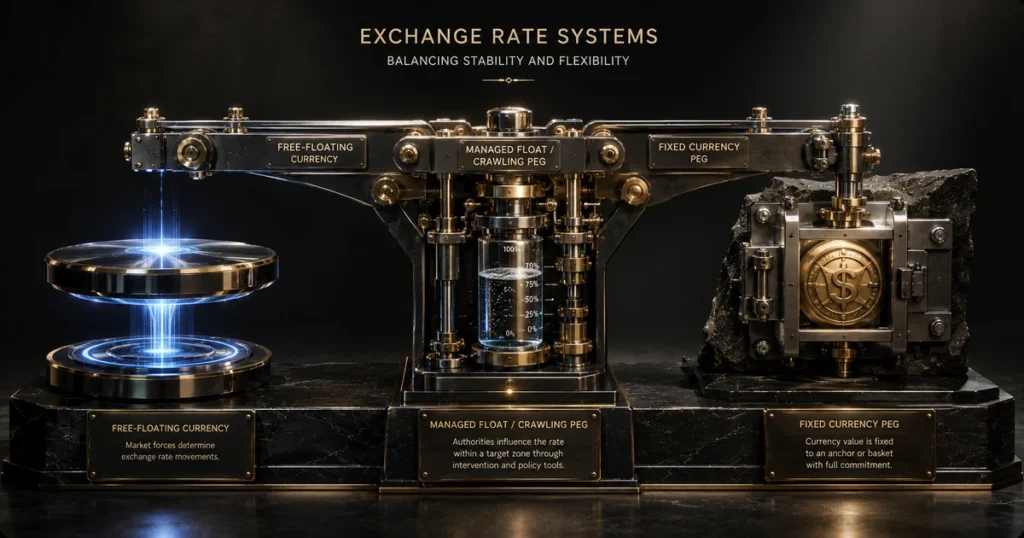
Governments and monetary authorities manage their currencies using established policy frameworks:
- Free-Floating Regimes: Currency values are primarily determined by market supply and demand, with exchange rates influenced by monetary policy, capital flows, trade conditions, expectations, and other market factors (e.g., USD, EUR, JPY, GBP, AUD).
- Managed / Market-Determined Float: The currency is largely determined by market forces, while the central bank may intervene in foreign exchange markets to address disorderly conditions or excessive volatility (e.g., Indian Rupee).
- Crawling Peg Regimes: The currency is pegged to another currency or basket, with the peg rate adjusted periodically in small increments in response to inflation differentials or selected indicators (e.g., historical Latin American stabilization frameworks).
- Fixed Pegs & Currency Boards: The domestic currency is formally pegged to an anchor currency (such as the USD) or a fixed basket, maintained through active central bank operations (e.g., Hong Kong Dollar maintained within the convertibility zone of 7.75–7.85 HKD per USD by the HKMA).
Real-World Case Studies: Global Shocks & Market Response
Case Study 1: The Swiss National Bank (SNB) Franc Floor Shock (2015)
- Background: To prevent deflationary pressures and protect export competitiveness, the Swiss National Bank maintained an exchange rate floor of
1.20 CHF per EUR. - The Event: On January 15, 2015, the SNB unexpectedly discontinued the minimum exchange rate.
- Global Market Reaction: The Euro fell sharply against the Swiss Franc within minutes. Interbank market liquidity declined significantly, resulting in pricing gaps and substantial losses across international brokerages and institutional funds.
- Core Takeaway: Currency policy pegs and managed rate bands carry structural tail risks when fundamental economic pressures make ongoing intervention unsustainable.
Case Study 2: Cross-Border Corporate Hedging (Semiconductor Sector)
- Corporation: East Asian Semiconductor Manufacturer.
- Exposure: Incurs production and capital expenditure costs in local currency, while selling components through long-term commercial contracts priced in US Dollars.
- Risk: A depreciation of the US Dollar relative to the domestic currency reduces revenue when converted to cover local operating costs.
- Execution: The corporate treasury executes Outright Forward Contracts locking in exchange rates on projected USD receipts, securing operating margins against currency volatility.
Advantages & Strategic Value of the Global FX Market
- Unmatched Liquidity: High transaction volume enables institutional market participants to execute large transactions with minimal price slippage on major currency pairs.
- Continuous Market Access: The global FX market operates around the clock from Sunday evening through Friday evening, giving market participants capacity to manage risk across global events.
- Bi-Directional Flexibility: Participants can express both long views (anticipating currency appreciation) and short views (anticipating depreciation) without the borrowing constraints often found in stock short-selling.
- Tight Transaction Costs: Deep competition among interbank liquidity providers keeps bid-ask spreads narrow on major currency pairs.
- Corporate Risk Management: Standardized and OTC derivative instruments allow international businesses to hedge foreign cash flows and secure supply chain budgets.
Risks, Vulnerabilities, and Structural Limitations
- High Leverage and Liquidation Risk: In retail derivative trading, high leverage ratios can magnify both gains and losses. Adverse market moves against a leveraged position can quickly deplete account equity.
- Macroeconomic Shocks & Flash Liquidity Events: Unexpected policy decisions, geopolitical developments, or sudden rate adjustments can trigger sharp price movements and temporary liquidity gaps.
- Decentralized Counterparty Risk: In over-the-counter markets, transaction safety depends on the financial stability and regulatory compliance of the trading counterparty or broker.
- Multifactor Analytical Complexity: Forecasting currency movements requires analyzing central bank policies, sovereign bond yields, inflation metrics, trade flows, and geopolitical dynamics simultaneously.
Frequently Asked Questions (FAQs)
1. What makes the global forex market different from traditional stock markets?
Stock markets trade equity shares of individual publicly listed companies on centralized national exchanges (e.g., NYSE, NASDAQ, LSE) during specific regional trading hours. The global forex market trades sovereign currency pairs over-the-counter across an international banking network operating around the clock from Sunday evening through Friday evening.
2. Who are the largest institutional participants in the global FX market?
Major commercial and investment banks account for the largest share of market volume through interbank trading. Central banks (such as the Federal Reserve, the ECB, and the Bank of Japan) influence currency markets through monetary policy, interest-rate settings, and foreign exchange market operations.
3. What is the single most traded currency pair in the world?
According to official data from the Bank for International Settlements (BIS), the US Dollar–Euro (EUR/USD) pair remains the world’s most traded currency pair, followed by USD/JPY and GBP/USD.
4. Can an investor lose more than their initial deposit in foreign exchange?
In physical currency conversion, losses generally arise from exchange-rate movements, fees, and changes in purchasing power. In leveraged derivative products such as margin FX or CFDs, losses can be substantial and, depending on the product, broker terms, and jurisdiction, may exceed the initial amount deposited. Some regulatory regimes provide negative balance protection for certain retail clients, but its availability and scope vary.
5. What are the main regional sessions in global FX trading?
Global FX trading moves through four continuous regional sessions: the Sydney session, the Tokyo (Asian) session, the London (European) session, and the New York (North American) session, with peak global liquidity occurring during the London–New York session overlap.
Conclusion
The global forex market is the fundamental infrastructure connecting international trade and global capital markets. From multinational corporations managing cross-border supply chains to sovereign central banks maintaining monetary stability and institutional funds managing multi-asset portfolios, foreign exchange provides the liquidity, pricing mechanisms, and hedging tools that support global economic integration.
Understanding the mechanics of currency pricing, market structure, and macroeconomic catalysts enables market participants and financial professionals to navigate international capital markets with clarity and discipline.
Next Reading Suggestions
To build your expertise in macroeconomic analysis and institutional currency strategies, explore our related guides:
- [Understanding Interest Rate Parity and Institutional FX Carry Trades]
- [Central Bank Interventions: Mechanics of Sovereign Currency Management]
- [Spot vs. Forwards vs. Futures: Selecting the Optimal Hedging Instrument]
- [The Structural Role of the US Dollar as the Global Anchor Reserve Currency]
Author Box & E-E-A-T Verification
Written By: CurrencyPlans Financial Research Team
Fact-Checked & Reviewed By: Senior Institutional Market Analyst & FX Strategist
Editorial Integrity & Research Standards: CurrencyPlans publishes institutional-grade research grounded in verified macroeconomic data. All market turnover figures, reserve allocations, and regulatory disclosures are cross-referenced with primary multilateral institutions, including the Bank for International Settlements (BIS), the International Monetary Fund (IMF), and sovereign central banks.
Institutional References & Official Resources
For primary data on global market turnover, central bank reserve assets, and international regulatory frameworks, consult official institutional sources:
- Global Market Turnover & Derivatives Data: Bank for International Settlements (BIS) Triennial Central Bank Survey
- Global Official Foreign Exchange Reserves (COFER Data): International Monetary Fund (IMF) Currency Composition of Official Foreign Exchange Reserves
- Monetary Policy Frameworks & FX Operations: Board of Governors of the Federal Reserve System Foreign Exchange Rates & Data
- European Exchange Rate & Reserve Management: European Central Bank (ECB) Euro Foreign Exchange Reference Rates
- UK FX Market Governance & Oversight: Bank of England (BoE) Foreign Exchange Joint Standing Committee
Educational Disclaimer
This guide is prepared strictly for educational, informational, and research purposes and does not constitute financial, investment, legal, or tax advice. Foreign exchange and leveraged currency instruments carry substantial risk of capital loss and are not suitable for all investors. Always perform independent due diligence and consult a licensed financial advisor before allocating capital to financial markets.

