

Exploring the history of stock markets reveals how global exchanges built modern wealth. The stock market is one of the most powerful financial systems ever created. It moves trillions of dollars daily, shapes economies, builds global corporations, and creates wealth at a scale completely unmatched in human history.
But stock markets didn’t begin with high-frequency algorithms, glowing neon green screens, advanced technical charts, or mobile trading apps.
Their roots go back more than 400 years into the past.
Long before Nasdaq, the New York Stock Exchange (NYSE), or the National Stock Exchange (NSE) existed, early merchants and traders were actively exchanging ownership fractions of businesses in noisy coffee houses, chaotic shipping ports, and tightly regulated medieval merchant guilds. The stock market began as a remarkably simple yet revolutionary idea: shared ownership.
That single conceptual breakthrough changed global finance forever.
From Europe to America, from Asia to Australia, stock exchanges quickly transformed from localized gathering spots into highly structured national economic engines. Today, understanding how the evolution of exchanges took place is absolutely essential to explaining how global capital moves, how corporate capitalism operates, and how retail investors build wealth. To truly master modern financial markets, we must first pull back the layers of time to understand the fascinating history of stock markets.
Stock Markets at a Glance
| Metric | Historical Insight | Modern Economic Significance |
| First Stock Exchange | Amsterdam Stock Exchange (1602) | Birthed the concepts of public shares, liquidity, and secondary markets. |
| Oldest Public Company | Dutch East India Company (VOC) | Introduced fractional ownership and limited liability to the world. |
| Largest Exchange Today | New York Stock Exchange (NYSE) | Actively anchors global capital flows and institutional investment. |
| Biggest Market Cap Country | United States of America (USA) | Dominates global equity indices and international portfolio allocations. |
| India’s First Exchange | Bombay Stock Exchange (BSE, 1875) | Asia’s oldest exchange, driving the financial growth of the Indian subcontinent. |
| Modern Trading Structure | High-Frequency Electronic Networks | Replaced physical open-outcry pits with algorithmic matching engines. |
1. The Birth of the Stock Market: The Dutch Miracle
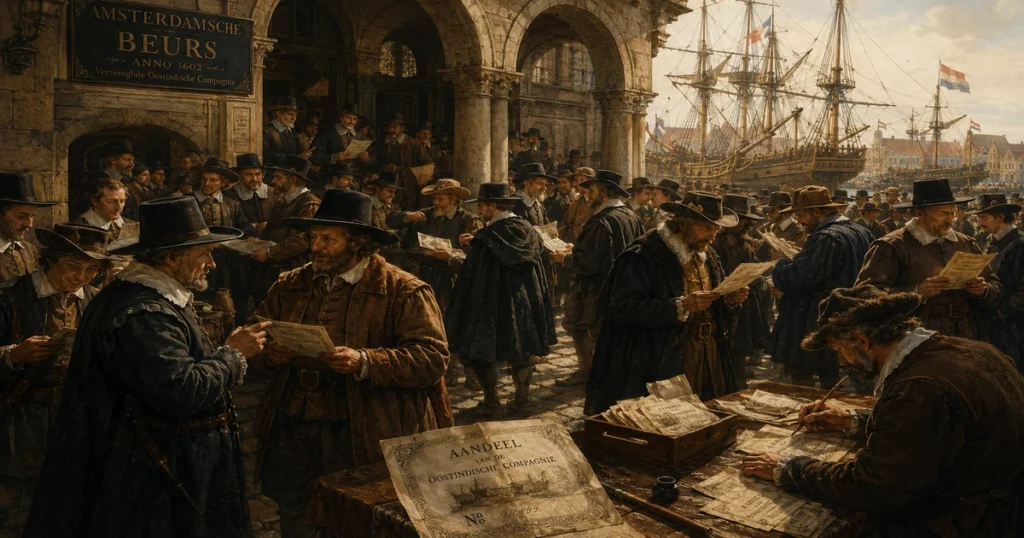
The official history of stock markets began in the early 17th century within the borders of the newly independent Dutch Republic. The year was 1602, and the Netherlands was locked in a fierce, global geopolitical battle for control of the incredibly lucrative spice trade in the East Indies.
Sailing merchant ships across uncharted oceans to harvest pepper, nutmeg, and cloves from distant shores was an extraordinarily profitable business—but it was also fraught with catastrophic risks. Ships routinely sank in violent tropical storms, ran aground on shallow reefs, or were violently captured by competitive foreign navies and opportunistic pirates.
To finance these incredibly expensive and dangerous maritime expeditions, a monumental corporate entity was chartered: the Vereenigde Oostindische Compagnie (VOC), known historically as the Dutch East India Company.
The Invention of Fractional Public Shares
The VOC broke the historical mold of business financing. Previously, a single voyage was funded by a small partnership of ultra-wealthy merchants; once the ship returned, the partnership dissolved. The VOC, however, was structured as a permanent enterprise.
More importantly, it became the first company in human history to issue fractional shares of stock directly to the general public.
Suddenly, investment was no longer the exclusive playground of the aristocracy. Any ordinary Dutch citizen—whether a high-ranking politician, a middle-class shopkeeper, or a humble domestic servant—could walk into the company’s offices and purchase a share of ownership in the enterprise. By buying a share, investors were legally entitled to a proportional slice of the company’s future profits, paid out in the form of dividends.
This completely decentralized corporate risk; if a single VOC ship sank, no individual investor was financially ruined, as their capital was spread across an entire massive fleet.
The Genesis of the Secondary Market
As thousands of Dutch citizens accumulated physical paper stock certificates, an immediate structural need arose. What happened if an investor suddenly needed hard cash to buy a house or pay off an unexpected medical debt before the VOC ships returned from their multi-year voyages?
The answer was the creation of the Amsterdam Stock Exchange.
The Amsterdam exchange became the world’s very first official secondary market. It was a dedicated physical space where people could freely buy, sell, and trade their existing VOC shares to other investors.
Almost overnight, the Dutch invented the foundational mechanics that drive every single stock exchange today:
- Liquidity: The ability to convert an abstract business ownership stake into cold, hard cash at a moment’s notice.
- Speculation: Traders quickly realized they could buy shares cheap if rumors about a successful voyage surfaced, and sell them at a massive premium later.
- Short Selling: Devious early traders like Isaac Le Maire invented strategies to profit from falling prices, creating the world’s first market crashes and regulatory framework battles.
The Dutch model created the ultimate financial blueprint. Every modern stock market in existence today is a direct descendant of the innovations engineered in the crowded streets of 17th-century Amsterdam.
2. The United Kingdom and the Rise of London
Following the structural decline of Dutch maritime dominance, the epicenter of global financial innovation crossed the English Channel to the United Kingdom. In the late 1600s and early 1700s, London was rapidly expanding into a massive mercantile metropolis, and the hunger for corporate capital was growing exponentially.
However, the British government initially looked upon organized public share trading with deep suspicion and intense regulatory hostility. Because of this legal friction, early stockbrokers were banned from entering the prestigious, formal royal trade markets.
Undeterred, these early brokers relocated their operations to a vibrant, chaotic district of London known as Change Alley.
The Coffee House Culture of Capital
Brokers, merchants, and speculative investors began gathering daily inside London’s booming network of coffee houses. The most famous of these was Jonathan’s Coffee House, established by a man named Jonathan Miles in 1680.
Inside Jonathan’s, amid clouds of tobacco smoke and cups of strong black coffee, brokers would post paper lists pinned to the walls detailing the current prices of commodities, government lottery tickets, and shares in early joint-stock operations.
In 1698, a broker named John Casting began publishing a regular, systematic price list titled “The Course of the Exchange and Other Things.” This was a historical breakthrough; it was the first time stock market data was organized, printed, and distributed to the public on a consistent schedule, laying the groundwork for modern financial journalism and market data feeds.

The South Sea Bubble and the Formalization of the LSE
In 1720, the British market experienced a catastrophic speculative disaster known as the South Sea Bubble. The South Sea Company, which possessed a monopoly on trade with South America, saw its stock price driven up to astronomical heights by wild rumors, insider manipulation, and intense public FOMO (Fear Of Missing Out). When the public realized the company had virtually zero actual trade operations, the stock collapsed spectacularly, bankrupting thousands of elite families, including the famous scientist Sir Isaac Newton.
“I can calculate the motion of heavenly bodies, but not the madness of people.” — Sir Isaac Newton, after losing his fortune in the South Sea Bubble.
To clean up the market’s reputation and restore public trust, the brokers decided to formalize their chaotic coffee house system. In 1773, a group of brokers constructed a dedicated building in Threadneedle Street, which they officially dubbed The Stock Exchange.
In 1801, the institution formally restructured into a subscription-based members-only club, officially creating the modern London Stock Exchange (LSE).
Financing the Industrial Revolution
The LSE became the primary engine that funded the historic rise of the British Empire. When the Industrial Revolution erupted in the 19th century, the scale of capital required to build massive infrastructure was far too large for any single bank or wealthy family to provide. The LSE stepped in to fill the void:
- Railways: Thousands of miles of iron tracks across the UK, India, and the Americas were financed by issuing public railway stocks in London.
- Heavy Industry: Massive steel foundries, textile mills, global shipping lines, and colonial banks raised capital via the LSE.
- Global Empire: By providing deep, unmatched liquidity, London became the undisputed financial capital of the world throughout the 19th century, demonstrating that capital markets were far more potent than raw military might alone.
3. The United States and the Rise of Wall Street
While London dominated the 19th century, the absolute future of modern stock market capitalism was quietly taking root across the Atlantic Ocean in a young, fiercely ambitious nation: the United States of America.
Following the conclusion of the American Revolutionary War, the newly formed US government found itself saddled with immense war debts. To consolidate this debt, the first US Congress authorized the issuance of $80 million in government bonds. Concurrently, early commercial banks began issuing shares to raise capital.
A small, unorganized group of independent brokers and merchants stepped forward to trade these early securities in lower Manhattan.
The Buttonwood Agreement of 1792
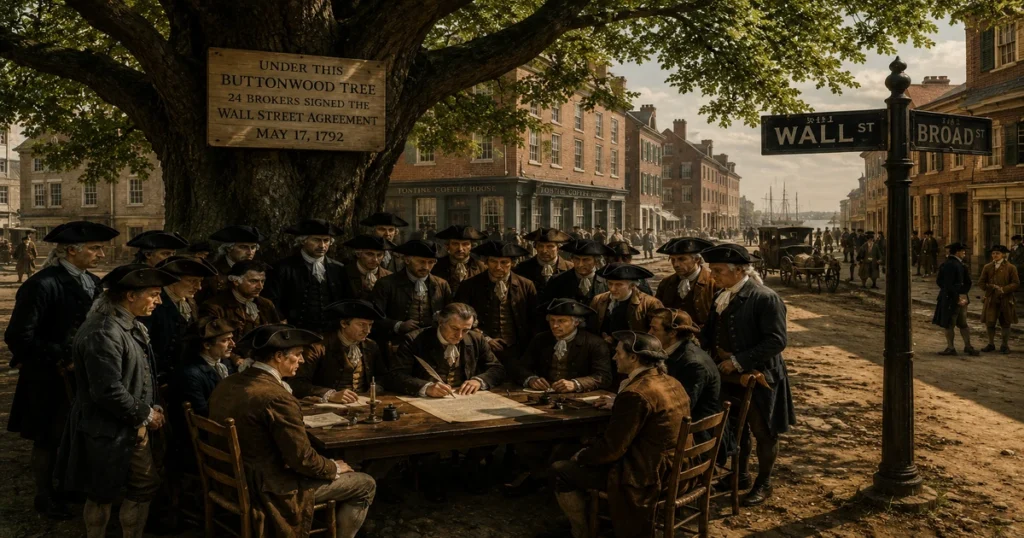
On May 17, 1792, a group of twenty-four prominent brokers gathered outside on Wall Street under the shade of a large buttonwood tree. Anxious to eliminate chaotic public auctions and establish a high-trust, exclusive trading circle, they signed a brief, historic document known as the Buttonwood Agreement.
The agreement was simple but incredibly impactful. The signatories pledged to only trade securities with each other, established a fixed, mandatory commission rate of 0.25% for all transactions, and explicitly promised to give preference to one another in all deals.
This simple outdoor pact laid the institutional foundations for what would eventually evolve into the New York Stock Exchange (NYSE).
11 Wall Street and the Domination of Capital
In 1817, the brokers formalized their structure, adopting a constitution and renaming themselves the New York Stock and Exchange Board. They moved their operations indoors, renting space and implementing strict codes of conduct. In 1863, the name was permanently shortened to the New York Stock Exchange.
As the United States rapidly industrialized following the American Civil War, the NYSE became the premier platform to fund the nation’s continental expansion. Tycoons like Cornelius Vanderbilt, John D. Rockefeller, and J.P. Morgan utilized Wall Street to pool billions of dollars, creating massive corporate monopolies in railroads, oil, electricity, and steel. By the conclusion of World War I, Europe was devastated and financially exhausted, allowing New York to permanently overtake London as the absolute center of global financial capital.
Key Milestones in the United States Stock Market
| Year | Defining Historic Event | Macroeconomic Consequences |
| 1792 | The Buttonwood Agreement Signed | Formed the initial, exclusive broker framework on Wall Street. |
| 1929 | The Great Stock Market Crash | Triggered the Great Depression, wiping out fortunes and birthing the SEC. |
| 1971 | The Launch of Nasdaq | Introduced the world’s very first electronic, computer-driven stock market. |
| 2008 | The Subprime Financial Crisis | Lehman Brothers collapsed, forcing massive central bank interventions. |
4. Canada’s Stock Market Evolution
While Wall Street dominated the global spotlight, America’s northern neighbor was quietly carving out a highly specialized, incredibly robust financial ecosystem. The history of the Canadian stock market is deeply intertwined with the nation’s vast geography, its rich natural resources, and its close economic ties to both London and New York.
The genesis of organized Canadian trading occurred in the economic hub of Montreal. In 1832, a small group of local businessmen established the Montreal Exchange to facilitate the trading of bank shares and early shipping lines. However, as the focus of the Canadian economy shifted westward toward the expanding province of Ontario, a new financial powerhouse emerged.
The Birth of the Toronto Stock Exchange (TSX)
On July 26, 1852, an association of Toronto businessmen gathered together to form a private trading network. In 1861, twenty-four corporate listings were formally brought to market, officially marking the grand launch of the Toronto Stock Exchange (TSX).
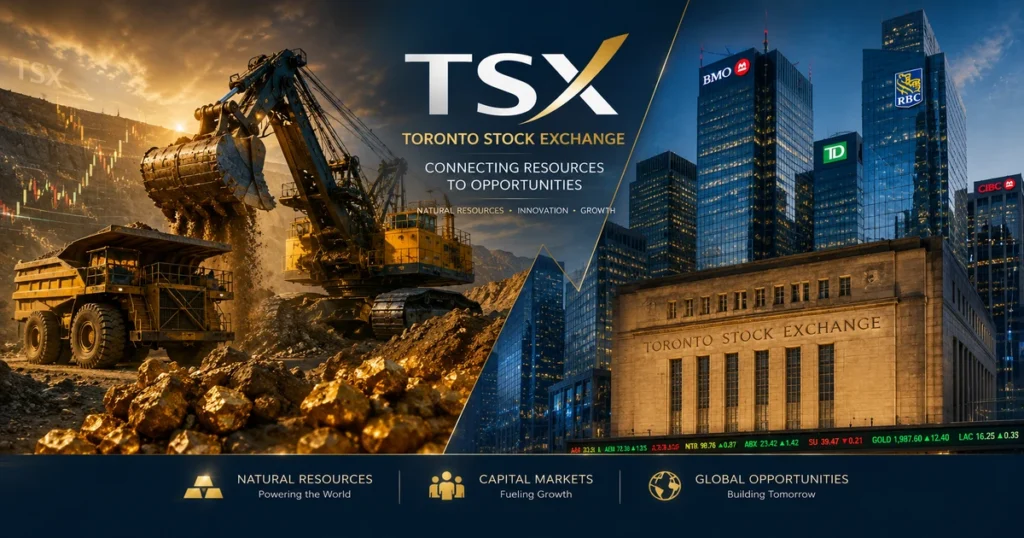
The TSX developed a highly distinct operational niche that separated it from the NYSE and LSE. Canada was a vast, largely untamed frontier brimming with immense mineral wealth, dense timber forests, and massive oil reserves.
Consequently, the Canadian stock market evolved specifically to cater to the unique needs of natural resource extraction and commodity financing:
- Junior Mining Exploits: The TSX, along with the historic Vancouver Stock Exchange, became the world’s premier platform for high-risk, high-reward junior mining exploration companies to raise early-stage venture capital.
- Energy and Oil Powerhouses: With the discovery of massive oil sands in Alberta, the Canadian markets became the primary financing vehicle for multi-billion-dollar global energy corporations.
- Banking Redoubts: Backed by conservative regulatory oversight, Canada’s big banks listed on the TSX grew into some of the most stable financial institutions in the world, shielding the country from the extreme structural panics that frequently rocked Wall Street.
5. India’s Stock Market Journey: From a Banyan Tree to Electronic Dominance
The narrative of India’s capital markets is one of the most remarkable, colorful, and culturally distinct journeys in the entire history of stock markets. India possesses the absolute oldest stock exchange in all of Asia, with a legacy that dates back into the high era of the 19th-century British Raj.
The story began in the bustling commercial city of Bombay (now Mumbai) in the 1850s. A small, informal group of five pioneering Gujarati and Parsi brokers began gathering daily to trade shares in local textile mills and commercial banks. Because they had no formal office or government building, their meeting place was completely public: they gathered outside under the shade of a large, sprawling banyan tree located in front of Mumbai’s Town Hall.
The Native Share & Stock Brokers’ Association (BSE)
As the number of brokers rapidly multiplied, the group outgrew the original banyan tree, moving from one street corner to another. Finally, in 1875, the group formalized their trading ring into an official entity called “The Native Share & Stock Brokers’ Association.”
Years later, this entity acquired a permanent home on a street that would become synonymous with Indian wealth: Dalal Street (Broker Street), officially establishing the Bombay Stock Exchange (BSE).
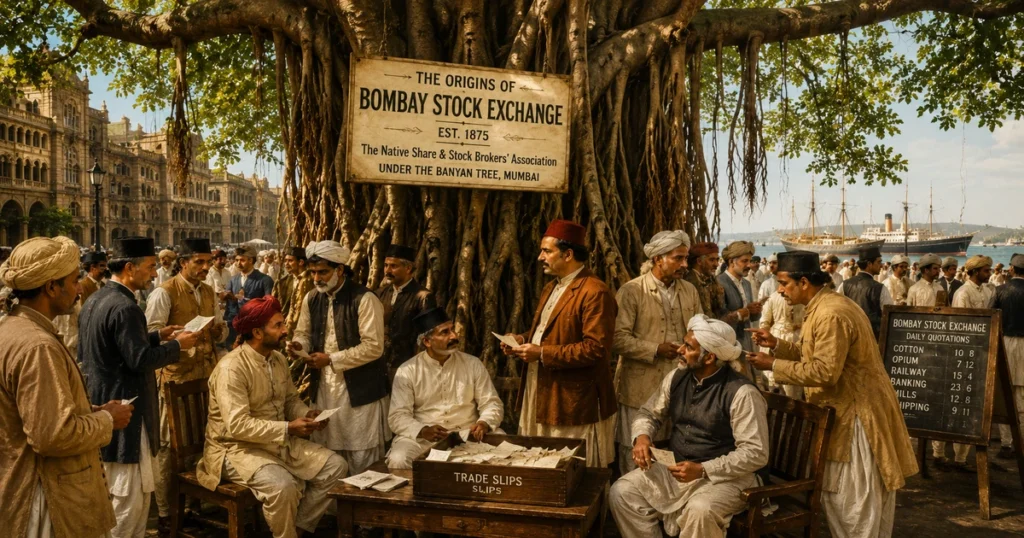
For over a century, the BSE operated as a traditional open-outcry pit market. It was an intense, crowded arena filled with shouting traders wearing traditional colored jackets, utilizing complex hand signals (Jhatkas) to execute stock trades on paper slips.
While the system was vibrant, it was highly vulnerable to insider manipulation, lack of transparency, and localized broker monopolies.
The 1992 Crisis and the Rise of the NSE
The year 1992 was a massive watershed moment for Indian finance. The country was shaken to its core by the infamous Harshad Mehta Stock Market Scam, where a charismatic broker manipulated systemic loopholes in the banking system to pump billions of rupees into the BSE, triggering a wild boom followed by a devastating, trust-shattering crash.
In direct response to this crisis, the Government of India acted decisively:
- SEBI Empowerment: The Securities and Exchange Board of India (SEBI) was granted immense, autonomous statutory powers in 1992 to police the markets with an iron fist.
- The Launch of the NSE (1994): In 1994, the National Stock Exchange (NSE) commenced operations. The NSE was engineered from day one as a highly advanced, fully automated, screen-based electronic trading platform. It utilized satellite terminals to democratize trading, allowing a broker in a small town in Bihar or Kerala to trade stocks instantly at the exact same price as a major institution in Mumbai.
The NSE’s electronic disruption permanently changed Indian finance. It forced the old BSE to rapidly abandon its physical trading pits and digitize. Today, India’s equity market infrastructure is one of the most technologically advanced and fastest-growing in the entire world, attracting massive amounts of global institutional capital while empowering millions of retail domestic investors via mutual funds, SIPs, and mobile apps.
6. Australia’s Stock Market Development
The history of stock markets in the Southern Hemisphere is anchored almost entirely by the rapid, mineral-rich development of Australia. The Australian equity markets owe their existence not to banking or manufacturing, but to the frantic, historic gold rushes of the 19th century.
Before a unified national exchange existed, Australia’s capital markets were deeply fragmented across independent British colonies. The discovery of gold in New South Wales and Victoria in the 1850s triggered an unprecedented economic explosion.
Thousands of international miners rushed to the continent, and hundreds of speculative mining companies were formed overnight to extract gold, silver, copper, and coal from deep underground.
The Formation of the Australian Securities Exchange (ASX)
To raise the immense capital required to sink shafts and build crushing mills, localized stock exchanges sprang up across major colonial cities: the Melbourne Stock Exchange was formed in 1861, followed by Sydney in 1871, and Brisbane in 1884.
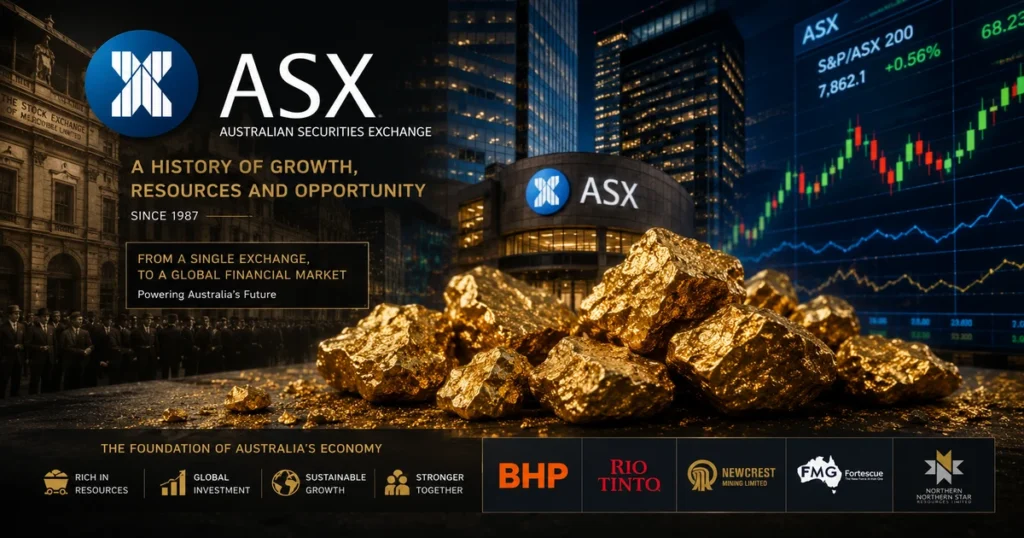
For over a century, these state-level exchanges operated independently. Finally, in 1987, the Australian Parliament passed legislation enabling the historic amalgamation of all six distinct state exchanges into a singular, powerful national entity: the Australian Securities Exchange (ASX).
The ASX built a powerful global reputation founded upon distinct corporate strengths:
- Global Mining Titans: The ASX is the primary home to the world’s largest, most influential diversified mining corporations, such as BHP Group and Rio Tinto, making it a critical barometer for global industrial demand.
- The Superannuation Inflow: In 1992, Australia introduced a mandatory universal retirement savings system known as Superannuation. This policy created an immense, non-stop river of domestic capital flowing directly into the ASX every single month, transforming ordinary Australian citizens into one of the most stock-market-literate populations on Earth.
7. Japan’s Market Revolution: From Samurai Bonds to the Asset Bubble
Japan’s history of stock markets provides a stunning case study in rapid industrialization, cultural adaptation, and one of the most dramatic macroeconomic cycles ever recorded in modern history.
For centuries, feudal Japan was completely closed off from the Western world. However, following the Meiji Restoration in 1868, the Japanese state realized it had to rapidly modernize its economy or risk colonization by Western powers. The samurai class was dismantled, feudal fiefdoms were abolished, and Japan rushed to adopt Western capitalist financial structures.
The Foundation of the Tokyo Stock Exchange (TSE)
In 1878, the government officially chartered the Tokyo Stock Exchange (TSE). The early Japanese market was explicitly designed to finance the rapid rise of the Zaibatsu—massive, family-controlled industrial conglomerates (such as Mitsubishi, Mitsui, and Sumitomo) that drove Japan’s military, shipping, and manufacturing expansion.
Following the devastation of World War II, the US occupation forces restructured the TSE, breaking up the old Zaibatsu and replacing them with the Keiretsu—intricate networks of cross-shareholding corporations anchored by central banks. This system fueled the legendary post-war Japanese economic miracle, transforming Japan into a global electronics and automotive manufacturing juggernaut.
The Great Asset Bubble of the 1980s
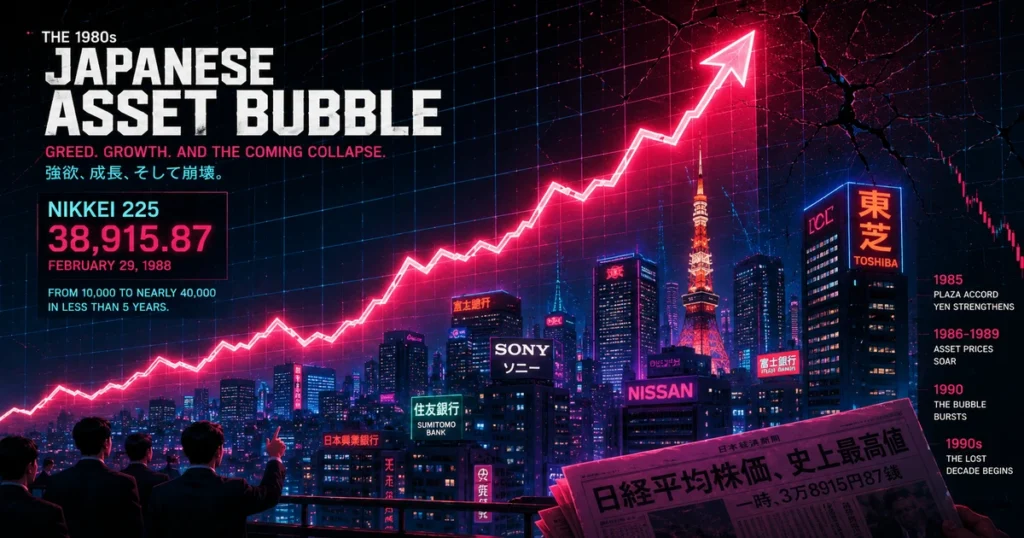
By the late 1980s, Japan’s stock market entered a state of absolute, unprecedented speculative madness. Driven by ultra-low interest rates, aggressive corporate liquidity, and immense real estate speculation, the Japanese stock market exploded. By 1989, the flagship Nikkei 225 index reached an all-time high of 38,915 points.
The valuation distortions were breathtaking:
- At the peak of the bubble, the total market value of the stocks traded on the Tokyo Stock Exchange accounted for over 40% of the value of all stocks on Earth, completely eclipsing the United States.
- The land value of the Imperial Palace grounds in Tokyo was famously estimated to be worth more than the entire real estate value of the state of California.
In 1990, the monumental bubble finally burst. Real estate and stock prices collapsed catastrophically, plunging Japan into a decades-long period of economic stagnation, deflation, and structural debt workouts known historically as the “Lost Decades.” The Japanese asset crash serves as a permanent, global reminder of what happens when stock market speculation completely detaches from economic reality.
8. Germany’s Financial Markets: The Industrial Powerhouse
The story of Germany’s stock market is distinct because it completely rejects the speculative, equity-centric cultures found in London or New York. Instead, the German financial model evolved as a highly structured, long-term credit partnership designed explicitly to support heavy manufacturing and engineering excellence.
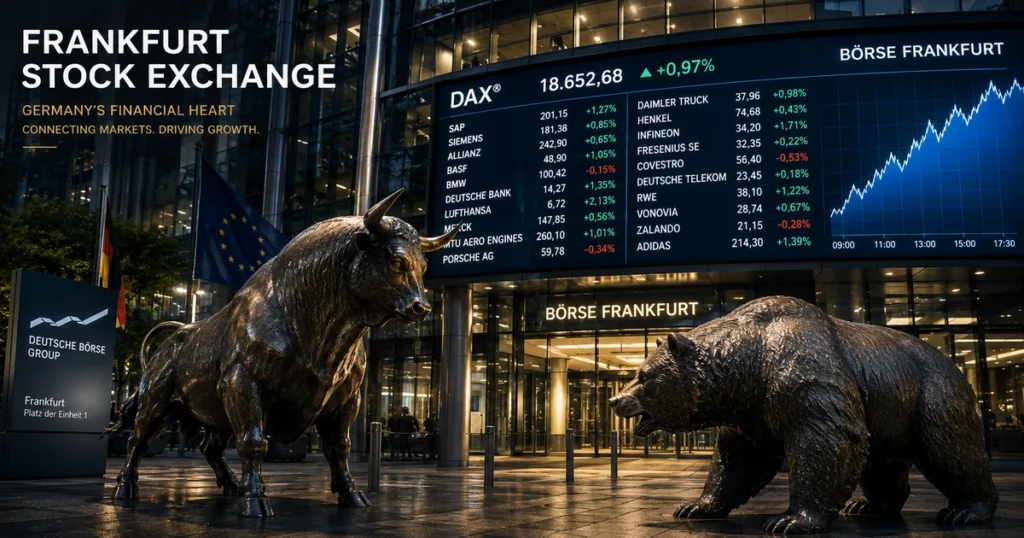
The roots of German trading run deep. In 1585, merchants gathered in the trade city of Frankfurt to establish standard, uniform exchange rates for a chaotic array of regional currencies, creating the historical foundation for the Frankfurt Stock Exchange (Börse Frankfurt).
The Universal Bank System and the DAX
As Germany unified and industrialized in the late 19th century, its stock market grew to finance world-class engineering, chemical, and automotive giants like Siemens, Bayer, and Volkswagen.
However, unlike American corporations that relied heavily on issuing new public shares to raise money, German industrial firms relied primarily on the Universal Banking System—forming deep, long-term lending relationships with giant institutions like Deutsche Bank.
In 1988, Germany formalized its premier blue-chip equity performance index: the DAX. The Frankfurt exchange eventually evolved into the modern Deutsche Börse Group, a highly sophisticated corporation that operates the electronic trading system Xetra.
Today, Frankfurt stands proud as the absolute financial heart of the European Union, financing the continent’s most powerful export-driven industrial economy.
9. The Modern Electronic Revolution: From Pits to Algorithms
If a stockbroker from the 1920s were placed into a modern financial firm today, they would be completely unable to recognize the profession. For nearly four centuries, the history of stock markets was defined entirely by physical presence, human noise, and paper trails.
The Era of the Open-Outcry Pit
Traditional stock trading required human actors to occupy a shared physical room called the trading floor. The system was known as open-outcry:
- Brokers stood packed into tiered circular pits, screaming buy and sell orders at the top of their lungs.
- They utilized complex hand signals to communicate stock symbols, quantities, and prices across chaotic, noisy rooms.
- When a deal was struck, the details were scribbled onto small paper tickets and thrown onto the floor to be collected by clerks.

The Silicon Disruption
The digital revolution systematically dismantled this human-centric infrastructure. The critical inflection point occurred in 1971, when the United States launched Nasdaq (National Association of Securities Dealers Automated Quotations).
Nasdaq was the world’s very first electronic stock market; it had no physical trading floor whatsoever. Instead, it operated as a decentralized network of computer terminals that displayed current bid and ask prices electronically.
The success of the electronic model triggered a rapid global domino effect:
- Dematerialization: Physical paper stock certificates were completely phased out, replaced by secure digital entries inside centralized electronic depositories (such as NSDL and CDSL in India).
- High-Frequency Trading (HFT): Human floor brokers were replaced by complex algorithmic black-box servers. Today, massive HFT computers are physically co-located inside exchange data centers, executing millions of stock trades within microseconds, extracting tiny fractions of a cent in profit per trade.
- Retail Democratization: The rise of internet connectivity and mobile smartphone interfaces completely eliminated transaction friction. Anyone with a smartphone can open an account, link their bank, and buy ownership shares in global companies instantly, creating a truly globalized, round-the-clock capitalist grid.
Top 7 Countries by Stock Market Influence
| Rank | Country | Flagship Exchange | Primary Sector Strengths | Global Strategic Influence |
| 1 | USA | NYSE / Nasdaq | Technology, Healthcare, Finance | Sets the absolute direction for global investment risk sentiment and asset pricing. |
| 2 | UK | London Stock Exchange | Banking, Energy, Insurance | The historical bridge for international capital allocation across Europe and the Commonwealth. |
| 3 | Japan | Tokyo Stock Exchange | Automotive, Advanced Robotics | The anchor of East Asian industrialized capital and low-yield funding structures. |
| 4 | India | BSE / NSE | Information Tech, Banking, Energy | The world’s fastest-growing major emerging market, capturing institutional flows. |
| 5 | Canada | Toronto Stock Exchange | Mining, Crude Oil, Natural Gas | The undisputed global hub for resource venture capital and commodity financing. |
| 6 | Germany | Frankfurt Stock Exchange | Engineering, Autos, Heavy Industry | The absolute core industrial and monetary engine driving the European Union. |
| 7 | Australia | Australian Securities Exchange | Mining, Superannuation Capital | Highly liquid resource market backed by massive, non-stop retirement fund inflows. |
Key Historical Observations
- Stock Markets Began in Amsterdam: The Dutch Republic engineered the foundational mechanics of public fractional shares, dividends, and secondary liquidity to spread maritime trade risk.
- London Industrialized Stock Financing: Shifting from Change Alley coffee houses to a formalized exchange, the UK utilized capital markets to construct the infrastructure of the Industrial Revolution.
- Wall Street Became the Center of Global Capital: Starting from a basic outdoor agreement under a buttonwood tree, New York built the deep liquidity pools that fund modern technological corporations.
- Canada Specialized in Commodity Markets: The TSX evolved as a highly unique platform, perfectly tailored to raise venture capital for mineral exploration and global energy conglomerates.
- India Pioneered Asia’s Capital Journey: Moving from an informal banyan tree gathering to the electronic innovation of the NSE, India constructed a highly advanced domestic investment framework.
- Australia Anchored Resource Wealth: Fueled by 19th-century gold rushes and modern mandatory Superannuation inflows, the ASX became a mining finance powerhouse.
- Japan Demonstrated Bubble Vulnerability: The dramatic rise and devastating collapse of the Nikkei index in the late 1980s serves as a timeless warning against asset speculation.
- Germany Anchored Credit and Manufacturing: The Frankfurt exchange evolved to support structural engineering and export dominance via stable corporate partnerships.
- Electronic Automation Reshaped Capitalism: The transition from noisy physical open-outcry pits to high-frequency algorithmic networks completely democratized public market access.
FAQ Section
Which exchange was the absolute first stock market in history?
The Amsterdam Stock Exchange, established in the Netherlands in 1602 by the Dutch East India Company (VOC), is widely recognized as the world’s very first official stock market to feature public share issuance and secondary trading.
Which country currently possesses the largest stock market?
The United States of America holds the largest stock market in the world by an immense margin. Combined, the New York Stock Exchange (NYSE) and Nasdaq account for over 40% to 50% of the entire global equity market capitalization.
Which is the oldest stock exchange in Asia?
The Bombay Stock Exchange (BSE), founded on Dalal Street in Mumbai, India, in 1875, is the absolute oldest formal stock exchange on the Asian continent.
Why were stock markets originally created?
Stock markets were created to allow expanding corporate businesses to raise massive amounts of investment capital from the general public, while simultaneously allowing individual investors to spread out their financial risks through fractional business ownership.
What is the primary difference between the NYSE and Nasdaq?
The NYSE was historically an auction market centered around a physical trading floor and human specialists, whereas Nasdaq was launched in 1971 as a fully computerized dealer network operating entirely through electronic telecommunication systems.
How did electronic trading change the stock market landscape?
Electronic trading completely eliminated physical trading floors, paper tickets, and human shouting pits. It reduced transaction fees, increased market speed, enabled algorithmic trading, and allowed ordinary retail investors to trade stocks instantly from their smartphones.
Final Perspective
The history of stock markets is, at its deepest core, the history of human economic progress, ingenuity, and cooperation.
Stock markets transformed the structure of the world. They provided the democratic platform required to pool the savings of millions of ordinary citizens, turning raw capital into world-changing corporate endeavors. They financed historic maritime exploration, built vast transcontinental railroad systems, powered the factories of the Industrial Revolution, and provided the financial fuel that allowed modern technology giants to reshape daily human life.
From the crowded streets of 17th-century Amsterdam to the legendary buttonwood tree on Wall Street, and into the modern global server farms that execute trades at the speed of light, the stock market has consistently evolved to match the scaling ambitions of human civilization.
However, despite centuries of radical technological and structural transformation, the foundational psychological driver of the stock market remains completely unchanged: the delicate balance between risk and reward.
Exchanges thrive when built upon a bedrock of transparency, strict regulatory trust, and authentic economic productivity. When managed with high discipline, the stock market operates as the ultimate wealth-creation machine ever devised by humanity—a system that will undoubtedly continue to build, expand, and reshape global wealth for generations to come.

