

The modern australian stock market history does not trace its lineage back to a single boardroom decree or a calculated piece of modern financial engineering. Instead, it is an epic, 150-year developmental saga deeply intertwined with the raw geology of the continent, the chaotic expansion of British colonial outposts, and the eventual unification of fragmented state economies into a single digital powerhouse. Long before the Australian Securities Exchange (ASX) transformed into a top-tier global hub moving billions in daily liquidity, equity trading “down under” was a wild, decentralized frontier. By analyzing this evolutionary arc, we can map how a scattered network of localized mining exchanges transformed into one of the most technologically advanced and resilient capital markets in the world.
Part I: The Colonial Gene (1820s–1850s)
To trace the absolute earliest roots of Australian capital markets, one must look far beyond formal marble trading floors or sophisticated corporate legislative frameworks. During the 1820s and 1830s, major structural hubs like Sydney and Melbourne were primarily remote British penal and agricultural outposts, relying heavily on localized barter systems and basic commodity trading. However, as private commercial infrastructure began to expand rapidly, developing businesses required structured access to long-term funding pools.
The very first equity transactions in Australian history were executed not on an official exchange desk, but within private coffee houses, informal taverns, and crowded hotel lobbies. In these spaces, independent brokers met face-to-face to manually clear high-risk contracts. During this initial era, the primary circulating asset classes were not traditional industrial stocks, but rather the custom credit notes issued by early commercial entities like the Bank of New South Wales (the financial institution known today as Westpac) and specialized maritime shipping enterprises.
These early transactions were completely informal arrangements recorded in handwritten paper ledgers. Without a centralized regulatory authority or statutory oversight, the integrity of the market rested entirely on a fragile network of mutual trust and localized professional reputations.
Part II: The Gold Rush Cataclysm (1850s–1880s)
This basic, informal network was permanently supercharged into a massive industrial engine by the discovery of gold in 1851. When deep alluvial gold fields began yielding massive mineral wealth across Ballarat and Bendigo in Victoria, an unprecedented avalanche of international speculative capital, global miners, and British investment syndicates flooded into the continent.
Extracting deep quartz gold deposits required sophisticated heavy engineering tools and extensive long-term funding that far exceeded the financial capabilities of individual syndicates. This massive capital deficit triggered the rapid adoption of the joint-stock corporate model for mining operations.
To efficiently process the explosive trading volumes generated by these mining shares, the Melbourne Stock Exchange was formally established in 1861, marking the official dawn of structured trade infrastructure in Australia.
Exactly one decade later, in 1871, the Sydney Stock Exchange commenced formal operations, specifically designed to aggregate the capital required to build New South Wales’ sprawling rail and maritime logistics networks. As separate, high-yield mineral deposits were continuously uncovered across the continent, independent regional exchanges emerged to satisfy localized infrastructure funding demands: Hobart in 1882, Brisbane in 1884, Adelaide in 1887, and Perth in 1889.

Part III: The Era of the “Chalkies” and Regional Isolation
Even following the Federation of Australia in 1901, the domestic stock market landscape remained highly fragmented. Each state-based exchange operated as an entirely independent financial kingdom. They maintained completely separate corporate listing criteria, distinct clearing mechanisms, mismatched trading hours, and non-uniform margin requirements. If a Sydney-based asset manager wanted to liquidate a position listed exclusively on the Melbourne board, the cross-border transaction and manual settlement loop could take up to several weeks to finalize.
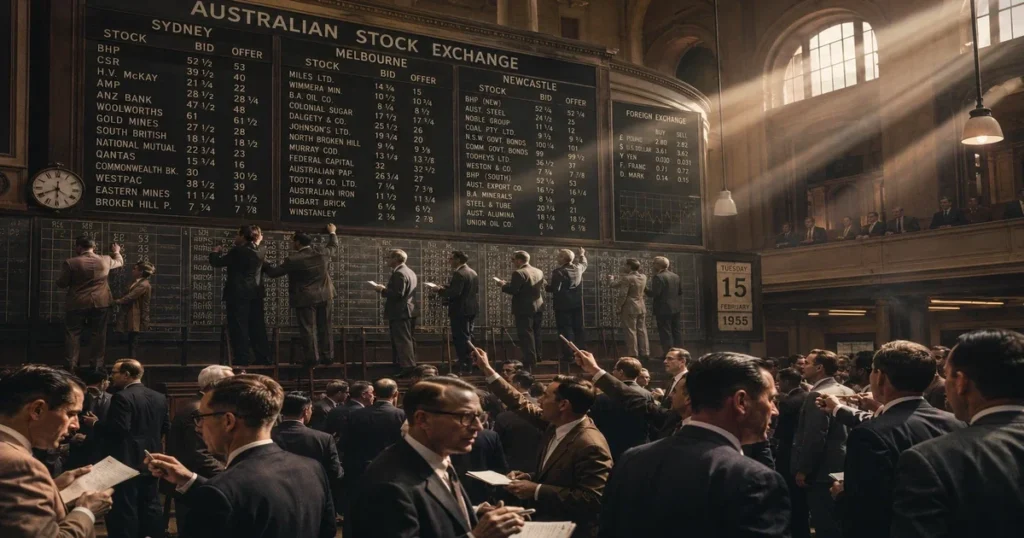
The physical trading environment inside these twentieth-century exchanges was an incredibly high-energy, mechanical spectacle. The market used a structural framework known as the “Post Trading System,” where distinct physical wooden pillars or designated desks were scattered across the floor, each representing a separate industry sector such as Gold, Copper, Base Metals, or Banking.
“The functional heartbeat of the physical trading floor rested squarely with the ‘Chalkies’—specialized exchange employees who stood on elevated ladders in front of massive wall-mounted blackboards, using chalk to continuously update live bids, offers, and transaction prices as shouting brokers signaled their orders.”
These chalkies served as the primitive, real-time database servers of their era. Whenever high-impact news hit the wires—such as the legendary 1969 Poseidon Bubble, where a massive nickel discovery in Western Australia caused a small exploration company’s share price to rocket from 80 cents to over $280—the rapid adjustments on the chalkboards triggered absolute chaos across the trading floors. The subsequent systemic fallout from the Poseidon crash finally convinced federal regulatory authorities that a fragmented system could no longer sustain a modern, industrial economy.
Part IV: 1987 Unification and the Automated SEATS Revolution
The definitive structural turning point in australian stock market history arrived during the mid-1980s, driven forward by the global shift toward automated computer processing networks. Maintaining six duplicative, state-level transactional infrastructures had become completely unviable economically. In response, the Australian Parliament enacted landmark legislative reforms designed to consolidate national capital operations into a single, cohesive marketplace.
The Historic Milestones of Australian Market Integration
| Architectural Milestone Year | System Integration Formed | Operational Impact on Global Trade |
| 1937 | Associated Australian Stock Exchanges (AASE) | First institutional council formed to implement basic uniform listing rules across state hubs. |
| 1979 | All Ordinaries Index Creation | Consolidated the national market into a single tracking metric with a baseline value of 500. |
| 1 April 1987 | Australian Stock Exchange (ASX) Amalgamation | Permanent structural merger of all six separate state-based exchanges into a single national company. |
| October 1998 | Demutualization & Self-Listing Milestone | Made history as the world’s first major exchange to convert into a public company and trade its own stock. |
| July 2006 | Sydney Futures Exchange (SFE) Merger | Expanded the corporate platform to clear high-volume derivatives under the unified ASX Group. |
On 1 April 1987, the six independent state-based stock exchanges were permanently dissolved and amalgamated to create the Australian Stock Exchange Limited (ASX). Coinciding with this structural unification, the newly formed entity launched a revolutionary, proprietary software platform known as SEATS (Stock Exchange Automated Trading System).
The deployment of SEATS completely shattered traditional trading methodologies. Brokers no longer needed to maintain a physical presence on trading floors or monitor handwritten blackboards. Within a remarkably brief transition window, the physical screaming pits were permanently replaced by automated electronic data loops operating on centralized server networks.
Part V: Crash Survival and the Modern Sovereign Matrix
Merely six months after achieving national unification, the young ASX faced its ultimate systemic trial. In October 1987, a massive wave of panic selling swept across Wall Street, triggering a violent global equity correction. On 20 October 1987—a day remembered locally as Black Tuesday—the shockwaves slammed directly into the Australian market. The benchmark All Ordinaries Index plunged by a staggering 25% within a single trading session, wiping out billions in asset value and testing the operational breaking points of the freshly consolidated clearing systems.
Rather than fracturing under the intense pressure, this systemic crisis provided invaluable engineering lessons for market architects. The ASX aggressively overhauled its risk-mitigation frameworks, upgraded its automated margin-call protocols, and deployed advanced electronic clearing house systems (culminating in the world-class CHESS system).
These foundational data buffers allowed the Australian market to exhibit remarkable resilience during subsequent global economic shocks, such as the 1997 Asian Financial Crisis and the 2008 Great Recession.
In July 2006, the parent organization executed a strategic merger with the Sydney Futures Exchange (SFE), officially renaming the consolidated corporate entity the Australian Securities Exchange. Today, the ASX stands as a multi-asset powerhouse, handling a highly liquid mix of equities, fixed-income instruments, complex energy commodities, and advanced derivatives across flawless electronic ledgers.

Part VI: Capital Management Guide for Digital System Operators
For high-level technology developers, enterprise SaaS architects, and modern digital asset managers operating across international boundaries, studying the structural evolution of the Australian capital markets provides vital strategic blueprints for corporate system deployment:
- Prioritize Infrastructure Unification: Just as the historical ASX extracted massive efficiency gains by dismantling fragmented state exchanges in favor of a centralized software core (SEATS), digital businesses should systematically eliminate isolated database silos in favor of unified cloud processing pools.
- Deploy Algorithmic Risk Buffers: By studying how modern indices manage heavy transactional volatility, software platform operators can design automated transaction monitoring layers that protect core operating margins from sudden international currency fluctuations.
- Insulate Operations via Network Moats: Transition your platform’s core mechanics toward open-ended, self-sustaining ecosystems. This mirrors how the ASX shifted from a closed broker guild into a transparent, self-listed public enterprise that commands absolute structural authority over its region.

Frequently Asked Questions
1. Where and when did the first official stock exchange open in Australia?
The first official stock exchange in Australian history was established in Melbourne in 1861, primarily driven by the urgent capital aggregation demands triggered by the massive 1851 Victorian Gold Rush.
2. What specific function did “Chalkies” perform on historical trading floors?
Chalkies were specialized market operators who stood on elevated structures to manually write live bids, offers, and transaction prices with chalk on massive blackboards, directly reacting to the verbal buy and sell signals shouted by floor brokers.
3. What is the historical significance of the All Ordinaries Index?
Launched in 1979 with a pre-calculated base value of 500, the All Ordinaries Index represented Australia’s very first consolidated market indicator. It replaced regional tracking systems to provide a unified snapshot of national equity health.
4. Why did the independent state stock exchanges merge in 1987?
The six independent state boards were merged into the centralized ASX on 1 April 1987 via federal parliamentary legislation to establish uniform listing criteria, reduce transactional overhead, and deploy fully automated computer trading architectures.
5. Why was the ASX demutualization in 1998 considered a world-first milestone?
In October 1998, the ASX made global financial history by becoming the first major stock exchange to eliminate its traditional, broker-owned mutual structure, converting into a public limited company that listed its own shares on its own trading boards.
6. Where does the modern ASX rank within the global financial architecture?
The modern ASX is securely positioned within the world’s top 20 listed exchange groups. It stands as the dominant integrated clearing, settlement, and derivatives trading infrastructure across the Southern Hemisphere.
Final Perspective: The Golden Vector of Resilient Infrastructure
Ultimately, the trajectory of australian stock market history proves that top-tier financial ecosystems are built on structural adaptation rather than speculative luck. The continent successfully captured the raw, volatile wealth exploding from its 19th-century gold fields and channeled it into a highly disciplined, technologically flawless digital grid. For sophisticated platform architects and macro asset strategists, understanding this evolutionary history provides a clear template for long-term planning. By prioritizing systemic consolidation over fragmentation and embedding automated risk buffers into core networks, modern operators can insulate their international enterprises and thrive across shifting economic cycles.

