

Exploring the history of commodities reveals how raw materials built the global economy. Before centralized currencies existed, before modern stock markets emerged, and long before digital assets transformed the face of modern finance, the world traded physical goods.
The extensive history of commodities serves as humanity’s very first economic foundation.
These raw materials fed expanding civilizations, powered industrial machinery, created multi-generational wealth, and shaped global trade routes across uncharted oceans. From precious gold and silver to crude oil, wheat, coffee, and industrial copper, studying the history of commodities is essential to understanding the backbone of all economic systems.
Every single empire in history depended entirely on them. Wars were fought over them. Global trade routes were built around them. Entire nations rose to absolute power because of them.
Today, raw materials remain one of the most vital asset classes in existence. To fully comprehend how modern global financial markets operate, we must first dive deep into the fascinating history of commodities.
Commodities at a Glance
| Metric | Historical Insight | Modern Economic Significance |
| First Trade Asset | Agricultural Goods (c. 6000 BCE) | Formed the initial foundation of human economic exchange. |
| First Major Material | Harvested Grain (Wheat & Barley) | Enabled nomadic tribes to transition into permanent urban civilizations. |
| First Exchange Structure | Dojima Rice Exchange, Osaka (1730) | Birthed the global framework for structured futures contracts. |
| Most Traded Today | Brent & WTI Crude Oil | Acts as the primary energy benchmark driving international geopolitics. |
| Oldest Precious Asset | Physical Gold Bullion | Serves as the ultimate universal safe-haven store of value. |
| Main Asset Groups | Energy, Metals, and Agriculture | Forms the three pillars tracked by global macroeconomic indexes. |
1. The Birth of Commodity Trading: Deep Roots in the History of Commodities
Long before the concept of money or paper notes entered human consciousness, early human civilizations survived by trading raw materials. Looking back at the early history of commodities, this primitive form of commerce was conducted via direct barter. A sedentary farmer traded his surplus wheat harvest for living livestock. A nomadic hunter exchanged cured animal skins for sharp flint tools. A primitive miner traded essential rock salt for cultivated food.
This was the raw, unrefined beginning of the global market.
The earliest human economies depended entirely on these essential goods. Because these raw materials possessed immediate utility and natural scarcity, they quickly transformed into reliable stores of value.
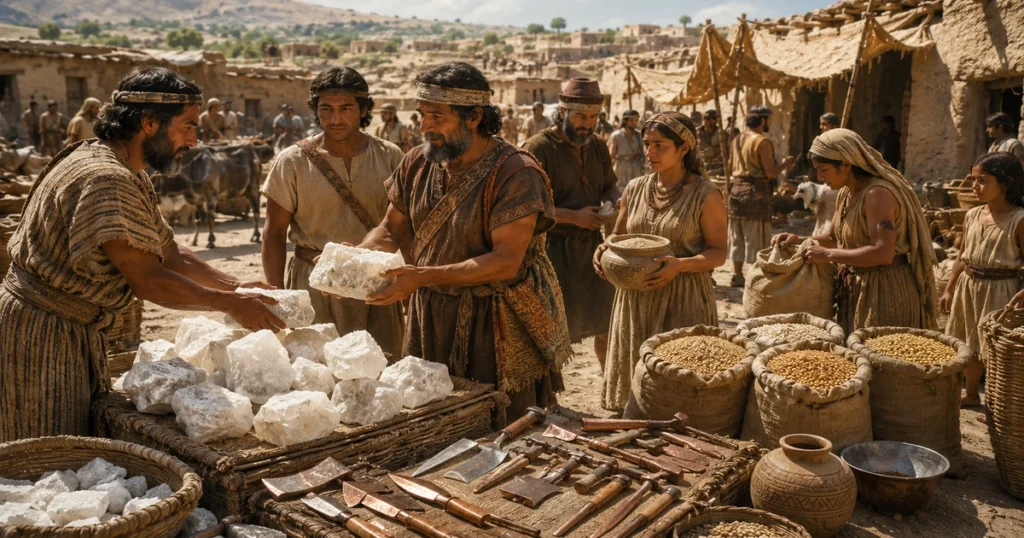
When we trace the ancient history of commodities, the first materials that attained a universal status were:
- Grain: The ultimate biological fuel for expanding labor forces.
- Salt: The critical biochemical preservative needed to sustain urban life.
- Livestock: Portable, reproductive assets that provided meat, milk, and physical labor.
- Metal & Timber: The foundational structural blocks required to forge weapons and build permanent shelters.
These foundational materials single-handedly shaped the development of early human laws, migration patterns, and settlement designs, cementing their place at the very start of the history of commodities.
2. Grain: The First Global Asset in the History of Commodities
No single agricultural asset has wielded more geopolitical power than harvested grain. In the ancient history of commodities, fields of wheat, barley, and rice were the literal engines of state-building.
The foundational civilizations of Ancient Egypt, Mesopotamia, the Indus Valley, and Imperial China were anchored completely around the predictable cycles of grain cultivation. Without massive, centrally managed grain surpluses, early cities could not survive, armies could not march, and specialized labor could not exist.
[ Grain Abundance ] ---> [ Population Growth ] ---> [ Military Expansion ]
        │                                                    │
        └─────────────────> Controls Society <───────────────┘
Therefore, grain became the ultimate expression of economic power. Whoever controlled the granaries controlled the food supply. Whoever controlled the food supply maintained absolute control over human society.
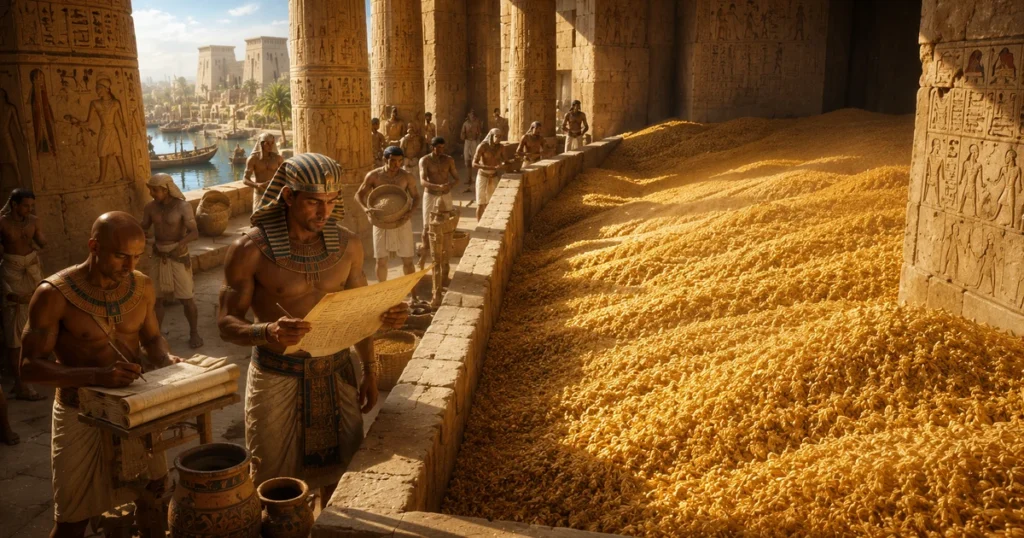
Ancient Egypt operated its entire taxation and state payment framework using physical grain stored in massive royal storehouses. Centuries later, the Roman Empire implemented the famous Cura Annonae (the grain dole)—importing millions of tons of wheat from North Africa and Egypt to distribute free grain to its citizens, utilizing this crucial raw material to maintain domestic political stability and prevent violent plebeian rebellions.
Even in our modern electronic era, agricultural raw materials remain absolutely vital, keeping the legacy of grain alive in the ongoing history of commodities.
3. Salt: The Wealth-Creating Preservative in the History of Commodities
To modern consumers, salt is a cheap, ubiquitous mineral found on every kitchen table. However, a glance at the ancient history of commodities reveals that salt was once considered far more valuable than pure gold. Before mechanical refrigeration was engineered, salt was the only viable technology available to preserve meat, fish, and dairy over long winters. This single capability made it an irreplaceable element for human biological survival.
                   ┌─────────────────────────────┐
                   │    THE SALARIUM INFLUENCE   │
                   └──────────────┬──────────────┘
                                  │ Roman Soldiers Paid
                  ┌───────────────┴───────────────┐
                  ▼                               ▼
       [ The Latin "Sal" ]               [ The Modern Wage ]
       Forms the basis of                 Directly creates the English
       imperial Roman payments.            word "Salary" for labor.
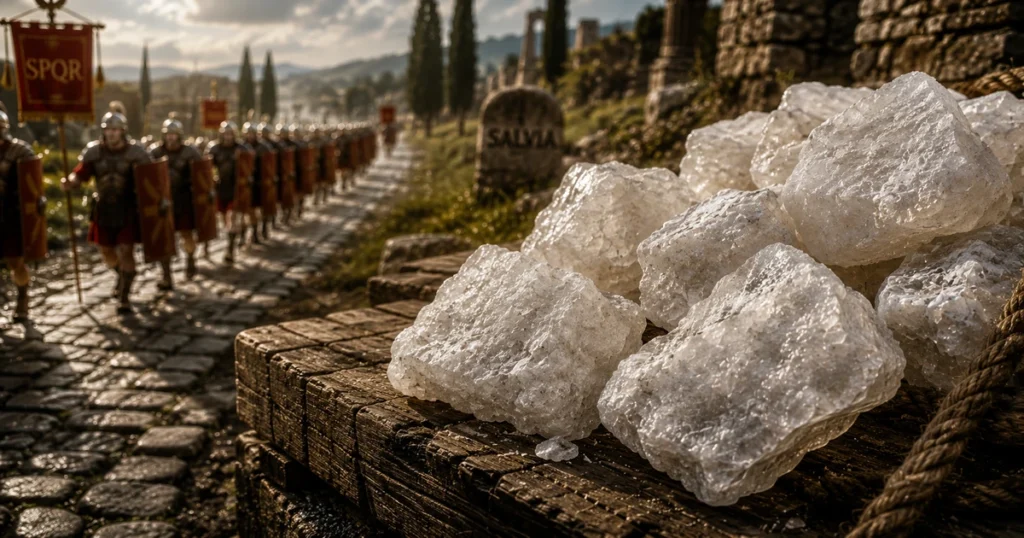
Because of its extreme value, extensive salt trade routes were mapped out across harsh deserts and rugged mountain ranges, effectively connecting distant continents. The iconic Roman road, the Via Salaria (Salt Road), was built specifically to transport this crucial asset from the Adriatic coast directly to the heart of Rome.
The profound impact of this mineral is still visible in our language today; Roman soldiers were paid an allowance to purchase salt, known as a salarium, which serves as the direct linguistic root of our modern English word salary. This structural connection highlights how deeply the history of commodities has shaped our modern daily working lives.
4. Gold and Silver: Precious Metals in the History of Commodities
As early civilizations expanded their boundaries, the limitations of trading bulky agricultural assets became apparent. This friction drove the next major leap in the history of commodities: the rise of precious metals. Gold and silver completely transformed the nature of trade, evolving from industrial decorative elements into the ultimate global settlement tools.
Precious metals immediately solved the durability issues that plagued earlier agricultural goods. A basket of wheat rots within months; an ingot of gold remains completely pristine for ten thousand years.
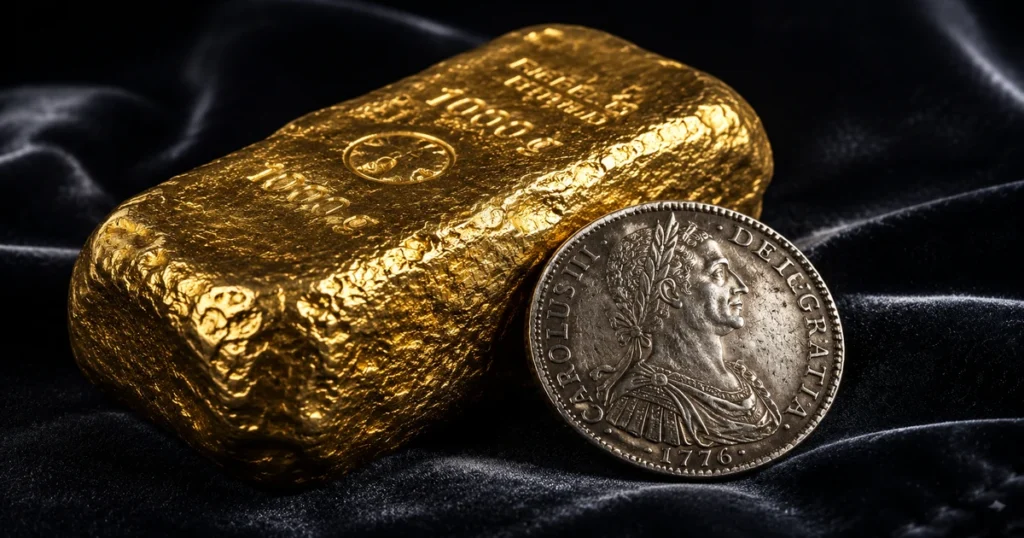
Throughout the long history of commodities, gold and silver have simultaneously fulfilled three separate economic functions:
- Tangible Wealth: A highly concentrated, scarce store of human labor and value.
- Universal Currency: Standardized metal tokens that allowed merchants to trade across international borders without friction.
- Sovereign Reserves: The financial bedrock held deep inside central bank vaults to guarantee institutional trust.
From the Spanish treasure fleets extracting massive silver deposits from the mines of Potosí to modern institutional macro funds hoarding gold bars during periods of deep geopolitical conflict, precious metals have consistently maintained their dominant position throughout the entire history of commodities.
5. The Industrial Revolution: A Massive Boom in the History of Commodities
The advent of the Industrial Revolution in the late 18th and 19th centuries completely rewrote the global rules of commerce, triggering an unprecedented demand explosion in the global history of commodities. Before this era, markets focused heavily on precious metals and food crops.
However, as coal-powered steam engines, mechanical looms, and massive iron foundries spread across Europe and North America, the global economy developed an unquenchable thirst for deep industrial raw materials.
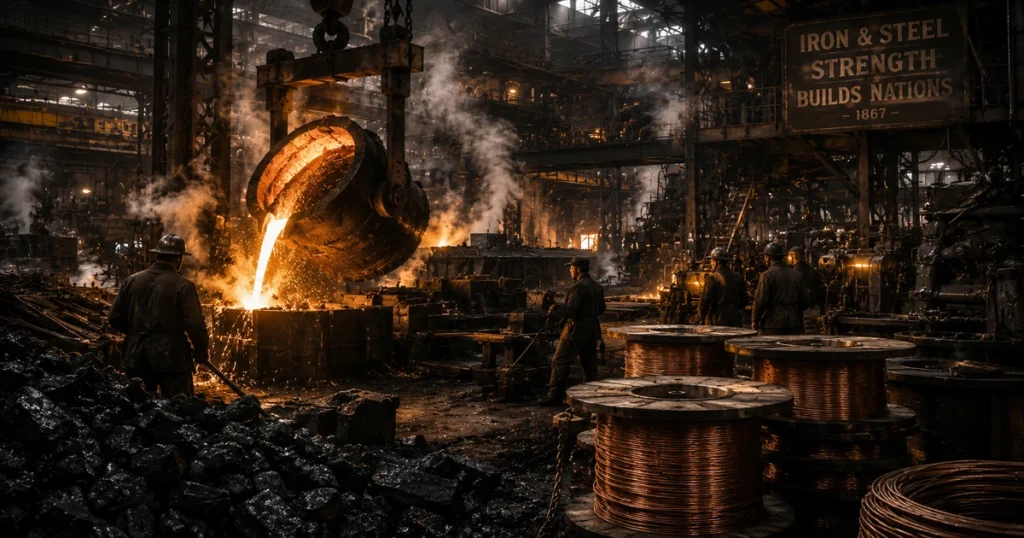
Factories required an immense, non-stop flow of diverse physical goods to fuel their production lines:
- Coal: The essential energy asset harvested to power steamships, trains, and factory machinery.
- Iron & Steel: The structural components needed to forge heavy machinery, build complex bridges, and lay thousands of miles of railway tracks.
- Copper: The vital industrial metal required to manufacture early electrical grids and global telegraph communication lines.
- Cotton: The agricultural base material imported from distant plantations to feed the booming textile mills of Manchester and New England.
This transformative historical period created a state of absolute, permanent global asset dependence. The modern financial supply chain as we know it today was forged during this intense industrial boom, permanently altering the history of commodities.
6. Oil: The Black Gold Revolution in the History of Commodities
No single asset has dominated the modern geopolitical landscape quite like crude oil. When analyzing the 20th-century history of commodities, the discovery and extraction of petroleum stands out as the ultimate turning point for global industry.
The modern oil era officially erupted into existence in 1859, when Edwin Drake successfully struck oil in Titusville, Pennsylvania, triggering the world’s very first localized oil boom.
                      [ 1859: The Drake Well ]
          First commercial oil strike in Titusville, PA.
                                │
                                ▼ (The Combustion Shift)
                    [ The Industrial Engine ]
          Automobiles, aviation, and navies dump coal for oil.
                                │
                                ▼ (The Geopolitical Titan)
                 [ Modern Global Crude Markets ]
          Controls inflation and shapes international trade loops.
As the internal combustion engine replaced the old steam engine, the entire global transportation infrastructure shifted away from coal toward petroleum. Automobiles, commercial shipping vessels, military navies, and airplanes all demanded oil to operate.
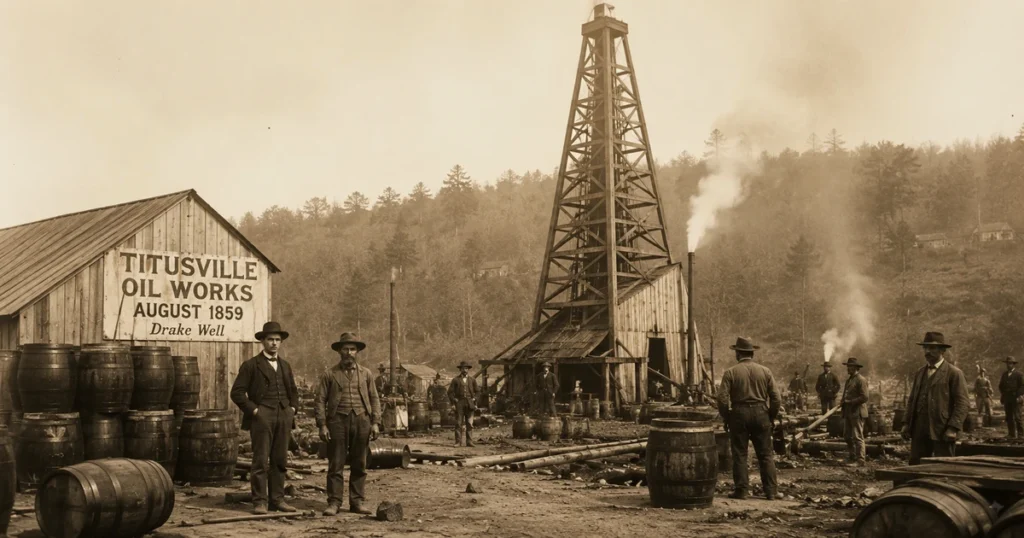
Today, crude oil remains the absolute most traded material on the planet, anchoring its dominant position in the modern history of commodities.
It serves as a powerful macroeconomic force:
- Inflation Vector: When crude oil prices surge, the cost of transporting food, manufacturing plastics, and generating electricity increases across the globe, driving up core inflation.
- Geopolitical Weapon: The formation of OPEC (Organization of the Petroleum Exporting Countries) demonstrated that controlling oil reserves allowed nations to directly influence Western foreign policies.
- Economic Cycle Indicator: A severe drop in global oil demand is often the first warning sign of an impending global recession.
7. Copper: The Barometer of Growth in the History of Commodities
In the industrial sector of the global history of commodities, copper occupies a highly distinct and deeply respected position. Unlike gold, which is hoarded for its scarcity, copper is prized for its extreme utility as an unmatched electrical and thermal conductor. It is the literal nervous system of modern global infrastructure.
                           ┌─────────────────────────┐
                           │       DR. COPPER        │
                           └────────────┬────────────┘
                                        │ Predicts Health
                 ┌──────────────────────┴──────────────────────┐
                 ▼                                             ▼
       [ Industrial Demand ]                         [ Economic Trajectory ]
       Rises sharply during structural                Plummets ahead of construction
       construction and grid expansion.               and manufacturing slowdowns.
Because copper is required in everything from residential electrical wiring and industrial plumbing to automotive manufacturing, telecommunication networks, and renewable energy grids, its price movements are incredibly sensitive to the overall health of the global economy.
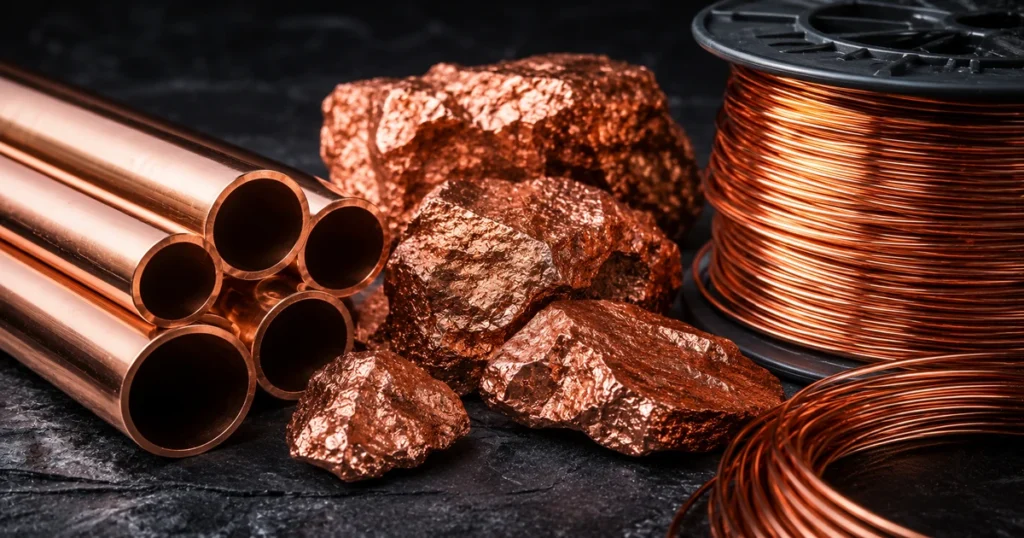
This unique predictive quality is exactly why financial analysts and global traders affectionately nickname the metal “Dr. Copper.” They state that copper is the only element with a PhD in economics because it accurately predicts turning points in global growth faster than traditional government data.
When Dr. Copper’s price rises, it indicates that global manufacturing and construction are booming; when it drops, it warns investors to prepare for an economic slowdown, reinforcing the metal’s unique predictive role in the history of commodities.
8. Agricultural Markets: Feeding the World in the History of Commodities
While energy and industrial metals drive heavy manufacturing, the agricultural sector forms the soft, yet vital, underbelly of the history of commodities. These are the renewable, cultivated goods harvested from the earth to feed and clothe billions of human beings daily.
The major agricultural assets driving international trade include:
- Wheat & Corn: The core nutritional building blocks utilized to sustain global food security and livestock feed operations.
- Coffee & Sugar: High-volume cash crops that drive massive retail consumer markets across every single continent.
- Soybeans: The highly versatile protein and oil source heavily traded across major international trade loops between the Americas and Asia.
- Cotton: The foundational textile raw material that fuels the global fashion and manufacturing industries.

Agricultural markets are uniquely volatile because they are highly exposed to the unpredictable forces of nature. A sudden, severe drought in Brazil can instantly send global coffee prices soaring, while an ideal monsoon season in India can create an absolute supply glut in sugar.
Managing these sudden supply shocks is exactly what drove merchants to develop sophisticated risk management frameworks, creating a massive turning point in the history of commodities.
9. The First Commodity Exchanges: A Crucial Milestone in the History of Commodities
As international trade expanded in volume and complexity, merchants faced an existential financial problem: wild, unpredictable price volatility. A farmer could spend months cultivating a crop, only to find that prices had completely crashed by the time he arrived at the port to sell it. To mitigate this extreme risk, the history of commodities witnessed a massive structural breakthrough: the creation of organized financial exchanges.
The world’s very first formalized commodity futures market did not emerge in London or New York. It was born in Japan in 1730 with the establishment of the Dojima Rice Exchange in Osaka.
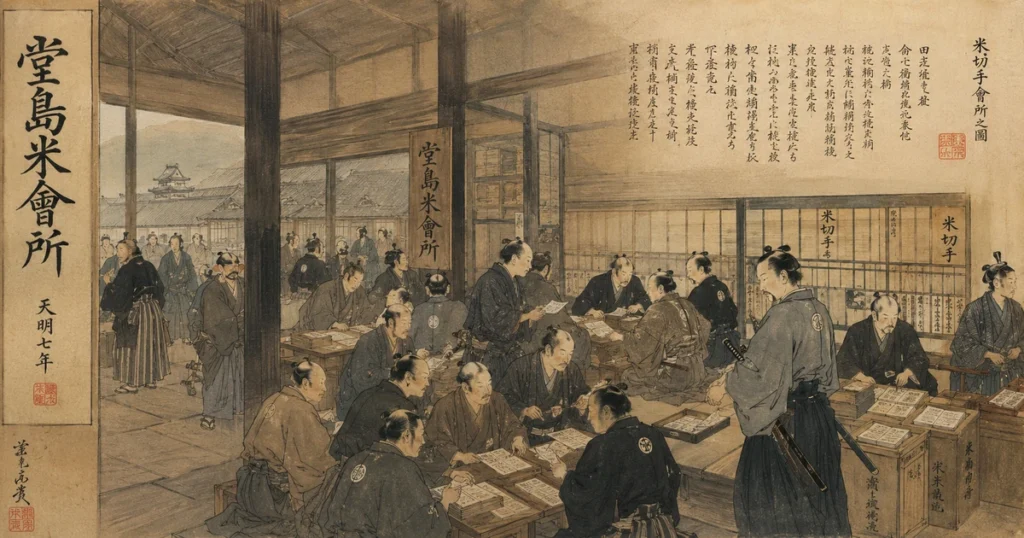
In Osaka, samurai and merchants traded paper receipts representing future deliveries of harvested rice. This was a revolutionary milestone in the history of commodities:
- Forward Pricing: For the first time, merchants could lock in a guaranteed price for their goods months before they were actually harvested.
- Risk Hedging: Producers could safely offload their environmental and financial risks to speculative traders who were willing to assume that risk in pursuit of profit.
- Standardization: The exchange established rigid rules regarding the exact quality, weight, and delivery schedules of the rice, eliminating disputes between trading parties.
This successful Japanese model served as the structural blueprint for Western financial centers. In 1848, a group of merchants formed the Chicago Board of Trade (CBOT), which eventually grew into the largest agricultural derivatives market in the world, forever altering the global history of commodities.
10. Modern Financial Markets: The Digital Evolution in the History of Commodities
In our modern, high-speed electronic era, the trading landscape has transformed completely from its primitive origins, entering a new phase in the history of commodities. Today, trading physical raw materials does not require merchants to physically handle bags of grain or haul heavy gold bars across borders.
Instead, the modern global financial framework relies on highly sophisticated electronic investment vehicles:
- Spot Markets: Instant electronic platforms where physical assets are bought, sold, and delivered for immediate cash settlement.
- Futures Contracts: Standardized legal agreements traded on centralized exchanges to buy or sell a specific asset at a predetermined price on a precise future date.
- Exchange-Traded Funds (ETFs): Financial instruments that allow ordinary retail investors to gain exposure to gold, silver, or oil prices directly through regular stock brokerage accounts without physically holding the raw material.
Core Asset Groups in Modern Markets
| Asset Group | Flagship Examples | Primary Macroeconomic Driver | Geopolitical Sensitivity |
| Energy | Crude Oil, Natural Gas | Industrial production output, seasonal weather spikes. | Extremely High (OPEC policy, Middle East trade routes). |
| Metals | Gold, Silver, Industrial Copper | Global inflation hedges, structural infrastructure demand. | Medium (Central bank gold purchases, mining strikes). |
| Agriculture | Wheat, Corn, Soybeans, Coffee | Global weather events, fertilizers, supply chain logistics. | High (Export bans, shipping canal disruptions). |
This complete digitalization of trading has democratized public market access. Today, institutional hedge funds, algorithmic black-box servers, and independent retail investors all participate simultaneously in the same electronic grid, adding a fast-paced, digital chapter to the long history of commodities.
11. Why Raw Materials Still Dominate Economic Reality
Despite the explosive rise of software-as-a-service corporations, artificial intelligence networks, and abstract digital tech platforms, the modern global economy remains deeply anchored by physical raw materials. The history of commodities proves that you cannot run a digital empire without physical inputs. You cannot build a high-performance server farm without industrial copper wiring; you cannot power a modern city without steady energy inputs; you cannot sustain an elite workforce without stable agricultural systems.
                           ┌─────────────────────────┐
                           │  MACRO MARKET SIGNALS   │
                           └────────────┬────────────┘
                                        │ Asset Trends
         ┌──────────────────────────────┼──────────────────────────────┐
         ▼                              ▼                              ▼
  [ Crude Oil Spikes ]           [ Gold Surges ]               [ Copper Rises ]
  Signals immediate risk         Signals systemic fear         Signals structural
  of global consumer inflation.  and economic uncertainty.     industrial expansion.
This enduring dependence is exactly why the world’s most elite hedge funds, central bank technocrats, and institutional currency traders monitor raw material price trends with extreme intensity. These physical assets reveal true, unedited macroeconomic reality significantly faster than traditional corporate earnings reports or backward-looking government statistics.
They are the foundational bedrock upon which the entire global financial grid is constructed, continuing their timeless legacy in the ongoing history of commodities.
Key Historical Observations
- Humanity’s First Trade Foundation: The deep history of commodities reveals that raw materials formed the initial basis of human economic exchange long before money was invented.
- Grain Fueled Early State-Building: Surpluses of wheat and barley allowed ancient empires to sustain large populations, maintain standing armies, and build complex urban centers.
- Salt Acted as an Early Wealth Titan: Because it preserved food, salt became a highly strategic asset that directly created imperial trade routes and the modern concept of wages.
- Precious Metals Institutionalized Trust: Gold and silver brought permanent durability and natural scarcity into the history of commodities, acting as universal global currencies.
- The Industrial Revolution Surged Demand: The rise of mechanized factories turned coal, iron, and copper into the essential lifeblood of global economic expansion.
- Crude Oil Transformed Geopolitics: The discovery of petroleum shifted the global energy balance, turning crude oil into the most traded and politically sensitive material on Earth.
- Copper Predicts Economic Trajectories: The unique industrial utility of “Dr. Copper” allows it to serve as a reliable real-time barometer for global manufacturing health.
- Agriculture Governs Human Survival: Renewable food crops like wheat, corn, and coffee remain highly volatile asset classes exposed to unpredictable weather patterns.
- Osaka Birth Structured Derivatives: The Dojima Rice Exchange engineered the first formalized futures contracts, providing the ultimate blueprint for modern risk hedging.
- Digitalization Democratized Asset Access: Modern electronic tools like spot markets, futures contracts, and ETFs have completely streamlined how the world interacts with the history of commodities.
FAQ Section
What exactly was the very first traded asset in the history of commodities?
Looking back at the earliest history of commodities, agricultural crops like wheat, barley, and early livestock were the first raw materials systematically traded by humans, dating back to around 6000 BCE.
Why was salt considered so valuable in the early history of commodities?
Salt was highly prized in the history of commodities because it was the only available technology to preserve food. This made it a vital asset for imperial armies and expanding urban populations.
What is recognized as the most heavily traded material in the world today?
Crude oil (specifically international benchmarks like Brent and WTI) is the undisputed most traded material on Earth, driving global transportation, inflation metrics, and international geopolitics.
Why is physical gold classified as an asset within the history of commodities?
Gold is categorized as a core precious asset within the history of commodities because it is a naturally occurring, scarce raw material extracted from the earth that serves as a universal store of value.
Which institution stands as the oldest formalized commodity exchange?
The Dojima Rice Exchange, established in Osaka, Japan, in 1730, is recognized as the world’s first formal exchange to trade structured commodity futures contracts.
How do central banks utilize the history of commodities to guide policy?
Central bank technocrats closely monitor raw material price indices (like oil and wheat) because fluctuations in these basic goods act as early indicators for consumer inflation and global economic growth.
Final Perspective
The extensive history of commodities is, in its purest essence, the unfolding narrative of human survival, technological triumph, and economic integration.
Raw materials built our world. Before paper currencies were printed, raw commodities were the definition of value. Before corporate stock exchanges were formed, raw materials driven by supply and demand defined the limits of international commerce. Before digital finance transformed our daily lives, physical resources powered our industries.
From the ancient grain storehouses of the Egyptian Pharaohs to the frantic trading rings of Chicago, and into the modern digital grids that clear trades in microseconds, the history of commodities remains tightly linked to our shared destiny.
Markets will continue to shift. Advanced technologies will continue to disrupt old industries. Completely new digital assets will undoubtedly emerge.
Yet, through every wave of structural transformation, the foundational reality remains absolute: human civilization will always depend entirely on the steady harvesting, mining, and trading of raw materials. It is an inescapable physical truth that has anchored the history of commodities for over eight thousand years—and it will continue to drive global economic wealth for the rest of human history.

